




 Solicitar orçamento


O erro mais caro em um projeto de reciclagem de veículos não é comprar a “marca errada”. É comprar a máquina certa para a etapa errada do processo.
Uma empresa de desmontagem que precisa drenar fluidos e remover peças reutilizáveis requer equipamentos muito diferentes dos de uma usina de processamento de sucata que recebe carrocerias de veículos já preparadas. Uma usina de trituração de automóveis de alto volume apresenta requisitos distintos em termos de obras civis, demanda elétrica, controle de emissões e triagem posterior em comparação com um sistema móvel de processamento de metais. Um operador que busca recuperar valor a partir de resíduos de trituração automotiva (ASR) está, mais uma vez, enfrentando um problema diferente.
O que o termo “equipamentos de reciclagem de veículos” realmente abrange
A reciclagem de veículos costuma ser resumida em uma única expressão — “triturador de carros” —, embora o processo comercial comece muito antes. A Comissão Europeia afirma que mais de seis milhões de veículos na Europa chegam ao fim da vida útil a cada ano, e uma gestão inadequada pode causar problemas ambientais e resultar na perda de materiais valiosos. As orientações da Agência de Proteção Ambiental dos EUA (EPA) sobre veículos em fim de vida (ELV) determinam que a remoção da bateria, a recuperação do refrigerante, a remoção do combustível e a drenagem de fluidos sejam realizadas antes da trituração ou fragmentação.
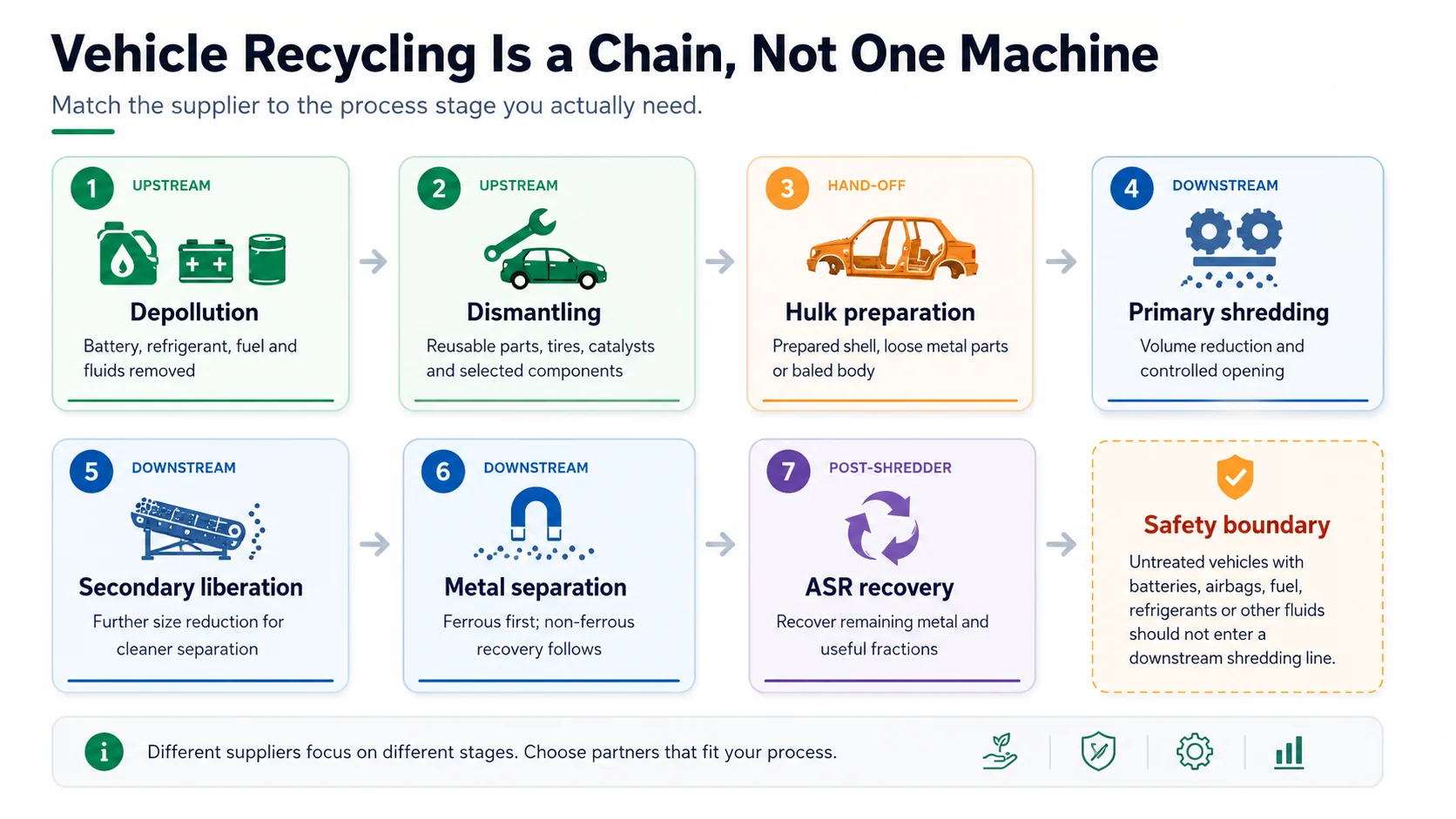
Esse limite do processo é importante. Antes que a carcaça preparada entre no equipamento de redução a jusante, o operador pode precisar desmontar ou tratar da bateria, do airbag, do combustível, do óleo, do líquido de arrefecimento, do óleo de freio e de transmissão, do refrigerante, dos pneus, dos catalisadores, dos componentes reutilizáveis e dos sistemas de alta tensão aplicáveis.A ordem exata é determinada pelas leis locais, pelas combinações de veículos e pelos estacionamentos. Um comprador que esteja planejando a oficina de pré-tratamento deve começar com um guia específico sobre equipamentos de desmontagem de veículos, em vez de presumir que um fornecedor de trituração cubra todas as tarefas.
A montante
Descontaminação, desmontagem, recuperação de peças, manuseio de alta tensão e preparação da carcaça.
Processamento central
Trituração primária, liberação secundária, peneiramento, recuperação de materiais ferrosos e separação de materiais não ferrosos.
Pós-triturador
Recuperação adicional de metais e frações úteis a partir de resíduos de trituração de veículos automotores.
Como selecionamos esses fabricantes
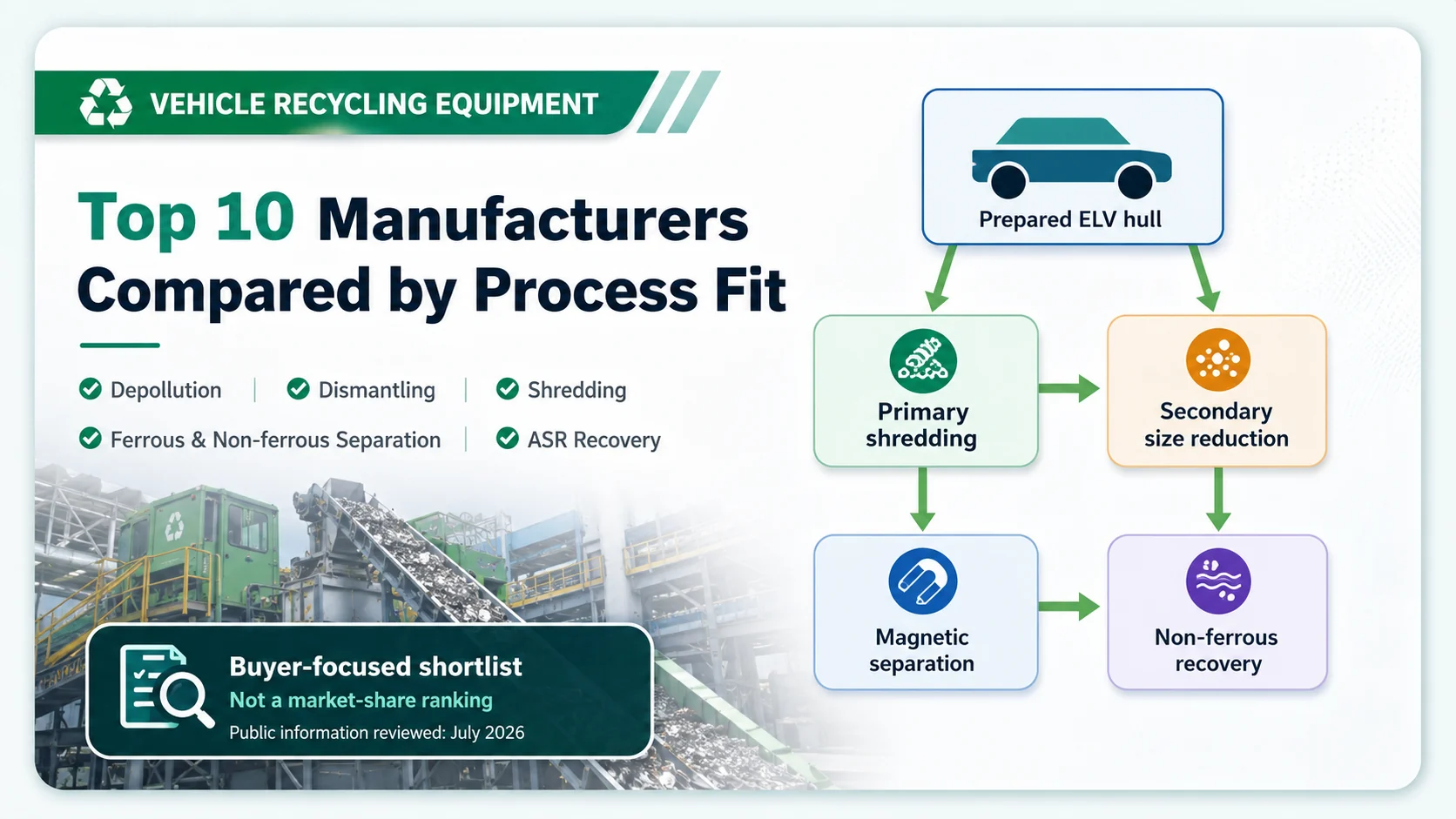
A lista de finalistas foi elaborada para representar o processo completo, e não dez fornecedores de moinhos de martelo praticamente idênticos. As páginas públicas dos fabricantes foram analisadas quanto à abrangência do processo, categorias de equipamentos, aplicações declaradas, integração de sistemas, personalização, controles, assistência técnica e documentação. Nenhuma auditoria de fábrica, teste de desempenho ou verificação de referências de clientes foi realizada para este artigo.
Os critérios de avaliação foram:
| Critério | O que um comprador deve verificar | Por que isso é importante |
|---|---|---|
| Adequação entre processo e estágio | Veículos em fim de vida (ELV) não tratados, carcaças preparadas, sucata mista ou ASR | Um fornecedor pode ser forte em uma etapa e inadequado para outra. |
| Destruição e libertação | Condição de alimentação, vazão realista, faixa de saída, recirculação | A capacidade nominal, por si só, não descreve o desempenho de separação. |
| Separação de metais | Metais ferrosos, metais não ferrosos condutores e metas de qualidade nas etapas posteriores do processo | A receita depende das frações comercializáveis, e não apenas das toneladas alimentadas. |
| Descontaminação e desmontagem | Fluidos, baterias, airbags, catalisadores, pneus e procedimentos para veículos elétricos | Essas tarefas são realizadas antes da trituração posterior. |
| Integração da fábrica | Controles, transportadores, tratamento de poeira, fundações e serviços de utilidade pública | As lacunas nas interfaces geram atrasos, trabalho extra e falta de clareza quanto às responsabilidades. |
| Facilidade de manutenção | Peças de desgaste, suporte local, comissionamento e treinamento de operadores | O tempo de atividade não depende apenas do equipamento principal. |
| Qualidade das evidências | Desenhos, testes de amostras, referências e base de desempenho por escrito | As alegações de marketing devem ser convertidas em cláusulas contratuais. |
Comparação rápida dos 10 melhores
| # | Fabricante | Base | Ideal para | Etapa principal do processo | Ponto importante a ser confirmado |
|---|---|---|---|---|---|
| 1 | YUXI Machinery | China | Linhas personalizáveis de trituração e separação de metais para carcaças pré-fabricadas | Trituração primária com separação de materiais ferrosos e não ferrosos | Escopo da despoluição a montante e capacidade específica do projeto |
| 2 | WENDT Corporation | Estados Unidos | Grandes usinas de trituração de automóveis da América do Norte | Soluções completas para trituração pesada e integração de instalações | Escopo total da instalação, serviços de apoio e pacote de operações posteriores |
| 3 | LINDEMANN | Alemanha | Pré-trituração para serviços pesados, trituração e suporte ao ciclo de vida global | Preparação de sucata e trituração de veículos | Escopo final da separação e acordos de prestação de serviços locais |
| 4 | Danieli Centro de Reciclagem | Itália | Processamento de sucata ferrosa e não ferrosa vinculado a siderúrgicas | Usinas de processamento pesado e preparação de sucata em etapas posteriores | Se o pacote começa com sucata já preparada ou inclui mais etapas do ciclo de vida do veículo em fim de vida (ELV) |
| 5 | ZATO | Itália / Estados Unidos | Configuração modular de pré-triturador, moinho de martelos e classificação | Sistema de trituração de veículos fora de uso (ELV) e caminhões de embalagem | Preparação da ração, meta de emissões e apoio regional |
| 6 | HAMMEL Recyclingtechnik | Alemanha | Processamento móvel ou modular de sucata de carroceria e de metais mistos | Triturador primário/secundário e separação magnética | Pureza real do produto, licença e aspectos econômicos dos setores de telefonia fixa e móvel |
| 7 | Reciclagem ELDAN | Dinamarca | Recuperação de ASR e da fração leve do triturador | Tratamento de resíduos pós-trituração | Testes de materiais e frações de produção garantidas |
| 8 | SEDA-Tecnologia Ambiental | Áustria | Fluxos de trabalho de descontaminação, desmontagem e alta tensão de veículos fora de circulação (ELV) | Preparação do veículo na fase inicial | Interfaces do triturador a jusante e da separação de metais |
| 9 | Despoluição por vórtice | Estados Unidos | Ferramentas de drenagem de veículos e processamento em pátio voltadas para a produção | Descontaminação na fase inicial e processamento de componentes | Quais equipamentos são fabricados diretamente e quais são fornecidos por parceiros |
| 10 | Iris-Mec | Itália | Equipamentos configuráveis para remoção de poluentes e desmontagem | Remediação e desmontagem de veículos em fim de vida (ELV) na fase inicial | Suporte local, nível de automação e integração completa da linha |
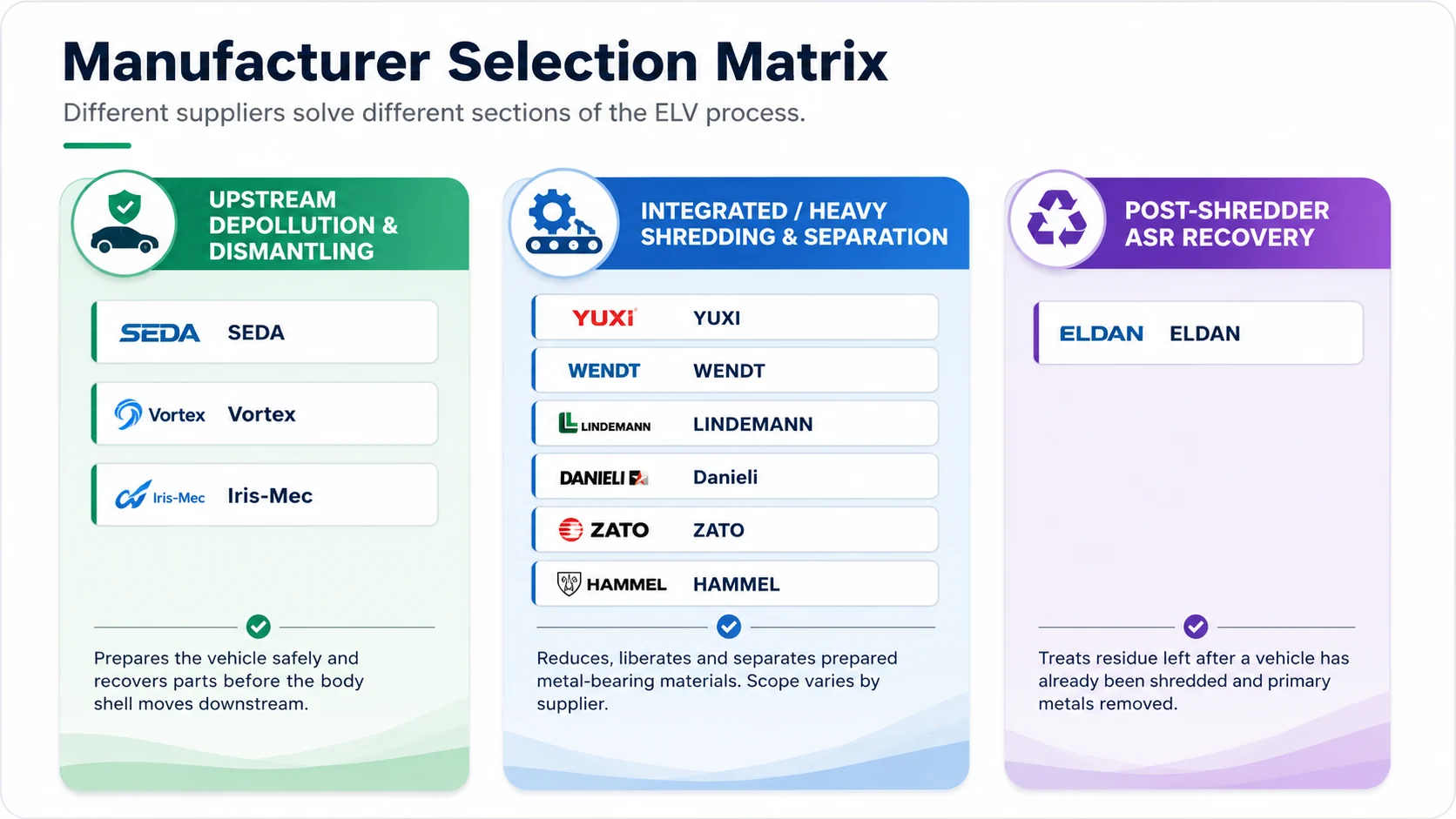
Os 10 principais fabricantes de equipamentos para reciclagem de veículos
1. YUXI Machinery — A melhor opção para linhas personalizáveis de trituração e separação
Posicionamento: O YUXI é uma opção prática para projetos que recebem carrocerias de veículos pré-preparadas ou peças metálicas de descarte e precisam de um fluxo configurável, desde a redução primária do tamanho até a separação de metais ferrosos e não ferrosos condutores.
O representante oficial Linha de reciclagem de veículos fora de uso da YUXI apresenta um processo em etapas: um triturador de eixo duplo para a redução primária, um triturador de metal do tipo martelo para a liberação adicional, separação magnética para materiais ferrosos, separação por correntes parasitas para metais não ferrosos condutores e controle centralizado por PLC. A lista de aplicações inclui carrocerias de automóveis e diversas peças automotivas que contêm metal, bem como motocicletas e bicicletas.
Essa sequência é comercialmente útil porque trata a trituração como uma etapa preparatória para a separação. A primeira máquina reduz e desagrega o material de alimentação volumoso; a etapa secundária altera a liberação das partículas; as etapas magnética e de correntes parasitas, por sua vez, atuam sobre diferentes comportamentos do material. Os compradores podem, portanto, discutir a linha em termos dos resultados comercializáveis exigidos, em vez de se limitarem a perguntar apenas por “toneladas por hora”.”
Principais pontos fortes
- Redução de tamanho integrada nas etapas primária e secundária, em vez de uma única máquina isolada.
- A separação de materiais ferrosos e não ferrosos condutores está incluída no fluxo publicado.
- A configuração da linha de produção pode ser discutida com base no material recebido e nas metas de produção a jusante.
- Os controles centralizados permitem o acionamento, a parada e o intertravamento coordenados em toda a linha.
Ideal para
Pátio de sucata que estão incorporando o processamento de carrocerias de veículos, investidores que planejam uma linha integrada de recuperação de metais em média escala e operadores que desejam que um único fornecedor coordene a trituração, o transporte e a separação básica de metais.
Pontos a serem confirmados
A página de soluções públicas não estabelece uma capacidade, potência do motor, tamanho de descarga, taxa de recuperação ou custo de instalação universais. Esses valores devem ser calculados com base nas condições da matéria-prima, contaminação, densidade, produção desejada e serviços públicos locais. A linha publicada também não deve ser interpretada como uma oficina completa de despoluição de veículos fora de uso (ELV) não tratados. Baterias, combustível, fluidos, refrigerantes, airbags e outros itens perigosos exigem um procedimento prévio comprovado. Para uma análise mais detalhada sobre a escolha da máquina principal, consulte o guia de trituradores de carrocerias do site.
2. WENDT Corporation — A melhor opção para grandes usinas de trituração de automóveis na América do Norte
Posicionamento: A WENDT é uma forte candidata à lista de finalistas para projetos norte-americanos de grande porte que buscam serviços de engenharia de trituradores de automóveis, integração de instalações e suporte ao ciclo de vida.
A página oficial da WENDT sobre trituração de automóveis destaca as capacidades completas da fábrica e o suporte oferecido desde a fase de concepção até o fim da vida útil da instalação. O posicionamento do produto da empresa concentra-se na liberação de metal e em sistemas integrados, em vez de se limitar ao fornecimento de um simples moinho de martelos. Isso é relevante para compradores que precisam de um único fornecedor para coordenar os principais equipamentos, controles e interfaces.
Principais pontos fortes
- Portfólio de instalações especializadas na trituração de veículos.
- Forte orientação para o mercado norte-americano e para os serviços.
- Projeto de estrutura “chave na mão” capaz de reduzir os riscos de interface entre os principais pacotes da planta.
- Ideal para compradores que estejam comparando infraestruturas industriais de longa durabilidade, em vez de uma máquina isolada.
Ideal para
Processadoras de sucata de alto rendimento com fornecimento garantido de matéria-prima, infraestrutura de serviços públicos robusta, capacidade de obtenção de licenças e um mercado de metais a jusante.
Pontos a serem confirmados
Defina o que está incluído no conceito de “chave na mão”: fundações, edifícios, guindastes, distribuição elétrica, tratamento de poeira e emissões, sistemas hidráulicos, recuperação de metais não ferrosos a jusante, comissionamento e testes de desempenho. Confirme também se o material recebido consiste em carcaças soltas e preparadas, fardos ou sucata mista e como essa classificação afeta a capacidade cotada. Fonte oficial.
3. LINDEMANN — A melhor opção para pré-trituração em serviços pesados e suporte ao longo do ciclo de vida
Posicionamento: A LINDEMANN deve figurar na lista de finalistas das empresas de reciclagem de metais industriais que buscam equipamentos consolidados para o preparo de sucata pesada, trituradores de automóveis e uma ampla rede de serviços e peças.
A empresa conta com mais de um século de experiência em reciclagem de metais e um portfólio que abrange papel triturado, papel pré-triturado, corte, embalagem e briquetes. No projeto de veículos fora de uso (ELV), o valor não se resume apenas ao triturador principal: o pré-tratamento e o controle da alimentação podem reduzir os impactos, estabilizar a carga e proteger os equipamentos a jusante.
Principais pontos fortes
- Especialização de longa data em equipamentos para reciclagem de metais.
- Linha de equipamentos capaz de atender às etapas de pré-trituração e trituração principal.
- Peças e assistência pós-venda para garantir uma longa vida útil do equipamento.
- Aplicável a empresas de reciclagem que lidam com diversos tipos de sucata, e não apenas com carrocerias de veículos.
Ideal para
Grandes depósitos de sucata, fornecedores da indústria siderúrgica e operadores que priorizam instalações fixas para serviços pesados e suporte técnico de longo prazo.
Pontos a serem confirmados
Verifique se o projeto de embalagem proposto inclui apenas a preparação de resíduos e papel triturado, ou se abrange também a classificação por ar, a separação magnética, a reciclagem de metais não ferrosos e o tratamento de resíduos. Obtenha estimativas por escrito sobre o desgaste das peças, com base na alimentação real do sistema. Fonte oficial.
4. Danieli Centro Recycling — A melhor opção para o processamento integrado de sucata na siderurgia
Posicionamento: A Danieli Centro Recycling se destaca especialmente quando a preparação de sucata de veículos e sucata ferrosa mista está intimamente ligada à qualidade da produção de aço, à logística e às exigências da aciaria.
Danieli descreve a unidade de negócios como uma ponte entre o processamento de sucata e a produção de aço. Essa perspectiva pode ser valiosa quando o objetivo da aquisição não é apenas reduzir a estrutura de um carro, mas produzir um fluxo consistente de sucata para a fusão em etapas posteriores, remover contaminantes e gerenciar a alta taxa de utilização da planta.
Principais pontos fortes
- Relação direta entre a preparação da sucata e as necessidades da produção de aço.
- Capacidade em engenharia industrial pesada e integração de instalações.
- Âmbito do processamento de metais ferrosos e não ferrosos.
- Adequado para grandes projetos com requisitos formais de desempenho e aceitação.
Ideal para
Produtores de aço, grandes processadores de sucata e projetos em que a qualidade da trituração, a densidade, a contaminação e a logística do forno fazem parte de um único caso de investimento.
Pontos a serem confirmados
Esclareça os limites relativos ao material recebido. Uma usina de processamento de sucata de aço pode presumir que os veículos já tenham sido despoluiados, desmontados e enfardados. Separe também as referências a projetos específicos de modelos das garantias de desempenho para uma nova unidade. Fonte oficial.
5. ZATO — Ideal para configurações modulares de pré-triturador e moinho de martelos
Posicionamento: O ZATO é uma boa referência para empresas de reciclagem que estejam avaliando um pré-triturador, um moinho de martelos e uma linha de triagem como um sistema integrado para veículos em fim de vida (ELVs), carros enfardados e sucata metálica mista.
O material da ZATO sobre veículos em fim de vida (ELV) descreve o processo de remoção de poluentes antes da reciclagem e apresenta soluções de pré-trituração e trituração de automóveis. A abordagem sistêmica é importante quando carrocerias compactadas ou matérias-primas mistas e inconsistentes poderiam, de outra forma, causar picos de carga no triturador principal.
Principais pontos fortes
- Arquitetura reconhecível do pré-triturador e do moinho de martelos.
- Configurações do sistema para aplicações em veículos e sucata.
- Presença na América do Norte, além de sua sede na Itália.
- Isso é relevante nos casos em que o condicionamento da matéria-prima é um fator essencial para a estabilidade da planta.
Ideal para
Processadores que lidam com vagões de fardos, ração compactada ou sucata mista e que desejam avaliar a redução em etapas antes da separação final.
Pontos a serem confirmados
Especifique as dimensões e a densidade dos fardos, o material estranho, o tamanho desejado na etapa seguinte do processo e a rota de recirculação proposta. Confirme o estoque regional de peças de reposição e quais tecnologias de classificação estão incluídas no escopo do orçamento. Fonte oficial.
6. HAMMEL Recyclingtechnik — A melhor opção para o processamento móvel ou modular de metais
Posicionamento: A HAMMEL se destaca por seus conceitos de processamento móveis e modulares para carrocerias de automóveis, sucata mista, blocos de motor e outros materiais metálicos.
A documentação oficial da planta de processamento descreve a trituração primária e secundária, as esteiras transportadoras e a separação de materiais magnéticos e não magnéticos. A mobilidade pode ser uma vantagem quando a matéria-prima está distribuída por vários locais, o terreno é temporário ou quando uma empresa de reciclagem deseja aumentar sua capacidade sem precisar construir imediatamente uma grande instalação convencional de trituração.
Principais pontos fortes
- Opções de processamento móveis e modulares.
- As aplicações publicadas incluem carrocerias de automóveis e diversas categorias de sucata metálica.
- Separação magnética integrada ao conceito do sistema.
- Alternativa útil a uma usina tradicional fixa de trituração de automóveis.
Ideal para
Processadoras regionais, prestadores de serviços, operadores com várias unidades e projetos em que a realocação ou o investimento em fases apresentam um valor real.
Pontos a serem confirmados
Compare os aspectos econômicos da mobilidade com os de uma instalação fixa ao longo das horas de operação previstas. Verifique a limpeza real da produção, as necessidades de combustível/energia elétrica, os controles de poeira e ruído, a proteção contra incêndios e as licenças locais. Fonte oficial.
7. ELDAN Recycling — A melhor opção para a recuperação de resíduos de trituração automotiva
Posicionamento: O ELDAN deve ser considerado quando a unidade já produz ASR ou fração leve de trituração e necessita de processos adicionais de liberação, classificação por tamanho e separação — e não quando a principal necessidade é a despoluição ou a trituração de veículos inteiros.
A ELDAN descreve o ASR como a fração leve que resta após a trituração dos veículos fora de uso (ELVs). Sua solução oferecida ao público enfatiza o projeto personalizado das instalações e a importância de avaliar o material em si. Essa é uma abordagem sensata, pois a composição do ASR varia de acordo com a composição da frota de veículos, as configurações do triturador a montante e os equipamentos de separação já instalados.
Principais pontos fortes
- Especialização clara no processamento de ASR/SLF.
- Linha de produtos que inclui trituradores, granuladores e equipamentos de separação.
- Configuração baseada no material, em vez de um fluxograma universal.
- Útil para recuperar valor adicional após a remoção dos metais primários.
Ideal para
Operadores de trituradoras de veículos, empresas de processamento centralizado de resíduos e projetos que enfrentam pressões relacionadas aos custos de aterro ou às metas de recuperação.
Pontos a serem confirmados
Envie amostras representativas e defina os produtos necessários antes de discutir uma garantia. Confirme o teor de umidade, partículas finas, material contendo cobre, plásticos, vidro e impurezas, bem como as formas de descarte dos resíduos restantes. Fonte oficial.
8. SEDA-Umwelttechnik — A melhor opção para a despoluição e desmontagem de veículos fora de uso (ELV)
Posicionamento: A SEDA é uma empresa especializada na fase inicial do processo para instalações que precisam remover fluidos com segurança, desmontar veículos e preparar veículos convencionais e de alta tensão antes do processamento dos materiais na fase final.
O portfólio público da SEDA divide os trabalhos de descontaminação, desmontagem e alta tensão em categorias específicas de equipamentos. São oferecidas soluções fixas e móveis, permitindo que os compradores projetem a oficina de acordo com o volume de veículos e os equipamentos de manuseio já existentes.
Principais pontos fortes
- Sistemas específicos de descontaminação de veículos em fim de vida (ELV) e dispositivos individuais de remoção de fluidos.
- Ferramentas de desmontagem e layouts voltados para oficinas.
- Atenção especial ao manuseio de veículos elétricos e de alta tensão.
- Relativo à transferência crítica para a segurança antes que uma concha seja esmagada ou triturada.
Ideal para
Empresas de desmontagem, instalações de tratamento autorizadas, pátio de sucata e usinas integradas que necessitam de uma estação formal de preparação prévia.
Pontos a serem confirmados
A vantagem do SEDA reside na preparação na fase inicial; portanto, os compradores precisarão definir os fornecedores de enfardadeiras, trituradores, desfiadores e sistemas de separação de metais para as etapas posteriores. Verifique as normas locais relativas à alta tensão, as qualificações dos operadores, o armazenamento de fluidos e os requisitos de combate a incêndios. Fonte oficial.
9. Depuração por vórtice — Ideal para drenagem de veículos em ambiente de produção
Posicionamento: O Vortex é uma boa opção para estaleiros norte-americanos que buscam sistemas de drenagem de veículos voltados para o operador, ferramentas de processamento e uma estação de trabalho de despoluição configurável.
O site atual da empresa apresenta sistemas de passarelas e drenagem de veículos, ferramentas móveis, equipamentos de armazenamento, ferramentas para conversores catalíticos, equipamentos para processamento de motores e fios, além de enfardadeiras para automóveis, todos fornecidos como parte de seu amplo portfólio. A ênfase declarada no projeto é o acesso do operador e a adaptação dos sistemas ao pátio do cliente.
Principais pontos fortes
- Equipamentos específicos para drenagem de veículos e conceitos de células de trabalho.
- Ferramentas posicionadas ao redor do operador e a sequência de trabalho.
- Equipamentos de jardinagem mais versáteis podem simplificar o processo de aquisição para pequenos operadores.
- Declaração de que o projeto e a fabricação são realizados nos Estados Unidos, conforme consta no site atual.
Ideal para
Empresas de reciclagem de veículos, centros de peças com serviço completo e operações de sucata que estão migrando de um sistema improvisado de drenagem de fluidos para uma estação de produção padronizada.
Pontos a serem confirmados
Distinguir os equipamentos projetados e fabricados pela Vortex dos produtos distribuídos por parceiros e, em seguida, atribuir claramente as responsabilidades relativas à garantia e à assistência técnica. Uma estação de drenagem não substitui os processos de preparação de resíduos, trituração ou separação de metais não ferrosos realizados a jusante. Fonte oficial.
10. Iris-Mec — A melhor opção para plataformas configuráveis de descontaminação e desmontagem
Posicionamento: A Iris-Mec é uma opção relevante para compradores que estejam comparando plataformas compactas ou configuráveis de tratamento de veículos fora de circulação (ELV), equipamentos de drenagem de fluidos e combustíveis, elevadores e sistemas de desmontagem.
A linha oficial de produtos inclui sistemas completos de drenagem, equipamentos de drenagem de fluidos e combustíveis, elevadores e ferramentas especiais. Essa estrutura de produtos atende aos compradores que precisam montar uma estação de pré-tratamento de acordo com o espaço disponível, o volume do veículo e o nível de desmontagem realizado antes que a carcaça saia do pátio.
Principais pontos fortes
- Ampla seleção de equipamentos para recuperação de fluidos e desmontagem de veículos em fim de vida (ELV).
- Suportes configuráveis, elevadores e sistemas completos de drenagem.
- Foco na reciclagem de veículos em instalações especialmente projetadas para esse fim.
- Adequado para o desenvolvimento gradual de oficinas.
Ideal para
Pequenas e médias empresas de desmanche, instalações regionais de tratamento de veículos em fim de vida (VFV) e projetos que necessitem de uma estação de trabalho configurável na fase inicial, em vez de uma grande unidade de trituração.
Pontos a serem confirmados
Confirme a cobertura da concessionária local, a responsabilidade pela instalação, as peças de reposição e como a estação de tratamento prévio se integra ao processo de enfardamento ou trituração. Para veículos elétricos (EVs), solicite um fluxo de trabalho documentado separadamente, em vez de presumir que os equipamentos convencionais de descontaminação abrangem a remoção da bateria e veículos de alta tensão danificados. Fonte oficial.
Como escolher um fabricante de acordo com o tipo de fábrica
Uma lista de pré-seleção só se torna útil quando está vinculada a um modelo de negócios definido. Comece analisando as condições do veículo recebido e o produto vendido no local.
| Tipo de planta | Matéria-prima típica | Equipamentos prioritários | Perfil do fornecedor a ser priorizado |
|---|---|---|---|
| Pátio de desmontagem voltado para peças | Veículos em fim de vida (VFL) completos não tratados | Inventário, içamento, recuperação de fluidos, remoção segura de componentes | Especialistas em instalações a montante do tipo SEDA, Vortex ou Iris-Mec |
| Pátio de preparação e embarque de cascos | Conchas despoluídas | Tesouras, enfardadeiras ou trituradores para densidade de transporte | Fornecedores com capacidade comprovada de preparação e enfardamento |
| Linha integrada de reciclagem de metais | Conchas e peças metálicas pré-fabricadas | Triturador primário, liberação secundária, separação magnética e por correntes de Foucault | YUXI ou outros fornecedores de trituradores e sistemas de separação integrados |
| Fábrica de trituradores automotivos em grande escala | Casco pré-fabricado, sistema de alimentação de resíduos leves agrupados e misturados, pré-triturador/moinho de martelos, controle de poeira, separação pesada a jusante | Fornecedor de equipamentos pesados do tipo WENDT, LINDEMANN, Danieli ou ZATO | |
| Processador regional móvel | Carrocerias de automóveis dispersas e sucata mista | Processamento primário/secundário móvel e separação magnética | Fornecedor de equipamentos móveis ou modulares do tipo HAMMEL |
| Planta de recuperação de ASR | Fração leve do triturador | Redução de tamanho, peneiramento e separação em múltiplas etapas com base em amostras | Especialista em pós-trituradores do tipo ELDAN |
Para obter uma explicação mais detalhada sobre as funções dos equipamentos e as transferências de responsabilidade, consulte o guia de equipamentos de reciclagem de veículos do site antes de emitir uma solicitação de cotação.
Não compare cotações levando em conta apenas o preço de compra
Um preço baixo da máquina pode ser compensado pela ausência de transportadores, fundações, painéis elétricos, proteção contra incêndio, tratamento de poeira, guindastes, rotores de reserva, peças de desgaste, mão de obra de instalação ou classificação posterior. Compare o escopo total da instalação e os produtos garantidos da linha. Um modelo financeiro realista também deve separar a capacidade projetada da produção anual comercializável; a taxa de utilização, o custo da matéria-prima, os preços dos metais, o descarte de resíduos e a manutenção podem influenciar significativamente o resultado. A estrutura de ROI da usina de reciclagem de veículos do local pode ser usada para testar essas premissas.
Perguntas a fazer antes de solicitar um orçamento
Material e processo
- Os veículos são deixados sem tratamento, submetidos a processo de remoção de poluentes, achatados, enfardados ou parcialmente desmontados?
- Quais são as maiores dimensões e a densidade aparente típica?
- Quais componentes perigosos foram removidos?
- Que tipos de sucata não automotiva serão misturados à matéria-prima?
- A trituração é a etapa final ou uma preparação para a separação e a fundição?
Resultados e aspectos econômicos
- Quais frações comercializáveis são necessárias?
- Quais são os limites de contaminação impostos pelos compradores?
- Como o ASR e as multas serão tratados ou descartados?
- Quais são os horários de funcionamento e os índices de utilização realistas?
- O que está incluído no custo de instalação e nos testes de aceitação?
Terreno e serviços públicos
- Quais são os limites de potência disponível, tensão e demanda?
- Fundação, altura do edifício e acesso para guindastes?
- Requisitos relativos a poeira, ruído, águas pluviais e incêndios?
- Há espaço para manutenção e remoção do rotor?
- Circulação de caminhões e armazenamento de materiais?
Verificação de fornecedores
- O fornecedor pode testar material representativo?
- Quais valores de desempenho serão estabelecidos no contrato?
- Onde as peças de desgaste ficam estocadas?
- Quem supervisiona a instalação e o treinamento?
- Quais exclusões podem invalidar uma garantia?
Onde a Linha de Reciclagem de Carros Usados da YUXI se encaixa
Para a YUXI, a mensagem de vendas mais clara não é “reciclamos todas as peças de todos os veículos”. A mensagem confiável é mais específica e útil: depois que o veículo é devidamente despoluiado e preparado, a YUXI pode configurar uma linha de processamento que combina trituração primária, liberação adicional de metais, recuperação de metais ferrosos, separação de metais não ferrosos condutores e controle centralizado.
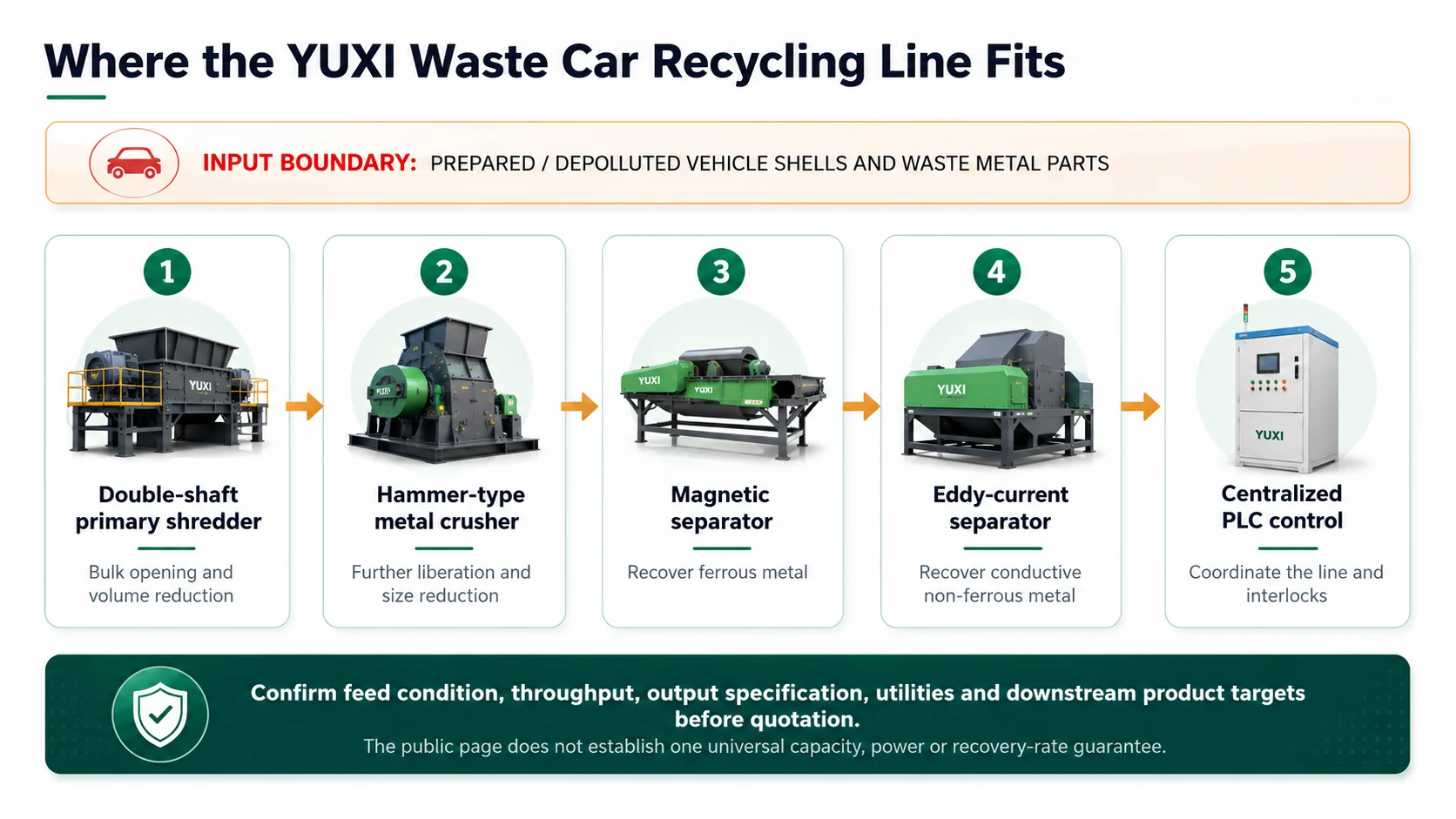
Uma cotação séria da YUXI deve, portanto, começar com evidências: fotos ou vídeos do material, o estado de descontaminação, as dimensões máximas da matéria-prima, a alimentação prevista por hora e por ano, as frações de saída desejadas, as metas de contaminação, a tensão no local, as restrições de espaço e o país de destino. A equipe de engenharia poderá então determinar se é necessária a sequência completa publicada ou se o comprador precisa apenas de etapas selecionadas.
PERGUNTAS FREQUENTES
Quem é o melhor fabricante de equipamentos para reciclagem de veículos?
Não existe um fornecedor ideal para todos os casos. A escolha do fabricante adequado depende de se o projeto envolve descontaminação, desmontagem, preparação do casco, trituração pesada, separação de metais ou reciclagem ASR, bem como da escala da fábrica, da localização e dos requisitos de serviço.
É possível colocar um carro inteiro diretamente em um triturador de veículos?
Não é uma regra geral. Baterias, combustível, refrigerantes, fluidos, airbags e outros componentes perigosos exigem um procedimento de pré-tratamento em conformidade com as normas. O fornecedor do triturador deve receber uma especificação de alimentação claramente definida e preparada.
Quais equipamentos são necessários para uma unidade completa de reciclagem de veículos fora de uso (ELV)?
Uma unidade completa pode incluir recepção e inventário, descontaminação, desmontagem, manuseio de peças, preparação da carcaça, redução primária e secundária do tamanho, separação de metais ferrosos e não ferrosos, controles de poeira e incêndio e tratamento de resíduos. Nem todas as instalações realizam todas as etapas.
Qual é a diferença entre o triturador de carros e o triturador de automóveis?
Um triturador ou enfardador serve principalmente para reduzir o volume para armazenamento e transporte. Um desintegrador quebra e desagrega o material para a separação em etapas posteriores. Alguns projetos utilizam ambos, pois a densidade de transporte e a desagregação do material são objetivos distintos.
Como os fabricantes devem comprovar sua capacidade?
A capacidade deve ser considerada em função do material a ser processado, das dimensões e densidade da matéria-prima, da contaminação, do tamanho do produto final, das condições operacionais e de toda a linha de produção. Um valor de catálogo sem carga ou genérico não é suficiente para o planejamento de investimentos.
Quando é necessário um separador por correntes parasitas?
É comumente utilizado após a redução de tamanho e a remoção de metais ferrosos para separar metais não ferrosos condutores, como o alumínio. O desempenho depende do tamanho das partículas, da liberação, da carga na correia e da composição do material remanescente.
O equipamento ASR faz parte de todas as linhas de trituração de veículos?
Não. As instalações básicas podem encerrar suas operações após a recuperação primária de metais ferrosos e não ferrosos. O tratamento ASR mais avançado é um processo separado a jusante, projetado com base no resíduo específico e nos produtos necessários.
Que informações devo enviar à YUXI para a seleção da linha?
Envie fotos ou vídeos do material, o estado de descontaminação, o tamanho máximo do material de alimentação, a produtividade alvo, as frações de saída desejadas, o uso posterior, a fonte de alimentação, as restrições do local e o país de destino. A capacidade e a configuração exatas devem ser confirmadas pela equipe de engenharia.
Notas sobre fontes e verificação de fatos
- Comissão Europeia: Veículos — contexto de mercado e fundamentos da gestão ambiental.
- EPA dos EUA: Tratamento de veículos em fim de vida útil — sequência de descontaminação e tratamento de materiais perigosos.
Elabore um orçamento que possa ser detalhado
Envie as informações sobre as condições do material recebido, o status de descontaminação, as dimensões máximas, a capacidade de processamento alvo por hora e por ano, as frações de saída exigidas, a tensão elétrica no local, a área disponível e o país de destino. A YUXI poderá, então, determinar quais etapas de trituração e separação devem ser incluídas no projeto.