




 Request Quote



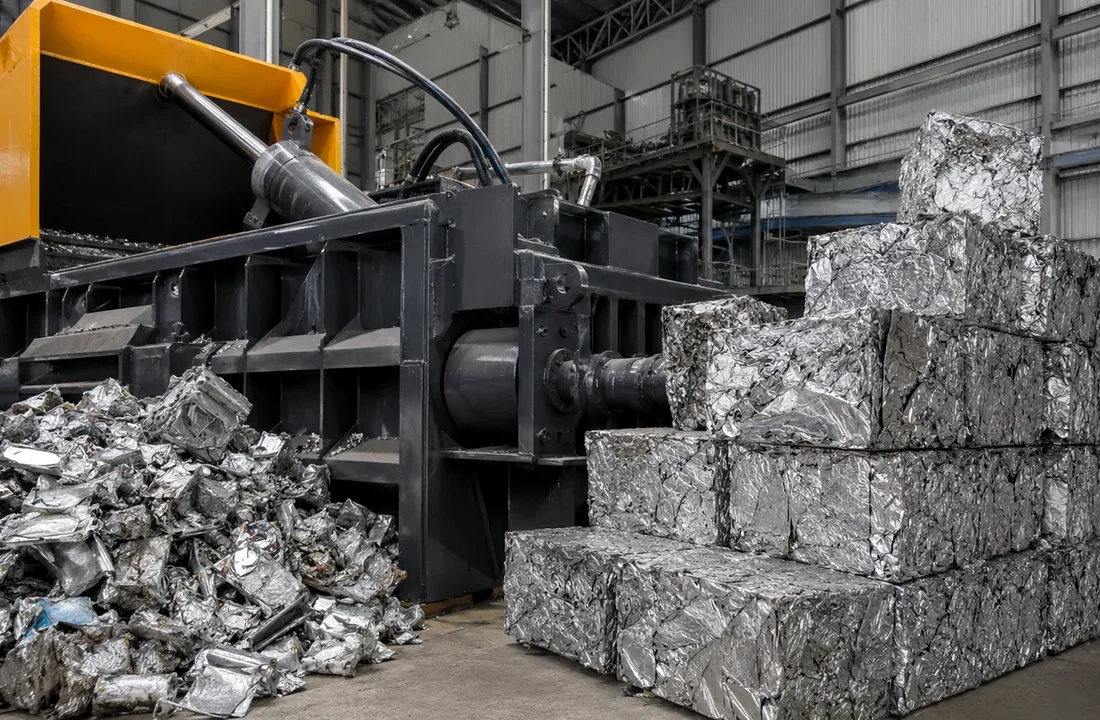
One of the first questions buyers ask is, “How many machines do we need?” In practice, that question comes too early. A clean stream of loose beverage cans may need little more than inspection and densification. A mixed dry-recyclables stream needs separation. A hard UBC bale can hide steel cans, plastic, glass, liquid, and dirt inside a block that looks clean from the outside.
What This Aluminum Scrap Recycling Process Covers
A recycling yard, a material recovery facility, and an aluminum mill may all use the phrase “UBC recycling,” yet they perform different parts of the chain. The yard may sort and bale. The mill may open the bale, remove contamination, thermally remove coatings, and remelt the metal. These are connected operations, but they should not be presented as one standard machine package.
The U.S.EPA describes secondary aluminum pretreatment as sorting and processing waste before smelting to remove other metals, dirt, oil, plastics, and paint. It also identifies mechanical cleaning methods such as size reduction,magnetic removal,screen and air classification.That is the technical territory covered here. EPA AP-42, Secondary Aluminum Operations
The Process Starts with Feedstock Condition, Not a Flowsheet
UBC is often treated as if it were one uniform commodity. It is not. The same truck weight can arrive as fluffy loose cans, compacted briquette-like material, standard bales, or cans recovered from a mixed packaging stream. Bulk density, contamination, and how the cans are nested change the line behavior immediately.
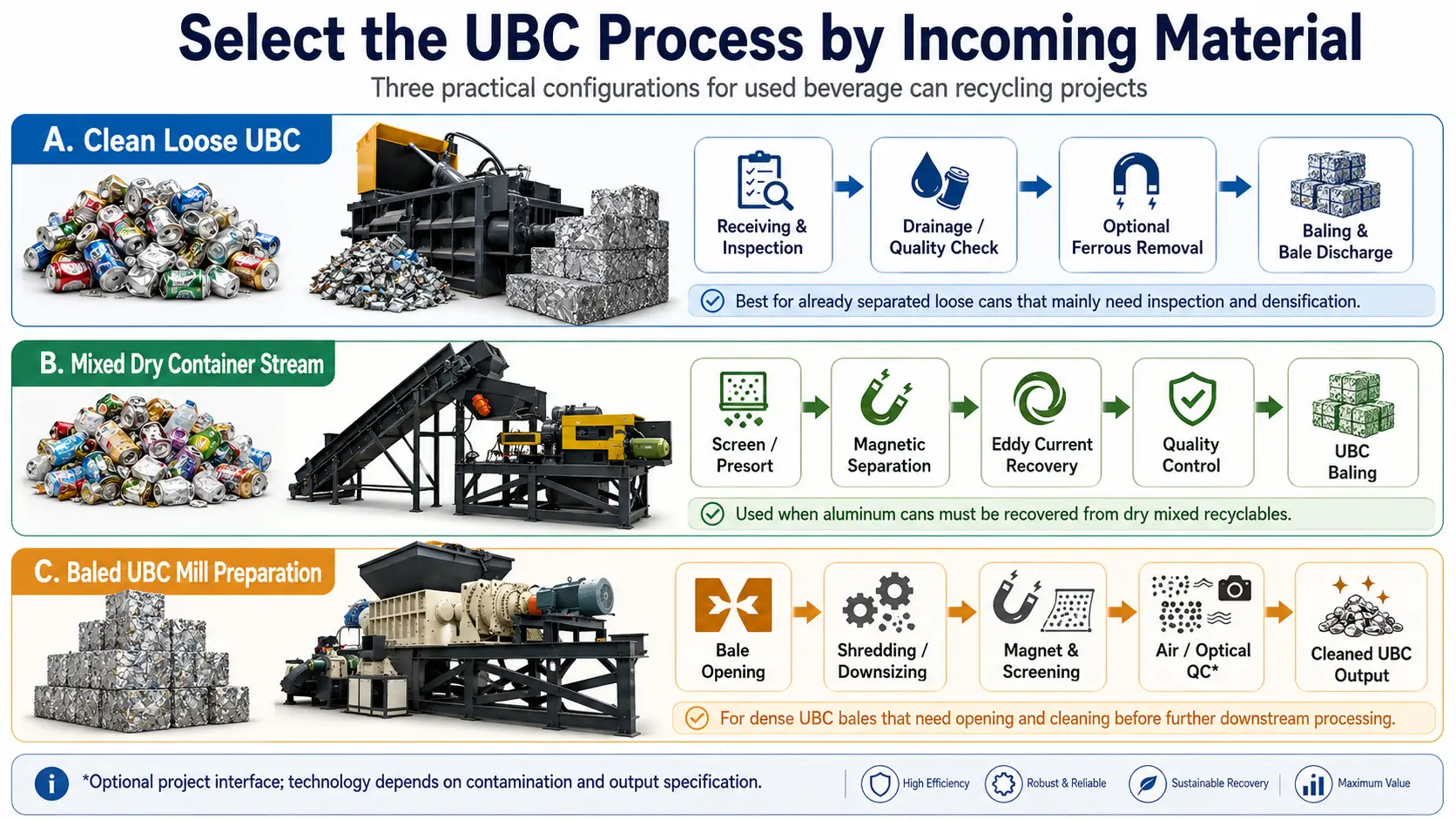
We normally separate the incoming material into three practical classes:
Clean loose UBC
Already separated cans from a collection center or deposit-return stream. The main job is inspection, liquid control, optional steel removal, and baling.
Mixed dry containers
A can-rich fraction containing steel containers, paper, plastic, and glass. The main job is staged sorting before the aluminum is densified.
Dense UBC bales
Compacted cans delivered for further preparation. The main job is opening the bale and releasing contamination that cannot be seen from the surface.
A broader scrap aluminum recycling line may also process profiles, castings, wheels, sheets, or machining chips. Those materials need different decisions. Chips may require liquid control and briquetting. Profiles may need low-speed shredding and attached-steel removal. This guide stays with UBC so the process logic remains useful rather than becoming a catalogue of unrelated equipment.
Feed data that should be recorded at receiving
- Loose, compacted, or baled condition.
- Bale dimensions, weight, density, and strap or wire type.
- Estimated steel-can content.
- Plastic, paper, glass, dirt, and organic contamination.
- Residual liquid and moisture.
- Presence of non-beverage aluminum items.
- Pressurized containers, batteries, electronics, or sealed unknown items.
- Required output: loose UBC, opened pieces, or finished bales.
That record becomes the basis for equipment selection and later quality control. Without it, an operator can mistake a feed change for a machine fault.
Aluminum Scrap Recycling Process: Step by Step
- Receive, weigh, and inspect the load. Confirm that the material matches the purchase and plant specification. Photograph representative layers, not only the top surface. For bales, inspect broken straps, protruding metal, moisture, and signs of trapped non-can material.
- Remove prohibited and unsafe items. Aerosol cans, pressure vessels, lithium batteries, sealed containers, electronics, large hard steel pieces, and hazardous residue should not enter the line. A physical process cannot make an unknown pressurized item safe.
- Control residual liquid and wet contamination. Even “empty” cans may hold beverage residue. Free liquid adds weight, creates housekeeping problems, changes friction on conveyors, and can carry fines into places where they are difficult to clean. The control method depends on the feed and local discharge requirements.
- Meter the material into a stable layer. A receiving conveyor does more than move cans. It creates an inspection zone and controls the depth of material entering screens and separators. Surges reduce separation quality; an even layer gives each piece a better chance to meet the magnetic or eddy-current field.
- Screen or presort when the stream is mixed. Oversized objects, fines, broken glass, and flat light material should be managed before precision separation. The screen opening and sequence depend on the actual contamination—not a universal UBC setting.
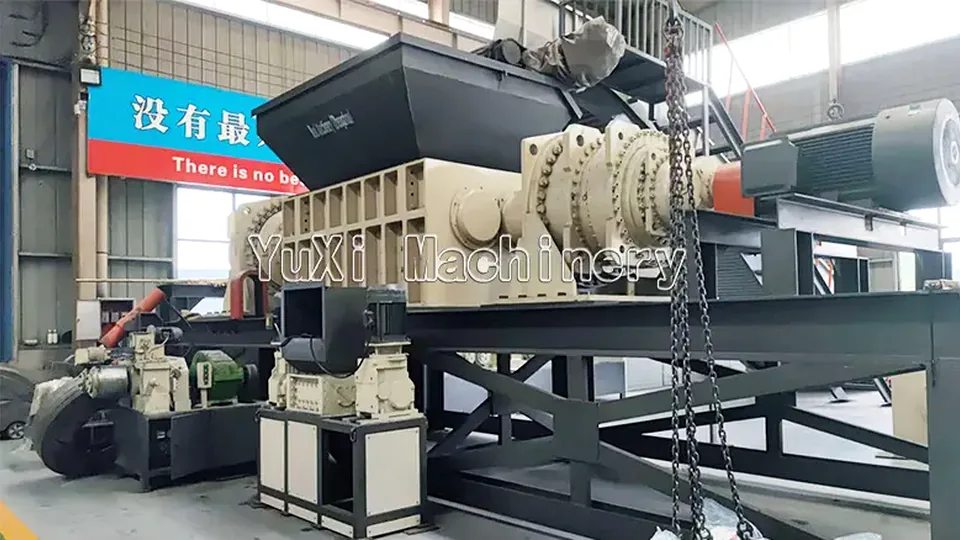
- Open dense bales or downsize only when justified. Bale breaking releases cans and trapped impurities. Controlled shredding may be used when nested cans, compacted layers, or the downstream process require more consistent pieces. Clean loose cans should not be shredded simply because a shredder is available.
- Remove ferrous metal. Steel cans, wire, straps, and iron fragments are commonly removed magnetically. Early ferrous removal protects downstream quality and gives the eddy current stage a more appropriate feed.
- Remove light and non-metal contamination. Screens, air separation, or manual quality control may be used to reduce labels, paper, plastic film, glass, dirt, and other residue. The correct technology depends on particle size, shape, moisture, and how tightly contamination remains attached.
- Recover aluminum from a mixed dry stream. An eddy current separator can eject conductive non-ferrous material from a suitable non-metal stream. It works best with controlled particle size, even feed, and prior ferrous removal. It does not identify aluminum alloys or correct poor upstream preparation.
- Verify the output and bale or discharge it. Sample the product against an agreed specification. Record steel, non-metal residue, moisture, and product form. Then discharge loose prepared UBC or compact it into a transport-ready bale.
How the Line Produces Clean Fractions
“Clean aluminum” is not a visual promise. It is an output specification. One buyer may accept whole UBC with a defined limit for steel and non-metal residue. Another may need opened pieces for downstream decoating. A third may only want dense, consistent bales for transport.
The word fraction is useful because the line does not create one output. It separates the incoming stream into several controlled products and rejects:
| Output fraction | How it is produced | What should be checked |
|---|---|---|
| Sorted loose UBC | Inspection, ferrous removal, optional screening and quality control | Steel cans, non-can aluminum, plastic, glass, liquid and dirt |
| Opened or downsized UBC | Bale opening or controlled shredding followed by cleaning | Piece-size distribution, fines generation, exposed contamination and aluminum loss |
| Dense UBC bales | Quality-controlled can fraction compressed in a metal baler | Bale dimensions, weight, density, stability and buyer acceptance limits |
| Ferrous reject | Magnetic separation of steel cans, wire and iron fragments | Aluminum carryover and non-metal contamination |
| Light/non-metal residue | Screening, air classification and manual or optical quality control | Recoverable aluminum loss, moisture and disposal route |
The important word is controlled. A cleaner aluminum fraction is only valuable when the plant can measure it consistently. One good sample taken from the top of a pile proves very little. Sampling should cover different times, conveyor positions, and feed batches.
Why magnetic separation comes first
Ferrous metal is normally removed before an eddy current separator. The magnet handles steel and iron. The eddy current stage then separates conductive non-ferrous pieces from a prepared non-metal stream. It is a sequence, not a competition between two machines.
Particle presentation also matters. A thick pile can hide smaller pieces. Very fine particles behave differently from intact cans. Moist or sticky contamination can move with aluminum. Separation quality therefore depends on feed preparation as much as separator settings.
Three Practical Routes from Feedstock to Output
Route A: Clean loose cans to bales
This is the simplest route: receiving conveyor, inspection, liquid check, optional magnetic removal, and baling. It is appropriate when the cans are already separated and the buyer’s main objective is logistics. In our experience, over-processing this feed can add wear, fines, and maintenance without improving the saleable product.
Route B: Mixed dry containers to recovered UBC
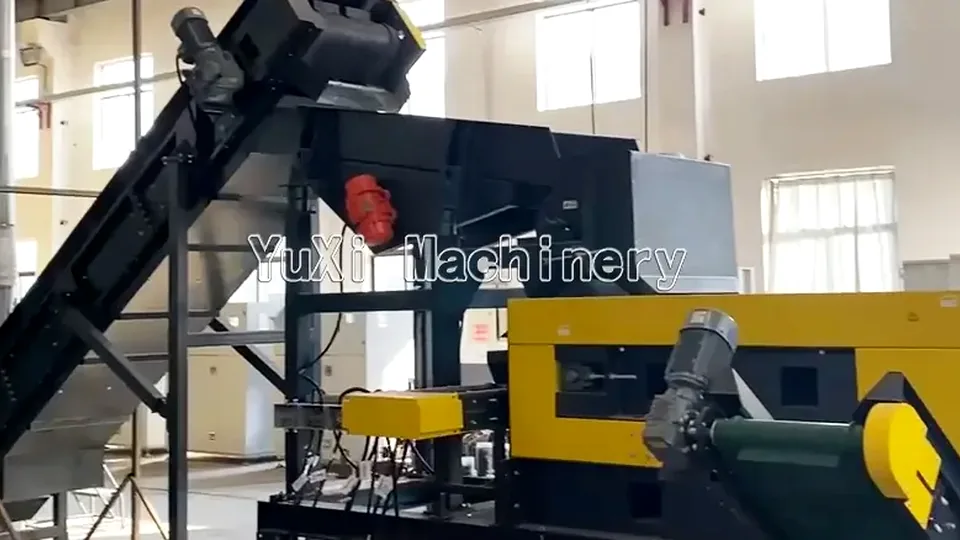
This route uses presorting or screening, magnetic removal of steel, eddy-current recovery of aluminum, final quality control, and baling. It works only when the material is reasonably dry and the line creates a suitable particle and material layer for the separators.
Route C: Dense UBC bales to mill-prepared material
This route begins with bale opening or controlled shredding. Once the compressed mass is opened, magnets, screens, and light-fraction removal can release steel and non-metal contamination. The final product may remain loose, be downsized, or be rebaled according to the mill contract.
What Changes Recovery, Cleanliness, and Throughput?
Catalog capacity cannot answer this alone. A line that handles dry loose cans smoothly may slow down on wet, tightly compacted bales. The same eddy current separator can perform differently when the feed layer, particle size, or contamination changes.
Feed variables
- Bulk density and bale compaction
- Steel-can percentage
- Glass and fines
- Moisture and residual liquid
- Nested or flattened cans
- Non-beverage aluminum
Process variables
- Conveyor layer depth
- Screening cut points
- Magnet position and burden depth
- Particle-size distribution
- Separator settings
- Sampling and operator response
The Aluminum Association’s container design guidance also shows why packaging design can affect recovery. Decorations, attachments, and sleeves may change how a can behaves during sorting and recycling. That does not mean every decorated can is unrecyclable. It means feed composition should be observed rather than assumed. Aluminum Association container design guide
Track losses, not only product purity
A line can produce a visually clean product while losing aluminum into the reject stream. Operators should therefore inspect both sides of every separation stage. Check the ferrous fraction for trapped cans. Check light residue for small aluminum pieces. Check fines after shredding. A recovery plant is balanced when product quality and metal retention are measured together.
The economic reason is substantial. The Aluminum Association reported that compared with competitive beverage packaging, aluminum cans retain high waste value and high recycling content. It also reported that 43% of cans shipped to the United States in 2023 were eventually recycled, leaving a large amount of recoverable metal outside the recycling loop. 2024 aluminum can recycling data
How the YUXI UBC Recycling Line Fits the Process
The public YUXI Aluminum UBC Scrap Recycling Line page is built around the same feed-first logic. It accepts loose, compacted, baled, or dry-recyclable UBC fractions and separates projects into clean loose-can baling, mixed-stream can recovery, and baled-UBC preparation.
YUXI positions the line as configurable rather than fixed. Depending on the feed, the physical equipment may include receiving conveyors, inspection stations, bale opening or a metal shredder, magnetic separation, screening, air or optical quality control, eddy-current recovery, and a metal baling machine.
That product boundary is important: the standard scope prepares UBC physically. It does not automatically include thermal decoating, a melting furnace, alloy adjustment, rolling, or casting. Those systems should be specified separately when the project extends into mill operations.
Common Mistakes in Aluminum Scrap Process Design
1. Starting every line with a shredder
Shredding is useful when it releases contamination or creates a necessary particle size. It is unnecessary when clean loose cans only need inspection and baling. Extra size reduction can create fines and extra maintenance.
2. Treating a bale as a verified clean feed
A dense bale hides its interior. Surface inspection is not enough. Bale opening, batch sampling, and supplier records may be needed before the plant can trust the contamination level.
3. Installing an eddy current separator without feed preparation
An ECS cannot compensate for a deep, wet, sticky, or badly sized stream. Ferrous removal, stable feeding, and particle presentation are part of separator performance.
4. Measuring only the aluminum product
Inspect the rejects. Aluminum lost in ferrous, light residue, or fines is a recovery problem even when the saleable pile looks clean.
5. Mixing UBC with every aluminum scrap type
Profiles, castings, chips, foil, and wheels do not belong in one generic process. Their size, attached components, alloy concerns, and handling needs are different.
6. Asking for tons per hour without defining the output
Throughput depends on whether the line merely bales loose cans or opens bales, screens, separates, inspects, and rebales. The final product definition belongs beside every capacity figure.
RFQ Checklist for a UBC Recycling Project
A useful quotation starts with material evidence. Send enough information for the engineering team to understand the feed behavior and the saleable product.
| Buyer data | Why it matters |
|---|---|
| Representative photos and video | Shows can condition, contamination, loading method and material variability. |
| Loose, compacted or baled condition | Determines receiving, metering and whether bale opening is needed. |
| Bale size, weight and strap type | Affects handling, opening method and feed control. |
| Contamination list and estimated percentages | Defines magnetic, screening, air and quality-control stages. |
| Target throughput and working hours | Sets the scale of conveyors, separators, storage and baling. |
| Required output and buyer specification | Determines whether the line produces loose UBC, opened pieces or bales. |
| Power supply and workshop dimensions | Supports motor, electrical, layout and maintenance-access planning. |
| Installation and automation scope | Clarifies conveyors, controls, dust management, commissioning and operator interfaces. |
Work Backward from the Buyer’s Specification
The most reliable aluminum scrap recycling process is designed backward: define the accepted product, identify what prevents the incoming feed from meeting it, and add only the equipment needed to remove those barriers.
Aluminum Scrap Recycling Process FAQ
What is the first step in aluminum scrap recycling?
The first industrial step is to define and inspect the feedstock. Loose clean cans, mixed dry recyclables and dense UBC bales behave differently, so the process should be selected only after confirming contamination, bale condition, moisture, prohibited items and the required final product.
Does every UBC recycling line need a shredder?
No. Clean loose used beverage cans may only need inspection, optional ferrous removal and baling. Shredding or bale opening becomes useful when dense bales trap contamination, cans are nested, or downstream separation needs a smaller and more consistent material stream.
Why is magnetic separation used before eddy current separation?
A magnet removes iron and steel first. The eddy current separator can then work on a more suitable non-ferrous and non-metal stream. It does not replace magnetic removal, and it does not sort aluminum alloys from one another.
What are clean aluminum fractions?
In this article, clean fractions means physically prepared outputs with unwanted steel and non-metal residue reduced to an agreed limit. It may include sorted loose UBC, opened can pieces, a dense UBC bale, a ferrous reject fraction and a non-metal residue fraction. The exact acceptance specification must be agreed with the buyer or mill.
Does this process include melting and casting?
Not by default. The physical preparation scope covers receiving, conveying, inspection, bale opening or shredding, magnetic separation, screening, optional eddy current recovery, quality control and baling. Decoating, drying, melting, alloy adjustment and casting are separate downstream systems unless included in the project contract.
What information is needed for an aluminum recycling line quotation?
Provide representative photos and video, whether the feed is loose or baled, bale dimensions and weight, contamination types and estimated percentages, target tons per hour, required output form, operating hours, power supply and available workshop space.
References and Source Notes
- U.S. EPA: Aluminum Material-Specific Data ? aluminum packaging and municipal waste context.
- The Aluminum Association: Aluminum Recycling ? recycled aluminum and circular-economy context.
- The Aluminum Association and Can Manufacturers Institute: 2024 aluminum beverage can recycling data.
- OSHA: Guidance for the Identification and Control of Safety and Health Hazards in Metal Scrap Recycling.