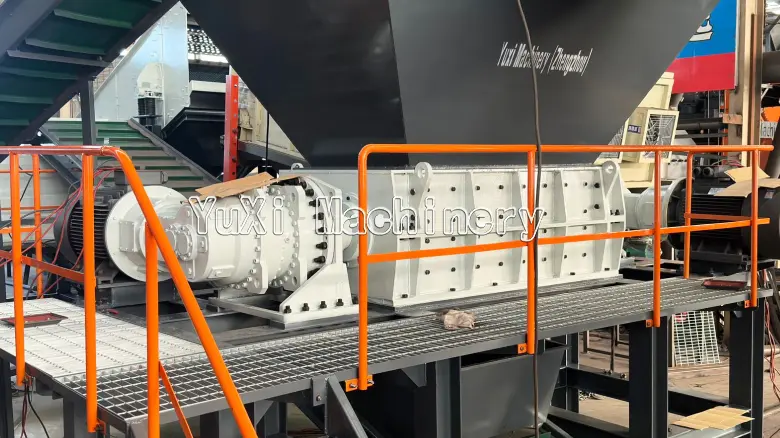
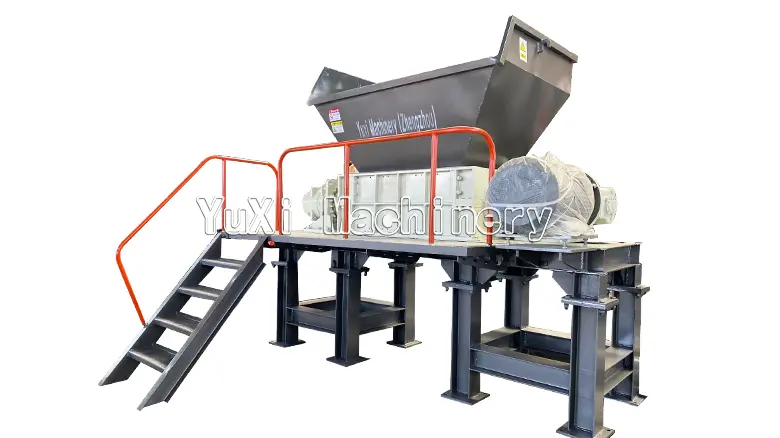
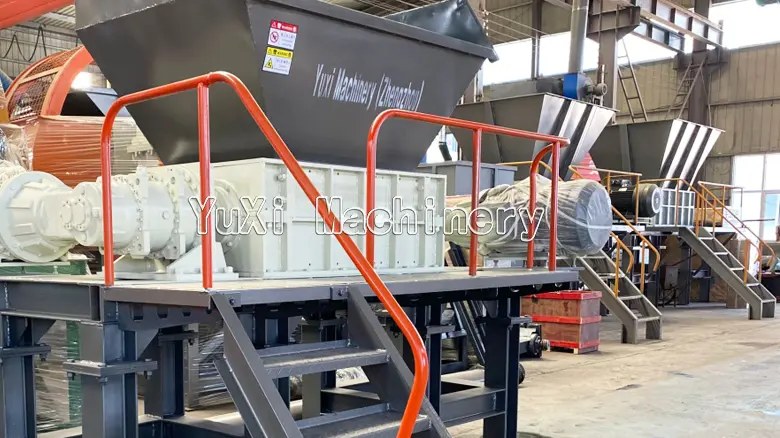
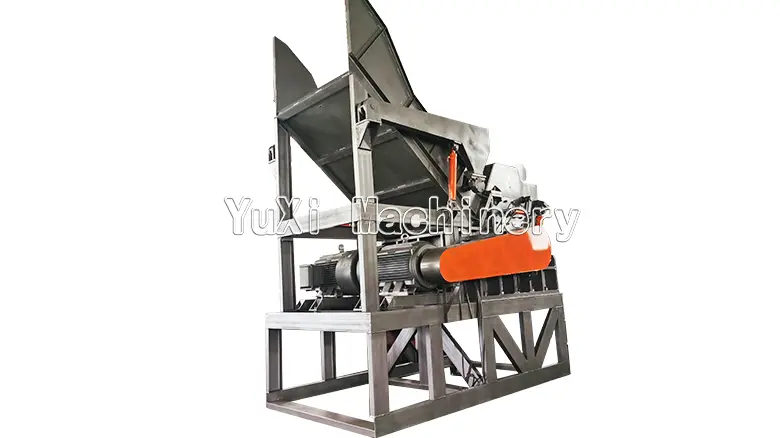
YUXI metal shredder machines use two counter-rotating, low-speed, high-torque cutter shafts to reduce bulky light- and medium-gauge scrap for transport, sorting, secondary crushing or further recycling. Typical materials include steel drums, sheet metal, appliance shells, prepared car bodies, aluminum profiles and production offcuts. Nine YXS models are available, with reference capacities ranging from 2–3 t/h to 25–60 t/h.
The right model is selected according to feed dimensions, metal thickness, bulk density, required throughput and the downstream recycling process.
A metal shredder is industrial recycling equipment that reduces the physical size of scrap metal before transport, sorting, secondary crushing or remelting. The YUXI machine shown on this page uses two counter-rotating cutter shafts. Each shaft is driven through a motor and reducer, trading high rotational speed for the torque needed to bite irregular, hollow and folded metal objects.
In practical terms, this is a primary metal shredder. Its job is to open and reduce bulky scrap, not to produce a fine, perfectly uniform granule in one pass. Twin-shaft rotary shear systems generally make pieces related to cutter thickness, but fragment length still changes with the feed shape, hook design and number of cutting passes. When a project needs finer sizing or stronger liberation of attached plastic, rubber, paint and non-ferrous components, the shredder is normally followed by secondary crushing and separation.
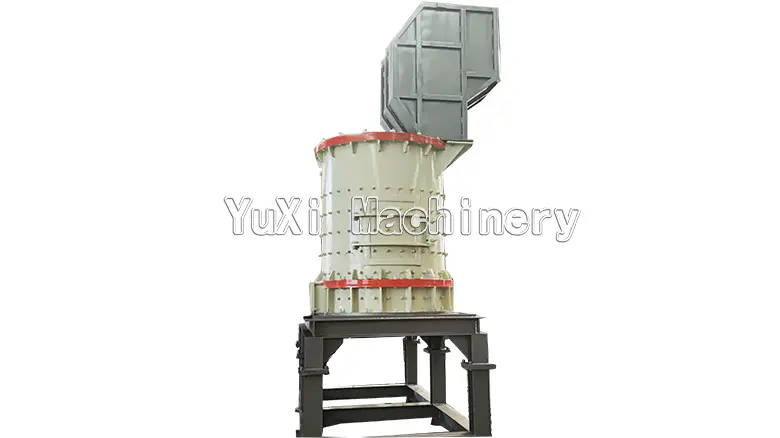
This distinction matters because the phrase “metal shredder” covers several very different machines. A low-speed double-shaft shredder, a high-speed hammer mill and a vertical crusher do not have the same duty.
Reduce bulky volume
Open hollow items and turn irregular scrap into a denser, conveyor-friendly stream that is easier to store, load and transport.
Prepare material for sorting
Expose connected materials so magnets, eddy current separators and other downstream equipment can work on smaller pieces.
Protect downstream equipment
Use controlled primary reduction before a hammer mill or sorting line instead of feeding large, unpredictable items directly.
Material photographs are useful for preliminary selection, but thickness, dimensions, density and contamination must also be confirmed.
Feedstock suitability
What Materials Can the Scrap Metal Shredder Process?
The machine is mainly intended for light and medium-gauge ferrous and non-ferrous scrap. Suitability depends on more than the metal name. A thin hollow steel drum and a solid forged steel block may both be called “steel,” but they place completely different loads on the cutter shafts, bearings and gearbox.
Material group
Examples
General fit
Preparation and selection notes
Light sheet and packaging scrap
Color-coated sheet, thin iron sheet, paint cans, steel cans, metal packaging
Good fit
Remove liquids and hazardous residues. Loose, continuous feeding gives more stable output than occasional large batches.
Steel and metal drums
Oil drums, diesel drums, paint buckets and similar hollow containers
Good fit
Drain, clean, open and confirm that every container is non-pressurized before feeding.
Appliance shells
Refrigerators, washing machines, cabinets and light steel furniture
Good after preparation
Refrigerants, compressor oil, batteries and other hazardous parts must be removed. A dedicated refrigerator line is required for compliant full treatment.
Prepared vehicle scrap
Car shells, body panels, bicycle frames and selected light vehicle parts
Engineering check
Vehicles must be depolluted. Confirm body preparation, remaining engine or axle parts, feed method and desired recovery process.
Aluminum scrap
Profiles, sheet, cans, siding, radiator material and factory offcuts
Good fit
Blade geometry and line layout depend on whether the target is densification, delacquering preparation, sorting or furnace feed.
Copper and mixed non-ferrous scrap
Copper sheet, tubing, selected parts and mixed non-ferrous components
Engineering check
Confirm purity, geometry, hardness and whether liberation from plastic or steel is required.
Production offcuts
Stamping scrap, plate trimmings, light profiles and factory metal waste
Good within limits
Provide maximum thickness, longest dimension, bundle condition and bulk density.
Thick solid or hardened metal
Heavy shafts, solid blocks, hardened alloy parts and oversized structural sections
Not standard feed
Requires written engineering approval and may be better handled by shearing, cutting or a purpose-built heavy-duty system.
Do not feed unknown or unsafe material. Sealed containers, gas cylinders, explosives, ammunition, radioactive scrap, lithium batteries, pressurized items and unidentified hazardous waste must not enter the shredder. Vehicles and appliances require depollution before shredding. Site owners are responsible for local environmental, fire, occupational safety and waste-handling compliance.
Machine in operation
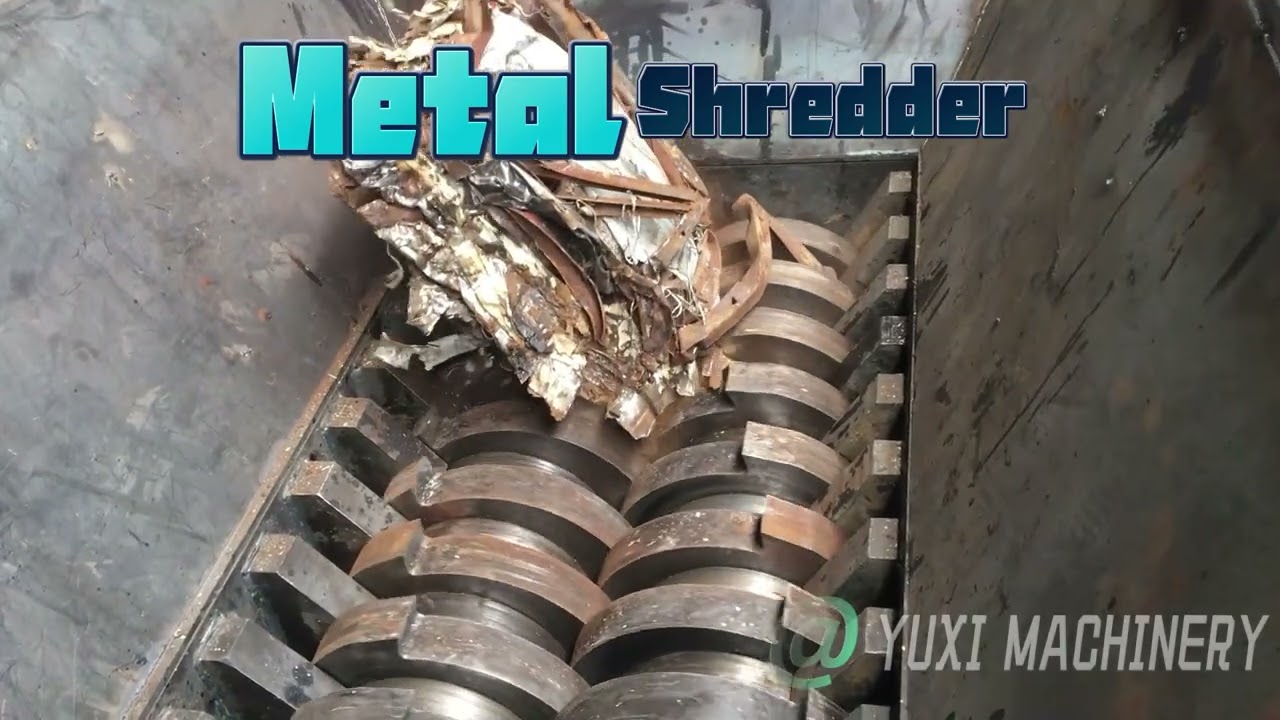
Metal Shredder Machine Working Video
Operating process
How Does a Double-Shaft Metal Shredder Work?
The operating principle combines gripping, tearing, shearing and compression. Instead of striking scrap at high speed, the two shafts rotate inward at low speed. Hooked cutters catch the material, pull it into the cutting zone and apply torque through the overlapping cutter edges.
Controlled feedingScrap enters through a hopper by grab, loader or conveyor. Feed rate must match the chamber load.
GrippingCutter hooks catch bulky material and draw it downward between the two shafts.
Tearing and shearingIntermeshing cutters rip folded sections and shear sheet, hollow and irregular metal.
Load controlThe PLC monitors overload. The shafts can stop and reverse to release a difficult bite before restarting.
DischargeReduced pieces fall below the chamber onto a conveyor for collection, sorting or secondary processing.
The auto-reverse function is equipment protection, not permission to feed unsuitable scrap. Repeated reversing usually indicates overfeeding, an inappropriate cutter configuration, excessive thickness or an unshreddable object.
The cutting chamber must be configured around the actual material rather than selected from motor power alone.
Engineering details
Main Components and Why They Matter
A serious comparison should go beyond headline power and capacity. These components determine whether the industrial metal shredder can grip the material, survive impact, clear overloads and be maintained without excessive downtime.
Alloy cutters and cutter layout
Company information lists replaceable cutter thicknesses of 15, 20, 40, 50, 75 and 100 mm. Thickness, hook number, hook profile and cutter spacing are selected for the feed. Thinner cutters can produce narrower strips on suitable light scrap; thicker cutters give more section strength for tougher duty but generally create coarser output.
Twin cutter shafts
The two shafts work together to pull material into the chamber. The source information describes a hexagonal connection between cutter bores and the shaft surface, intended to distribute force around the shaft rather than depend on a simple round interface.
Motors and reduction gearboxes
The motor supplies power while the reducer lowers shaft speed and increases usable torque. The listed range uses two motors, from 15 × 2 kW on the YXS-600 to 160 × 2 kW on the YXS-2600. Gearbox duty, shock loading and shaft speed should be evaluated together.
PLC overload protection
The control system provides start, stop, reverse and overload-reverse functions. Correct current settings and restart logic help clear difficult bites and reduce the chance that a temporary jam develops into drive damage.
Sealed bearing arrangement
Company material describes a multi-layer sealing design intended to reduce water and dust ingress. Seal condition and bearing temperature should still be part of routine inspection, especially with dirty, wet or fine-contaminated scrap.
Split chamber construction
The source information states that the box can be separated to simplify removal of the cutter-shaft assembly, including shafts, cutters, bearings and seals. Service access can have a larger lifetime impact than a small difference in quoted motor power.
Operational benefits
Key Advantages for Scrap Recycling Operations
Strong bite at low speed
High torque and hooked cutters help pull hollow, folded and irregular scrap into the chamber without relying on high-speed impact.
Lower-speed primary reduction
Compared with a hammer mill, rotary shearing normally creates less high-speed impact, although dust, noise and sparks still depend on the feed and site controls.
Configurable output
Cutter thickness and geometry can be selected around the required coarse product and downstream process instead of using one cutter arrangement for every material.
Automatic overload response
PLC reversing can clear many transient overloads, reduce manual intervention and protect the cutting and drive system.
Standalone or line integration
The shredder can discharge into a collection conveyor or become the first stage of magnetic, eddy-current, screening and secondary crushing systems.
Service-oriented construction
Replaceable cutters and a split chamber are intended to shorten access time when shafts, blades, seals or bearings require work.
Model comparison
YUXI Metal Shredder Models and Technical Parameters
The company source table provides nine YXS models. These figures are useful for narrowing the range, but final selection must be based on the actual scrap and test conditions. A 10 t/h requirement for loose aluminum cans is not equivalent to 10 t/h of folded steel plate or mixed appliance scrap.
Model
Motor power
Reference capacity
Reference shredded size*
Hopper opening
Weight
Overall dimensions
YXS-600
15 × 2 kW
2–3 t/h
30–100 mm
820 × 900 mm
2.5 t
2600 × 2000 × 1900 mm
YXS-800
22 × 2 kW
3–5 t/h
30–100 mm
900 × 1000 mm
3.6 t
2800 × 2000 × 1900 mm
YXS-1000
37 × 2 kW
5–8 t/h
30–100 mm
1200 × 1000 mm
5.7 t
3000 × 2000 × 1900 mm
YXS-1200
45 × 2 kW
6–10 t/h
30–100 mm
1400 × 1000 mm
9.5 t
3200 × 2000 × 1900 mm
YXS-1400
55 × 2 kW
8–12 t/h
30–100 mm
2000 × 2000 mm
18 t
4300 × 2000 × 2400 mm
YXS-1600
75 × 2 kW
12–18 t/h
30–100 mm
2300 × 2000 mm
24 t
5000 × 3000 × 2400 mm
YXS-2000
90 × 2 kW
16–22 t/h
30–100 mm
2300 × 2000 mm
35 t
6000 × 3500 × 2400 mm
YXS-2200
132 × 2 kW
20–26 t/h
30–100 mm
2500 × 1800 mm
62 t
7000 × 4000 × 4500 mm
YXS-2600
160 × 2 kW
25–60 t/h
30–100 mm
3200 × 2000 mm
85 t
8200 × 4000 × 4300 mm
*The original company table labels 3–10 cm as “Materials size.” Because the same range is shown for every model and hopper size is listed separately, it is treated here as a reference shredded-size range. It is not a guarantee of identical particles. Confirm cutter thickness, hook geometry, allowable input and target output during technical selection.
About the 25–60 t/h YXS-2600 range: the unusually wide range indicates how strongly throughput changes with feedstock. High-volume, low-resistance hollow scrap can move through much faster than thick, dense or tangled material. A quotation should state the reference material used for the capacity estimate.
How to Read the Model Table
Hopper opening is not the only feed limit. Material may physically fit but still be too thick, dense, hard or compacted for the selected cutter and drive.
Installed power is not production capacity. Throughput also depends on bite rate, bulk density, loading consistency, reverse cycles and discharge clearance.
Machine weight matters. Larger shafts, chamber structure and drives increase foundation and handling requirements as well as duty capability.
Output is application-specific. A primary twin-shaft shredder normally produces irregular coarse pieces. Secondary equipment is required when the buyer specifies a fine or tightly controlled final fraction.
Selection guide
How to Select the Right Industrial Metal Shredder
Model selection should begin with the material and finished-product objective, not a request such as “send your 10-ton machine.” Two buyers asking for 10 t/h may need different chamber widths, cutter thicknesses, motor margins and downstream systems.
1. Define the Feed Material Precisely
List each major feed stream and its percentage. Send clear photos and a short working video. Record metal type, product form, maximum thickness, longest dimension, unit weight, bulk density, contamination and whether the material is loose, nested or baled. For mixed scrap, identify the hardest and heaviest regular item—not only the average material.
2. State the Real Production Target
Provide tons per hour, working hours per shift and planned annual volume. The feed system must be able to supply the target continuously; a large shredder cannot reach rated output when a loader delivers intermittent small batches or the discharge conveyor cannot clear material fast enough.
3. Define What “Output Size” Means to Your Process
Some buyers only need volume reduction. Others need pieces suitable for a magnet, eddy current separator, hammer mill, furnace or baler. State the downstream machine and acceptable size distribution. Do not specify one exact dimension unless the complete process includes a sizing method capable of enforcing it.
4. Match Cutter Design to the Duty
Discuss blade thickness, hook count, cutter material, gap, shaft speed and repair method. More hooks can improve grabbing on certain shapes, while a stronger section may be needed for impact-prone material. Cutter selection is a trade-off among bite, output size, strength, wear and power demand.
5. Check the Whole Installation
Confirm voltage and frequency, transformer capacity, foundation, crane access, feeding height, discharge elevation, maintenance clearance, ambient temperature, dust extraction, fire protection and local guarding standards. A model that fits the process but not the building is not the correct model.
Get a Model Recommendation Based on Your Scrap
Send YUXI your material photos or video, maximum dimensions and thickness, hourly capacity, target output and available plant space. The technical team can then review the model, cutter layout, feeding system and downstream equipment.
Equipment comparison
Metal Shredder vs Other Scrap Processing Machines
Buyers often compare machines that solve different stages of the process. The table below helps define the duty before discussing price.
Equipment
Main action
Best use
Typical limitation
Double-shaft metal shredder
Low-speed tearing and shearing
Primary reduction of bulky light and medium scrap
Does not normally make a fine, tightly uniform product by itself
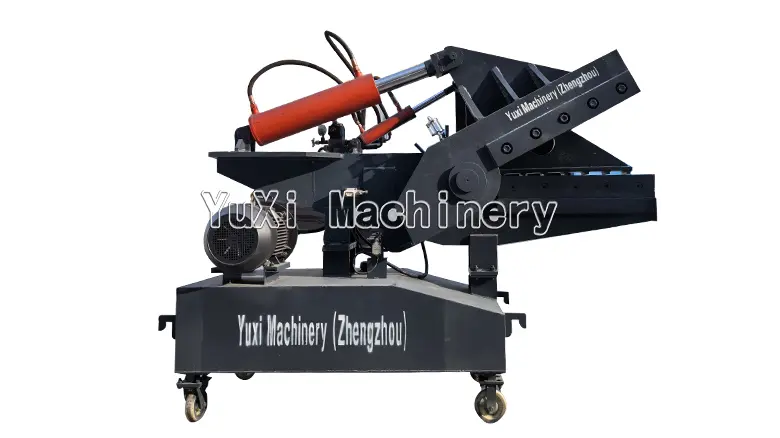
Compresses material but does not open composites for sorting
System configuration
Standalone Machine or Complete Metal Recycling Line?
A standalone scrap metal shredder is appropriate when the goal is coarse reduction and the buyer already has suitable feeding, collection and sorting equipment. A complete line is needed when the project must deliver separated or furnace-ready material rather than a mixed shredded stream.
Project objective
Typical configuration
Selection logic
Reduce storage and transport volume
Feeding system → metal shredder → discharge conveyor
The simplest arrangement when mixed coarse output is acceptable.
Recover ferrous metal
Shredder → conveyor → magnetic separator
A magnet removes iron and steel after size reduction exposes the material stream.
Refrigerants, compressor oil, insulation foam, plastics and metals require a dedicated process.
A common steel-scrap route is: inspection and preparation → controlled feeding → primary shredding → secondary reduction where required → ferrous separation → non-ferrous recovery → screening and product collection. The exact sequence changes with the feed and sale specification. ReMA maintains internationally recognized specifications used by buyers and sellers of recycled commodities, so the desired sale grade should be considered before the equipment is finalized. See the ReMA Specifications Circular.
Project budgeting
What Determines Metal Shredder Machine Price?
Industrial equipment is normally quoted by project because machine size alone does not define cost. The major price drivers are:
Required duty: light sheet, prepared car shells, aluminum profiles and heavy mixed scrap require different structural and cutter margins.
Chamber and shaft size: larger feed openings and stronger shafts increase steel weight, machining scope and drive requirements.
Cutter specification: alloy grade, heat treatment, thickness, hook design, quantity and spare sets affect both purchase price and lifetime cost.
Drive system: motor and reducer brands, power margin, coupling arrangement and electrical standard change the configuration.
Feeding and discharge: hoppers, conveyors, grabs, platforms and steel structures can be a significant part of the installed project.
Automation and protection: PLC components, sensors, interlocks, remote monitoring and line integration add control scope.
Downstream recovery: magnets, eddy current separators, screens, hammer mills, dust collection and balers turn a machine purchase into a complete plant.
Delivery and service scope: packing, shipping, installation supervision, commissioning, training and spare parts should be compared on the same basis.
Ask every supplier to separate the base machine, included auxiliaries, spare parts, freight and service scope. A low initial quotation can become expensive when the hopper, conveyors, electrical cabinet, foundation drawings or commissioning are excluded.
Site planning
Installation, Safety and Operating Requirements
Before installation
Confirm foundation loads and anchor layout.
Check incoming voltage, frequency and transformer capacity.
Allow crane and service access for shaft and gearbox work.
Coordinate feeding and discharge elevations.
Plan drainage, housekeeping and contamination control.
Before production
Install guards, emergency stops and interlocks.
Define prohibited materials and inspection procedures.
Train operators on feed rate and overload response.
Confirm lubrication and torque-check schedules.
Test downstream conveyors and separation equipment together.
Metal shredding can generate dust, fines, noise, sparks and heat depending on coatings, contamination and the downstream process. The plant designer should evaluate extraction, spark detection, fire suppression, enclosures and local permitting for the actual feedstock. Detailed layout checks are covered in the metal shredder installation guide.
Lifecycle planning
Maintenance and Wear-Part Planning
The goal of maintenance is not only to avoid failure. Stable cutter condition, correct clearances and a healthy drive system protect throughput and energy use. A practical plan should include:
Daily inspection for abnormal noise, vibration, leakage, loose fasteners and material wrapped around shafts.
Routine checks of cutter wear, hook shape, cracked or chipped edges and the condition of spacers and cleaning fingers.
Lubrication according to the bearing and gearbox requirements, with attention to contamination and seal condition.
Monitoring motor current, reverse frequency and bearing or gearbox temperature to identify a changing load pattern.
Scheduled checks of couplings, reducer mounting, foundation bolts, electrical terminals and safety devices.
A spare-parts plan covering cutters or rebuild strategy, seals, bearings, sensors and critical drive components.
Frequent reversal, falling output or increasing current should trigger an inspection rather than simply a higher overload setting. See the metal shredder maintenance guide for a more detailed schedule.
Quotation checklist
Information Required for an Accurate Quotation
Providing the following information reduces back-and-forth and makes quotations from different suppliers easier to compare:
Photos and video of every regular material.
Metal type, form, maximum thickness and maximum dimensions.
Unit weight of the largest item and approximate bulk density.
Loose, bundled, nested, compacted or baled condition.
Required tons per hour and operating hours per day.
Purpose of shredding and acceptable output range.
Existing or planned downstream equipment.
Feeding method and available loader or grab.
Local voltage, frequency, site dimensions and height restrictions.
Required delivery, installation, commissioning and spare-parts scope.
Useful test question: ask the supplier what material, thickness, feed method and working conditions were used to produce the quoted capacity. A tons-per-hour figure without a reference feedstock is not enough for model selection.
Buyer questions
Metal Shredder Machine FAQ
What is the difference between a metal shredder and a metal crusher?A double-shaft shredder tears and shears bulky scrap at low speed. A hammer mill or vertical crusher uses higher-speed impact for further size reduction, densification or liberation. Many production lines use both stages.
What scrap can the machine process?Typical feed includes steel drums, paint cans, color-coated sheet, appliance shells, prepared car bodies, metal furniture, aluminum profiles and production offcuts. Thickness, size, density and contamination must be checked before selection.
Can it shred complete cars?A suitably configured large machine can process prepared car shells and selected vehicle scrap. Complete end-of-life vehicles must first be depolluted, and heavy components may need removal. A full vehicle project normally requires a dedicated recycling line.
What output size does a twin-shaft metal shredder make?The company table lists a reference range of 30–100 mm, but twin-shaft output is not perfectly uniform. Cutter thickness influences piece width, while length changes with feed shape, cutter hooks and repeated bites.
How much capacity do I need?Base capacity on the actual material, required daily volume and available feeding method. The listed model range is 2–60 t/h, but the same model can have very different throughput on hollow sheet scrap and thick dense scrap.
Can the machine shred steel plate or rebar?Selected plate offcuts and light sections may be suitable within an approved thickness and size. Thick plate, hardened steel, large rebar bundles and solid heavy sections require engineering confirmation and may be better cut or sheared first.
Does the shredder produce clean separated metal?No standalone shredder separates every material. It reduces and opens the feed. Magnets, eddy current separators, screens, density systems or manual sorting are added when clean fractions are required.
How much does an industrial metal shredder cost?Price depends on chamber size, power, cutter specification, material duty, automation, conveyors, separation equipment and service scope. YUXI quotes the machine after reviewing the project data.
Discuss Your Metal Shredding Project with YUXI
Whether you need a standalone scrap metal shredder or a complete recovery line, start with the material. Send representative photos, dimensions, thickness, capacity and target product through the inquiry form below so the machine and process can be selected around your actual operation.





 Request Quote