




 Request Quote



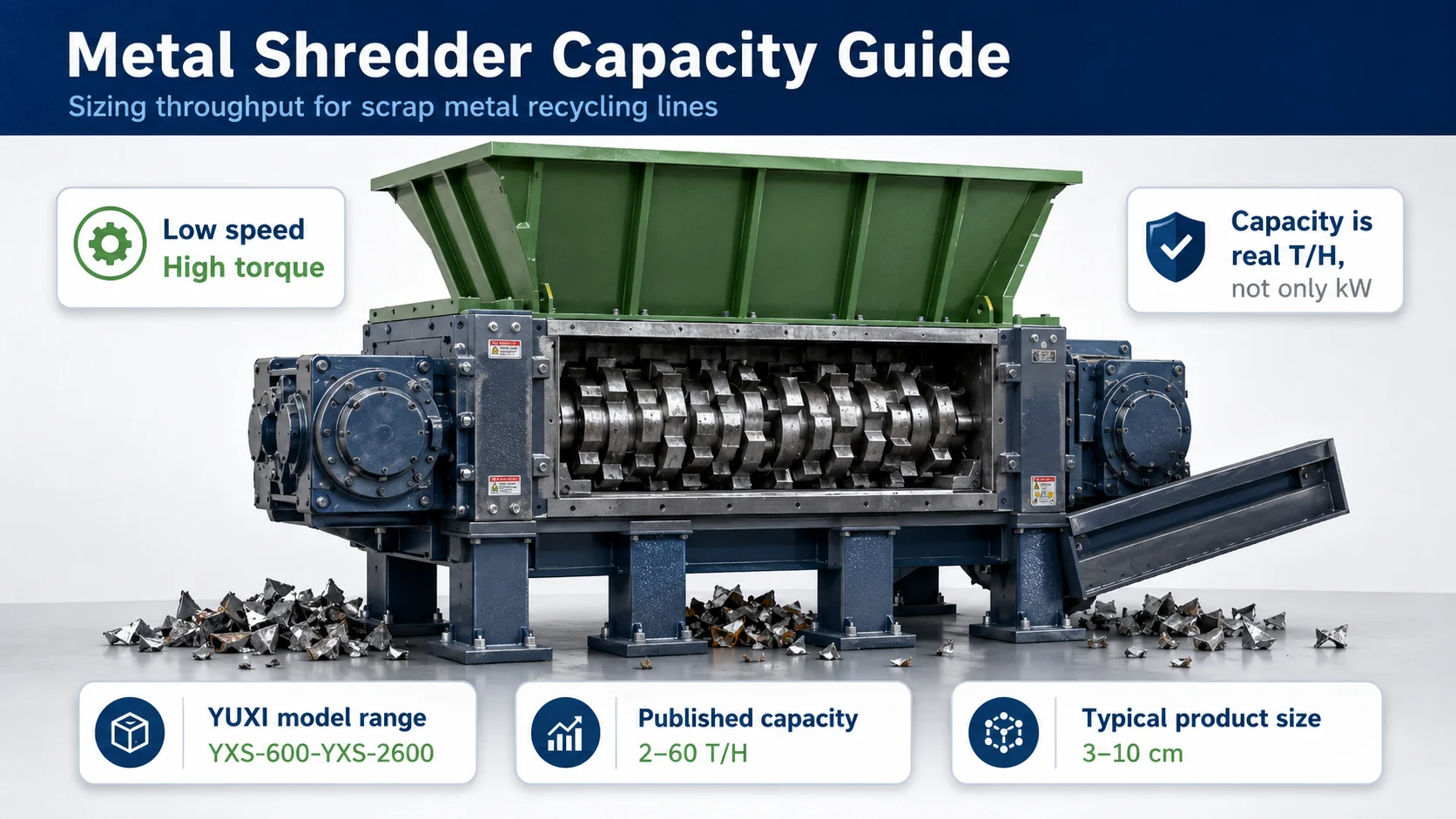
A recycling buyer often starts with a simple question: “I need 10 tons per hour. Which metal shredder should I buy?” In practice, that question is not simple enough. Ten tons per hour of loose aluminum cans, nested paint buckets, sheet steel offcuts, mixed light iron and compressed metal drums are very different workloads. The machine may have the same motor power on paper, but the real plant output can change sharply once the material starts bridging in the hopper, wrapping on cutters or slowing the downstream separator.
This Metal Shredder Capacity Guide is written for buyers who need a practical way to size a shredder before requesting a quote. For a broader overview of equipment types and selection criteria, see the industrial metal shredder machine guide. This guide then explains how to adjust capacity expectations around material density, feeding method, output size and recycling-line layout.
What metal shredder capacity really means
Metal shredder capacity is usually expressed as tons per hour. In a quotation table, it looks like a clean number: 5–8 T/H, 12–18 T/H or 25–60 T/H. In the plant, however, the number means “how many tons the system can accept, cut and discharge under suitable feeding and material conditions.” It is not the same as the maximum material that can be pushed into the hopper for a short moment.
For a double shaft shredder, the capacity is created by the whole cutting process. When the material enters the hopper,the two reverse rotating shafts grab it,and the cutting disc shears and tears it.The overload protection reacts to the jam,and the debris falls into the conveyor,separator,crusher,baler or recycling line.If any stage is slower than the shredder’s cutting ability, the plant capacity drops.
That is why a good capacity guide starts with four numbers:
- Daily tonnage: how many tons of metal scrap must be processed every day?
- Actual productive time: how many hours can be used after loading,rest, inspection, cleaning and blade inspection?
- Material behavior: is the feed loose, bulky, nested, compressed, greasy, contaminated, worn or mixed with plastics/rubber?
- Target output: Does the shredder only open bulky material, or must provide a more controlled size before separation?
Why real T/H changes from one metal stream to another
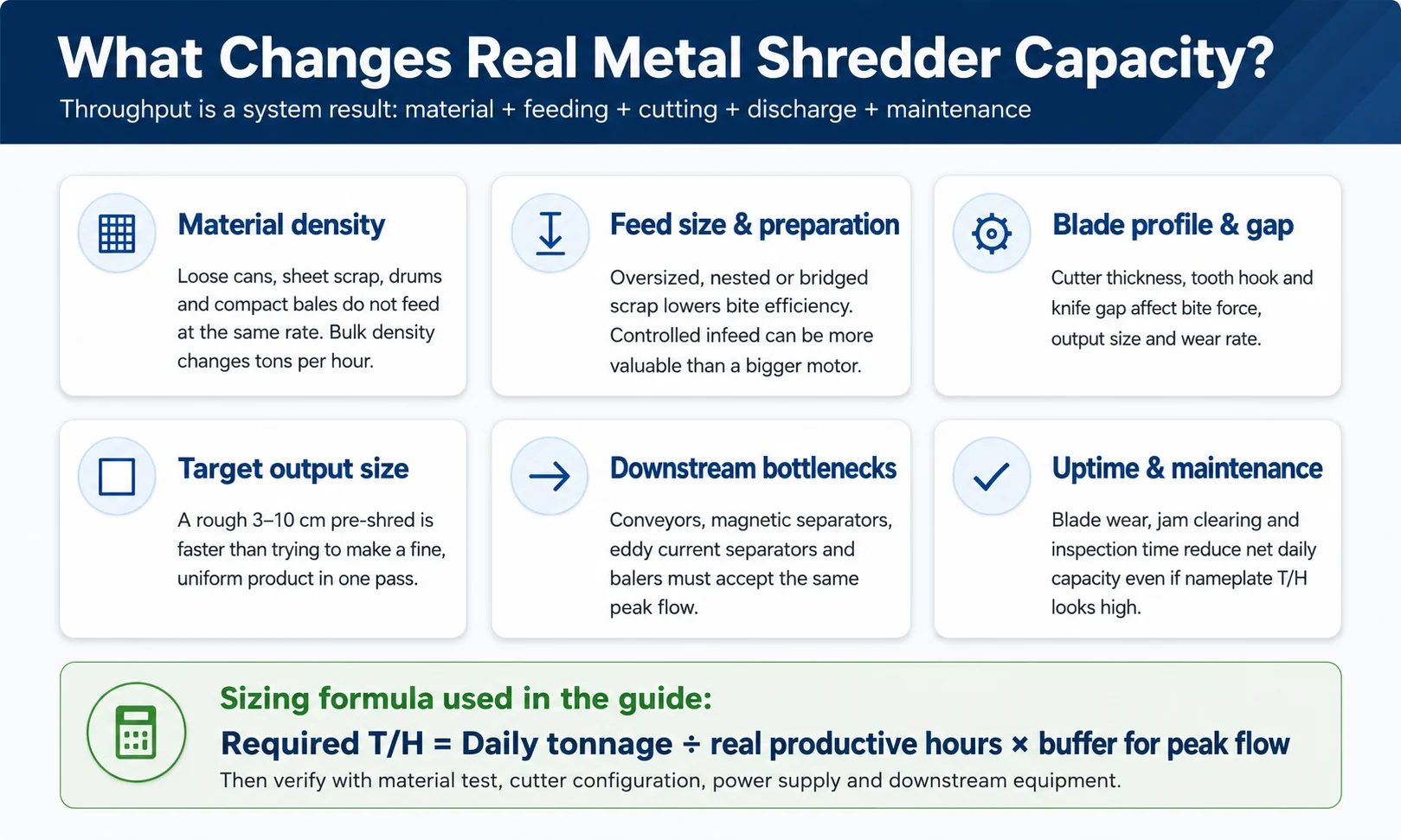
1. Bulk density and material shape
Capacity is weight over time, so dense material can appear to give a higher T/H than light, bulky material. But density is not always helpful. A compact bale or nested drum may be heavy, yet it may also resist the first bite and create shock load. Loose cans or thin sheet metal may feed easily but occupy a lot of hopper volume. The heavy-duty metal shredder applications guide shows why different scrap streams require different cutter profiles and feeding arrangements.
2. Feed opening, hopper design and feeding rhythm
A bigger hopper helps bulky waste enter the machine, but a bigger hopper does not automatically mean higher capacity. If a loader drops large batches unevenly, the shafts may alternate between overload and empty running. A conveyor or controlled grab feeding often gives a better net output because the shredder receives a steadier load.
3. Cutter thickness, tooth profile and output size
For double shaft shredders, output size is usually rougher than a screen-controlled single shaft machine. YUXI’s published product-size range for the double shaft series is 3–10 cm. Within that range, cutter thickness and tooth geometry affect both the bite and the discharge. A coarser pre-shred is normally faster; a smaller or more uniform product usually requires more cutting work, more wear and sometimes secondary crushing or screening.
4. Contamination and non-shreddable objects
Paint, dirt, stones, thick castings, long wire, explosive containers, batteries and mixed non-metal fractions can all change real output. Some contamination mainly increases blade wear; some creates safety risks; some causes repeated auto-reverse cycles. For capacity planning, every minute spent clearing jams is part of the capacity calculation.
5. Downstream bottlenecks
A shredder can discharge 15 tons per hour, but if the discharge conveyor, magnetic separator,vortex separator, screen, baler or receiving box can only process 10 tons per hour. The most useful capacity number is the capacity of the complete recycling line, not only the cutting chamber.
YUXI double shaft shredder capacity table
YUXI’s double shaft shredder is described as a low-speed, high-torque industrial shredder for bulky waste reduction and mixed material recycling, including metal scrap, plastic drums, tires, e-waste, wood pallets and MSW. The product page also explains that it is often used as a primary shredding stage before sorting, separation, RDF production or other downstream recycling processes.
The published model table covers small to heavy-duty projects. Use the table below as a planning reference, not as a guaranteed output for every material. Final capacity should be confirmed through material photos, feed dimensions, sample testing and engineering review.
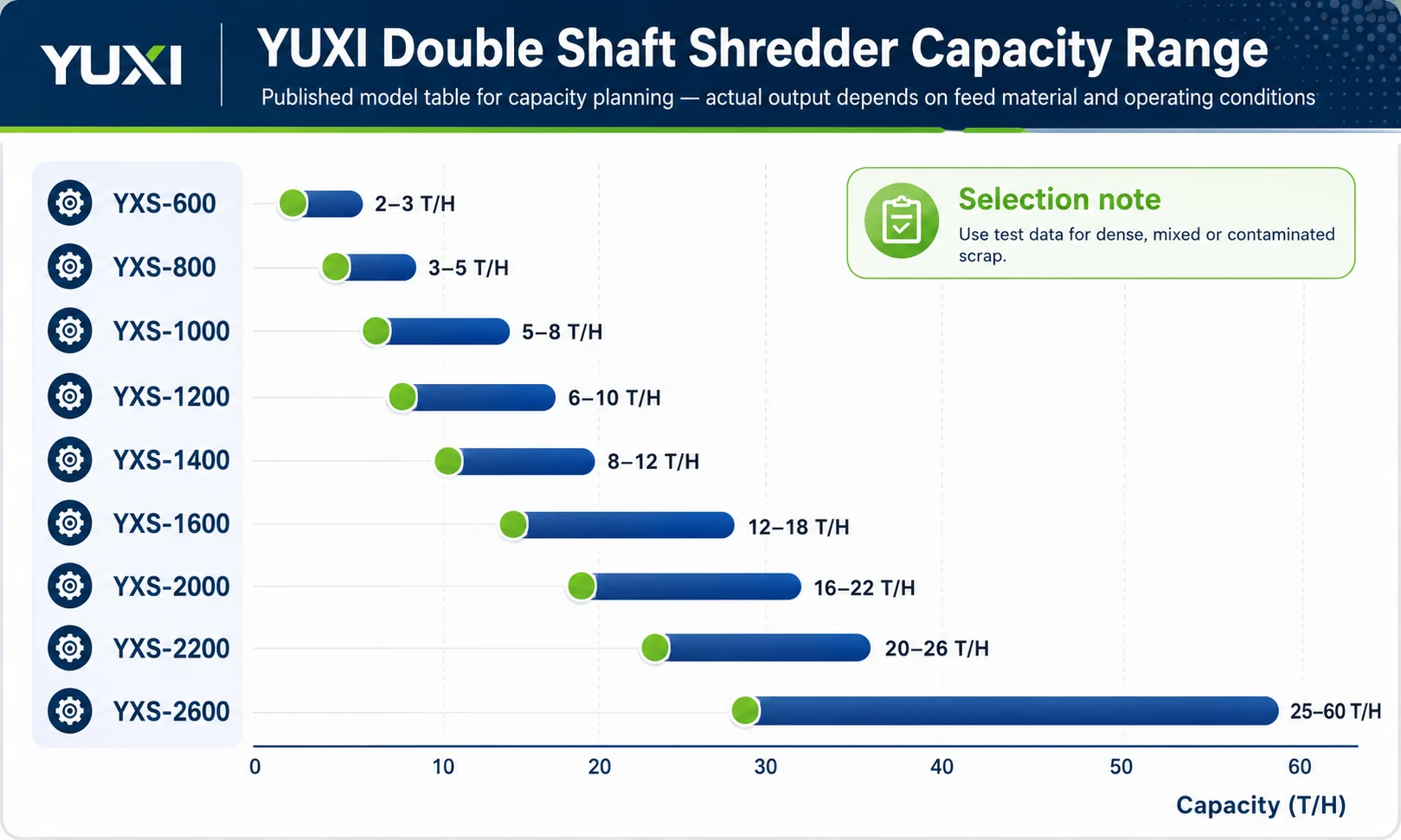
| Model | Power | Published capacity | Product size | Hopper size | Weight | Typical selection note |
|---|---|---|---|---|---|---|
| YXS-600 | 15×2 kW | 2–3 T/H | 3–10 cm | 0.82×0.9 m | 2.5 T | Small-volume light scrap, containers, cans or trial projects. |
| YXS-800 | 22×2 kW | 3–5 T/H | 3–10 cm | 0.9×1.0 m | 3.6 T | Entry-level commercial line where daily tonnage is modest. |
| YXS-1000 | 37×2 kW | 5–8 T/H | 3–10 cm | 1.2×1.0 m | 5.7 T | Small to mid-size scrap yard or mixed light metal preparation. |
| YXS-1200 | 45×2 kW | 6–10 T/H | 3–10 cm | 1.4×1.0 m | 9.5 T | Useful when the buyer needs around one truckload-scale daily processing. |
| YXS-1400 | 55×2 kW | 8–12 T/H | 3–10 cm | 2.0×2.0 m | 18 T | Mid-range bulky scrap, drums, profiles and mixed recycling feed. |
| YXS-1600 | 75×2 kW | 12–18 T/H | 3–10 cm | 2.3×2.0 m | 24 T | Good shortlist for projects needing steady double-digit T/H. |
| YXS-2000 | 90×2 kW | 16–22 T/H | 3–10 cm | 2.3×2.0 m | 35 T | Higher-throughput metal preparation before separation or baling. |
| YXS-2200 | 132×2 kW | 20–26 T/H | 3–10 cm | 2.5×1.8 m | 62 T | Large industrial feed with stronger power and heavier machine frame. |
| YXS-2600 | 160×2 kW | 25–60 T/H | 3–10 cm | 3.2×2.0 m | 85 T | Heavy-duty capacity range; material testing is especially important because the range is broad. |
How to calculate required metal shredder capacity
Use this simple workflow before comparing models:
Step 1: Convert daily target into base T/H
Base T/H = daily tonnage ÷ real productive shredding hours.
If a factory receives 80 tons a day and the operates for 8 hours, it should not be automatically divided by 8. After loading, checking, changing shift , cleaning and a brief stop, the real efficient shredding time may be close to 6.5 hours.
80 tons ÷ 6.5 hours = 12.3 T/H base requirement.
Step 2: Add a peak-flow and material-variation buffer
Real feeding is not perfectly even. Trucks arrive in batches, operators load differently, and material lots vary. For planning, many buyers shortlist a model above the exact base requirement rather than selecting a machine whose upper range is barely enough. In the 80-ton/day example, a practical shortlist may be around 15–16 T/H after buffer, depending on feed conditions.
Step 3: Check the material against the model range
If the feed is mostly light sheet metal, cans or drums and the target is rough pre-shredding, a model in the YXS-1600 range may be worth evaluating. If the material includes denser mixed scrap, compact bales, long profiles, high contamination or a high uptime requirement, the safer engineering conversation may move toward YXS-2000 or a customized configuration.
Step 4: Confirm the downstream equipment
Do not size the shredder alone. Check conveyor belt width and speed, magnetic separator capacity, eddy current separator feed rate, dust collection, receiving bin volume, baler cycle time and floor layout. A large shredder feeding a narrow discharge conveyor is a common reason that nameplate capacity fails to become real line capacity.
Metal shredder capacity selection matrix
| Feed stream | Common capacity issue | What to check before model selection | Likely YUXI shortlist logic |
|---|---|---|---|
| Paint buckets, cans, thin drums | Bulky but relatively light; may bounce or nest. | Hopper opening, cutter hook, anti-bridging feeding, discharge conveyor. | Small to mid models if daily tonnage is moderate; larger hopper if bulk volume is high. |
| Light steel scrap and sheet metal | Variable thickness and sharp edges increase shock load. | Blade material, shaft strength, overload protection, pre-sorting of heavy pieces. | Model based on peak T/H and maximum thickness, not average tonnage only. |
| Aluminum profiles and UBC scrap | Loose profiles can bridge; bales can resist first bite. | Feed preparation, cutter tooth profile, bale density, downstream eddy current separation. | Test both loose and compacted samples if both will be processed. |
| Mixed industrial scrap | Composition changes from batch to batch. | Contamination, non-shreddables, operator sorting, easy chamber access. | Select with wider capacity margin and stronger protection logic. |
| Metal-plastic composites or e-waste | Material liberation matters more than only T/H. | Target size for separation, dust/fire risk, battery exclusion, downstream screening. | Capacity must be matched to safe sorting and separation speed. |
Capacity is decided by the whole recycling line
YUXI positions the double shaft shredder as a primary shredding stage that can connect with sorting, separation, RDF production or downstream recycling processes. The steel scrap shredding process guide explains how primary size reduction connects with magnetic separation, eddy current separation, screening, crushing and baling.
When the shredder is too small
The line waits for material. Operators overload the hopper to catch up, jams increase, cutters wear faster, and downstream equipment runs below its potential.
When the shredder is too large
Capital cost, installed power, floor space and wear-part cost rise. If the plant cannot feed it steadily, cost per ton may be worse than a correctly sized model.
A better rule is to size the shredder for the real operating window of the plant. If the facility receives 40 tons every two days, it may not need the same machine as a facility that must clear 40 tons before lunch. Capacity planning should include truck arrival pattern, storage space, labor shifts, power availability and maintenance schedule.
Buyer checklist: information to send before requesting capacity advice
A supplier can give a more realistic capacity recommendation when the inquiry includes real material details. Before requesting a YUXI quotation, prepare the following:
- Material name and main composition: steel, aluminum, mixed metal, metal-plastic composite, drum, can, sheet, profile or bale.
- Photos or videos of the actual feed material, including the largest pieces.
- Maximum feed size and typical feed size.
- Loose material or compressed bale? If baled, give bale dimensions and approximate weight.
- Required daily tonnage and expected working hours per day.
- Target output size and the next downstream machine.
- Feeding method: manual, loader, grab, conveyor or hydraulic pusher.
- Power supply, plant layout, discharge direction and available floor space.
- Known contaminants or banned items, such as stones, batteries, sealed containers or thick castings.
Safety and maintenance affect net capacity
Capacity discussions often focus on T/H, but net daily output also depends on safe access and maintenance discipline. Industrial shredders include rotating shafts, clamping points, heavy tools and high storage energy. Guards, interlocks, emergency stops and locking/marking procedures are separate from productivity; they reduce unplanned incidents and help maintain in a controlled manner.
For a metal shredder production line, the maintenance plan should include tool inspection, tool gap inspection, gearbox lubrication, bearing temperature monitoring, conveyor inspection, hydraulic inspection (if applicable), electrical cabinet cleaning and overload event review. The more abrasive or contaminated the scrap stream is, the more important it is to treat maintenance time as part of the capacity model.
Practical recommendation
Do not ask only “Which model has 10 T/H?” Ask “Which model can deliver my daily tonnage with my actual scrap, feeding method, output size and downstream equipment?” For a YUXI double shaft shredder quote, send material photos, daily tonnage, largest feed size, target output size and line layout. That gives the engineering team enough context to shortlist the correct model and blade configuration.
FAQ: Metal shredder capacity
What capacity metal shredder do I need?
Start with daily tonnage and real productive hours. Then adjust the feed size, material density, target output size, pollution and downstream capacity. The factory that needs 80 tons per day in 6.5 hours of production needs at least about 12.3 T/H before adding a utility buffer.
Is motor power enough to compare capacity?
No. The motor power is only a part of the selection.The cuttting chamber,blade thickness,tooth shape,gearbox torque,shaft design,feeding method and discharge system will all affect the actual output.
Why does the same shredder have a capacity range instead of a number?
Because material behavior changes. The feedinhg or cutting methods of bulk cans,metal barrels,steel plate,aluminum envelopes and mixed scraps are different.The capacity range reflects different materials and operating conditions.
Should I choose the model with highest capacity I can afford?
Not always. Oversizing can increase capital cost, power use, floor space and wear-part expense. The better choice is the model that matches your real material flow with enough reserve capacity for peak feeding and future growth.
Can the double-shaft shredder produce the final product size at one time?
It can produce rough debris output, but usually double-shaft shredder is chosen to reduce the main size. If the project needs tighter product size control, add screening, secondary crushing or choose a different shredder configuration.
References and source notes
- Franklin Miller: How to Choose an Industrial Shredder For Your Business. Used for industry guidance on capacity, bulk density, chamber size and avoiding poor sizing.
- Gradeall: Industrial Shredding Machines: A Complete Guide. Used for general guidance on matching throughput to actual material volumes and downstream integration.
- OSHA: 29 CFR 1910.212 General Requirements for All Machines. Used for machine guarding and point-of-operation safety context.
- OSHA: 29 CFR 1910.147 management of dangerous energy sources while machines undergo service. Used for lockout/tagout maintenance context.
- U.S. EPA: Basic knowledge and benifits of recycling.. Used for the context of recycling and waste-management hierarchy.
- Bureau of International Recycling: Ferrous Metals. Used for steel recycling and ferrous metal recycling benefit context.