




 Request Quote



A car body shredder is usually the first heavy machine buyers notice in an ELV recycling line. But the shredder itself is only one part of the decision. The more important question is whether the whole process—depollution, primary shredding, secondary crushing, magnetic separation, eddy-current separation and central control—matches the actual material you receive.
Contents
What Is a Car Body Shredder?
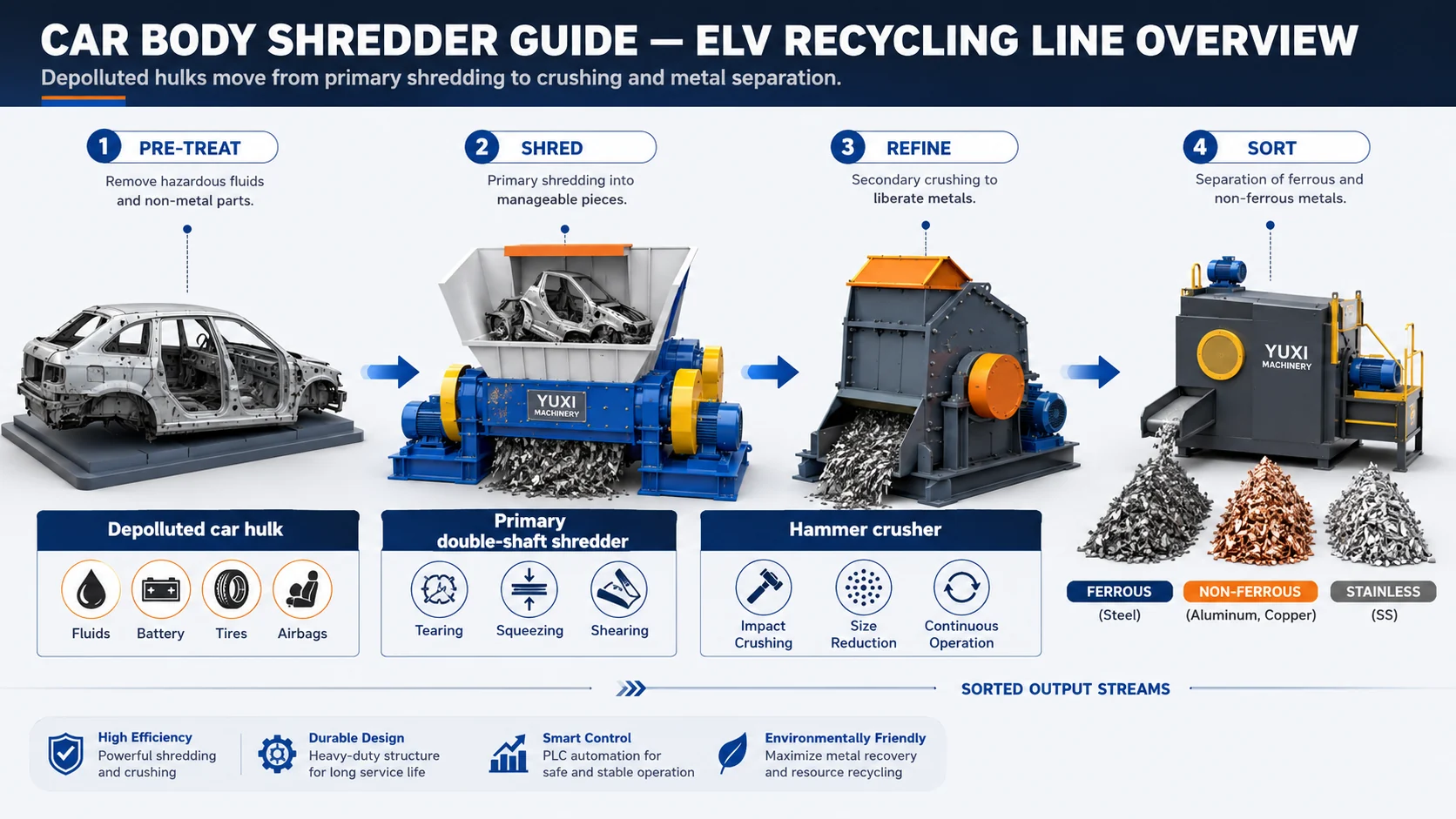
A car body shredder is a heavy-duty metal recycling machine used to reduce end-of-life vehicle hulks, car shells, body panels and mixed automotive metal parts into smaller pieces for transportation, secondary crushing and separation. On YUXI’s waste car recycling line, the car body processing concept is not limited to shredding; it is designed to crush and separate mixed materials such as scrap iron, aluminum and engine casings from car casings.
In practical yard language, the primary shredder solves three problems at once: it reduces volume, opens closed or folded sections of metal, and creates a material size that downstream equipment can handle more consistently. It should not be treated as a substitute for depollution, dismantling or separation.
Field note: A recycler who receives only stripped car shells has a different equipment problem from a recycler who receives shells mixed with bumpers, engine casings, wheels, oil filters, motorcycles and bicycles. YUXI lists these mixed applications for its waste car recycling line, so the line should be discussed as a system rather than a single shredder purchase.
Before the Shredder: Depollution and Hulk Preparation
One of the biggest mistakes in car body shredding is sending vehicles to the machine before they are ready. The U.S. EPA describes discarded vehicle processing as a sequence that includes accepting and storing vehicles, removing hazardous materials, dismantling usable or recyclable parts, storing hulks, managing hazardous fluids and finally crushing or shredding vehicle hulks.
For shredder buyers, this matters because the machine is designed for size reduction, not for solving uncontrolled fuel, refrigerant, battery, mercury switch or free-liquid risks. The EPA guide advises removing the battery, refrigerants and fuels first, then removing fluids such as antifreeze, brake fluid, engine oil, transmission fluid, power steering fluid and other vehicle fluids before crushing or shredding.
Good feed to discuss
Depolluted car shells, flattened hulks, car body panels, bumpers, carriage boards, motorcycle frames, bikes, wheels and compatible mixed metal parts.
Feed to control carefully
Sealed tanks, batteries, refrigerants, free liquids, pressurized components, oversized unbreakables and unknown hazardous items should be removed or managed before shredding.
Recommended YUXI Waste Car Recycling Line Process
YUXI’s waste car recycling line uses a staged process: a hydraulic-driven heavy double-shaft shredder for primary car shell shredding, a hammer-type metal crusher for deeper crushing into granules, magnetic separation for iron metals, eddy-current separation for copper, aluminum and other non-ferrous metals, and a central control system based on Siemens PLC for whole-line monitoring and operation.
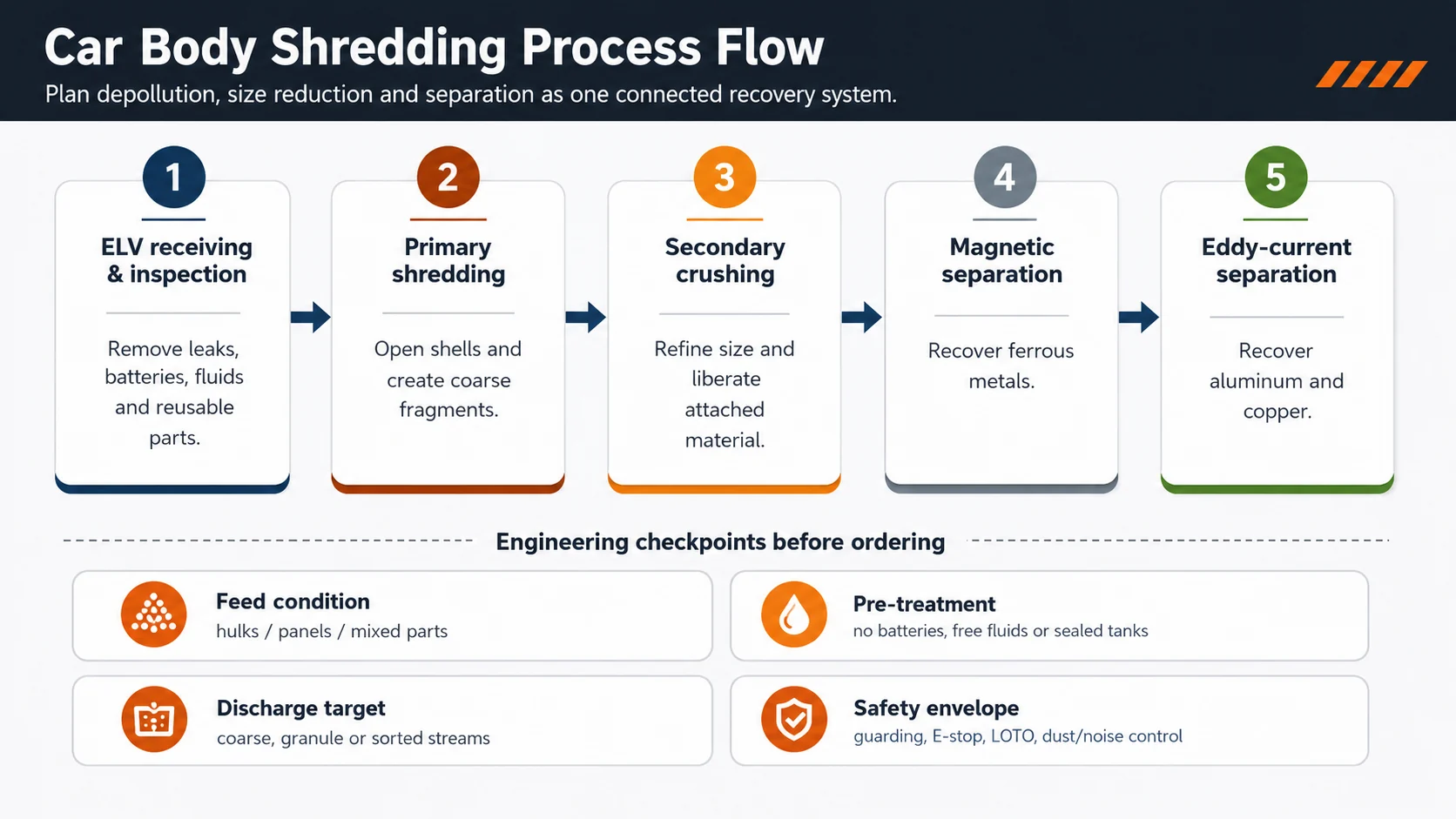
- Primary double-shaft shredding. The first machine grips the car shell and tears it into coarse fragments. YUXI describes this heavy two-shaft shredder as low speed, high twisting force and low noise, with automatic start, stop, reversal and overload response through Siemens program control.
- Secondary hammer crushing. After primary reduction, the hammer-type metal crusher refines the material to meet the target output size and improve liberation before sorting. YUXI describes the crusher as practical, easy to operate, convenient to maintain and suitable for higher bulk-density abrasive grit output.
- Magnetic separation. Powerful rollers separate ferrous metals. This is usually the first recovery gate after crushing because iron and steel represent the main mass stream from vehicle bodies.
- Eddy-current separation. Eddy-current separation helps recover non-ferrous metals such as aluminum and copper from the broken mixed flow. In a vehicle line, this is where value can be lost if the feed size, moisture and liberation are not suitable.
- Central control. A unified control system reduces the need to operate each machine like an isolated island. For a line that includes conveyors, crushers and separators, real-time monitoring is as important as the shredder’s motor power.
How the Primary Car Body Shredder Works
YUXI’s metal shredder page explains the basic working principle clearly: material enters the shredding box through the feeding system; the box carries shredding blades; the material is reduced by tearing, squeezing and shearing, then discharged from the lower part of the box. For car bodies, this action is useful because thin-gauge panels are irregular, springy and difficult to feed into a high-speed crusher directly.
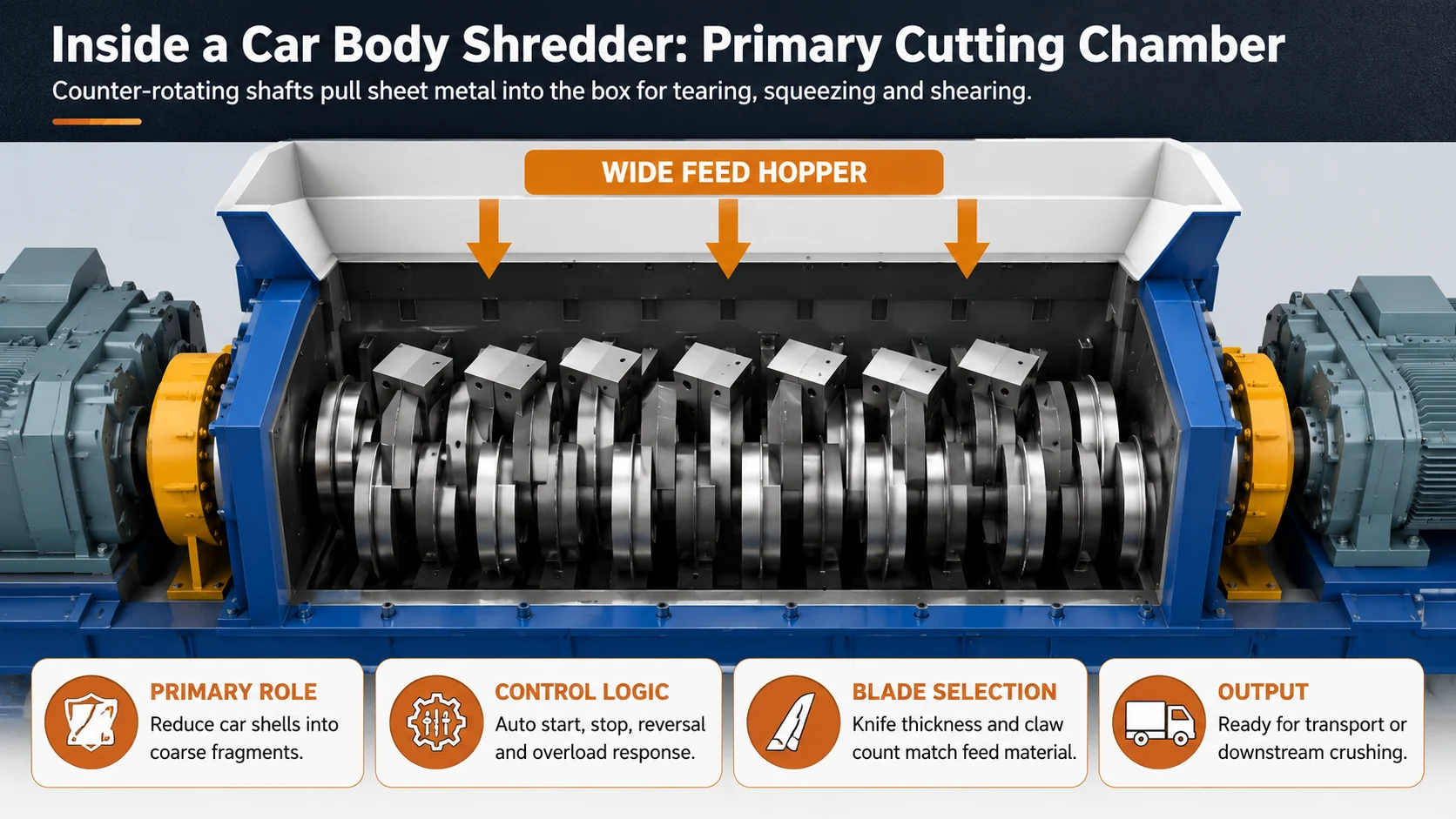
The double-shaft design is usually preferred for the first stage because it gives strong bite at lower speed. Instead of relying on impact alone, the opposing shafts pull material down and apply torque. This is why the same buyer conversation should cover feed opening, shaft torque, cutter thickness, number of claws, hydraulic drive arrangement, overload reversal and maintenance access.
YUXI states that its moving knife material uses special alloy tool steel forging blanks, precision machining, multiple heat treatments and low-temperature freezing heat treatment. It also lists knife thickness options including 15 mm, 20 mm, 40 mm, 50 mm, 75 mm and 100 mm, with thickness and claw count replaceable according to different materials. For a car body application, that means blade configuration should be discussed around actual feed material—not copied from another recycling plant with a different scrap mix.
How to Choose the Right Car Body Shredder Configuration
A good car body shredder specification starts with the recovered-material target. For broader planning, see the industrial metal shredder machine guide and the steel scrap shredding process guide. If the goal is only to reduce stripped shells for transport, a primary shredder may be enough. If the goal is to produce cleaner ferrous and non-ferrous streams, the line needs secondary crushing and separation. If the goal is to meet stricter ELV recovery expectations, depollution workflow and residue control become part of the equipment decision.
| Decision point | What to confirm | Why it matters |
|---|---|---|
| Feed material | Whole hulks, flattened cars, body shells, bumpers, engine casings, wheels, motorcycles, bikes and mixed parts. | The cutter configuration and downstream crusher must match the toughest recurring feed, not the easiest sample. |
| Pre-treatment level | Battery removal, fluid drainage, refrigerant recovery, fuel removal and removal of reusable or hazardous parts. | Undrained vehicles create fire, contamination and equipment-risk issues that the shredder should not be expected to solve. |
| Target output | Coarse fragment, refined granule, ferrous product, aluminum/copper stream or full sorted output. | The output target determines whether an independent shredder or an integrated recycling line is more suitable. |
| Separation route | Magnetic separation for ferrous metals; eddy-current separation for non-ferrous metals; air or gravity sorting when non-metallic fractions must also be controlled. | Recovered-metal value often depends more on liberation and separation than on the shredder alone. |
| Control and protection | Automatic start/stop/reverse, overload response, emergency stop, interlock protection and real-time line monitoring. | Car bodies vary widely; the line must recover from overloads and foreign objects without constant manual intervention. |
| Maintenance access | Cutter replacement method, chamber access, foreign object discharge, lubrication points and spare blade plan. | Downtime cost can exceed the price difference between a basic machine and a maintainable system. |
Safety and Compliance Checkpoints for Car Body Shredding
Car body shredding combines heavy material handling, mobile machinery, sharp metal, potential pollutants and high-energy equipment. OSHA notes that scrap recycling can expose workers to metals, batteries, waste oil and chemicals, along with hazards such as traffic, moving machine parts, unexpected startup, trips and falls.
Machine guarding deserves special attention. OSHA states that moving machine parts can cause severe injuries and that any machine part, function or process that may cause injury must be safeguarded. OSHA’s general machine guarding standard also requires methods of guarding to protect operators and nearby employees from hazards such as point of operation, ingoing nip points, rotating parts, flying chips and sparks.
Guarding
Protect feed and discharge areas, rotating parts, hydraulic drives, belts and access points. Guards should not create new hazards or be easy to bypass.
Energy control
Use lockout/tagout procedures during jam clearing, chamber inspection, blade service and conveyor maintenance. Never clear jams while energy remains uncontrolled.
Fire and contamination
Keep fuel, free liquid, batteries and refrigerants out of the shredder feed. Prepare spill kits, drainage control and hot-work rules for the yard.
Why Recovery Targets Change the Equipment Conversation
Recovery of end-of-life vehicles is not just a disposal task. In the EU reporting framework, ELV targets include at least 95% reuse and recovery and at least 85% reuse and recycling by average vehicle weight. Even if buyers are outside the EU, these goals are useful because they reflect where the industry is heading: more recycling, cleaner fractions and fewer residues.
This is one reason a line that only shreds may underperform compared with a line that also crushes, liberates and separates. The plan may lose revenue and create avoidable disposal pressure if aluminum, copper and mixed non-ferrous metals remain trapped in ferrous output or shredder residue.
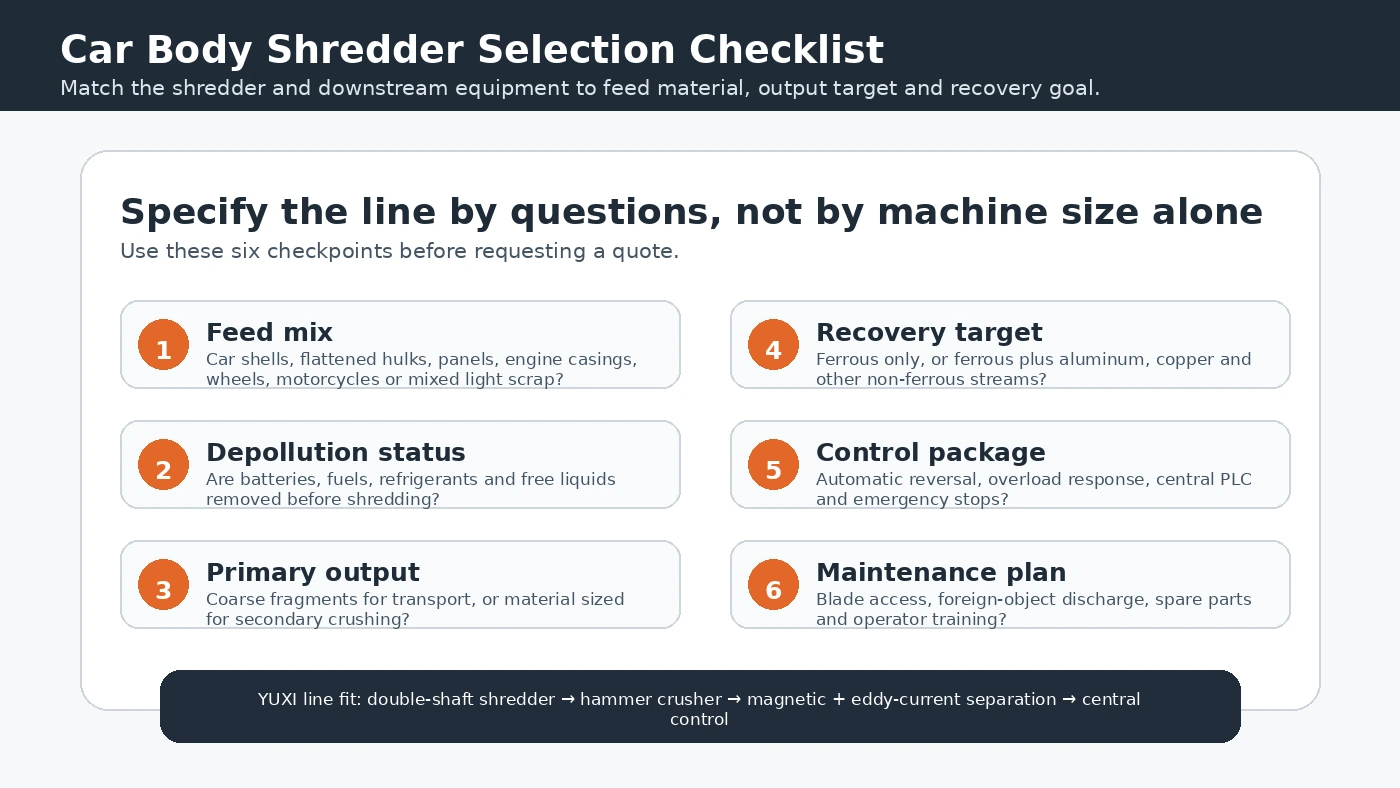
Buyer Checklist: Questions to Ask Before Requesting a Quotation
Material questions
What percentage of incoming feed is full car body, flattened hulk, loose body panel, engine casing, wheel, motorcycle, bike or mixed light scrap? Are vehicles fully depolluted before arrival?
Output questions
Do you need coarse shredded scrap, secondary crushed material, ferrous product, non-ferrous product or a more complete sorted stream?
Operation questions
How many operators are available? Is the line expected to run as a semi-automatic or centrally controlled system? What maintenance skill is available on site?
Site questions
What are the limits for noise, dust, power supply, foundation, crane or grabber feeding, truck circulation, fire prevention and residue storage?
When sending an inquiry to YUXI, the most useful information is not only the desired capacity. Include photos or descriptions of the feed material, depollution status, largest expected item size, target discharge size, desired metal streams and any local environmental or safety requirements. That gives the engineering team a much better basis for selecting the shredder, hammer crusher, separators, conveyor layout and control package.
Where YUXI Fits This Application
YUXI positions its waste car recycling line for scrapped vehicles and waste metal parts, including car shells, bumpers, engine parts, carriage boards, oil filters, motors, wheels, motorcycles and bikes. The equipment combination on the page—heavy double-shaft primary shredder, hammer-type metal crusher, magnetic separator, eddy-current separator and Siemens PLC central control—fits buyers who need a line approach rather than a standalone machine.
For lighter scrap metals beyond car shells, YUXI’s metal shredder page also lists refrigerators, metal drums, waste color steel tiles, scrap steel and steel furniture as applications, and describes automatic reverse protection when overload or foreign objects enter the cutting unit. This is relevant for recyclers whose yards receive mixed light scrap together with vehicle bodies.
Planning a Car Body Recycling Line?
Prepare a material list, feed photos, required output size and desired separation targets before requesting a quotation. A car body shredder is easiest to specify when the whole recycling route is clear: what enters, what must be removed, what gets shredded, what gets crushed, and what metal streams must leave the line.
Contact YUXI for a waste car recycling line configuration based on your car shell material, plant layout and recovery target.
FAQ: Car Body Shredder Guide
Can a car body shredder process a whole vehicle?
It depends on how the vehicle has been prepared and on the machine configuration. In professional ELV recycling, batteries, fluids, refrigerants, fuel, reusable parts and hazardous materials should be removed before crushing or shredding. A depolluted hulk or car shell is a more appropriate feed description than an untreated whole vehicle.
For car bodies, is a double-shaft shredder better than a hammer crusher?
They serve different stages. A double-shaft shredder is commonly used for primary shredding because it grips bulky car shells with low-speed, high-torque cutting. When smaller output and better material liberation are required, a hammer crusher is more suitable after primary size reduction.
Why should magnetic and eddy-current be added after shredding?
Magnetic separation recovers ferrous metals, while eddy-current separation helps recover non-ferrous metals. Without these stages, valuable material may remain in shredder residue or lower-quality output.
What information should I provide before buying a car body shredder?
Provide material photos, feed dimensions, depollution status, material mix, desired output size, required metal streams, available power, site layout, operating hours, maintenance conditions and local safety or environmental requirements.
Does YUXI offer a complete car body recycling line?
YUXI’s waste car recycling line page presents a complete process that includes a double-shaft crusher, scrap hammer type metal crusher, magnetic separator, eddy-current separation and central control system for scrapped vehicles and waste metal parts.