



 Request Quote


Quick answer: choose around the scrap you cut every day
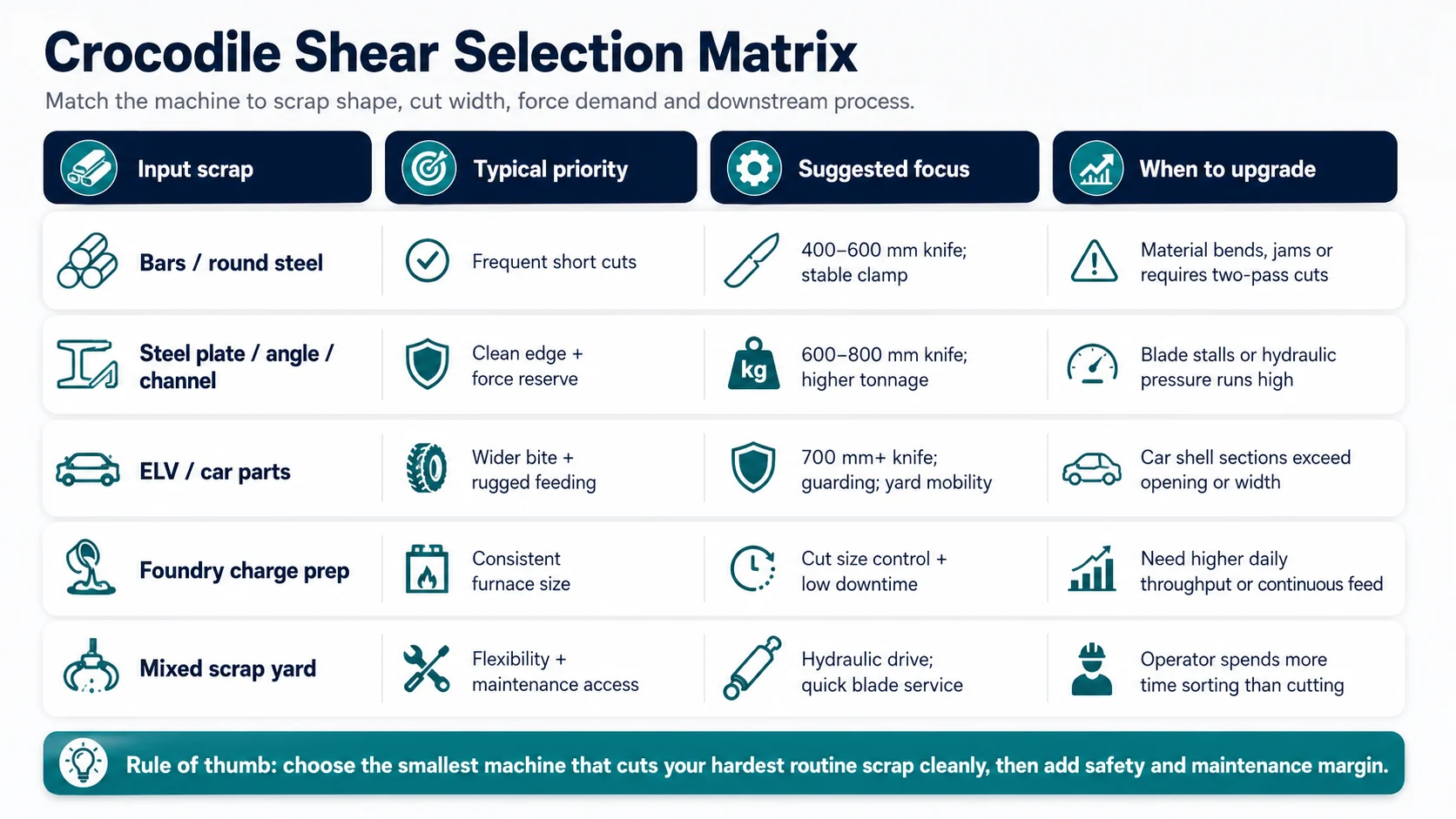
The correct crocodile shearing machine can cleanly,safely and repeatedly cold cut your daily waste without for forcing the operator to struggle with the material.Start with the hardest daily material,and then determine the size of the machine according to the blade length,shear force,clamp opening,hydraulic drive,power supply,protection and downstream processing.
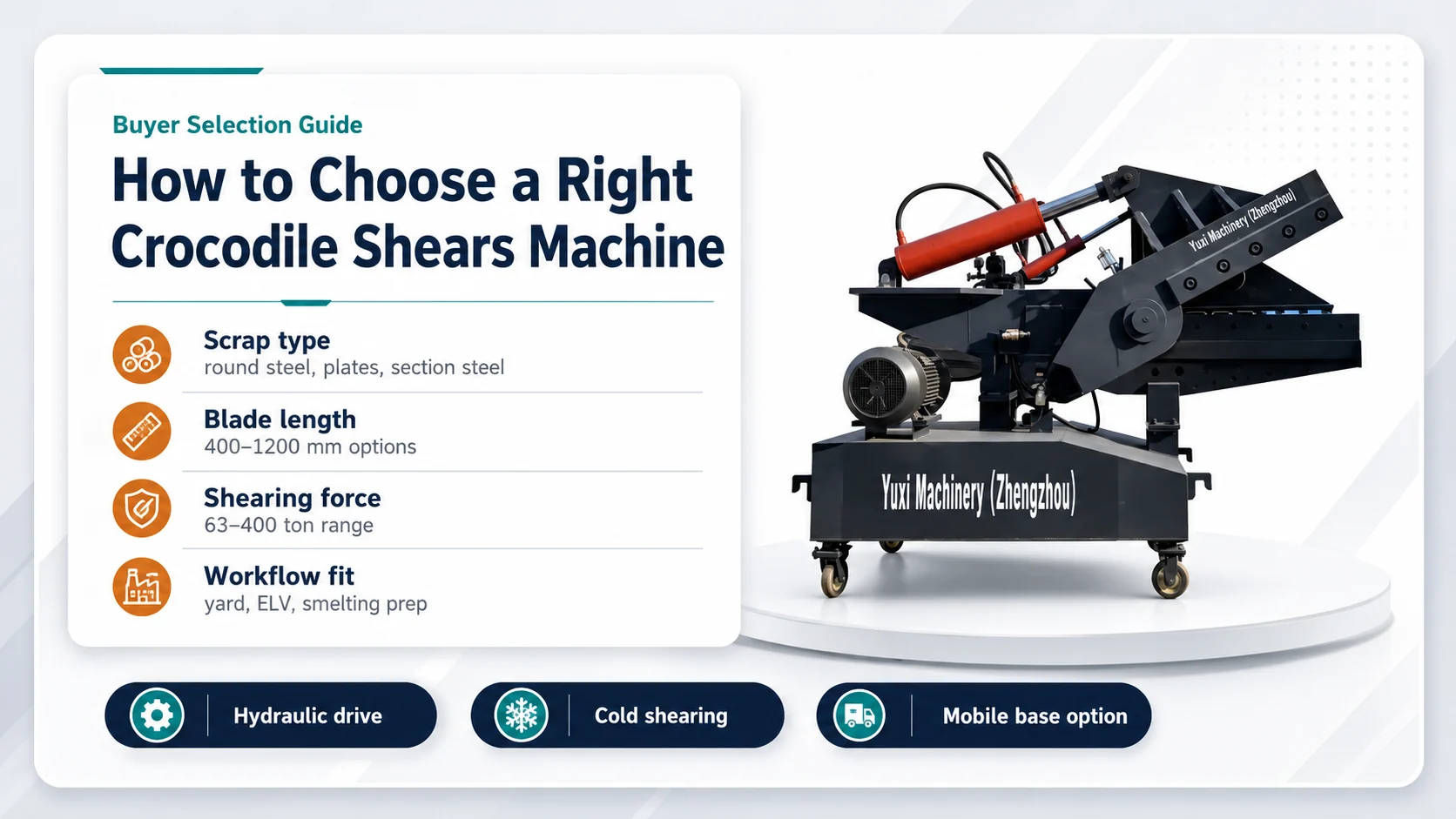
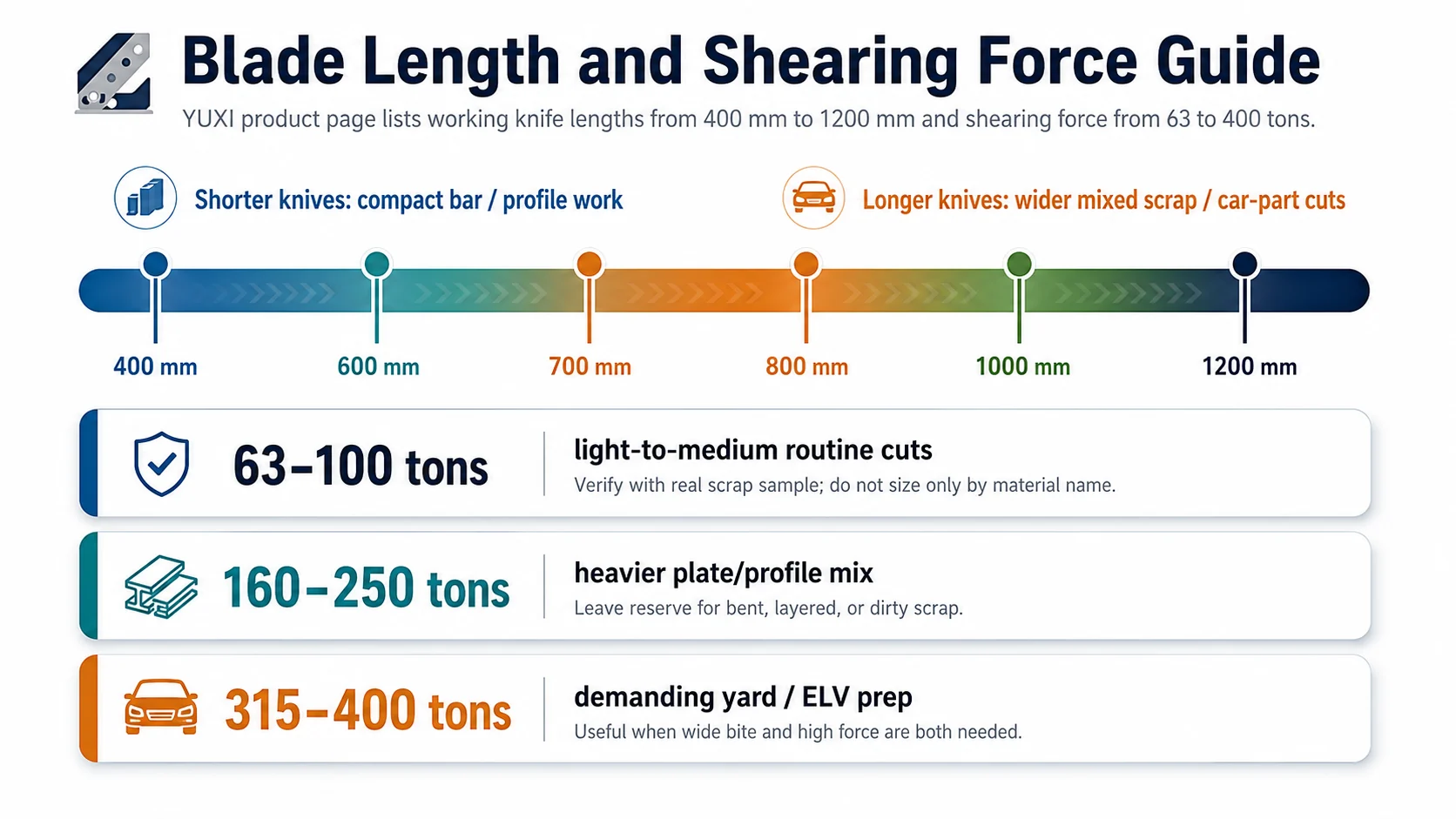
YUXI describes its Crocodile Shears Machine as a hydraulic-driven metal shearing machine used for fast cutting of various metal scraps. The public product page lists the lengths of working knives as 400, 600, 700, 800, 1000, and 1200 mm, and the shear force is from 63 tons to 400 tons. It also points out that cutting edges of 700 mm or above are particularly suitable for cutting scrapped cars.
What is a crocodile shears machine?
A crocodile shear, also called an alligator shear, is a metal cutting machine with a jaw-like cutting head. In recycling yards, it is usually used to cut scrap bar, round steel, steel plate, section steel, pipe, small structural pieces, and dismantled metal parts into shorter sections for sorting, charging, transport, or further processing.
The useful point is not only “it cuts metal.” It cuts irregular waste without requiring each piece to be completely straight, flat or clamped like the szheet shearing in the manufacturing workshop. That is why it appears in scrap recycling stations, steel mills, smelters, casting preparation areas and vehicle demolition sites.
Buyer mindset: do not regard crocodile shear as a catalogue p. Treat it as a small production cell. The machine, operator position, feeding method, material staging, blade service, and discharge area all decide whether it saves labor or becomes a bottleneck.
Seven factors that decide the right machine
1. Identify the material family before asking for a price
“Scrap metal” is too broad for sizing.Cutting short round steel in the yard requires a different operating feeling from cutting flat car panels, angle iron, channel steel, mixed removal and external cutting or casting back to the yard. Make a brief list of your five daily materials and pay attention to the maximum thickness, width, shape, and whether the work is oiled,bent,layered or contaminated.
For ELV dismantling, crocodile shears are often used before or beside larger crushing and separation systems. YUXI’s Waste Car Recycling Line page describes processing scrapped vehicles and waste metal parts, including car shells, bumpers, engines, wheels, motorcycles, and bikes. A crocodile shear is not the whole ELV line, but it can be useful for cutting parts down before feeding, sorting, baling, or transporting.
2. Choose blade length by the actual bite you need
Blade length affects how much material the jaw can take in one cut. A short knife can be efficient for bar, rod, and compact profiles. A longer knife becomes useful when scrap is wide, irregular, or difficult to position. But longer is not automatically better; it can increase footprint, power demand, and purchase cost.
YUXI’s public data gives a practical range from 400 mm to 1200 mm. For many buyers, the key turning point is whether the daily scrap is mostly compact profiles or wider mixed pieces. If scrapped car sections are part of the routine, the YUXI product note that 700 mm or longer cutting edges are especially suitable for scrapped cars is a helpful starting reference, but final selection should still be confirmed with sample cuts.
3. Size shearing force with reserve, not hope
Shearing force is where under-buying hurts most. If the machine barely cuts during a clean test, it may struggle with bent, dirty, layered, or higher-strength scrap. A proper force reserve protects the hydraulic system, reduces operator frustration, and helps blades last longer.
The YUXI page lists an available shearing-force range from 63 tons to 400 tons across eight grades. In an RFQ, do not simply ask for “100 ton” or “250 ton.” Send photos, dimensions, material types, and a short video of how the scrap arrives at your yard. A supplier can then recommend a machine around real cutting resistance rather than a guessed category.
4. Check hydraulic system, not only the cutting head
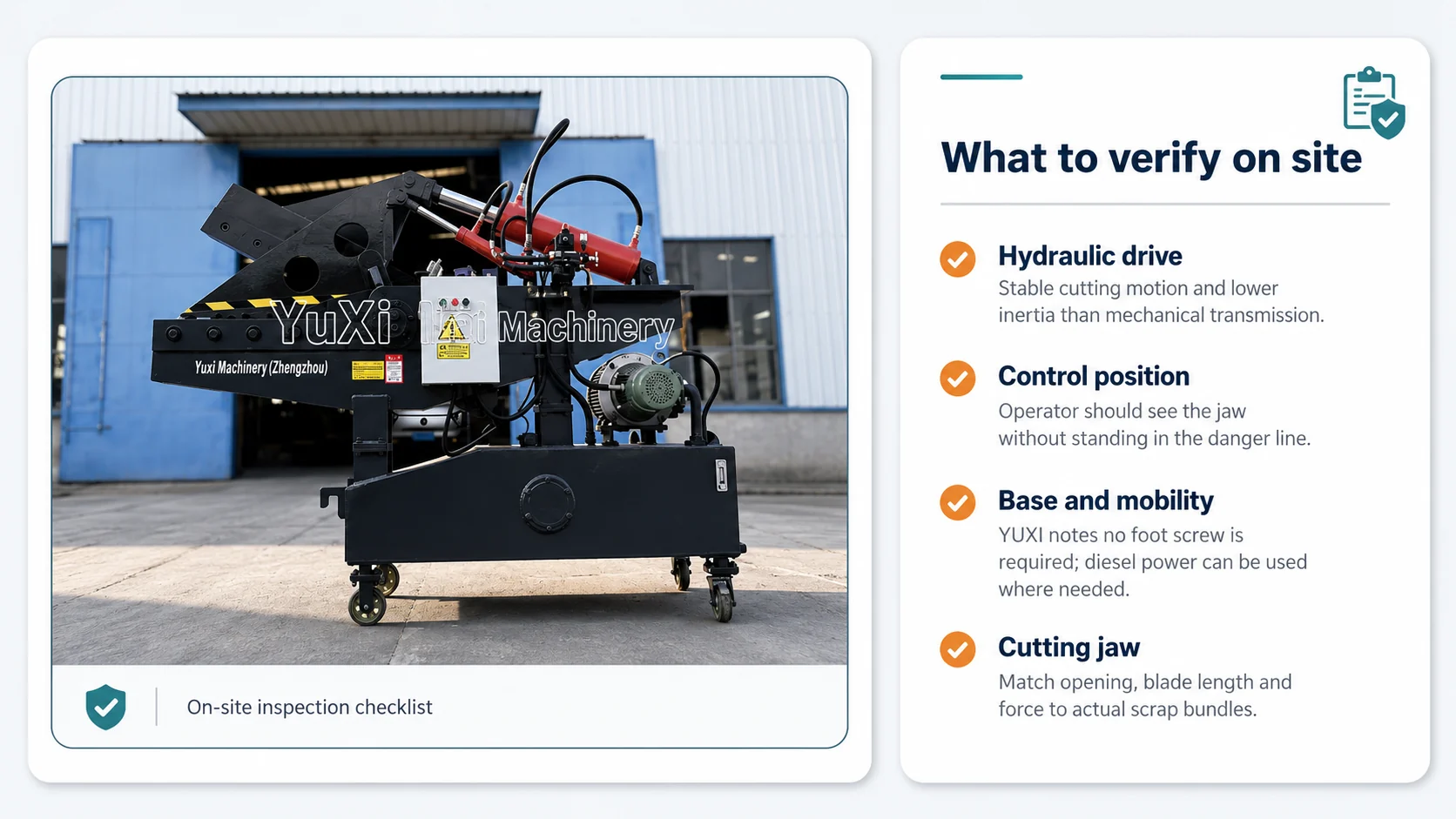
Hydraulic drive is a major reason crocodile shears are popular in recycling yards. YUXI notes advantages such as easier operation and maintenance, smaller volume, lower weight, low inertia, lower noise, stable movement, flexible operation, large shear section, and convenient scissors adjustment compared with mechanical transmission shearing equipment.
Purchase, check or request detailed information about hydraulic pumps, motors, cylinders, hoses, valve blocks, fuel tank channels, cooling arrangements, pressure gauge positions and routine filter replacements. An easy-to-repair shearing machine is more valuable than a machine that only looks sturdy in the product photo.
5. Match installation and power source to the yard
Some yards have stable three-phase electrical supply and a fixed cutting area. Others need a machine that can be moved around a scrap yard, seasonal dismantling site, or temporary processing area. YUXI states that the crocodile shear does not need foot-screw installation and can use a diesel engine as the power source. That can matter when foundation work or reliable power access is difficult.
6. Look at the downstream process
Crocodile shears usually sit in a larger handling flow. After cutting, scrap may go to manual sorting, magnetic separation, furnace charge bins, containers, or baling. If the goal is to reduce transport cost after cutting, a Metal Baling Machine may be paired downstream to compress cut scrap steel, aluminum, or other metal waste into denser blocks.
If the material is not only shortened,but also needs to be continuously reduced in size, released and separated,then shearing may not be enough. For large-capacity mixed light waste, such as car shells, refrigerators and metal barrels, Metal Shredders are usually more suitable core machines. The choice between shears,balers and shredders depends on whether your main job is cutting,compacting or reducing and separating mixed materials.
7. Ask for a real operating video
The catalogue can list the force and blade length, but the short test video shows the feeding behavior,clamp stability, operator position, cutting speed, hydraulic smoothness, and whether the material kicks, slides or needs to be repositioned repeatedly. For serious buying, please ask for videos of scraps similar to yours, not just clean bar inventory.
Blade length and shearing force: a practical sizing table
| Buyer situation | Common material | What to prioritize | Risk if undersized |
|---|---|---|---|
| Small scrap station | Round steel, rebar, small profiles, short offcuts | Compact footprint, easy operation, suitable blade length, quick maintenance | Frequent repositioning and slower cutting |
| Medium recycling yard | Plate, angle steel, channel steel, mixed demolition scrap | Higher force reserve, stable hydraulic system, blade service access | Blade damage, stalled cuts, operator fatigue |
| ELV dismantling support | Vehicle parts, body sections, brackets, mixed metal structures | Longer cutting edge, wider jaw handling, guarding and material support | Scrap does not fit the jaw; unsafe manual handling |
| Smelting or foundry preparation | Charge material needing shorter, more consistent sizes | Cut-size consistency, reliability, duty cycle, spare blades | Irregular charge size and avoidable downtime |
| Remote or temporary site | Collected scrap needing on-site cutting before transport | Power-source flexibility, mobile base, simple setup | Installation delay or dependence on unavailable power |
The safest sizing method is sample-based. Put your common materials into three groups: easy daily scrap, hard daily scrap, and occasional maximum scrap. The machine should cut the hard daily group comfortably. For occasional maximum pieces, decide whether you want the shear to handle them directly or whether those pieces should be torch-cut, pre-sorted, or sent to another machine.
Do not oversell the machine in your own head. The crocodile shears are very strong, but it is still a cutting machine with a blade, pliers, hydraulic system and operator. Materials that are too wide, too thick, too hard, spring-loaded, sealed, pressurized or contaminated should be handled through a clear safety process,rather than forcibly entering the lower jaw.
Safety and maintenance should be part of the buying decision
OSHA’s metal scrap recycling guidance specifically discusses alligator and guillotine shears, noting that employees must remain at a safe distance from the point of operation and that stationary cutting areas should have shields to protect against flying objects. The same OSHA guidance also says shearing equipment should be periodically inspected, maintained in proper working order, and locked out during servicing or maintenance.
That means a buyer should ask practical safety questions before purchase: Where does the operator stand? How is the cutting area guarded? How are flying pieces controlled? Is there an emergency stop? How can the machine lose its destock for blade replacement,blockage removal,lubrication or hydraulic service?
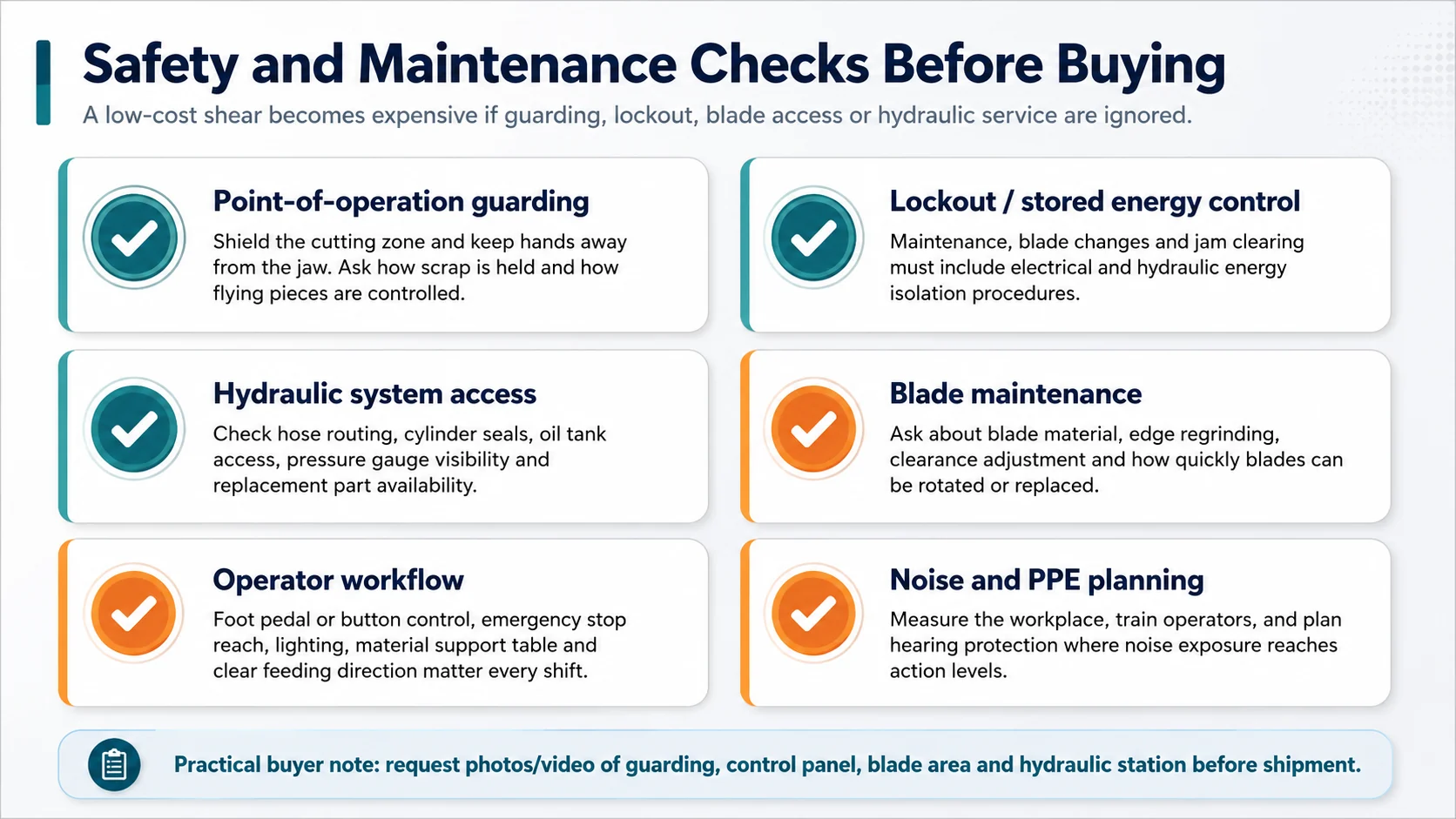
Check the point of operation, moving linkage, hydraulic cylinder area, motor and belt/drive areas, and any exposed pinch points.
For maintenance and unjamming, plan electrical and hydraulic energy isolation, including stored pressure release.
Ask how often blades are rotated, reground, shimmed, or replaced under your material mix.
Scrap cutting can be loud. Measure actual yard exposure and plan hearing protection and operator training.
OSHA’s locking/marking standards cover services and maintenance that may harm employees by accidental power-up,start-up or release of stored energy. Its machine protection standards identify 29 CFR 1910.212 as a general requirement for all machines. OSHA also said that when the noise exposure od employees is equal to or exceeds the 8-hour time-weighted and average of 85 decibes,the general industry needs to carry out hearing production plans.
RFQ checklist: what should send before asking for a quote
- Material photos and videos: show the real scrap, not only the best-looking pieces.
- Maximum dimensions: thickness, width, diameter, length, and whether pieces are layered or bent.
- Daily volume: estimate tons per day, working hours, and peak load periods.
- Target cutting length: explain whether the purpose is container loading, furnace charging, packing, or sorting.
- Construction site conditions: indoor/outdoor, fixed or mobile use, available electricity, floor condition, crane/forklift channel.
- Operator mode: an operator or team, manual feeding or auxiliary feeding, requiring guards and emergency stop layout.
- Maintenance expectations: spare blades, hydraulic seals, hoses, filters, lubrication points, training, and documents.
- Compliance requirements: voltage, language labels/manuals, local security expectations, PPE and LOTO program requirements.
Common buying mistakes
Choosing only by tonnage
High shearing force is very important, but the machine also requires the exact blade length, clamp opening, hydraulic stability, material support,and operator workflow. Stronger machine with the misplaced clamps may still be slow.
Ignoring the scrap that comes once a week
If a difficult scrap category appears regularly, include it in the sizing conversation. If it appears only occasionally, write a separate handling rule so operators do not force unsafe materials into the shear.
Forgetting blade service
Blades are not an afterthought. Ask about spare sets, regrinding, replacement time, clearance adjustment, bolt access, and training. Downtime often starts at the blade area.
Buying a machine but not a work cell
Where to wait for the planned uncut scrap,how to list it,where the operator stands,where the cut debris falls,how to remobe the finished product,and how to isolate the machine for repair.Well-arranged small shear can be better than poor.
Final recommendation
To choose the right crocodile shears machine, begin with the material, not the machine. Confirm the hardest routine scrap, match blade length to the required bite, add shearing-force reserve, verify hydraulic service access, and treat guarding and lockout as part of the specification. YUXI’s hydraulic crocodile shear range gives buyers useful reference points—400–1200 mm working knife lengths, 63–400 tons shearing force, hydraulic transmission, no foot-screw installation requirement, and diesel power option—but the final model should be selected from your real scrap samples and production workflow.
Need help matching a crocodile shear to your scrap?
Send YUXI your scrap photos, dimensions, daily tonnage, power conditions, and target cut length. Inquire about the recommended blade length,shear force,hydraulic configuration,productive layout,spare parts list,and test cutting videos using similar materials.
FAQ
What size crocodile shears machine should I choose?
Choose based on your hardest routine scrap. Start with material shape and size, then confirm blade length, shearing force, jaw opening, hydraulic configuration, operator method, and maintenance access.
Is a 700 mm blade enough for car scrap?
YUXI pointed out that cutting edges of 700 mm or more are suitable for cutting scrapped cars. In practice, the right choice still depends on the exact car parts, thickness, width, and the type of materials.
Can a crocodile shear replace a metal shredder?
Usually no. A crocodile shear cuts scrap into shorter pieces. A shredder is better for continuous size reduction and material liberation. Some yards use both, with shearing for preparation and shredding for high-volume reduction.
What safety items should be checked before purchase?
Check point-of-operation guarding, flying-object shields, emergency stop access, operator position, lockout/tagout procedure, hydraulic stored-energy control, blade-change process, and workplace noise exposure planning.
References and source notes
- OSHA 3348: Guidance for the Identification and Control of Safety and Health Hazards in Metal Scrap Recycling. Used for scrap recycling hazards, alligator shear safety, guarding, inspection, maintenance and lockout/tagout context.
- OSHA: Machine Guarding. Used for general machine-guarding reference and related standards.
- OSHA: Control of Hazardous Energy. Used for maintenance and hazardous-energy control context.
- OSHA: Occupational Noise Exposure. Used for hearing conservation and workplace noise planning.
- World Steel Association: Circular Economy. Used for the broader recycling and steel circularity context.