




 Request Quote



How to Choose a suitable High-Voltage Electrostatic Separator
If the copper cable recycling line has produced clean copper particles,but the plastic outlet still has bright metal spots,the problem is usually not in the crusher.This is the last percentage of separation.This is where the high-voltage electrostatic separator has become useful.
Quick answer
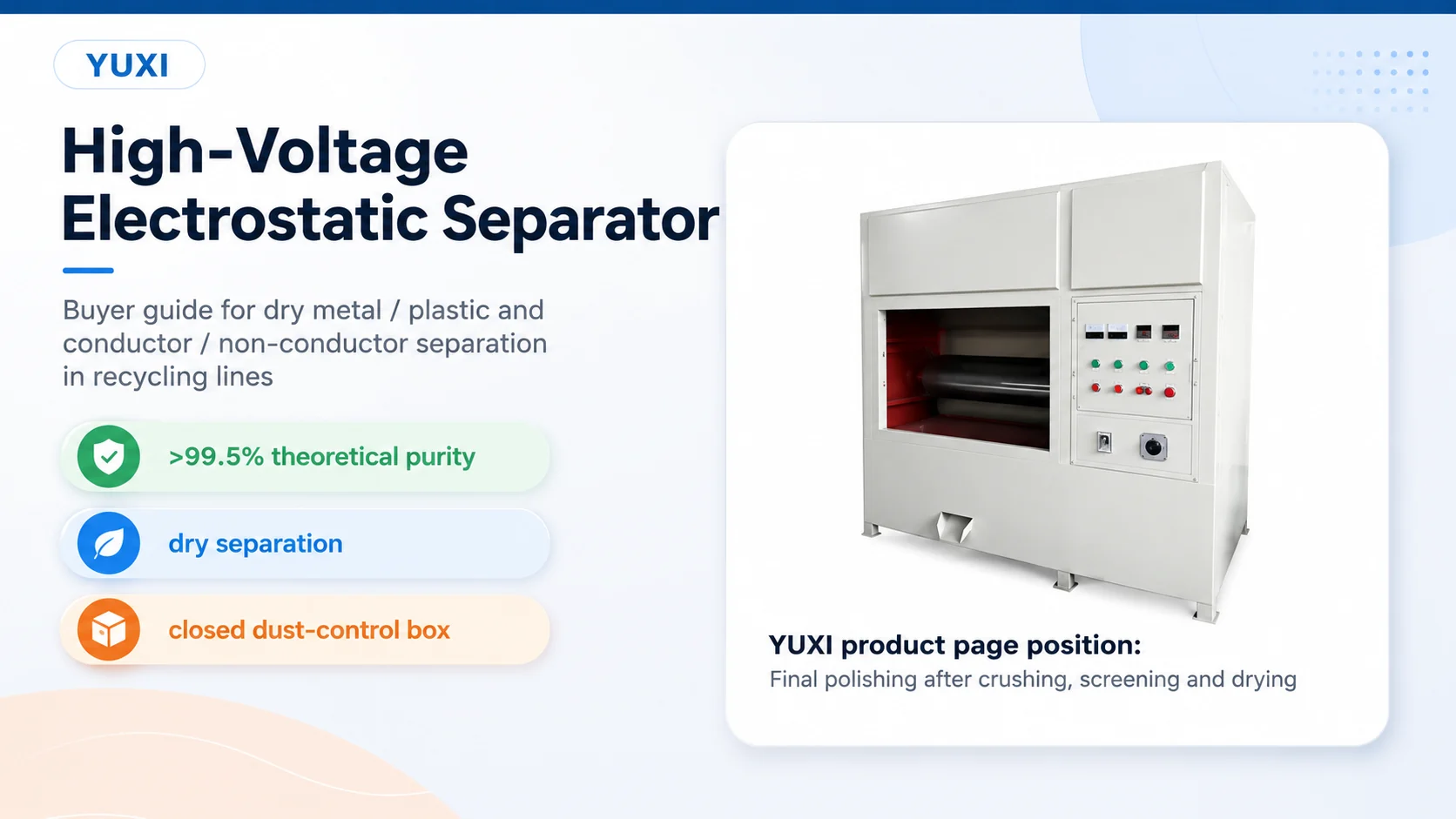
Choose a high-voltage electrostatic separator when your material is already crushed, dry, well-liberated and mostly separated, but you still need a cleaner metal fraction, cleaner plastic fraction, or lower valuable metal loss in the tailings. For copper-plastic, aluminum-plastic, waste circuit board and mineral mixtures, the machine should be evaluated with a real sample test rather than a catalog promise.
What YUXI’s product is designed to do
YUXI describes its high-voltage electrostatic separator as a device that uses ultra-high-voltage electric field to charge and separate materials. Its main targets are conductors such as metals and non-conductors,such as plastics. The product page lists metal/non-metal particles granules,conductor/non-conductor mixtures, aluminum-plastic products, copper-plastic products, waste circuit board products and mineral mixtures as suitable applications.
The same page states that the separation rate can be adjusted according to material characteristics, capacity-versus-purity requirements and particle uniformity, with a theoretical separation rate above 99.5%. It also mentions practical features that matter in plant operation: high-voltage corona and composite electric field technology, no chemical solvent requirement, operating noise of ≤75 dB, automatic voltage regulation, an intelligent drying mechanism, a closed sorting box and negative-pressure dust removal.
How the separation principle affects your buying decision
Electrostatic separation takes advantage of the difference in conductivity.In the drum system,the vibrating feeder conveys the dry released particles to the grounding drum;the high-voltage electrode charges the particles;the conductive particles are quickly discharged and leave the drum,while the non-conductive particles can be connected for a lonfer time and removed separately .
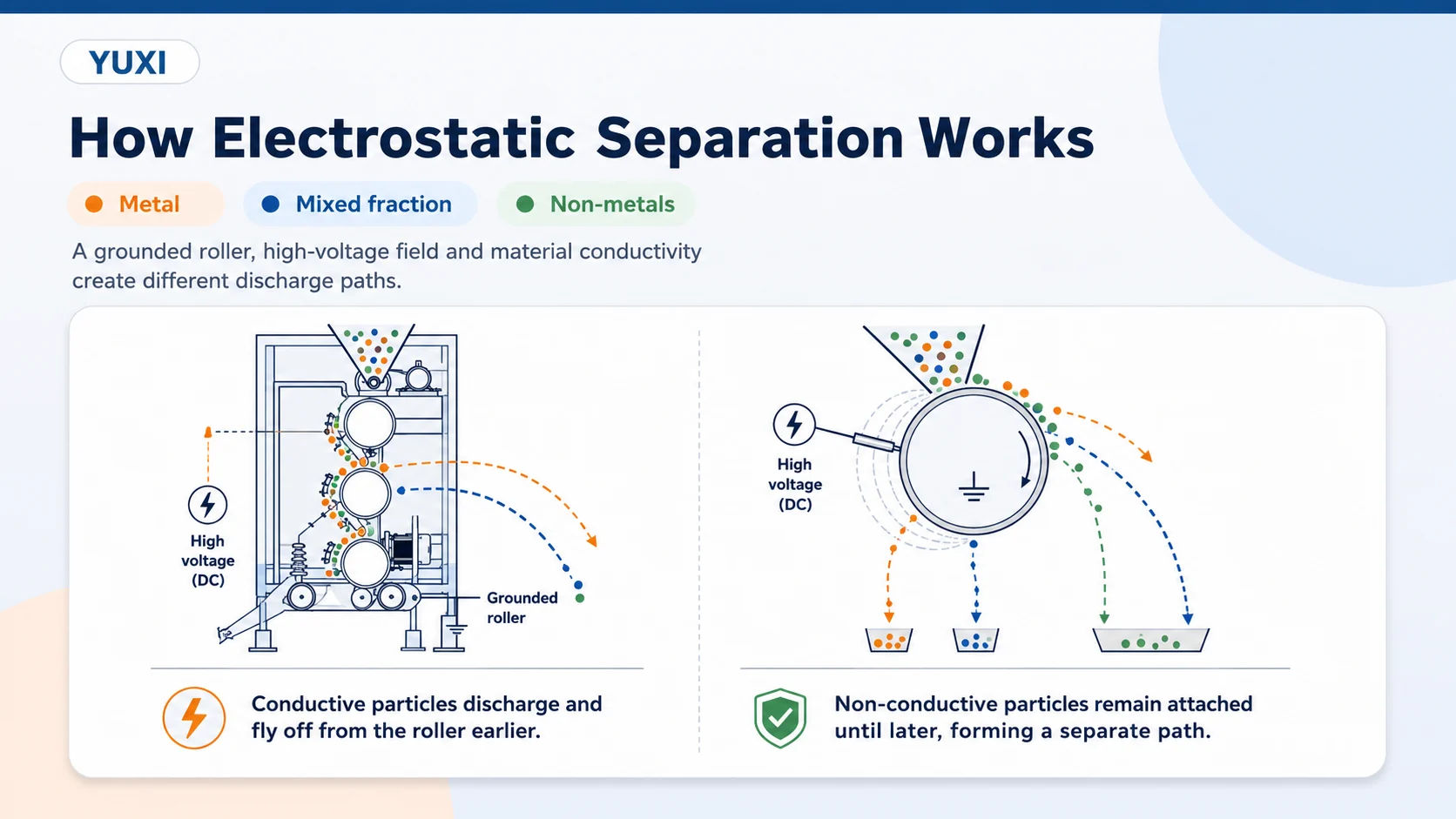
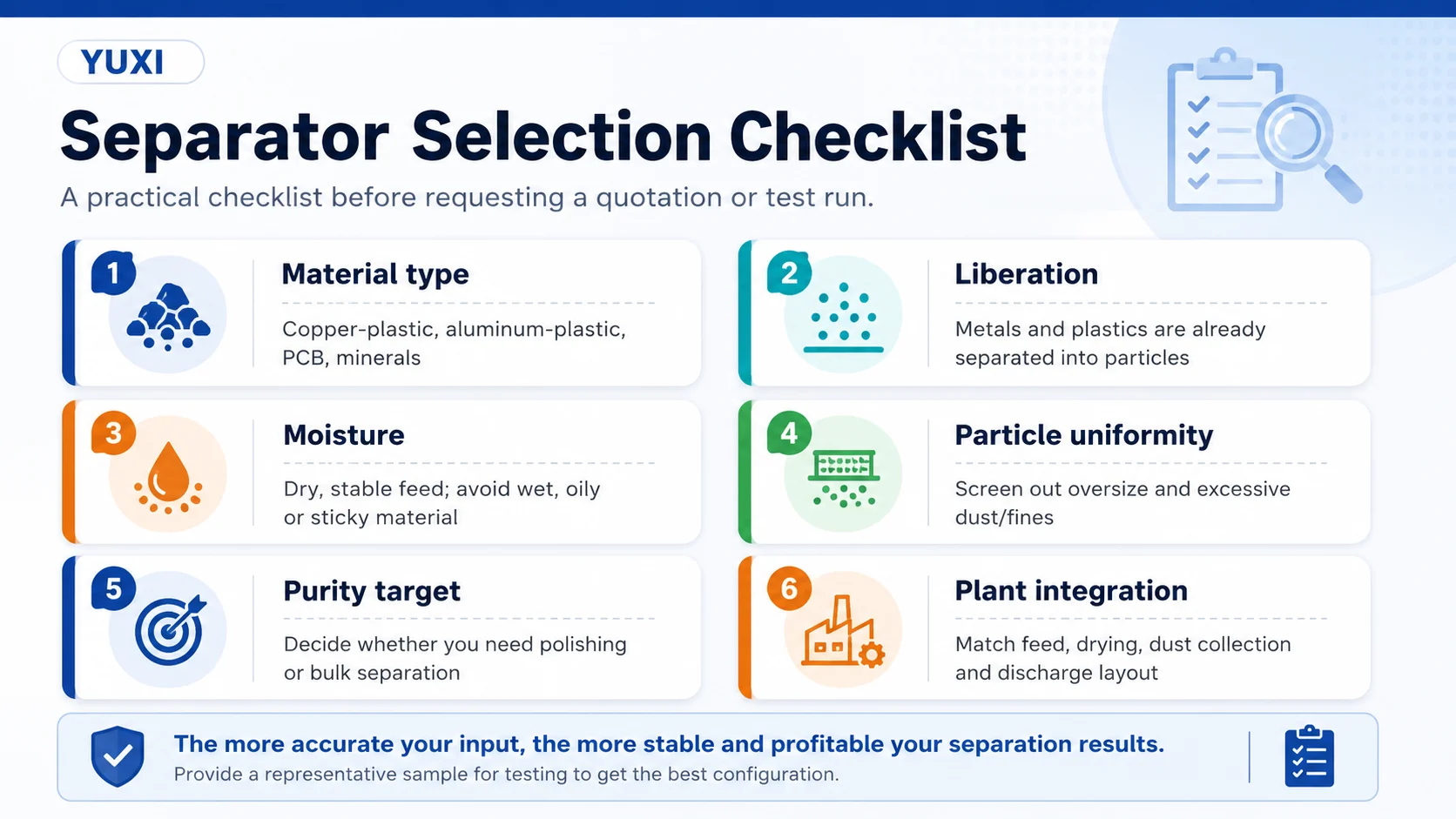
This means that three feed conditions are critical. First, metals and plastics must be physically liberated; a copper particle still wrapped in insulation will not behave like clean copper. Second, moisture must be controlled because damp surfaces reduce charge stability and make fine particles stick together. Third, particle size should be relatively uniform so the separator is not forced to handle dust, fines and oversize pieces in the same pass.
When a high-voltage electrostatic separator is the right choice
Use electrostatic separation when the job is dry polishing of a conductor/non-conductor mixture. Typical examples include residual copper in plastic from cable recycling, aluminum-plastic composites after crushing, PCB fragments after mechanical pretreatment, and mineral streams where conductivity differences are meaningful.
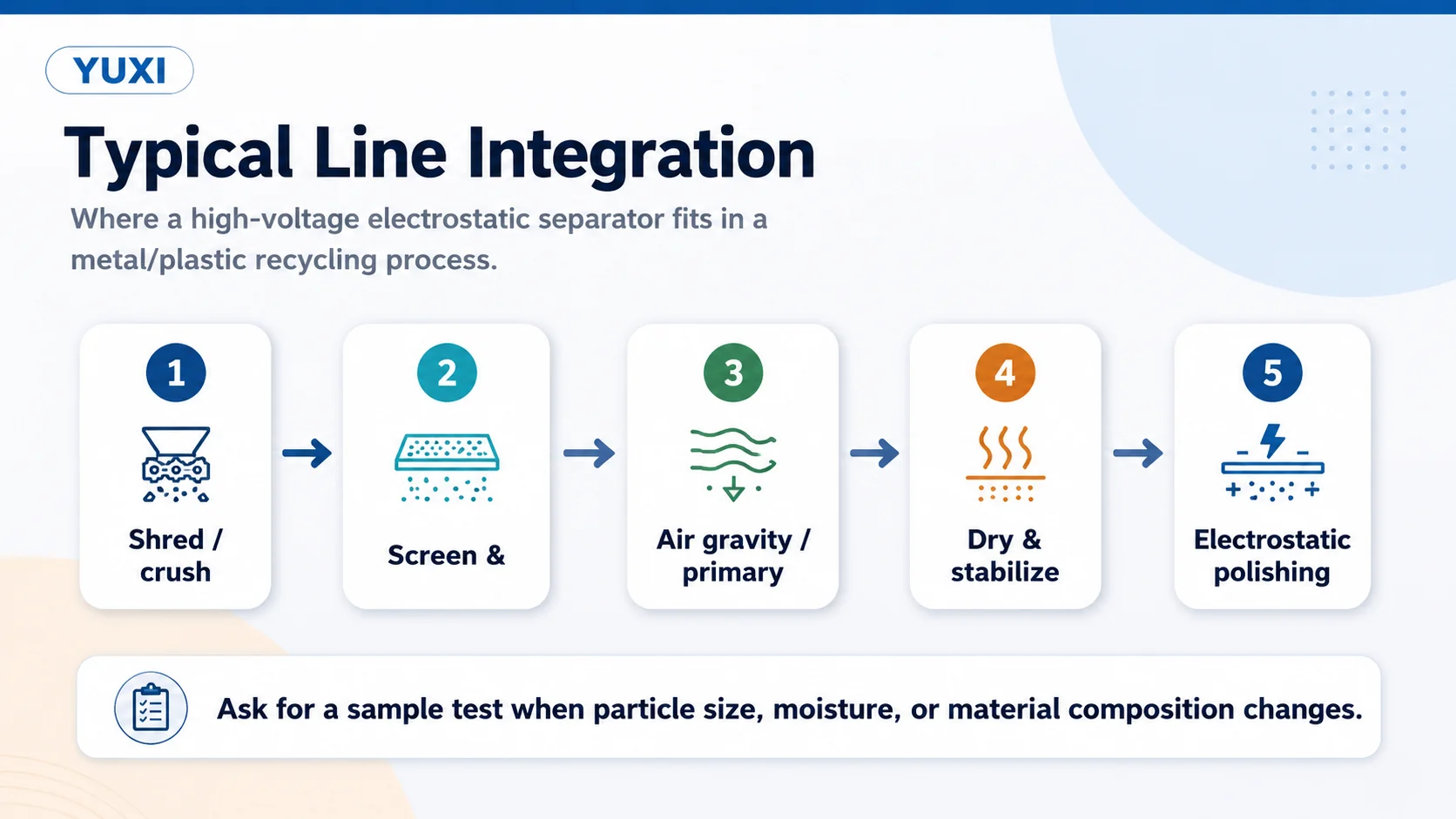
For cable recycling projects, YUXI’s copper wire recycling line already uses crushing, airflow, vibration and dust collection to separate copper from plastic. When the factory wants to recover the remaining metal from the plastic flow or improve the purity of the outlet after the main separation stage,the high-voltage electrostatic separator becomes relevant.
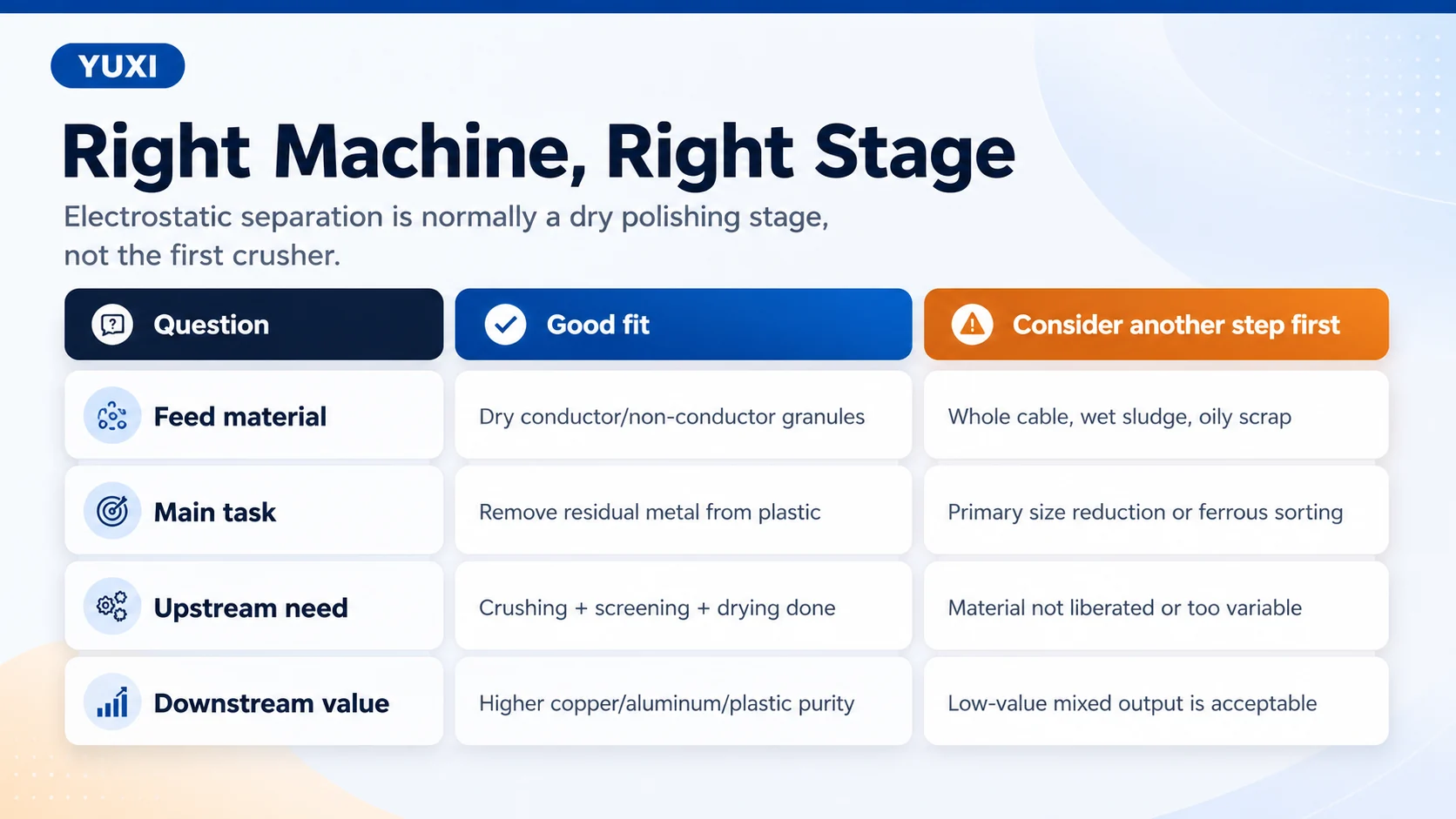
Do not use it as a substitute for a shredder, granulator, magnetic separator or screening system. If the material is still in long cable pieces, wet sludge, oily flakes, whole circuit boards or mixed bulk scrap, the separator will be asked to solve the wrong problem.
Selection factor 1: start with materials, not the machine
Before requesting a quotation, please define the feeding materials in operational terms: composition, upstream process, particle size range, moisture level, metal percentage, pollutants and target export quality.Recyclers who handle copper-plastic particles have different requirements from factories that handle aluminum-plastic packaging or PCB powder.
The best supplier conversation starts with samples. Send representative material from normal operation, not only hand-picked clean material. Include the worst material you expect to run, because that is where capacity, purity and adjustment range will be tested.
Selection factor 2: check liberation and particle size
Electrostatic separation does not produce liberation; it reads the electrical behavior of the released particles. If the copper is still locked in the plastic, no voltage setting can completely correct the upstream crushing problem. If the particle size is too wide, the outlet split becomes less stable because tiny fines and larger flakes behave differently in the electric field and airflow around the roller.
Ask the supplier what particle size range they recommend for your material and whether screening should be installed before the separator. For many recycling lines, a simple screening adjustment upstream can improve separation more than increasing voltage.
Selection factor 3: control moisture and surface condition
Moisture is one of the most common reasons for the poor performance of electrostatic separators in the field. Surface moisture will change the charge behavior, increase adhesion and turn small materials into lumps. YUXI’s page specifically emphasizes intelligent drying and automatic voltage adjustment, which are valuable when the humidity changes between batches or seasons.
The practical question is not only “does the machine have drying?” Ask how the dryer is controlled, whether the drying capacity is in line with your feed rate,how the operator knows whether the feed is stable,and how easy it is to clean up the material accumulation around the drum,brush amd dust collection area.
Selection factor 4: define purity and recovery together
A common buying mistake is to ask only for “highest purity.” In real production, purity, recovery and throughput move together. If the operator tightens the setting to maximize metal purity, some valuable metal may report to the mixed fraction. If the operator pushes for maximum recovery, the metal outlet may carry more plastic.
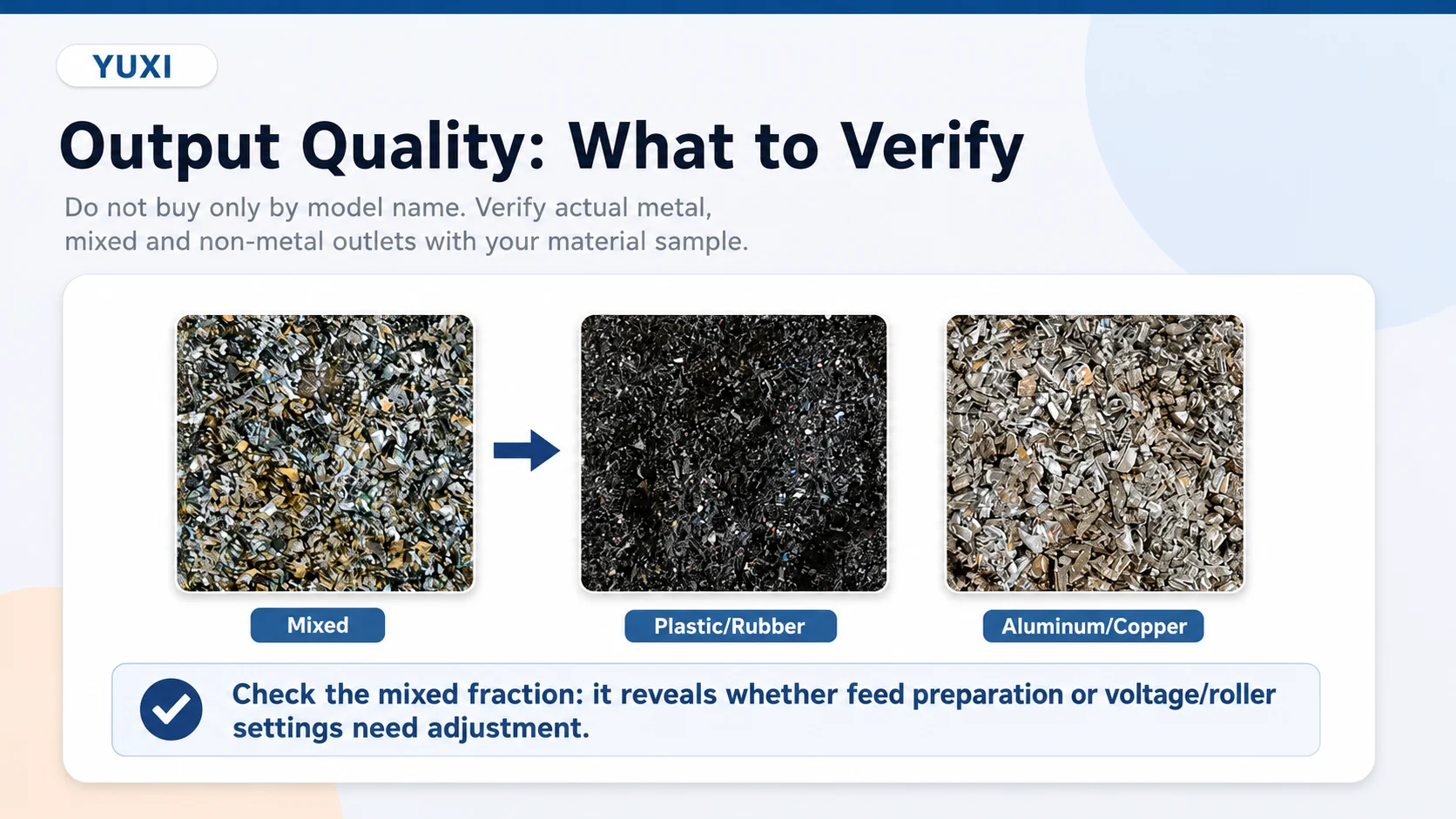
For this reason, acceptance testing should record at least four values: feed rate, metal purity, non-metal purity and mixed fraction percentage. The mixed fraction is not a failure by itself; it is a control signal. A large mixed fraction may mean the feed needs better screening, drying, or a second pass.
Selection factor 5: decide where it fits in the plant
A high-voltage electrostatic separator usually sits after size reduction, air separation or gravity separation, not at the front of the line. If your plant uses density differences first, YUXI’s air flow gravity separator is the logical upstream comparison because it separates copper and plastic by airflow, vibration and specific gravity. Electrostatic separation then becomes a finishing stage for materials that remain too similar in size or density but differ in conductivity.
For larger shredder residue or municipal/e-scrap streams containing non-ferrous metals, YUXI’s eddy current separator may be the better primary non-ferrous recovery step before electrostatic polishing. The right choice depends on whether the feed is a bulk non-ferrous stream or a fine dry conductor/non-conductor mixture.
Selection factor 6: review dust, high voltage and maintenance
Because the process handles dry particles, dust control cannot be an afterthought. A closed sorting box and negative-pressure dust removal are helpful because they reduce dust escape around feeding, separation and discharge points. Maintenance access also matters: operators need to clean the roller, brush and electrode area without fighting the cabinet design.
High voltage adds another layer of safety planning. Inquire about interlocks, access control, discharge procedure, grounding, locking/marking point and operator training. Machines that are easy to maintain safely can last longer than machines that are difficult to check.
Electrostatic separator vs. gravity separator vs. eddy current separator
| Equipment | Best role | Typical feed | Main buying question |
|---|---|---|---|
| High-voltage electrostatic separator | Dry polishing of conductor/non-conductor particles | Copper-plastic, aluminum-plastic, PCB and mineral mixtures | Is the feed dry, liberated and uniform enough? |
| Air flow gravity separator | Primary density-based separation | Crushed copper wire granules and plastic fragments | Can airflow and vibration split heavy and light particles cleanly? |
| Eddy current separator | recycles a large number of non-ferrous metal | shredder material, electronic waste, urban waste and aluminum-rich flow | Are the particle size, metal type and belt speed suitable for trajectory separation? |
What should You ask before buying
- Can the supplier test my actual material and show metal, non-metal and mixed outlet samples?
- What feed moisture and particle size range should I maintain?
- How does capacity change when I choose higher purity?
- What upstream equipment is required: crusher, screen, dryer, air separator or dust collector?
- How are voltage, roller speed, feed rate and brush position adjusted?
- What high-voltage safety, interlocking, grounding and locking procedures are included?
- What spare parts wear out the fastest and how often should they be checked?
- Can the layout match my existing discharge height, dust ducting and operator access space?
Recommended buying process
First, map the current process and identify the exact outlet that needs improvement. Second, collect representative material samples from different shifts or batches. Third, run a supplier test that records feed rate, purity, recovery and mixed fraction. Fourth, confirm drying, dust collection, layout and safety requirements. Finally, choose the separator configuration that gives the best balance between operating stability and the value of recovered metal.
In most projects, the right high-voltage electrostatic separator is not the largest model. It is the model that matches the prepared feed and keeps its separation stable day after day.
FAQ
Can electrostatic separation replace a copper wire granulator?
No. A granulator creates the particle mixture by cutting and liberating copper from insulation. Electrostatic separation is usually a downstream polishing stage for already-crushed and separated material.
Is a higher voltage always better?
No. Voltage must be adjusted together with feed rate, roller speed, material size, moisture and purity target. Excessive voltage is not a substitute for dry, liberated and uniform feed.
What materials are suitable for YUXI’s high-voltage electrostatic separator?
YUXI lists metal/non-metal mixtures, conductor/non-conductor mixtures, waste aluminum-plastic products, waste copper-plastic products, waste circuit board products and mineral mixtures as applications.
What should I send for a test?
Send representative material from normal production, including difficult batches. Include approximate feed rate, particle size, moisture, upstream process and the target quality of each outlet.