




 Request Quote


Recyclers usually start looking for Dry Type Copper Wire Recycling Machines after the easy cables are stripped off. The rest are difficult material: automobile wire harnesses,electrical wires,communication wires,short-cut, tangled cable bundles and heavy insulation waste that requires too much labor to peel off. The value still exists,but it must be restored through a controlled mechanical process.
What is a dry type copper wire recycling machine?
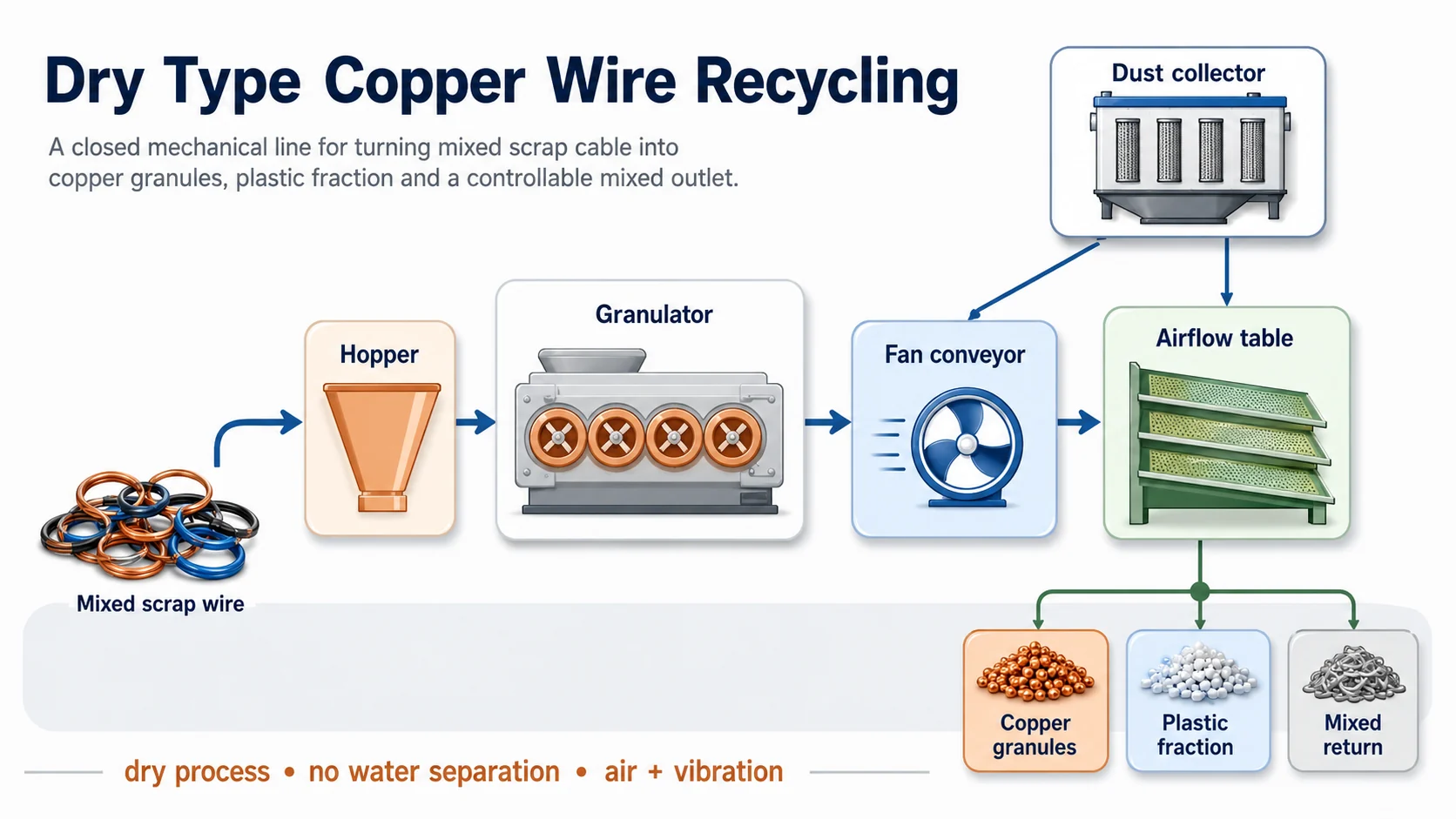
A dry type copper wire recycling machine is a mechanical system that separates copper conductor from plastic or rubber insulation without using water as the separation medium. The cable is cut into small particles, conveyed by air, spread across a vibration and airflow separation surface, and discharged as copper granules, plastic pieces and a smaller mixed fraction.
The word “dry” matters because it changes the plant layout. There is no settling tank, water circulation loop or wet sludge stream in the normal separation stage. Instead, operators control feed rate, blade condition, granule size, airflow, vibration frequency and dust collection. For many scrap yards, this is easier to install and keep clean than a wet process, especially where water discharge rules or indoor space are concerns.
Copper recycling itself has strong material logic. The International Copper Association notes that copper can be recycled repeatedly without loss of performance and that copper recycling uses less energy than primary production. The U.S. Geological Survey also describes copper’s major role in electrical uses and notes that manufacturing byproducts and obsolete copper products are readily recycled and contribute significantly to supply.
Where the YUXI copper wire recycling line fits
YUXI positions its Copper Wire Recycling Line as an environmental protection device for processing waste copper wires and separating copper from plastic. The public product page lists common feed materials including automobile circuit lines, motorcycle lines, battery lines, household appliance wires, communication lines, computer lines and other waste wires that are not suitable for wire stripping machines.
A dry-type granulation line is usually not bought for perfect, long, uniform cable. It is bought because the buyer has mixed scrap that is too irregular for efficient stripping but still valuable enough to recover mechanically.
Based on YUXI’s published description, the line includes a crusher, fan conveyor, vibrating screen, dust collector and electrical control. After shredding and crushing, waste wires become plastic fragments and “copper rice.” The material then moves on the screen surface, where airflow suction and linear vibration separate the core and insulation. YUXI also states that the vibrating screen is controlled by frequency conversion, air volume is adjusted by regulating valve, and dust reaches the dust collector through an air duct.
Dry copper wire recycling process step by step
1. Feed sorting before the granulator
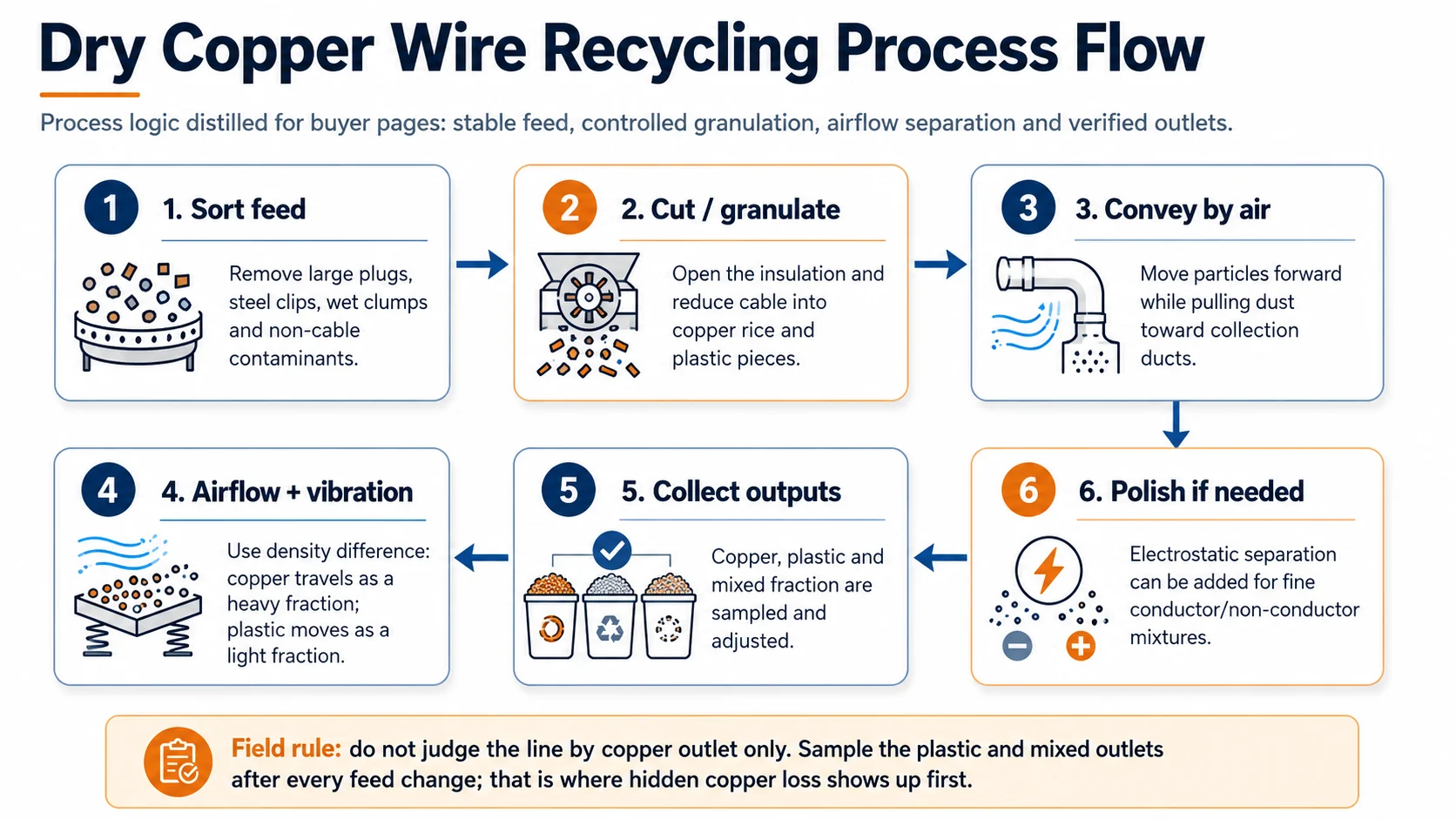
The dry process starts before the first motor runs. Operators should remove obvious non-cable contaminants: large plugs, steel clips, stones, large aluminum pieces, heavy dirt, wet clumps and oversized cable that needs pre-cutting. This step is not glamorous, but it protects the granulator and keeps the separator from chasing too many problems at once.
2. Crushing and granulation
The crusher or granulator opens the insulation and cuts the material into small particles. The goal is not simply to make scrap smaller. The goal is to create a particle size where copper and insulation can separate cleanly. If the output is too coarse, copper may stay attached to plastic. If it is too fine, copper loss to the plastic outlet and dust load can rise.
3. Fan conveying and enclosed dust movement
After size reduction, air movement transfers particles toward the separation stage and pulls dust through ductwork. On YUXI’s line, the dust collector is part of the stated configuration. In a real plant, sealed covers, clean filters, correct negative pressure and accessible ducts are not just environmental details; they also help the separation stage behave consistently.
4. Airflow gravity separation on a vibrating bed
Copper is much denser than most cable insulation. The Air Flow Gravity Separator principle is to use specific gravity difference, adjustable airflow and vibration to make heavier particles and lighter particles travel differently. In the copper-wire line, heavier copper granules and lighter plastic pieces separate into different discharge zones.
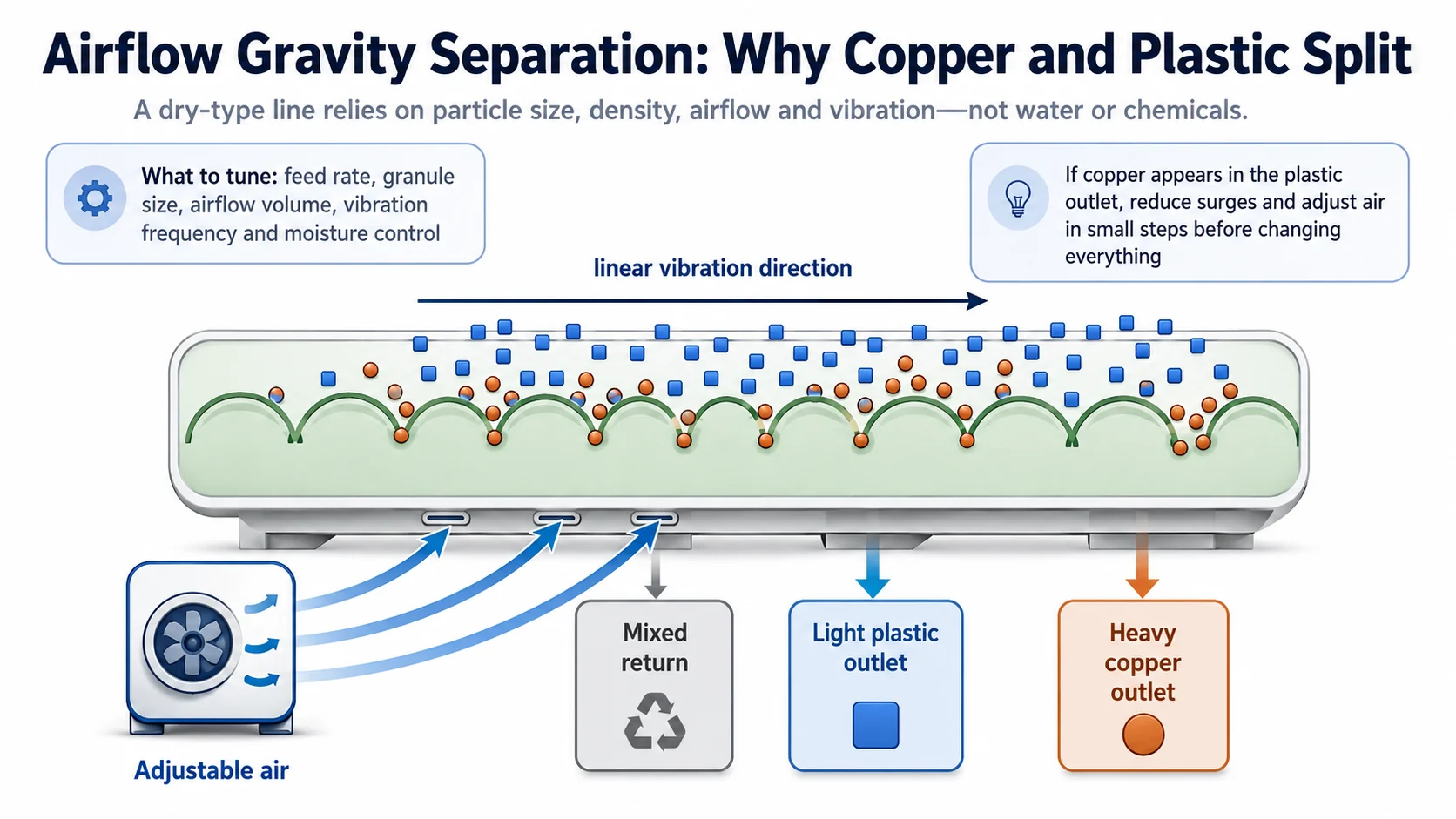
5. Output collection: copper, plastic and mixed return
A realistic line should be judged by all outlets, not just the copper outlet. The plastic fraction should not hide visible copper grains. The mixed fraction should be small enough to re-run economically. During commissioning, samples should be weighed and checked after each adjustment instead of relying only on a quick visual inspection.
6. Optional polishing for fine mixed particles
For common cable streams, airflow gravity separation may be enough to make saleable copper granules. For fine conductor/non-conductor mixtures, higher purity targets or difficult insulation blends, a polishing stage may be considered. YUXI’s High Voltage Electrostatic Separator page describes a conductor/non-conductor separation device using an electric field, with adjustment based on material characteristics, capacity and purity requirements.
What affects copper purity in a dry-type system?
YUXI’s copper wire recycling line page states that separation purity can reach more than 99.9% by adopting crushing and sorting processes. For buyer-facing content, it is better to present this as a published performance point that should be confirmed by test material. In the field, purity is never created by one specification alone. It is the result of several stable conditions working together.
| Control point | What can go wrong | What to check |
|---|---|---|
| Feed rate | Surges create thick particle beds and unstable separation. | Feed steadily; avoid dumping tangled bundles in sudden loads. |
| Granule size | Coarse particles keep copper attached to insulation; over-fine particles increase dust and copper carryover. | Inspect screen size, blade sharpness and particle appearance. |
| Air volume | Too much air may blow copper into plastic; too little air may leave plastic in copper. | Adjust in small steps and sample all outlets after each change. |
| Vibration frequency | Material may pile, dead-zone or move too quickly. | Use frequency conversion settings to match the cable mix and feed layer. |
| Moisture and dirt | Wet insulation sticks to copper and reduces density-based separation. | Keep feed dry; remove mud, oil-heavy scrap and wet clumps where possible. |
| Dust collection | Poor suction reduces cleanliness and may disturb airflow balance. | Check duct sealing, filter condition and collector maintenance schedule. |
A good operator looks first at the plastic outlet. If visible copper is leaving with plastic, that is direct value loss. If too much plastic is in the copper outlet, the product may sell lower or require reprocessing. The mixed outlet tells whether the line is correctly balanced or simply pushing the problem downstream.
Dry type vs. wet type vs. wire stripping
A dry type copper wire recycling machine is not automatically better than every other method. It is better when it matches the scrap. Wire stripping works well for long, uniform, thick cables where blades can open the insulation with little copper loss. Wet separation may be used in some recycling systems, but it brings water handling, discharge and drying considerations. Dry granulation is strongest where feed is mixed, short, fine, tangled or too labor-intensive to strip one by one.
Choose dry granulation when…
The feed includes automotive harnesses, appliance wires, computer cables, communication wire, short offcuts and mixed copper-plastic cable scrap. The operator wants a compact mechanical line with dust collection and output sampling.
Choose stripping when…
The cable is long, straight, uniform and thick enough to be stripped cleanly. In that case, a stripping machine may keep the conductor whole and avoid unnecessary granulation.
Buyer checklist for configuration and acceptance
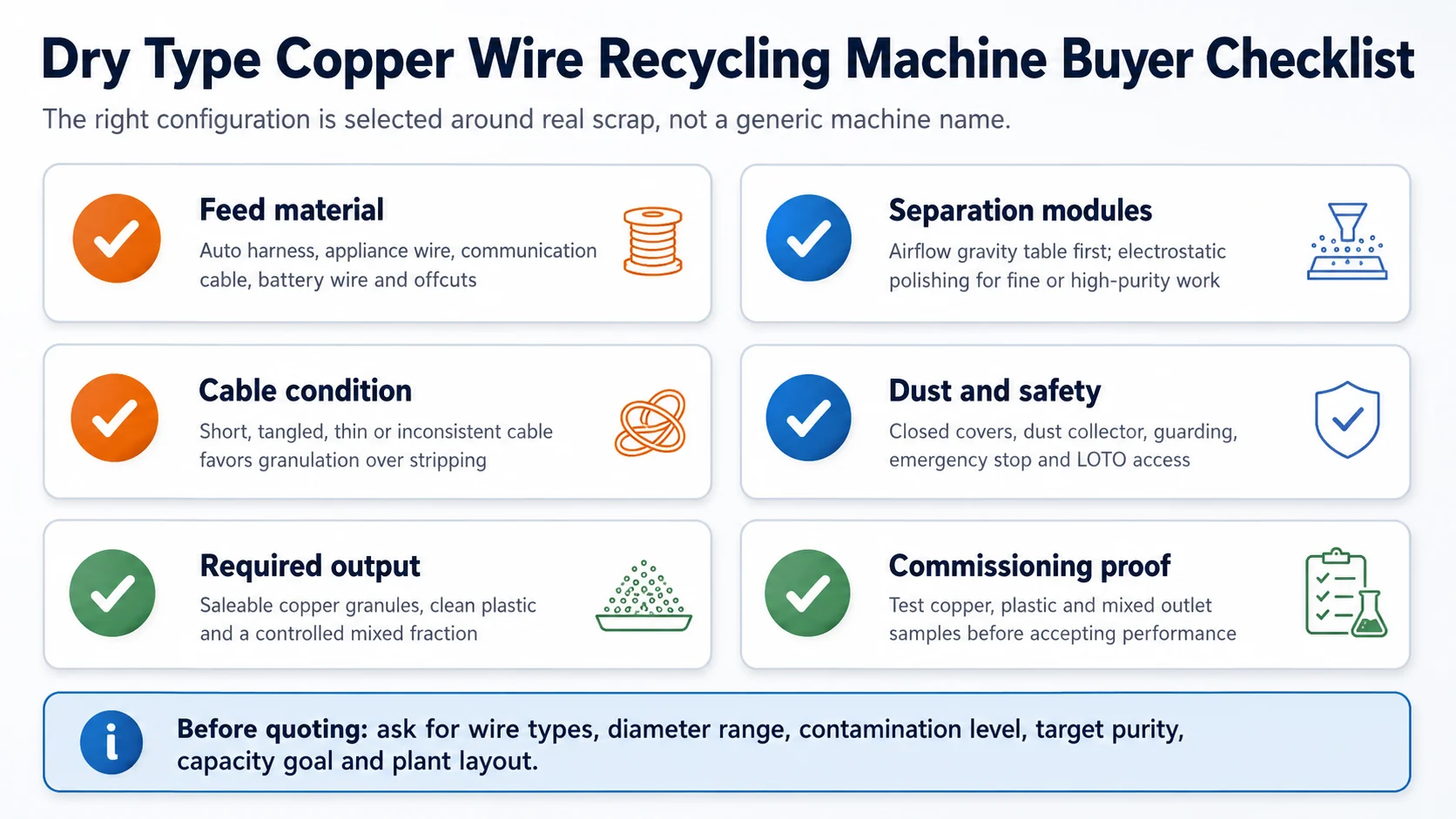
Before asking for a quotation, prepare the information that actually changes the line design. A supplier cannot size or configure a dry-type copper wire recycling machine accurately from a keyword alone.
| Question | Why it matters |
|---|---|
| What wire types dominate your feed? | Automotive harnesses, appliance wires, communication cables and power offcuts behave differently during cutting and separation. |
| What diameter range and cable condition? | Fine wire, thick cable, short offcuts and tangled bundles need different feeding and granulation attention. |
| How much contamination is present? | Plugs, steel clips, aluminum, moisture and dirt affect blade life, separation stability and dust load. |
| What is the target output? | Saleable copper granules, smelter feed, higher-purity copper or clean plastic each set different acceptance standards. |
| Is optional polishing needed? | Fine mixed particles may justify electrostatic separation, while simpler cable streams may not need it. |
| How will performance be accepted? | Run a sample test, weigh outlet fractions and check copper loss in plastic before final acceptance. |
Safety, dust and maintenance notes
Copper cable granulation equipment includes rotating cutters, conveyors, fans, vibrating screens, electrical controls and dust collection systems. OSHA’s machine guarding guidance highlights that machine guarding hazards are addressed in OSHA standards, including general requirements for machinery and machine guarding. OSHA’s recycling hazard guidance also notes that recycling facilities may expose workers to moving-part hazards if machines are not safeguarded properly.
Maintenance is another high-risk moment. OSHA’s lockout/tagout standard covers servicing and maintenance where unexpected energization or startup could injure employees. For a dry-type copper wire recycling machine, that matters during blade inspection, jam clearing, screen changes, duct cleaning, conveyor work and electrical troubleshooting.
Noise should also be checked during commissioning. NIOSH said that the recommended exposure limit for occupational noise is 85 weighted decibels for 8-hour shifts. The actual factory noise depends on the shell design, process load, fan size, building acoustics and nearby equipment, so hearing protection should be based on workplace measurements rather than assumptions.
From the perspective of maintenance, the most useful routines are simple: check the blades and screens, keep the feed dry, clean the magnetic or manual pre-sorting points, check the air duct, empty or maintain the dust collector, and sample each outlet after the feed is replaced. Factories that measure small losses in the early stage usually avoid large losses in the later stage.
FAQ: Dry Type Copper Wire Recycling Machine
Does a dry type copper wire recycling machine use water?
No. The dry-type process described in this guide uses mechanical crushing or granulation, air conveying, airflow-vibration separation and dust collection. It does not rely on water as the normal separation medium.
What materials can it process?
It is commonly used for mixed waste copper wires such as automotive circuit lines, motorcycle lines, battery lines, household appliance wires, communication lines, computer lines and other wires that are difficult to process by stripping.
Can it reach 99.9% copper separation purity?
YUXI’s public product page states that its crushing and sorting process can reach more than 99.9% separation purity. For a real project, the result should be confirmed with your actual cable sample because feed composition, moisture, contamination and machine adjustment all affect purity.
Is electrostatic separation always required?
No. Airflow gravity separation is the core dry separation stage for many cable streams. Electrostatic separation is better treated as an optional polishing step for fine mixed particles, higher purity targets or materials that are difficult to split by density alone.
What should I send before requesting a quote?
Send wire photos or videos, cable types, diameter range, estimated capacity, contamination level, desired output quality, available plant space and power requirements. A small sample test is the best way to confirm the final configuration.
Need to evaluate mixed cable scrap?
Share your feed material, output target and plant layout constraints with YUXI. The right dry type copper wire recycling machine should be selected around the real scrap stream—not only around a model name.
Source notes
- YUXI Copper Wire Recycling Line product page: application materials, machine modules, process description, dust collector, frequency control and published purity statement.
- International Copper Association: copper recyclability, lower energy demand and reduced CO₂ emissions from recycling.
- U.S. Geological Survey: copper uses and the role of recycled manufacturing byproducts and obsolete copper products in supply.
- OSHA machine guarding, OSHA recycling hazards and OSHA lockout/tagout requirements for maintenance.
- CDC/NIOSH: recommended exposure limit for occupational noise exposure.