




 Request Quote



Metal Shredder Installation Guide | YUXI
Before the first piece of scrap reaches the cutting box,the installation of the metal shredder often goes wrong .The equipment might be properly chosen, yet the construction site is far from ready. The concrete slab is too thin,the unloading belt has no reserved clearance,the control cabinet is positioned out of the operator’s sight of the feeding hopper.Many buyers also overlook one key point:low-speed,high-torque shredding units require complete power lockout and safety protection measures.This document sorts out all these on-site installation matters into a clear, workable checklist,tailored for customers preparing to run YUXI double-shaft metal shredders or full-set scrap recycling production lines.
1. Before Installation: Confirm the Real Duty of the Metal Shredder
A Metal Shredder Installation Guide should start before the machine arrives. The first job is to make sure the site plan matches the material and the role of the shredder in the line.
YUXI describes its double-shaft metal shredder as a low-speed, high-torque industrial machine for bulky waste reduction and mixed material recycling. It is designed for metal scrap, plastic drums, tires, RDF and bulky waste recycling, and uses dual counter-rotating shafts with automatic overload detection and reverse protection. In a plant, it is often used as the primary shredding stage before sorting, separation, RDF production or downstream recycling.
For a metal-focused project, the YUXI metal shredder page also lists common materials such as waste color steel tiles, metal drums, car shells, refrigerators, scrap steel and steel furniture. The working principle is tearing, squeezing and shearing inside the shredding box before discharge from the lower part of the machine.
Confirm these inputs before final layout
- Material type: car shells, light scrap, metal drums, appliances, color steel tile, mixed industrial waste or pre-sorted scrap.
- Largest feed size and whether the feed is loose, nested, baled, wet, painted, oily or contaminated.
- Required capacity per hour and working hours per day.
- Target output size and whether a secondary crusher, screen or baler is needed.
- Downstream process: magnetic separation, eddy current separation, hammer crusher, granulator, dust removal or manual sorting.
Do not finalize installation from motor power alone
Motor power is only one part of installation planning. The buyer should also check chamber size, machine weight, blade thickness, hopper size, discharge height, gearbox access, electrical load, foundation, lifting access and maintenance clearance. YUXI’s published double-shaft shredder range includes models from compact machines to heavy units, so every project should use the final general arrangement drawing for foundation and layout.
2. Plant Layout: Where the Shredder Sits in the Recycling Line
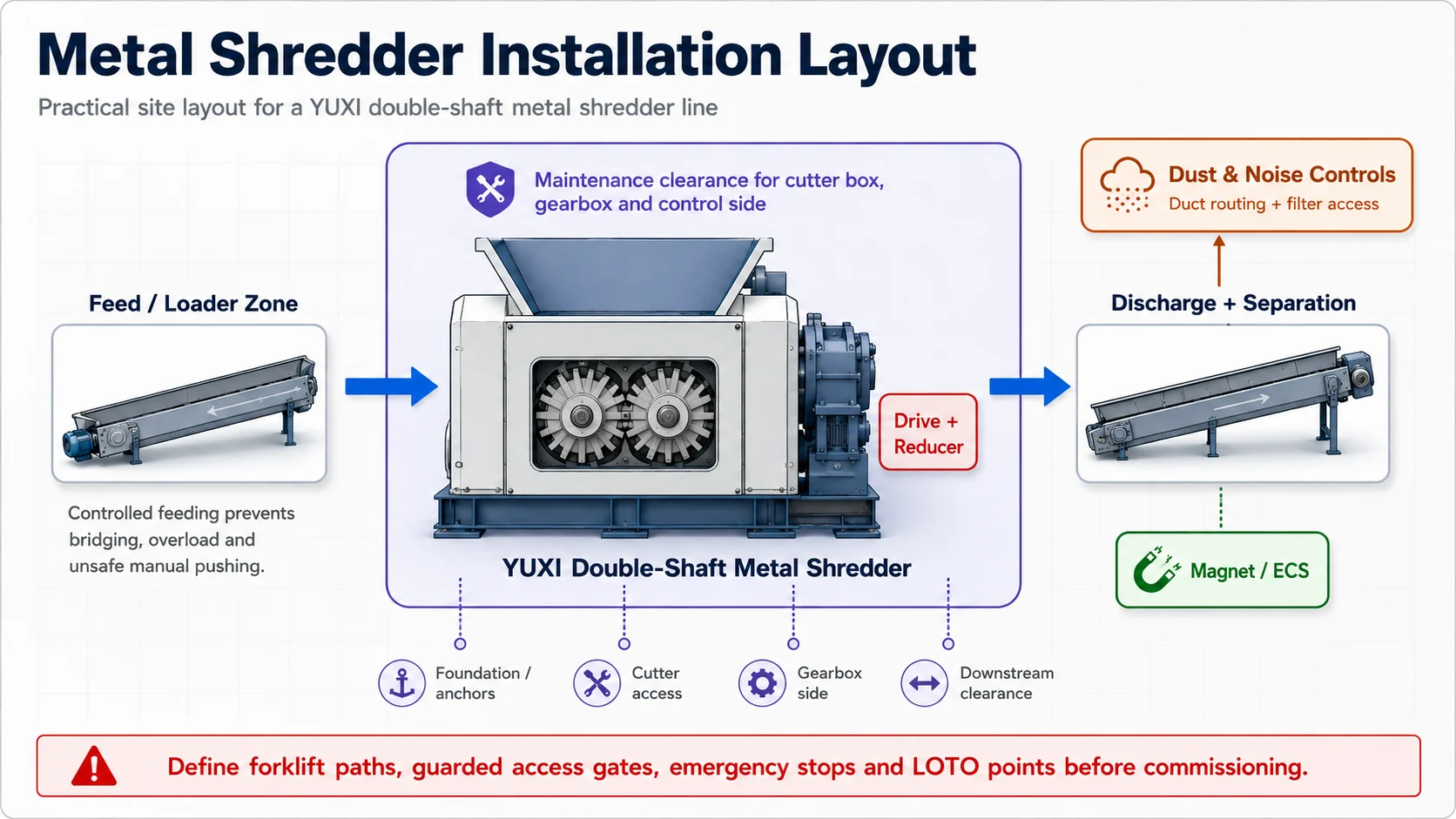
The shredder is not just a machine; it is a traffic point. Material arrives, operators work around it, forklifts or loaders feed it, conveyors carry discharged pieces away, and maintenance people need safe access to the cutter chamber and drive system. A good installation layout reduces downtime because it gives the machine enough room to breathe.
Recommended layout logic
- Feed side: reserve space for loader approach, grab feeding, inclined conveyor or manual sorting table. Avoid forcing operators to push scrap by hand near the hopper.
- Shredder centerline: mark the final centerline on the foundation before the machine arrives. Align it with upstream and downstream conveyors, not just with the wall.
- Discharge side: plan enough height and belt width for rough shredded output. If the machine feeds a magnet, eddy current separator, crusher or baler, confirm transfer heights early.
- Control view: place the control cabinet or operator station where the operator can see the hopper, discharge and emergency area, while keeping it outside the throw, dust and traffic zones.
- Maintenance access: reserve clearance around the cutter box, gearboxes, motor side, hydraulic units if used, inspection doors and lubrication points.
For YUXI metal recycling solutions, the installation layout should also allow for optional equipment such as feeding conveyor, discharge conveyor, customized hopper, magnetic separator, eddy current separator, hammer crusher, granulator, screen, dust removal system, sound insulation cover, remote control cabinet and spare wear-part storage.
3. Foundation, Anchoring and Leveling
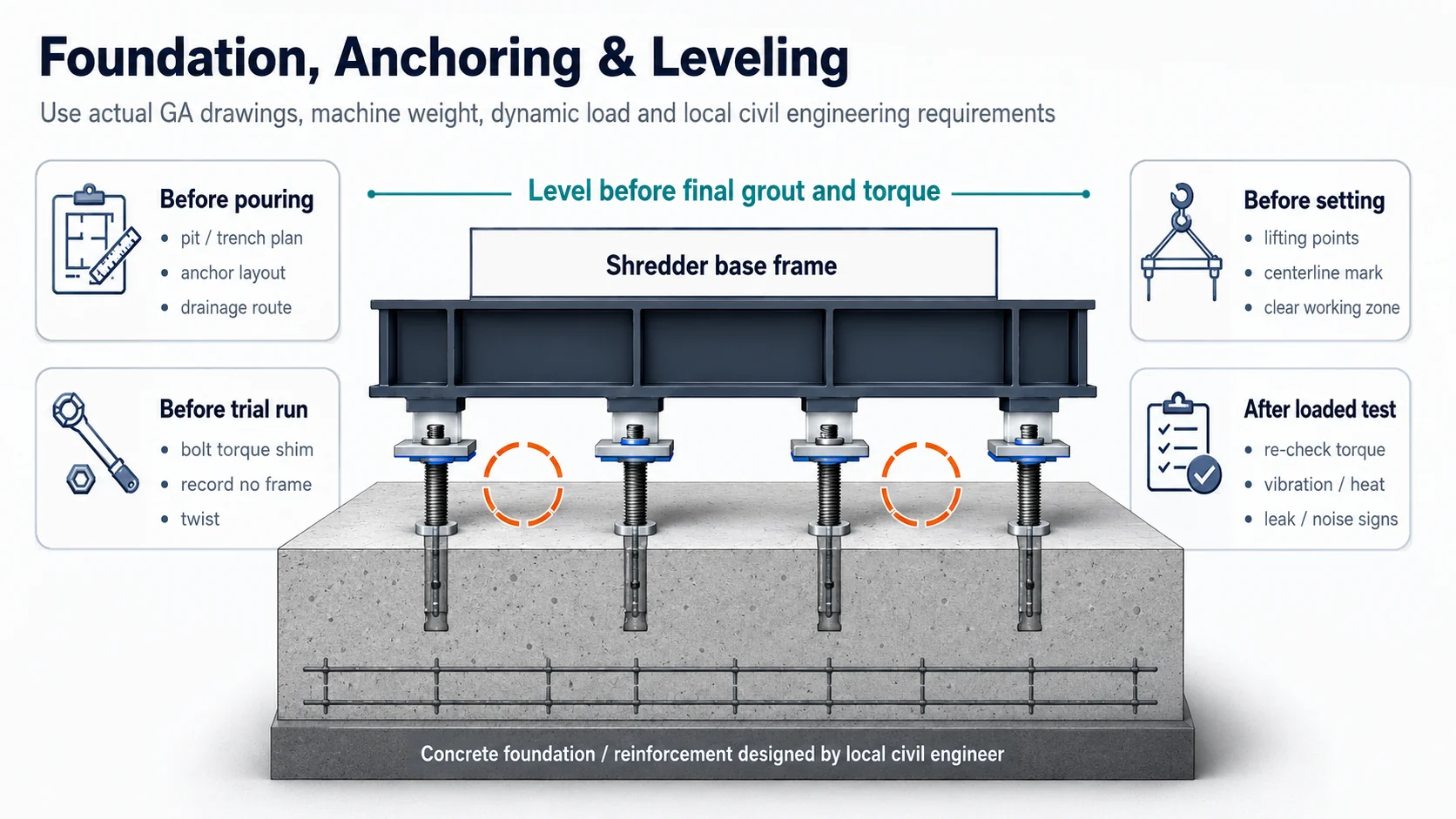
A double-shaft metal shredder handles shock load. Even when it runs at low speed, the torque, intermittent bite force and material impact can make a weak installation move, vibrate or loosen. OSHA’s machine-guarding guidance states that a machine designed for a fixed location must be securely anchored to prevent walking or moving. For a shredder, that means the foundation is part of the machine system, not a construction afterthought.
Foundation checklist
- Use the final GA drawing: do not pour anchor holes based on brochure dimensions. Confirm the exact model, base frame, bolt layout, hopper, platform and conveyor arrangement.
- Design of thstatic and dynamic loads: machine weight,cutting box load, drive torque, scrap impact, conveyor load and maintenance movement should be reviewed by local civil engineers.
- Keep the plate flat: poor flatness may disdort the frame, affect the axis alignment and lead to uneven wear.
- Prepare the anchor bolt correctly: use the correct bolt grade, embedding, gasket, grouting and torque procedure. Record the torque after no-load and loaded test run.
- Planning drainage and housework: metal shredding may involve dust, oil, coolant residue, dirt, rainwater or waste. The floor should not get the materials stuck under the machine.
- Leave service pits only if needed: some lines need discharge pits or underground conveyors. Confirm guarding, drainage and rescue access before building a pit.
Foundation requirements change with machine size. YUXI’s published double-shaft shredder models show machine weights from several tons to heavy-duty units above 60 tons, so the foundation for a small recycling shop and a high-capacity scrap processing line should not be treated the same way.
4. Unloading, Lifting and Positioning
Installation risk is highest when the machine is moving. The shredder body, drive units, hopper and control cabinet may arrive in separate packages. Before unloading, create a lifting plan with the buyer’s rigging contractor and the YUXI delivery documents.
Practical rules: Do not lift from the hopper, cover,motor cover,conveyor rack or any point that is not confirmed as the starting point.Use the rated hpoist device to prevent people from leaving the suspended load area,and take pictures of machine condition before and after unloading..
Receiving inspection
- Check packing list, main machine, hopper, control cabinet, spare blades, fasteners, sensors, cables and documents.
- Photograph visible shipping damage before unpacking fully.
- Before the truck arrives,verify whether the foundation is solidified and ready.
- Confirm crane/forklift capacity, lifting height and turning radius.
- Place small parts in a locked area so fasteners, keys and sensor brackets are not lost during site work.
5. Mechanical Assembly: Hopper, Conveyor, Guards and Wear Parts
Once the shredder is set on the foundation, mechanical assembly should follow a fixed sequence. The exact order depends on the model,but the buyer’s logic is the same:set up the machine,level it,anchor it,connect the material flow,and then turn off the protection and test the access point .
Assembly sequence
- Set and level the base frame. Use shims or leveling pads at the correct support points. Check across the frame, not only front-to-back.
- Install hopper and feeding devices. Confirm that the hopper does not interfere with loader reach, conveyor head pulley, platform handrails or dust hood.
- Install discharge conveyor. Check belt tracking, transfer height, skirt boards, guards, emergency pull-cords where required and access for cleaning.
- Connect downstream equipment. For metal recycling lines, confirm the magnet, eddy current separator, crusher, baler, storage bin or manual sorting station.
- Install guards and platforms. Guard rotating parts, couplings, chains, belts, shafts and access doors. Do not leave guards off “until later.”
- Fill and check lubrication points. Gearbox oil, bearing grease, hydraulic oil if applicable and automatic lubrication settings should be checked before no-load running.
YUXI’s metal shredder page notes that the moving knife uses special alloy tool steel forging blanks with precision machining and heat treatment, and that blade thickness can be selected according to different materials. During installation, this matters because the buyer should keep the supplied blade layout, spacers and claw arrangement consistent with the intended feed material unless YUXI advises a change.
6. Electrical, Controls and Safety Integration
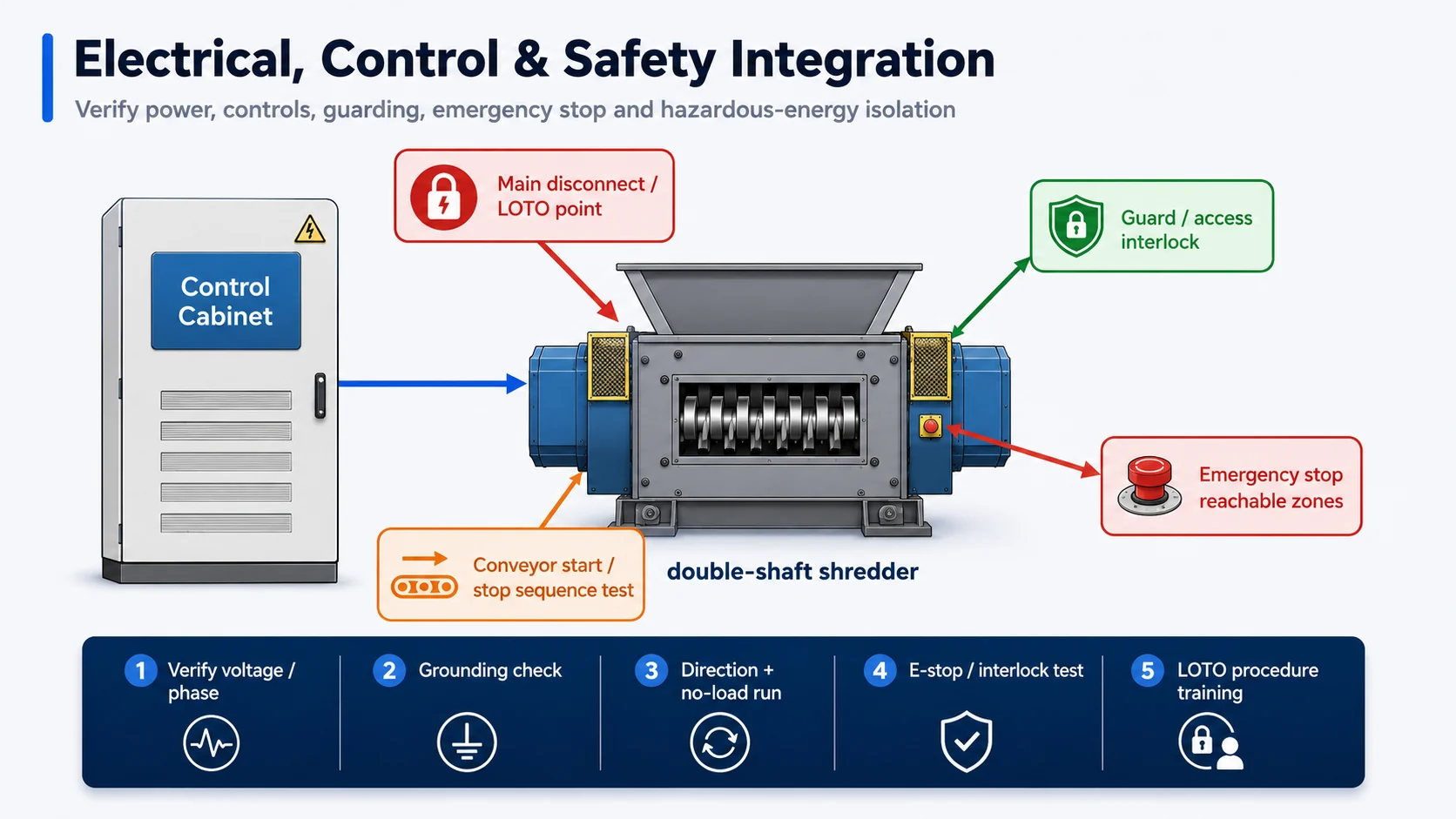
Electrical work should be performed by qualified personnel according to local codes, plant rules and the equipment documentation. This guide is not a wiring manual. It is a buyer-side checklist for what must be ready before the electrician and commissioning engineer start.
OSHA electrical requirements state that electric equipment must be suitable for installation and use, installed and used according to listing or labeling instructions, installed in a neat and workmanlike manner, firmly secured when mounted, and provided with sufficient access and working space for safe operation and maintenance. In a shredder installation, those points translate into cabinet placement, cable routing, grounding, short-circuit protection, ventilation and clear service space.
Electrical readiness checklist
- Confirm site voltage, frequency, phase, transformer capacity and permitted starting method.
- Check cable trays, conduit route, cabinet location and grounding before the machine arrives.
- Confirm the rotation direction of the motor during the no-load test,the wrong direction may affect the feeding and discharge.
- Verify the control signals between shredders, feed conveyors, discharge conveyors, magnets, dust collectors and downstream machines.
- Test emergency stop, pull rope,door switch, security interlock and alarm light.
- Set overload current and auto-reverse logic according to material test results, not guesswork.
- Label disconnects, LOTO points and cabinet circuits clearly for maintenance teams.
Lockout/tagout and machine guarding
Metal shredders expose workers to high torque, stored energy, moving shafts, pinch points and falling material. OSHA’s lockout/tagout standard covers servicing and maintenance where unexpected energization, startup or stored energy release could cause injury. It also requires an energy control program and procedures to disable equipment and prevent unexpected startup. .
For a shredder, LOTO should cover more than the main drive. Include the feeding conveyor, discharge conveyor, hydraulic power unit if used, dust collector, magnets, compressed air, gravity hazards, stored mechanical energy and any downstream machine that can start automatically.
7. Dust, Noise, Fire and Traffic Controls
Installation planning should also cover the environment around the shredder. Scrap metal can generate impact noise, dust, sparks, flying fragments and traffic conflict. The control plan should be written before commissioning, because it affects equipment position and not just PPE.
- Noise: 85 dBA recommended exposure limit over an eight-hour workday.. A loaded shredder test should include a practical noise survey at operator, maintenance and traffic positions.
- Dust: reserve duct routing and maintenance access for the dust collector. Do not block inspection doors with conveyors, bins or walls.
- Fire prevention:Confirming the feeding inspection before the fuel tank,aerosol,battery,sealing barrek and other prohibited materials reach the hopper.
- Traffic: Mark the forklift lane,loader entry,pedestrian route and no-standing area around the feed hopper and discharge.
- Housekeeping: plan bins for oversize, tramp material and daily cleaning so scrap does not accumulate around guards and cable routes.
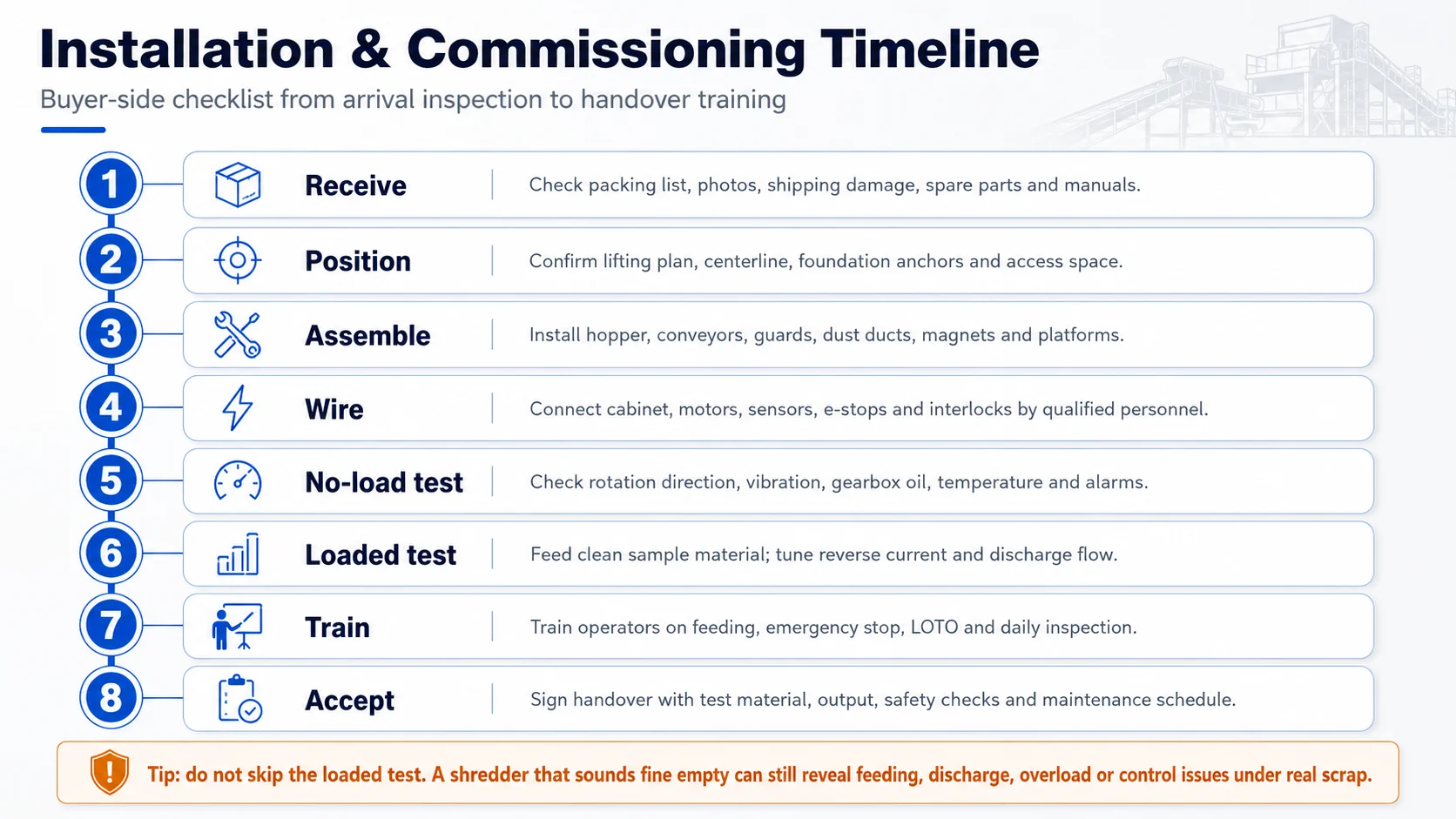
8. Commissioning Procedure: From No-Load Test to Loaded Trial
Commissioning is not a single start button. It is a sequence of checks that proves the installation, the controls and the operators are ready for real material. A machine that runs quietly with no load can still reveal problems as soon as irregular scrap enters the cutter box.
No-load commissioning
- Confirm that all tools, shipping blocks and loose fasteners have been removed.
- Check lubrication, gearbox oil level, reducer breather, couplings, guards and inspection covers.
- Power on the control cabinet and check alarms, display, sensors and communication with conveyors.
- Jog the motor to confirm shaft rotation direction.
- Run the shredder empty and monitor vibration, abnormal sound, bearing temperature and current.
- Test start/stop, emergency stop, guard interlock, conveyor sequence and auto-reverse simulation where possible.
Loaded commissioning
- Start with clean, representative material, not the worst material in the yard.
- Feed gradually and observe bite, bridging, discharge flow and current peaks.
- Confirm that auto reverse activates correctly when overloaded and returns safely to normal operation.
- Inspect discharge size and decide whether downstream crushing, screening or separation settings need adjustment.
- Stop, lock out and inspect cutter box, bolts, guards, conveyors and transfer points after the first loaded run.
- Record current, temperature, noise, output condition, maintenance observations and operator feedback.
For YUXI metal shredder projects, loaded commissioning should use the buyer’s actual material whenever possible: light metal scrap, drums, car shell pieces, refrigerator shells, color steel tile or the mixed stream agreed before purchase. This is the only way to validate feeding behavior, rough output size and downstream material flow.
9. Installation Acceptance Checklist
Use this checklist before signing installation acceptance or beginning continuous production.
| Area | What to verify | Evidence to keep |
|---|---|---|
| Foundation | Machine level, anchors tightened, no abnormal movement after loaded test. | Level record, bolt torque record, photos. |
| Mechanical | Hopper, cutter box, reducers, conveyors, guards and platforms installed correctly. | Assembly checklist, spare-parts list. |
| Electrical | Voltage, grounding, rotation direction, cabinet cooling, labels and working clearance confirmed. | Electrical test sheet, cabinet photos. |
| Controls | Start/stop, emergency stop, guard interlocks, conveyor sequence, overload reverse and alarms tested. | Commissioning report with signatures. |
| Safety | LOTO points, guarding, traffic zones, dust/noise controls and operator training completed. | Training record, LOTO procedure, risk assessment. |
| Process | Representative material shredded; output, discharge flow and downstream separation acceptable. | Material photos/video, capacity notes, output sample. |
| Maintenance | Daily inspection, lubrication, blade checking, bolt re-torque and wear-part storage agreed. | Maintenance schedule, handover notes. |
10. Installation Mistakes That Cause Early Downtime
Most early downtime comes from avoidable installation details. The machine itself may be strong enough, but the line around it cannot keep up.
- Under-sized discharge conveyor: rough shredded metal piles up under the chamber and causes stoppages.
- No access to cutter-box covers: maintenance takes hours because the hopper, handrail or wall blocks inspection points.
- Control cabinet placed in the dust zone: components overheat or operators cannot see the feed condition.
- No defined feed inspection: sealed drums, fuel tanks, batteries or other prohibited materials reach the hopper.
- Weak anchor plan: the shredder walks, vibrates or loosens after repeated shock loads.
- Skipping loaded test: the line appears ready but fails when real scrap bridges, bounces or overloads the cutter box.
- Missing operator training: workers use the emergency stop as a normal stop, bypass guards or clean the machine without correct isolation.
11. Information to Send YUXI Before Installation Design
To help YUXI recommend a practical installation layout, prepare the following project details:
- Material name, photos and short videos.
- Largest feed size, average size and whether material is loose, baled, nested or mixed.
- Target output size and downstream process.
- Required tons per hour and working hours per day.
- Site voltage, frequency, available power and electrical room distance.
- Plant drawing with available length, width, height, door size and crane/forklift access.
- Feeding method: loader, grab, conveyor or manual sorting table.
- Required options: feed conveyor, discharge conveyor, magnetic separator, eddy current separator, crusher, dust collector, sound cover or remote cabinet.
Metal Shredder Installation Guide FAQ
How long does a metal shredder installation take?
It depends on model size, foundation readiness, conveyors, downstream equipment, electrical work and local inspection requirements. A standalone compact unit is very different from a full line with conveyors, magnetic separation, dust collection and control integration.
Does a metal shredder need a special foundation?
Yes, in most industrial applications. The foundation should be designed around the real machine weight, dynamic load, anchor layout and local soil/slab conditions. Heavy-duty double-shaft shredders should not be placed on unverified floors.
Can the control cabinet be installed far away from the shredder?
It can be remote-mounted if the cable length, signal reliability, environmental protection and operator visibility are planned correctly. The operator still needs safe visibility of the hopper, discharge and emergency zones.
What should be tested before feeding scrap?
Check rotation direction, lubrication, guard interlocks, emergency stops, conveyor sequence, overload reverse, alarms, grounding, cabinet ventilation and abnormal noise or vibration during no-load running.
Why is loaded commissioning necessary?
A shredder may run smoothly empty but behave differently under real material. Loaded testing validates feeding, bite, discharge, current peaks, auto reverse, downstream separation and operator procedure.
Can YUXI provide a complete metal recycling line around the shredder?
YUXI’s product information shows that double-shaft shredders can work with conveyors, magnetic separators, eddy current separators, crushers, granulators, balers, dust removal and other equipment according to the project layout.
Plan Your Metal Shredder Installation With YUXI
Send YUXI your material photos, largest feed size, target output, required capacity, plant layout, voltage and downstream recycling goal. The more installation details you share before shipment, the easier it is to avoid foundation changes, conveyor conflicts and commissioning delays.