




 Request Quote



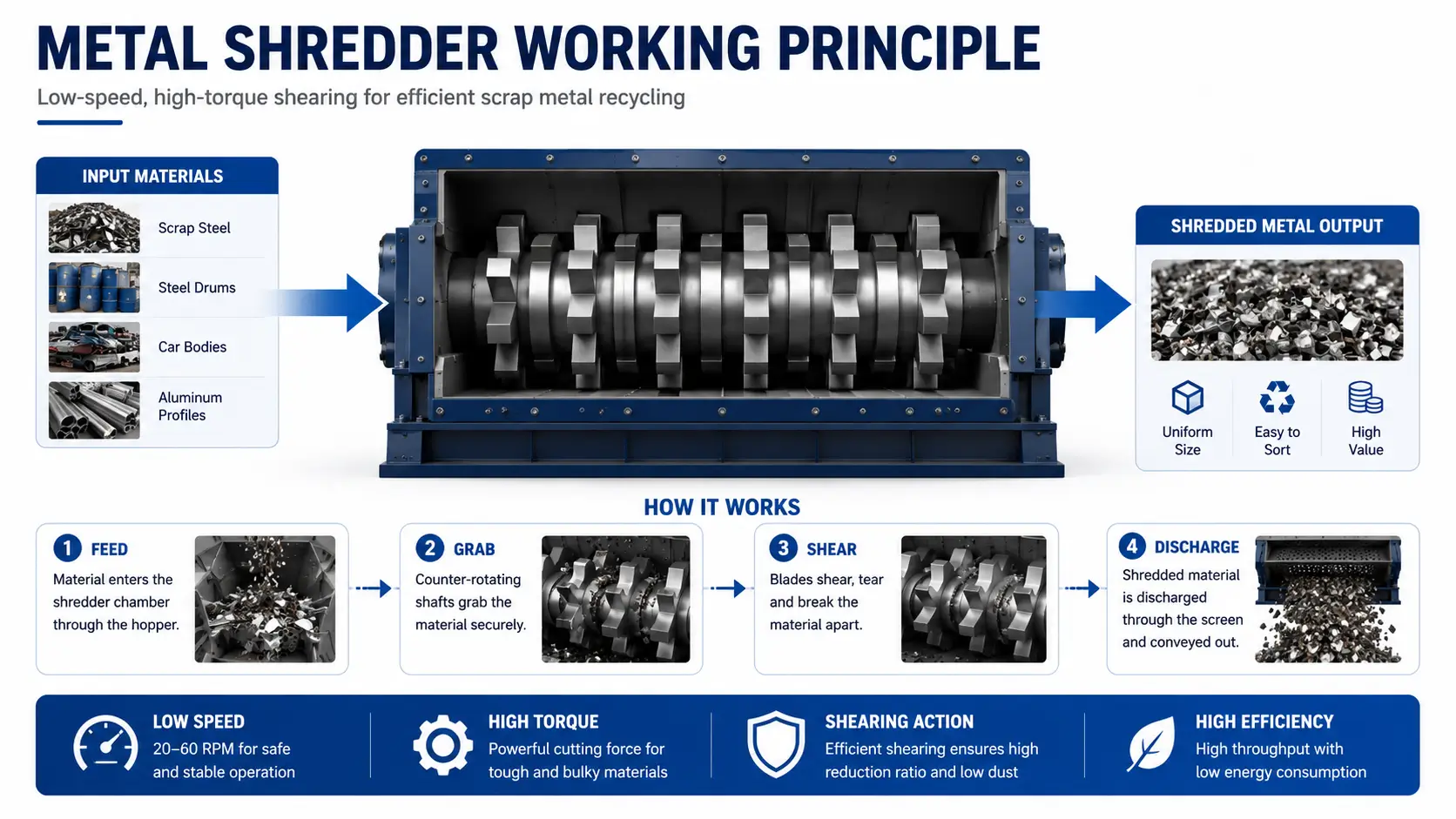
Metal recycling begins long before scrap ever undergoes melting, sorting or resale. In most recycling plants, the first real productivity gain comes from size reduction. A metal shredder machine converts bulky, irregular scrap into a controlled stream of smaller pieces so that downstream conveyors, magnetic separators, eddy current separators, balers, and smelting preparation systems can work more efficiently.
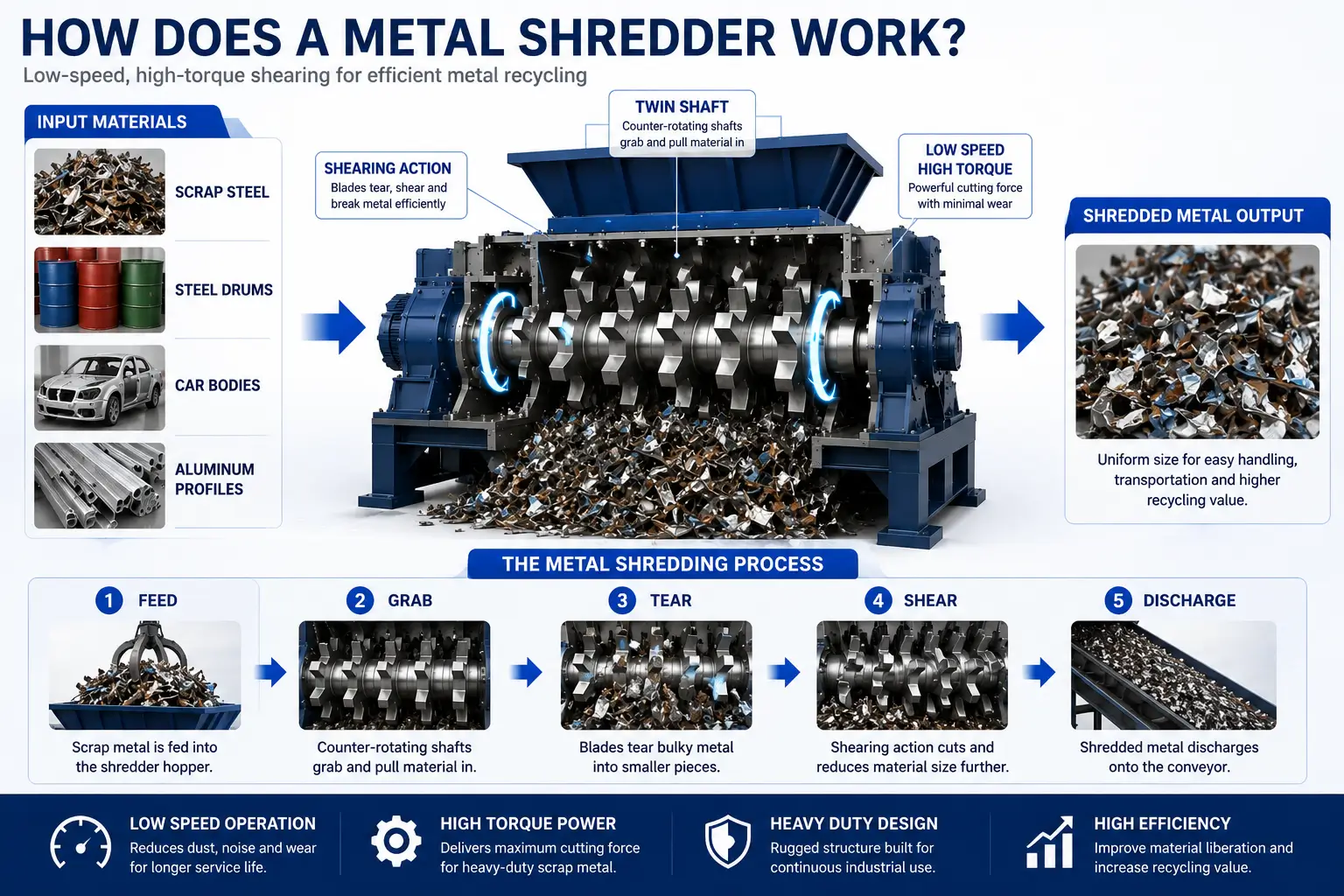
For buyers comparing industrial recycling equipment, the question is often simple: How does a metal shredder work, and what is the difference between it and a crusher or hammer mill? The answer is based on low-speed, high-torque mechanical shearing. Rather than hammering material at high speeds, metal shredders rely on two opposing rotating shafts lined with alloy steel cutters to catch, rip, slice and push scrap metal out.
We’ll break down every detail of how metal shredders run, their key components, the full step-by-step shredding workflow, and how these machines integrate into a full metal recycling system. This piece caters to recycling plant proprietors, scrap yard operators, purchasing managers, and project engineers seeking actionable insights to choose a suitable industrial shredder.
Why Metal Shredding Is Important in Recycling
Raw scrap metal rarely arrives in a convenient size. It may come as steel drums, appliance shells, aluminum profiles, production offcuts, car body panels, mixed light scrap, or irregular structural pieces. These materials take up space, are difficult to load efficiently, and often contain attached plastics, rubber, foam, wiring, or non-ferrous materials.
Shredding solves this problem by turning bulky scrap into smaller and more uniform fragments. This makes storage denser, transportation more economical, and sorting more accurate. The Bureau of International Recycling notes that almost 40% of global steel production is made from scrap, while recycling one tonne of steel saves significant raw materials and energy compared with primary production. BIR ferrous metals recycling facts
World Steel Association also describes steel as a highly recyclable material within the circular economy, with more than 25 billion tonnes of steel recycled since 1900. World Steel circular economy This is why efficient scrap preparation is not only a production issue, but also a resource recovery issue.
Metal shredders use slow-speed, heavy-torque shearing to break down bulky scrap into uniform chunks that are simple to separate later. Not only does this cut down shipping volume and pull different materials apart, it also makes sorting far more accurate and drives up the resale price of your scrap.
What Is a Metal Shredder Machine?
A metal shredder machine is heavy-duty recycling equipment designed to reduce the size of ferrous and non-ferrous metal scrap. It uses rotating shafts and cutting blades to pull material into a cutting chamber and break it down through mechanical shear force.
Unlike high-speed impact machines, most primary metal shredders operate at low speed. This creates several advantages: stronger grabbing force, lower dust generation, lower noise compared with impact crushing, and better control when processing mixed or irregular scrap. For many recycling yards, a double shaft metal shredder is the first stage before sorting and separation.
You’ll find these shredders widely used at scrap yards, car dismantling workshops, waste appliance recycling sites, aluminum recovery factories, steel mills and general industrial waste recycling hubs. If you pick a model matched to your workload, it can handle steel barrels, thin steel scrap, aluminum framing, bundled copper scrap, old fridges, washing machines and all kinds of mixed metal waste.
Looking for a robust metal shredder to support your recycling operation? YUXI supplies industrial shredders built to handle scrap steel, aluminum extrusions, steel barrels, household appliances, car panels and assorted mixed metal waste. Our technical team can suggest the best model based on your raw materials, hourly output demands and desired finished scrap size.
View YUXI Metal Shredder Machine ?
Looking for a robust metal shredder to support your recycling operation?
View YUXI Metal Shredder Machine ?Main Components of a Metal Shredder
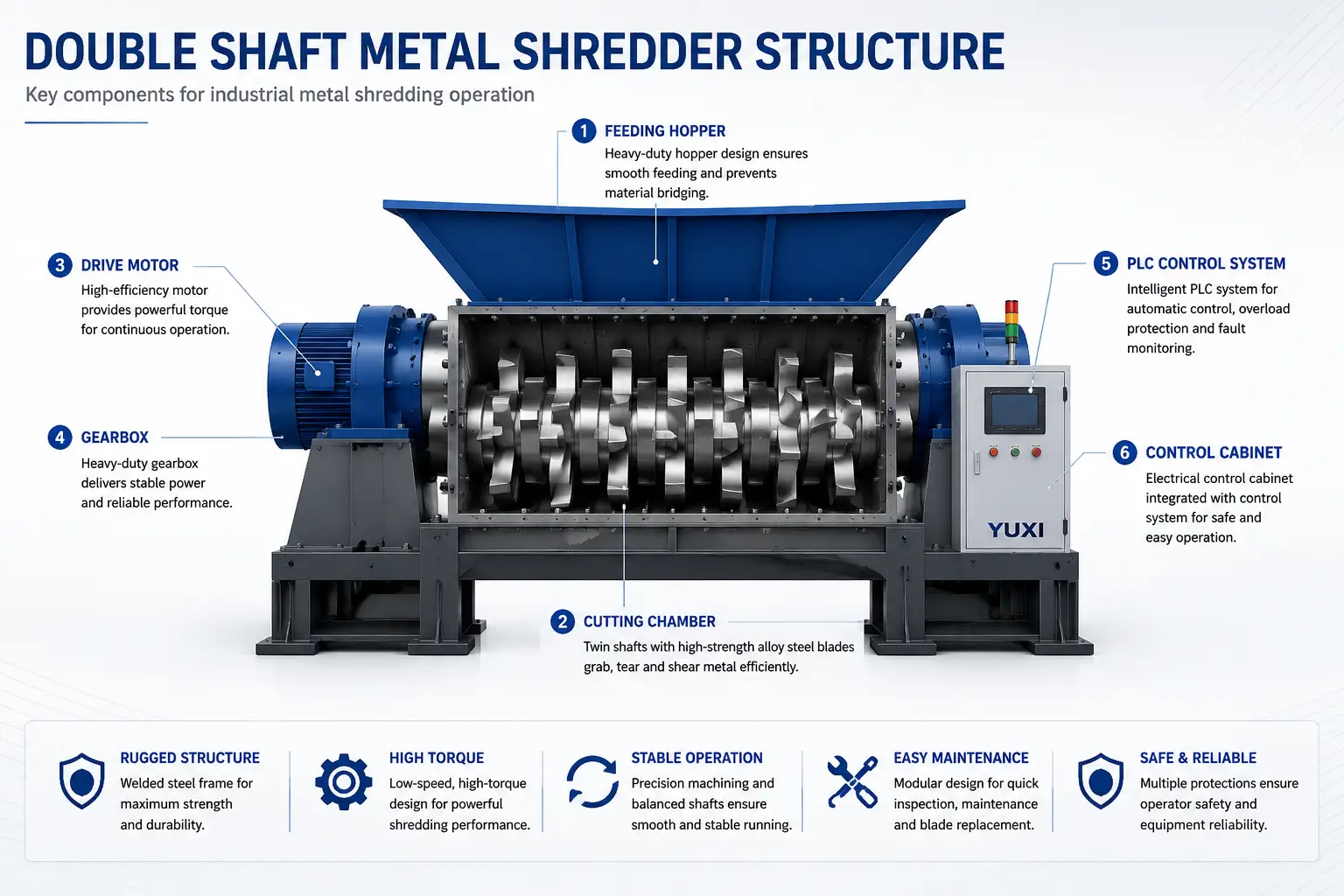
Understanding the components makes the working principle much easier to understand. A double shaft metal shredder is not simply a box with blades. It is a coordinated system of feeding, driving, cutting, protection, and discharge components.
Feeding Hopper
Scrap gets fed into the hopper via loaders, overhead cranes, material grabs, forklifts or conveyors. A well-engineered hopper channels waste straight into the cutting chamber, cuts down messy spillage, and keeps staff safely clear of the dangerous cutting area.For bulky scrap such as drums or appliance shells, hopper volume and opening size are important selection factors.
Twin Shafts and Cutting Chamber
The twin shafts are the heart of a double shaft shredder. The two shafts spin inward against one another, generating a powerful pulling force that drags scrap down into the equipment. The size of the cutting chamber sets the maximum dimensions of material you can feed in, as well as how much scrap the machine can handle in each working cycle.
Alloy Steel Blades
We craft these blades from premium high-strength alloy steel and apply specialized heat treatment to boost wear resistance. Factors including blade thickness, hook contour, tooth structure and gap spacing all play a key role in deciding final scrap size and the equipment’s overall service life. Light scrap may use thinner blades, while heavy mixed scrap or steel drums require thicker, stronger blade designs.
Gearbox and Drive Motor
The motor delivers raw power, and the gearbox slows rotation to generate massive torque. This powerful twisting force lets the unit grip and slice through metal cleanly, rather than just knocking scrap around inside the cutting chamber. Depending on model size, industrial systems may use single or dual motors.
PLC Control & Overload Protection
All our latest shredders come with a PLC system that constantly tracks load levels, motor current, shaft rotation direction and all safety sensors. When overly thick or stuck scrap creates too much resistance, the shafts will auto-reverse to clear blockages before resuming work. This simple yet effective function prevents premature wear or breakdowns on blades, gearboxes and drive motors.
Working Principle of Metal Shredders: Complete Step-by-Step Explanation
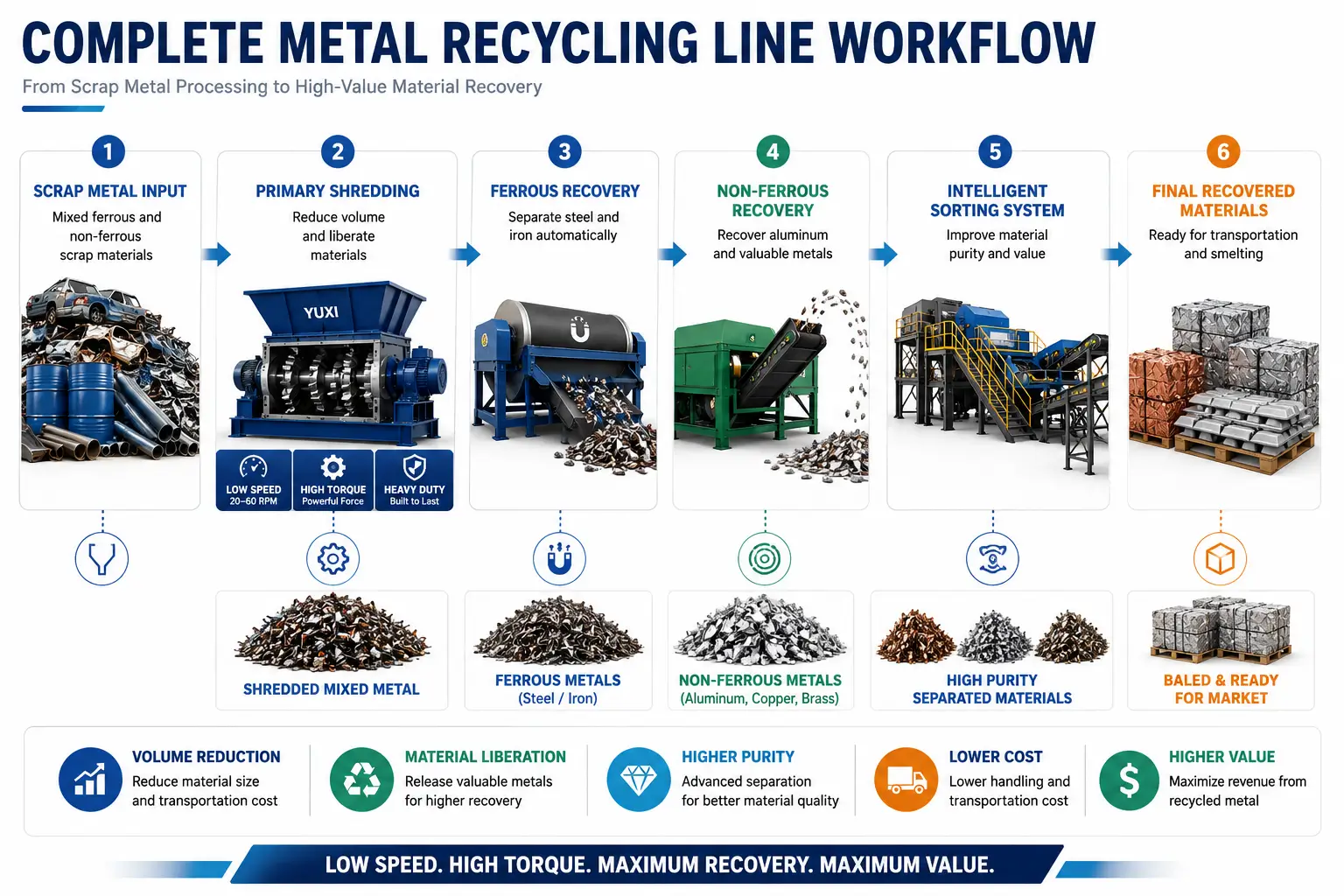
Metal shredding adopts a standardized mechanical process, which includes six core procedures: material feeding, material grabbing, tearing, shearing, gradual size reduction and finished material discharge.While the entire procedure appears simple from the exterior, each stage exerts a direct influence on production throughput, blade service life, finished shredded material quality and the stable operation of the whole equipment.
Step 1: Load Raw Scrap Into the Machine
Scrap metal is fed into the hopper. Feed methods vary based on your factory layout-options include manual loading, forklift feeding, grab crane delivery or conveyor transport. The core goal is maintaining a consistent stream of scrap without overfilling the cutting chamber.
Step 2: Material Gripping
As the twin shafts spin, the hooked blades latch onto scrap and drag it inward. This is exactly why sufficient torque matters so much. High-torque shredders excel at processing irregular and bulky scrap such as crushed steel drums, bundled sheet metal, waste appliance housings and aluminum profiles, outperforming low-torque models by a wide margin.
Step 3: Tearing & Shearing
Once scrap enters the cutting zone, intermeshed blades generate strong shearing force. Thin sheet metal slices apart instantly, while thick or folded stock gets ripped apart over multiple rotation cycles. The machine breaks materials down with a mix of compressive cutting power and downward pulling tension.
Step 4: Gradual Size Reduction
Scrap circulates repeatedly between the cutting blades until it shrinks to a size that passes through toward the discharge outlet. The final fragment size is determined by blade thickness, hook profile, shaft clearance, optional screen specifications, and the inherent hardness and thickness of your input scrap.
Step 5: Discharge and Subsequent Transport
Once shredded completely, the processed scrap falls onto a conveyor belt for further transportation. From there it may go to magnetic separation, eddy current separation, manual sorting, baling, or secondary crushing. Within a full recycling production line, the shredder acts as the primary processing stage, pre-breaking scrap to enable more precise metal sorting and recovery downstream.
What Materials Can a Metal Shredder Process?
A well-engineered scrap metal shredder is capable of handling an extensive variety of waste metal materials.However, capacity and blade selection should always be matched to the material. A machine designed for aluminum profiles may not be suitable for heavy structural steel without modification.
Ferrous Scrap
It can process scrap steel, metal sheets, leftover steel rebar, steel drums and light structural metal scraps.
Non-Ferrous Scrap
Aluminum extrusions, copper scrap, brass fittings, zinc castings and assorted mixed non-ferrous metal waste.
Appliances & ELV Scrap
Refrigerators, washing machines, car body panels, vehicle parts, and mixed appliance shells.
For appliance and automotive scrap, shredding also helps liberate attached materials. For example, a refrigerator may contain steel, plastic, foam insulation, copper, and aluminum. Shredding opens the structure so that separation equipment can recover each material more efficiently.
Benefits of Metal Shredding for Recycling Plants
1. Volume Reduction
Bulky scrap occupies excessive storage space and reduces truck loading efficiency. Shredding cuts down material volume and raises bulk density, thus cutting costs for material transportation and storage.
2. Lower Transportation Costs
Smaller material allows more scrap to be loaded into each truck or container. For scrap yards shipping material to mills or downstream processors, this can create direct savings.
3. Improved Sorting Efficiency
Magnetic separators and eddy current separators work better when the feed material is smaller and more consistent. Shredding improves separation accuracy by exposing individual material components.
4. Better Material Liberation
Many metal wastes are composite products. Shredding enables effective separation of metals from impurities including plastic, rubber, foam, glass and insulation materials, which significantly improves the purity of recycled metal products.
5. Higher Recycling Value
Clean, properly sized scrap is generally easier to sell or process. ReMA’s ISRI Specifications provide a common language for trading recycled commodities including ferrous and non-ferrous metals. ISRI Specifications
Metal Shredder vs Hammer Mill: What Is the Difference?
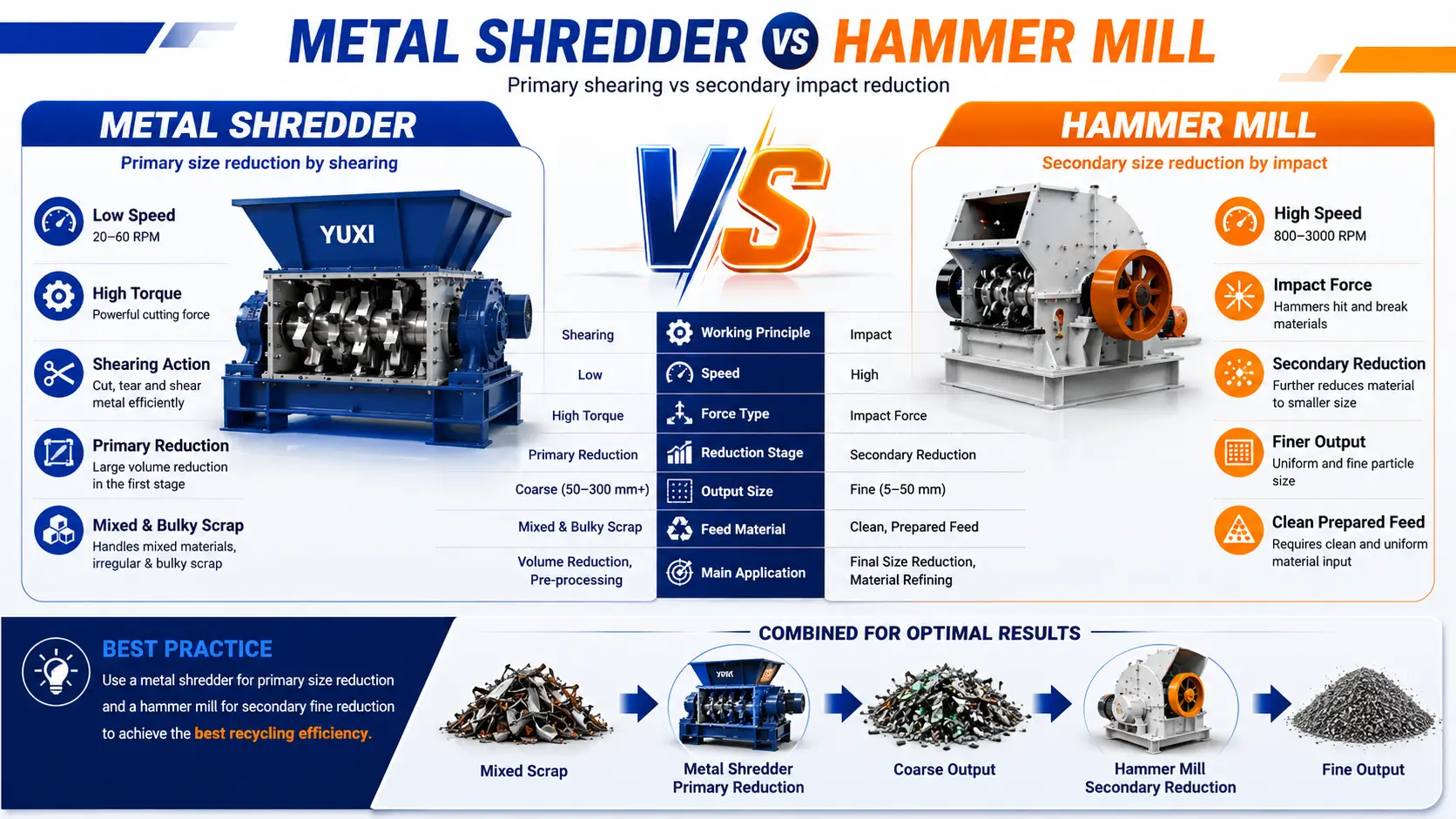
Though metal shredders and hammer mills are both widely utilized in metal recycling, they are two distinct types of equipment with different working principles, applicable materials and processing positions in production lines. Double-shaft metal shredders are generally adopted for primary coarse crushing, while hammer mills serve as secondary crushing equipment to further pulverize materials into finer fragments.
| Feature | Metal Shredder | Hammer Mill |
|---|---|---|
| Working Principle | Shearing, tearing, and cutting | High-speed impact and collision |
| Speed | Low speed | High speed |
| Torque | High torque | Medium to high impact energy |
| Best Use | Primary reduction of bulky and mixed scrap | Secondary reduction or finer fragmentation |
| Dust and Noise | Usually lower | Usually higher |
| Typical Processing Materials | Twin-shaft metal shredder: Steel drums, waste household appliances, assorted bulky scrap, aluminum profiles | Hammer mill: Pre-crushed metal scraps, pre-shredded feedstock |
For most recycling projects, relying solely on a single piece of equipment is not the optimal solution. The metal shredder first crushes large, bulky scrap into easy-to-handle fragments, and the hammer mill carries out further pulverization of the pre-shredded materials when fine granular finished products are required.
How to Choose the Right Metal Shredder
Selecting a suitable industrial metal shredder involves far more than simply comparing motor power ratings.A good selection starts with material testing and project requirements.
Material Type and Feed Size
List the main materials you need to process: drums, aluminum profiles, car body panels, refrigerators, mixed light scrap, or heavier steel. Feed size determines hopper design and chamber size.
Required Capacity
Processing capacity is commonly measured in kilograms per hour (kg/h) or tons per hour (t/h). The actual throughput is determined by multiple factors including material bulk density, feeding mode, blade structure and discharging efficiency.
Target Output Size
Primary shredders produce coarse fragments for sorting or secondary reduction. If you need a small final size, the line may require additional crushing or screening equipment.
Blade Thickness and Material
The blade thickness needs to match the type of scrap being processed. Thick blades deliver superior strength for heavy-duty metal recycling tasks, while thinner blades produce finer shredded output when handling lighter metal materials.
Automation and Safety
Prioritize models equipped with PLC overload protection, auto-reverse function, emergency stop device, safety guards and stable electrical control systems. These configurations boost operational stability and cut equipment downtime effectively.
How a Metal Shredder Fits into a Complete Recycling Line
A metal shredder usually serves as the front-end equipment of a full recycling production line. After materials are shredded to a uniform size, the subsequent sorting equipment can recover ferrous and non-ferrous metals with much higher efficiency.
A typical line may include:
- Feeding conveyor or loading hopper
- Primary metal shredder
- Discharge conveyor
- Magnetic separators pull out ferrous metals.
- Eddy current units pick up all non-ferrous metals instead.
- Manual or optical sorting system
- Baler or storage system
YUXI is capable of customizing standalone units or full recycling production lines tailored to customers’ factory layouts, raw material categories and target throughput. If you’re building a new scrap yard or upgrading your existing processing line, getting this complete turnkey system beats buying every piece of equipment separately hands down.
Want to build a scrap metal recycling line?
Just tell me what materials you process, raw scrap size, your hourly output target and your factory floor space.YUXI engineers can recommend a suitable shredder model and line configuration.
Request a Project Recommendation ?Real Applications of Metal Shredder Machines
Scrap Metal Recycling Yards
Recycling shops rely on shredders to shrink bulky mixed metal scrap. This saves space for truck shipments and preps materials for sorting or selling.
Waste Household Appliance Recycling Plants
Recyclers of discarded household appliances utilize metal shredders to disintegrate refrigerators, washing machines, air conditioners and water heaters. This process strips metallic components apart from plastic casings and insulating fillers for subsequent sorting and recycling.
Automobile Recycling Plants
Vehicle recycling facilities deploy shredders to process car body panels and pre-treated auto scrap prior to ferrous and non-ferrous metal separation.
Aluminum Recycling Plants
Aluminum extrusions and factory production scrap are shredded to cut bulk volume and produce uniform, stable feedstock for melting or sorting procedures.
Industrial Manufacturing Facilities
Manufacturing factories rely on metal shredders to handle production trimmings, defective finished parts, metal packaging waste and other internal scrap materials.
Wrap-up: Metal shredders are the backbone of efficient metal recycling operations
Metal shredders operate via low-speed, high-torque rotating shafts fitted with alloy steel blades, which grip, tear and shear scrap metal to break it down into uniform small fragments. This simple mechanical principle creates major benefits for recycling operations: lower storage volume, better transport density, improved sorting efficiency, better material liberation, and higher recovered material value.
For a recycling plant, the shredder is not just a machine. It is the starting point of the entire material recovery process. When matched with conveyors, magnetic separators, eddy current sorters, sorting machines and balers, the shredder constitutes a complete all-in-one metal recycling production line.
When purchasing a metal shredder for scrap metal recycling, you need to take multiple core factors into consideration: raw material categories, hourly processing capacity, blade structure, final shredded material size, degree of automation and layout of downstream supporting equipment. Pick the right shredder matching your actual production needs, and you’ll run smoother day-to-day while earning more profit long-term from your recycling business.
Common Questions
How do metal shredders actually work?
These machines have slow-turning, high-power shafts with tough cutting blades. They grab scrap metal, pull it into the cutting area, then rip and slice everything into small pieces. The shredded materials are finally discharged onto conveyors for subsequent separation processes.
What is the working principle of a metal shredder?
Its core working principle relies on mechanical shearing. A pair of counter-rotating drive shafts fitted with interlocking alloy blades produce intense cutting force, gradually crushing bulky scrap metal into readily processable fragments.
What materials can a metal shredder handle?
Subject to the machine model and blade specifications, metal shredders are capable of processing scrap steel, aluminum extrusions, steel barrels, automotive body panels, discarded refrigerators and washing machines, copper scraps, as well as mixed metal waste.
Is a double shaft shredder good for metal recycling?
Definitely. Double-shaft shredders are everyone’s top pick for first-stage crushing in scrap yards and recycling factories. They pack massive torque, grab scrap firmly, and come with tough long-lasting blades built for nonstop heavy work.
What is the difference between a metal shredder and a hammer mill?
Metal shredders adopt low-speed shearing to realize primary volume reduction of bulky or mixed scrap materials. Hammer mills rely on high-speed impact force for secondary crushing or fine processing after pre-shredding.
Can a metal shredder shred steel drums?
Yes. Industrial-grade metal shredders are regularly applied to dispose of steel oil drums, metal buckets and other hollow metal waste of similar types.
Can a metal shredder process car bodies?
Metal shredders can handle auto body panels and fragmented vehicle scrap. A full end-of-life vehicle recycling production line usually integrates pre-processing devices, magnetic separators, eddy current separators and sorting equipment for complete treatment.
What output size can a metal shredder achieve?
Output size depends on blade thickness, knife hook design, shaft speed, screen configuration where applicable, and the material being processed. Primary metal shredders usually produce coarse fragments for further sorting or secondary reduction.
How much does a metal shredder cost?
Metal shredder cost depends on capacity, motor power, blade material, chamber size, automation level, and whether the project requires conveyors and separation equipment. Most industrial systems are quoted according to project requirements.
How do I pick the right metal shredder?
Base your choice on what scrap you process, the size of your raw materials, how much you need to crush each hour, the piece size you want after shredding, your power supply, matching downstream machines, upkeep costs and any plans to expand later on.
Industry References
Looking for a Metal Shredder Machine for Your Recycling Plant?
YUXI provides heavy-duty metal shredders and complete metal recycling solutions for scrap yards, appliance recycling plants, aluminum recycling projects, and mixed metal waste processing lines.
View Metal Shredder Machine ?