




 Request Quote


Article navigation
Quick answer: how scrap cable recycling worksWhy the process matters more than a single machineStep 1: Receive, inspect and sort the scrap cableStep 2: Pre-cutting or shredding opens the cable structureStep 3: Granulation cuts cable into “copper rice” and plastic fragmentsStep 4: Air-gravity separation splits copper from plasticStep 5: Dust collection keeps the dry process under controlStep 6: Optional electrostatic separation for higher purityStep 7: Check copper recovery and output qualityTypical process layout for a scrap cable recycling lineHow to improve copper recovery rate in daily operationCommon troubleshooting tableScrap Cable Recycling Process: A Practical Guide
A buyer rarely asks for a “machine” only. What they really need is a process that can turn mixed, dirty, awkward cable scrap into saleable copper granules without losing too much copper into the plastic stream. The Scrap Cable Recycling Process is therefore not just shredding. It is a controlled sequence of sorting, size reduction, granulation, air-gravity separation, dust collection, quality checking and, when needed, electrostatic polishing.
This guide explains the process from an operator’s point of view and connects it with the way YUXI designs its Copper Wire Recycling Line: a dry mechanical system built to process waste copper wires, separate copper from plastic, and support resource recovery for cables that are often not suitable for manual stripping.
Quick answer: how scrap cable recycling works
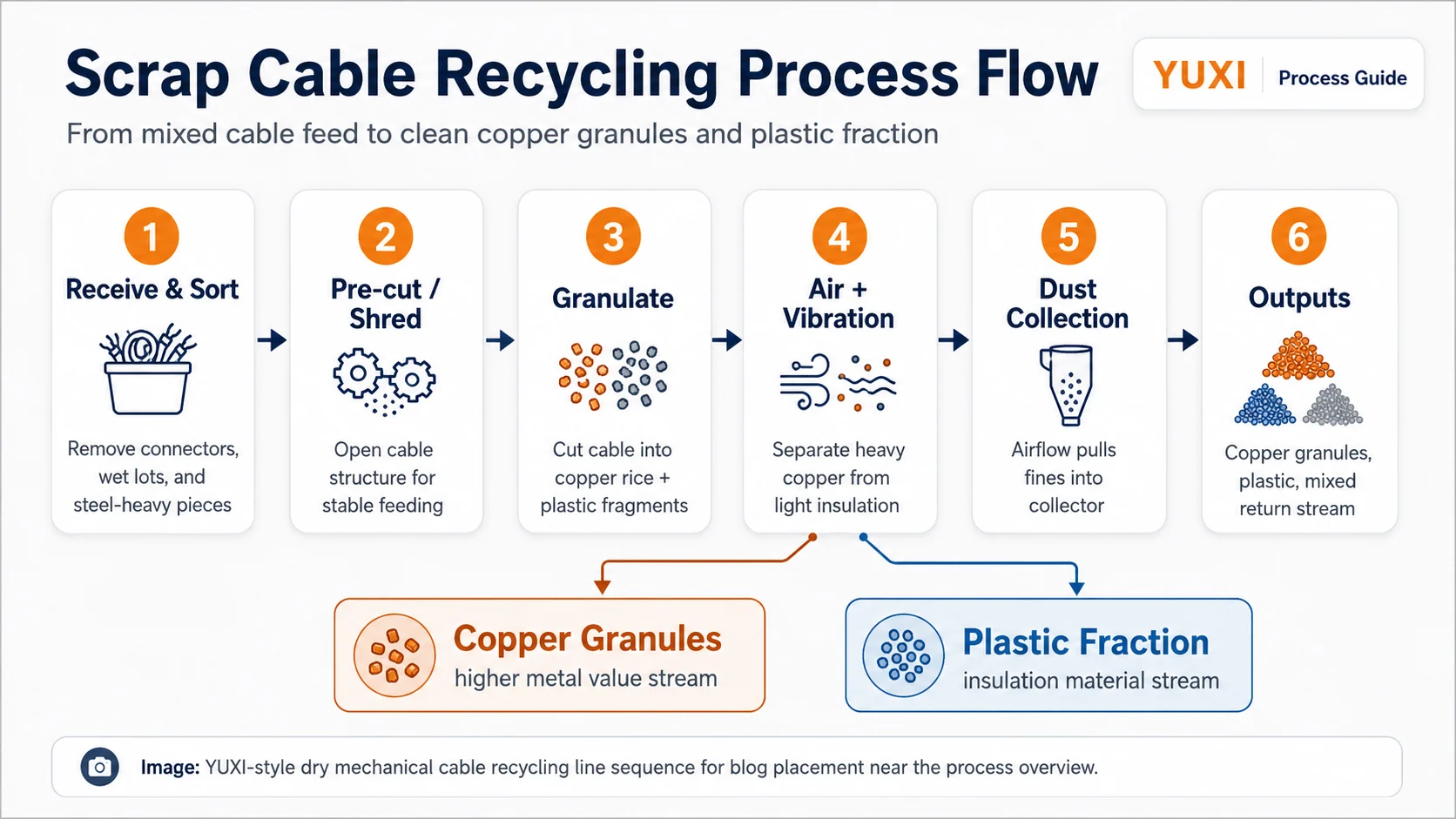
Scrap cable is first inspected and sorted to remove unsuitable materials. It is then shredded or pre-cut, granulated into small copper-and-plastic particles, conveyed into an air-gravity separator, and separated by the combined action of airflow suction and screen vibration. Heavier copper granules discharge from one outlet, lighter plastic insulation exits from another outlet, and mixed material can be returned for re-separation. Dust is pulled through air ducts into a dust collector.
Why the process matters more than a single machine
Two cable lots can look similar from a distance but behave very differently in the machine. Automotive harness wire may contain clips and terminals. Communication cable may include very fine conductors. Appliance cables may have flexible insulation that does not break cleanly if the cutter gap is wrong. Large power cable may still be better handled by stripping or pre-cutting before granulation. This is why a good process begins with the feedstock, not the discharge outlet.
YUXI lists common application materials such as automobile circuit lines, motorcycle lines, battery lines, household appliance wires, communication lines and computer lines. The important detail is that these are waste wires “not suitable for processing by wire stripping machines.” In other words, the granulation process is especially valuable when manual or stripping-machine recovery is too slow, inconsistent or labor-heavy.
The market reason is also clear. Copper is still crucial to electrification,and recycling copper can reduce the pressure on primary resources.The International Copper Association said that recycled copper requires 85% less energy than primary production, and the International Energy Agency expects that copper demand will grow strongly in a clean energy situation.For recyclers,this macro trend will only be useful if the factory can control the purity,recovery rate and operating costs..
Step 1: Receive, inspect and sort the scrap cable
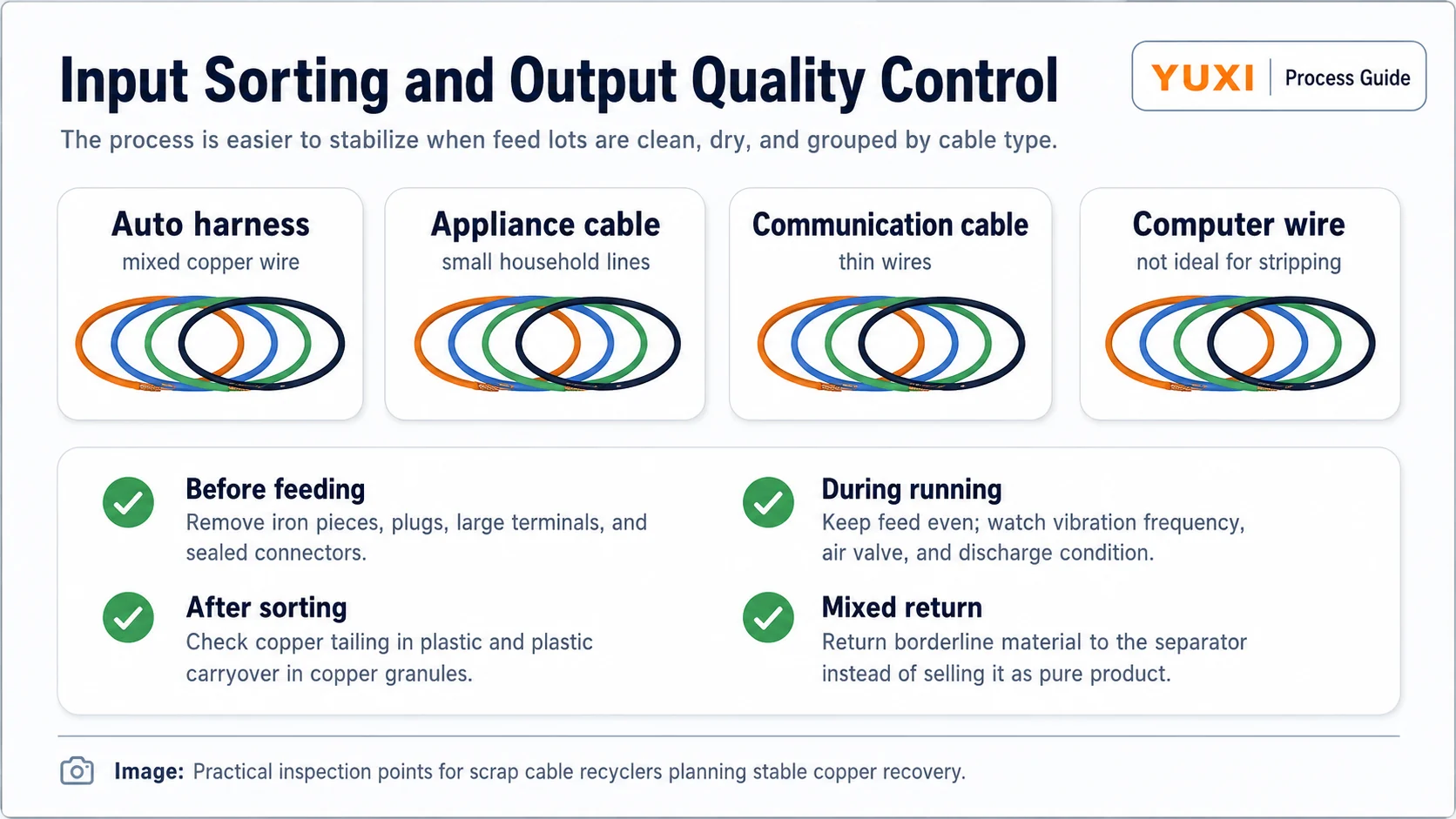
Before feeding, operators should separate obvious problem material. Remove large steel connectors, plugs, rubber blocks, sealed components, stones, wet sludge, lead-acid battery pieces and anything that could jam the blades or contaminate the output. If the cable lot contains valuable thick copper cable, it may be worth stripping that fraction separately and sending only the complex thin wire to the granulator.
Practical sorting normally focuses on four questions:
- Is it copper or aluminum? Aluminum wire behaves differently and affects the selling grade of the copper fraction.
- Is the feed dry? Wet insulation carries fines, clogs screens and reduces separation sharpness.
- Is the size range too wide? Very thick and very thin cable in the same run can make cutter and airflow settings unstable.
- Are there hazardous or non-cable materials? Unknown e-waste components should be removed before mechanical processing.
Step 2: Pre-cutting or shredding opens the cable structure
Some cable scrap can go directly to a granulator, but tangled bales, long harnesses and mixed wire bundles often need pre-cutting or shredding first. The goal is not to make final copper granules at this stage. The goal is to reduce length, loosen bundles and make feeding predictable.
In a complete line, the pre-shredding stage also protects downstream equipment. A stable feed mat reduces sudden motor load changes, prevents long wire from wrapping around shafts, and gives the granulator a more consistent bite. For heavy or bulky feed, a shredder before the granulator can be optional but useful, especially when the incoming cable is long, tangled or delivered in compressed lots.
Step 3: Granulation cuts cable into “copper rice” and plastic fragments
The granulator is the heart of the process. Its job is to cut the cable small enough that copper conductor and insulation can separate physically. If the particle size is too large, copper may remain locked inside insulation. If the particle size is too fine, copper dust and plastic fines increase, which can lower recovery and make dust control harder.
YUXI describes the material after shredding and crushing as plastic fragments and copper rice. That wording is useful because it reminds operators what they are trying to produce: discrete, liberated particles. The granulator does not “melt” the cable and does not use chemicals. It prepares the material for dry separation.
Step 4: Air-gravity separation splits copper from plastic
Once the cable is granulated, the mixture moves to the separation table. YUXI’s process description explains that the material moves forward on a waveform screen surface, and the core and skin are separated by the dual effects of airflow suction and linear vibration. Copper, plastic and mixed material leave through different outlets.
The separation principle is simple but sensitive. Copper is heavier while plastic insulation is lighter. On the vibration screen, airflow and vibration produce different movement paths. Heavier copper particles travel a shorter path and drop into the copper outlet. Lighter plastic pieces travel farther and discharge separately. Borderline material exits as a mixed fraction and should usually be returned for another pass.
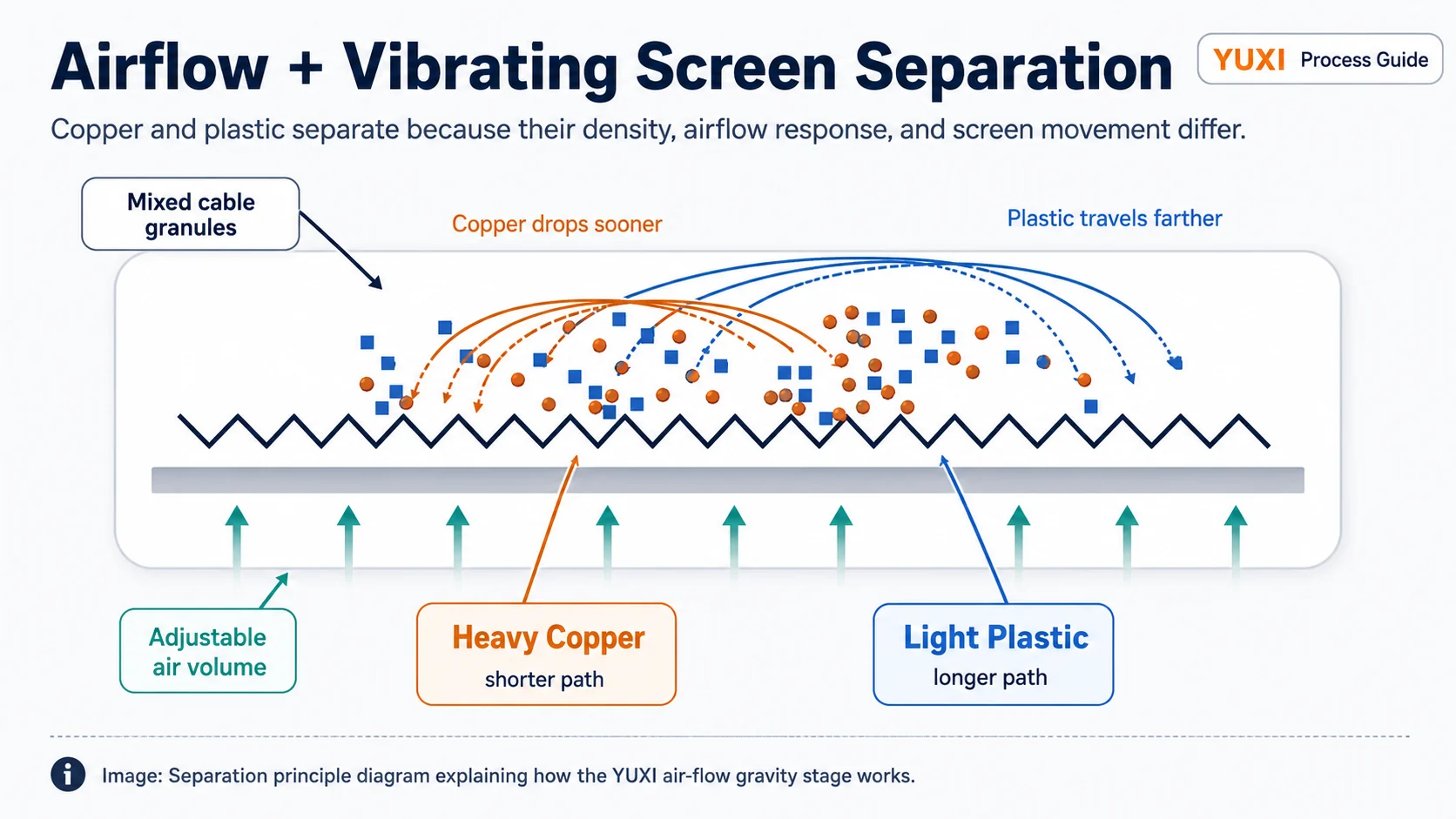
YUXI’s Air Flow Gravity Separator page describes the same specific-gravity idea: heavier particles have shorter movement trajectories under airflow, while lighter particles have longer movement trajectories before being collected in layers through the discharge port. In real production, that means the operator must balance feed rate, screen vibration, air volume and particle size together rather than adjusting one setting blindly.
Step 5: Dust collection keeps the dry process under control
Dry cable recycling creates dust from insulation, copper fines and surface contamination. YUXI’s copper wire recycling line includes a dust collector, and the product page notes that dust reaches the dust collector through the air duct. This matters for both housekeeping and recovery. Poor dust control can contaminate the working area, reduce visibility around the machine, and carry fine copper into waste streams.
A good dust-control plan includes sealed covers, intact air ducts, routine filter checks, negative pressure at the right points and careful cleaning around conveyors and outlets. Dust control is also part of environmental performance. EPA’s recycling guidance emphasizes energy conservation and reducing waste and pollution; in cable recycling, those benefits depend on running the plant with controlled emissions and usable output fractions.
Step 6: Optional electrostatic separation for higher purity
Air-gravity separation is the standard workhorse stage, but some materials need a polishing stage. Fine wire, flexible insulation, mixed cable grades or high-value copper contracts may require additional cleaning. In that case, electrostatic separation can be added after the main separator.
YUXI’s High Voltage Electrostatic Separator is designed for conductor and non-conductor mixture particles. It uses the difference in charging properties in the high-voltage electric field to separate metals and non-metals. For cable recycling plants, this type of stage is usually considered when buyers need cleaner copper particles, cleaner plastics, or better results from small particle mixtures.
Step 7: Check copper recovery and output quality
Do not judge the process only by how shiny the copper outlet looks. The real question is where the copper went. Operators should sample the copper fraction, plastic fraction and mixed return fraction at the same time. A bright copper stream is not enough if too much copper is hiding in the plastic outlet.
Useful checks include:
- Copper carryover in plastic: Shake or pan a plastic sample and look for heavy copper grains at the bottom.
- Plastic contamination in copper: Inspect copper granules under good light and check for colored insulation fragments.
- Particle liberation: Look for copper still wrapped in insulation; this suggests the granulator setting or screen size needs adjustment.
- Moisture: Damp feed can make plastic stick to copper and reduce separation accuracy.
- Mixed stream volume: A large mixed stream may mean the air valve, vibration frequency or feed rate is not balanced.
Typical process layout for a scrap cable recycling line
A practical dry cable recycling line normally follows this layout:
- Manual sorting or feed preparation area
- Optional shredder or pre-cutter for long cable and tangled bundles
- Feeding conveyor
- Granulator or crusher
- Fan conveyor or air conveying section
- Vibrating screen / air-gravity separator
- Dust collector and air duct system
- Copper outlet, plastic outlet and mixed-material outlet
- Optional electrostatic separator for polishing
- Bagging, storage and QC sampling area
This matches the YUXI product description closely: the cable wire recycling machine consists of a crusher, fan conveyor, vibrating screen, dust collector and electrical control. The vibrating screen is controlled by frequency conversion, while the air volume is controlled by a regulating valve. These two controls are important because cable lots change, and the separator must be tuned to the actual material.
How to improve copper recovery rate in daily operation
Most recovery problems are not caused by one dramatic failure. They come from small mismatches: uneven feed, dull blades, damp insulation, excessive fines, poor air settings or skipped sampling. The following adjustments usually matter most.
Keep the feed rate steady
Overfeeding forces mixed particles across the screen before they have time to stratify. Underfeeding may look clean but reduces capacity and can make airflow too aggressive for the material. Use a conveyor and avoid dumping batches directly into the granulator.
Maintain sharp cutters and correct clearances
Dull blades smear insulation and create long strips instead of clean fragments. Poor liberation forces the separator to solve a problem that should have been fixed in the granulator.
Control particle size
Particle size should be small enough for liberation but not so fine that copper dust increases. A balanced granule size improves both recovery and dust control.
Adjust air and vibration together
If copper appears in the plastic outlet, air may be too strong, feed may be too high, or particles may be too fine. If plastic appears in the copper outlet, air may be too weak, vibration may be poorly tuned, or the material may not be fully liberated.
Return the mixed fraction
The mixed outlet exists for a reason. Sending borderline material back through the separator is often better than contaminating the final copper or plastic stream.
Common troubleshooting table
| Symptom | Likely cause | Practical response |
|---|---|---|
| Copper in plastic outlet | Air too strong, feed too fast, particles too fine or uneven | Reduce air volume, stabilize feed, check screen and granulator setting |
| Plastic in copper outlet | Air too weak, poor liberation, damp feed | Increase airflow carefully, dry feed, inspect blade sharpness |
| Large mixed-material stream | Material size range too wide or vibration setting not balanced | Improve pre-sorting, adjust vibration frequency and reprocess mixed stream |
| Excessive dust | Over-granulation, damaged ducting, poor filter condition | Check particle size, seal air ducts, clean or replace collector filters |
| Granulator overload | Long tangled cable, steel pieces, sudden batch feeding | Pre-cut/shred feed, remove contaminants, use controlled conveyor feeding |
Safety and environmental controls
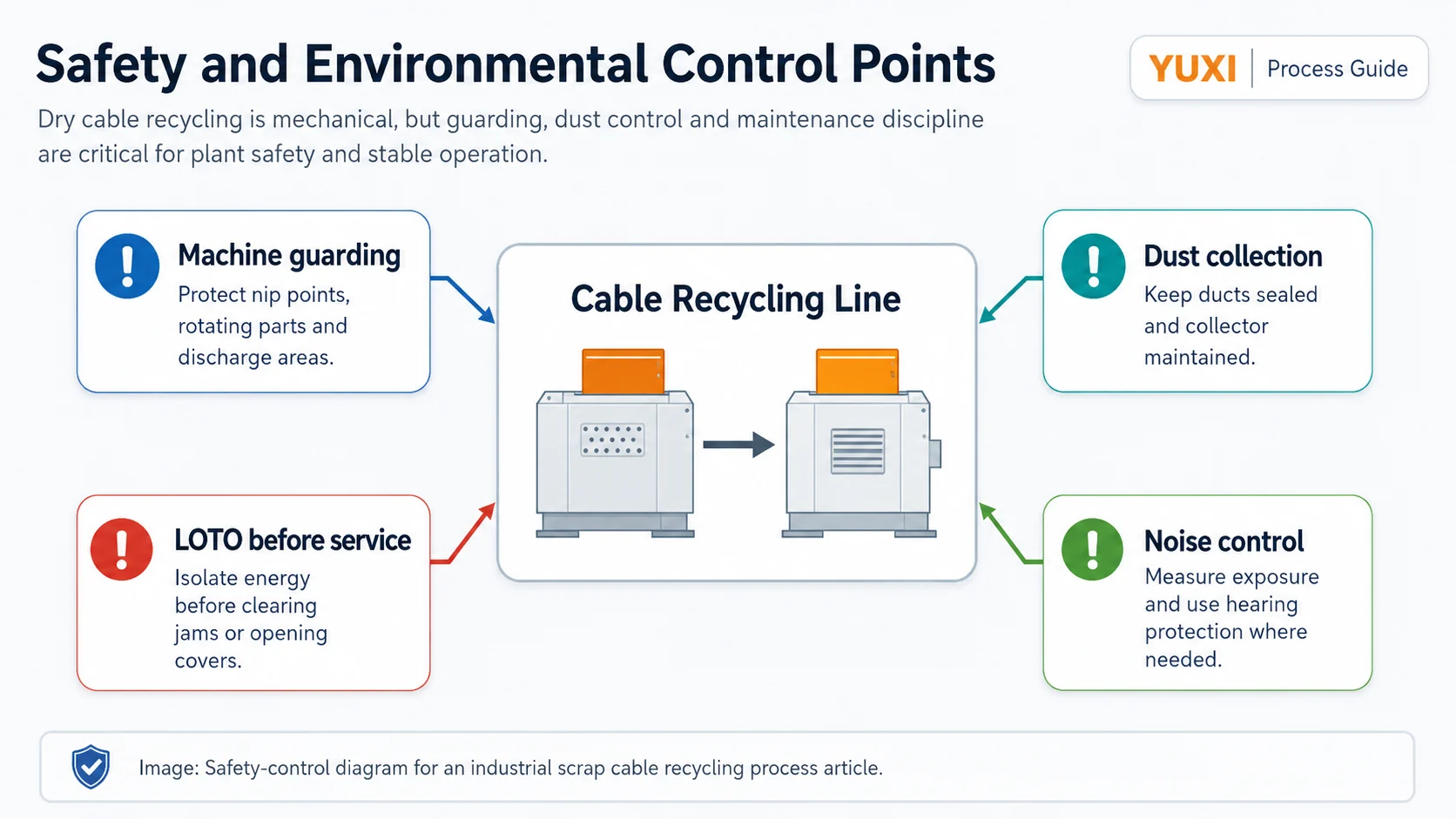
Cable recycling lines include rotating cutters, conveyors, fans, vibrating equipment and electrical controls. OSHA’s general machine-guarding requirement says guarding should protect operators and nearby employees from hazards such as point of operation, ingoing nip points, rotating parts, flying chips and sparks. That applies directly to granulators, shredders, belt conveyors and discharge points.
Maintenance is another high-risk moment. Clearing a jam, opening a cover, replacing a screen or inspecting a cutter should follow lockout/tagout procedures. OSHA’s control of hazardous energy guidance places responsibility on employers to protect workers from hazardous energy and train workers on applicable energy-control procedures.
Noise should not be ignored. NIOSH said that the recommended exposure limit is 85 dBA,with an average of eight hours a day. Cable granulators, shredders, air fans and dust collectors will produce continuous industrial noise, so factories should measure exposure and provide control when needed.
When a scrap cable recycling process is better than wire stripping
Wire stripping is still useful for straight, thick, clean cable where the conductor can be removed easily. Granulation becomes more attractive when the cable is thin, tangled, mixed, short, flexible or labor-intensive. This is why many recyclers use both methods: strip the high-value large cable, then granulate the complex remainder.
A cable recycling process is usually the better fit when:
- the scrap lot contains many small wires or harnesses;
- manual stripping cost is too high;
- the cable is short, bent or tangled;
- the recycler needs continuous throughput;
- the business wants both copper and plastic output streams;
- the feedstock comes from appliances, vehicles, communication equipment or computer wire.
Commercial factors that decide line configuration
There is no universal line for every cable recycler. The correct configuration depends on feed type, hourly capacity, target purity, labor cost, available space, local environmental rules and buyer specifications. A small recycler may start with sorting, granulation, air separation and dust collection. A larger plant may add pre-shredding, multiple conveyors, automatic feeding, electrostatic polishing and more detailed sampling stations.
When discussing a project, prepare sample photos and basic feed data: cable type, approximate diameter range, copper content, expected tons per day, moisture level, contamination level and desired output grade. These details make the equipment proposal more accurate than a generic capacity number.
Why choose a YUXI-style process design
YUXI’s copper wire recycling line is built around the practical stages discussed in this guide: crushing/granulating, fan conveying, vibrating separation, dust collection and electrical control. The product page states that the separation purity can reach over 99.9% by adopting crushing and sorting processes, and that the fully enclosed design helps collect dust effectively. For recyclers, those two points target the daily priorities that matter most: clean copper output and a cleaner working environment.
The strongest use case is not “any cable at any condition.” The strongest use case is mixed waste wire that is hard to strip but can be efficiently processed through dry mechanical liberation and separation. That includes many automotive lines, appliance wires, communication lines and computer wires.
FAQ: Scrap Cable Recycling Process
What is the first step in scrap cable recycling?
The first step is feed inspection and sorting. Remove large connectors, steel pieces, wet sludge, non-cable waste and hazardous items before the cable reaches the shredder or granulator.
Does cable recycling use water or chemicals?
A modern dry cable recycling process normally uses mechanical size reduction, airflow, vibration and sometimes electrostatic separation. It does not need water flotation or chemical leaching for ordinary copper-plastic cable separation.
Why is copper sometimes lost in the plastic outlet?
Copper loss usually comes from excessive airflow, overfeeding, too much fine material, poor liberation or wet feed. Sampling the plastic outlet is the fastest way to detect the problem.
What purity can a cable recycling line reach?
YUXI states that its copper wire recycling line can reach over 99.9% separation purity by adopting crushing and sorting processes. Actual production depends on cable type, feed preparation, equipment configuration and operator settings.
When should electrostatic separation be added?
When air gravity separation alone cannot meet the required purity, add electrostatic separation, especially fine particles,difficult to insulate,mixed cable grades or stricter copper/plastic buyer specifications.
Can the plastic insulation also be recycled?
Yes, but the value depends on the cleanliness, polymer mixture, local buyers and degree of pollution. Cleaner separation increases the opportunity to sell or further process plastic parts.
Conclusion
The Scrap Cable Recycling Process works best when it is treated as a complete production system, not a single machine purchase. Sort the feed, liberate copper cleanly, tune air and vibration, collect dust, sample every output and reprocess the mixed fraction. A well-configured YUXI cable recycling line gives recyclers a practical dry route for turning complex waste wire into copper granules and separated plastic with high recovery potential.
Planning a cable recycling line?
Send YUXI your cable photos, diameter range, expected daily capacity and target output purity. A process recommendation can then be matched to your real feedstock instead of a generic machine list.
Request a Process RecommendationReferences and source notes
- International Copper Association – Recycling — Copper recycling energy-saving and circular-economy context.
- International Energy Agency – Global Critical Minerals Outlook 2024 — Copper demand outlook for clean-energy technologies.
- US EPA – Recycling Basics and Benefits — Recycling benefits including energy conservation and waste/pollution reduction.
- OSHA 1910.212 Machine Guarding — Machine guarding requirements for operators and employees.
- OSHA Control of Hazardous Energy — Lockout/tagout responsibility and worker training context.
- NIOSH Noise-Induced Hearing Loss — 85 dBA eight-hour recommended exposure limit.