




 Request Quote


Cable Recycling Machine Guide
The cable recycling machine is not just a crusher with a copper outlet. For most recyclers, the real question is whether the production line can handle the cable combination they actually purchase: automotive wiring harnesses, household-appliance wires, computer cables, telecommunication cables, battery wires, fine copper wires, and materials that are too small or too mixed for wire strippers.
What is a cable recycling machine?
Cable recycling machine is a mechanical recycling system used to cut waste wires and cables, release them from metal conductors and insulating materials, and separate heavier copper or aluminum parts or lighter plastic or rubber. In the factory, people may call it a cable granulator, a copper wire granulator or a cable recycling production line. The name will change, but the work is the same: convert low-density cable scrap into saleable metal particles and cleaner non-metal parts.
YUXI locates its Copper Wire Recycling Line for the separation of waste copper wire and copper-plastic. The product page lists applications including automobile circuit lines, motorcycle lines, battery lines, TV wires, washing-machine wires, refrigerator and air-conditioner wires, communication lines and computer lines, especially wires that are not suitable for processing by wire stripping machines.
According to the International Copper Association,copper can be recycled repeatedly without improving its performance.Electronic recycling can recycle meaningful copper from products,otherwise these products will be stored in warehouses or into waste flow. The U.S. Environmental Protection Agency pointed out that recycling one million mobile phones can recycle about 35,000 pounds of copper and precious metals. For recycling plants, that’s why cable waste is regarded as a recoverable resource,not just mixed waste.
How a dry cable recycling machine works
Most modern cable granulator lines use a dry physical process. That means no burning and no chemical dissolution. A practical line uses cutting, airflow, vibration, screening and dust collection to separate copper from plastic. On YUXI’s product page, the line is described as consisting of a crusher, fan conveyor, vibrating screen, dust collector and electrical control. After shredding and crushing, the cable becomes plastic fragments and copper rice. Air suction and linear vibration move the material across the screen so copper, plastic and a copper-plastic mixed fraction can discharge from different outlets.
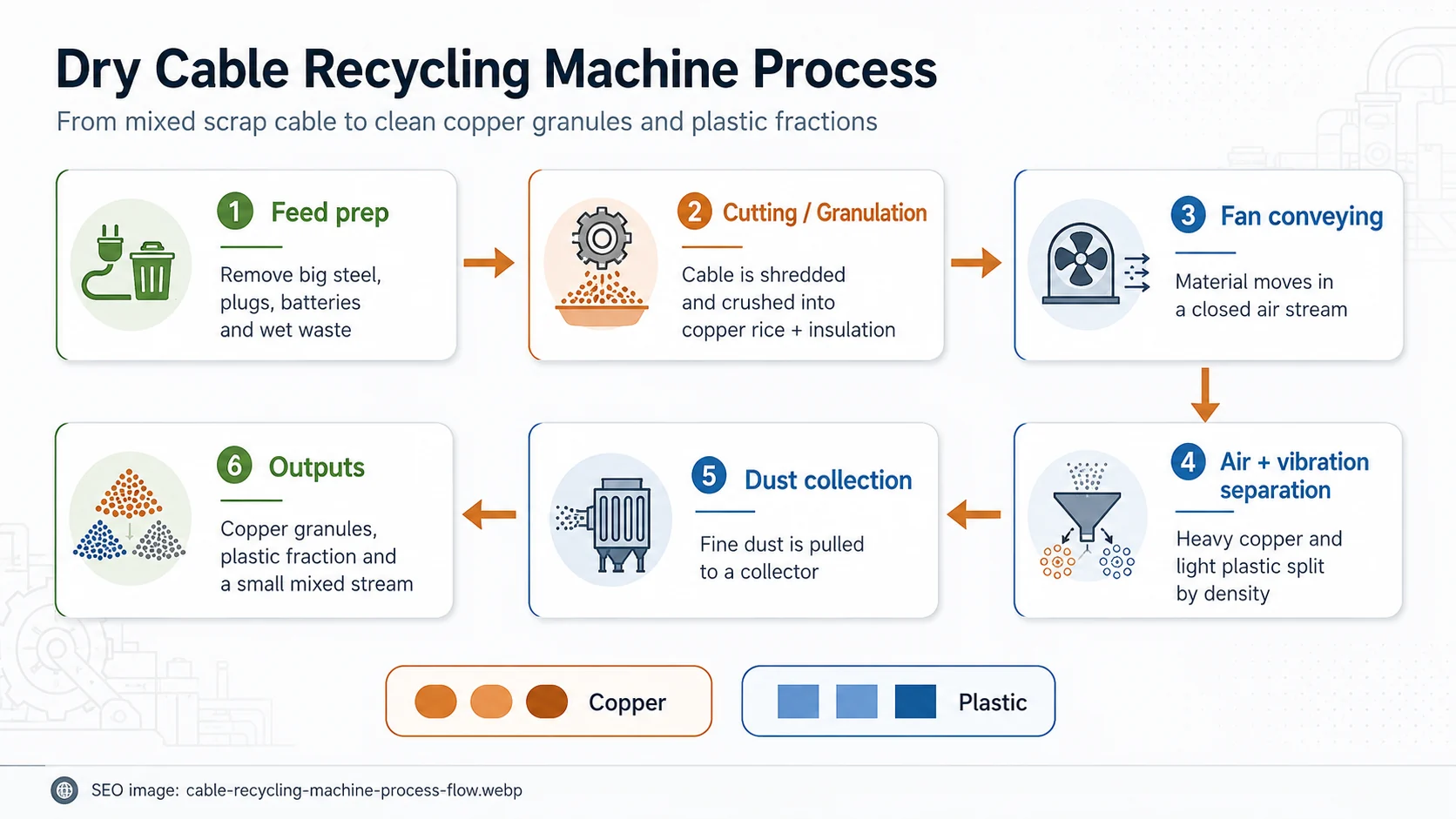
The process usually follows six steps:
- Feed preparation. Operators remove obvious steel, stones, plugs, batteries, wet material and oversized non-cable waste. This protects knives, screens and downstream separators.
- Cutting or granulation. Cable is chopped until the conductor and insulation are physically opened. The target is liberation, not simply the smallest possible particle.
- Air conveying. A fan moves the mixed copper-plastic particles in a controlled stream, reducing manual handling between the crusher and separator.
- Gravity and vibration separation. Copper is denser than plastic, so airflow and vibration help the heavier metal particles travel differently from lighter insulation.
- Dust collection. Fine dust is sucked into the dust collector through the air duct,keeping the system clean and reducing the annoying dust around the pipe.
- Outlet inspection. Operators check the copper outlet, plastic outlet and mixed-material return. If the mixed fraction is high, the line may need airflow, screen or feed-rate adjustment.
Main equipment in a complete cable recycling line
A cable recycling machine is often sold as one line, but buyers should understand the individual modules. This makes it easier to compare quotations and avoid a low-price system that leaves out the separator or dust-control capacity needed for stable copper purity.
1. Pre-shredder or feed cutter
Bulky cable bundles, long harnesses and connector-heavy scrap can bridge in a small granulator. A heavy pre-cutting stage reduces length and makes feeding more stable. For very bulky or mixed scrap preparation, a double-shaft metal shredder may be used before fine granulation, especially when the site processes other light metal scrap as well.
2. Crusher or granulator
The granulator opens the cable structure and creates the copper-plastic particle mix. Knife condition, screen opening, rotor speed and feed stability affect both throughput and liberation. Under-granulated material leaves copper attached to insulation; over-granulated material may create too much fine dust and make separation harder.
3. Air flow gravity separator
The separator is where most of the value is recovered. YUXI’s Air Flow Gravity Separator uses the different specific gravity of copper and plastic, with adjustable airflow and vibration, to separate heavier and lighter particles. For cable recycling, this is the core machine that turns crushed mixed material into cleaner copper and plastic streams.
4. High-voltage electrostatic separator
When the feed contains fine wires, very thin insulation, or stubborn mixed particles, an electrostatic stage can polish the output. YUXI’s High Voltage Electrostatic Separator is designed to separate conductors and non-conductors in an electric field. It is especially useful when the buyer wants higher metal-plastic separation after the first gravity stage.
5. Dust collector and electrical control
Dust collection is not an accessory to ignore. A cable recycling line cuts PVC, rubber and mixed insulation, so fine particles are created during crushing and conveying. A closed structure and negative-pressure dust collection help keep the line cleaner, while the control panel allows operators to manage start-up sequence, vibration frequency, air volume and emergency stop logic.
How to choose the right cable recycling machine
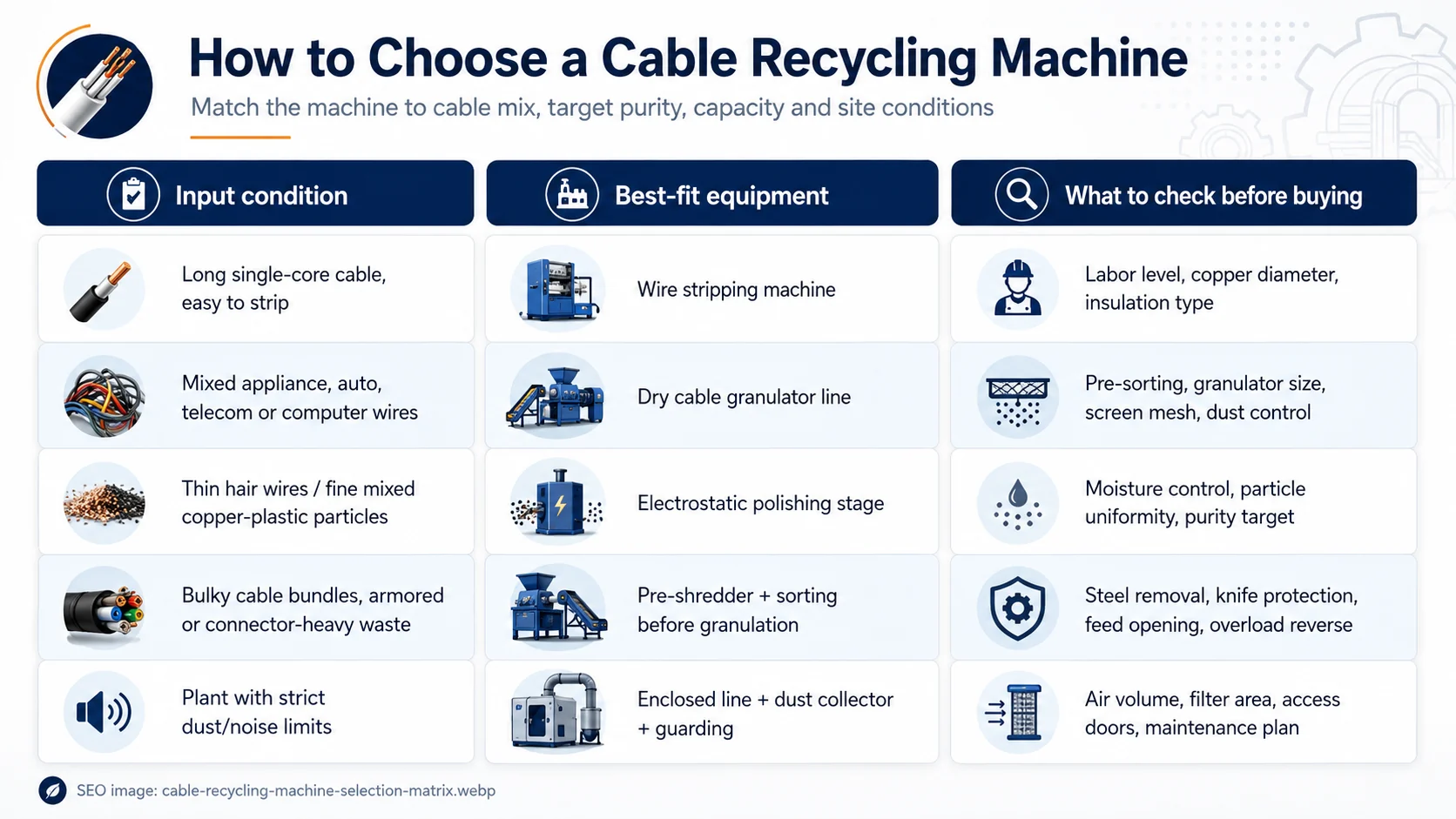
Search results for “Cable Recycling Machine Guide” often focus on price or capacity first. In real procurement, the better starting point is the material. Two machines with the same motor power can perform very differently if one is processing clean single-core cable and the other is processing mixed appliance harnesses with plugs, steel clips and thin copper strands.
Start with the cable mix
Make a simple table of what you plan to process: cable source, approximate copper content, diameter range, insulation type, moisture level, and how much steel or non-cable contamination is mixed in. Automotive harnesses, appliance wires and computer lines usually need granulation and separation. Large clean single-core cables may be stripped first if labor and cable size make stripping economical. Very fine wires often need a better separator and tighter operating control.
Define capacity as real input, not brochure capacity
A useful capacity number should be based on your real feed condition. The kg/h or t/h rating is based on clean copper wire, mixed household-appliance wire, automotive cable, or pre-cut cable. Dirty and heavy connector feed will reduce the stable output, even if the main motor is large.
Set a purity target and a recovery target
Purity and recovery are related, but they are not identical. A plant can make a very clean copper outlet while losing too much copper to the plastic outlet, or it can recover more copper but carry more plastic contamination. For most buyers, the target should be practical: clean copper granules that meet the buyer’s acceptance standard, while keeping copper loss in the plastic stream low enough for the economics to work.
Check space, power, dust and labor
Before ordering, confirm plant layout, available power, installation height, dust-collector position, forklift path, bagging or bin discharge, and maintenance space around the cutter and separator. A compact line can still be difficult to operate if operators cannot open access doors, remove screens, clean ducts or sample outlet material safely.
Copper recovery rate and separation purity
YUXI states that its copper wire recycling line can reach more than 99.9% separation purity by adopting crushing and sorting processes. That figure is a useful performance reference, but buyers should treat any purity claim as a system result under suitable feed and operating conditions. In practice, copper purity depends on feed cleanliness, particle size, moisture, airflow, screen loading, separator adjustment and operator sampling.
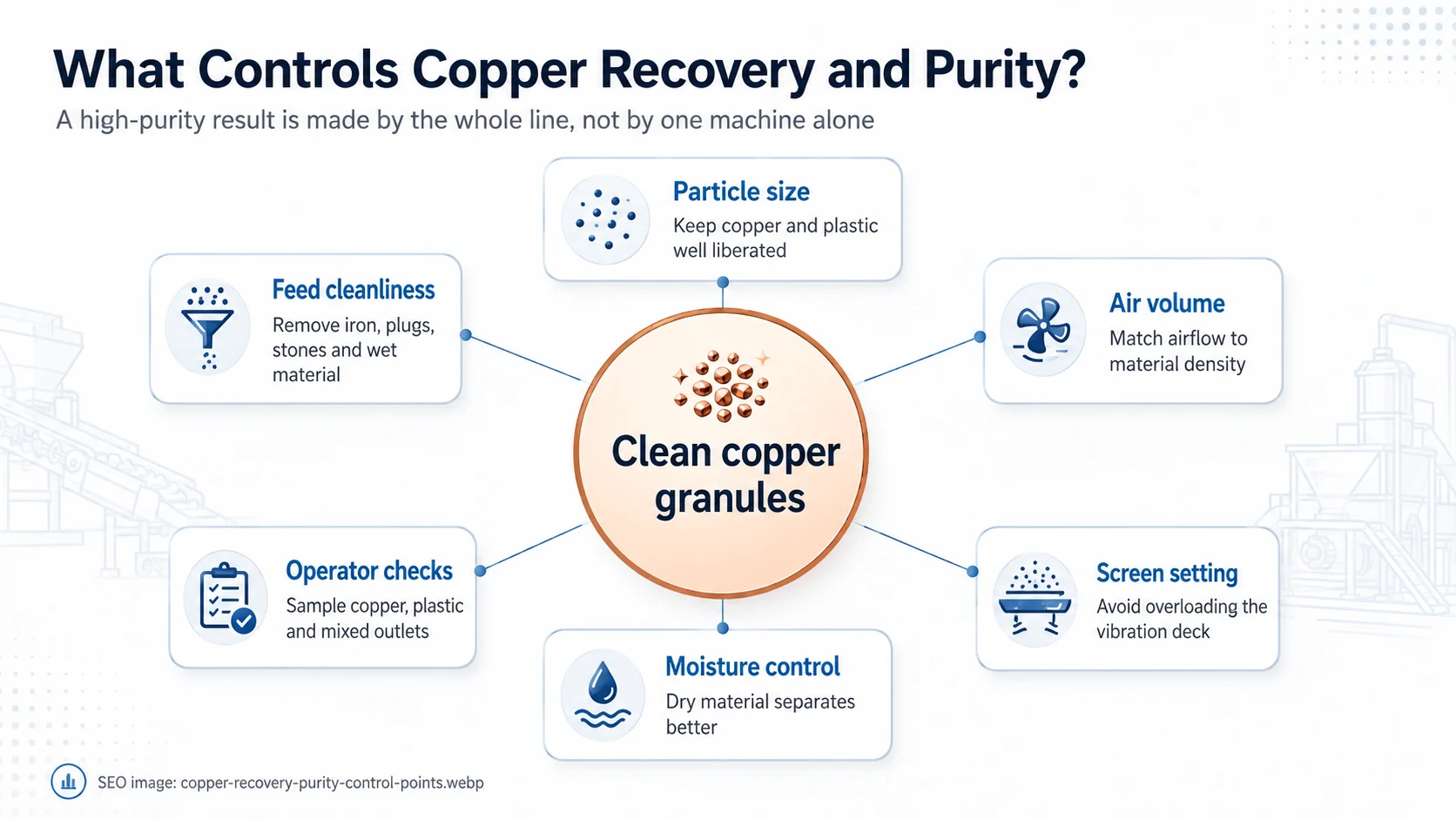
The most common purity problems are easy to diagnose:
- Plastic in copper outlet: airflow may be too low, feed rate too high, particle size uneven, or the screen may be overloaded.
- Copper in plastic outlet: airflow may be too strong, particles may be too fine, or copper may not be fully liberated from insulation.
- Too much mixed fraction: incoming cable may need better pre-sorting, the granulator screen may be wrong, or the line may need an electrostatic polishing step.
- Dust around the line: ducts, filters or negative-pressure settings may need attention, and the feed may be too dry or over-crushed.
A professional acceptance test should include sampling from all outlets, not only a photo of the copper product. Ask for a test using your actual material or a comparable material mix. A short test with clean cable is not the same as a full production day with mixed wires from a recycling yard.
Cable recycling machine price factors
There is no single reliable price for a cable recycling machine because the system can be configured as a small granulator, a complete dry copper wire recycling line, or a larger line with pre-shredding, multi-stage separation and dust control. A serious quotation usually reflects these factors:
- Production capacity and feed port: larger cutters, motor conveyors and separators increase cost, but at the same time,they can reduce labor and avoid bottlenecks.
- Material complexity: mixed cables, thin wires, plugs and armored material require more pre-sorting or stronger preparation equipment.
- Separation target: high-purity copper often needs better airflow control, vibration control, screens and sometimes an electrostatic stage.
- Dust and noise control: enclosed transfer points, ducting and filter area matter for real workshop conditions.
- Automation and service: control logic, overload protection, spare knives, screens, installation guidance and operator training should be compared between suppliers.
The cheapest quote can become expensive if the line cannot process the buyer’s real cable mix. The better question is: what copper quality and hourly output can the line maintain with your material after several hours of operation?
Safety, layout and compliance checks
Cable recycling equipment includes rotating cutters, conveyors, fans, vibrating screens, electrical control cabinets and dust collection. Safety should be built into layout and operating procedures, not added after installation.
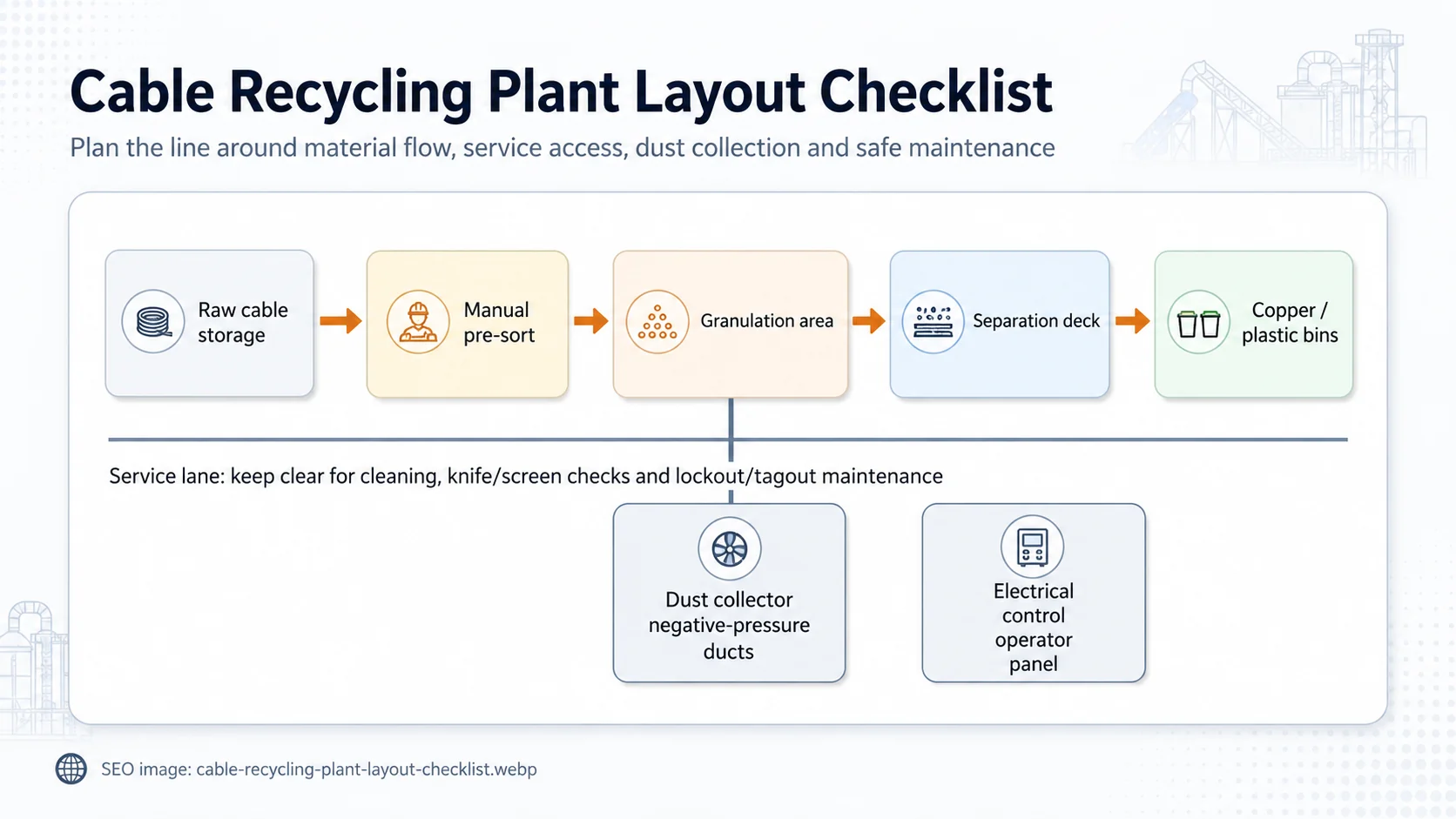
Practical plant layout checklist
- Keep raw cable storage, manual pre-sort, granulation, separation and finished-material bins in a straight flow where possible.
- Leave enough clearance for screen changes, knife inspection, bearing service and dust-collector maintenance.
- Use guarding around belts, rotating shafts, cutter access points and pinch points.
- Train operators not to reach into feed openings, discharge chutes or jammed material zones while equipment is energized.
- Create lockout/tagout steps for cleaning, knife replacement, screen changes, electrical work and jam removal.
- Use hearing protection and noise surveys where the operating environment approaches occupational-noise action levels.
- For international e-waste trade, verify local import/export rules. The U.S. EPA notes that, from January 1, 2025, Basel Convention controls apply to international shipments of electrical and electronic waste and scrap destined for recycling or disposal.
Questions to send a supplier before buying
Before asking for the final price, send the supplier a short technical questionnaire. This helps the supplier size the line and gives you a better way to compare offers.
1. MaterialWhat cable types, diameter ranges and contamination levels will you process?
2. CapacityUnder real feed conditions,how many kg/h or tons/day do you need?
3. OutputWhat is the purity of copper, the cleanliness of plastic and the tolerance of mixed-fraction required by your buyer?
4. UtilitiesWhat power supply, compressed air, floor area and installation height are available?
5. LaborHow many operators will sort, feed, sample, bag and clean the line?
6. ServiceWhat spare knives, screens, filters and wear parts are included in the first order?
Common mistakes when buying a cable recycling machine
Buying only by motor power. Motor power matters, but separator design, screen area, airflow control and dust collection often decide whether the plant can produce clean copper consistently.
Ignoring pre-sorting. Steel connectors, stones and batteries are not cable. If they enter the granulator, they can damage knives, contaminate output and slow the line.
Testing only clean material. Always test material that looks like your real feed. A demo with clean cable does not prove performance on automotive harnesses or appliance-wire mix.
Skipping dust planning. Cable recycling creates dust at cutting, conveying and separation points. Dust-control capacity should match the line, not be treated as a decorative accessory.
No acceptance standard. Define acceptable copper purity, copper loss, hourly throughput and operating conditions before installation, so commissioning has a clear target.
FAQ: Cable recycling machine guide
What materials can a cable recycling machine process?
It can handle many waste wires and cables,including automotive cables,motorcycle cables,battery cables,electrical cables,communication cables,computer cables and other small hybrid cables.The exact applicability depends on the cable diameter,insulation type,moisture and pollution.
Is the cable granulator better than wire stripping machine?
Both are not always better. The wire stripper can be economical for clean, long, larger-diameter cables.Cable granulators are usually more suitable for mixed, short, thin or tangled wires that cannot be peeled off efficiently.
What is the difference between separation purity and recovery rate?
Purity describes the cleanliness of the copper outlet.The recovery rate describes how much copper in the input is actually captured in the copper product.A good production line requires:clean copper and low copper loss in plastic exports.
Does dry cable recycling need water?
The dry cable recycling line separates copper and plastic through cutting, airflow, vibration and sometimes electrostatic separation, so it does not depend on water separation. This simplifies wastewater management, but the cleanliness of dust collection and feed is still very important.
Why do some cable recycling lines add electrostatic separation?
Electrostatic separation helps to polish fine conductor and non-conductor mixtures, especially when tiny copper particles are still attached to plastic,or when buyers need a cleaner final product than gravity separation alone.
Need to size a cable recycling line?
Prepare photos or videos of your cable scrap, estimated hourly capacity, target copper purity, available power and plant layout. With these details, YUXI can recommend a practical configuration instead of giving a generic machine list.