




 Request Quote


Copper Wire Granulator vs Stripper: Which one to choose
Buyers who compare copper granulators and strippers usually do not ask theoretical questions.They are looking at a pile of waste cables and trying to decide whether to peel off one cable at a time or chop it up and separate it into a continuous recycling process.
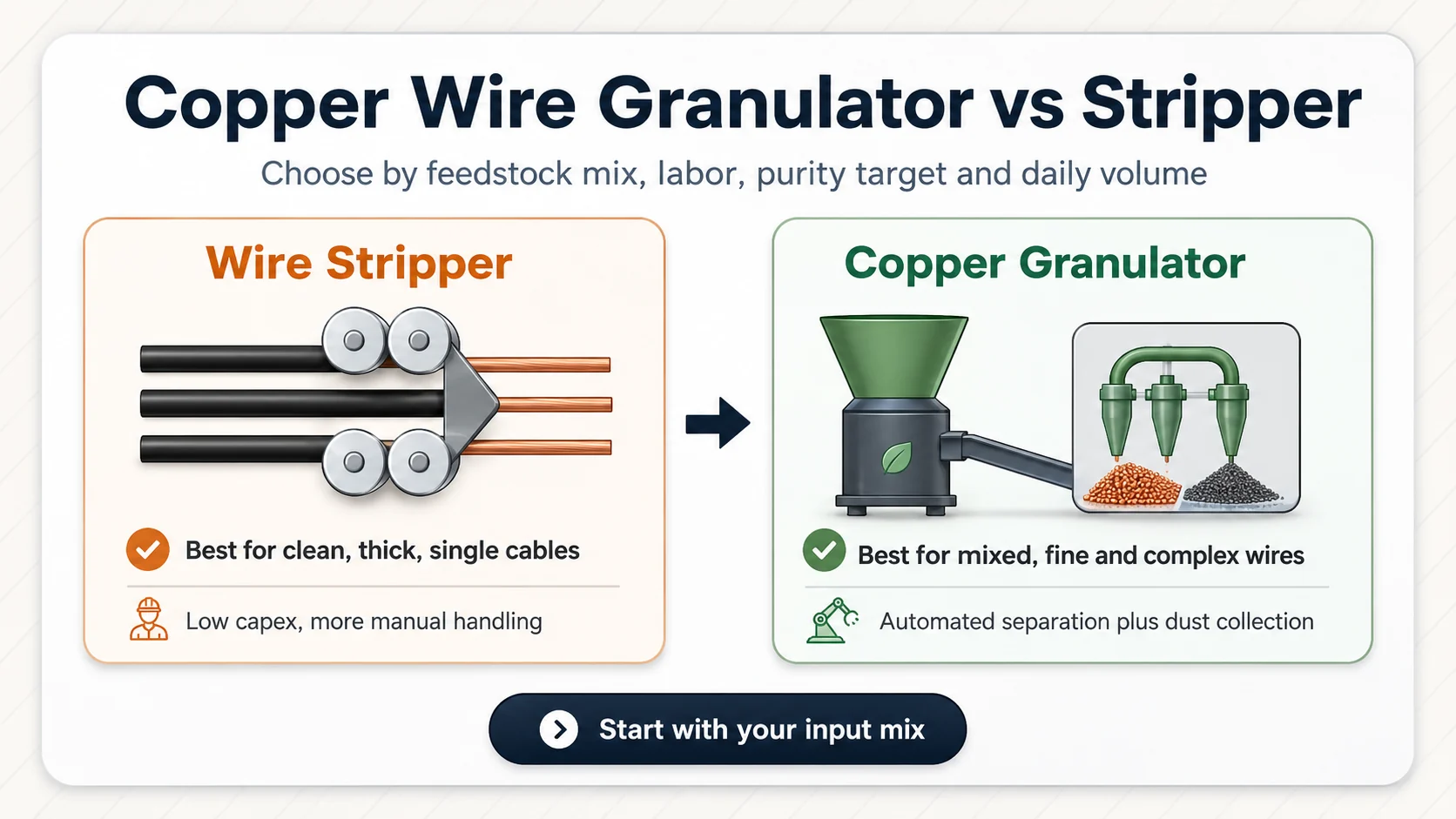
Here is the practical answer: choose a wire stripper when most of your material is clean, thick, sorted cable that can be fed steadily by an operator. Choose a copper wire granulator when your input is mixed, thin, tangled, short, multi-core, harness-style, appliance, automotive, telecom or computer wire. That is exactly the type of material YUXI positions its Copper Wire Recycling Line for: waste wires that are difficult or unsuitable for traditional stripping, then separated into copper and plastic through crushing, airflow, vibration and dust collection.
Table of contents
Quick answer: strip the easy cable, granulate the difficult cable
Choose a wire stripper when
The cable is clean, thick and sorted
When the material is long enough to be feeded,the insulating material is cut cleanly,the conductor is as valuable as a bare wire,and the labor cost is not a bottleneck,the stripper is meaningful.This is a simple route for large single-core cables,cleaning construction wires and batches of similar diameters.
Choose a granulator when
The cable is mixed, fine or labor-heavy
A copper wire granulator makes sense when the yard receives automotive wiring, appliance lines, communication cable, computer cable, tangled wires or short pieces. Instead of asking an operator to peel every line, the system crushes the material and separates copper from plastic.
This is not only a machine choice. It is a sorting strategy. Many profitable operations use both: they strip obvious premium cable first, then granulate everything that would slow down the stripping bench.
How each machine works in real scrap processing
Wire stripper: mechanical peeling
A wire stripper cuts or scores insulation and pulls it away from the copper conductor. The machine is usually compact, easy to understand and relatively low in capital cost. The tradeoff is that the material often needs to be straightened, sorted by diameter and fed one by one. When the cable is thick and clean, that extra handling can be worth it because the output may be sold as long bare copper rather than granules.
Copper wire granulator: size reduction plus separation
A copper wire granulator works more like a recycling line than a single hand-fed tool. Waste wires are cut or crushed into small particles, then the copper and plastic are separated according to particle behavior. The YUXI line, for example, combines a crusher, fan conveyor, vibrating screen, dust collector and electrical control system. After crushing, copper rice and plastic fragments move across the screen, while airflow suction and linear vibration help separate the heavier copper from the lighter insulation.
Because copper is widely used in electrical applications and is readily recycled, cable recycling is not just a yard-level profit topic. USGS notes that electrical uses account for about three quarters of copper use and that manufacturing scrap and obsolete copper products contribute significantly to copper supply.[3] The International Copper Association also describes copper as 100% recyclable without loss of chemical or physical properties.[2]
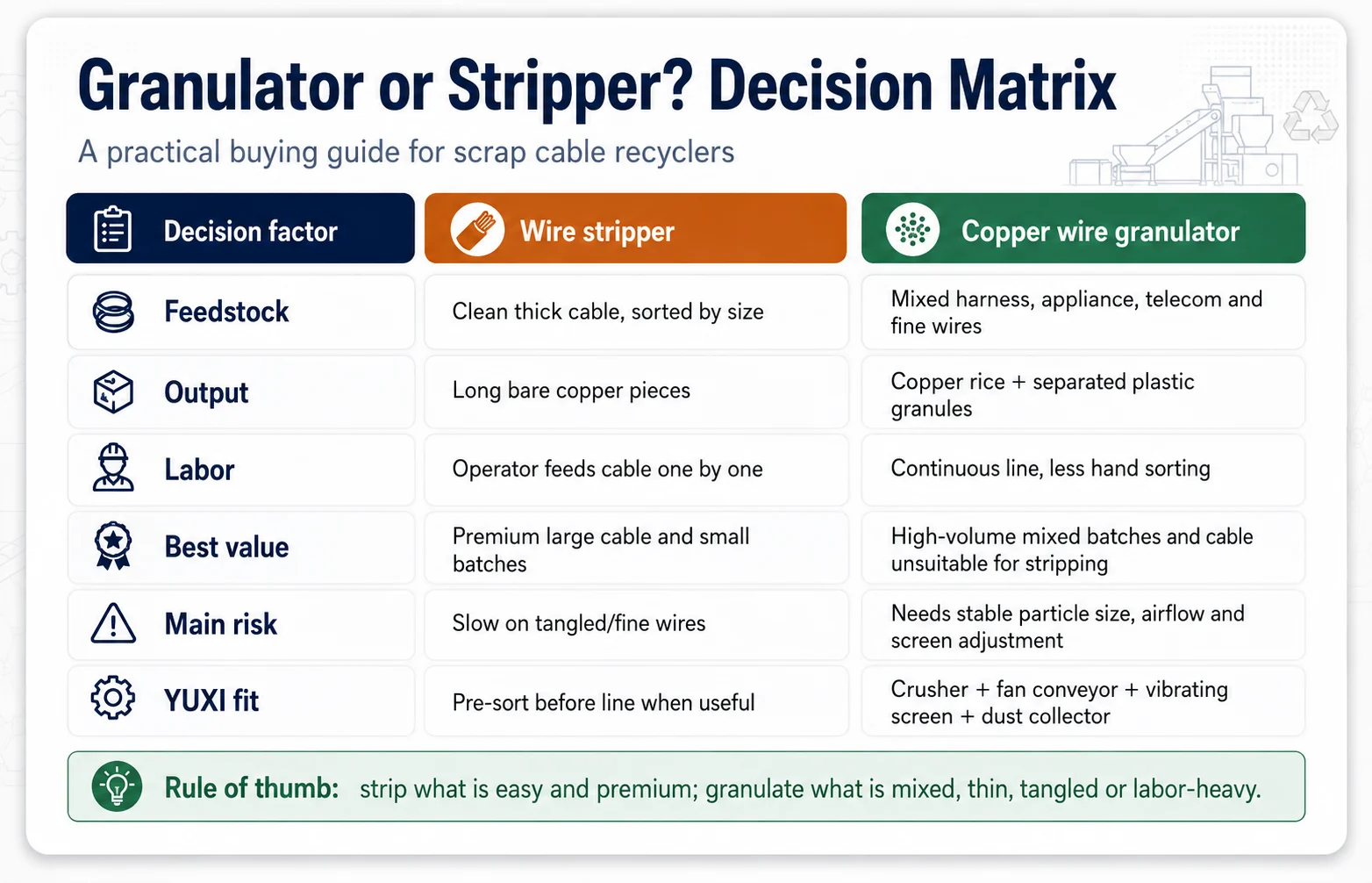
Copper wire granulator vs stripper comparison table
| Factor | Wire stripper | Copper wire granulator |
|---|---|---|
| Best feedstock | Clean, thick, long, sorted single cables | Mixed, fine, tangled, short, multi-core and harness-style cables |
| Typical output | Bare copper wire or stripped conductor | Copper granules, plastic granules and a small middling stream for re-processing |
| Labor requirement | Higher manual feeding and sorting | Lower manual handling once material is prepared and fed |
| Capital cost | Lower | Higher, because it is a process line with crusher, separator, conveyors and dust collection |
| Throughput potential | Limited by operator speed and cable type | Better suited to continuous production and larger mixed batches |
| Material flexibility | Narrower; diameter and insulation type matter | Wider; especially good for cable that is not suitable for stripping |
| Purity control | Depends on clean peeling and manual sorting | Depends on crushing size, screen behavior, airflow setting, vibration and optional secondary separation |
| Dust control | Usually limited because cutting is less dusty | Important; enclosed operation and dust collection are part of a complete line |
| Best business model | Small yard, electrician scrap, demolition cable sorted by type | Scrap recycling plant, e-waste processor, appliance recycler, automotive harness processor |
Which feedstock should go to each machine?
Material that usually belongs on a wire stripper
Use a stripper for cable that has enough length and stiffness to feed cleanly: large building cable, thick power cable, single-core copper cable and sorted batches with similar outside diameter. The operator can set the blade depth and pull the insulation away with predictable results. The higher the copper content and the cleaner the cable, the more attractive stripping becomes.
Material that usually belongs in a copper wire granulator
Use a granulator for the material that frustrates a stripping operation: fine wires, tangled cables, short cutoffs, mixed household appliance lines, communication lines, computer wires, automotive circuit lines, motorcycle wiring, battery lines and multi-core cable. YUXI specifically lists many of these as application areas for its copper wire recycling line, including automobile circuit lines, motorcycle lines, battery lines, household appliance lines, communication lines and computer lines.
A good rule is to test the worst 20% of your cable pile. If the worst material is still profitable after sorting and stripping, a stripper may carry the operation. If the worst material consumes labor, clogs the workflow or gets sold at a discount because nobody wants to sort it, granulation becomes the stronger option.
How the YUXI copper wire recycling line fits the decision
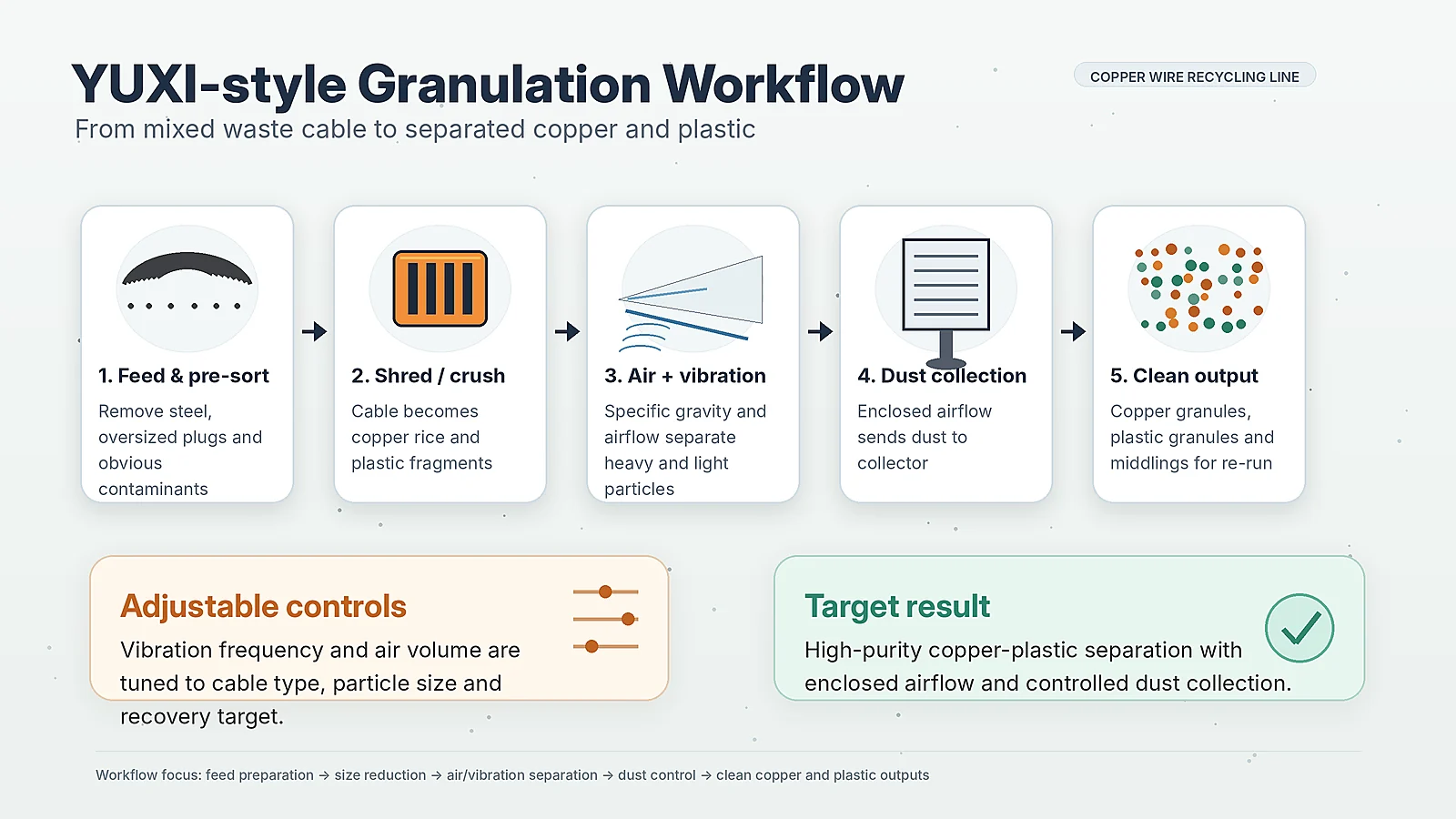
The YUXI copper wire recycling line is best understood as the answer to a common yard problem: mixed cable has copper value, but manual stripping cannot keep up. In YUXI’s process, waste wire is shredded and crushed, then airflow and screen vibration separate the copper rice from plastic fragments. Dust is directed to the dust collector through an air duct, while the vibration frequency and air volume can be adjusted for different working conditions.
For plants that need a more complete copper-plastic separation system, YUXI also supplies related separation equipment. The Air Flow Gravity Separator uses different specific gravity and adjustable airflow to separate heavier and lighter particles. When an operation needs additional metal/non-metal polishing, the High Voltage Electrostatic Separator can separate conductor and non-conductor particles through an electric field.
That is the main difference between a granulator-based line and a stripper. A stripper is a tool for removing insulation. A granulator line is a controlled process for converting difficult cable into saleable copper and plastic fractions.
ROI: do not compare machine price alone
Many buyers start with equipment price, but the better comparison is margin per ton after labor, sorting loss and downtime. A cheap stripper can be the highest-return machine for a small shop with clean cable. The same machine can become expensive if operators spend the day fighting tangled harnesses and small telecom wires.
For a realistic comparison, calculate:
| ROI input | Why it matters |
|---|---|
| Daily input volume | Low volume favors simple tools; steady high volume favors continuous granulation. |
| Average copper content | Higher copper content improves payback for both machines, but mixed cable may need granulation to unlock the value. |
| Labor cost per shift | Stripping looks cheaper until labor becomes the bottleneck. |
| Rejected or discounted material | Granulation can recover value from cable that would otherwise be sold cheaply. |
| Purity and moisture control | Better sorting and drying reduce plastic contamination in copper granules. |
| Dust and housekeeping | EPA describes recycling as collection and processing of materials that would otherwise be discarded, but industrial recyclers still need practical pollution and waste controls in the facility.[4] |
A simple formula is:
Net value per day = recovered copper value + recovered plastic value − feedstock cost − labor cost − electricity cost − maintenance and blade/screen wear − residue disposal.
Run that formula for your actual cable mix. If the stripper depends on ideal cable but your yard receives mostly mixed wire, the formula will expose the mismatch quickly.
Buying checklist before choosing a granulator or stripper
1. Sort a representative sample, not the best sample
Do not test only clean thick cable. Include automotive harness, appliance wires, plugs, cable ends, communication cable, wet cable and fine wire. The machine should be selected for your normal incoming stream, not a cleaned-up sample.
2. Ask for output samples
For a stripper, inspect whether the copper surface is clean and whether insulation remains attached. For a granulator, inspect copper granule purity, plastic carryover, dust level and middling ratio. YUXI states that its crushing and sorting process can reach over 99.9% separation purity under suitable conditions; the important phrase for buyers is “under suitable conditions,” because feed preparation and tuning still matter.
3. Check adjustment range
Mixed cable changes from batch to batch. Granulation lines need adjustment points such as screen, airflow, vibration, feeding speed and dust handling. Strippers need blade depth, guide holes and feed pressure adjustment. A rigid machine can work well on one cable type and struggle on the next.
4. Plan for maintenance
Strippers need blade replacement and feed wheel maintenance. Granulators need crusher knife maintenance, screen cleaning, bearing checks, airflow inspection and dust collector service. Ask for the wear parts list before comparing quotations.
5. Think about layout
A stripper can sit in a small workshop. A granulator line needs feeding space, discharge space, dust collection, electrical control access, maintenance clearance and safe walking paths. The better the layout, the more stable the line becomes.
Final recommendation
For clean large cable, start with a wire stripper. It is simple, lower-cost and can preserve high-value bare copper when the operator can feed cable efficiently.
For mixed scrap cable, choose a copper wire granulator. It is the stronger answer when the material is too small, tangled or inconsistent for stripping. In that case, the value is not in peeling cable perfectly; it is in turning an unpredictable pile of waste wire into controlled copper and plastic output.
For many recyclers, the best solution is not “granulator or stripper.” It is “strip the obvious premium material, granulate the rest.” That keeps labor focused on cable that deserves hand processing and lets the recycling line handle the material that slows people down.
FAQ
Is a copper wire granulator better than a wire stripper?
It is better for mixed, fine, tangled or high-volume cable streams. A stripper is better for clean, thick, sorted cables where a person can remove insulation efficiently.
Can a granulator process cable that is not suitable for stripping?
Yes. That is one of the main reasons to use it. The YUXI copper wire recycling line is positioned for waste wires such as automotive lines, appliance lines, communication lines and computer wires that are difficult for stripping machines.
Does a wire stripper produce cleaner copper than a granulator?
For large clean cable, stripping can produce long bare copper with very little contamination. For mixed fine cable, a tuned granulator line can produce a more consistent commercial output because it processes the entire mixed batch rather than leaving difficult pieces unsorted.
What affects copper granule purity?
Particle size, cable dryness, feed consistency, screen condition, airflow, vibration frequency, dust control and whether middlings are re-run all affect final purity.
Need help matching the machine to your cable mix?
Prepare 3–5 representative cable samples, estimate daily input volume, list your target output purity and note whether the material is clean, mixed, fine, wet or tangled. YUXI can then help evaluate whether a stripping-first workflow, a granulation line, or a combined process is the better fit.