




 Request Quote



Copper Recovery Rate Explained
A cable recycling line can produce bright copper granules and still leave money on the floor. This guide explains how copper recovery rate is calculated, why it is different from separation purity, and how a YUXI-style copper wire recycling line can be tuned to reduce copper loss in plastic, dust, and mixed outlets.
Quick answer
What does copper recovery rate mean?
Copper recovery raterefers to the percentage of copper actually recovered for usable copper products in the waste line afterchopping,granulation,air separation,vibrationn acreening,dust collection and any final polishing steps.
This figure is important for buyers who compare copper wire recycling machines,because the income comes from the copper actually sold,not the copper that looks clean in a brief demonstration.A good evaluation therefore checks every outlet: copper granules, plastic, mixed material, and dust.
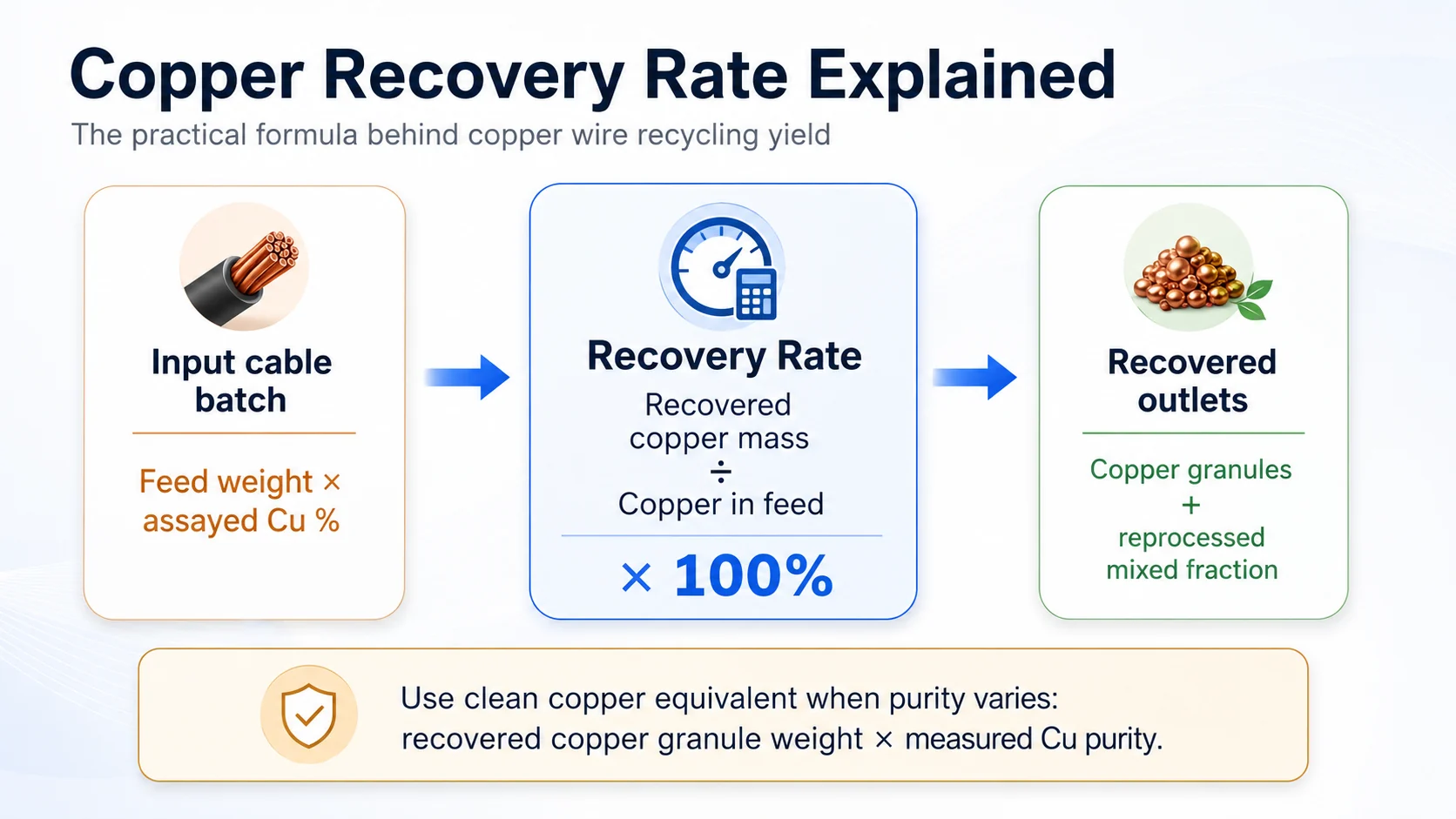
The recovery rate formula buyers should use
Many machine quotations use phrases like “high recovery rate”, “99% copper rate,” or “99.9% separation.” These phrases do not always measure the same thing. For serious factory acceptance tests, please use quality balance formula:
Recovery rate (%) = (recycled copper outlet weight × copper purity %) ÷ (input cable weight × copper content %) × 100
This formula can prevent a common mistake: even if the profuct contains plastic,rubber,dust or fine insulation residue,the total weight of copper products should be counted as recycled copper.It also prevents the opposite mistake: judging the line only by purity while ignoring copper that escaped into the plastic outlet or mixed fraction.
The International Copper Association pointed out that copper can be recycled repeatedly without losing performance.When the quality requirements are met,recycled copper can be used interchargeable with mining copper.That’s why recycling numbers are commercially important:every kilogram of extra clean copper captured from scrap wire can be returned to the circular copper supply chain ionstead of being downgraded lost.
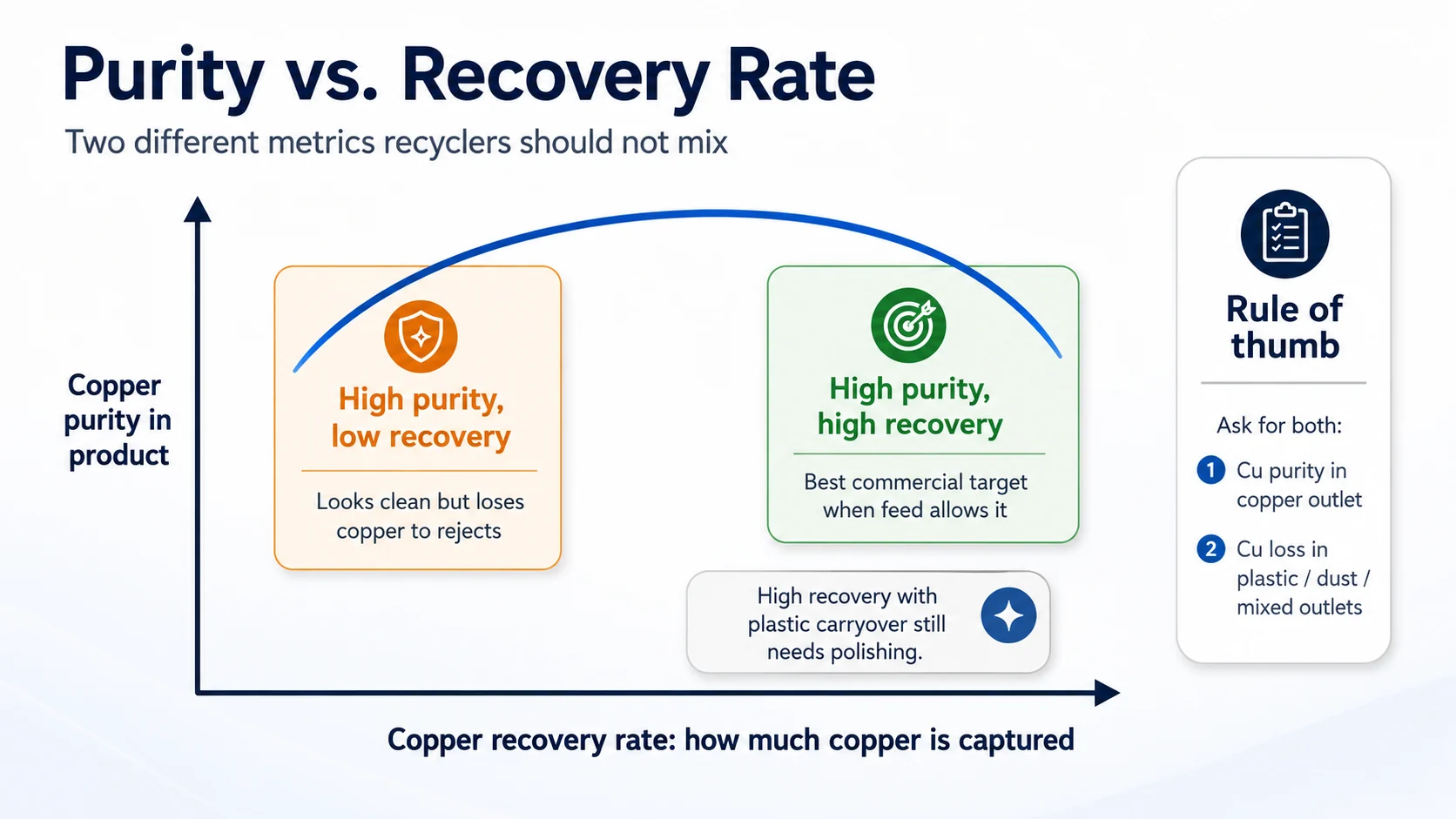
Purity is not the same as recovery rate
The YUXI copper wire recycling line page states that, by adopting crushing and sorting processes, the Copper Wire Recycling Line can reach separation purity of over 99.9% under suitable conditions. That is a useful product-quality metric. But it is not exactly the same as total copper recovery.
| Metric | What it measures | Why it matters | Common mistake |
|---|---|---|---|
| Copper purity | Copper percentage in the recovered copper granule outlet. | Determines product grade, resale value, and downstream acceptance. | Assuming clean-looking copper means no copper was lost elsewhere. |
| Copper recovery rate | Copper captured compared with copper originally present in the feed. | Determines yield, profit, and loss control. | Ignoring copper in plastic, dust, and mixed outlets. |
| Separation efficiency | How well the line separates conductor and non-conductor streams. | Shows whether airflow, vibration, or electrostatic settings are working. | Using one short run on clean cable to represent all incoming scrap. |
In real plants, the best result is a balance: high copper purity without sacrificing too much copper to reject streams. Pushing airflow too hard may clean up the copper outlet but send fine copper into plastic or dust. Running too gently may increase yield but allow plastic carryover in the copper product. Operators need data, not just visual inspection.
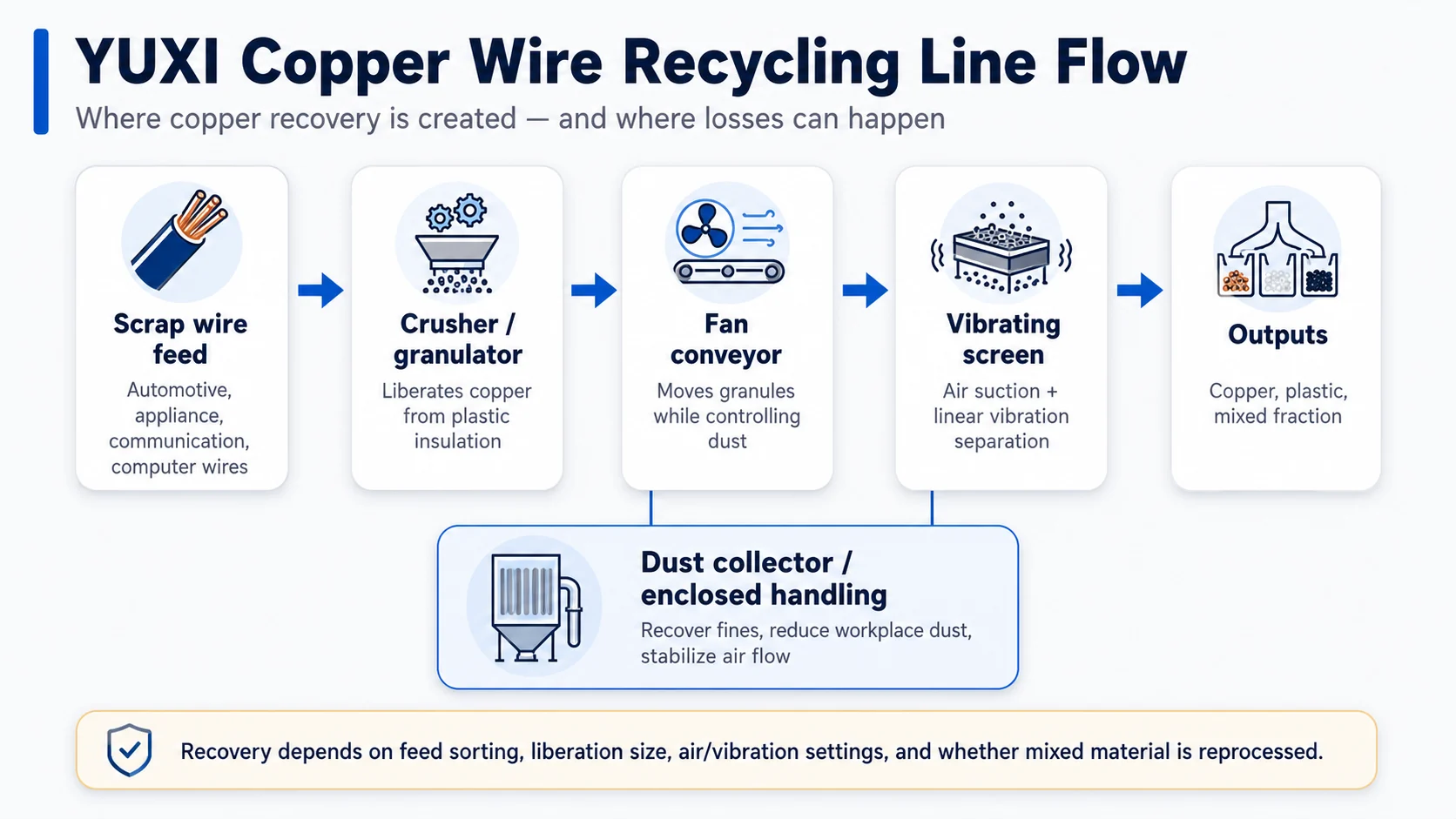
How YUXI’s copper wire recycling process affects recovery
YUXI describes its cable wire recycling machine as a system made of a crusher, fan conveyor, vibrating screen, dust collector, and electrical control. After waste wires and cables are shredded and crushed, the material becomes plastic fragments and copper rice. Then airflow suction and linear vibration of the screen box separate copper, plastic, and mixed material into different outlets.
This process layout is important because most copper loss does not happen in one dramatic place. It appears as small percentages across several streams: slightly unliberated copper-plastic pieces, light copper flakes carried with plastic, fine copper in dust, and mixed material that is not reprocessed. The Air Flow Gravity Separator is especially relevant for copper-plastic separation because it uses differences in specific gravity with controlled airflow and vibration. Where higher metal-plastic polishing is required, the High Voltage Electrostatic Separator can further separate conductors from non-conductors by electric-field behavior.
For mixed automotive harnesses, appliance wires, communication wires, and computer wires that are not suitable for simple stripping, a granulation-and-separation line is usually more practical than manual stripping. The machine, however, must be matched to the feedstock. Thin wires, oily wires, plugs, steel clips, wet insulation, and mixed cable diameters all change the actual recovery rate.
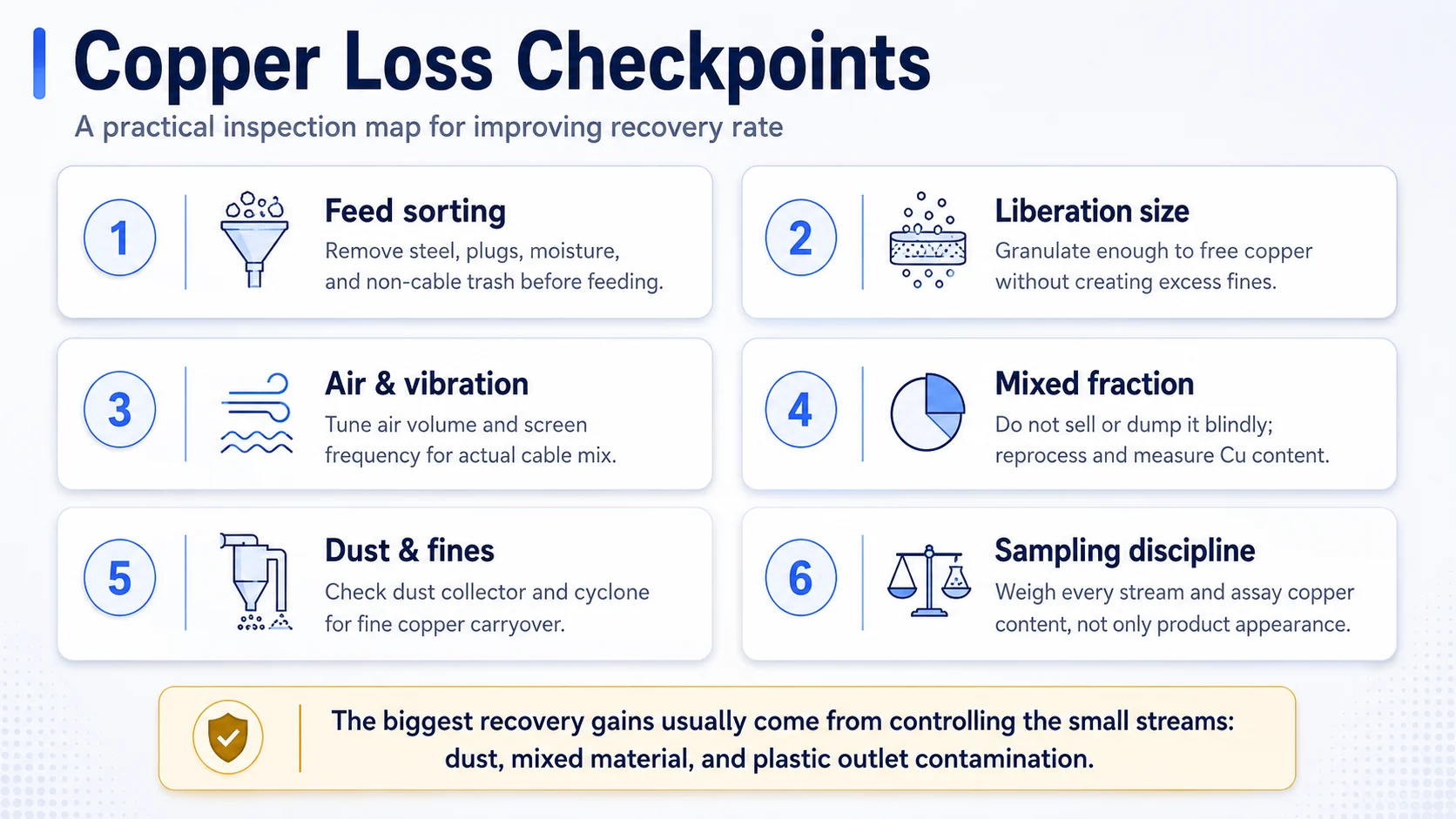
Where copper recovery rate usually drops
When recyclers say a machine is “not recovering enough copper,” the cause is often not the separator alone. It is usually a chain of small process issues. The following loss points are the first places to inspect.
1. Poor feed preparationMixed scrap with plugs, iron, heavy rubber, wet material, and non-cable waste makes stable separation harder.
2. Incomplete liberationIf copper and insulation are still attached after granulation, airflow cannot separate them cleanly.
3. Excessive finesOver-crushing can create tiny copper particles that travel with dust or light plastic.
4. Wrong airflowToo much air may carry copper away; too little air may leave plastic in the copper outlet.
5. Screen frequency mismatchVibration settings that work for one cable mix may not work for another.
6. Unchecked mixed materialThe mixed outlet often contains recoverable copper and should be sampled, weighed, and reprocessed.
Dust collection is not only an environmental feature. It also protects yield. YUXI’s product page emphasizes fully enclosed design and dust collection. EPA recycling guidance also frames recycling as a system of collection, sorting, cleaning, and processing materials into usable inputs for manufacturing. In copper wire recycling, a clean enclosed process helps stabilize air movement and reduce uncontrolled material loss.
How to test copper recovery rate before buying equipment
A supplier demonstration should not only show clean copper granules. It should produce a repeatable mass balance. The test below gives buyers a more reliable way to compare machines and line configurations.
| Step | What to do | Why it matters |
|---|---|---|
| 1. Define the feed | Use the cable mix you actually process: automotive harness, appliance wire, communication cable, computer wire, or mixed low-grade cable. | Clean demo wire can overstate performance for real scrap. |
| 2. Weigh the input | Record total feed weight after removing obvious non-processable contaminants. | Recovery cannot be calculated without a known input mass. |
| 3. Assay copper content | Take a representative sample or manually strip a small portion to estimate copper percentage. | The denominator must be copper in feed, not just total cable weight. |
| 4. Run at steady state | Let the crusher, airflow, vibration screen, and dust collector reach stable operating conditions. | Startup and shutdown streams can distort the result. |
| 5. Weigh every output | Measure copper product, plastic, mixed material, dust/fines, and any oversize return. | Losses often hide outside the main copper outlet. |
| 6. Test product purity | Check copper purity in the recovered copper outlet and copper content in the plastic and mixed outlets. | This separates a purity problem from a recovery problem. |
| 7. Reprocess mixed fraction | Run mixed material again if it contains meaningful copper. | Some plants improve recovery substantially by managing this stream. |
During the test, watch the operator’s adjustments. A good line should allow practical tuning of vibration frequency and air volume according to different working conditions. On YUXI’s line, the vibrating screen is controlled by frequency conversion, and the air volume is controlled by a regulating valve, which gives operators room to match the separation to real feedstock.
How to improve copper recovery rate in daily operation
Once the line is installed, recovery rate becomes an operating habit. The following practices are simple, but they usually matter more than chasing one “magic” separator setting.
1. Sort feed into practical families
Do not run thick power cable, fine communication wire, greasy automotive harness, and appliance wiring as one uncontrolled stream if the plant can avoid it. Grouping similar materials makes granulation size and separation settings more stable.
2. Tune liberation, not only throughput
Higher throughput is useful only if copper and insulation are properly liberated. If output contains attached copper-plastic pieces, reduce feed surges, inspect blade condition, and adjust granulation before blaming the separator.
3. Treat the mixed outlet as money, not waste
The mixed outlet is often the recovery-rate alarm. Weigh it, sample it, and decide whether it should be returned to the line, sent to an electrostatic polishing step, or processed separately.
4. Control dust without stealing copper
Dust systems should remove nuisance dust and light insulation particles, but fine copper should not disappear into a collector unchecked. Inspect dust bags, cyclones, and settled fines during recovery audits.
5. Keep safety controls part of the process
Copper wire recycling equipment includes moving cutters, conveyors, fans, screens, and electrical control systems. OSHA machine guarding requirements to protect workers from hazards such as operating points,rotating parts,feeding points,flying chips and sparks.OSHA lockout/tagout requirements also cover repairs and maintenance that may cause injury from accidental start-up or storage of energy. Stable recovery should never depend on bypassing guards or clearing jams while equipment is live.
Choosing the right recovery target
There is no single honest recovery number for every cable batch. A clean, dry, single-family cable stream is easier to process than mixed low-grade automotive and appliance wire. A supplier can give a realistic target only after knowing the feed type, copper content, cable diameter range, contamination level, moisture, desired throughput, and required final product purity.
For buyers, the best question is not “Can the machine reach 99%?” but: “Under my material conditions, what copper purity can the line produce, what copper loss remains in plastic and dust, and how will the mixed fraction be handled?” That question leads to a more useful process design and a more reliable return-on-investment calculation.
Need a copper recovery test plan?
Send YUXI your cable type, feed photos, target capacity, and desired final product quality. The team can recommend a copper wire recycling line layout and separation configuration based on your real material.
FAQ: Copper Recovery Rate Explained
What is a good copper recovery rate?
A good recovery rate depends on the cable mix and how it is measured. Clean, dry, well-sorted cable can usually perform much better than wet, dirty, mixed, or very fine cable. Always ask for a mass-balance test using your own material rather than relying on a generic number.
Can a line have high purity but low recovery?
Yes. The copper outlet can be very clean while some copper is lost in the plastic outlet, dust collector, or mixed fraction. That is why recovery testing must weigh and sample every output stream.
Why does feedstock change the recovery rate?
Different wires have different copper content, insulation density, strand size, moisture and pollution. These factors change the ease of copper release from the crusher,and the degree to which air/vibration or electrostatic separation can accurately divide the material.
Does electrostatic separation always improve recovery?
It can improve separation of conductor and non-conductor particles, especially for difficult mixed fractions, but it should be used as part of the total process design. The upstream granulation size, dryness, feed uniformity, and airflow separation still matter.
What information should I send for a YUXI recommendation?
Send cable photos or video, material source, estimated copper content, cable diameter range, moisture/contamination condition, required capacity, power supply, final copper purity target, and any local dust or noise requirements.