




 Request Quote


Copper Wire Recycling Process | YUXI
A good copper wire recycling process is not just “put cable into a crusher.” In a actual yard, the feed may include automotive harnesses, appliance wires, thin communication cable, battery wires, plugs, dust, tape, moisture and mixed insulation. The goal is to convert the messy input into clean copper fractions,plastic fractions and small mixed fractions,which can be reprocessed without wasting copper.
Quick answer: what is the copper wire recycling process?
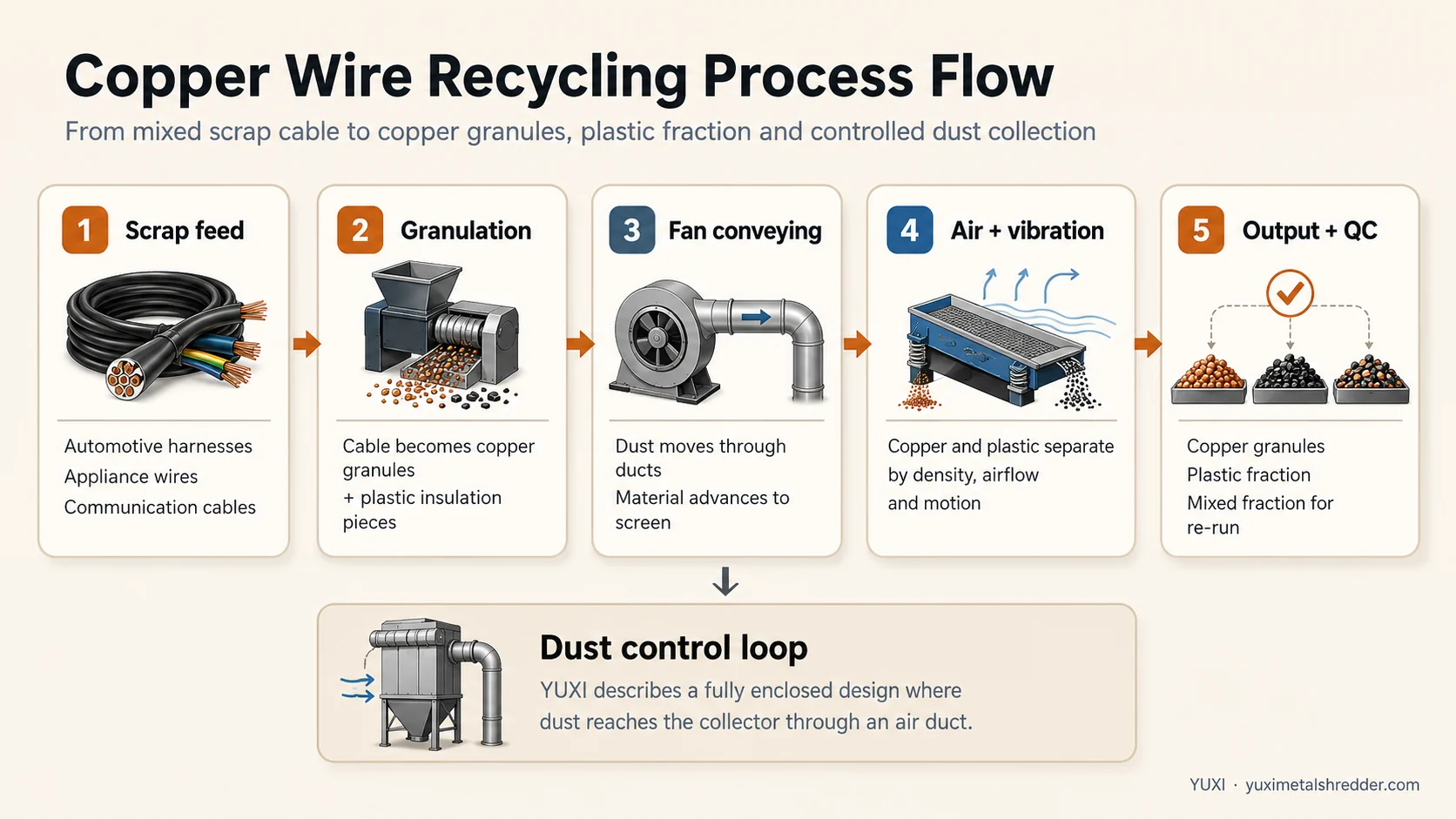
The copper wire recycling process is a dry mechanical process that separates copper conductor from plastic or rubber insulation. In a typical granulation line, waste wires are sorted, fed into a crusher or granulator, cut into small particles, conveyed by air, separated on a vibrating airflow table, and discharged as copper granules, plastic pieces and a mixed fraction for re-run or further polishing.
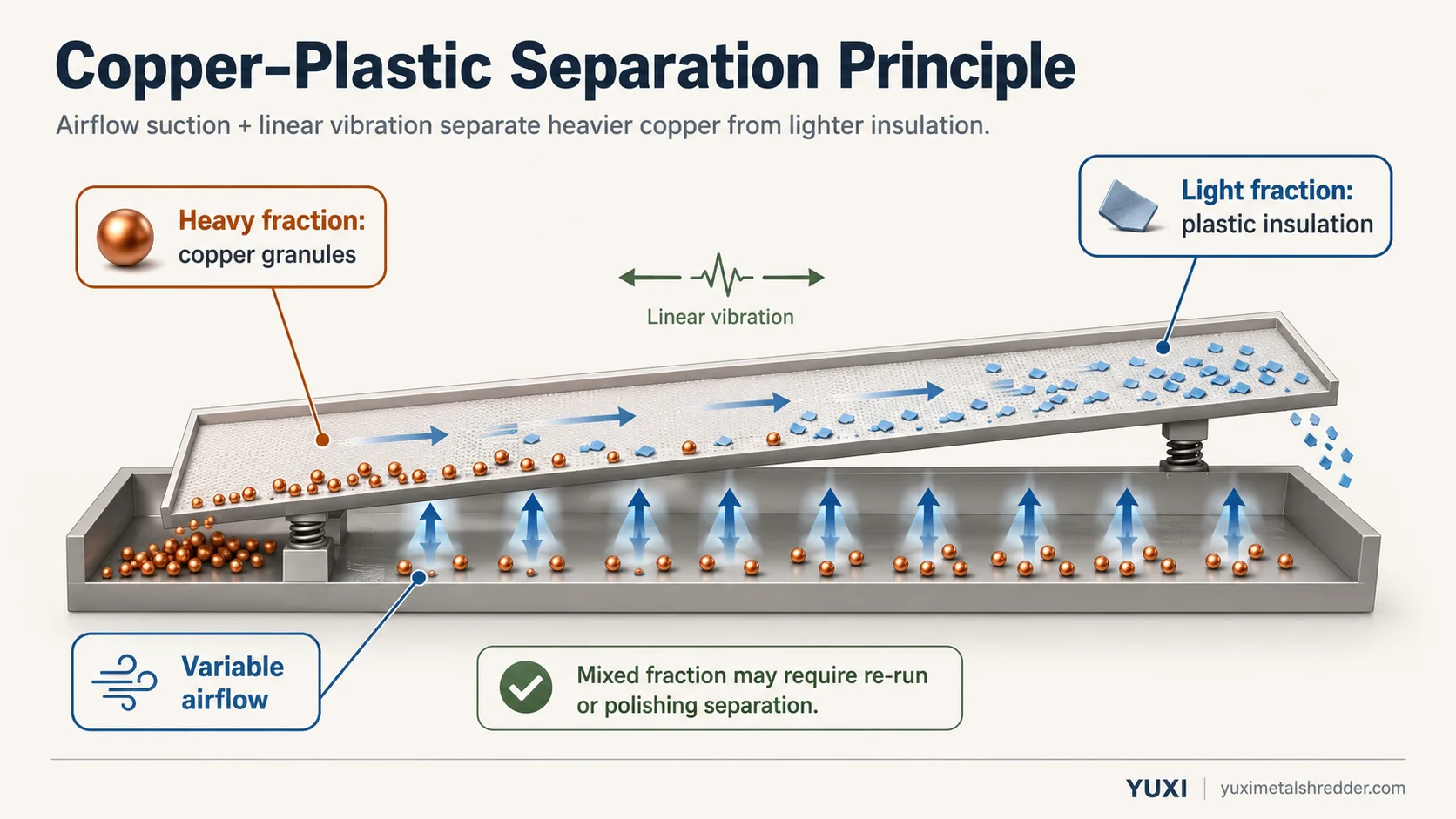
YUXI describes its copper wire recycling line as an environmental protection device for processing waste copper wires and separating copper from plastic. The published line consists of a crusher, fan conveyor, vibrating screen, dust collector and electrical control. After shredding and crushing, the material becomes plastic fragments and “copper rice,” then moves across the screen surface where airflow suction and linear vibration separate the core and insulation.
Practical point of view: The purity of copper cannot be made by one machine alone. It comes from correct feed sorting, stable granule size, balanced airflow, suitable vibration frequency, dust capture and repeat sampling at the outlets.
Why is copper wire recycling so important?
Copper is of high value because it is durable and widely uses in electricity,electronics,communications,automobiles and electrical systems.The International Copper Association pointed out that copper can be recycled repeatedly without losing performance,and raw copper can be interchanged in terms of quality.That makes cable scrap more than a waste stream; it is a secondary raw material stream.
For recyclers, the business value is very practical. Clean copper granules usually command a higher price than mixed cable because the buyer does not need to pay for insulation, plugs, dirt and processing uncertainty. The cleaner the copper fraction, the less downstream refining or hand sorting is required.
Copper wire recycling process step by step
1. Collection and feed sorting
The process starts before the machine. Operators should separate obviously different materials: thick armored cable, household appliance wires, automotive harnesses, fine communication wires, aluminum cable, plugs, connectors, ferrous attachments, wet material and non-cable contaminants. The more stable the feed, the easier it is to keep the granulator and separator in balance.
YUXI lists typical applications including automobile circuit lines, motorcycle lines, battery lines, TV, washing machine, refrigerator and air-conditioner wires, communication lines, computer lines and other waste wires that are not suitable for wire stripping machines. That product positioning is important: granulation is especially useful when the cable mix is thin, tangled, short, irregular or difficult to process by straight stripping.
2. Feeding and size reduction
After sorting, waste wires are fed into the crushing section. The aim is not only to “break” cable but to cut it into a particle size where copper and insulation can separate cleanly. If pieces are too large, plastic may remain attached to copper. If pieces are too fine, copper can become difficult to recover and dust can increase.
In YUXI’s published process description, the waste wires and cables are shredded and crushed until they become plastic fragments and copper rice. This “copper rice” language is common in cable granulation because the recovered copper particles often look like small reddish grains.
3. Fan conveying and dust movement
The fan conveyor moves the mixed particles to the separation section. Air is doing two jobs here: material transport and dust movement. YUXI states that dust reaches the dust collector through an air duct. In practice, clean duct design, sealed covers, filter maintenance and correct airflow are essential because fine plastic, copper dust and insulation dust can reduce visibility, cleanliness and worker comfort.
4. Airflow gravity separation on a vibrating screen
This is the heart of the copper wire recycling process. Copper has a higher density than most cable insulation. On a vibrating screen or air gravity table, linear vibration moves the material forward while controlled airflow lifts and shifts lighter plastic particles. Heavier copper particles travel differently and discharge from the copper outlet. YUXI’s air flow gravity separator page describes this principle as sorting by specific gravity, with heavier particles having shorter movement trajectories and lighter particles having longer trajectories under airflow.
5. Outlet collection: copper, plastic and mixed fraction
A realistic recycling line should not pretend there are only two outputs. There are usually three: clean copper, clean plastic and a mixed fraction. The mixed fraction matters because it tells the operator what is happening inside the process. Too much copper in the plastic outlet can mean excessive air volume, poor screen setting, wrong particle size, unstable feeding, or unsuitable material. Too much plastic in the copper outlet may mean incomplete granulation, low airflow, moisture or overloaded screening.
6. Re-run or optional polishing separation
For many common cable streams, the airflow gravity separation stage can produce a saleable copper granule. For finer, more complex or higher-purity applications, a downstream polishing stage may be considered. YUXI’s high-voltage electrostatic separator is published as a device for separating conductors and non-conductors using an electric field, and the page notes that separation can be adjusted according to material characteristics, capacity and purity requirements. It should be treated as a layout option to confirm against your feedstock, not an automatic requirement for every copper wire recycling line.
How the YUXI Copper Wire Recycling Line fits this process
Based on the public YUXI product page, the copper wire recycling line is designed for waste copper wires and copper-plastic separation. Its line configuration is described as:
- Crusher — reduces wire and cable into copper rice and plastic fragments.
- Fan conveyor — transfers particles and supports air movement through the process.
- Vibrating screen — moves material forward and helps create the separation surface.
- Dust collector — receives dust through air ducts in an enclosed design.
- Electrical control — controls actions by buttons; YUXI also notes frequency conversion control for the vibrating screen and air-volume adjustment by regulating valve.
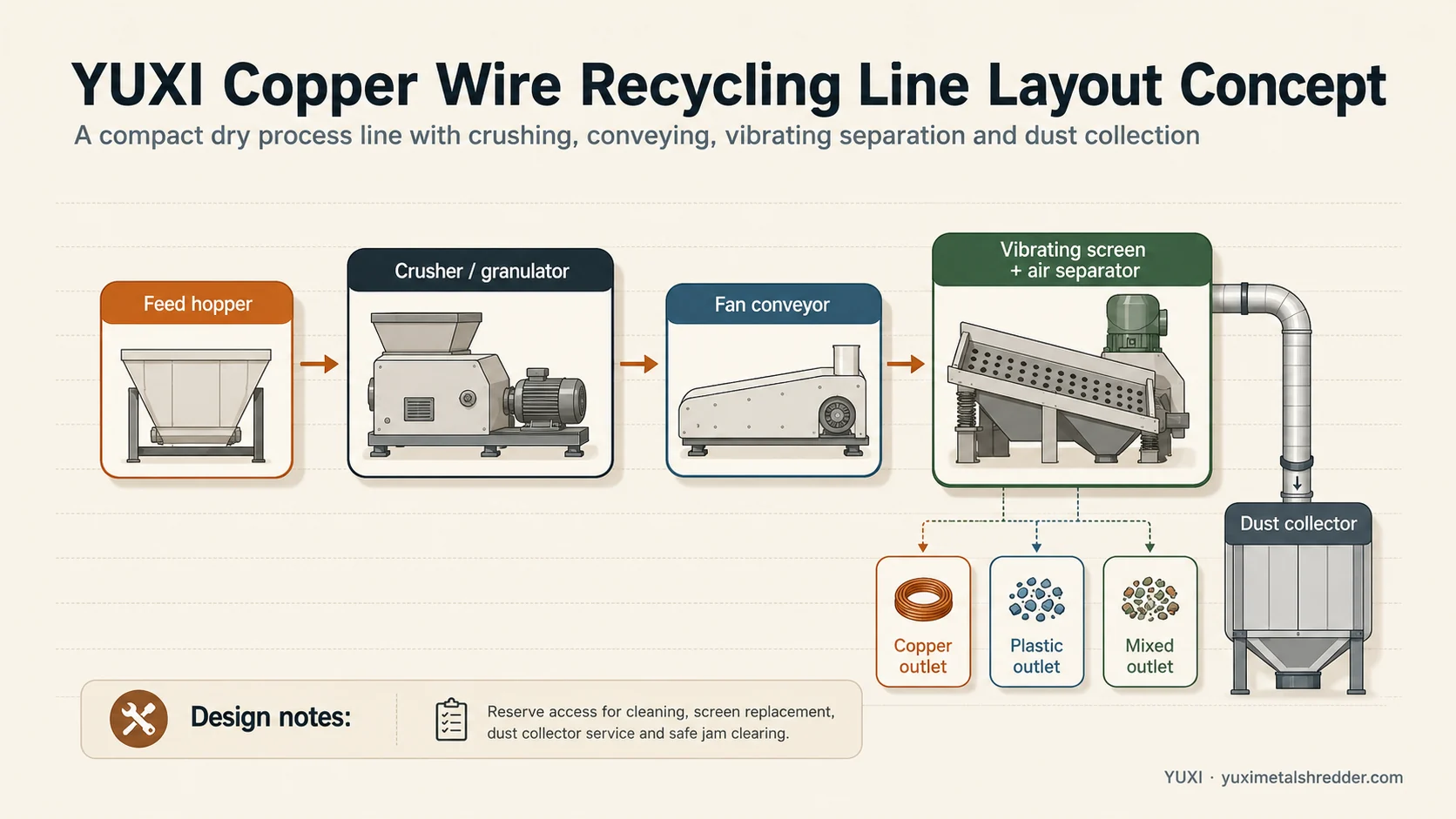
The same YUXI page lists three advantages: the crushing and sorting process can reach separation purity of more than 99.9%, the fully closed design helps collect dust, and the machine is positioned as low energy consumption and high efficiency. For buyer-oriented articles, it is better to use the purity statements as a published capacity,and material testing is still recommended,because the actual purity dependes on the feed composition,mopisture,particle size and operator settings.
Best-fit feed materials
| Feed material | Why granulation fits | Process note |
|---|---|---|
| Automotive and motorcycle harnesses | Tangled, short and mixed wire sections are difficult to strip one by one. | Remove large plugs, steel clips and non-wire contaminants before feeding. |
| Household appliance wires | Mixed insulation and varied lengths can be processed as a bulk stream. | Watch for plugs, rubber, small motors and other attachments. |
| Communication and computer wires | Fine wires are often unsuitable for manual or straight wire stripping. | Fine copper can be sensitive to over-crushing and airflow loss. |
| Battery lines and power-cable offcuts | Useful when the material is short, irregular or not economical to strip. | Very thick cable may need pre-cutting or a different pre-processing step. |
Wire stripping vs. copper wire granulation
A wire stripping machine is attractive when the cable is long, straight, uniform and thick enough for the blade to open the insulation cleanly. A copper wire granulator is more suitable when the cable is tangled, short, thin, mixed, irregular or too labor-intensive for stripping. YUXI’s own application wording specifically includes wires not suitable for processing by wire stripping machines, which makes the process relevant for recycling yards dealing with mixed scrap rather than clean production offcuts only.
Choose stripping when…
Cable is uniform, long, easy to feed, and labor or automation can remove insulation with little copper loss.
Choose granulation when…
Cable is mixed, short, tangled, fine, or has inconsistent insulation that makes stripping inefficient.
Process control points that affect copper purity
When a copper wire recycling process performs poorly, the first reaction is often to increase air, slow down feed or blame the separator. A better approach is to check the whole chain in order.
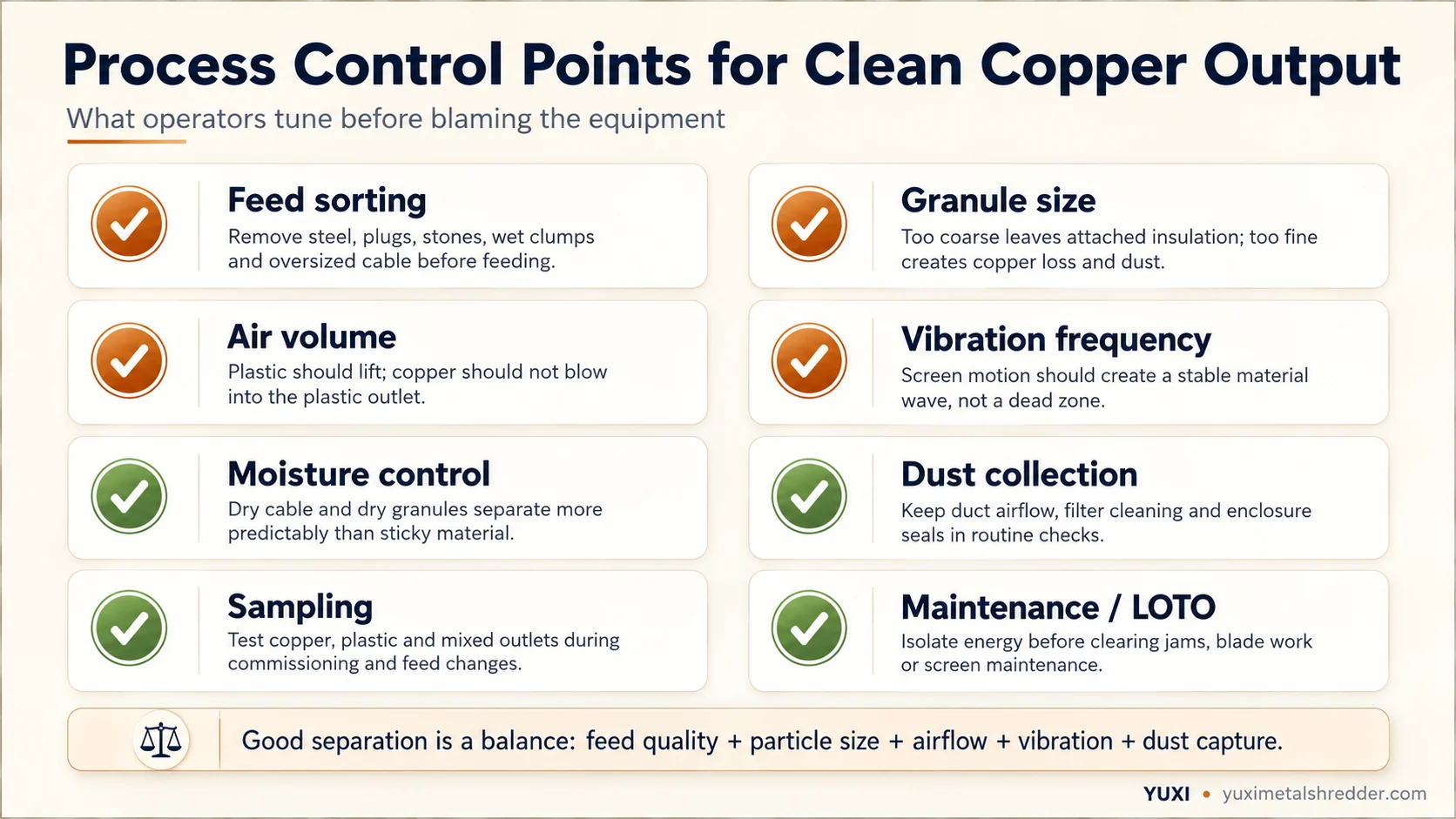
| Control point | What can go wrong | What to check |
|---|---|---|
| Feed rate | Overloading creates uneven particle layers and poor separation. | Feed steadily; avoid surges from tangled cable bundles. |
| Blade / screen condition | Dull cutting or wrong screen size leaves copper attached to insulation. | Inspect blades, screens and granule size during routine maintenance. |
| Air volume | Too high may carry copper into plastic; too low may leave plastic in copper. | Adjust gradually and sample every outlet after changes. |
| Vibration frequency | Dead zones, material piling or unstable wave motion reduce separation. | Use frequency conversion settings to match material conditions. |
| Moisture | Wet plastic and copper stick together and reduce density-based separation. | Keep feed dry where possible and avoid processing wet clumps. |
| Dust collection | Poor suction can cause dust escape and inconsistent airflow behavior. | Check duct sealing, filter condition, collector cleaning and negative pressure. |
| Sampling | Operators may miss gradual copper loss in the plastic fraction. | Sample copper, plastic and mixed outlets after feed changes and shift start. |
Layout and installation considerations
For recycling plants, the line should be arranged so the process is easy to operate and safe to maintain. Leave space around the crusher for feeding and clearinr blocked channels,leave space around the vibrating screen for inspection and screening,also leave space around the dust collector for filtering screen.The electrical control area should be visible to prevent heavy flow and be used by trained operators.
Dust collectorS need pipes, service access and clean emission plans. If the feed includes old cables with unknown coatings or fine dust, the factory should also consider the local environmental and occupational exposure requirements.Dust collection and ventilation should be regarded as part of the layout, not afterthought.
Safety and environmental notes for the copper wire recycling process
Copper wire recycling equipment includes rotating cutters, conveyors, fans, vibrating screens, electrical controls and dust collection. OSHA’s machine guarding rule requires guarding methods to protect operators from danger such as operating points, feeding points, rotating parts, flying chips and sparks. OSHA’s lockout/tagout standards apply to service and maintenance that may alarm employees by accidental start-up or storage energy release.
That means operators should not clear jams, open guards, inspect cutters, service screens or clean ducts without a written isolation procedure, trained personnel and verification that hazardous energy has been controlled. Guards, interlocks, emergency stops, signage and safe access platforms should be matched to the final layout.
Dust is also part of process control. NIOSH lists recommended exposure limits for copper dust and mist,that is, the 8-hour TWA is 1 mg/m³ of copper. A recycling plant should use it as a reference point for exposure assessment,and design its dust collection and cleaning around local legal restrictions, actual raw materials and measured workplace conditions.
How to judge output quality
A clean copper output should be visually bright, mostly free of attached insulation and consistent in particle size. A clean plastic fraction should not contain visible copper grains. The mixed outlet should be small and should decrease after the operator has stabilized feed rate, airflow and vibration. During commissioning, it is useful to weigh samples from each outlet and calculate copper loss, not just judge by appearance.
Field rule: sample the plastic outlet first. The easiest copper to lose is the copper nobody checks.
Questions to ask before selecting a copper wire recycling line
- What cable types and diameter range will dominate the feed?
- Are the wires long and uniform enough to be peeled off or mixed enough to prove the reasonableness of granulation?
- How many non-eletronic pollutants will appear in the feed:plugs,steel,aluminum,dirt,rubber or moisture?
- What output do you need: copper granules for resale, smelting feed or higher-purity material for specific buyer?
- Will you need only airflow gravity separation, or a downstream polishing step for fine mixed particles?
- In the factory layout,how to handle dust collection,protection,locking/marketing and maintenance access?
FAQ: Copper Wire Recycling Process
What’s the main equipment of the copper wire recycling line?
A typical line includes a crusher or granulator, fan conveyor, vibrating screen or airflow gravity separator, dust collector and electrical control. YUXI’s published copper wire recycling line uses these same core modules.
Does copper wire recycling use water?
The YUXI process described here is a dry mechanical process based on crushing, airflow suction and vibration. It does not rely on water separation in the published process description.
Why is copper sometimes found in the plastic outlet?
Common causes include excessive air volume, too-fine granulation, overloaded feeding, unstable vibration, wet material or poor pre-sorting. The operator should sample all outlets before making large adjustments.
Can a copper wire recycling line process appliance and automotive wires?
Yes. YUXI lists automobile circuit lines, motorcycle lines, battery lines, household appliance wires, communication lines and computer wires among typical applications, especially where wire stripping machines are not suitable.
Is electrostatic separation always required?
No. Airflow gravity separation is often the core copper-plastic separation step. Electrostatic separation can be considered as a polishing stage when the material is fine, mixed or requires higher separation precision. The final configuration should be confirmed by testing the actual feedstock.
What safety rules matter most during operation?
Machine protection,locking/marking,dust collection,safety passage,operator training and emergency stop design are crutial.Operators should isolate dangerous energy before removing blockages or repairing cutters,screens,conveyors or pipes.
Need to evaluate your cable scrap?
Share your wire types, approximate cable sizes, contamination level, desired output purity and plant layout constraints with YUXI. The right copper wire recycling process should be selected around the real feedstock—not a generic machine name.
Request Cable Scrap Evaluation