




 Request Quote



In this guideQuick answerWhy blade material mattersYUXI blade design contextCommon blade material familiesSelection by scrap typeHeat treatment and hardnessMaintenance and safetyFAQ
Quick answer: what are the best metal shredder blade materials?
For most U.S. scrap recycling plants, the best metal shredder blade material is a forged alloy tool steel with a heat treatment designed for both wear resistance and impact toughness. D2-type cold-work tool steel can be useful where abrasion and edge retention are the main problems, while H13-type hot-work tool steel is known for hot toughness and thermal shock resistance. In real shredding work, however, blade design, thickness, tooth count, shaft speed, overload control and feed discipline often decide blade life as much as the steel grade itself.
YUXI’s metal shredder page describes the moving knife material as special alloy tool steel forging blanks processed by precision machining, multiple heat treatments and low-temperature treatment. The same product page also notes replaceable knife thickness options of 15 mm, 20 mm, 40 mm, 50 mm, 75 mm and 100 mm, with knife thickness and claw count selected according to different materials. That is the right way to think about the topic: material grade and blade geometry should be selected together, not separately.
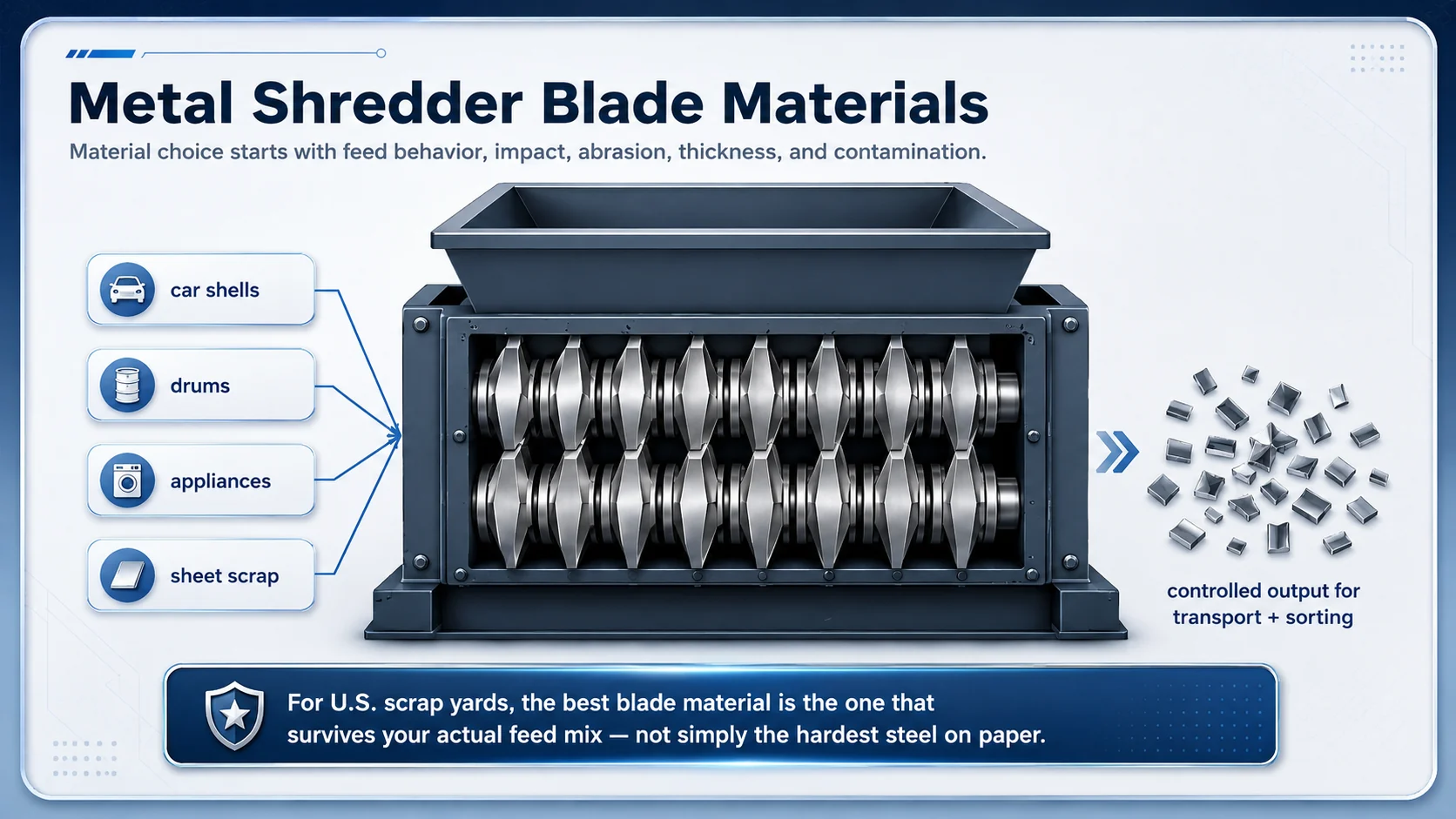
Why blade material matters in a metal shredder
A metal shredder blade is not working like a clean machine-shop cutting tool. It is pulling, tearing, squeezing and shearing irregular scrap. A single load may include painted sheet metal, galvanized panels, loose bolts, hinges, small castings, aluminum pieces, plastic, rubber and dirt. That mix creates three types of blade stress:
- Abrasion: rust, coatings, soil and hard particles slowly round the cutting edge.
- Impact: thick sections, folded scrap or unexpected hard objects can chip a brittle edge.
- Fatigue: repeated torque peaks, reverse cycles and uneven feeding can start cracks around teeth or bore areas.
This is why a blade material conversation should not stop at “what HRC is it?” Hardness helps edge retention, but a scrap shredder also needs toughness. A blade that is very hard but chips during real feed conditions usually costs more per processed ton than a slightly softer but tougher blade that wears predictably.
YUXI metal shredder blade design context
YUXI’s metal shredder is positioned for light scrap metal materials such as car shells, refrigerators, metal drums, waste color steel tiles, metal buckets, scrap steel and steel furniture. The shredding chamber uses blades to reduce large materials through tearing, squeezing and shearing before discharge from the lower part of the box.
For blade selection, the important YUXI product details are:
- Moving knife material: special alloy tool steel forging blanks.
- Processing route: precision machining, multiple heat treatments and low-temperature freezing heat treatment technology.
- Blade geometry flexibility: 15 mm, 20 mm, 40 mm, 50 mm, 75 mm and 100 mm knife thickness options, with thickness and claw count replaceable according to material.
- Machine protection: when overloaded or when foreign objects enter the cutting unit, the rotor can stop and reverse automatically to reduce overfeeding and protect against damage.
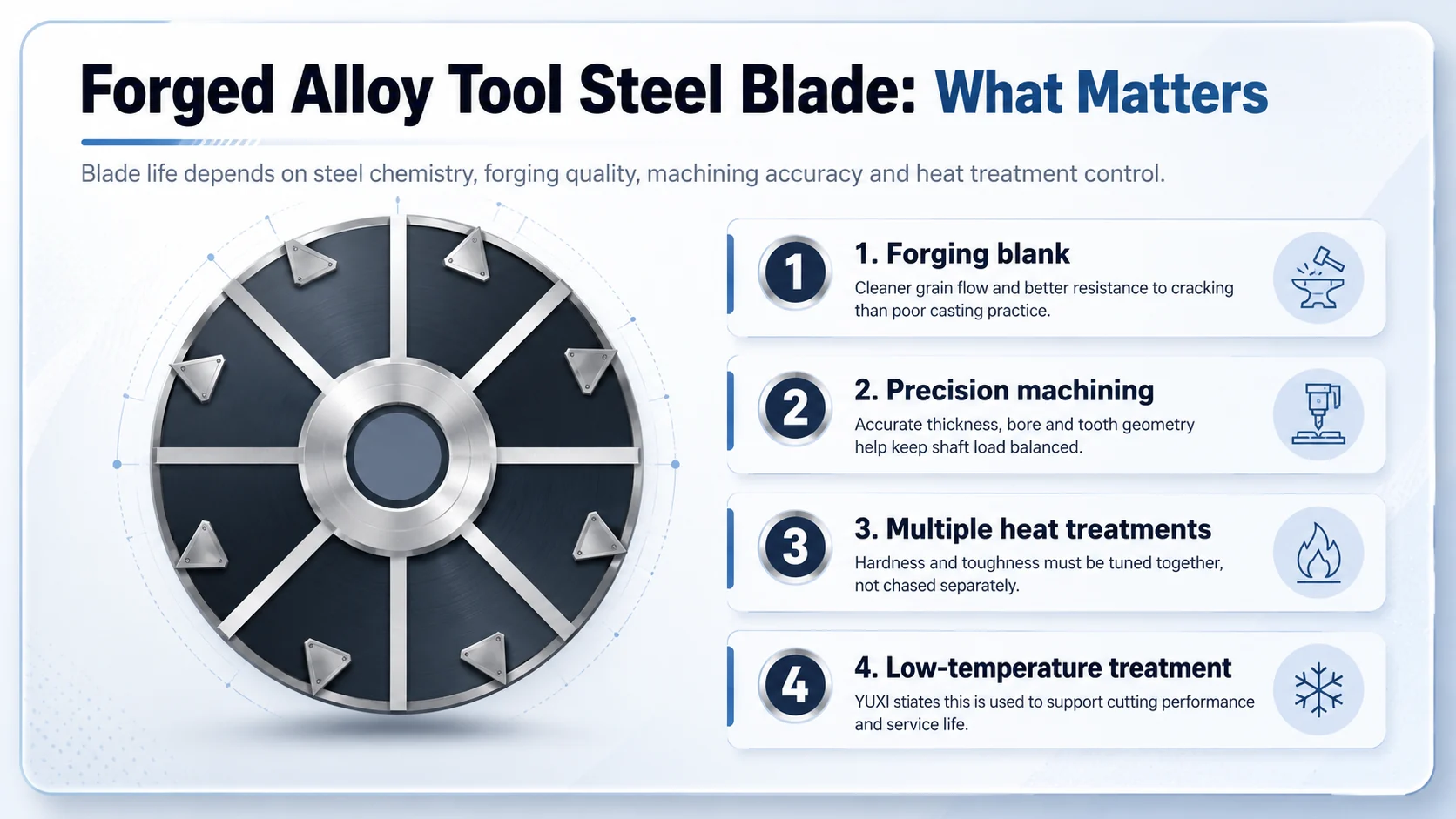
For the buyer, these details are important because they convey that blade life is designed by a system: forged tool steel, machining accuracy, heat-treatment control, geometry selection and machine overload logic. A replacement blade should match the machine and feed strategy, not only the nominal steel grade.
Common metal shredder blade material families
1. Forged alloy tool steel
This is the most practical starting point for mixed scrap. Alloy tool steel can be tuned for a balance of hardness, toughness and wear resistance. Forging can help create a stronger internal structure than poor casting practice, and controlled heat treatment can reduce the chance of premature cracking. YUXI uses this general direction for its moving knives rather than presenting a one-grade-fits-all claim.
2. D2 / high-carbon, high-chromium cold-work tool steel
D2 is frequently discussed for industrial cutting tools and dies due to its high carbon and chromium content, outstanding wear resistance and hardness after heat treatment. Xometry categorizes D2 as a D-series cold-work tool steel with high carbon-chromium content that provides exceptional wear resistance; AZoM lists D2 chemical composition: carbon content ranges from approximately 1.4% to 1.6%, chromium content is 11–13%, and it reports Rockwell C hardness around 62 in its reference table.
For shredders, that means D2-type material may help where edge rounding is the dominant problem. But it is not a universal answer. High hardness can come with lower tolerance for shock, chipping and difficult machining. For appliance shells, car body scrap or mixed light metal with unknown inclusions, the operator should confirm whether the blade is failing by abrasion or by impact before moving toward a harder material.
3. H13 / hot-work tool steel
H13 is a hot-work tool steel often associated with hot toughness, wear resistance and thermal shock resistance. MatWeb’s H13 material notes describe high hardenability, excellent wear resistance and hot toughness, while also noting that nitriding can improve hardness but may reduce shock resistance if the hardened layer is too thick.
In a metal shredder, H13-type material is usually discussed when temperature, impact and toughness are concerns. It may be more relevant to hot shear or high-impact tooling than to every slow-speed double-shaft shredder blade. The key takeaway is not “choose H13”; it is “match the steel family to the failure mode.”
4. Surface treatments or nitrided blades
Surface treatments can improve the wear resistance of the outer layer, but the wrong base steel and heat treatment cannot be repaired. A hard surface on a weak or brittle core may still crack. A surface layer that is too brittle may chip when the shredder sees folded metal, hard inserts or foreign objects. Treat surface enhancement as a finishing option after the base material and heat treatment are correct.
5. Cast wear steels and manganese-type materials
Some recycling equipment uses cast wear parts or manganese-type steels in impact areas. These materials may work well in hammers, liners or impact zones, but they are not automatically the best choice for precision intermeshing shredder knives. Double-shaft shredder knives need dimensional control, tooth accuracy and predictable mating clearance. That is why forged, machined alloy tool steel is often preferred for knife stacks.
How to choose blade material by scrap type
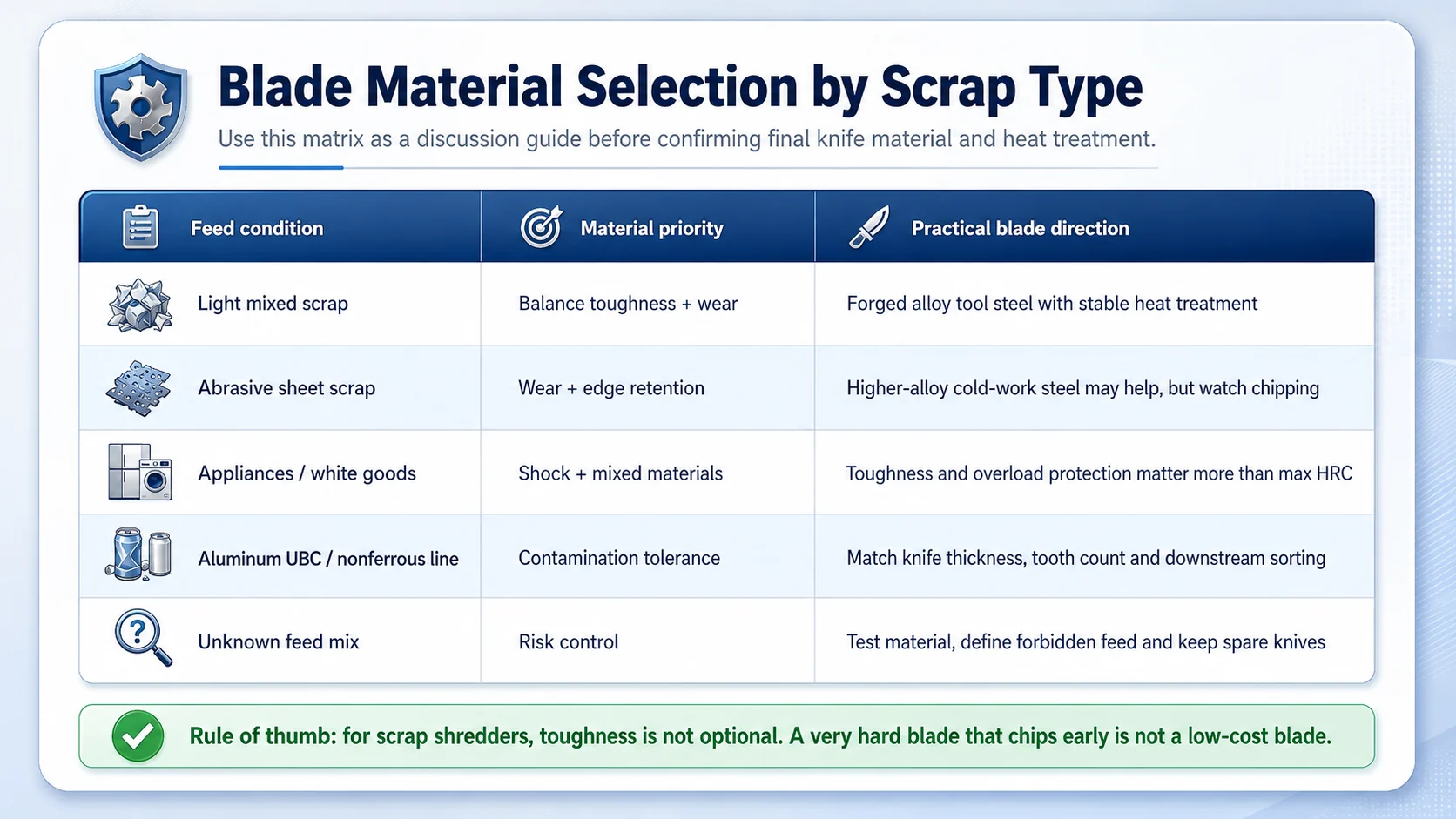
| Scrap stream | Typical blade stress | Material direction | Design note |
|---|---|---|---|
| Car shells and light auto body scrap | Impact, folded sheet, mixed attachments | Forged alloy tool steel with strong toughness | Overload reverse logic and feed control matter. |
| Refrigerators and white goods | Mixed steel, plastic, insulation materials ,and occasional copper/aluminum | A balanced combination of wear resistance and toughness is required | A complete production line design shall be taken into consideration including crusher, magnetic separation, eddy-current separation and dust control. |
| Metal drums and buckets | Thin-wall cutting, coatings, possible residue risk | Wear-resistant alloy tool steel | Define prohibited feed and empty/clean drum procedures. |
| Waste color steel tiles and sheet scrap | Abrasion and edge rounding | Higher wear-resistance tool steel may help | Do not over-harden if folded bundles cause shock. |
| Aluminum UBC and nonferrous scrap | Volume reduction, contamination, downstream purity | Stable blade geometry and wear control | YUXI’s UBC line combines double-shaft shredding, magnetic separation, screening, eddy-current separation and PLC control. |
| Unknown mixed scrap | Unpredictable impact, foreign objects, downtime risk | Prioritize toughness and spare-parts availability | Start conservative, log blade failures, then optimize. |
Heat treatment matters as much as the material name
Two suppliers may both say “tool steel,” but the blades may perform very differently. Ask about the full manufacturing route: forged blank, rough machining, heat treatment, tempering, final machining, dimensional inspection and any low-temperature treatment. YUXI’s published product page emphasizes precision machining, multiple heat treatments and low-temperature treatment for the moving knife, which is exactly the type of process information buyers should request.
For U.S. buyers comparing replacement knives, request the following information before approving a large spare-parts order:
- Base material or material family, not just “alloy steel.”
- Target hardness range and where hardness is measured.
- Heat-treatment processing steps and whether the blade is fully-hardened or surface-strengthened.
- Dimensional permissible errors of thickness, bore, keyseat and tooth contour.
- Recommended feed limitations and known non-shreddable items.
- Expected regrinding or rotation practice, if applicable to the knife design.
A material that performs well in a clean test may fail in a yard where operators feed sealed cylinders, thick castings, high-strength bolts or stones. Good blade selection is partly engineering and partly feed discipline.
Blade maintenance and safety for U.S. facilities
Blade replacement and inspection expose workers to stored energy, sharp edges, suspended loads, pinch points and unexpected machine movement. OSHA’s lockout/tagout standard, 29 CFR 1910.147, applies to servicing and maintenance where unexpected energization, startup or release of stored energy could injure workers. OSHA’s machine-guarding standard, 29 CFR 1910.212, requires protection from hazards such as points of operation, ingoing nip points, rotating parts, flying chips and sparks.
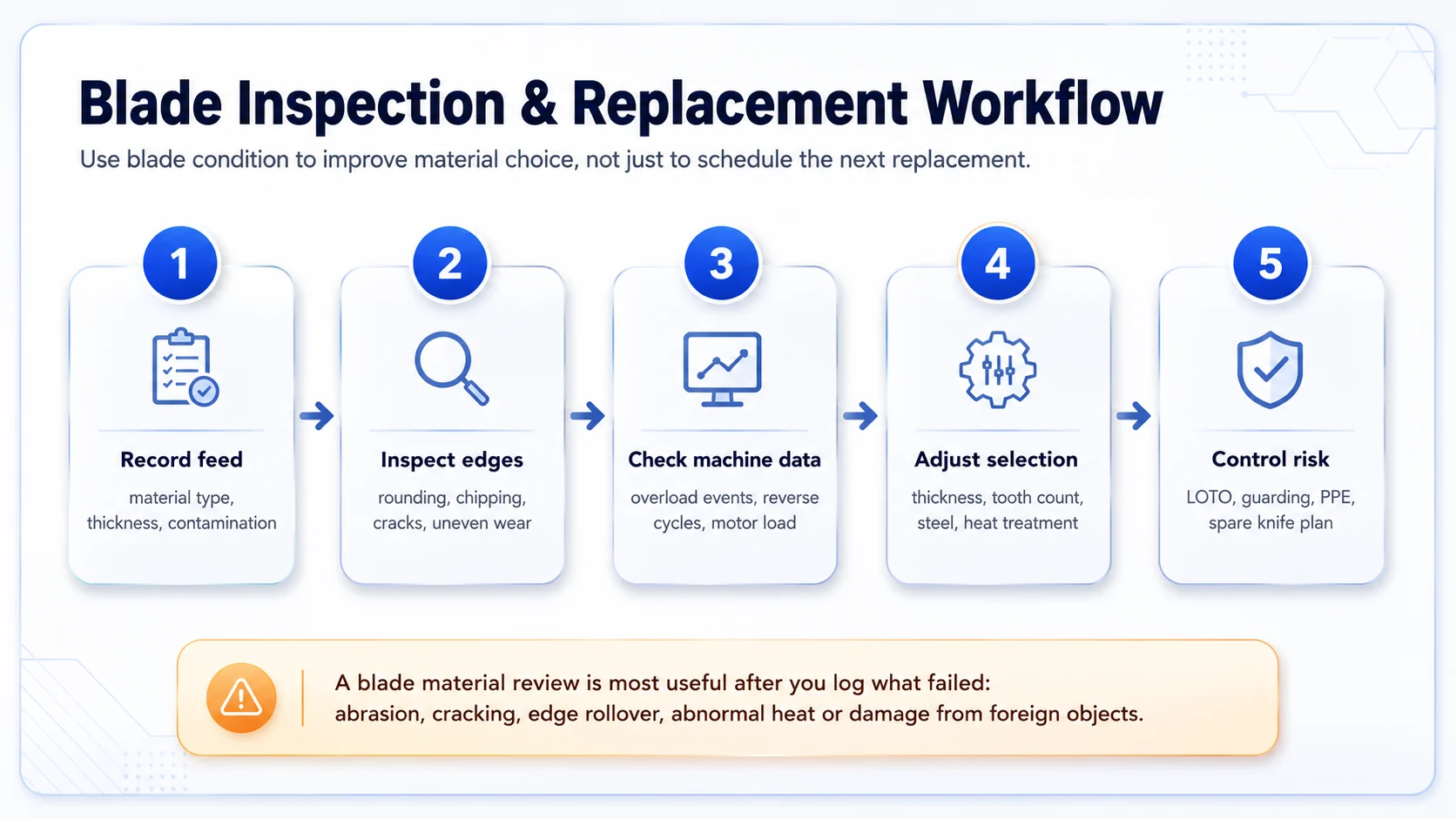
Scrap recycling also has broader hazards. OSHA’s scrap metal recycling topic page flags moving parts, unexpected startup, combustible dust, fire and explosion, and other risks. When a facility generates dust while cutting aluminum, magnesium or other combustible metals, review NFPA 484 together with local fire codes and insurer requirements. For workplace noise, NIOSH recommends an exposure limit of 85 dBA averaged over eight hours; allowable exposure time decreases as noise levels rise.
Practical maintenance note: Blade records should not only say “changed on Friday.” Track feed type, operating hours, overload events, chipped teeth, rounded edges, cracks, abnormal heat, regrinding history and foreign-object incidents. That record is what tells you whether the next improvement should be a different blade material, a different tooth count, better feed sorting, or a better operator rule.
Blade material is part of the full recycling line
A shredder blade does not work alone. In a complete scrap recycling line, blade performance affects downstream particle size, magnetic separation, eddy-current separation, screening and dust load. YUXI’s Aluminum UBC Scrap Recycling Line, for example, describes a process with double-shaft shredding, magnetic separation, vibrating screening, eddy-current separation and a central control system. For white goods, YUXI describes refrigerator recycling lines that use a double-shaft shredder, metal crusher, eddy-current separator and dust removal equipment.
This is why a U.S. plant building a new line should not only ask, “What blade material do you use?” A better question is: “For my feed material, target output size, downstream sorting method and safety requirements, what blade thickness, tooth count, shaft speed, heat treatment and spare-parts plan do you recommend?”
Buyer checklist: questions to ask before ordering shredder blades
- What exact scrap stream will the blades process: car shells, drums, appliances, sheet scrap, aluminum, mixed metal or something else?
- What is the largest feeding size and typical wall thickness?
- What contaminants are realistic: bolts, hinges, castings, stones, rubber, plastics, sealed containers?
- What target output size and downstream sorting equipment will the line use?
- What blade thickness and claw count are recommended for the material?
- What is the target hardness range and heat-treatment method?
- How will overload events be detected, reversed and logged?
- How many spare knife sets should be stocked for your operating schedule?
- What lockout/tagout and lifting procedures are required for safe replacement?
Need help matching blade material to your scrap stream?
YUXI can help evaluate the full shredding requirement rather than treating the blade as an isolated spare part. For a faster recommendation, prepare: material type, feeding size, target output size, capacity requirement, site layout, automation level, downstream sorting goal and dust-control needs.
Contact YUXI for a blade and shredder configurationFAQ: Metal shredder blade materials
Is harder always better for metal shredder blades?
No. Higher hardness can improve wear resistance, but it can also increase chipping risk if the blade lacks toughness. Mixed scrap shredding needs a balance between hardness, impact resistance and heat-treatment stability.
What blade material does YUXI use for its metal shredder?
YUXI’s published metal shredder page describes the moving knife material as special alloy tool steel forging blanks with precision machining, multiple heat treatments and low-temperature freezing heat treatment technology.
When should I consider D2-type tool steel?
D2-type steel can be considered when the main blade failure is abrasive edge wear rather than impact cracking. It is known for high carbon and chromium content, wear resistance and high hardness, but it must be matched carefully to shock conditions.
When should I consider H13-type tool steel?
H13-type steel is known for hot toughness, wear resistance and thermal shock resistance. It may be useful when heat and shock are the main concerns, but it does not automatically become the best choice for every double-shaft scrap shredder.
How should I choose the blade thickness?
Blade thickness depends on material size, material toughness, target output and machine configuration. YUXI lists 15 mm, 20 mm, 40 mm, 50 mm, 75 mm and 100 mm knife thickness options and notes that thickness and claw count can be replaced according to different materials.
Sources and authority references
- YUXI Metal Shredder product page — YUXI product applications, working principle, moving knife material, blade thickness options and overload reversal statement.
- YUXI Aluminum UBC Scrap Recycling Line — double-shaft shredder, magnetic separator, vibrating screen, eddy-current separator and central control system context.
- OSHA 29 CFR 1910.147 — management of dangerous energy sources while machines undergo servicing and maintenance.
- OSHA 29 CFR 1910.212 — baseline safety guard standards for all mechanical equipment.
- OSHA Scrap Metal Recycling — U.S. scrap recycling hazards including moving parts, unexpected startup, combustible dust, fire and explosion.
- CDC/NIOSH Noise-Induced Hearing Loss — 85 dBA recommended exposure limit over an eight-hour workday.
- NFPA 484 — standard development page for combustible metals.
- Xometry D2 Tool Steel Guide and AZoM D2 Tool Steel — D2 composition, hardness and wear-resistance context.
- MatWeb AISI H13 Tool Steel — H13 wear resistance, hot toughness, thermal shock and nitriding notes.