




 Request Quote



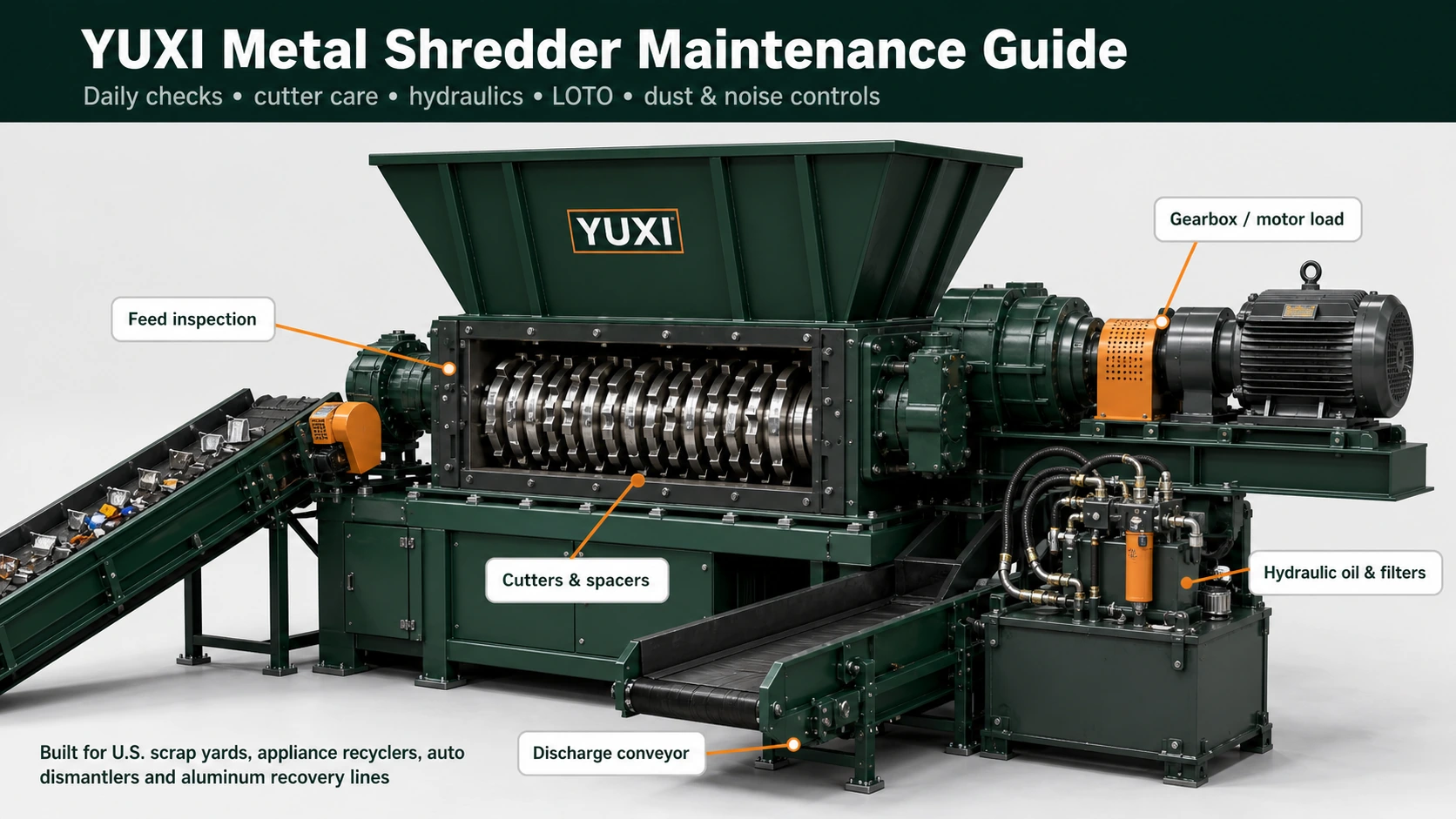
Quick answer: what does good metal shredder maintenance include?
Good metal shredder maintenance is not just changing oil or sharpening blades. It is a repeatable system: inspect the feed stream, keep cutters and spacers within usable condition, control hydraulic temperature and contamination, monitor motor load, protect conveyors and separators, clean dust safely, document abnormal events, and use lockout/tagout before servicing or jam clearing.
1. Protect people first
Use written lockout/tagout, guards, interlocks, PPE, safe access and trained authorized employees before any maintenance work.
2. Protect the cutting chamber
Most production losses begin with unshreddables, wire wrap, dull cutters, loose spacers or blocked discharge.
3. Protect oil, power and controls
Hydraulic oil, reducers, bearings, sensors and PLC alarms tell you whether the shredder is stable or heading toward failure.
In many U.S. recycling plants, the shredder is the bottleneck. When it stops, feeding equipment, conveyors, magnetic separation, eddy current separation and downstream sorting also slow down. That is why this guide focuses on maintenance actions that can be used by production managers, mechanics and EHS teams—not just theoretical advice.
YUXI equipment context: maintain the shredder as part of a recycling line
The YUXI Metal Shredder product page describes equipment that shreds large metal materials into smaller pieces for transportation and recycling, with common applications including waste color steel tiles, metal drums, car shells, refrigerators, metal buckets, scrap steel and steel furniture. The same product page explains the working principle: material enters through the feeding system, then tearing, squeezing and shearing actions reduce the scrap before discharge from the lower part of the box.
The YUXI Waste Car Recycling Line uses a heavy-duty two-shaft shredder for primary shredding, followed by a hammer-type metal crusher for deeper size reduction, magnetic separation, eddy current separation and central PLC control. This matters for maintenance: the shredder should not be treated as an isolated machine. A dull cutter, blocked conveyor or unstable separator can change the load profile of the whole line.
YUXI also notes that its double-shaft shredder uses low-speed, high-torque operation with automatic start, stop, reverse and overload functions in the waste car recycling line. These controls help protect the machine, but they are not a substitute for preventive inspection. If auto-reverse is happening more often, the maintenance question is not “did the PLC protect us?” but “why is the chamber seeing overload conditions?”
Safety before maintenance: the U.S. compliance lens
For U.S. plants, maintenance planning should start with safety controls. OSHA’s scrap metal recycling guidance lists moving parts, unexpected machine startup, combustible dust, fire and explosion, falls, manual handling and other hazards as issues that recycling employers should recognize and control. OSHA’s lockout/tagout standard applies to servicing and maintenance where unexpected energization, startup or release of stored energy could cause injury. In practical terms, cutter inspection, jam clearing, lubrication inside danger zones, hydraulic repair and guard removal need a written energy-control procedure.
Machine guarding also matters during normal operation. The shredder, conveyors, belt drives, couplings, pulleys, feed points and discharge points should be guarded so operators and maintenance staff are not exposed to rotating parts, in-running nip points, flying chips or ejected scrap. When maintenance requires guard removal, the job must shift from “production adjustment” to controlled servicing.
Noise and dust deserve equal attention. NIOSH states that its recommended exposure limit for occupational noise is 85 dBA as an eight-hour time-weighted average, and it recommends measuring area noise with sound level meters and personal exposure with dosimeters. Metal shredding can also create dust and fines, especially when processing mixed scrap, painted materials, aluminum, appliances or downstream residue. NFPA 484 covers combustible metals in production, processing, recycling, storage and handling, so facilities processing combustible metal fines should coordinate dust hazard analysis, housekeeping and fire protection with qualified EHS professionals.
Site note
This article is a maintenance guide, not a legal compliance manual. Use it together with the machine manual, plant-specific risk assessment, OSHA requirements, NFPA guidance, local regulations and your qualified safety team.
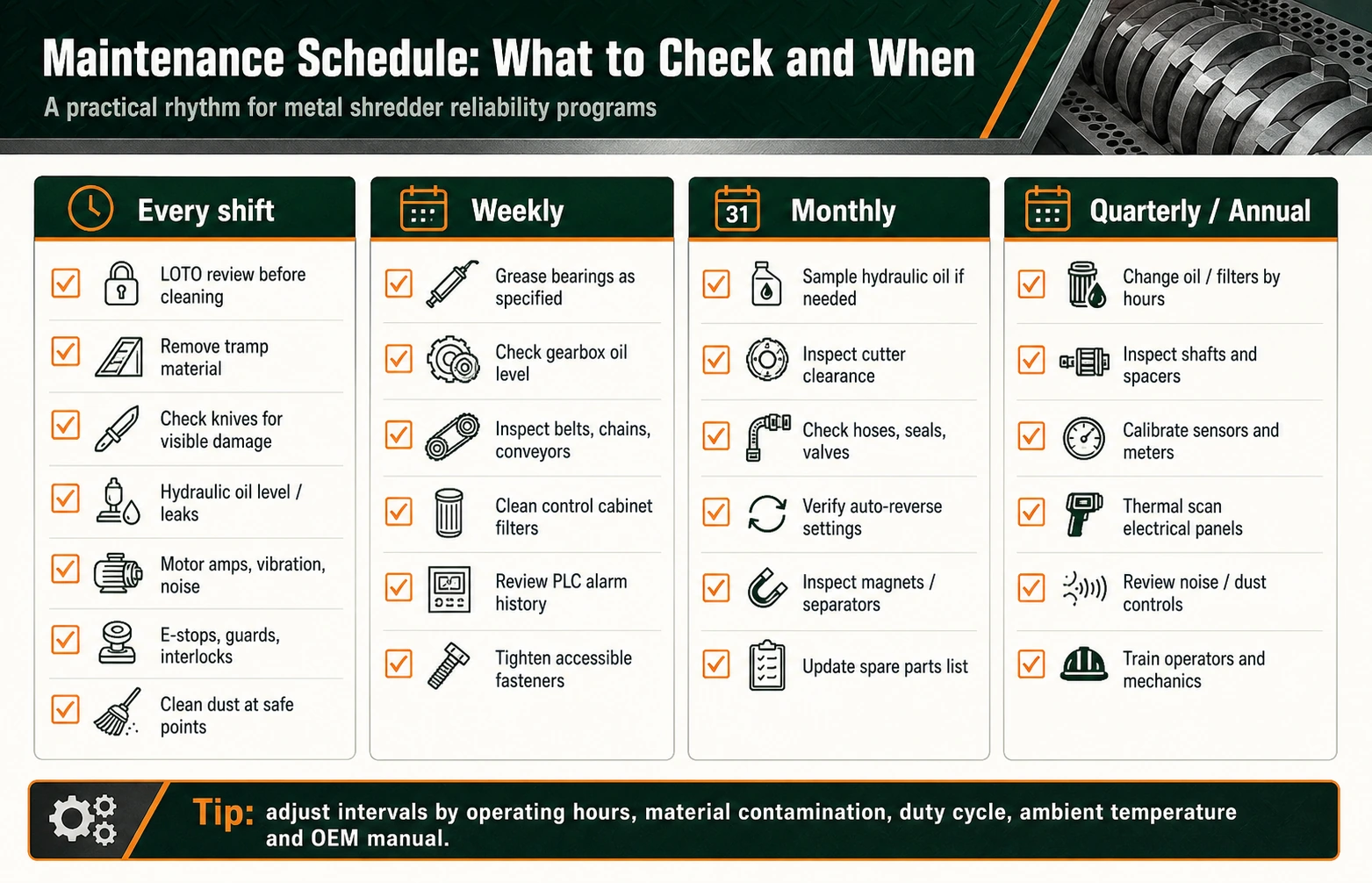
Metal shredder maintenance schedule
The table below gives a practical starting point. Adjust intervals by operating hours, input material, contamination level, ambient temperature, shift pattern, hydraulic oil analysis and OEM instructions. A shredder processing clean aluminum UBC scrap will not have the same wear pattern as a shredder taking mixed car shell material, appliances, drums and long steel furniture.
| Interval | Maintenance focus | What to record |
|---|---|---|
| Before each shift | Confirm guards, emergency stops, interlocks, chamber condition, feed hopper, hydraulic oil level, visible leaks, conveyor condition and discharge clearance. | Operator initials, abnormalities, startup motor amps, hydraulic pressure, unusual noise or vibration. |
| During production | Watch for repeated auto-reverse, slow throughput, material bridging, discharge pile-up, belt drift, dust accumulation and hot bearing or reducer smell. | Time of event, material being processed, alarm code, corrective action, whether production continued. |
| End of shift | Clean safe access areas, inspect cutter chamber from approved viewing points, remove loose scrap around conveyors, check dust collection zones and empty bins if required. | Cleaning completed, leftover jam risk, maintenance handover notes. |
| Weekly | Lubricate bearings as specified, check fasteners, belts, chain tension, gearbox oil level, coupling guard, hydraulic filter indicator and control cabinet cleanliness. | Grease amount, oil level, filter status, loose components, belt tension, corrective work order. |
| Monthly | Inspect cutter wear, spacer condition, shaft wrap, hydraulic hoses, oil color, sensors, limit switches, PLC alarm trend, separator alignment and magnet cleaning. | Wear measurements, photo evidence, parts needed, planned downtime window. |
| Quarterly / semiannual | Oil sampling, hydraulic filter replacement if indicated, motor alignment, vibration check, electrical thermal inspection, interlock validation and structure weld inspection. | Oil analysis result, vibration trend, thermal image notes, EHS validation. |
| Annual overhaul | Major cutter inspection or replacement, shaft and bearing review, gearbox service, hydraulic tank cleaning if required, full control system audit and operator retraining. | Overhaul report, replaced parts, updated procedures, recommended next overhaul date. |
Daily inspection points that prevent bigger failures
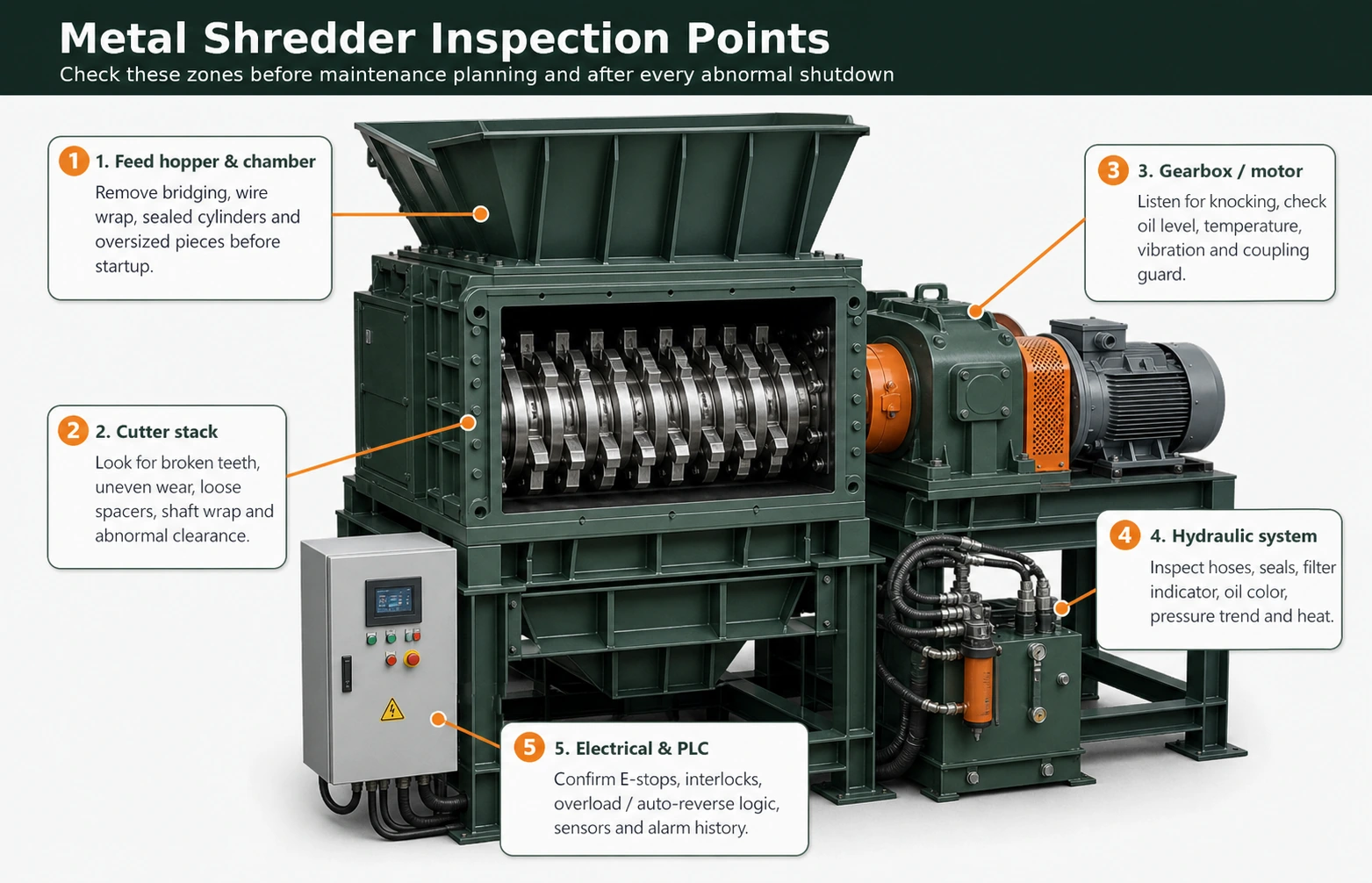
1. Feed hopper and incoming material
Do not let the shredder become a sorting station for unknown material. Operators should remove sealed containers, cylinders, excessive wire, concrete, stones, large cast blocks, explosive risk items, batteries and any material outside the machine’s agreed feed specification. Feeding discipline is maintenance discipline. Many cutter, shaft, gearbox and hydraulic problems begin before the material reaches the rotors.
- Confirm the feed stream matches the approved application: car shells, drums, refrigerators, color steel tiles, scrap steel, aluminum scrap or other specified material.
- Check for long pieces that may bridge across the hopper or wrap around shafts.
- Watch whether the crane, grab, conveyor or loader is delivering too much material at once.
- Stop the line when material repeatedly triggers overload or auto-reverse.
2. Cutting chamber
The cutting chamber is where production value is created and where maintenance cost is concentrated. A healthy cutter stack should pull material consistently, create a predictable discharge size and avoid frequent stalling. Inspect for broken cutter edges, missing teeth, uneven wear, loose spacers, shaft wrap and signs of metal-to-metal contact in areas that should not be rubbing.
3. Discharge and downstream equipment
A blocked discharge conveyor can look like a cutter problem. When shredded material cannot leave the machine, chamber pressure rises and the drive system sees unnecessary load. Keep discharge belts aligned, magnets cleaned, chutes open and separator settings stable. In integrated systems, the YUXI Hammer Mill Metal Crusher, vibrating screen, magnetic separator and YUXI Eddy Current Separator should be included in the same maintenance handover.
Cutter system maintenance: blades, spacers and shaft wrap
YUXI’s metal shredder page notes that the moving knife material uses special alloy tool steel forging blanks, precision machining and heat-treatment processes, and that cutter thickness can be selected according to different materials. From a maintenance standpoint, that means the cutter configuration should match the feed stream. A blade stack that works well for drums and color steel tiles may not be ideal for thick mixed scrap or long wire-rich material.
Signs the cutters need attention
- Throughput drops even though feed rate and material type are unchanged.
- The machine needs more reversals to process the same scrap.
- Discharge pieces become too large, stringy or inconsistent.
- Motor current rises, hydraulic pressure spikes or oil temperature runs high.
- Operators hear knocking, scraping or rhythmic impact that was not present before.
- Wire, sheet or strips wrap around the shaft and reduce cutting clearance.
What mechanics should check
Use the OEM procedure to measure cutter clearance and wear. Do not rely only on visual inspection. Photograph the cutter stack at the same angle every month so wear can be compared over time. Check spacer condition, fastener integrity, bearing temperature, shaft-end seals and any abnormal movement. When a cutter is replaced, record the position and reason for replacement; repeated failure in the same position often points to feed impact, misalignment or a discharge restriction.
Hydraulic, drive and control system maintenance
Hydraulic system
Hydraulic systems make heavy-duty shredders productive, but they are sensitive to heat and contamination. Keep the oil clean, dry and within the correct temperature range. A small leak can become a major safety and reliability problem because low oil level, aeration and pressure instability can affect pushing devices, door systems, hydraulic stations and overload protection.
- Check oil level, oil color and abnormal smell at the required interval.
- Inspect hoses for abrasion, cracking, swelling, loose clamps and leakage.
- Watch oil temperature during heavy feed conditions and hot weather.
- Replace filters by indicator, hours or oil analysis—not only after a failure.
- Keep hydraulic power units and cooling surfaces clean.
Reducer, motor and coupling
Gear reducers and motors should be trended, not just inspected after failure. Record reducer oil level, oil change dates, motor current, vibration and temperature. Keep coupling guards installed and check alignment after heavy impact, foundation movement or major service work. If a reducer gets louder, hotter or starts leaking, schedule downtime before production forces an emergency stop.
PLC, sensors and overload logic
Automatic reverse and overload protection are useful only when sensors and control logic are reliable. Review alarm history weekly. If the same alarm appears every shift, treat it as a maintenance signal. Confirm limit switches, proximity sensors, emergency stops, chamber door interlocks and conveyor interlocks during planned downtime. Never bypass a safety device to keep production running.
Safe jam clearing: do not turn a downtime event into an injury
Jam clearing is one of the highest-risk maintenance activities around a shredder. OSHA’s scrap metal recycling page describes a fatality involving a worker crushed while trying to remove a jammed piece of metal from a shredder hydraulic door. A jam should therefore trigger a controlled process, not improvisation.
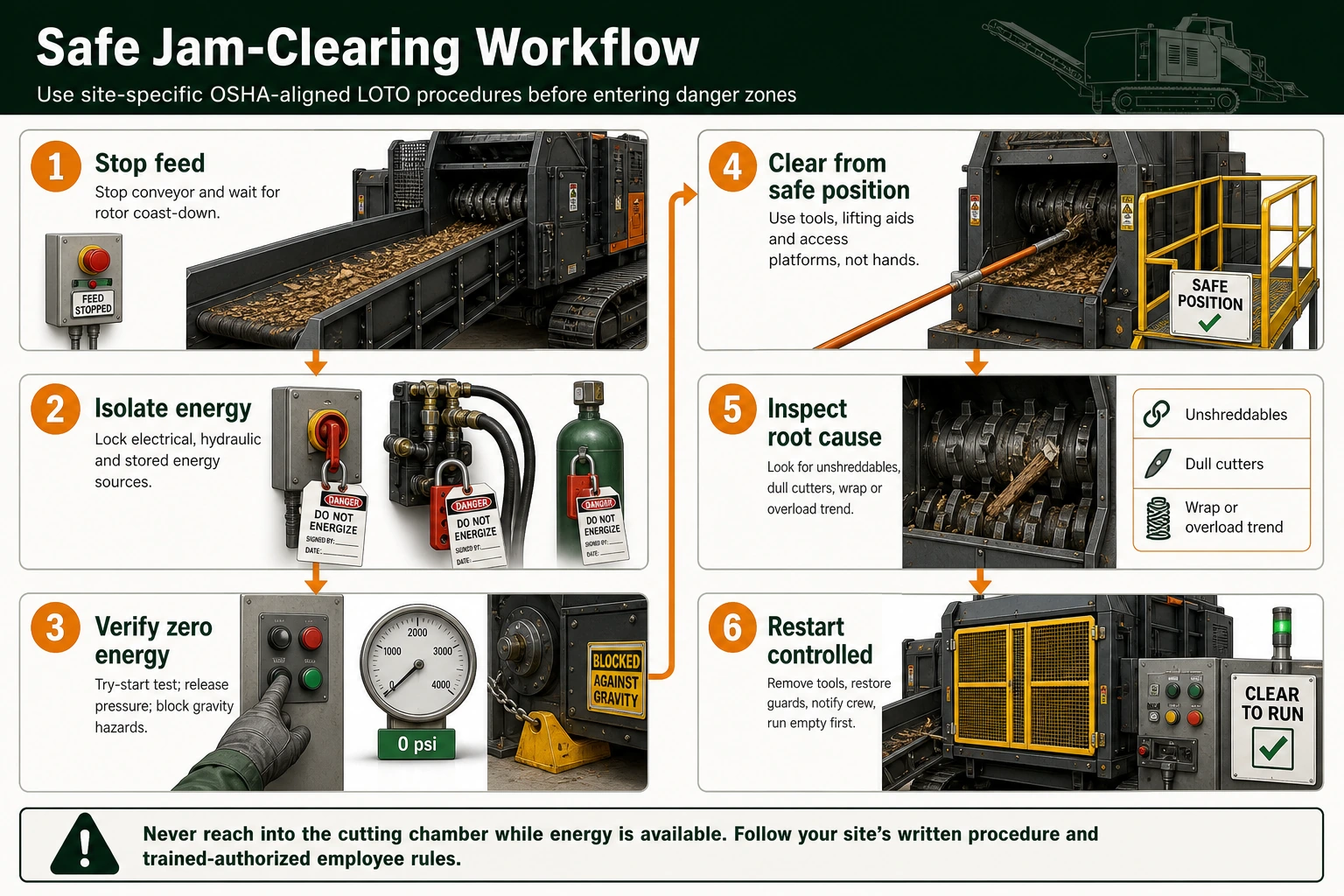
- Stop feeding first. Stop upstream conveyors, cranes or loaders so new material cannot enter the danger zone.
- Shut down and isolate energy. Lock electrical, hydraulic, pneumatic, mechanical and stored energy sources according to the written procedure.
- Verify zero energy. Try-start test, release hydraulic pressure where required, block or support gravity hazards and wait for moving parts to stop.
- Clear with tools and lifting aids. Use approved bars, hooks, hoists or access platforms. Do not reach into the cutter chamber by hand.
- Find the root cause. Identify whether the jam came from unshreddable material, cutter wear, poor feed control, shaft wrap or discharge blockage.
- Restart under control. Remove tools, reinstall guards, notify the crew, run empty and then feed gradually.
Troubleshooting table: symptoms, likely causes and first checks
| Symptom | Likely causes | First checks |
|---|---|---|
| Frequent auto-reverse | Too much feed, unshreddables, dull cutters, incorrect cutter configuration, discharge blockage. | Review feed material, inspect cutter stack, check discharge conveyor and PLC alarm times. |
| Output size too large | Worn cutters, excessive clearance, broken teeth, wrong blade thickness for material. | Measure cutter wear and clearance; compare to previous photos and OEM limits. |
| Hydraulic oil runs hot | Overload, clogged cooler, low oil level, contaminated oil, high ambient temperature, failing pump or valve. | Check oil level, cooler cleanliness, filter indicator, pressure trend and operating cycle. |
| Motor current higher than normal | Cutter wear, chamber packing, misalignment, bearing issue, gearbox drag, downstream restriction. | Run empty current check, inspect chamber, reducer, bearings and discharge points. |
| Unusual vibration | Loose fasteners, damaged cutter, bearing wear, shaft wrap, foundation issue, misaligned coupling. | Stop safely, inspect mechanical fasteners, cutter stack, bearings and coupling alignment. |
| Conveyor belt drifting | Material build-up, pulley misalignment, damaged belt edge, uneven loading, failed idler. | Clean build-up, inspect pulleys and idlers, adjust tracking during controlled maintenance. |
| Dust around shredder area | Poor housekeeping, inadequate capture, blocked duct, damaged enclosure, dry dusty material. | Clean using approved methods, inspect dust collection, review combustible dust and respiratory controls. |
Recommended spare parts for a metal shredder maintenance program
Spare parts strategy should reflect the cost of downtime. A small recycling yard may not need a complete duplicate cutter set on site, but it should still keep common consumables and failure-prone components ready. High-throughput yards should rank spares by lead time, failure history and the financial impact of an idle line.
Cutting chamber
Cutters, spacers, wear plates, screens or discharge wear parts, shaft seals and key fasteners.
Hydraulic system
Filter elements, seals, hoses, fittings, pressure gauges, valve coils and approved hydraulic oil.
Controls and drive
Proximity sensors, limit switches, E-stop parts, fuses, belts, chains, couplings and lubrication supplies.
Maintenance records: what should be measured?
The best maintenance teams do not depend on memory. They use simple records that reveal patterns. Track operating hours, processed material type, tons per hour if measured, reversals per hour, motor current, hydraulic temperature, oil changes, filter changes, cutter position, bearing temperature, downtime reason and corrective action. Over time, these records show whether downtime is caused by poor feed sorting, maintenance delays, wrong cutter selection or downstream restrictions.
| KPI | Why it matters | How to use it |
|---|---|---|
| Reversals per operating hour | Early sign of feed or cutter problems. | Investigate if the trend rises for the same material. |
| Hydraulic oil temperature | Shows load, cooling and oil condition issues. | Compare by shift, weather and material type. |
| Unplanned downtime minutes | Measures real production loss. | Group by root cause: jam, cutter, hydraulic, electrical, conveyor. |
| Cutter life by position | Finds uneven wear and impact zones. | Rotate, replace or adjust feed method based on data. |
How YUXI can support maintenance planning
YUXI’s product pages emphasize metal shredders, hammer mill metal crushers, vertical metal crushers, crocodile shears, eddy current separators, air flow gravity separators and metal baling machines for metal recycling applications. For a U.S. recycling project, maintenance planning should begin before installation: define the feed material, choose the cutter configuration, plan safe access, keep critical spares, train operators, and connect shredding, crushing, screening and separation equipment into one maintenance schedule.
Need a maintenance checklist for your specific scrap stream?
Tell YUXI what you process—car shells, metal drums, color steel tiles, refrigerators, aluminum UBC scrap, steel furniture or mixed industrial scrap—and the team can help review shredder configuration, spare parts and line maintenance points.
FAQ: Metal Shredder Maintenance Guide
How often should a metal shredder be maintained?
Use a layered schedule: every-shift checks, weekly lubrication and fastener checks, monthly cutter and hydraulic inspection, and larger quarterly or annual service. The exact interval depends on operating hours, scrap type, contamination and the OEM manual.
What causes most metal shredder downtime?
Common downtime causes include unshreddable feed material, cutter wear, shaft wrap, low or contaminated hydraulic oil, loose fasteners, conveyor misalignment, blocked discharge chutes and sensor faults.
Can operators clear a jam while the shredder is powered?
No. Jam clearing can expose workers to electrical, hydraulic, mechanical and stored energy hazards. Follow the site’s written lockout/tagout procedure, verify zero energy, use proper tools and restore guards before restart.
What should be included in a shredder lubrication checklist?
Include bearing points, reducer oil, hydraulic oil level, grease type, lubrication amount, service interval, person responsible and notes about abnormal temperature, contamination or leakage.
When should cutters be replaced?
Replace or rebuild cutters when wear causes poor bite, larger output, excessive reversals, higher current, abnormal vibration or measured clearance outside the OEM limit. Always inspect spacers and shafts at the same time.
Sources and standards consulted
- YUXI Metal Shredder product page — applications, working principle and cutter information.
- YUXI Waste Car Recycling Line — two-shaft shredder, hammer crusher, magnetic separation, eddy current separation and PLC control context.
- YUXI Hammer Mill Metal Crusher — downstream size reduction and metal/non-metal separation context.
- YUXI Eddy Current Separator — non-ferrous recovery and downstream separation context.
- OSHA 3348: Guidance for the Identification and Control of Safety and Health Hazards in Metal Scrap Recycling.
- OSHA 29 CFR 1910.147: The Control of Hazardous Energy (Lockout/Tagout).
- OSHA 29 CFR 1910 Subpart O: Machinery and Machine Guarding.
- CDC/NIOSH: Understand Noise Exposure.
- NFPA 484: Standard for Combustible Metals.