




 Request Quote


Best Copper Wire Recycling Machine: Buyer’s Guide
Buyers who require the best copper wire recycling machine usually do not seek slogans.They are trying to solve a practical problem: tangled automobile wiring harnesses,electrical wires, computer cables, communication lines or mixed copper-plastic scraps which are too slow or inconsistent to be peeled off manually. The correct answer depends less on the name of the individual model,but more on whether the line can cleanly release copper,consistently separate the copper,control dust,and maintain adjustment when the cable mixes changes.
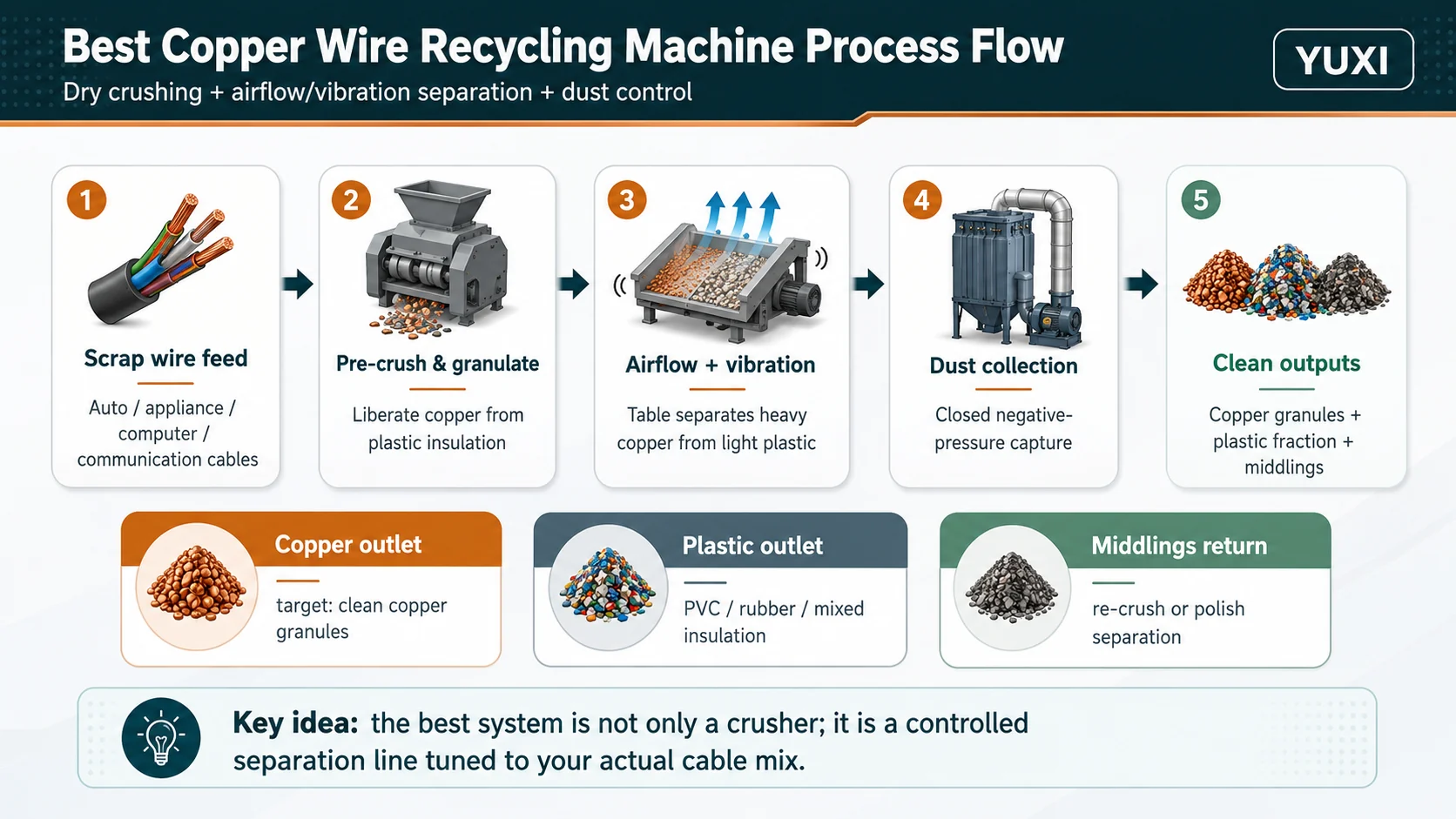
For many recyclers, the best machine is the dry copper cable granulation and separation line:the crusher or granulator opens the insulation,the airflow/vibration separator separates heavy copper particles from lighter plastics, the dust is collected through the pipe,and the fine mixture material can be returned or polished.That is also the logic behind the YUXI Copper Wire Recycling Line.It is specially designed for waste wires that are not suitable for wire stripping mashines,and use crushing,airflow suction,linear vibration,dust collection and electrical control to separate copper from plastic.
Quick answer: what is the best copper wire recycling machine?
The best copper wire recycling machine is a complete, enclosed dry-processing line matched to your feedstock. For mixed wires, choose a system with stable crushing, an adjustable air gravity/vibrating screen separator, dust collection, practical controls, and room to add electrostatic separation when fine copper loss becomes a concern.
- For thick, clean cable: stripping may be cheaper and simpler.
- For mixed appliance, automotive, computer, and communication wire: a copper wire granulator line is usually more practical.
- For very thin or mixed copper-plastic particles: add electrostatic polishing after mechanical separation.
- For serious production: judge the machine by recovered copper quality, plastic cleanliness, dust control, service access, and real test-run data.
What “Best” Really Means in Copper Wire Recycling
In search results, many pages call a machine “best” because it has a high capacity or a high separation rate. In actual recycling work, those numbers only matter after the feed material is defined. A plant processing dry, uniform power cable has a very different job from a plant processing thin automotive harness with plugs, tape, dust, rubber, and mixed plastic.
A better buying standard is this: the best copper wire recycling machine gives a repeatable profit margin on your actual scrap, not on a perfect sample. That means it should protect copper recovery while keeping plastic residue low enough for your buyer. It should also use closed layout and dust collection to maintain the manageability of the work area,instead of letting small PVC/rubber particles escape around the machine.
According to the International Copper Association,copper itself is a powerful recycling target because it can be recycled repeatedly without losing its performance.In many applications,the recoverd copper can be used interchangeably with primary copper.The same organization pointed out that the energy required for copper recovery is significantly lower than for primary production. For recyclers, that market logic is important, but machine choice still comes down to one operational question: how cleanly can you separate copper from insulation at your required throughput?
How a Copper Wire Recycling Machine Works
A copper wire recycling line normally follows four stages. First, incoming cable is fed into a crusher or granulator. The goal is not only to make the material small,but to free copper from plastic insulation without incurring too many fines.Second, the broken mixture moves to the separator,and the vibration and airflow create different movement paths for copper and plastic. Heavier copper granules fall into one outlet, lighter insulation moves toward another, and middlings can be returned for further processing.
YUXI’s product description follows this dry mechanical approach. Its copper wire recycling line consists of a crusher, fan conveyor, vibrating screen, dust collector, and electrical control system. After shredding and crushing, waste wires become plastic fragments and “copper rice”; airflow suction and linear vibration separate the core and sheath, while dust is routed through an air duct to the dust collector.
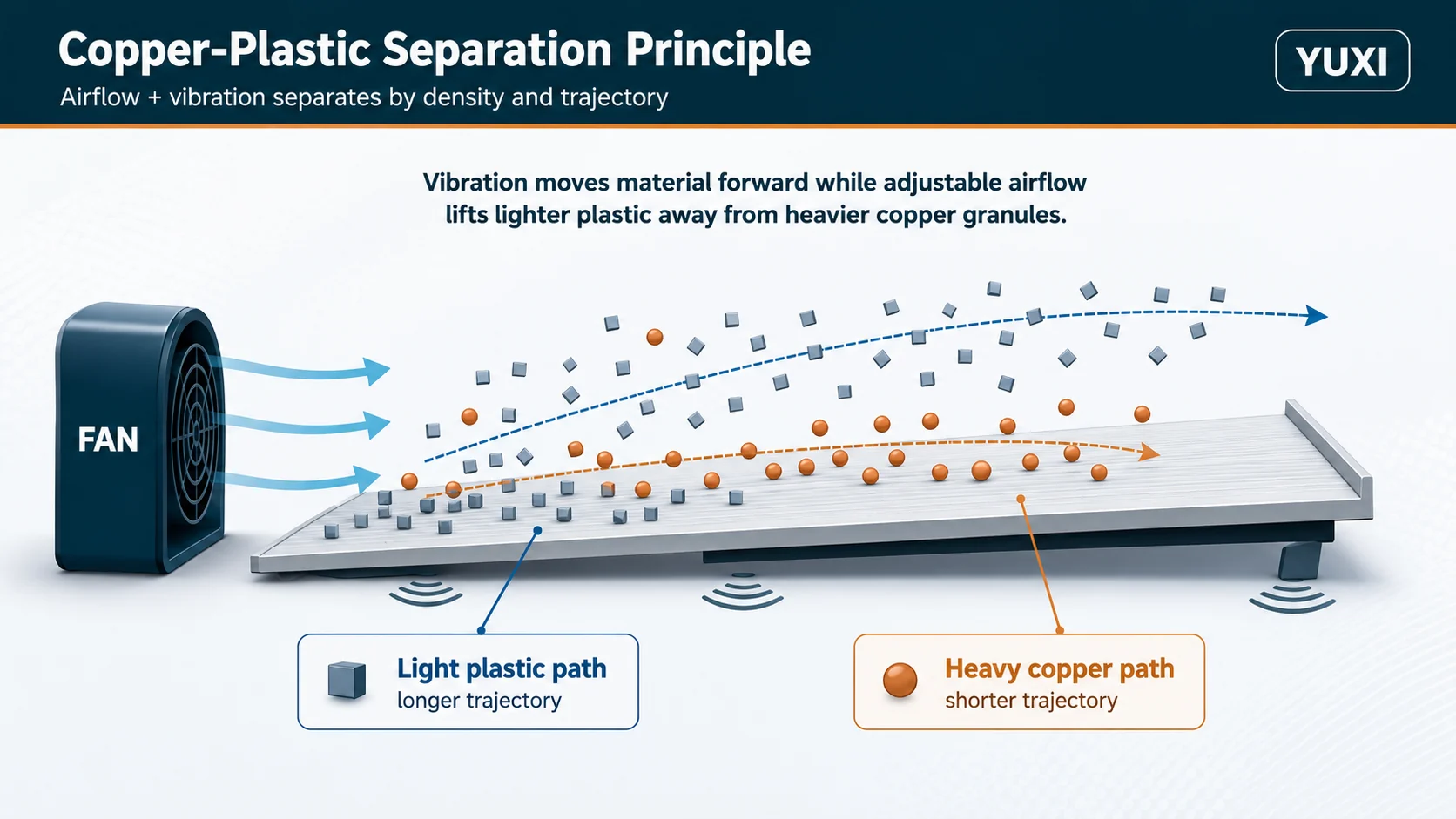
The separating step is where many low-cost machines disappoint buyers. If the airflow is too strong, copper can be carried into the plastic fraction. If it is too weak, plastic can remain in the copper. If the particle size is inconsistent, the separator must handle the particles whose behavior is unpredictable.That’s why frequency control,airflow adjuestment,surface cleaning and operator training are as important as motor power.
How to Choose the Best Copper Wire Recycling Machine
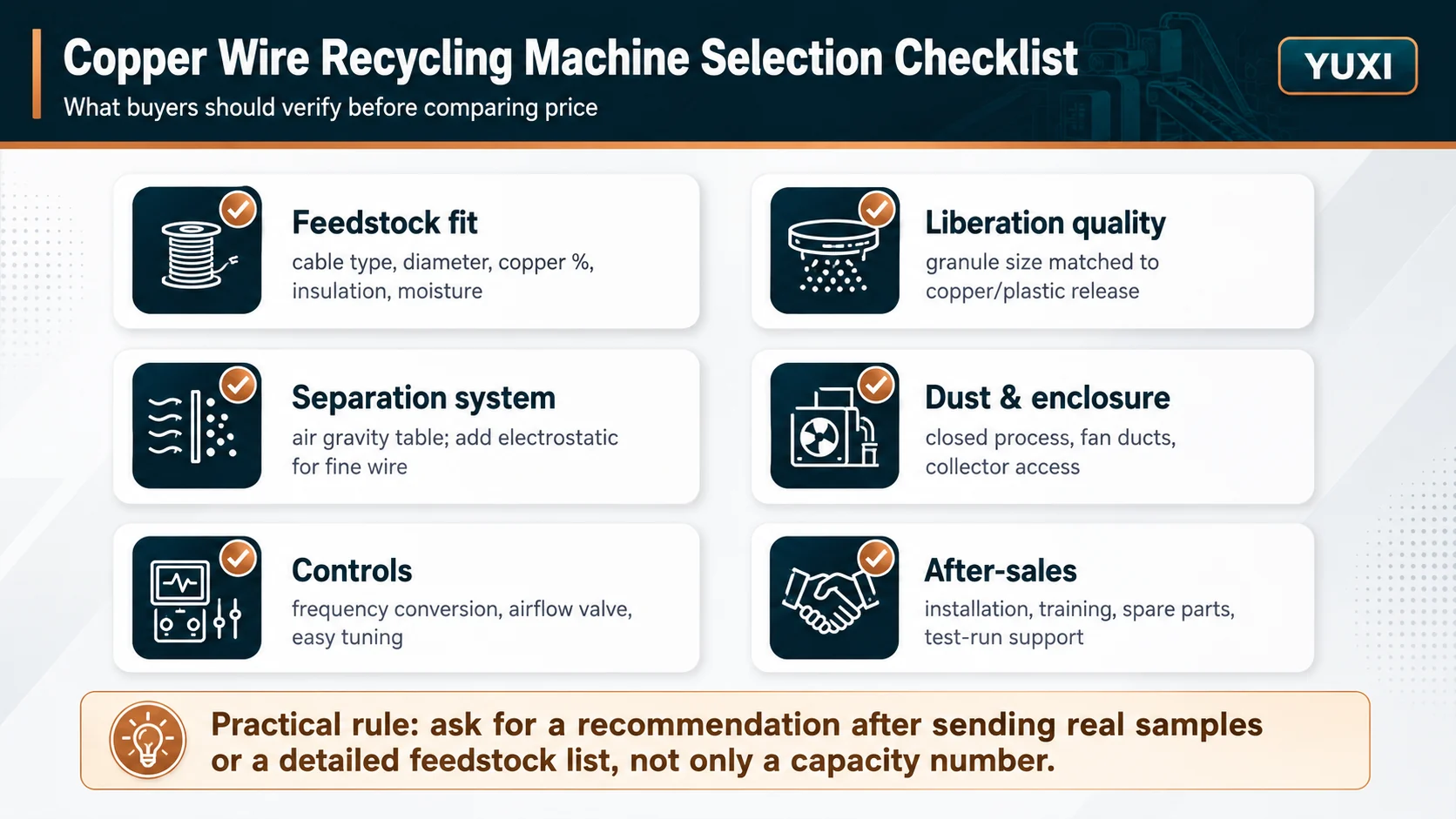
Use the following criteria before comparing prices. They turn a vague “best machine” search into a technical specification that a supplier can actually quote.
1. Match the machine to cable type, not only capacity
Capacity is usually quoted in kilograms per hour, but cable type changes everything. Coarse copper cables,thin wires,automobile wire harness,household appliances wires,telecommunications cables and mixed electronic waste lines behave differently in crusher and separators.Before asking for the price,please list the main cable type,approximate diameter range,copper content,insulation type,humudity conditions,and whether the feed includes iron,plug,connector,tape or aluminum.
2. Look for controlled liberation
The crusher or granulator must open the insulation without pulverizing the copper and plastic into excessive fines. A machine that produces too many fine particles may look powerful, but it can make separation harder. For a better test, check the crushed sample: copper should be visibly free from the plastic shell, and the amount of mixed copper-plastic particles should be low enough to handle by return crushing or polishing separation.
3. Prioritize separation adjustability
The separator should allow practical tuning. YUXI’s copper wire recycling line describes frequency conversion control for the vibrating screen and an air-volume regulating valve. This matters because real scrap changes from batch to batch. An operator should be able to adjust vibration and airflow when switching from appliance wire to communication cable, instead of accepting copper loss or plastic contamination.
4. Consider electrostatic separation for fine or difficult material
Air gravity separation works well when particles are properly liberated and density difference is clear. For fine copper-plastic mixtures, an electrostatic stage can improve polishing. YUXI’s High Voltage Electrostatic Separator is described as a conductor/non-conductor separation device that uses an electric field for metal and plastic separation, with separation performance adjustable according to material characteristics, capacity, purity requirements, and particle uniformity.
5. Do not ignore dust collection and enclosure
Scrap cable recycling produces fine plastic and copper dust during crushing and screening. A closed system with ducting and a dust collector is not just a “nice extra”; it improves housekeeping, protects operators, and supports a more professional recycling workshop. OSHA’s recycling hazard guidance notes that recycling facilities can involve moving machine parts, unexpected startup, lifting injuries, slips, trips, and hazardous materials. A buyer should therefore treat guarding, lockout/tagout access, emergency stops, and dust management as part of the machine specification, not afterthoughts.
Common Machine Configurations
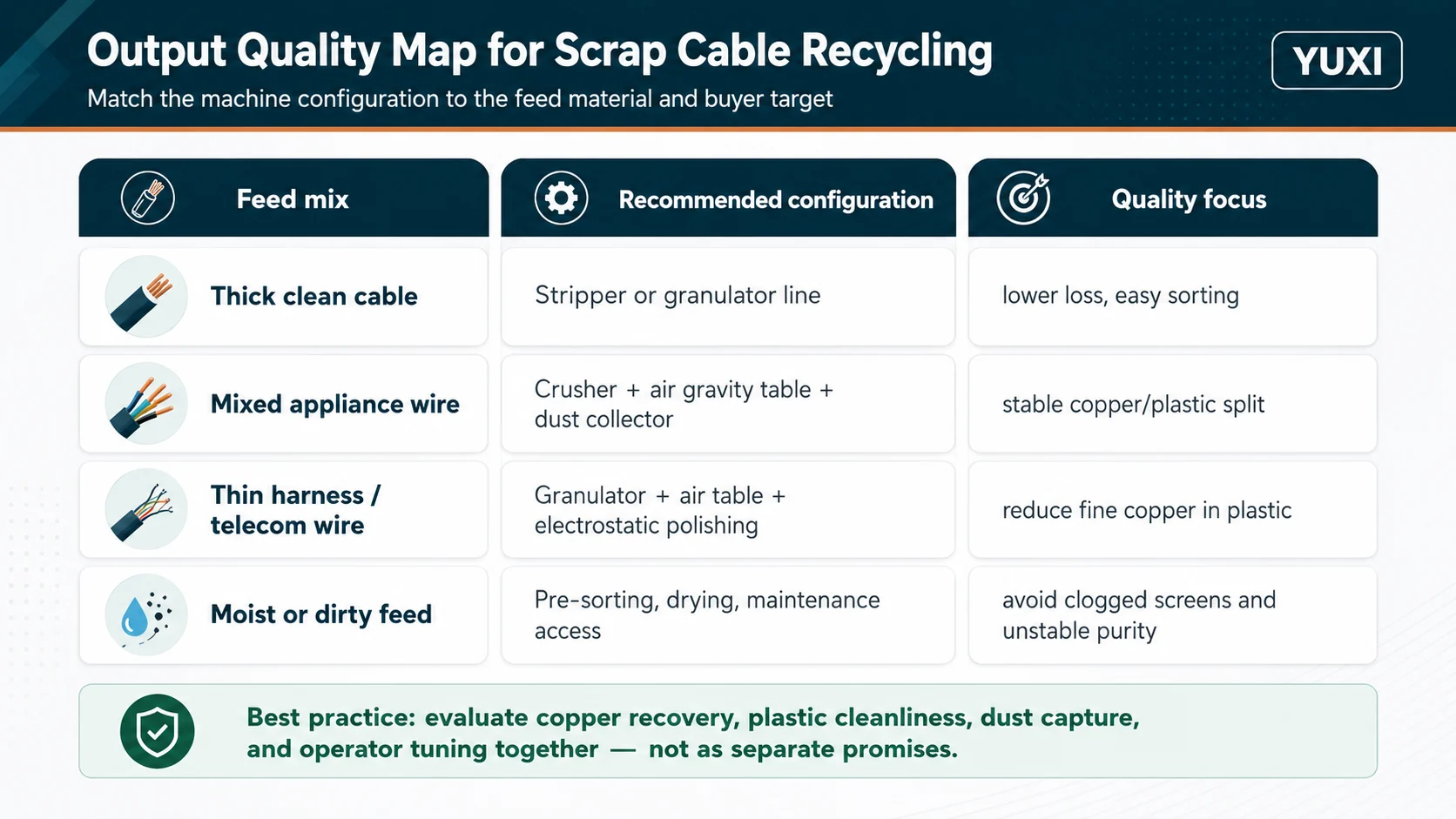
There is no universal best configuration. Use the cable mix and business model to choose the right setup.
Wire stripper vs. copper wire granulator
A wire stripping machine is often best for clean, thick, single-core cable where the operator can remove insulation with minimal loss. It is less suitable for tangled, thin, mixed, or irregular wires. For those materials, a granulation line usually wins because it processes the whole wire into small particles and separates copper from plastic mechanically.
Granulator + air gravity separator
This is the core setup for many scrap cable recyclers. The granulator liberates material, and the air/vibration separator sorts it by density and movement behavior. YUXI’s Air Flow Gravity Separator explains this principle clearly: it uses the different specific gravity of copper and plastic, variable-frequency airflow adjustment, and layered discharge to separate heavier and lighter particles.
Granulator + air gravity + electrostatic polishing
This configuration is better for thin wires, mixed particle sizes, or buyers who need lower copper loss in the plastic fraction. The electrostatic separator is normally used after mechanical separation, not before it. It works best when the material is dry, relatively uniform, and already sized for stable charging and separation behavior.
Complete line with dust collector and return system
For commercial recycling, a complete production line is usually more reliable than buying a separate machine and trying to connect them later. Finding coordinated feeding, crushing, conveying, screening, dust collection, electrical control, and discharge. This line should also make maintenance simple: screens, pipes, blades, bearings and electrical cabinets must be able to enter without unsafe accessation.
Where the YUXI Copper Wire Recycling Line Fits
The YUXI line is a good fit for buyers who want a dry, environmental copper wire recycling machine for mixed waste wires that are not efficient to strip manually. The official product page lists applications including automobile circuit lines, motorcycle lines, battery lines, television, washing machine, refrigerator, air conditioner, communication, computer, and other waste wires.
From a buyer’s point of view, the useful part is the process structure. YUXI combines crushing, fan conveying, vibrating screening, dust collection and electrical control on a production line. The page also points out that through crushing and sorting,the separation purity can reach more than 99.9&,and the closed design helps to collect dust and meet environmental protection requirements. In SEO terms, this should not be written as a magic guarantee for every feedstock; it should be presented as a capability that depends on feed preparation, machine configuration, particle size, and operator tuning.
That positioning is stronger than simply saying “high capacity” or “best price.” Real buyers want to know whether the supplier understands their cable mix. YUXI’s more powerful message should be: send your sample orraw material details, and then configure the production line around throughput, purity target,factory layout, dust protection needs and after-sales support.
What Should Ask Before Buying?
Before ordering a copper wire recycling machine, please send a clear technical brief to the supplier.It should include:
- main cable sources: automotive, appliance, communication, computer, battery, mixed scrap, or factory offcuts;
- wire size range and approximate copper content;
- insulation type: PVC, rubber, PE, mixed plastic, or unknown;
- hourly target capacity and planned working hours per day;
- required copper purity and acceptable copper loss in plastic;
- local voltage, workshop space, dust-control expectations, and installation conditions;
- whether you need a single machine, complete line, or future electrostatic upgrade.
A Practical Buyer Evaluation Table
| Question | Why it matters | What a strong supplier should answer |
|---|---|---|
| Can the machine process my exact cable mix? | Cable type changes crushing and separation behavior. | They ask for samples, photos, size range, and copper content before quoting. |
| How is copper separated from plastic? | Separation quality determines selling value. | They explain granulation, airflow, vibration, screen tuning, and discharge outlets. |
| How is dust collected? | Fine dust affects housekeeping and worker exposure. | They show enclosed points, fan ducts, collector design, and maintenance access. |
| What happens to mixed material? | Middlings can hide copper loss. | They explain return crushing, secondary sorting, or electrostatic polishing. |
| What training and spare parts are included? | Operator tuning affects real output quality. | They provide installation, operation training, blade/screen/spare part guidance, and support. |
Safety and Compliance Notes for Recycling Workshops
Even a well-designed copper wire recycling machine needs safe operation. OSHA’s lockout/tagout overview explains that LOTO practices can protect workers from hazardous energy releases during repair and maintenance. For cable recycling lines, this is suitable for removing blockages,replacing blades,cleaning screens,openning shields or repairing conveyors and dust collectors. Operators should never treat a stopped machine as a safe machine until hazardous energy is isolated and verified.
Machine production is also very important,because granulators, conveyors, fans and vibration equipment all have the danger of clamping, shearing, entanglement and rotating parts.Serious buyers should ask the security guard, interlock, emergency stop, electrical cabinet safety, door and written operating procedures. Good recycling economics should not depend on unsafe manual cleaning or bypassed guards.
Best Copper Wire Recycling Machine: Final Recommendation
For mixed scrap cable, the best copper wire recycling machine is a complete granulation and separation line, not just the cheapest crusher. It should be able to open the cable cleanly, separate copper and plastic with adjustable airflow and vibration, collect dust in a closed system, and leave a path for electrostatic polishing when fine wires make separation more difficult.
YUXI’s copper wire recycling line fits this buyer intent because it is built around crushing, fan conveying, vibrating screening, dust collection, and electrical control. The right next step is to compare the line against your actual scrap stream: send feedstock details, ask for test-run expectations, confirm installation requirements, and choose the configuration that protects copper recovery over the long term.
FAQ
What is the best copper wire recycling machine for mixed scrap cable?
For mixed scrap cable, the best choice is usually a dry copper wire granulator line with crushing, air gravity/vibration separation, dust collection, and adjustable controls. If the feed includes very fine wire, add electrostatic polishing.
Is a copper wire granulator better than a wire stripping machine?
It depends on the material. Stripping is often better for clean, thick, uniform cable. A granulator is better for tangled, thin, mixed, or irregular wires that are not efficient to strip manually.
What purity can a copper wire recycling machine reach?
YUXI said that its copper wire recycling line can achieve a separation purity of more than 99.9% through crushing and sorting. In actual operation,the purity depends on the type of the cable, moisture, particle size, tuning, maintenance and whether tp use secondary electrostatic separation.
Why does dust collection matter?
Crushing cable creates fine particles from copper and insulation. Dust collection can ensure the cleanliness of the workshop and help operators to work in a more safer environment.
References and source notes
This article uses YUXI product information from the body-linked product pages, plus the external references below for recycling benefits, commodity context, and recycling-workshop safety guidance.