




 Request Quote


There is usually one reason for buying copper wire granulators: the operator has a pile of mixed scrap cables,which are too tangled, too thin, or too inconsistent to be peeled off manually,but still contain valuable copper. The right machine should not simply “crush the wire.” It should convert variable raw materials into clean copper particles and separate plastic parts with predictable loss control.
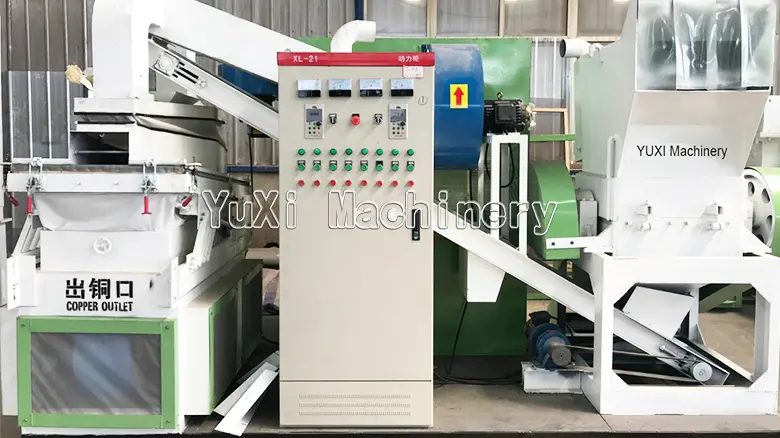
This Copper Wire Granulator Guide is written for recyclers, cable processors, dismantling yards, and equipment buyers comparing dry cable granulation lines. It uses YUXI’s Copper Wire Recycling Line as the product reference: a dry process line designed to crush waste copper wire and separate copper from plastic with a crusher, fan conveyor, vibrating screen, dust collector, and electrical control system.
What a Copper Wire Granulator Actually Does
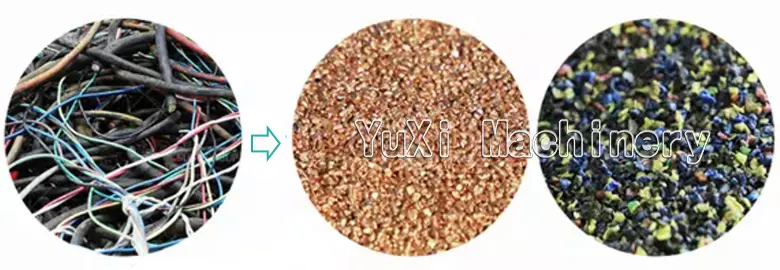
Copper wire granulator is a kind of dry recycling machine,which can mechanically reduce the insulated copper cable into small particles, and then separate the heavy copper from lighter plastic insulation material. The basic principle is simple, but good separation depends on controlling particle size, airflow, vibration, screen condition, moisture and dust.
For many codes, the granulator is somewhere between manual disassembly and downstream metal trading.It solves a practical problem:scrap wire is valuable,but if copper is still locked in PVC,rubber or mixed insulation,it is difficult to sell hybrid cables at full price. A granulator converts the mixed cable into two other valuable flows: copper rice and plastic particles.
Market demand is growing because wires and cables are part of a wider range of electrical and electronic waste logistics. According to the global electronic waste monitoring report in 2024,62 million tons of electronic waste will be generated in 2022,and the total amount is expected to reach 83 million tons by 2030[1] Copper is one of the economically attractive materials for organized cable recycling;BIR pointed out that high-quality copper waste can at least retain raw copper 95% of the value,and compared with primary production,copper recycling can save a lot of energy.[2]
Best-Fit Feedstock and Preparation
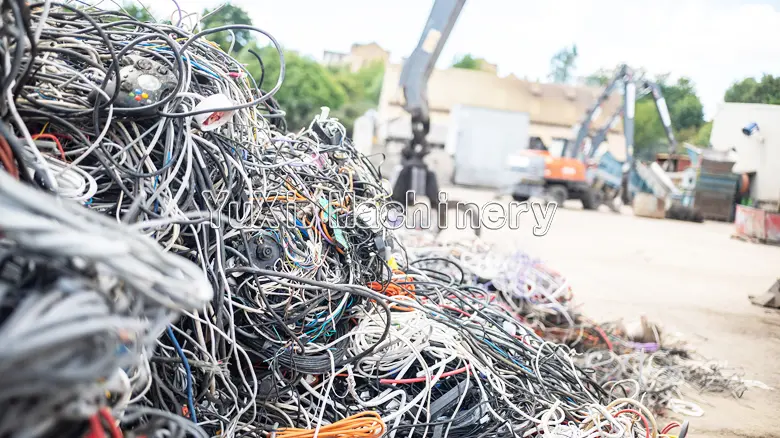
A copper wire granulator is strongest when the material is difficult to strip cleanly. YUXI lists suitable applications such as automobile circuit lines, motorcycle lines, battery lines, appliance wires, communication lines and computer lines, especially waste wires that are not suitable for processing by wire stripping machines.
Before sizing a line, separate the feedstock into realistic groups. A clean bundle of single-core cable behaves very differently from oily automotive harnesses, plug ends, aluminum-mixed conductors, or wire with steel clips attached.
| Feedstock type | Granulator fit | Pre-treatment note | Buyer checkpoint |
|---|---|---|---|
| Automotive and motorcycle harness | Very good for tangled mixed wires | Remove large connectors, iron parts and heavy plugs where practical | Ask for a test using real harness material, not only clean cable samples |
| Household appliance wire | Good for mixed small cable from TVs, washing machines, refrigerators and air conditioners | Separate obvious non-cable contamination before feeding | Check dust collection and outlet cleanliness |
| Communication and computer wire | Good, but fine wires may need tighter process control | Keep moisture low and avoid overfeeding | Watch copper carryover into plastic fraction |
| Battery line and thicker cable | Good after proper size reduction | May require pre-cutting or shredding before granulation | Confirm blade strength, screen opening and motor load |
| Very clean large cable | Granulation works, but stripping may be cheaper in some cases | Compare labor, speed and copper cleanliness | Do not overbuy a line if simple stripping is already efficient |
When granulation is better than stripping
- The wire is thin, tangled, short, mixed or irregular.
- Manual labor cost is high or operator safety is a concern.
- The facility needs a repeatable copper-plastic separation process.
- The cable mix changes by batch and requires adjustable airflow and vibration.
- The buyer wants copper granules instead of stripped bare wire.
Copper Wire Granulator Process Flow
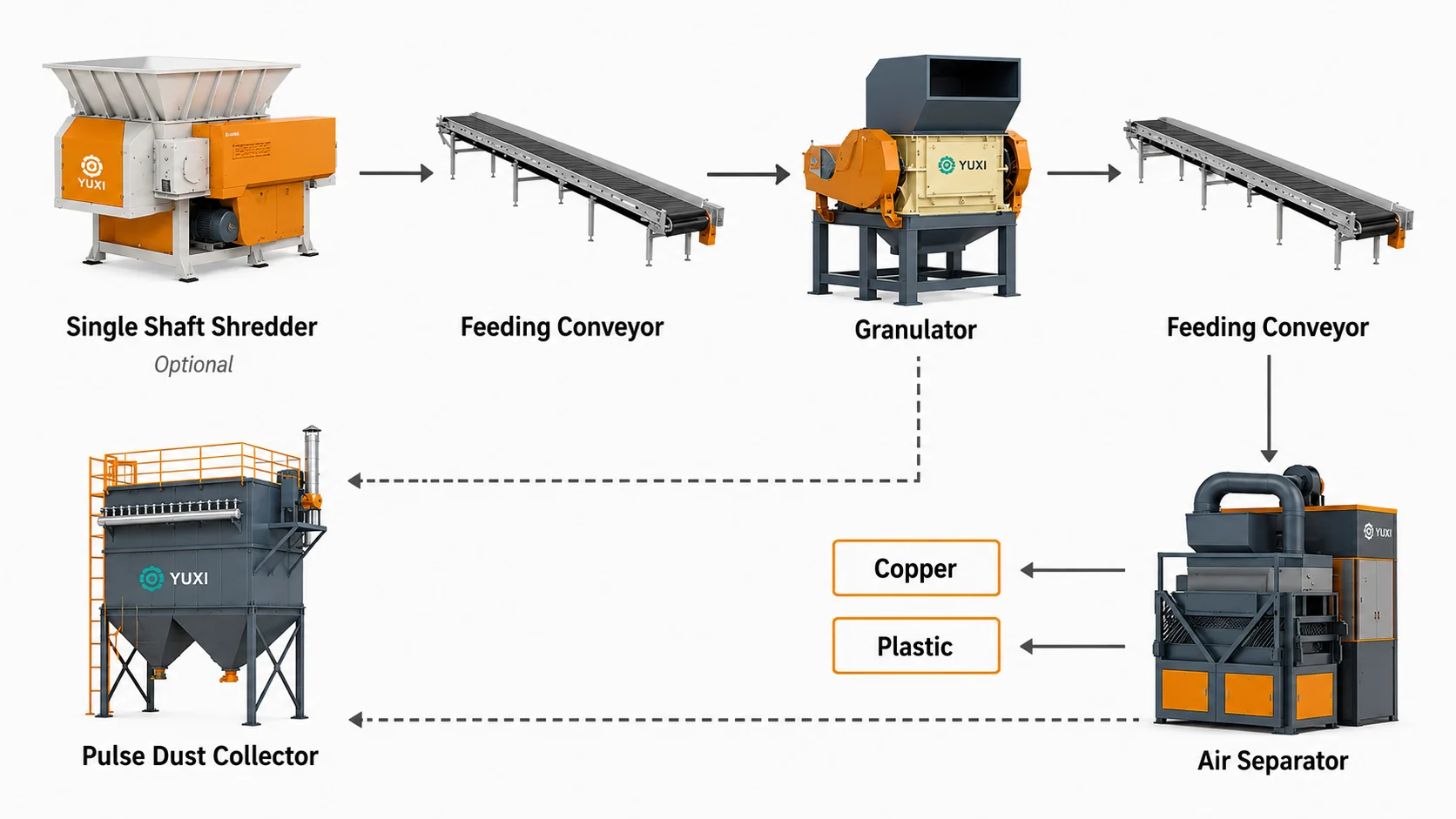
A well-designed dry copper wire granulator line is not just one machine. It is a sequence of controlled steps. In the YUXI configuration, the line consists of a crusher, fan conveyor, vibrating screen, dust collector and electrical control. After shredding and crushing, the cable becomes a mixture of plastic fragments and copper rice. Airflow suction and linear vibration then move and separate the material across the screen surface.
Step 1: Sorting and feeding
The first sorting step is not glamorous, but it protects the machine. Remove large steel, stones, thick plugs and items that do not belong in the granulator. If the scrap wire is long and tangled, pre-cutting or shredding improves feeding stability and reduces sudden load spikes.
Step 2: Crushing and granulation
The crusher opens the cable structure and reduces it to a particle size suitable for separation. If the particles are too large, copper may remain attached to insulation. If they are too fine, dust increases and separation can become more difficult. Buyers should ask the supplier what screen size is recommended for their cable mix.
Step 3: Airflow and vibration separation
Once the copper and plastic are liberated, separation is driven by the difference in density and movement behavior. YUXI’s process uses airflow suction and linear vibration so copper rice, plastic and mixed material leave through different outlets. For facilities that want to understand this stage in more detail, the Air Flow Gravity Separator is the key technology concept: airflow and table vibration must be tuned together, not treated as separate settings.
Step 4: Dust collection and control
Dust is not just a housekeeping issue. Cable insulation, fine plastic, paint, soil and metal fines can all move with the air stream. A fully enclosed layout with effective dust collection keeps the workshop cleaner and helps stabilize separation because the air system is working as designed.
Purity, Recovery and Output Quality
Many suppliers talk about purity, but buyers should ask what is being measured. Is the supplier measuring copper purity at the copper outlet, copper loss in the plastic outlet, or both? A sample that looks clean in a photo can still hide copper loss if the plastic fraction is not checked.
YUXI states that its crushing and sorting process can reach over 99.9% separation purity. That figure should be treated as a performance target under suitable material and operating conditions, not as a substitute for a feedstock test. Real-world purity depends on cable composition, moisture, granule size, screen condition, airflow, vibration frequency and whether mixed material is reprocessed.
How to read a machine test
When to add electrostatic separation
Air gravity separation is the workhorse stage, but some cable streams contain fine copper-plastic mixtures that benefit from a final clean-up step. YUXI’s High Voltage Electrostatic Separator uses the difference between conductive metals and non-conductive plastics; YUXI describes it as a device for metal/non-metal mixtures where separation can be adjusted according to material characteristics and purity requirements.
How to Configure a Copper Wire Granulator Line
The right configuration is a balance between feedstock condition, capacity, purity target, workshop layout and labor model. A small processor may value compact equipment and simple operation. A larger yard may need pre-shredding, buffer conveying, magnetic removal, electrostatic clean-up and more automated dust handling.
| Configuration question | Why it matters | Practical recommendation |
|---|---|---|
| Is the cable loose, bundled or tangled? | Tangled feed causes uneven loading and may wrap around shafts or conveyors. | Use pre-cutting or shredding for long, mixed harnesses. |
| What is the cable diameter range? | Fine cable and thick cable may need different blade/screen settings. | Give the supplier a real diameter distribution, not just a maximum size. |
| What copper purity is needed? | Higher purity may require slower feeding or extra separation. | Define outlet specs before buying; add electrostatic separation if needed. |
| How dusty is the material? | Dust affects workshop safety, airflow stability and maintenance. | Prioritize enclosed design, dust collector sizing and duct access. |
| Will the line run one shift or multiple shifts? | Continuous production changes requirements for cooling, blades and service access. | Check spare blades, screens, bearings and training support. |
Copper Wire Granulator Buyer Checklist
The most common buying mistake is comparing machines by nominal capacity while ignoring the cable mix. A line that performs well on clean, dry, pre-cut cable may struggle with damp, dirty, connector-heavy harnesses. Use the checklist below before requesting a quote.
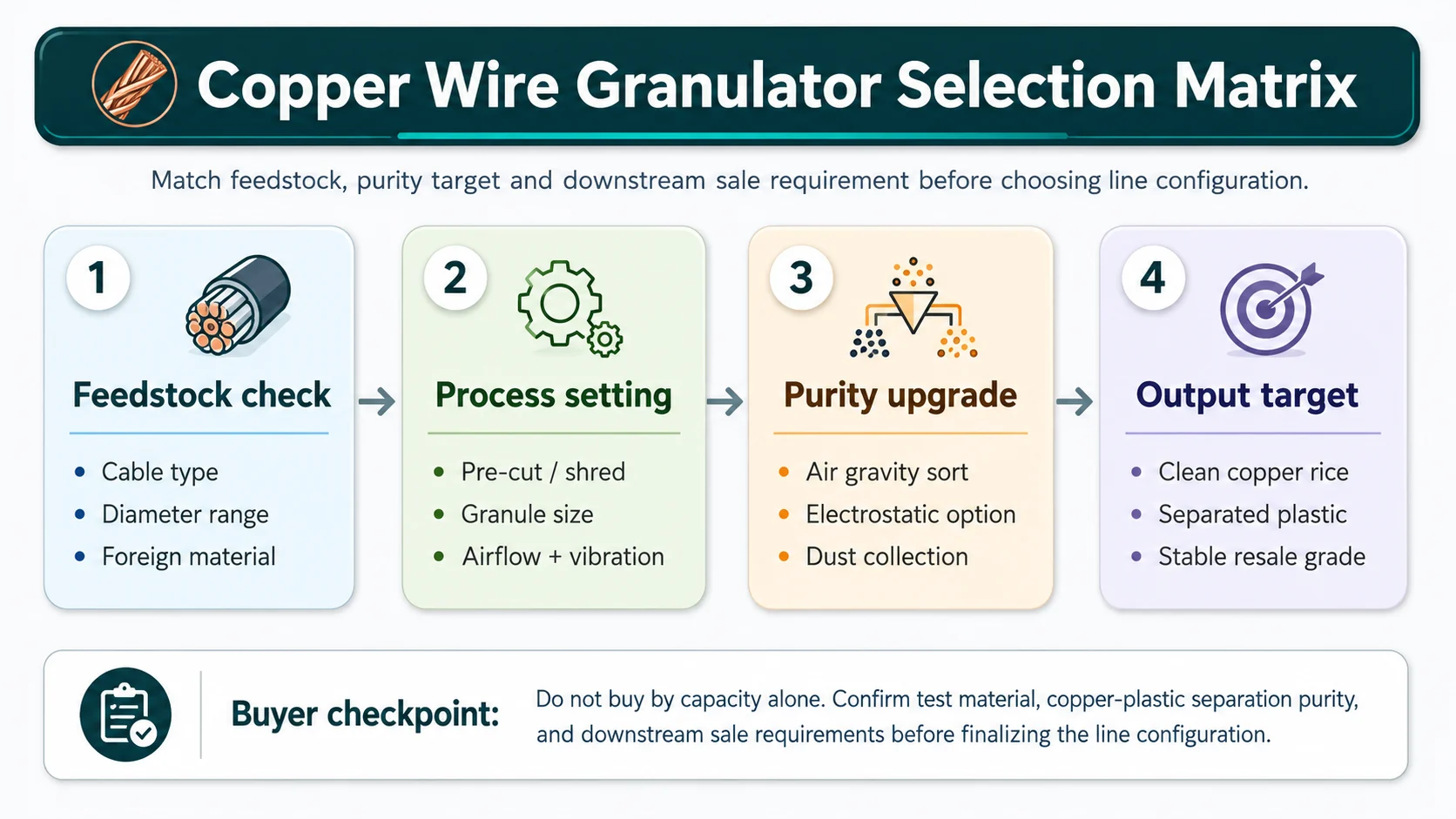
- Send representative samples. Include difficult material, not only clean cable that makes every machine look good.
- Ask for outlet samples. Check copper granules, plastic granules and mixed material separately.
- Measure copper loss. Do not judge by copper outlet appearance alone.
- Confirm dust-control design. Ask how the dust collector connects to the crusher, separator and ducts.
- Check adjustment points. Air volume, vibration frequency and screen settings should match different batches.
- Review maintenance access. Blades, screens, bearings, belts and ducts should be reachable without excessive downtime.
- Confirm installation support. Wiring, leveling, ducting, commissioning and operator training affect final performance.
Safety and Dust-Control Notes
Copper cable granulation involves rotating knives, conveyors, screens, fans, electrical panels and dust. Safety should be designed into the line, not added after installation. OSHA’s general machine-guarding rule requires one or more guarding methods to protect operators from hazards such as point of operation, nip points, rotating parts, flying chips and sparks.[3]
Maintenance is another critical area. Crusher blades, screens and conveyors must be serviced under a controlled energy procedure. OSHA’s lockout/tagout standard covers the control of hazardous energy during servicing and maintenance of machines and equipment.[4] For cable recycling shops, this should be translated into written lockout steps for the crusher motor, fan, conveyors, electrical cabinet and any stored mechanical energy.
Dust also deserves respect. OSHA warns that combustible material can become explosible when it is finely divided and suspended in air under the right conditions, and OSHA’s combustible-dust guidance lists plastic, rubber and certain metal dusts among examples that may create hazards when processed in powdered form.[5] A copper wire granulator line should therefore include dust collection, housekeeping access, ignition-source control and operator training appropriate to local regulations.
How the YUXI Line Fits This Application
YUXI’s copper wire recycling solution is positioned for dry separation of copper and plastic from waste wires that are not suitable for wire stripping. Its published process description emphasizes crushing, fan conveying, vibrating screen separation, dust collection, frequency-conversion vibration control and adjustable air volume.
| Buyer need | YUXI line feature | Why it matters |
|---|---|---|
| Process mixed waste wires | Crusher + conveying + vibrating separation line | Turns mixed cable into copper rice and plastic particles. |
| Separate copper and plastic efficiently | Airflow suction plus linear vibration screen movement | Uses density and motion behavior rather than wet chemical processing. |
| Control dust | Dust collector and enclosed-process emphasis | Supports cleaner operation and more stable airflow. |
| Adjust for different batches | Frequency-conversion screen control and air-volume regulating valve | Helps tune separation for changing cable mixes. |
| Reach higher copper-plastic cleanliness | Optional downstream refinement such as electrostatic separation | Useful when outlet specifications are stricter. |
Need to match a line to your cable mix?
Prepare photos or a short video of your scrap wire, approximate hourly capacity, cable diameter range, and your required copper purity. YUXI can use those details to recommend a cable granulation configuration and quotation.
Contact YUXI for a configuration reviewFAQ: Copper Wire Granulator Guide
What does a copper wire granulator do?
The copper wire granulator crushes the insulated waste cable into small copper and insulating particles,and then separates the copper from the plastic by airflow, vibration and electrostatic polishing steps if necessary.
Is the granulator better than the cable stripping machine?
For clean, straight and large-diameter cables, stripping can be effective.For fine,tangled,mixed,short or irregular wires,granulators are usually more practical because they can handle bulk materials and separate copper from the filler after breaking.
What should I expect to output?
The desired output is clean copper granules and a separate plastic fraction. In a machine test, inspect both outlets. A bright copper outlet is not enough if copper is still being lost into the plastic stream.
Can wet cable be processed?
Dry cable is strongly preferred. Moisture can affect crushing, airflow separation and dust handling. If material has been stored outdoors, plan for drying, sorting or conservative feeding during startup.
What information should I send before requesting a quote?
Send cable photos, sample composition, cable diameter range, expected capacity, available power, workshop layout, desired copper purity and whether connectors or non-cable materials are mixed in the feed.
References and Source Notes
- UNITAR / ITU, Global E-waste Monitor 2024 press release; see also the ITU publication page.
- International Recycling Agency,the fact of non-ferrous metal recycling..
- OSHA 29 CFR 1910.212, General requirements for all machines.
- OSHA 29 CFR 1910.147,hazardous energy (locked/marked).
- Overview of OSHA Combustible Dust and OSHA combustile dust hazard communication guide..