Henan University Science and Technology Park (Western) ,Zhengzhou, Henan ,China(Mainland)
Explain of ELV recycling process:from automobile halk to recycled metal
When the recycling site asks whether the whole waste vehicle can be thrown directly into the shredder,the honest answer is usually no.The profitable ELV production line is not only a large crusher;it is a controlled sequence:receiving vehicles,eliminating hazards,recycling reusable parts,reducing hulls,separating metals,and managing residues.
ELV recycling starts before the shredder. Depollution, parts recovery and hulk preparation decide how safe and valuable the downstream shredding process will be.
Quick answer: what is the ELV recycling process?
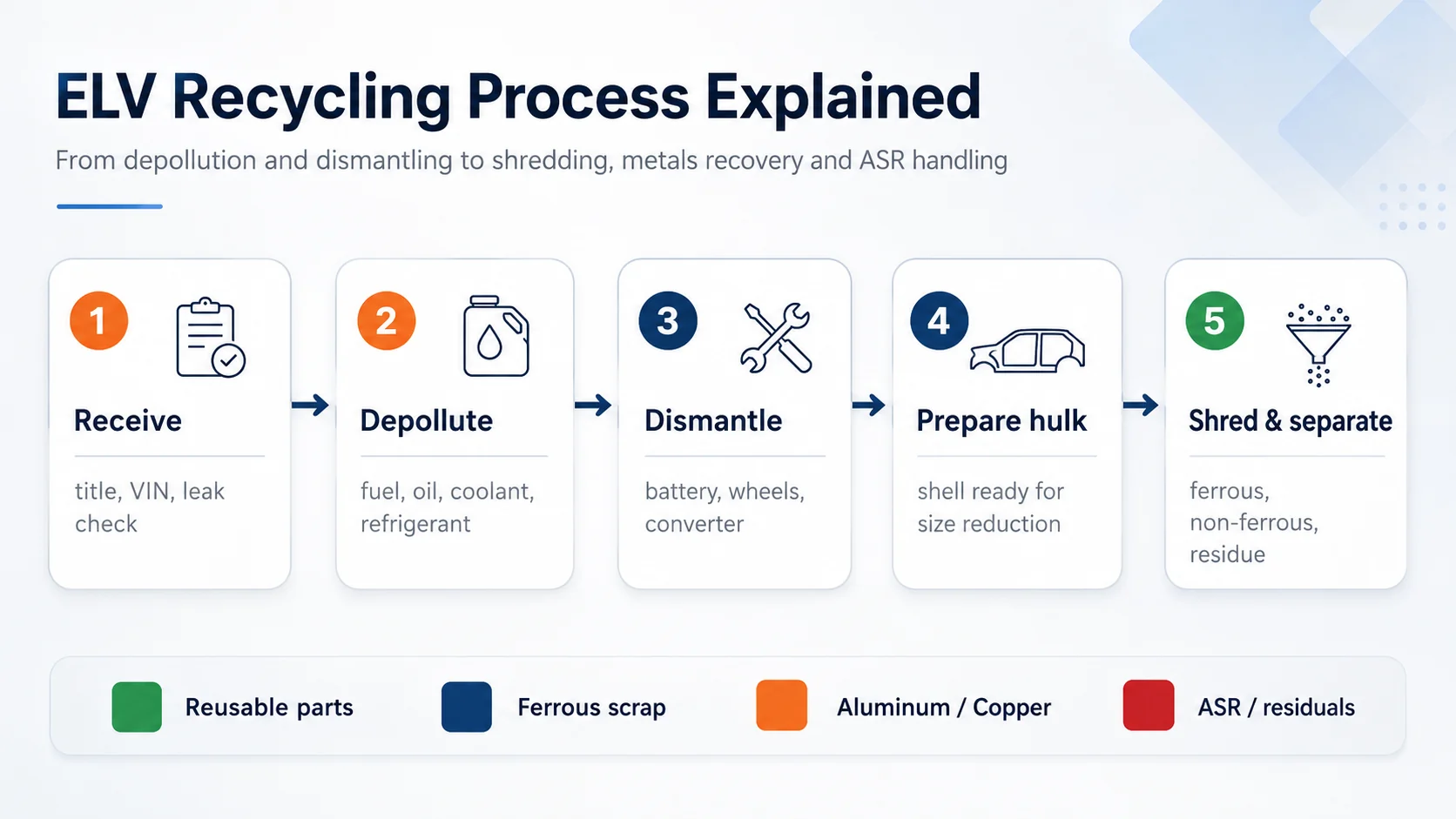
The ELV recycling process is a controlled disposal of parked vehicles in order to safely recover available parts,ferrous metals,non-ferrous metals and residual materials.In practice,it usually follows the following order:vehicle reception and recording decontamination,parts disassembly,hull preparation,primary crushing,secondary crushing,magnetic separation,vortex separation,residue treatment and final scrap transportation.
For the equipment line, the key point is that the shredder should receive a prepared hull, not an untreated vehicle full of fuel, oil, coolant, refrigerant, battery and pressurized components. The U.S. EPA guide for processing end-of-life vehicles states that hazardous fluids and materials should be removed before vehicle hulks are crushed; the same principle applies before heavy shredding.
What ELV recycling includes — and what it should not skip
An ELV is not just “scrap steel.” Even old passenger cars include reusable parts, steel, aluminum, copper wire, plastics, rubber, glass, fluid, electronic modules and sometimes high-risk materials. That is why modern vehicle recycling is a process chain,not a machine.
European ELV rules are useful as a benchmark because they connect recycling practice with measurable recovery targets. EUR-Lex summarizes the ELV framework as requiring vehicles to be designed for at least 85% reusability/recyclability and 95% reusability/recoverability by weight, while also requiring hazardous substances and components to be removed and separated before further treatment.
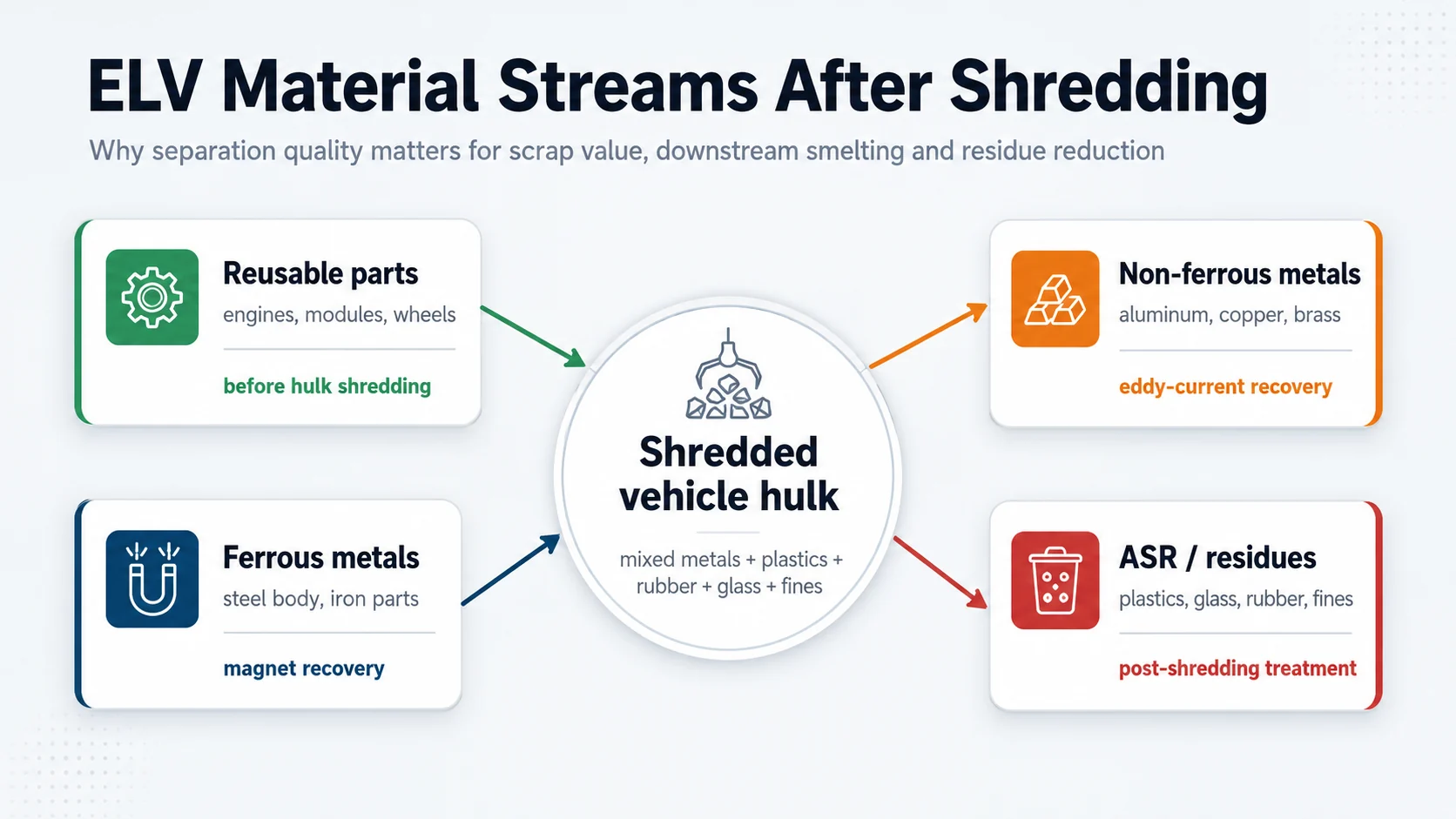
From an operator’s point of view, the process has three commercial goals: preserve parts that still have resale value, produce clean metal streams that downstream buyers can use, and reduce the amount and risk of automotive shredder residue, often called ASR or car fluff. Argonne National Laboratory has noted that the non-metallic fraction left after metal recovery can represent about a quarter of vehicle weight, which is one reason post-shredding recovery and residue management matter.
ELV Recycling Process Explained step by step
1. Vehicle receiving, inspection and documentation
The process begins at the gate. The operator records the source of the vehicle, checks the documents, confirms whether the equipment is a passenger car, a van, a motorcycle or a mixed metal load, and identifies obvious dangers,such as fuel leakage, battery damage, liquefied petroleum gas/CNG fuel tanks, undeployed airbags, mercury switches in older cars or hybrid vehicles and electric vehicles.The high-voltage battery pack in the car.
This stage is not just administration. Good intake control prevents a contaminated hulk from entering the production line and gives the yard a record for certificates of destruction, local environmental compliance and downstream material traceability.
2. Depollution: remove fluids and hazardous components
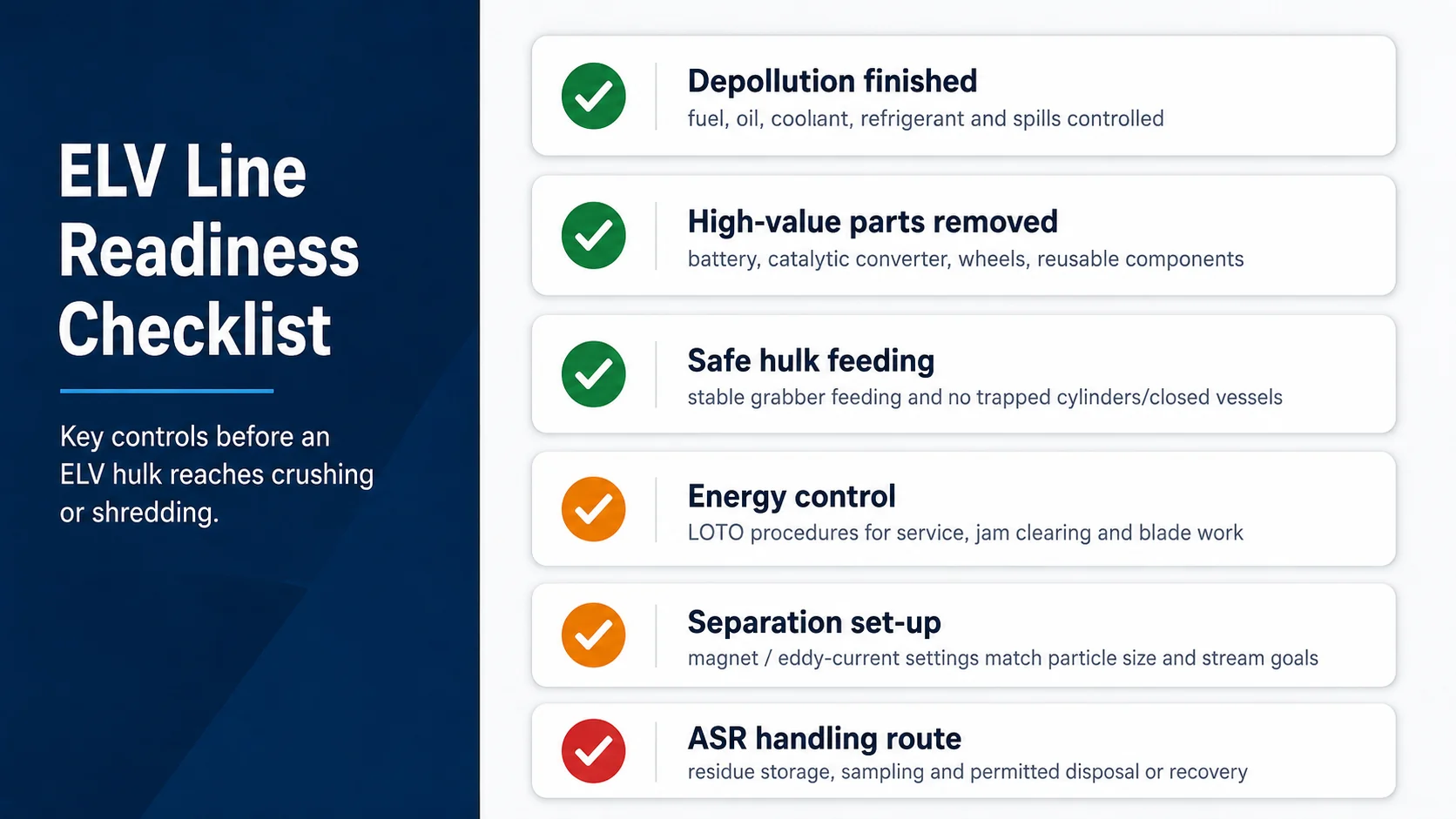
Depollution is the most important step before size reduction. All preprocessed end-of-life vehicles need to drain fuel, motor oil, gear oil, brake fluid, cooling liquid, windshield washer fluid and refrigerant into matched storage containers. Batteries, mercury switches where fitted, pressurised gas tanks and readily removable hazardous components must be disposed of following local regulatory standards.
At first,reducing decontamination steps may save time,but it often brings more serious problems:potencial fire hazards,contaminated waste,spilled liquids,unpleasant smells,legal penalties and additional costs for residual waste disposal.For any yard planned to build a bpdy shredder lione,the purification cabin should be regarded as part of the production system,not a separate after-the-fact.
3. Dismantling for reusable and high-value parts
The operator decides what should be removed before the hull is crushed or shredded after depollution. Common disassembly includes tires and wheels, catalytic converters, batteries, copper-rich wiring, alternators, starters, selected electronic products,available engines or transmissions,and body parts that need to be resold.
The decision is economic as much as technical. A small yard may remove only high-value parts; a large dismantling facility may run a more systematic parts operation before sending the hulk to shredding. Either way, every part recovered before shredding can reduce residue volume and improve revenue per vehicle.
4. Hulk preparation and feeding
Once hazards and selected parts are removed, the remaining car shell becomes a hulk. Depending on site layout and transport distance, hulks may be flattened, baled, logged or fed directly by grabber into a primary shredder. The goal is stable feeding and predictable loading on the machine.
For a continuous line, operators should avoid feeding sealed tanks, closed pressure vessels, large rubber clumps, oversized engine blocks not matched to the line design, or unknown mixed loads. A basic pre-feed inspection saves more downtime than it costs.
5. Primary shredding: open the car shell and reduce volume
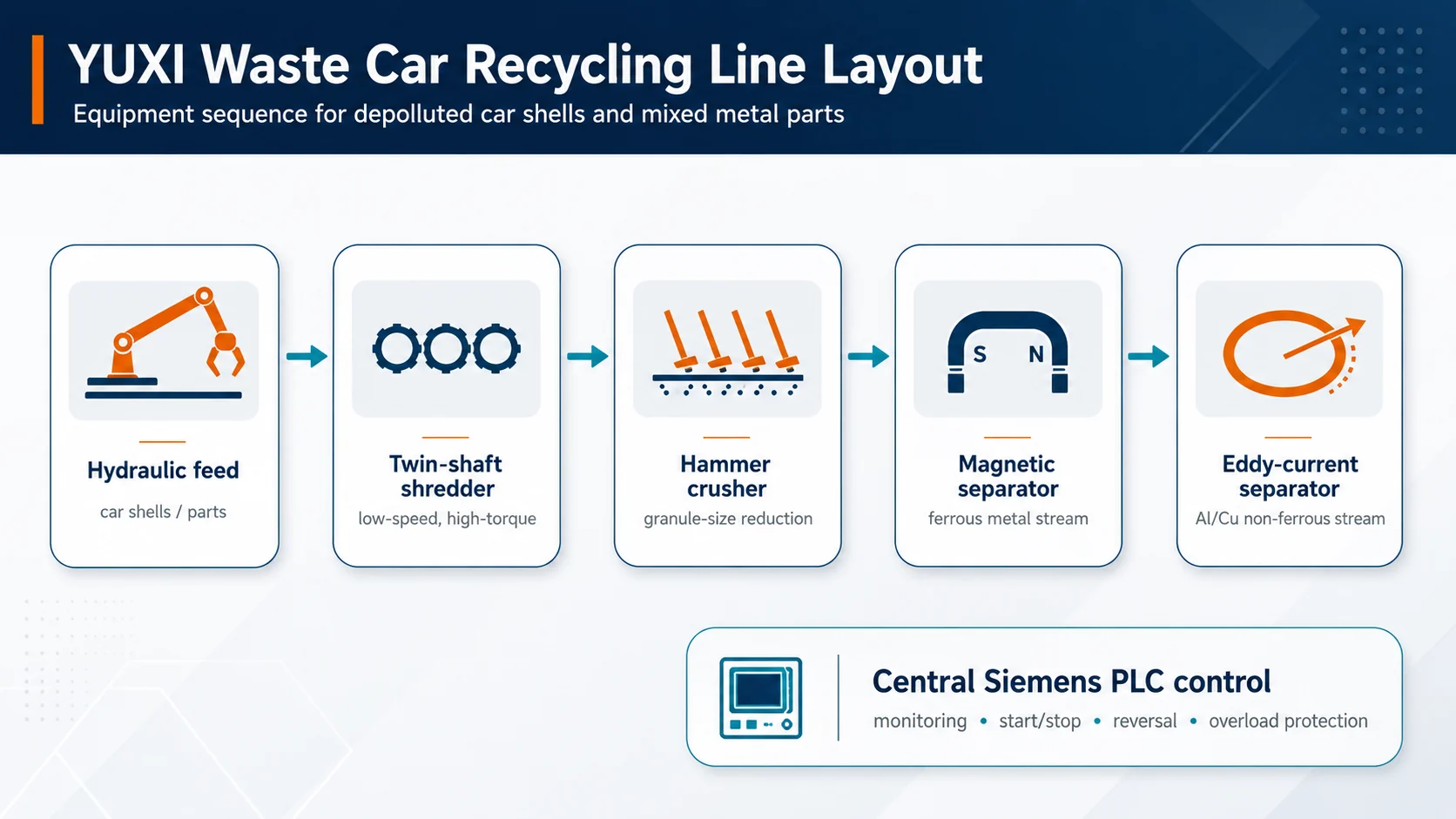
Primary shredding is where a prepared car shell is torn into smaller pieces so it can be conveyed, cleaned and separated. On YUXI’s Waste Car Recycling Line, the first major machine is a hydraulic-driven heavy-duty double-shaft shredder. YUXI describes this unit as a low-speed, high-torque machine used for primary car shell shredding, with automatic start, stop, reversal and overload functions through Siemens program control.
This low-speed, high-torque approach is useful because car bodies are large, springy and irregular. The primary shredder does not need to make a final clean scrap product by itself. Its job is to make the material manageable for the next reduction and separation stages.
6. Secondary crushing: produce a more sortable particle size
After primary shredding, the material often needs deeper size reduction. YUXI’s process uses a scrap hammer-type metal crusher after the double-shaft shredder to reduce material into granules or smaller pieces that meet downstream output-size requirements. YUXI’s hammer mill product page describes hammering, tearing and shearing as core actions for breaking scrap metals and improving metal/non-metal separation for recycling and smelting.
This stage affects the entire separation result. If pieces are too large, aluminum may remain attached to steel, wiring may stay wrapped inside mixed scrap, and non-metallic residue may carry recoverable metal. If pieces are too fine, dust, fines and wear can increase. The right setting depends on the feed mix, desired product and buyer specification.
YUXI’s line logic: primary shredding, deeper crushing, ferrous separation, non-ferrous separation and centralized control.
7. Magnetic separation: recover ferrous metals
Magnetic separation is normally the first major recovery stage after shredding and crushing. Steel and iron-rich materials are pulled out by magnetic rollers or rollers to generate iron waste flow for steel mills,foundries or scrap processors.
Good ferrous recovery depends on uniform feeding,appropriate particle size,stable belt speed and control of non-metallic transition.The magnet recovers the largest proportion of mass,so a small improvement in the magnet setting will have a huge impact on the output value.
8.Vortex separation: recycling aluminum, copper and other non-ferrous metals
After removing the ferrous metal,the remaining flow still contains valuable aluminum,copper,brass and stainless steel/non-magnetic metals. YUXI’s Eddy Current Separator aims to recover non-ferrous metals from shredder materials,including scrap car disassembly applications.The principle is that fast magnetic rotors induce vortex currents in conductive non-ferrous materials and repel them into diffirent trajectories from non-metallic materials.
For ELV recycling, eddy-current separation is especially important because modern vehicles contain more aluminum parts than older vehicles. A line that only recovers ferrous scrap leaves meaningful value in the residue stream.
9. ASR handling and post-shredding recovery
The material left after parts removal, ferrous recovery and non-ferrous recovery is automotive shredder residue. ASR can include plastics, rubber, foam, glass, textiles, wood, dirt, fine metals and dust. It should not be treated as a single harmless waste stream without local testing and a disposal or recovery route.
The European Commission’s CINEA description of post-shredding technology notes that ASR is highly heterogeneous and includes metals, plastics, glass, rubber, textiles, foams, wood and fines. It also describes modular, dry, automated post-shredding sorting as a way to recover more resource-value materials from ASR and similar granular waste streams.
10. Quality control, storage and shipment
The final stage is the control of quality. The operators need to check the density and cleanliness of black scrap, the purity of non-ferrous iron, the residual copper content,moisture oversized parts and pollution. Clean output should be stored in separated bays and shipped according to buyer requirements.
A practical KPI system should track tons per hour, downtime causes, blade and hammer wear, energy per ton, ferrous recovery, non-ferrous recovery, residue rate and buyer rejections. These numbers turn a recycling line from “running machinery” into a controllable business.
How YUXI’s waste car recycling line fits the ELV process
YUXI positions its waste car recycling line for scrapped vehicles and waste metal parts, including car shells, bumpers, engine casings, carriage boards, motors, wheels, motorcycles and bicycles. The published process combines a double-shaft crusher, hammer-type metal crusher, magnetic separator, eddy-current separator and central control system.
That makes the line most relevant after depollution and parts dismantling. In other words, YUXI’s system should be described as the heavy size-reduction and separation section of an ELV recycling plant, while the full ELV facility also needs receiving, drainage, hazardous material handling, reusable-parts storage, residue storage and compliant outbound logistics.
ELV stage
Practical purpose
YUXI equipment fit
Hulk preparation
Move depolluted shells and mixed metal parts into the line safely.
Grabber feeding and heavy-duty infeed layout.
Primary shredding
Open large car shells and reduce volume.
Low-speed and high-torque hydraulic double-shaft shredder.
Secondary crushing
Reduces the material to smaller fragments for better separation.
Separate aluminum, copper and other conductive metals.
Eddy-current separation.
Line operation
Coordinate start/stop, reversal, overload response and monitoring.
Central Siemens PLC control system.
For buyers comparing configurations, YUXI’s Car Body Shredder Guide is a natural supporting page because it focuses on choosing the primary shredding section for ELV and car body applications.
Recovered value comes from more than steel. Non-ferrous recovery and residue control often decide the final economics of an ELV plant.
Plant design notes for an ELV recycling line
Match the line to the incoming vehicle mix
A site processing stripped car shells needs a different layout from a site handling engines, wheels, motorcycles, bicycles and mixed industrial scrap. The more varied the feed, the more attention should be paid to pre-sorting, infeed opening size, torque margin, wear parts and unshreddable protection.
Plan the depollution bay before the shredder
Depollution needs covered or controlled working space, impermeable surfaces, fluid containers, spill kits, refrigerant recovery equipment where required and a traffic plan that keeps untreated vehicles away from prepared hulks. EPA’s ELV guide emphasizes storage on non-permeable surfaces and proper handling of hazardous materials.
Design material flow, not only machine capacity
Shredders may be rated as high throughput, but the real factory capacity is usually limited by excavator feeding, conveyor width, magnet cleanliness, non-soil sorting, residue discharge, truck loading or maintenance access to the balance line.There should be enough buffer space before and after each bottleneck.
Build safety into daily operation
Scrap metal recycling exposes workers to the danger of material handling, metal dust and smoke, machinery and substances used in processing. OSHA’s metal scrap recycling guidance highlights this range of hazards, while OSHA’s lockout/tagout guidance requires procedures and training to control hazardous energy during servicing and maintenance.
A simple readiness checklist helps operators prevent unsafe feeding, avoid contamination and keep the line available for production.
Common mistakes in ELV recycling process planning
Buying the shredder before defining feed material
Car shells, engine blocks, wheels, motorcycles and mixed light scrap do not behave the same way. Define feed categories, daily tonnage and unacceptable items before selecting rotor size, torque and downstream sorting.
Underestimate non-ferrous value
Ferrous scrap is the largest mass flow, but aluminum and copper can have a significant impact on profits. Eddy-current separation should be considered as early as possible, instead of adding it after the residue loss is visible.
Skipping residue planning
ASR storage, sampling and outbound disposal or recovery routes need planning. A line that produces clean metal but has no residue route will still face operating risk.
Treating automation as decoration
PLC control is the most valuable when helping operators manage load changes,overload reversals, emergency stops,serial interlocks and maintenance diagnostics.
Practical takeaway
If you are building a small ELV dismantling yard, focus first on depollution, parts value and hulk logistics. If you are building a complete car body recycling plant, configure shredding, crushing, magnetic separation, eddy-current separation and residue handling as one continuous material-flow system. YUXI’s waste car recycling line is best presented as the heavy processing section that turns prepared car hulks and mixed metal parts into recoverable ferrous and non-ferrous streams.
FAQ: ELV Recycling Process Explained
Can a whole ELV be shredded directly?
In most professional operations, no. Liquids,batteries,selected hazardous parts, and high-value reusable parts should be removed first.Direct shredding of untreated vehicles will increase safety, environmental and residual quality risks.
What equipment is usually needed after dismantling?
A typical heavy processing line uses feeding equipment, a primary car body shredder, secondary metal crusher, conveyors, magnetic separation, eddy-current separation, residue discharge and a centralized control system.
What is ASR in vehicle recycling?
ASR refers to the residue of the car shredder. It is a mixed non-metallic and fine material left after shredding and metal recovery, usually including plastics, rubber, textiles, glass, foams, dust and residual metals.
Why is vortex separation used in ELV recycling?
After the management removes ferrous steel,it helps to recycle conductive non-ferrous metals such as aluminum and copper. This improves output value and reduces metal loss into residue.
Where does YUXI equipment fit in the process?
YUXI’s waste car recycling line fits the hulk shredding, secondary crushing, ferrous separation, non-ferrous separation and central control stages. The receiving, depollution and reusable-parts dismantling sections should be arranged upstream according to local regulations and site workflow.
Daniel
Metal Recycling Equipment Specialist,YUXI Machinery
Daniel has over 7 years of experience serving the international recycling market.
He focuses on metal shredding and recycling systems,including feedstock evaluation,equipment selection,size reduction,separation,and complete line configuration.





 Request Quote