




 Request Quote


Copper Wire Recycling Business Guide
Quick answer: what makes copper wire recycling profitable?
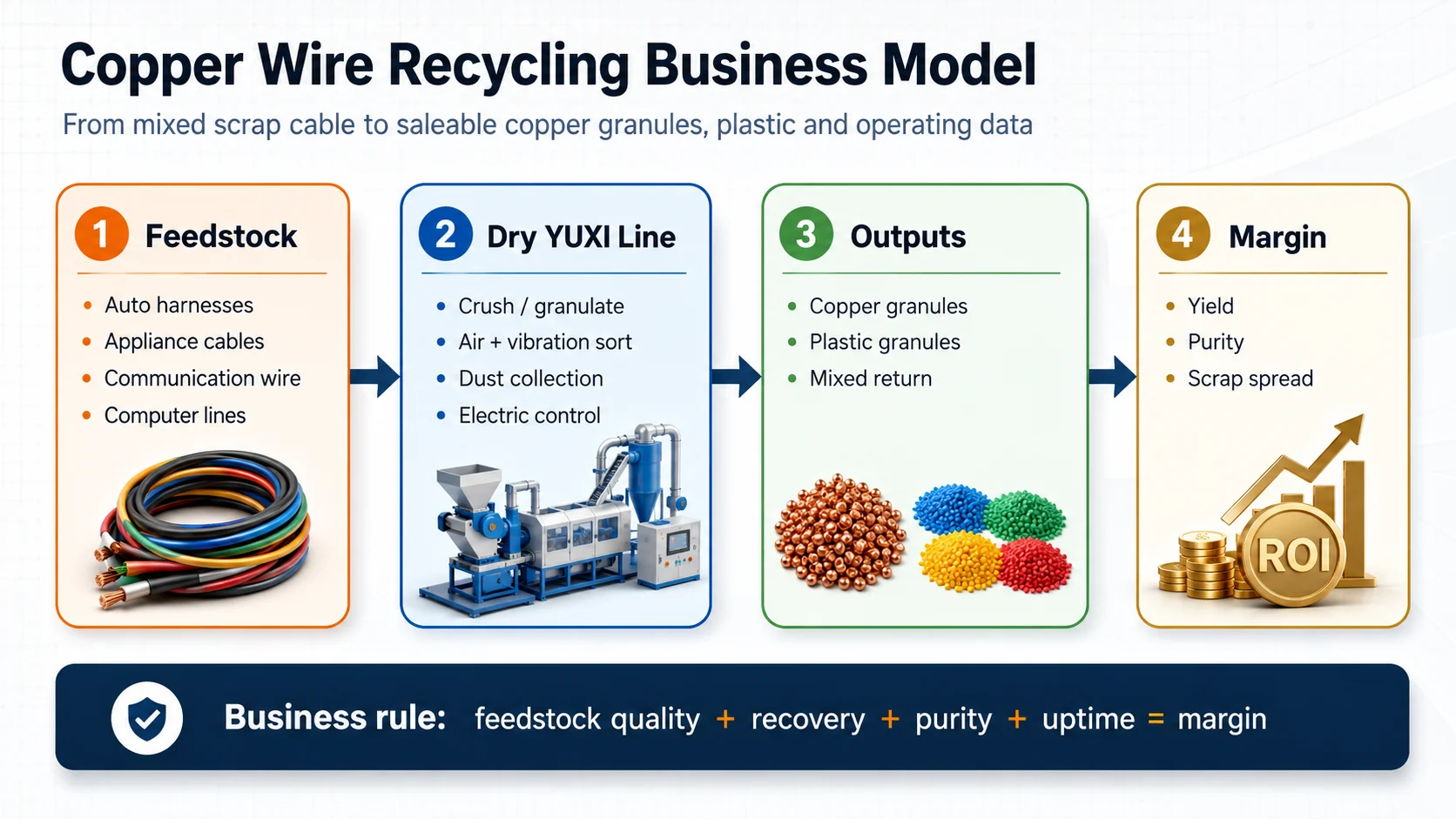
The business is profitable when the spread between mixed cable purchase cost and recovered copper value is large enough to cover all operating costs. In practice, the spread is protected by five things: buying suitable cable lots, keeping the feed dry and sorted, liberating copper from insulation during granulation, tuning the air-gravity separator correctly, and proving output quality with routine sampling.
YUXI’s Copper Wire Recycling Line fits this business model because it is designed as a dry mechanical system for waste copper wires that are not efficient to process with a stripping machine. The line uses crushing, conveying, vibrating-screen separation, airflow control, dust collection and electrical control to separate copper from plastic.
Macro demand supports business cases, but it does not replace factory discipline. The International Copper Association pointed out that copper can be recycled repeatedly without losing performance. Copper recycling consumes less energy than primary production, while reducing carbon dioxide emissions.The U.S. Environmental Protection Agency will also use recycling as a system to protect natural resources,save energy,reduce waste and create economic activity.For recyclers, these benefits only become commercial value when the factory continues to produce saleable fractions.
Why a cable recycling business is different from general scrap trading
General scrap trading is often about collecting, grading and reselling. Cable recycling adds processing risk. A load of mixed wire may contain copper conductors, aluminum conductors, plugs, rubber, steel clips, connectors, moisture, tape, oil or non-cable contaminants. Two bales can have similar weight but very different copper content and processing behavior.
That is why a copper wire recycling business should be managed like a small production plant, not only a buying yard. The machine must have stable feed, operators must understand the separator, and the owner must measure recovery. A shiny copper outlet looks good, but the real number is how much copper remains in the plastic outlet or mixed return stream.
The feedstock opportunity is growing because modern electrical products, vehicles, appliances, communication systems and e-waste contain a large amount of wire. According to the Global E-Waste Monitoring in 2024, 62 million tons of e-waste were generated in 2022, but only 22.3% were recorded as official collection and recycling.Not all e-waste should go directly into the cable granulator, but the data explains why formal and traceable recycling capacity is becoming more and more important.
Best feedstock for a copper wire recycling business
YUXI lists typical application materials such as automobile circuit lines, motorcycle lines, battery lines, television, washing machine, refrigerator and air-conditioner wires, communication lines, computer lines and other waste wires that are not suitable for wire stripping machines. That sentence is very important. The best use cases are usually small, mixed, tangled or labor-heavy cables, in which manual stripping is too slow or inconsistent.
| Feedstock type | Business value | Main risk | Practical handling |
|---|---|---|---|
| Automotive wire harness | Common, mixed copper wire source | Clips, plugs, tape and terminals | Pre-sort and remove large non-wire parts |
| Appliance cable | Stable local collection from repair and dismantling | Rubber, moisture and mixed insulation | Keep dry and sort by wire type when possible |
| Communication / computer wire | Good fit for granulation when conductors are small | Fine copper loss if the separator is poorly tuned | Run trials and consider polishing separation |
| Thick power cable | High copper value per ton | May be better for stripping than granulation | Separate high-value thick cable before feeding |
| Unknown e-waste mix | May contain valuable wire | Batteries, hazardous parts, boards or contaminants | Dismantle and separate cable before granulation |
A simple buying rule is useful: do not pay for “cable” as if it were all copper. Estimate copper content by sample cutting, batch history, supplier reputation and trial processing. If the incoming lot is wet, full of steel, or mixed with aluminum conductors, the purchase price should reflect the additional risk.
Recommended dry process layout
A practical scrap cable recycling process usually follows a controlled sequence: receive and sort the cable, pre-cut or shred long tangled wire when needed, granulate the material into copper rice and insulation fragments, separate the mixture by airflow and screen vibration, collect dust, return mixed material for re-separation, and sample the outputs.
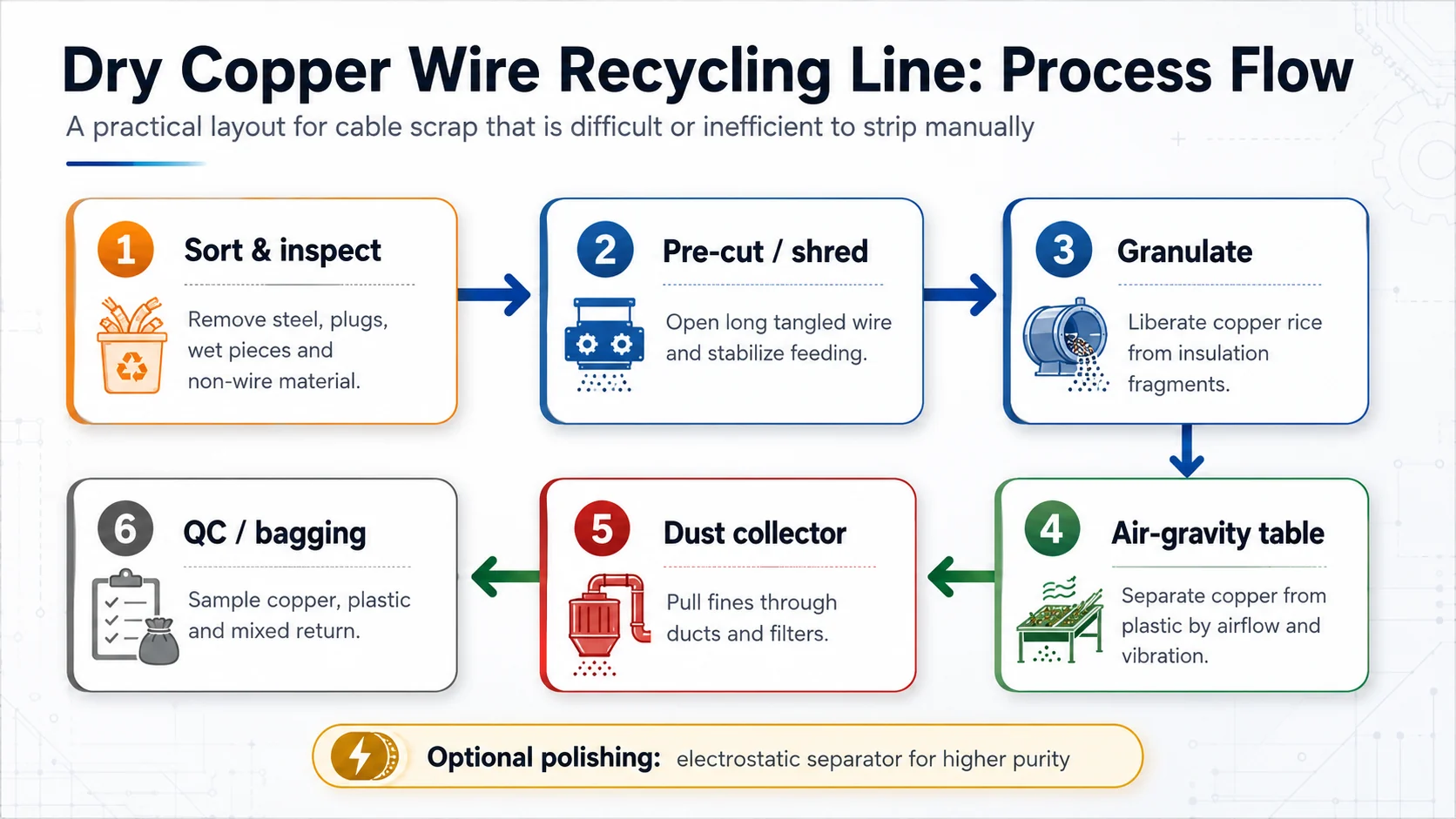
YUXI’s product page describes a line consisting of a crusher, fan conveyor, vibrating screen, dust collector and electrical control. After shredding and crushing, waste wires become plastic fragments and copper rice. The material moves on a waveform screen surface, where airflow suction and linear vibration separate core and skin; copper, plastic and mixed material discharge from different outlets. Dust is carried through air ducts to the dust collector.
This process explains why the Air Flow Gravity Separator is important in cable recycling. Copper is much heavier than plastic insulation, but the separator still depends on correct particle size, feed rate, screen motion and air volume. If the granulator does not liberate the material, the separator cannot fix it. If the airflow is too strong, copper may be carried into the wrong fraction. If the airflow is too weak, plastic contamination may remain in the copper outlet.
For fine wire, mixed insulation or stricter buyer specifications, an optional High Voltage Electrostatic Separator can be considered after the main dry separation stage. It is not always required, but it can help when the business model depends on cleaner copper granules or cleaner plastic output.
How to calculate the business model before buying equipment
A responsible buyer should build the financial model from the material, not from a brochure number. Start with a small batch test and use the formula below as a working model:
Net profit then subtracts cable purchase cost, freight, labor, electricity, blade and screen wear, dust filter replacement, rent, permits, packaging, maintenance, downtime and financing. The most common mistake is to calculate revenue from the theoretical copper content and ignore copper lost in the plastic stream.
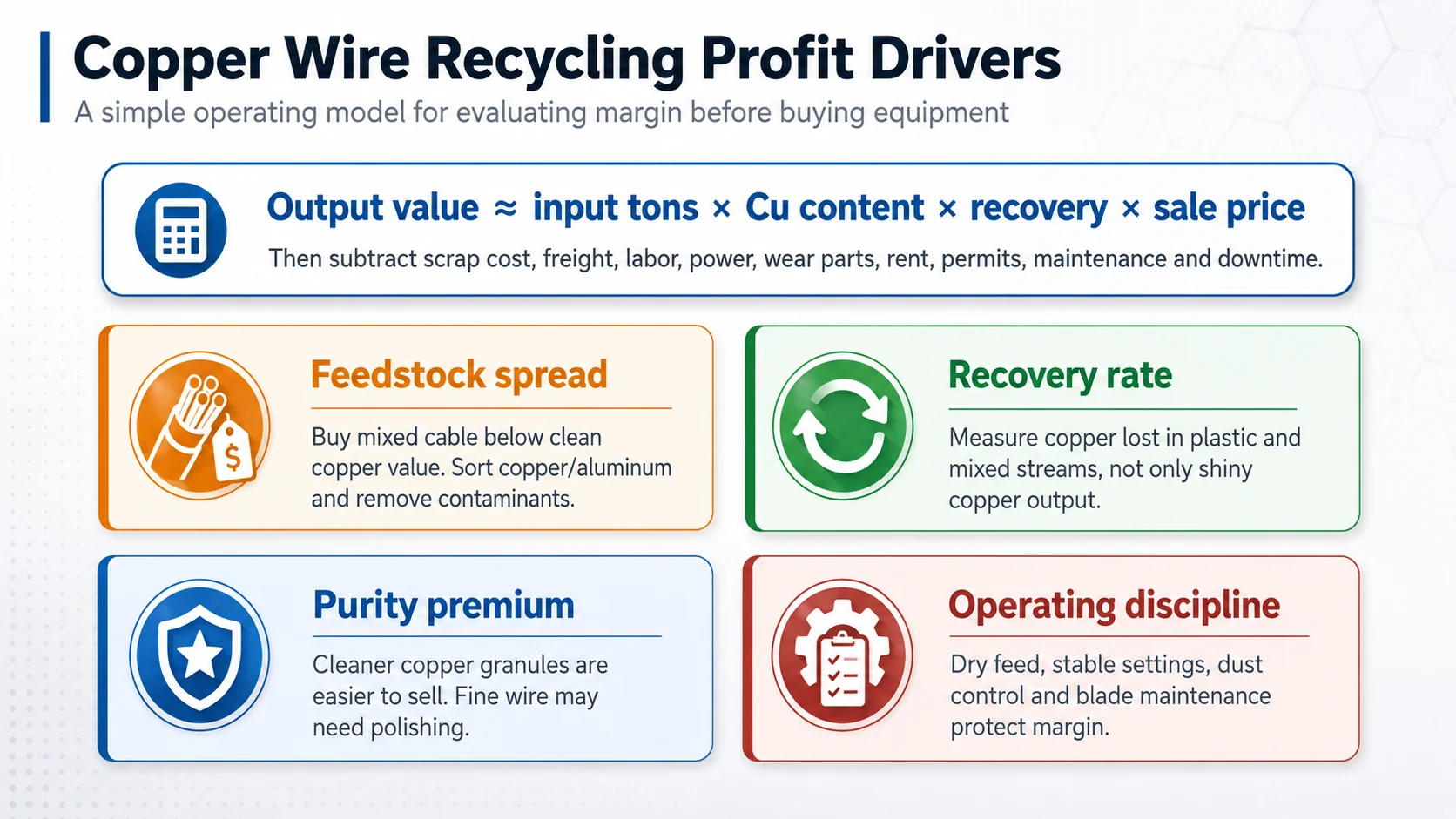
Use copper recovery rate as a daily management number. Recovery is not the same as purity. Purity asks how clean the copper outlet is. Recovery asks how much of the copper in the input was actually captured as useful product. A plant can show high purity but still lose money if too much copper escapes into the plastic fraction.
For equipment budgeting, compare a complete-line quotation rather than a single granulator price. The investment should include feeding, crushing or granulation, separation, dust collection, electrical control, installation, spare parts, training and possible downstream polishing. A separate copper wire recycling machine price analysis is useful when comparing line configurations, but the final decision should be based on local feedstock, target capacity and outlet quality requirements.
How to choose the right equipment size
Choose capacity from available feedstock, not from wishful thinking. A line that is too small creates bottlenecks and labor waste. A line that is too large may run half-empty, which makes separation less stable and stretches payback. The best sizing question is: how many tons of suitable cable can you buy every week at a safe margin?
When discussing a project with YUXI, prepare these details: cable types, estimated copper content, maximum cable diameter, percentage of fine wire, moisture level, contaminants, planned work hours per day, available power, floor space, dust-control expectations and target output buyer requirements. These details allow the equipment layout to be matched to real operating conditions.
Practical sizing principle
Do not design the plant only for today’s best cable lot. Design it for the normal mixed material you can buy repeatedly. A stable medium-margin feedstock is often better than an occasional high-grade lot that leaves the plant idle for days.
Output quality: what do buyers really care about
Most copper particle buyers are concerned about four things:visible plastic pollution, moisture, particle size consistency,and whether the material is actually copper rather than a copper-aluminum mixture.Plastic buyers are concerned about cleanliness,color mixing and whether there is too much copper in the plastic. A recycler should therefore sample all streams, not just the copper stream.
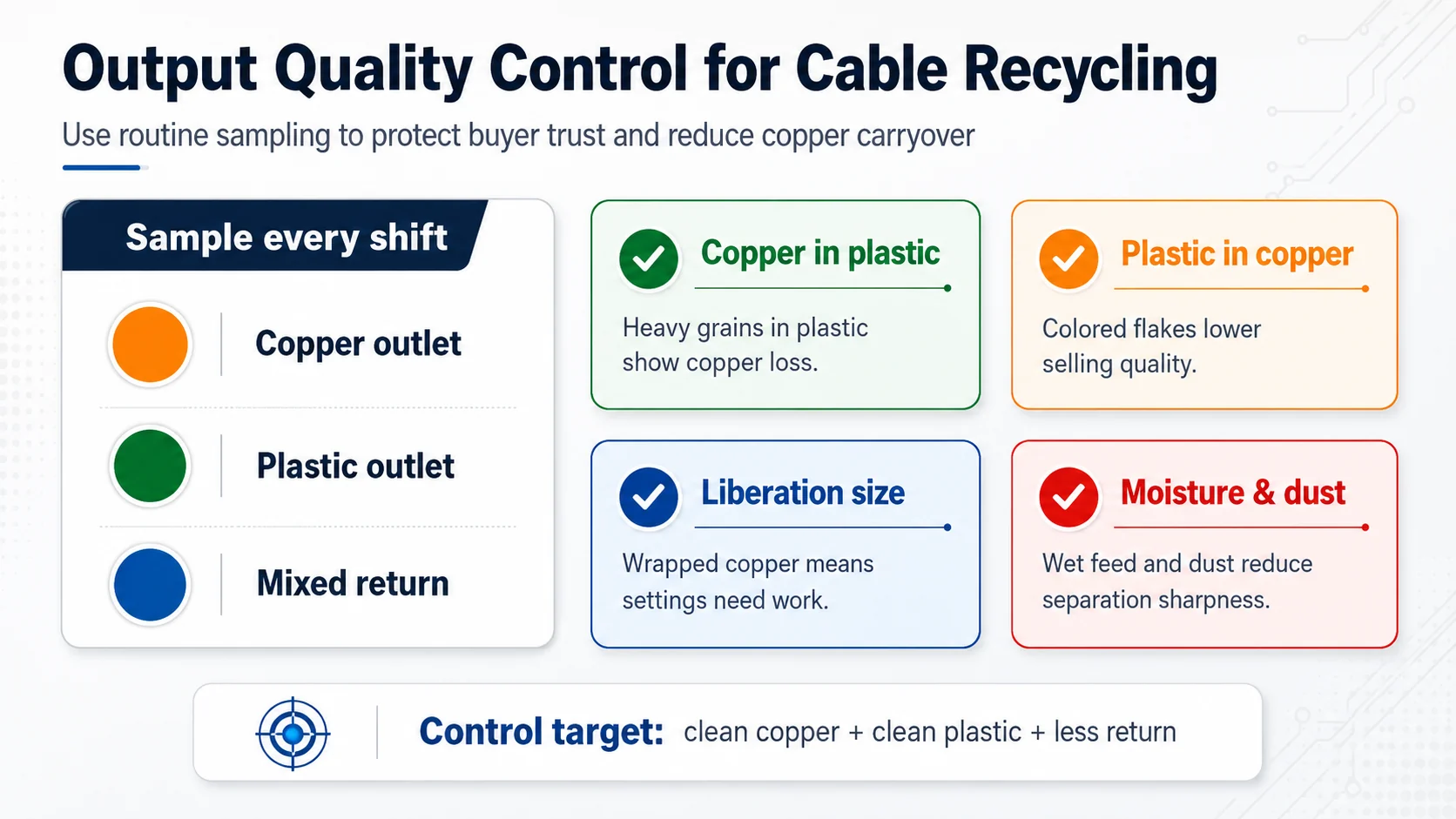
A good daily routine includes checking copper in plastic, plastic in copper, liberation size, moisture, dust buildup and mixed return volume. If the mixed flow continues to increase, the problem may be the feed rate, the condition of the cutter,the screen size,the air volume or the vibration frequency. Adjust one variable at a time and record the results.
Safety, dust control and compliance should be included in the plan
Copper wire recycling involves conveyors, cutters, rotating parts, electrical systems, dust and manual material handling. OSHA’s scrap metal recycling guidance lists hazards such as machinery moving parts, unexpected machine startup, combustible dust, forklifts, slips and trips, manual handling and harmful substances.4 The business plan should include guarding, emergency stops, housekeeping, training, PPE and safe material handling from the beginning.
Lockout/tagout is especially important during blade replacement, cleaning jams, screen checks,and maintenance. OSHA explained that hazardous energy sources can include electrical, mechanical, hydraulic, pneumatic and other stored energy. Appropriate LOTO procedures can protect workers from accidental start-up or storage energy release.5
Dust collection is not only an environmental feature. It affects workplace cleanliness, equipment reliability and customer confidence. YUXI’s enclosed process and dust collector are useful because a dry cable recycling plant must control fines generated by insulation, copper particles and surface contamination. Local regulations vary, so the license, fire protection, electrical standards and waste disposal requirements should be checked before installation.
Start-up list of copper wire recycling business
1. Prove supply
List regular cable suppliers, expected weekly tonnage, copper/aluminum mix, moisture risk and seasonal changes.
2. Run samples
Process representative material and sample copper, plastic and mixed fractions before finalizing capacity.
3. Confirm buyers
Ask the copper particle buyers about the purity, moisture, packaging and particle size they accept.
4. Calculate full cost
Include power, labor, freight, blades, screens, dust filters, rent, permits, downtime and financing.
5. Plan layout
Leave space for feed sorting, maintenance access, finished product storage and dust-collector service.
6. Train operators
Teach feed inspection, separator tuning, sample checking, emergency stop use and lockout/tagout routines.
When these six points are clear,the selection of equipment becomes much easier. You are no longer asking “Which machine is cheapest?” You are asking “Which line can keep my material, labor and buyer requirements under control?” For project sizing, layout discussion or sample testing, you can contact YUXI with your cable type, planned capacity and target output standard.
FAQ
Is copper wire recycling a good business?
It can be a good business when you have reliable cable supply, disciplined sorting, suitable equipment, stable output buyers and a realistic cost model. It is risky when profit is calculated only from copper price and machine capacity without testing actual material.
What cable is best for a copper wire granulator?
Mixed small copper wire, automotive harnesses, appliance cables, communication wire and computer wire are common feedstocks, especially when manual stripping is inefficient. Thick clean cable may sometimes be more profitable to strip separately.
Does dry copper wire recycling use water or chemicals?
A dry mechanical line normally uses crushing or granulation, airflow, vibration and dust collection rather than water or chemical treatment. Feedstock should still be kept dry for better separation.
What is the most important operating number?
Copper recovery rate is the number owners should watch closely. Copper outlet purity matters, but profit can still suffer if copper is being lost into the plastic or mixed stream.
When should electrostatic separation be added?
It is considered when fine wire, mixed insulation or strict buyer requirements make air-gravity separation alone insufficient. The need should be confirmed by sample tests.