




 Solicitar presupuesto


Respuesta rápida: ¿Qué es una trituradora de metal de tipo molino de martillos?
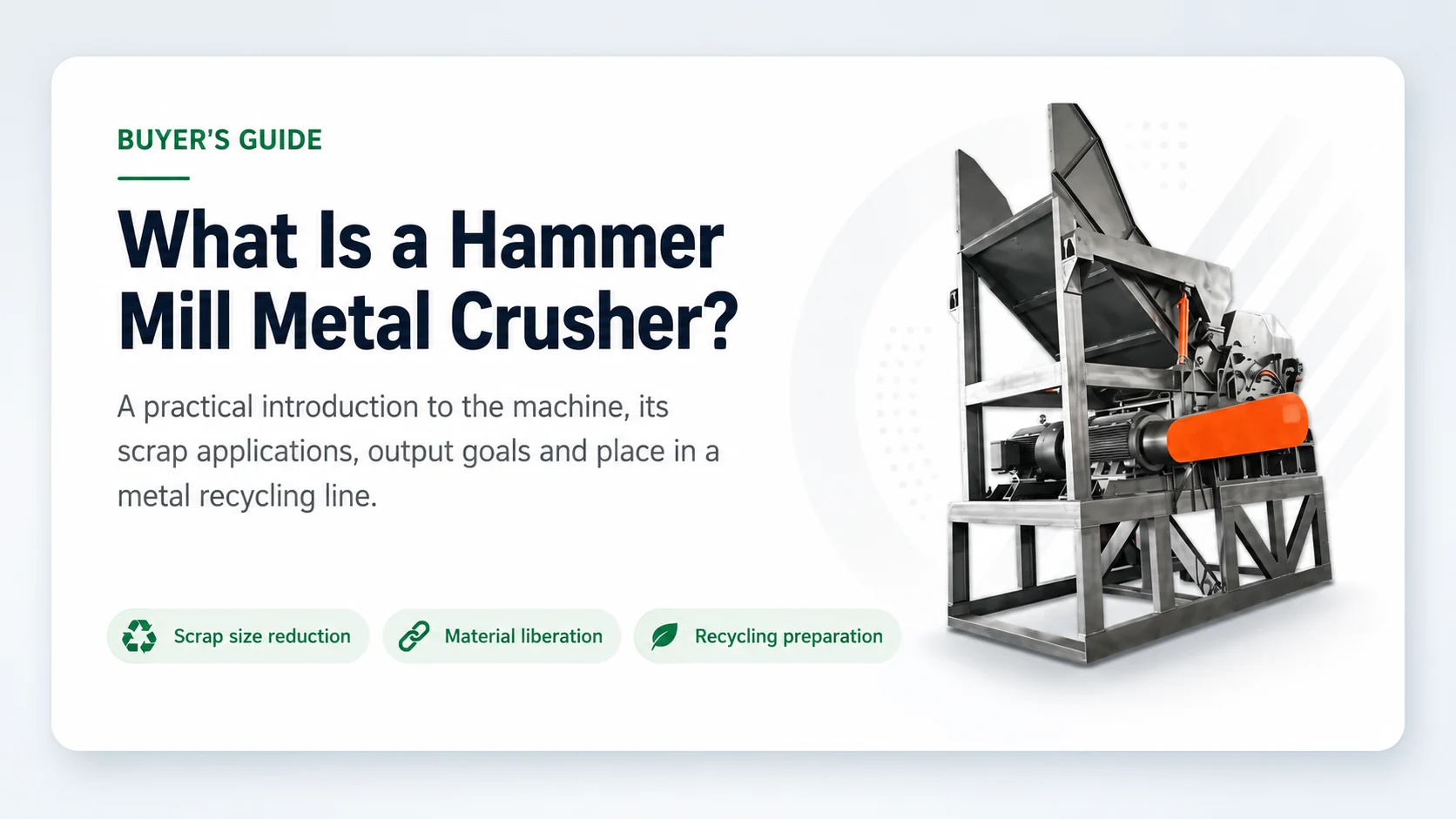
Una trituradora de metal de tipo martillo es un equipo industrial de reciclaje que utiliza impactos repetidos para reducir la chatarra metálica preparada en fragmentos más pequeños. Cuando no basta con reducir el volumen y el proceso siguiente requiere materiales más pequeños, más densos, más porosos o más fáciles de manipular, la planta de reciclaje recurre a ella.
La palabra preparado Es importante tenerlo en cuenta. Un molino de martillos no es necesariamente la primera máquina que hay que utilizar para cualquier montón de chatarra. Los objetos huecos de gran tamaño, el material enredado, los vehículos sin tratar, los contenedores sellados y los residuos mixtos de composición desconocida pueden requerir una descontaminación, un desmantelamiento, un corte con cizalla o una trituración primaria antes de la trituración por impacto. Las condiciones correctas de alimentación dependen de la configuración de la máquina y del diseño del proyecto.
¿Qué significa el nombre “trituradora de metal de molino de martillos”?
El nombre del equipo combina tres conceptos:
Martillo
La máquina aplica golpes repetidos en lugar de basarse únicamente en un corte lento. La acción de martilleo genera un fuerte impacto y una deformación en el material de alimentación.
Molino
El objetivo es la trituración controlada. En el reciclaje de metales, el término “molienda” no se refiere necesariamente a la obtención de polvo, sino que puede significar la producción de fragmentos adecuados para otra fase del proceso de recuperación.
Trituradora de metal
La máquina está diseñada para chatarra metálica seleccionada y conjuntos que contienen metal. Su trabajo es más pesado y supone un mayor desgaste que el de un molino de martillos agrícola o para madera de uso general.
En el mercado también se utilizan nombres como molino de martillos metálico, molino de martillos para chatarra, trituradora de martillos para metal, trituradora de martillos y a veces trituradora de metal molino de martillos. Estas etiquetas no están perfectamente estandarizadas. Dos proveedores pueden utilizar el mismo nombre para máquinas con diferentes límites de alimentación, estructuras de cámara y objetivos de producción.
Por ese motivo, los compradores no deben elegir los equipos basándose únicamente en la marca. La definición que realmente importa viene determinada por el material que admite, el estado de los fragmentos que produce, la preparación previa que requiere y el sistema posterior con el que es compatible.
¿Para qué está diseñada una trituradora de metal de tipo molino de martillos?
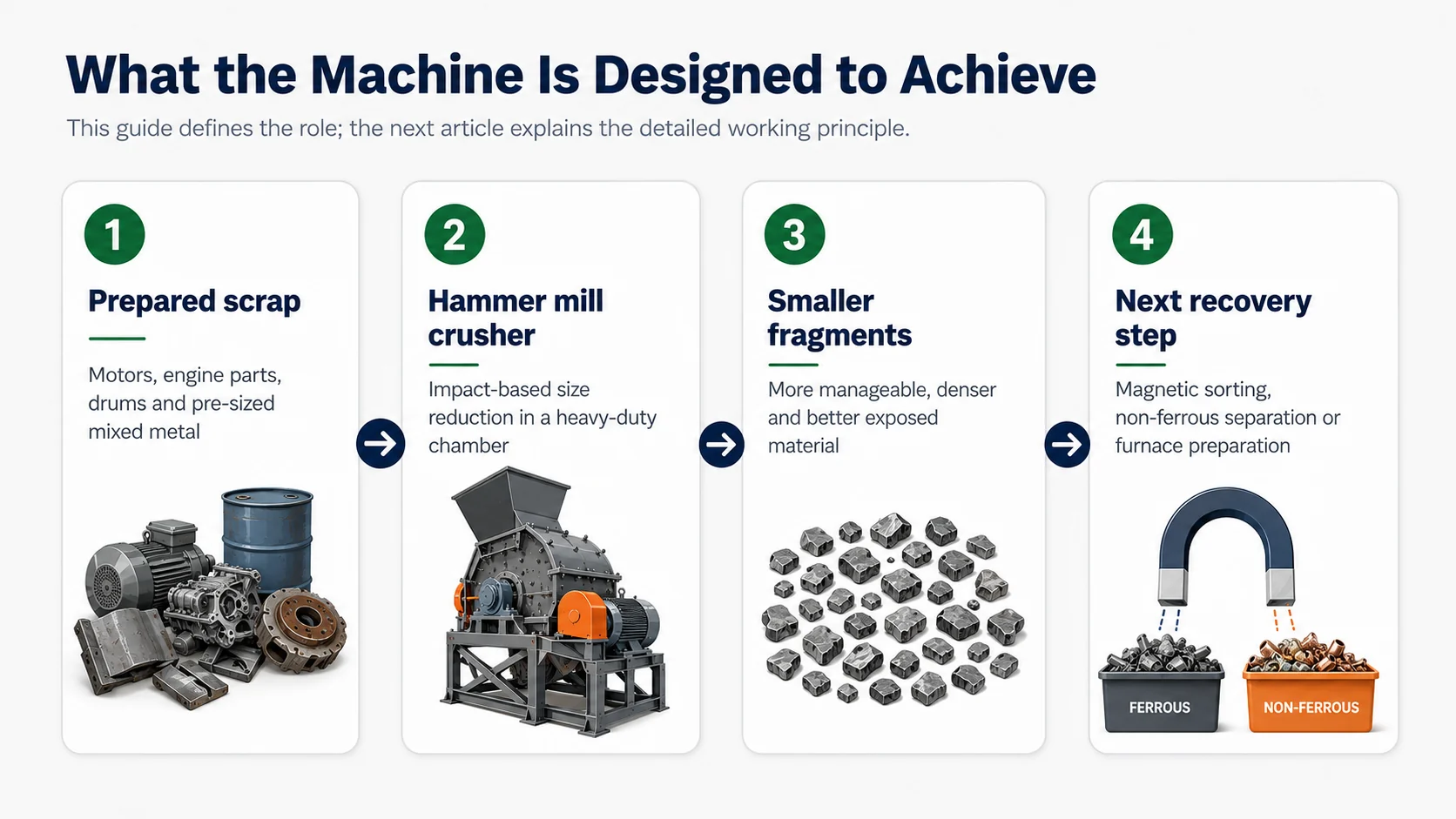
Normalmente se incorpora un molino de martillos porque una planta de reciclaje necesita algo más que una simple reducción de tamaño. Su utilidad práctica suele derivarse de cuatro resultados relacionados entre sí.
1. Reducir los restos a un tamaño más manejable
Los conjuntos de gran tamaño o complejos pueden resultar difíciles de transportar, dosificar, clasificar o introducir en otro proceso. Una trituración adicional genera un flujo más pequeño que puede desplazarse de forma más uniforme a través de cintas transportadoras, cribas, imanes y sistemas de almacenamiento.
2. Dejar al descubierto los materiales conectados
Los motores eléctricos, las piezas de motor, los componentes eléctricos y los residuos mixtos pueden contener acero, cobre, aluminio, plástico, caucho, recubrimientos y materiales aislantes. La trituración permite separar estos componentes y dejar al descubierto la interfaz oculta en el producto original. A esto se le suele llamar liberación.
La «liberación» no significa una separación perfecta. Significa que los materiales son físicamente más fáciles de reconocer o extraer en la siguiente fase de clasificación. La Agencia Internacional de Reciclaje describe el reciclaje por colores como una secuencia que puede incluir la clasificación, el desmontaje, el embalaje, el corte, la trituración y una separación adicional antes de la fusión.
3. Mejorar la densidad aparente y la manejabilidad
La chatarra de forma irregular contiene espacios vacíos. Tras una trituración adecuada, los fragmentos pueden apilarse más compactamente, lo que puede mejorar la estabilidad de la cinta transportadora, el aprovechamiento del almacenamiento y la preparación de la alimentación del horno. El resultado real de la densidad aparente depende de la forma del material, el tamaño de los fragmentos y la manipulación posterior; es recomendable comprobarlo en la práctica, en lugar de fiarse de lo que promete el nombre de la máquina.
4. Preparar el material de alimentación para la recuperación de metales o la refundición
Las operaciones de fabricación de acero y fundición dependen de flujos de chatarra aprovechables. La Asociación Mundial del Acero señala que la chatarra de acero es una materia prima esencial y que todas las vías de producción de acero utilizan chatarra en su mezcla de insumos metálicos. Un molino de martillos puede contribuir a este ciclo de materiales más amplio al preparar la chatarra adecuada para su separación, clasificación y eventual reutilización; sin embargo, el molino en sí mismo no certifica la calidad ni la composición química del metal acabado.
¿Qué materiales puede procesar una trituradora de metal de tipo molino de martillos?
Entre las aplicaciones típicas se incluyen motores eléctricos preparados, componentes de motores, chatarra ferrosa ligera, piezas de aluminio, bidones metálicos, restos de electrodomésticos y metal mixto pretriturado. La página de productos de YUXI muestra motores de coche, motores eléctricos y bidones metálicos como ejemplos de categorías de materia prima, y enumera entre los usuarios a los que va dirigido acerías, fundiciones, empresas de reciclaje de chatarra y empresas de transformación de metales.
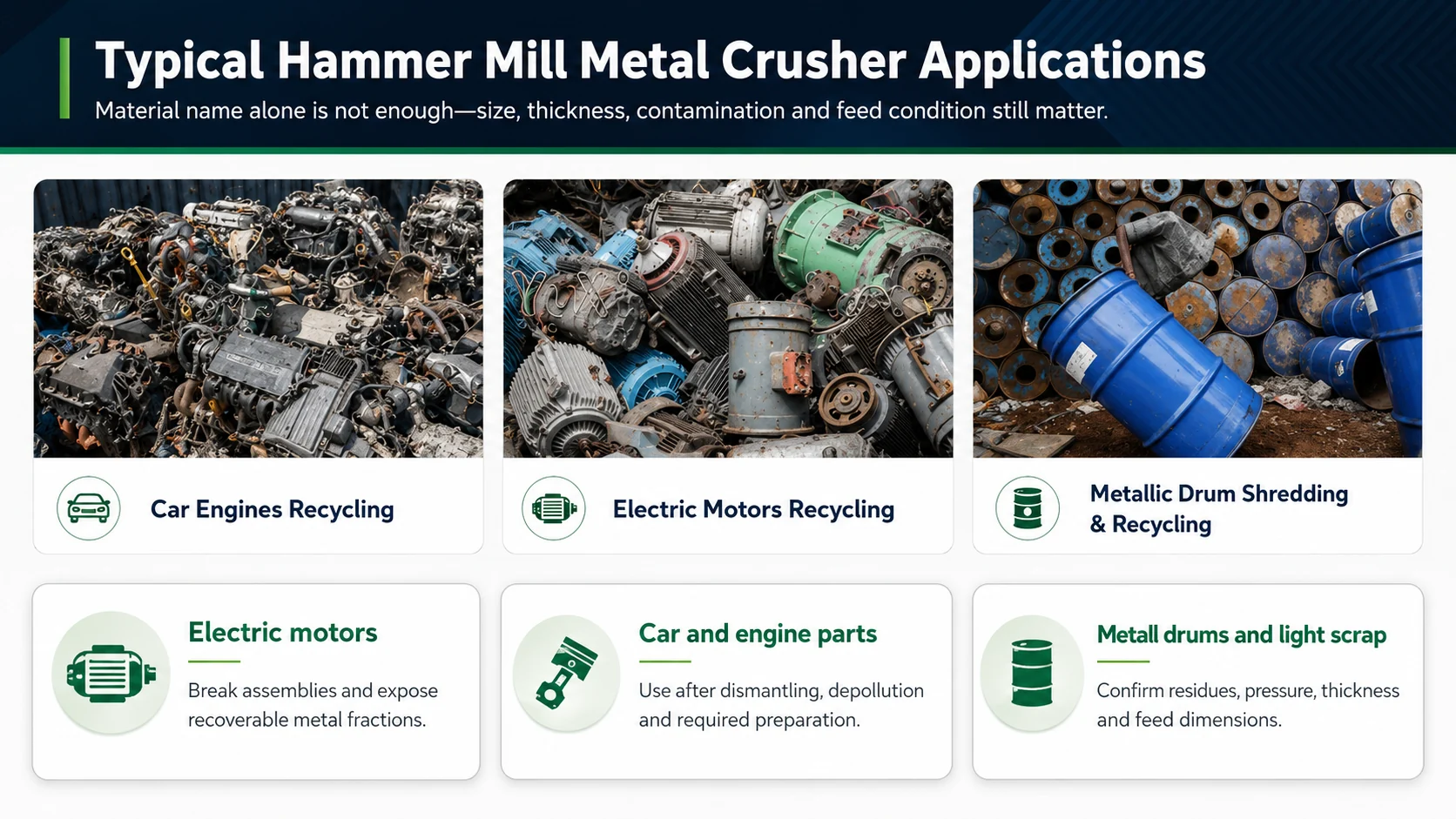
| Grupo de materiales | Por qué se puede utilizar un molino de martillos | Preguntas que hay que aclarar primero |
|---|---|---|
| Motores eléctricos y estatores | Desmontar los conjuntos y dejar al descubierto el cobre, el acero y otros componentes conectados para su posterior recuperación. | Tamaño del motor, estado del eje, material de la carcasa, desmontaje previo, objetivo de recuperación de cobre y separación posterior. |
| Piezas de motor y de automóvil | Reducir los componentes metálicos preparados una vez que se hayan retirado los líquidos, las pilas y los artículos peligrosos. | Dimensiones de las piezas, contenido de piezas fundidas o forjadas, ejes restantes, aceites, filtros, baterías y fracciones metálicas deseadas. |
| Chatarra ferrosa ligera | Para reducir el tamaño y aumentar la densidad de la chatarra de acero fina y mixta, con el fin de facilitar su clasificación o su preparación para el horno. | Espesor máximo, haces, piezas largas, inclusiones duras y si se requiere un corte primario. |
| Chatarra de aluminio | Para recortar perfiles, chapas o componentes seleccionados en los que sea necesario ajustar aún más las dimensiones y separarlos. | Segregación de aleaciones, adherencias de hierro, recubrimientos, humedad, tamaño deseado y problemas relacionados con las partículas finas. |
| Bidones y contenedores metálicos | Para reducir envases de pared fina, limpios, abiertos y sin presión. | Contenidos anteriores, residuos, presión, tapas, espesor de las paredes y si debe realizarse primero el aplanado o la trituración. |
| Residuos mixtos triturados previamente | Para refinar una corriente de alimentación controlada una vez que las piezas voluminosas ya se han abierto y triturado. | Tamaño del fragmento de entrada, material extraño, cambios en la composición, producción prevista y ruta de separación. |
Electrodomésticos de gran tamaño y residuos electrónicos
La Oficina Internacional de Reciclaje señala que, tras el pretratamiento necesario, los electrodomésticos de gran tamaño pueden triturarse en grandes molinos de martillos junto con otros residuos metálicos y vehículos al final de su vida útil que hayan sido sometidos a un pretratamiento. La frase clave es, una vez más, tras el pretratamiento necesario. Los refrigerantes, aceites, condensadores, baterías y demás componentes regulados o peligrosos deben manipularse de acuerdo con el tipo de equipo y la normativa local.
Vehículos y carrocerías
Un vehículo completo no es simplemente otro material metálico más. Los vehículos al final de su vida útil pueden contener líquidos, componentes del sistema de combustible, baterías, airbags, refrigerantes, neumáticos y otros materiales que deben retirarse de forma controlada. En el documento publicado por YUXI línea de reciclaje de residuos de automóviles, una trituradora de doble eje se encarga de la reducción primaria y, a continuación, la trituradora de metal de martillos realiza una trituración más profunda.
Baterías y materiales peligrosos
Las pilas de litio nunca deben tratarse como residuos comunes. La Agencia de Protección Ambiental de EE. UU. (EPA) ha explicado que las pilas de litio desechadas pueden ser inflamables y reactivas, y recomienda una gestión cuidadosa al final de su vida útil. El tratamiento de las pilas requiere un marco legal específico, medidas de seguridad contra incendios y un diseño de procesos específico; no basta con introducirlas sin más en un molino de martillos para metales de uso general.
¿Qué tipo de producto se obtiene con un molino de martillos para metales?
El producto final no viene definido únicamente por una medida nominal en milímetros. Los compradores deben describir el material acabado en varias dimensiones:
- Tamaño de los fragmentos: el rango aproximado que necesita la siguiente máquina o el siguiente comprador.
- Distribución por tamaños: si la corriente contiene una proporción reducida o una amplia mezcla de partículas finas y piezas de gran tamaño.
- Densidad aparente: cómo se acumulan los residuos en los contenedores de basura, los camiones, las cintas transportadoras o los sistemas de alimentación de los hornos.
- Exposición a sustancias: si el cobre, el aluminio, el acero, el plástico o el caucho siguen unidos entre sí.
- Limpieza: el nivel de pintura, aislante, caucho, tierra, líquidos y otros contaminantes.
- Partículas finas y polvo: cuánto material de muy pequeño tamaño se genera y si este puede recuperarse o si supone un problema de gestión.
Un fragmento más pequeño no es necesariamente un producto mejor. Una reducción excesiva puede aumentar el desgaste, el polvo, el ruido, el consumo energético y la pérdida de metal valioso en forma de partículas finas. El producto final adecuado es aquel cuyo tamaño y estado permiten al proceso posterior obtener la mejor recuperación práctica a un coste operativo aceptable.
¿Cuál es la diferencia entre una trituradora de martillos y una trituradora de metal o una trituradora de vehículos?
Las tres máquinas reducen los residuos, pero no resuelven el mismo problema.
| Equipamiento | Función principal | Condiciones típicas de alimentación | Motivo habitual para elegirlo |
|---|---|---|---|
| Trituradora de metal de doble eje | Trituración primaria y reducción gruesa mediante cizallamiento a baja velocidad y alto par. | Residuos voluminosos, huecos, de forma irregular y difíciles de alimentar. | Reducir el volumen y crear un flujo más seguro y controlable para su posterior procesamiento. |
| Molino de martillos triturador de metales | Mayor reducción y exposición debido a impactos repetidos. | Pienso preparado, cortado o rallado previamente, adaptado a la cámara. | Crear fragmentos más pequeños, más densos y más sueltos para su separación o para prepararlos para la refundición. |
| Trituradora vertical de metal | Reducción a alta velocidad en una cámara vertical para corrientes seleccionadas de metales ligeros. | Residuos ligeros, latas, virutas o material preparado de menor tamaño, en función de la configuración. | Procesamiento vertical compacto en el que el material y el objetivo de producción se ajustan al diseño. |
La decisión detallada entre una trituradora de metal y un molino de martillos se aborda en la guía de YUXI titulada «Trituradora de metal frente a molino de martillos». En este artículo, la cuestión clave es más sencilla: un molino de martillos se caracteriza por su función de trituración por impacto, y no simplemente por el hecho de que reduzca el tamaño de la chatarra.
¿Qué papel desempeña un molino de martillos en una línea de reciclaje de metales?
Un molino de martillos es uno de los módulos de un sistema de recuperación de materiales. Dependiendo del proyecto, puede situarse después del desmontaje, el corte o la trituración primaria, y antes de la separación magnética, la clasificación de metales no ferrosos, el cribado, la clasificación por aire, el almacenamiento o la preparación para el horno.
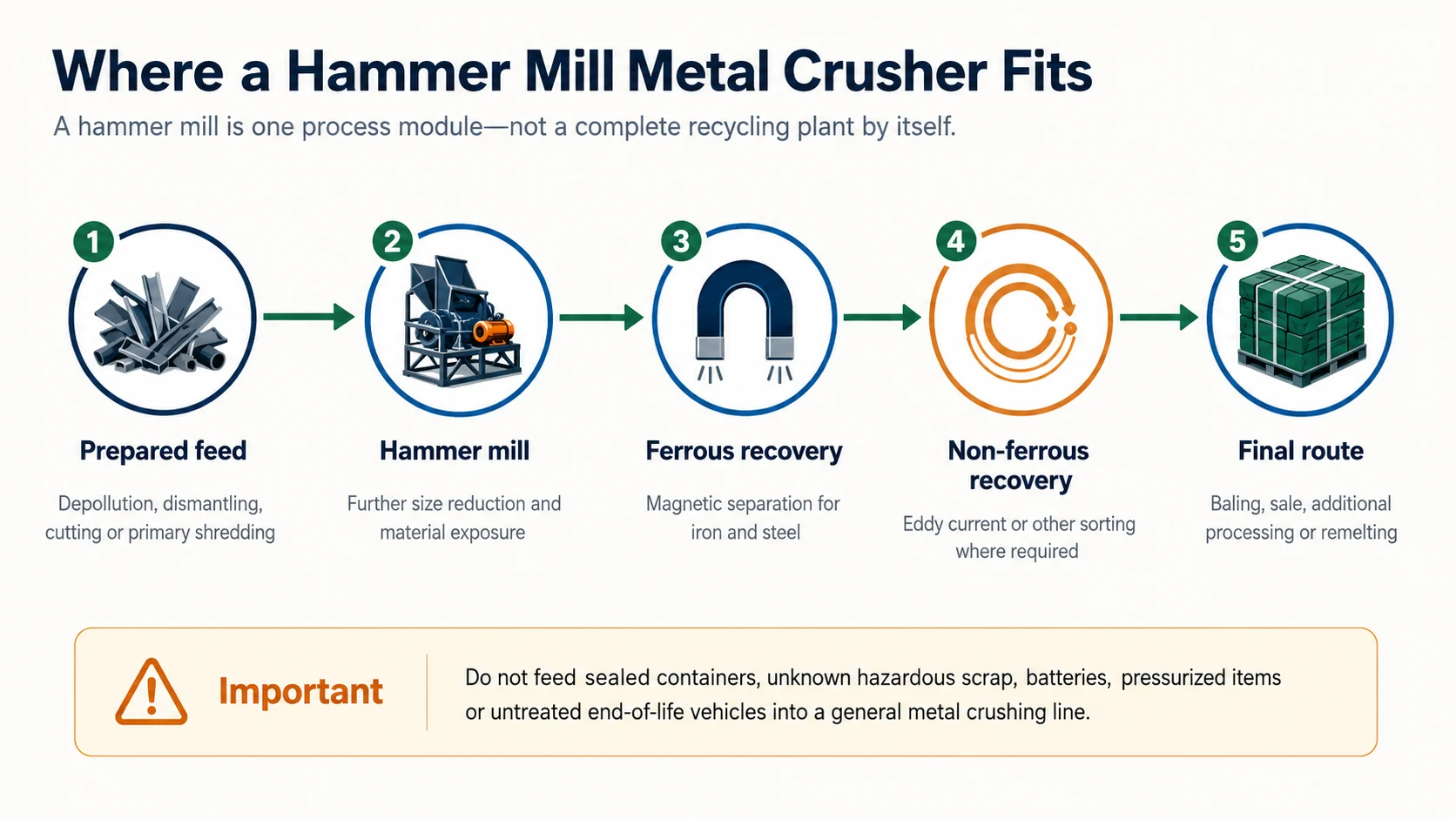
Antes del molino de martillos
Los trabajos previos garantizan una alimentación predecible. Estos pueden incluir la inspección, la depuración, el desmontaje manual, el vaciado, el corte, la cizalladura, la trituración primaria y la eliminación de objetos claramente peligrosos o irrompibles. Una alimentación estable reduce las variaciones bruscas y contribuye a que la planta funcione según lo previsto.
Después del molino de martillos
Los equipos de tratamiento posterior convierten los fragmentos más pequeños en fracciones comercializables. Los metales ferrosos pueden recuperarse mediante métodos magnéticos. Los metales no ferrosos pueden requerir un separador de corrientes de Foucault o cualquier otra tecnología seleccionada para ese material. Las cribas permiten clasificar por tamaño, mientras que los sistemas de aire pueden eliminar las fracciones ligeras cuando sea necesario.
Por qué es importante el diseño de las líneas
Una trituradora potente no puede compensar un proceso mal definido. Si el material de alimentación varía —pasando de láminas finas un día a bloques fundidos al siguiente—, el molino puede sufrir una carga inestable y un rendimiento impredecible. Si el separador posterior recibe un rango de tamaños demasiado amplio, la recuperación puede verse afectada incluso cuando la propia trituradora está en funcionamiento.
¿En qué casos es recomendable utilizar una trituradora de martillos para metales?
Indicadores de un buen ajuste
- La chatarra ya está preparada con un tamaño máximo controlado.
- El proyecto requiere una reducción mayor que la que ofrece una trituradora primaria.
- Los metales y no metales que están unidos deben someterse a una exposición más intensa antes de su clasificación.
- Los fragmentos más pequeños o más densos facilitan la manipulación o el proceso posterior.
- La planta permite gestionar las piezas de desgaste, así como controlar el polvo y el ruido.
- Se pueden medir la composición de la alimentación y las especificaciones de producción.
Indicadores de ajuste deficiente o de revisión técnica
- El cargamento contiene artículos sellados, presurizados, explosivos o no identificados.
- Las baterías de litio u otros componentes inflamables pueden introducirse sin que nadie se dé cuenta.
- Entre los residuos se incluyen ejes macizos de grandes dimensiones, bloques endurecidos o perfiles estructurales pesados.
- Los objetos huecos de gran tamaño no pueden alimentarse de forma constante sin una reducción previa.
- El comprador espera que una trituradora produzca metales perfectamente separados.
- La obra no cuenta con ningún plan relativo al polvo, el ruido, la seguridad, el acceso para el mantenimiento ni la respuesta ante incendios.
Realidad operativa: los equipos de alto impacto requieren controles
La trituración de metales conlleva riesgos derivados de la maquinaria en movimiento, la expulsión de chatarra, los atascos, la energía acumulada, el ruido y el polvo. Las directrices de la OSHA sobre el reciclaje de chatarra hacen hincapié en la protección de las máquinas y en los procedimientos de bloqueo y etiquetado antes de realizar tareas de limpieza o mantenimiento. El cumplimiento normativo específico de cada emplazamiento debe diseñarse en función del país, la materia prima y la instalación; un folleto de la máquina no constituye un plan de seguridad.
Esto también influye en la decisión de compra. Pregunta cómo se accede a la cámara, cómo se descarga el material irrompible, cómo están dispuestos los protectores y los enclavamientos, cómo se sustituyen las piezas de desgaste y cómo se aísla la línea antes del mantenimiento.
Cómo posiciona YUXI su trituradora de metal de tipo martillo
YUXI presenta su molino de martillos trituradora de metales como equipo para la trituración de chatarra y para la separación o extracción de fracciones metálicas y no metálicas antes del reciclaje o la preparación para la fundición. La página pública del producto muestra una máquina horizontal de gran tamaño con una tolva de alimentación, una protección del motor, componentes hidráulicos y una cámara reforzada.
En esa misma página se enumeran como posibles grupos de usuarios las acerías, las fundiciones, las plantas de reciclaje de chatarra, las fábricas de productos metálicos, las plantas de transformación de metales, las fábricas de productos de aluminio y los fabricantes de automóviles. Asimismo, se indican una puerta de seguridad, un control mediante PLC y un sistema de potencia hidráulica como características de la configuración publicada.
La página del producto incluye datos numéricos de marketing relativos a la eficiencia y la relación calidad-precio, pero no indica las condiciones de las pruebas ni aporta datos de proyectos que los respalden. Por lo tanto, este artículo no reproduce esas cifras como rendimiento garantizado.
¿Qué información debes enviar antes de solicitar un presupuesto para un molino de martillos?
Una cita útil comienza con datos concretos, no con el nombre de una máquina. Prepara la siguiente información:
| Información | ¿Por qué lo necesita el proveedor? |
|---|---|
| Fotos y composición de los materiales | Muestra formas geométricas, accesorios, mezclas de metales ferrosos y no ferrosos y posibles contaminantes. |
| La longitud, la anchura, el grosor y el peso máximos | Determina si el material se puede introducir directamente o si es necesario triturarlo previamente. |
| El estado de sueltos, empaquetados, enredados o triturados previamente | afectará al método de alimentación, a la estabilidad de la carga y al rendimiento real. |
| Inclusiones duras o irrompibles | Identifica el riesgo de metales extraños y los requisitos de protección de la cámara. |
| Rendimiento por hora requerido | Debe evaluarse en condiciones reales de alimentación, y no solo en función del tamaño teórico del motor. |
| Condición del fragmento objetivo | Especifica el rango de granulometría, la densidad, el grado de liberación, la tolerancia a las partículas finas y el uso posterior. |
| Servicios y distribución del recinto | Sirve de apoyo para la planificación de las instalaciones eléctricas, los cimientos, las cintas transportadoras, el control de polvo y el mantenimiento. |
| Requisitos locales en materia de seguridad y medio ambiente | Establece las obligaciones en materia de seguridad, emisiones, ruido, incendios y gestión de residuos. |
Define el material antes de elegir la máquina
Una recomendación seria sobre el equipo debe especificar qué material se introducirá en el molino de martillos, qué producto debe generar y cuál es el proceso posterior. Envíe fotografías representativas, las dimensiones, la composición y los requisitos de rendimiento para su revisión técnica.
PREGUNTAS FRECUENTES
¿Qué es una trituradora de metal de tipo molino de martillos?
Una trituradora de metal de tipo martillo es un equipo industrial de reciclaje que reduce la chatarra preparada en fragmentos más pequeños mediante impactos repetidos.
¿Son lo mismo los molinos de martillos y las trituradoras de metal?
No. Las trituradoras de metal de baja velocidad suelen agarrar y cortar materiales voluminosos, mientras que las trituradoras de martillos utilizan la fuerza de impacto para reducir aún más el material y aumentar su exposición. Algunas líneas de producción utilizan primero trituradoras y, a continuación, trituradoras de martillos.
¿Qué materiales se pueden procesar con el molino de martillos para metales?
Entre las aplicaciones típicas se incluyen motores preparados, piezas de motor, chatarra ferrosa ligera, chatarra de aluminio, barriles y metales mixtos pretriturados. La aplicabilidad final depende del tamaño, el grosor, la dureza, el grado de contaminación y el rendimiento requerido.
¿Puede el molino de martillos procesar directamente el cuerpo completo?
No es una regla general. Los vehículos deben someterse a un proceso de eliminación de contaminantes y preparación, y las estructuras de carrocería de gran tamaño suelen necesitar una reducción inicial antes de proceder a un aplastamiento más profundo. El método de tratamiento debe determinarse en función del estado concreto de cada vehículo.
¿El molino de martillos separa los metales por sí solo?
Su función principal es reducir el tamaño y dejar al descubierto el material.
¿Qué datos hay que facilitar antes de solicitar un presupuesto?
Envíe fotografías del material, su composición, las dimensiones y el grosor máximos, el objetivo de rendimiento, la producción requerida, los detalles sobre la contaminación, la preparación previa, el plan de clasificación posterior, los servicios públicos y la distribución del taller.
Referencias y notas bibliográficas
- Oficina Internacional de Reciclaje: Residuos electrónicos — el tratamiento previo de los aparatos eléctricos y el entorno de los molinos de martillos de gran tamaño.
- Oficina Internacional de Reciclaje: Metales no ferrosos — fase de reciclaje, que incluye la clasificación, el desmontaje, la trituración y la separación posterior.
- Asociación Mundial del Acero: Materias primas — el papel de la chatarra en la producción de acero.
- OSHA: Directrices para la identificación y el control de los riesgos para la seguridad y la salud en el reciclaje de chatarra metálica.
- Agencia de Protección Ambiental de EE. UU. (EPA): Preguntas frecuentes sobre el reciclaje de baterías de litio: riesgos y aspectos básicos sobre la manipulación de las baterías al final de su ciclo de vida.