




 Request Quote



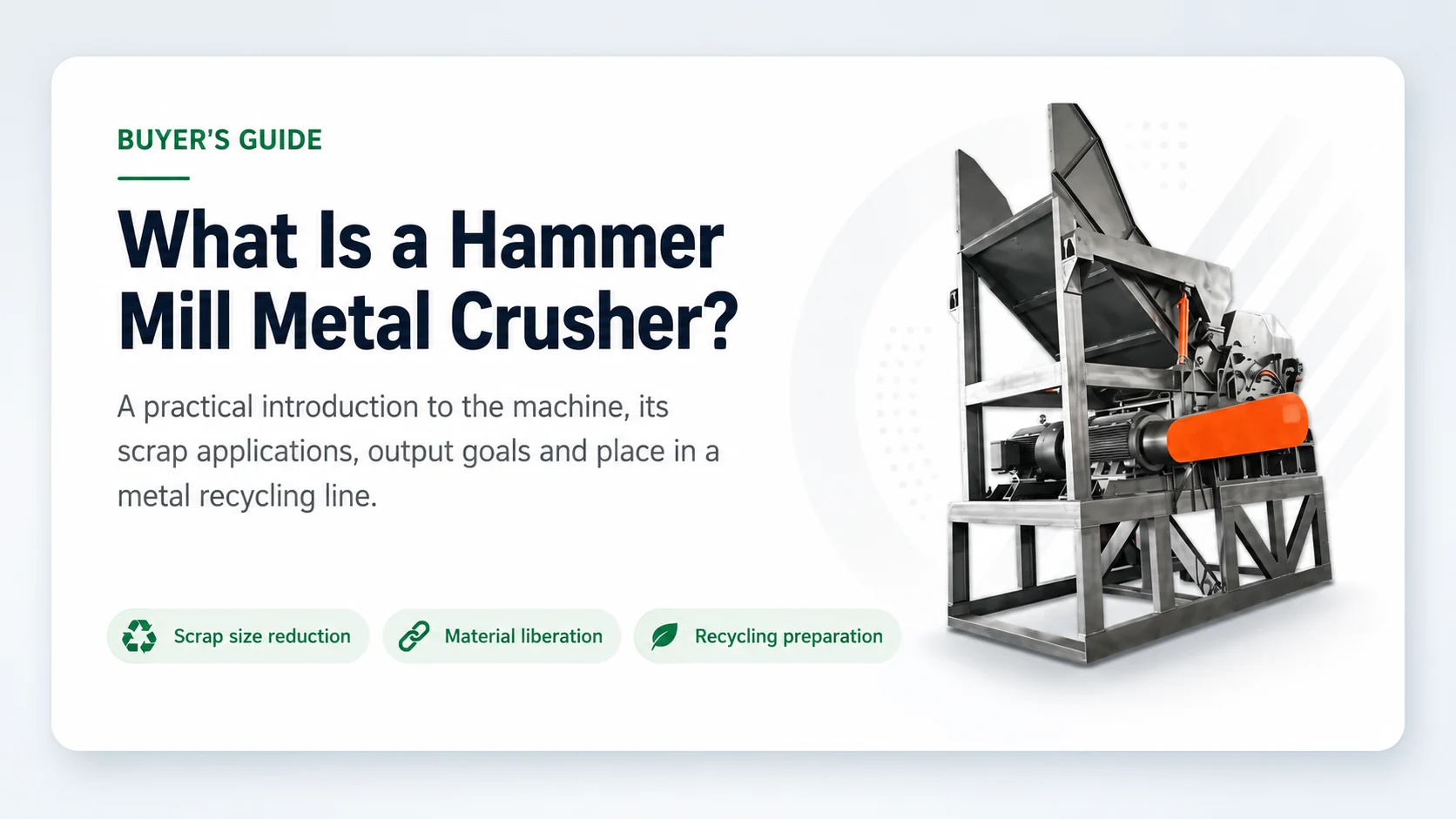
Quick Answer: What Is a Hammer Mill Metal Crusher?
A hammer mill metal crusher is an industrial recycling equipment that uses repeated shocks to reduce the prepared metal scrap to smaller fragments.When it is not enough to reduce the volume and the next process requires smaller,more denser,more open or easier materials,the recycling plant will use it.
The word prepared matters. A hammer mill is not automatically the first machine for every pile of scrap. Large hollow objects, tangled material, untreated vehicles, sealed containers and unknown mixed waste may require depollution, dismantling, shearing or primary shredding before impact crushing. The correct feed condition depends on the machine configuration and project design.
What Does the Name “Hammer Mill Metal Crusher” Mean?
The equipment name combines three ideas:
Hammer
The machine applies repeated blows rather than relying only on slow cutting. The hammering action creates strong impact and deformation in the feed material.
Mill
The purpose is controlled size reduction. In metal recycling, “mill” does not necessarily mean making powder; it may mean producing fragments suitable for another recovery step.
Metal crusher
The machine is built for selected metal scrap and metal-containing assemblies. Its duty is heavier and more wear-intensive than a general agricultural or wood hammer mill.
The market also uses names such as metal hammer mill, scrap metal hammer mill, hammer mill crusher for metal, hammer crusher and sometimes metal shredder hammer mill. These labels are not perfectly standardized. Two suppliers may use the same name for machines with different feed limits, chamber structures and output targets.
For that reason, buyers should not select equipment from the name alone. The useful definition comes from the material it accepts, the fragment condition it produces, the upstream preparation it requires and the downstream system it supports.
What Is a Hammer Mill Metal Crusher Designed to Achieve?
A hammer mill is normally added because a recycling plant needs more than basic size reduction. Its practical value usually comes from four connected results.
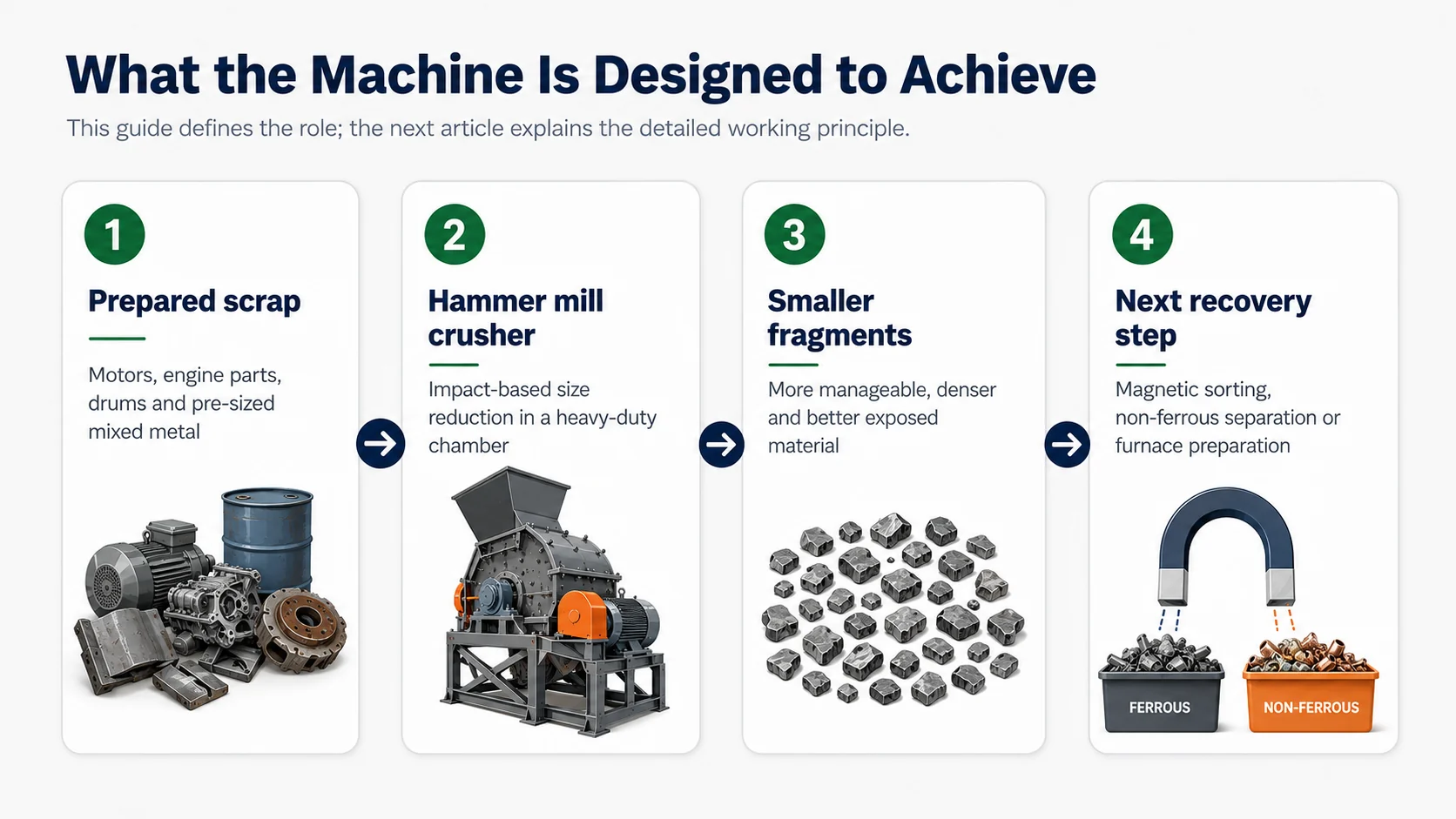
1. Reduce scrap to a more manageable size
Large or complex assemblies can be difficult to convey, meter, sort or charge into another process. Further crushing creates a smaller stream that can move more consistently through conveyors, screens, magnets and storage systems.
2. Expose connected materials
Electric motors, engine parts, electrical components and mixed waste may include steel, copper, aluminum, plastic, rubber, coating and insulation materials. Crushing can open these components and expose the interface hidden in the original product.This is usually called liberation.
Liberation does not mean perfect separation. It means the materials are physically easier for the next sorting stage to recognize or extract. The The International Recycling Agency describes color recycling as a sequence that may include sorting,disassembly,packaging,shearing,chopping and further separation before melting.
3. Improve bulk density and handling
Irregular scrap contains empty space. After suitable crushing, the fragments can pack more closely, which may improve conveyor stability, storage use and furnace-feed preparation. The real bulk-density result depends on material shape, fragment size and downstream handling; it should be tested rather than promised from the machine name.
4. Prepare feed for metal recovery or remelting
Steelmaking and foundry operations depend on usable scrap streams. The World Steel Association notes that steel scrap is a vital raw material and that all steel production routes use scrap in their metallic input mix. A hammer mill can support this wider material loop by preparing suitable scrap for separation, grading and eventual reuse—but the mill itself does not certify the grade or chemistry of the finished metal.
What Materials Can a Hammer Mill Metal Crusher Process?
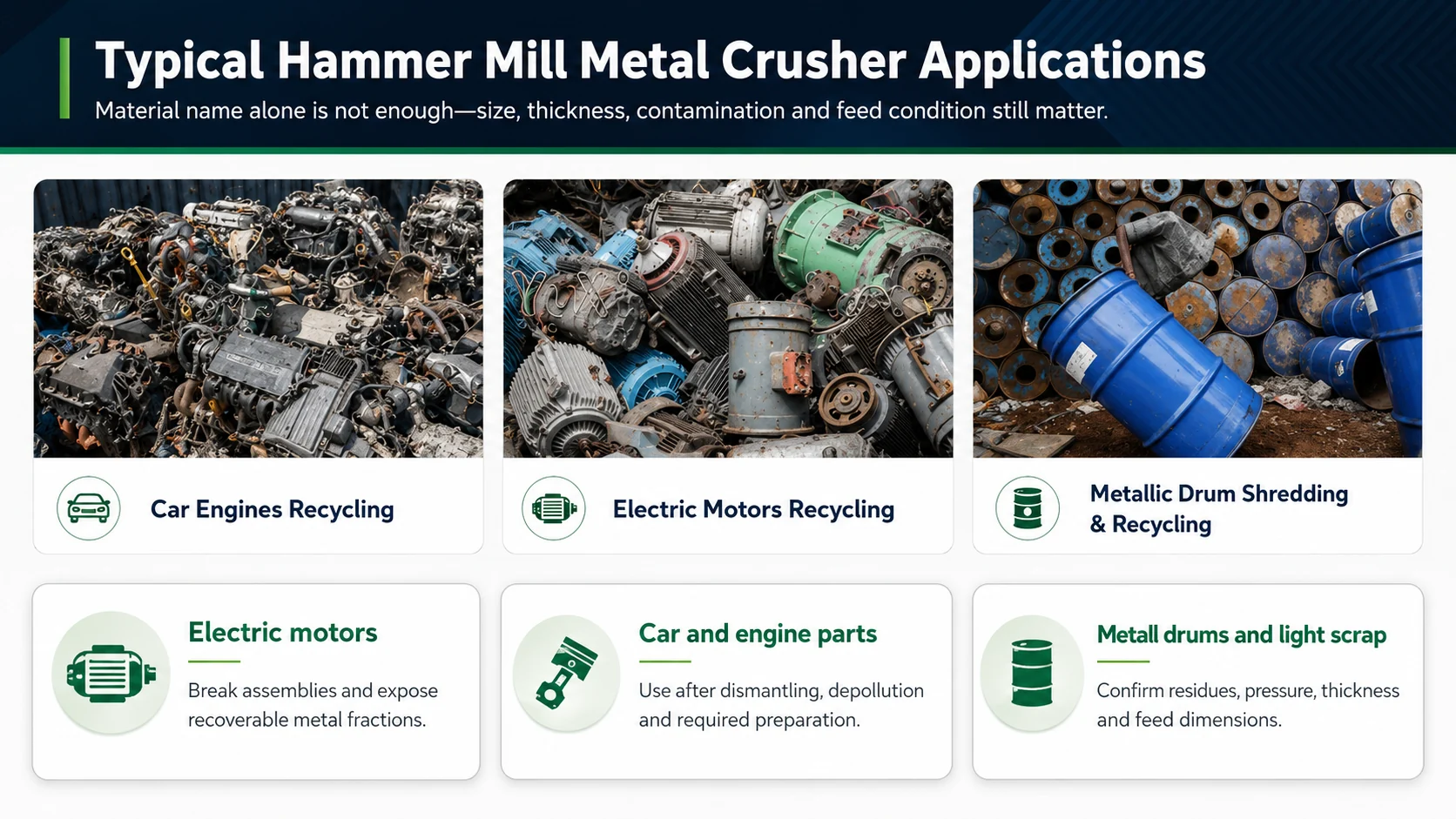
Typical applications include prepared electric motors, engine components, light ferrous scrap, aluminum pieces, metal drums, appliance fractions and pre-shredded mixed metal. YUXI’s product page illustrates car engines, electric motors and metallic drums as example feed categories and lists steel plants, smelters, foundries, scrap recyclers and metal-processing companies among the intended users.
| Material group | Why a hammer mill may be used | Questions to confirm first |
|---|---|---|
| Electric motors and stators | To break assemblies and expose copper, steel and other connected fractions for subsequent recovery. | Motor size, shaft condition, casing material, prior dismantling, copper recovery target and downstream separation. |
| Engine and automotive parts | To reduce prepared metal components after fluids, batteries and hazardous items have been removed. | Part dimensions, cast or forged content, remaining shafts, oils, filters, batteries and desired metal fractions. |
| Light ferrous scrap | To make thin and mixed steel scrap smaller and denser for sorting or furnace preparation. | Maximum thickness, bundles, long pieces, hard inclusions and whether primary shearing is required. |
| Aluminum scrap | To reduce profiles, sheet or selected components where further sizing and separation are needed. | Alloy segregation, iron attachments, coatings, moisture, desired size and fines concerns. |
| Metal drums and containers | To reduce cleaned, open and non-pressurized light-gauge containers. | Previous contents, residues, pressure, lids, wall thickness and whether flattening or shredding should come first. |
| Pre-shredded mixed scrap | To refine a controlled feed stream after bulky pieces have already been opened and reduced. | Incoming fragment size, tramp material, composition changes, target output and separation route. |
Large appliances and e-scrap
The Bureau of International Recycling notes that, after required pre-treatment, large electrical appliances may be shredded in large hammer mills with other metal scrap and pre-treated end-of-life vehicles. The important phrase is again after required pre-treatment. Refrigerants, oils, capacitors, batteries and other regulated or hazardous components must be handled according to the type of equipment and local rules.
Vehicles and car bodies
A complete vehicle is not simply another metal feed. End-of-life vehicles may contain fluids, fuel-system components, batteries, airbags, refrigerants, tires and other materials that need controlled removal. In YUXI’s published waste car recycling line, a double-shaft shredder performs primary reduction and the hammer-type metal crusher performs deeper crushing afterward.
Batteries and hazardous material
Lithium batteries should never be treated as ordinary waste inclusions. The U.S. EPA explained that discarded lithium batteries may be flammable and reactive,and recommends careful end-of-life management. Battery processing requires a dedicated legal, fire-safety and process design—not casual feeding into a general metal hammer mill.
What Kind of Output Does a Metal Hammer Mill Create?
The useful output is not defined only by a nominal millimeter size. Buyers should describe the finished material in several dimensions:
- Fragment size: the approximate range required by the next machine or buyer.
- Size distribution: whether the stream contains a narrow fraction or a wide mix of fines and oversize pieces.
- Bulk density: how the pack debris in trash cans,trucks,conveyors or furnace charging systems.
- Material exposure: whether copper, aluminum, steel, plastic or rubber are still locked together.
- Cleanliness: the level of paint, insulation, rubber, soil, liquid and other pollutants.
- Fines and dust: how much very small material is created and whether it can be recovered or becomes a handling problem.
A smaller fragment is not automatically a better product. Excessive reduction may increase wear, dust, noise, energy demand and loss of valuable metal into fines. The correct output is the size and condition that gives the downstream process the best practical recovery at an acceptable operating cost.
What is the difference between a hammer crusher and a metal crusher or a vehicle crusher?
All three machines reduce scrap, but they do not solve the same problem.
| Equipment | Primary role | Typical feed condition | Typical reason to select it |
|---|---|---|---|
| Double-shaft metal shredder | Primary opening and coarse reduction by low-speed, high-torque shearing. | Bulky, hollow, irregular and difficult-to-feed scrap. | Reduce volume and create a safer, more controllable stream for further processing. |
| Hammer mill metal crusher | Further reduction and exposure by repeated impact. | Prepared, cut or pre-shredded feed matched to the chamber. | Create smaller, denser and more liberated fragments for separation or remelting preparation. |
| Vertical metal crusher | High-speed reduction in a vertical chamber for selected light metal streams. | Configuration-dependent light scrap, cans, chips or smaller prepared material. | Compact vertical processing where the material and output target match the design. |
The detailed decision between a shredder and hammer mill is covered in YUXI’s Metal Shredder vs Hammer Mill Crusher guide. For this article, the key point is simpler: a hammer mill is identified by its impact-crushing duty, not merely by the fact that it makes scrap smaller.
Where Does a Hammer Mill Fit in a Metal Recycling Line?
A hammer mill is one module in a material-recovery system. Depending on the project, it may sit after dismantling, shearing or primary shredding and before magnetic separation, non-ferrous sorting, screening, air classification, storage or furnace preparation.
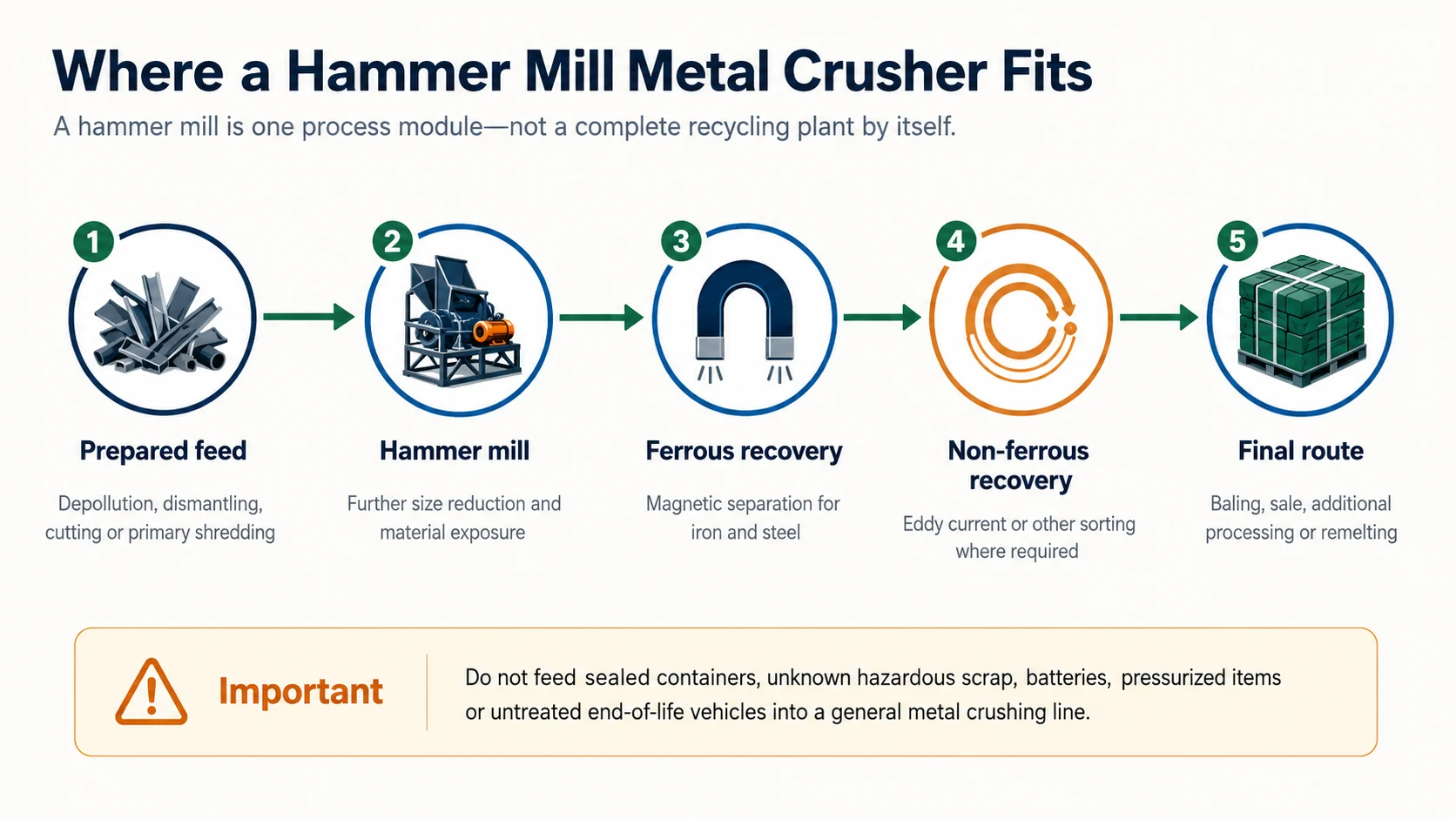
Before the hammer mill
Upstream work creates a predictable feed. This can include inspection, depollution, manual dismantling, draining, cutting, shearing, primary shredding and removal of obvious hazardous or unbreakable objects. A stable feed reduces shock variation and helps the mill operate as designed.
After the hammer mill
Downstream equipment converts smaller fragments into saleable fractions. Ferrous metal may be recovered magnetically. Non-ferrous metals may require an eddy current separator or another technology selected for the material. Screens can classify size, while air systems may remove light fractions where appropriate.
Why line design matters
A strong crusher cannot compensate for a badly defined process. If the feed varies from thin sheet one day to cast blocks the next, the mill may experience unstable loading and unpredictable output. If the downstream separator receives too wide a size range, recovery can suffer even when the crusher itself is running.
When Is a Hammer Mill Metal Crusher a Good Fit?
Good fit indicators
- The scrap is already prepared to a controlled maximum size.
- The project needs more reduction than a primary shredder provides.
- Connected metals and non-metals need stronger exposure before sorting.
- Smaller or denser fragments improve handling or the next process.
- The plant can support wear-parts management, dust control and noise control.
- Feed composition and output specifications can be measured.
Poor fit or engineering-review indicators
- Feed contains sealed, pressurized, explosive or unidentified items.
- Lithium batteries or other fire-sensitive components may enter unnoticed.
- Scrap includes oversized solid shafts, hardened blocks or heavy structural sections.
- Large hollow items cannot be fed steadily without primary reduction.
- The buyer expects one crusher to produce perfectly separated metals.
- The site has no plan for dust, noise, guarding, maintenance access or fire response.
Operational reality: high-impact equipment needs controls
Metal crushing creates hazards from moving machinery, ejected scrap, jams, stored energy, noise and dust. OSHA’s scrap metal recycling guidance emphasizes machine guarding and lockout/tagout before cleaning or maintenance. Site-specific compliance must be designed for the country, feedstock and installation; a machine brochure is not a safety plan.
This also affects the buying decision. Ask how the chamber is accessed, how unbreakable material is discharged, how guards and interlocks are arranged, how wear parts are replaced and how the line is isolated before maintenance.
How YUXI Positions Its Hammer Mill Metal Crusher
YUXI presents its hammer mill metal crusher as equipment for scrap-metal crushing and for separating or exposing metal and non-metal fractions before recycling or smelting preparation. The public product page shows a heavy horizontal machine with a feed hopper, drive guard, hydraulic components and a reinforced chamber.
The same page lists steel plants, smelters, foundries, scrap recycling stations, metal-products factories, metal-processing plants, aluminum-product factories and automobile manufacturers as possible user groups. It also identifies a safety door, PLC control and a hydraulic power system as features of the published configuration.
The product page contains numerical marketing claims concerning efficiency and material value, but it does not display the test conditions or supporting project data. This article therefore does not repeat those figures as guaranteed performance.
What Should You Send Before Requesting a Hammer Mill Quotation?
A useful quotation begins with feed evidence, not a machine name. Prepare the following information:
| Information | Why the supplier needs it |
|---|---|
| Material photos and composition | Shows geometric shapes,accessories, ferrous/non-ferrous mixtures and possible pollutants. |
| The maximum length, width, thickness and weight | Determine whether the material can be directly fed or needs to be reduced upstream. |
| The state of loose,packaged, entangled or pre-shredded | will affect the feeding method,load stability and actual throughput. |
| Hard or unbreakable inclusions | Identifies tramp-metal risk and chamber-protection requirements. |
| Required hourly throughput | Must be assessed under the real feed condition, not only by theoretical motor size. |
| Target fragment condition | Clarifies size range, density, liberation, fines tolerance and downstream use. |
| Utilities and site layout | Supports electrical, foundation, conveyor, dust-control and maintenance planning. |
| Local safety and environmental requirements | Determines guarding, emissions, noise, fire and waste-management obligations. |
Define the material before choosing the machine
A serious equipment recommendation should state what the hammer mill will receive, what it must produce and what process comes next. Send representative photos, dimensions, composition and output requirements for engineering review.
FAQ
What is a hammer mill metal crusher?
A hammer mill metal crusher is an industrial recycling equipment that reduces prepared scrap metal to smaller fragments through repeated impacts.
Are hammer mills and metal shredders the same?
No. Low-speed metal shreddera usually grab and cut bulky materials, while hammer shredders use the impact force to further reduce and strengthen material exposure.Some production lines use shredders first,and then hammer crushers.
What materials can be processed by the metal hammer mill?
Typical applications include prepared motors, engine parts, light ferrous scraps, aluminum scraps, barrels and pre-shredded mixed metals. The final applicability depends on the size, thickness, hardness,pollution and the required output.
Can the hammer mill directly process the complete body?
Not as a general rule. Vehicles require depollution and preparation, and large body structures commonly need primary reduction before deeper crushing. The equipment route must be confirmed for the specific vehicle condition.
Does the hammer mill separate metals by itself?
Its main job is reducen the size and expose the material.
What information is needed before requesting a quotation?
Send material photos, composition, maximum size and thickness, throughput target, required output, pollution details, upstream preparation, downstream sorting plan, utilities and workshop layout.
References and Source Notes
- International Recycling Bureau: E-scrap — pre-treatment of electrical appliances and the environment of large hammer mills.
- International Recycling Bureau: Non-Ferrous Metals — recycling stage including sorting, disassembly, shredding and further separation.
- World Steel Association: Raw Materials — the role of scrap in steel production.
- OSHA: Guidelines for the Identification and Control of Safety and Health Hazards in Metal Scrap Recycling.
- U.S. EPA: FAQ about Lithium Battery Recycling-battery hazards and handling background at the end-of-life cycle.