




 Request Quote



What Vehicle Recycling Plant ROI really means
ROI is not the same as revenue, gross margin or the price of a production line.
For a vehicle recycling project, return on investment compares the operating return generated by the defined plant with the capital committed to build and start that plant. It answers a practical question: after paying for feedstock, processing, labor, maintenance, residue handling and fixed overhead, how much annual operating return remains relative to the installed investment?
That definition sounds simple. The difficult part is agreeing on the boundary and using realistic plant data. One model may include vehicle purchasing, depollution, dismantling, parts sales, shell preparation and downstream shredding. Another may cover only prepared hulks entering a metal shredding and separation line. Those are different businesses. They should not share the same cost base, revenue assumptions or payback claim.
The U.S. Environmental Protection Agency describes end-of-life vehicle operations as a sequence that includes vehicle acceptance and storage, hazardous-material removal, dismantling, hulk storage and crushing or shredding. It also notes that proper processing can reduce disposal costs and create revenue opportunities from recovered parts and scrap materials. That sequence is useful for financial modeling because each stage adds its own assets, labor, compliance burden and potential income.
Define the plant boundary before calculating ROI
The first line of your spreadsheet should state what the investment includes. Without that sentence, two teams can use the same formula and reach completely different answers.
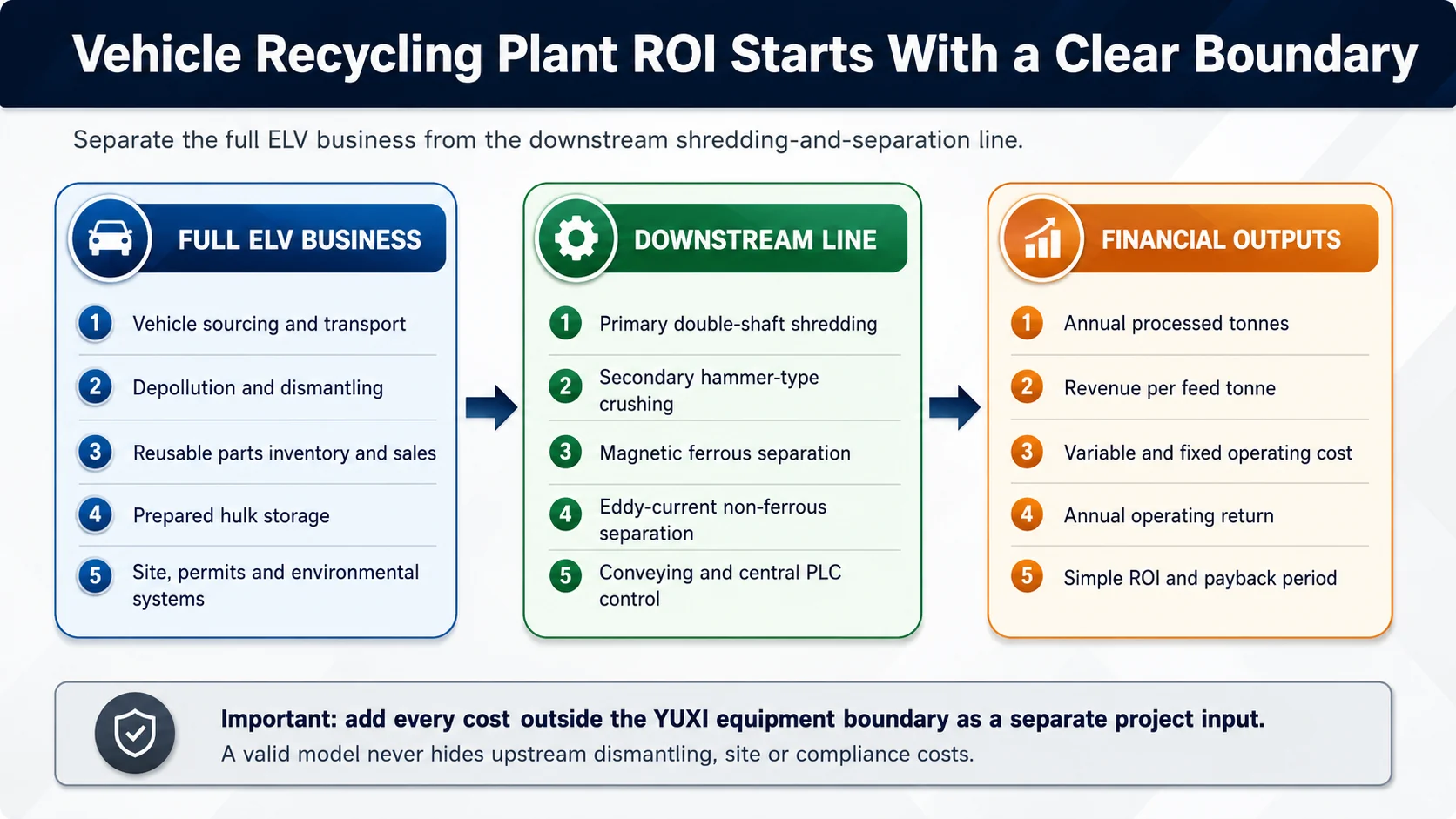
Full ELV business boundary
This may include buying and transporting vehicles, depollution bays, dismantling labor, parts testing, warehouse inventory, tire and battery handling, prepared-hulk storage, shredding, separation and final product sales. It can generate more revenue streams, but it also carries more working capital, labor and operating complexity.
Downstream processing boundary
This begins with depolluted, prepared vehicle shells or automobile metal scrap. The model covers feeding, primary shredding, deeper size reduction when required, ferrous recovery, non-ferrous recovery, conveying, controls, operating labor, wear parts and residue management.
YUXI’s public Waste Car Recycling Line belongs to the second boundary. The page presents a hydraulic-driven heavy double-shaft shredder for primary size reduction, a hammer-type metal crusher for deeper crushing, magnetic separation for iron, eddy-current separation for conductive non-ferrous metals and centralized Siemens PLC control. It should not be presented as a substitute for the entire vehicle receiving, depollution, dismantling and parts-sales operation.
Before any shell enters the downstream line, hazardous and unsuitable components must be handled according to local requirements. EPA guidance emphasizes removing and properly storing potentially hazardous materials. OSHA guidance for scrap recycling also warns that fuels and other hazardous materials must be removed before compacting or shredding automobiles. EV batteries require a separate, compliant handling route and should never be treated as ordinary vehicle-shell feed.
Data needed for a Vehicle Recycling Plant ROI model
A useful model starts with operating evidence, supplier scope and local commercial data. A catalog and a metal-price screenshot are not enough.
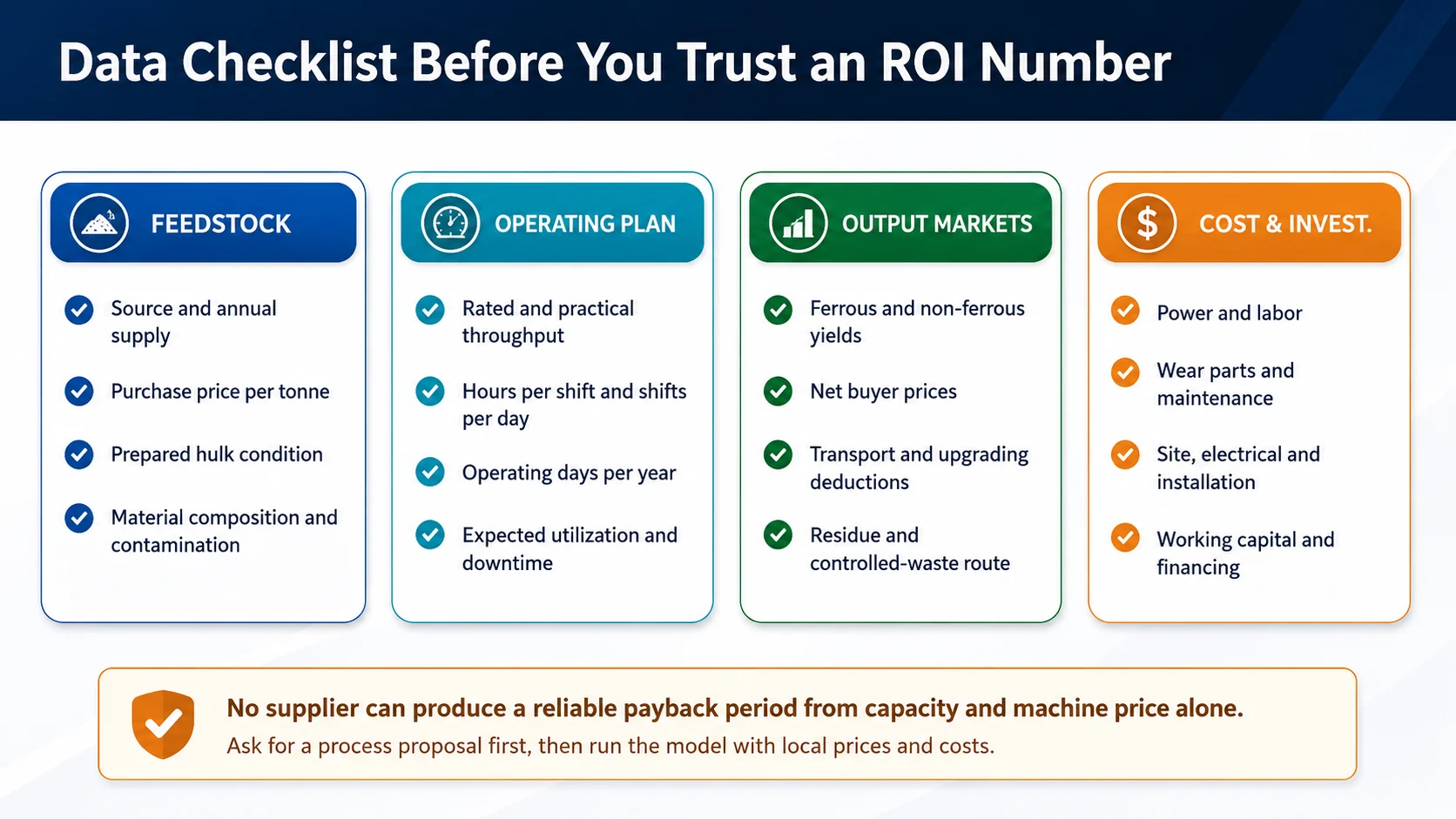
1. Feedstock supply and purchase terms
Record the annual tonnes that can be contracted or reliably sourced, not the theoretical number of vehicles in the region. Include seasonality, transport distance, delivered or yard-gate pricing, preparation level and rejected loads. Stable material supply is often more important than a high nominal machine capacity because underused equipment cannot spread its fixed cost over enough tonnes.
2. Practical throughput and utilization
Rated tonnes per hour are only one input. Practical throughput changes with shell size, density, pre-cutting, loading method, contamination, conveyor balance, downstream bottlenecks, operator experience and planned maintenance. Utilization should allow for shift changes, routine inspection, blade or hammer service, material changeovers, jams and upstream shortages.
3. Recoverable outputs and net prices
Build revenue by fraction. Use ferrous yield multiplied by the net ferrous selling price; then add aluminum-rich or mixed non-ferrous fractions, and any other verified saleable output. Net price means the amount the plant actually realizes after transport, brokerage, moisture or contamination deductions and any extra upgrading needed to meet the buyer’s specification.
4. Variable processing cost
Variable costs normally rise with processed volume. They may include feedstock purchase, electricity, direct labor, loader fuel, wear parts, routine consumables, product transport and residue disposal. Keep feedstock cost separate from processing cost so the model can show whether a bad purchasing decision or an inefficient plant is causing the loss.
5. Fixed annual cost
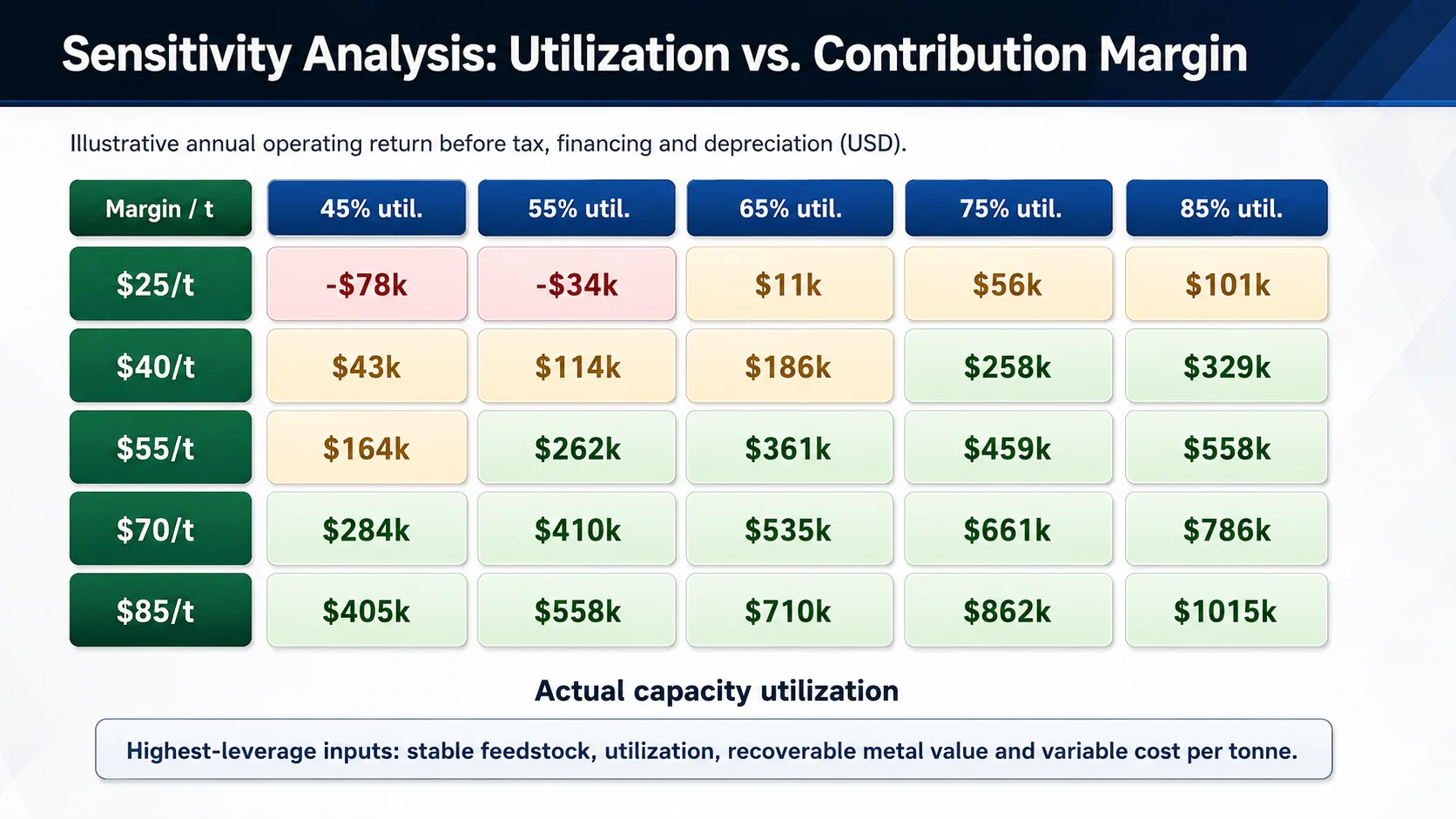
Fixed costs may include management, insurance, environmental monitoring, security, building cost, base maintenance contracts, permits, office expense and minimum staffing. Their share per tonne falls as utilization improves, which is why a plant that looks marginal at 45% utilization can become attractive at 75%—provided the extra feedstock and output buyers are real.
6. Total installed investment
Use the complete owner’s investment, not only the machinery price. The ELV Recycling Plant Cost guide separates equipment from foundations, conveyors, electrical work, environmental systems, freight, installation, commissioning, start-up spares and local site requirements. Working capital for feedstock and product inventory may also be material.
Vehicle Recycling Plant ROI calculation formulas
The core formulas are straightforward. The discipline lies in defining each input consistently and testing how the result changes.
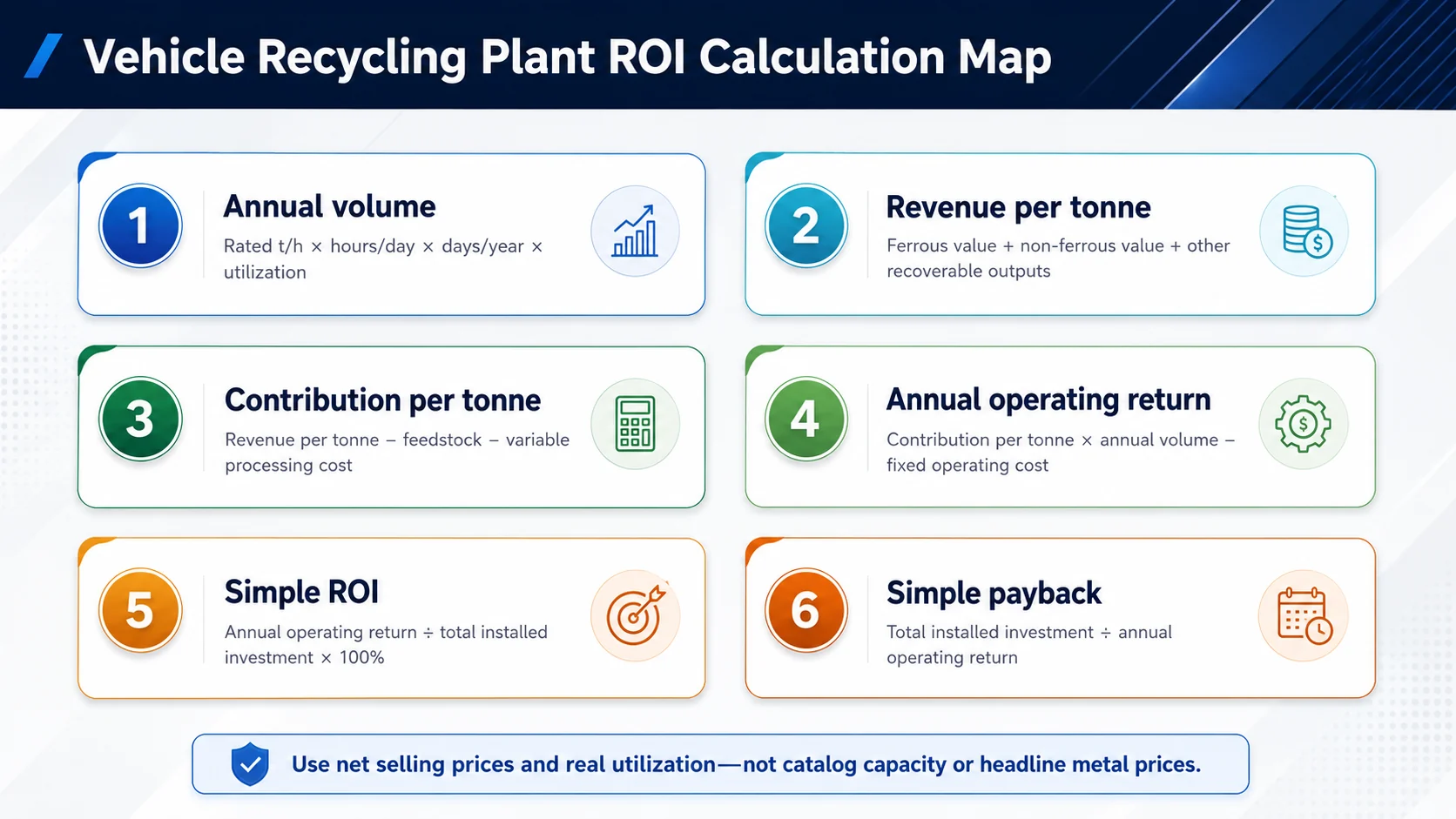
Annual processed tonnes
Use the throughput that can be sustained with the real feed and full downstream system. When the hammer crusher or separation section cannot accept the primary shredder discharge, the whole line is limited by the bottleneck.
Revenue per feed tonne
Do not use gross commodity quotations when your buyer applies transport, quality or contamination deductions. If the plant only produces mixed non-ferrous material that requires off-site upgrading, use the price of that mixed fraction rather than the price of clean aluminum or copper.
Contribution per feed tonne
This figure shows how much each additional tonne contributes toward fixed cost and operating return. A positive contribution does not automatically make the project profitable; annual volume must still be high enough to cover fixed cost.
Annual operating return
This article uses operating return as a simplified pre-tax project measure. Your accountant or financial adviser should extend the model for depreciation, tax, financing, inflation, working-capital changes and the time value of money.
Simple ROI and payback
Simple payback is easy to communicate, but it does not show cash-flow timing after payback or the value of money over time. Larger projects should also calculate net present value and internal rate of return using an appropriate discount rate.
Run conservative, base and upside scenarios
A single ROI result creates false confidence. Scrap prices, feedstock cost, utilization, metal composition, residue fees and wear can move at the same time. Scenario analysis makes that risk visible.
| Scenario | Typical assumptions to test | Management question |
|---|---|---|
| Conservative | Lower utilization, higher feedstock cost, lower metal prices, higher wear and residue cost. | Can the plant preserve cash and service debt during a weak market? |
| Base | Contracted supply, current net buyer prices, planned maintenance and realistic staffing. | Does the project meet the owner’s minimum required return? |
| Upside | Higher stable volume, improved non-ferrous recovery, cleaner products and controlled downtime. | What investment or operating change is required to achieve the upside? |
Do not improve every variable at once in the upside case. A useful sensitivity model isolates one or two changes so the team can understand cause and consequence. For example, test a five-point increase in utilization while keeping prices unchanged. Then test the effect of better non-ferrous recovery while keeping throughput unchanged.
Calculate break-even utilization
The U.S. Small Business Administration defines break-even as the point where total cost and total revenue are equal. For a processing plant, the same idea can be expressed as the annual volume required to cover fixed costs after each tonne contributes its margin.
What Improves Vehicle Recycling Plant ROI?
Stable prepared feedstock
A steady supply of depolluted hulks keeps utilization high and reduces the risk of unsuitable materials entering the line.
Better liberation and separation
When the output target justifies it, deeper crushing and controlled separation can move saleable metal out of residue and improve product value.
Balanced line design
Feeding, primary shredding, secondary crushing and separation must be sized as one system. One bottleneck can idle the rest of the investment.
Reliable maintenance planning
Accessible wear parts, planned inspections, start-up spares and operator training reduce expensive emergency downtime.
Defined product buyers
A plant should be configured around the size, purity and volume that actual buyers will accept—not a generic promise of “high recovery.”
Measured production data
Weigh feed and outputs, record downtime and track energy, wear and residue per tonne. ROI improves faster when losses are visible.
What commonly destroys ROI?
- Buying a large line before securing enough annual feedstock.
- Using nominal throughput as if the plant will run at 100% utilization.
- Valuing mixed non-ferrous fractions at clean metal prices.
- Ignoring residue disposal, controlled waste, dust, fire and environmental systems.
- Excluding foundations, transformers, conveyors, installation and start-up spares from investment.
- Adding reusable-parts revenue to a shredding model without adding dismantling, inventory and sales costs.
- Failing to remove batteries, fuels, fluids and other hazardous components before downstream processing.
- Building the layout without maintenance clearance, safe loader routes and product storage.
The Scrap Car Recycling Plant Layout guide is relevant because poor traffic flow, insufficient storage and inaccessible equipment create recurring operating losses that are easy to miss in a financial spreadsheet.
Where the YUXI Waste Car Recycling Line fits the ROI model
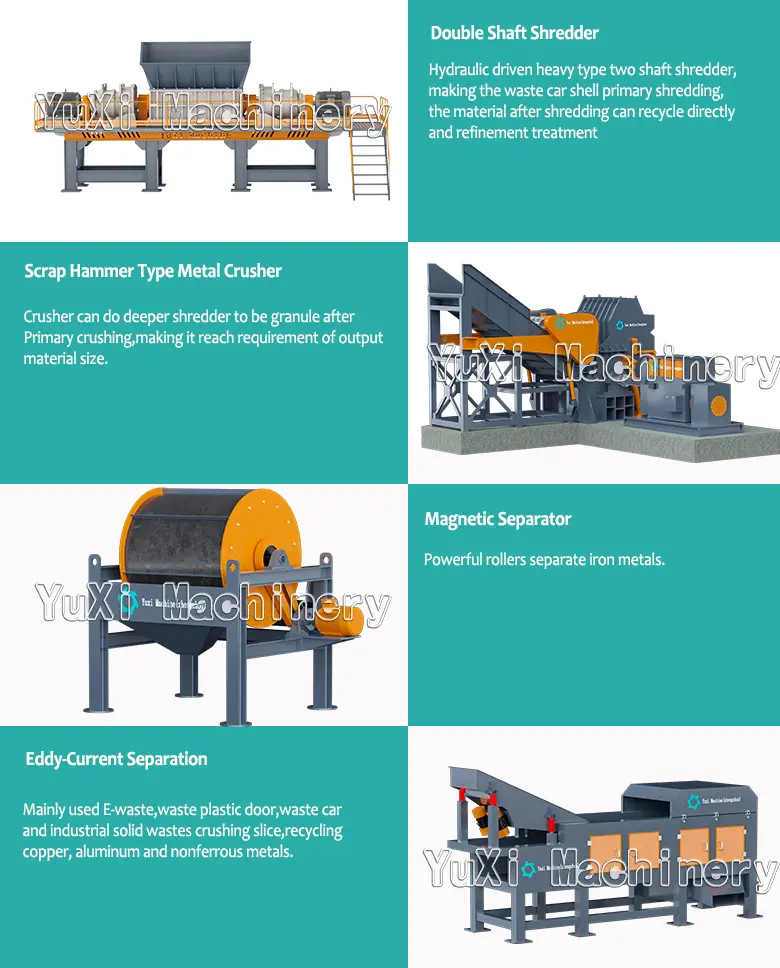
The line’s financial role is to convert prepared vehicle shells and automobile metal scrap into smaller, more separable material streams. According to YUXI’s public solution page, the process begins with hydraulic-driven double-shaft primary shredding. The hammer crusher can then provide deeper size reduction when a smaller output size and improved material liberation are required. A magnetic separator recovers ferrous metals, while an eddy-current separator targets conductive non-ferrous metals such as aluminum and copper. YUXI’s public solution page also describes a Siemens PLC-based central control system for real-time monitoring and whole-line coordination..
Each module should connect to a financial assumption:
| YUXI process module | ROI variable it can influence | Evidence needed in your model |
|---|---|---|
| Double-shaft primary shredder | Practical throughput, feeding stability, primary size reduction and downtime. | Feed description, maximum shell condition, target t/h, operating schedule and maintenance plan. |
| Hammer-type metal crusher | Liberation, output size, power, wear and downstream separation potential. | Required output, need for deeper crushing, expected wear environment and product buyer specification. |
| Magnetic separator | Ferrous recovery and ferrous product quality. | Feed composition, magnet configuration, measured ferrous yield and contamination limits. |
| Eddy-current separator | Recovery of aluminum-rich and other conductive non-ferrous fractions. | Particle-size distribution, liberation, feed consistency and actual buyer price for the recovered fraction. |
| Central PLC control | Line coordination, overload response, operator visibility and downtime control. | Control scope, interlocks, local electrical requirements and operator procedures. |
A buyer who is still deciding which modules are required should review the Vehicle Recycling Equipment Guide. The ROI article should not replace equipment selection; it should test whether the selected process can create enough value at realistic volume.
Information to prepare for a project ROI review
Send enough information for the equipment proposal and the financial model to describe the same plant.
- Raw material type: prepared shell, flat body, loose panel, engine shell, wheel or mixed automobile scrap.
- Preparation status: confirm whether batteries, fuel, fluids, refrigerants, airbags, tires and other hazardous or reusable components have been removed.
- Annual supply: contracted tonnes, seasonal changes and the cost of raw materials delivered.
- Maximum feed dimensions, density and representative photos or videos.
- Required hourly throughput, shifts, hours, operating days and expected utilization.
- Target output size and the ferrous/non-ferrous products that local buyers accept.
- Net local selling prices and transport or upgrading deductions.
- Electricity, labor, loader fuel, wear-part, maintenance and residue costs.
- Site plan, building height, loader route, foundation condition and storage area.
- Power voltage, frequency, transformer capacity and electrical standards.
- Dust, noise, fire, drainage, environmental and worker-safety requirements.
- Commercial scope: freight, installation, commissioning, training and start-up spares.
For the upstream business model, including sourcing, dismantling and parts revenue, the Car Recycling Business Guide provides the broader commercial context. Keep those revenues and costs separate until the full-business model is intentionally consolidated.
Build the process proposal before promising the payback
A credible ROI discussion begins with your prepared feedstock, annual supply, product buyers, operating costs, site and required output. YUXI can use those details to discuss the downstream shredding-and-separation configuration; your project team can then run conservative, base and upside financial cases with local data.
Vehicle Recycling Plant ROI FAQ
What is a good ROI for a vehicle recycling plant?
There is no universal target. Compare the result with your cost of capital, project risk, alternative investments and local market volatility. Use conservative, base and upside cases instead of relying on one promised percentage.
How do I calculate the payback period?
Divide total installed investment by annual operating return. This simple payback method does not include financing, tax, depreciation, inflation or the time value of money.
Should reusable parts revenue be included?
Only when the project boundary includes dismantling, testing, storage, inventory and parts sales. A downstream shredding-line model should not add parts revenue without adding the associated assets and costs.
Can an equipment supplier guarantee ROI?
A supplier can define equipment scope and provide verified operating information, but final ROI depends on local feedstock, metal yields, net selling prices, utilities, labor, residue cost, utilization, financing and compliance requirements.
What should I send YUXI?
Send feedstock photos or video, preparation level, expected annual supply, target throughput, output requirements, site and power information, local operating costs and the products you intend to sell.
References and source notes
- U.S. EPA and SEMARNAT — Processing End-of-Life Vehicles: A Guide for Environmental Protection, Safety and Profit.
- OSHA — Guidance for the Identification and Control of Safety and Health Hazards in Metal Scrap Recycling.
- U.S. Small Business Administration — Break-even point.
- EUR-Lex — End-of-life vehicles.
- U.S. EPA — Lithium-Ion Battery Recycling Frequently Asked Questions.