




 Request Quote


Quick answer: what decides ELV recycling plant cost?
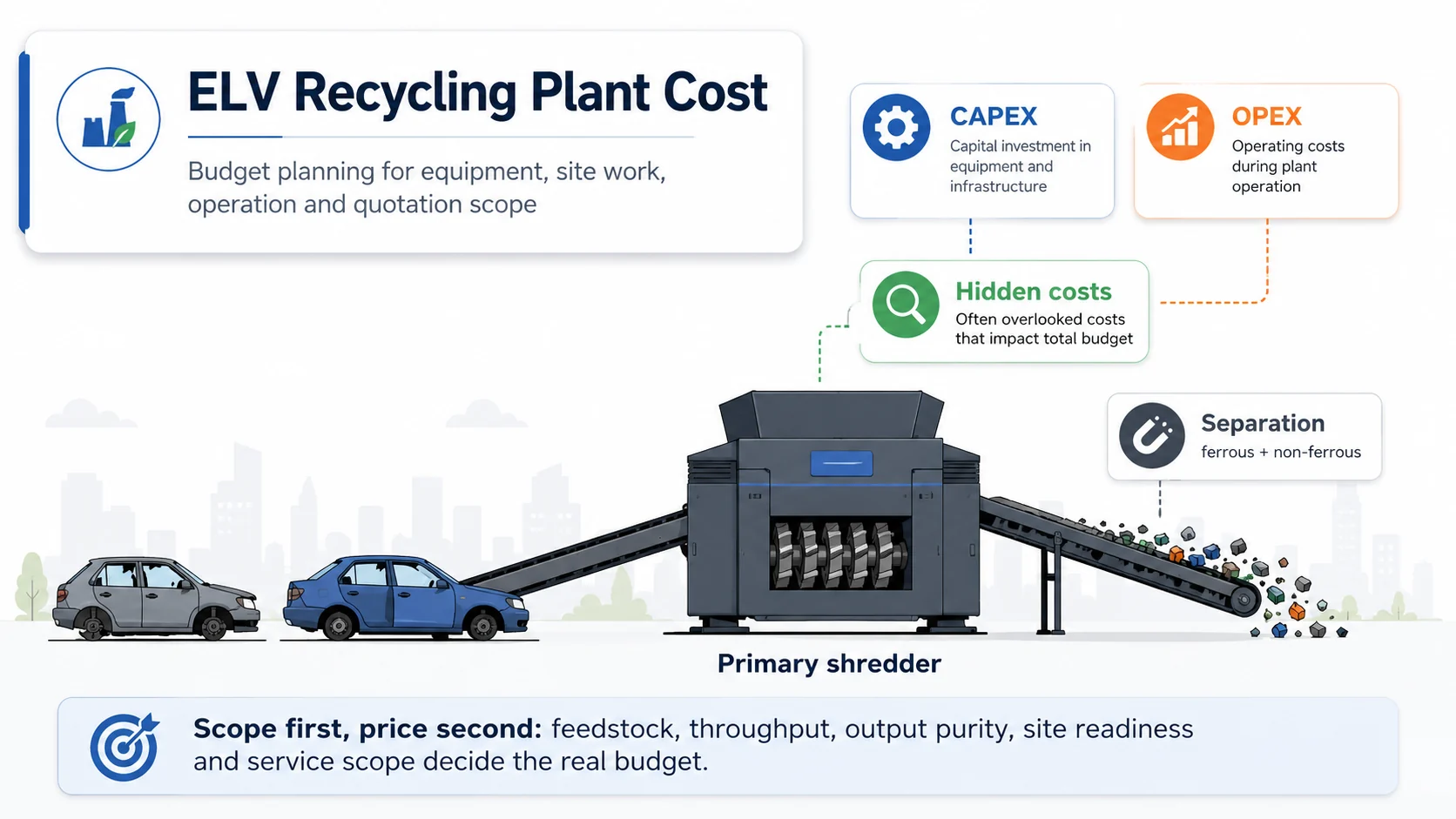
ELV recycling plant cost depends on project scope. The budget of the basic yard for pollution removal,disassembly and preparation of shell sales is very different from that of a comprehensive factory with primary shredding,secondary crushing,magnetic separation,vortex separation,conveyor,dust control,fire protection,central PLC control,installation and start-up spare parts.
If you want a useful number, first define the raw materials,preparation level,required throughput,final product specifications and service boundaries.Otherwise,the two suppliers may refer to two very different systems,and both suppliers seem to be answering the same question.
Main ELV recycling plant cost modules
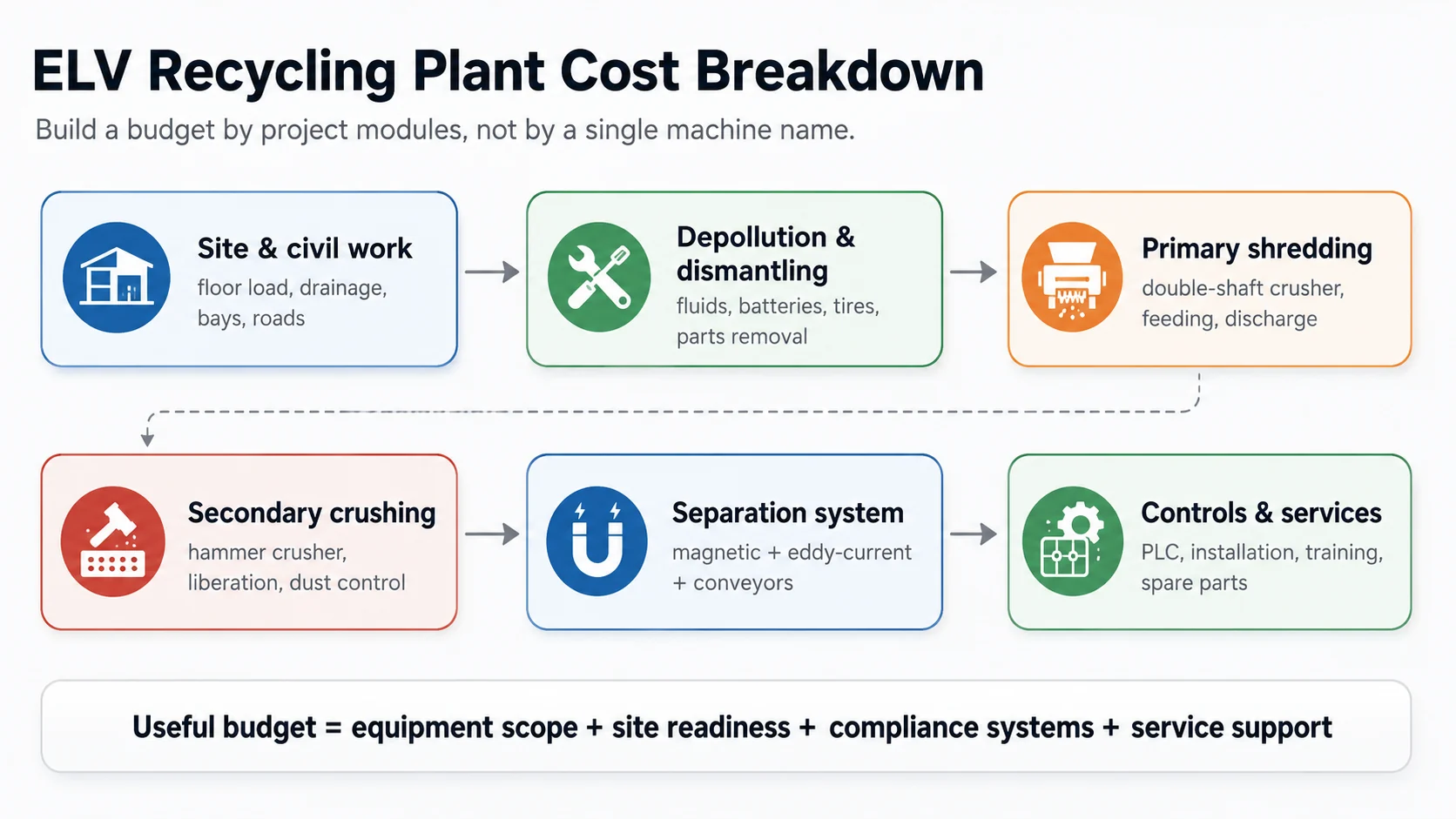
An ELV plant budget is best built as a set of modules. This helps the buyer compare quotes fairly and identify what is included, what is excluded and what must be handled locally.
1. Land, building and site preparation
Site work is often underestimated because it is not always shown in an equipment quotation. The plant needs safe receiving space, depollution bays, dismantling areas, prepared-hulk storage, loader routes, shredder feeding access, product storage, truck loading space, maintenance clearance, drainage and emergency response zones.
A layout that looks cheap on paper can become expensive if loaders cross worker areas, if separated materials block maintenance access, or if the foundation must be rebuilt after equipment arrives. The Scrap Car Recycling Plant Layout Guide is useful when the buyer needs to match the process flow with factory area, traffic routes and maintenance gaps.
2. Depollution and dismantling area
Before an ELV enters a shredder, the operator normally needs to remove or control fluids, fuel, batteries, tires, refrigerants, airbags, high-value parts and other hazardous or reusable components according to local requirements. The equipment cost here may include vehicle lifts, fluid-draining tools, tanks, spill control, battery storage, tire handling, parts racks and safety tools.
This area affects the downstream line cost too. A well-depolluted and prepared hulk is easier to feed, safer to process and less likely to create fire, explosion, contamination or residue problems. A plant that accepts poorly prepared vehicles may need heavier feeding equipment, stronger protection systems and more sorting after shredding.
3. Primary shredding system
The primary shredder is usually one of the largest equipment items in a complete ELV line. YUXI’s Waste Car Recycling Line uses a hydraulic-driven heavy double-shaft crusher for primary shredding of waste car shells. The public product page describes low-speed, high-torque operation, low noise, automatic start/stop, reversal and overload functions controlled by a Siemens program control system.
Cost changes with feed size, shell preparation, chamber size, blade design, torque demand, hydraulic or electric drive configuration, feeding method and protection against unshreddable objects. A line that only handles flattened shells is not the same as a line expected to process mixed car shells, engine casings, loose panels and other metal parts.
4. Secondary hammer-type metal crusher
Primary shredding reduces size, but some projects need deeper liberation before separation. The YUXI line includes a scrap hammer-type metal crusher after primary crushing to produce smaller granules and reach the required output material size. This improves separation potential, but it also changes the budget: stronger motor load, foundation, wear parts, dust control, sound control and maintenance access become more important.
Not every plant needs the same secondary stage. If the buyer only sells coarse ferrous scrap, a simpler configuration may be enough. If the buyer wants cleaner ferrous output and better recovery of aluminum and other non-ferrous metals, secondary crushing can become a key part of the investment.
5. Magnetic and eddy-current separation
Material separation is where plant economics often improve or weaken. The YUXI line uses magnetic separation to recover ferrous metals and eddy-current separation to recover conductive non-ferrous metals such as aluminum and copper from crushed mixed materials. The price of this section depends on the number of separators, feeding stability, conveyors, screens, manual picking stations, purity targets and whether extra downstream sorting is required.
A cheaper line that loses aluminum into residue may look attractive at purchase time but become expensive over several years. Compare cost per saleable tonne, not only machine price.
6. Conveyors, central control and electrical system
Connected plants need conveyors, feeders, discharge points, sensors, emergency stops, guards, electrical cabinets and control logic. YUXI’s public page describes a Siemens PLC central control system for real-time monitoring and whole-line control. This is important because the integrated line is not just a row of machines; it is the order in which upstrea feeding,crushing,discharging and separation must be balanced.
The electrical budget may also include local voltage adaptation, transformer capacity, cable trays, control room, operator interface, remote diagnostics and on-site commissioning. These items are easy to ignore when comparing only the visible machines.
7. Environmental, fire and residue control
ELV recycling plants handle metal, plastics, glass, fluids, batteries, rubber, dirt and auto shredder residue. Dust extraction, noise control, drainage, fire detection, suppression, residue storage and housekeeping equipment may be required by local authorities or insurers. The EU ELV framework’s reuse/recycling and reuse/recovery targets also make clean material handling more important, especially where operators must prove compliant treatment.
Do not treat these systems as optional “extras” until the last stage. If the plant is designed first and compliance is added later, the final cost can rise sharply.
Starter yard vs integrated ELV recycling plant
Many buyers ask for one price, but they are comparing different business models. The table below shows how the investment scope changes.
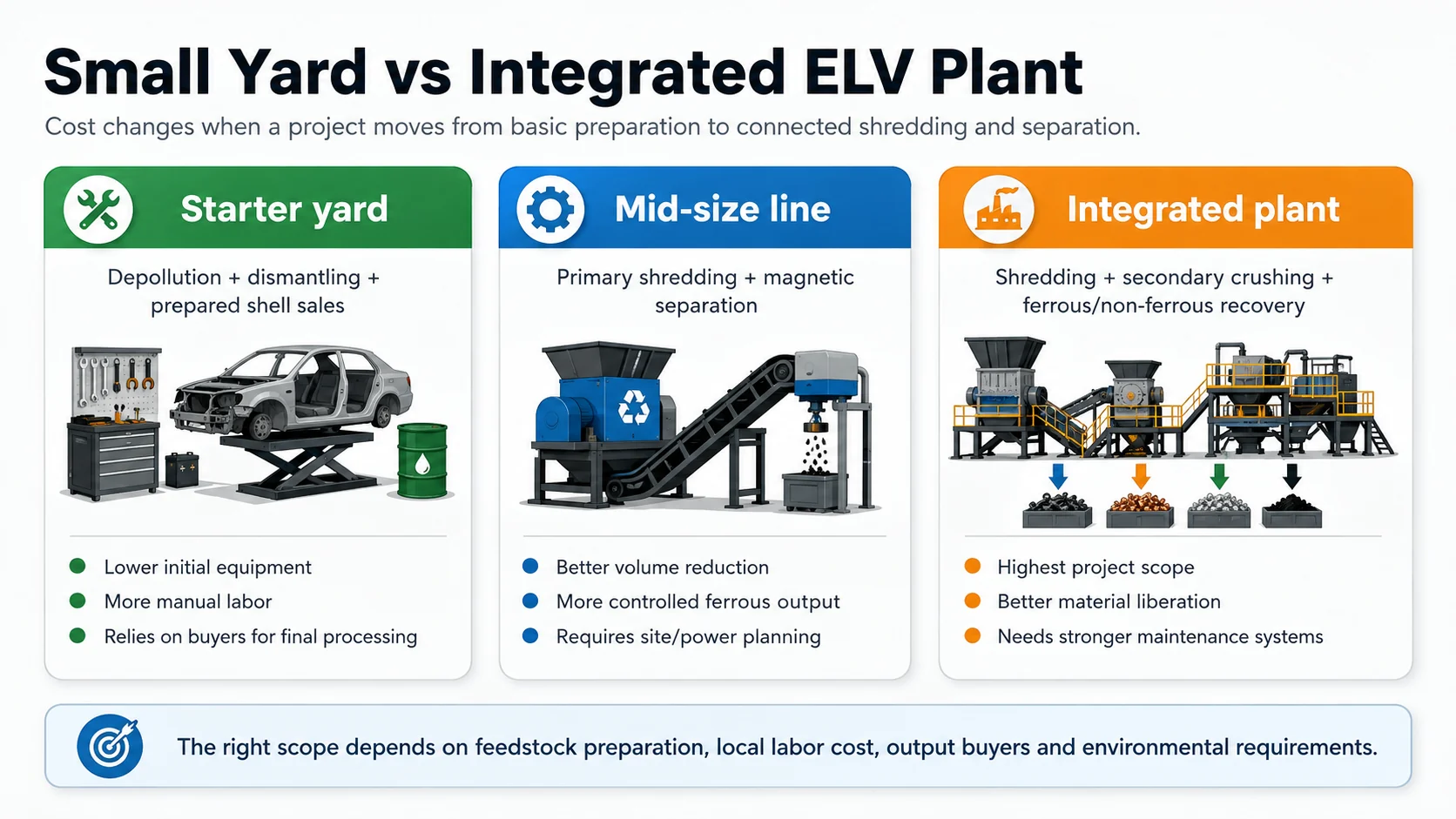
| Project type | Typical scope | Budget character | When it makes sense |
|---|---|---|---|
| Starter ELV yard | Depollution, dismantling, parts recovery, prepared shell sales | Lower equipment cost, more manual work, more dependence on external processors | Good for early-stage yards, limited supply volume or markets with strong prepared-shell buyers |
| Medium-sized processing line | Primary shredding, basic conveying, magnetic separation and product processing | Higher equipment costs, better volume reduction and more control of ferrous production | It is very useful when the cargo yard has steady hull and wants to reduce transportation costs or sell processed ferrous scrap |
| Integrated ELV factory | Primary shredding, secondary crushing, magnetic separation, eddy-current separation, conveyors, PLC control and environmental systems | The highest project scope, but stronger control over material release and non-ferrous metal recovery | It is most suitable for operators with stable,clear buyers,on-site preparation and maintenance capabilities |
The goal is not always to buy the biggest line. The goal is to match equipment scope with feedstock supply, local labor, output buyers, compliance requirements and cash-flow tolerance.
Why two ELV plants with similar capacity can cost differently
Hourly capacity is important, but it is not enough. Two plants may both be described as “10 tonnes per hour,” yet their real investment can differ widely.
Feed condition
Whole ELVs, depolluted shells, flattened car bodies, engine casings and mixed metal parts create different loading, torque and safety requirements.
Output specification
Coarse ferrous scrap is easier than clean, separated ferrous and aluminum-rich fractions. The cleaner the output target, the more the separation system matters.
Automation level
PLC control, overload protection, automatic reversal, line monitoring and interlocked safety systems add cost but may reduce downtime and operator risk.
Preparation before shredding
A project that receives depolluted, battery-free, tire-free, fluid-free shells can use a different risk model from a project where preparation is uncertain. Poor preparation increases the chance of fire, liquid contamination, hazardous components entering the line and unstable material discharge.
Recovery depth
Some operators only need a simple ferrous stream. Others want stronger recovery of aluminum, copper and mixed non-ferrous metals. The second project needs better liberation, more precise feeding and additional separation equipment. That raises capital cost but may improve revenue per tonne when buyers pay for cleaner fractions.
Local infrastructure
Power supply, building height, foundation strength, road access, drainage, dust limits and fire codes can change the real project cost. A machine quotation may not include civil work, cranes, electrical installation, local permits or residue disposal contracts. These items still belong in the owner’s budget.
Hidden costs many buyers miss
The purchase price is only one part of ELV recycling plant cost. The following items often decide whether the project performs well after installation.
| Cost item | Why it matters | Budget advice |
|---|---|---|
| Wear parts | Blades, hammers, liners and screens wear faster when feed contains dense parts, dirt or unshreddables. | Ask for recommended start-up spares and replacement intervals for your feedstock. |
| Power consumption | Primary shredding and secondary crushing can be energy-intensive under heavy feed. | Calculate cost per operating hour and cost per saleable tonne, not only installed motor power. |
| Downtime | A blocked conveyor, worn hammer or delayed spare part can stop the whole line. | Compare maintenance access, overload protection, spare part availability and operator training. |
| Residue handling | Auto shredder residue and controlled waste may require licensed disposal or further treatment. | Confirm local disposal routes before promising ROI based only on metal recovery. |
| Freight and installation | Of oversized machines, containers, inland transportation, healing and commissioning may exceed the basic quotation. | Ask whether the quotation includes EXW, FOB, CIF, installation, electrical work and start-up support. |
| Future expansion | When ELV supply grows,production lines that are too small may become bottlenecks. | Plan floor space, power room and discharge routes so extra sorting or conveying can be added later. |
This is where total cost of ownership becomes more useful than the lowest purchase price. YUXI’s Vehicle Recycling Equipment Guide makes the same practical point: budget should be based on the defined process, not capacity alone.
Information needed for an accurate ELV plant quotation
A reliable quotation starts with real project data. If a buyer only asks, “What is your ELV recycling plant price?” the answer will be broad. If the buyer provides feed videos, site drawings and output targets, the engineering discussion becomes much more useful.
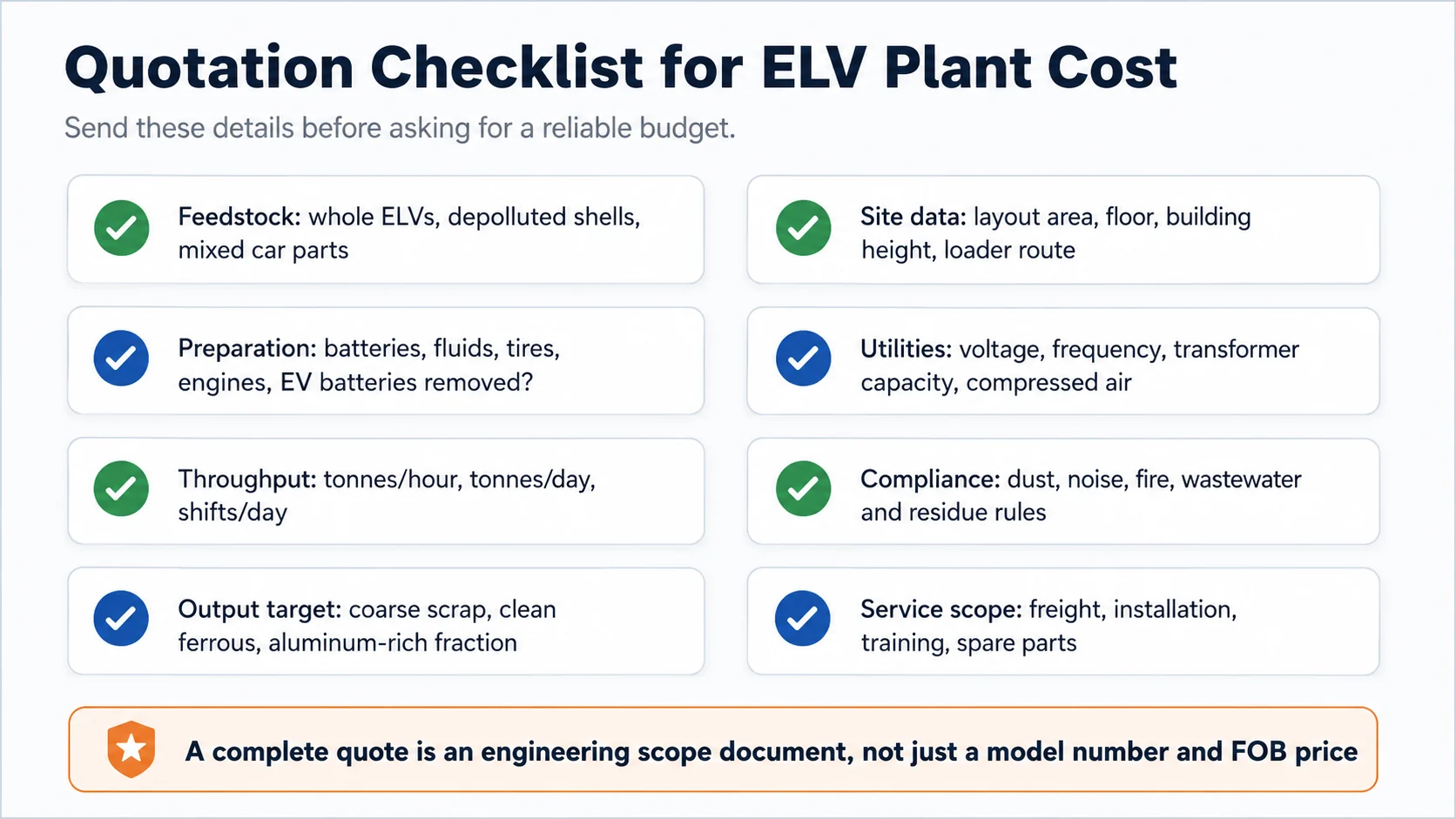
Prepare this before requesting a quotation
- Feedstock type: whole vehicles, depolluted shells, flattened bodies, loose car panels, engine casings, wheels or mixed metal parts.
- Preparation level: whether batteries, EV batteries, fuel, oils, refrigerants, tires, airbags, engines and transmissions are removed before shredding.
- Largest feed size and weight: maximum dimensions and typical density of the materials entering the shredder.
- Required capacity: hourly tons,daily tons, working time per shift and daily shifts.
- Final output requirements: coarse shredded scrap, smaller particles, clean ferrous fractions, aluminum-rich fraction or mixed non-ferrous fractions.
- Site information: available construction area, building height, loader passage, foundation condition, storage area and truck route.
- Power supply conditions: voltage, frequency, transformer capacity, electrical chamber distance and local electrical standards.
- Environmental requirements: dust, noise, fire fighting, drainage, wastewater and residue handling rules.
- Business scope: delivery port, freight terms, installation, commissioning, training, spare parts and warranty expectations.
Need a practical ELV recycling plant budget?
Share your raw material type, vehicle preparation level, target capacity, output size, site layout and power conditions with YUXI. The most useful proposal is not a one-size-fits-all price; it is a process configuration that matches your feedstock, local rules and saleable output targets.
How to compare supplier quotations fairly
When comparing several offers, do not only compare the headline price. First, check whether the suppliers are quoting the same plant boundary.
- Does the quote include feeding conveyors, discharge conveyors and product transfer?
- Is secondary crushing included or only primary shredding?
- Are magnetic separation and eddy-current separation both included?
- Does the electrical cabinet include whole-line control or only individual machine control?
- Are dust control, fire protection, foundation drawings, installation and operator training included?
- Are start-up spare parts listed with quantities?
- Is the line designed for your real feedstock or for an ideal prepared shell?
A low quotation may simply exclude items that the buyer still has to purchase later. A higher quotation may include more automation, separation depth, service support and spare parts. The fair comparison is total installed scope and expected cost per saleable tonne.
Final recommendation
ELV recycling plant cost should be treated as an engineering budget, not as a catalog price. Starting from the material flow:how to receive,decontaminate,disassemble,prepare,crush,separate and sell vehicles. Then define the equipment scope and support systems around that flow.
For YUXI’s waste car recycling solution, the key public process modules are primary double-shaft crushing, secondary hammer-type metal crushing, magnetic separation, eddy-current separation and centralized Siemens PLC control. That makes it suitable as the downstream processing core for operators who want to move beyond simple dismantling and prepared-shell sales. The right investment level depends on whether your project needs basic volume reduction, cleaner ferrous output, stronger non-ferrous recovery or a more integrated plant.
Before asking for a final number, prepare feedstock videos, capacity targets, desired outputs, site drawings and local compliance requirements. That will help the supplier quote the plant you actually need and help your team avoid under-budgeting the parts that make the system work.
FAQ: ELV recycling plant cost
How much does an ELV recycling plant cost?
There is no single fixed price. Cost depends on feedstock condition, throughput, preparation level, crushing stages, separation depth, automation, site work, environmental controls, freight, installation, spare parts and training. A budget should be built from a defined process scope.
Is a complete ELV recycling line always necessary?
No. Some operators begin with depollution, dismantling and prepared-shell sales. A complete line becomes more attractive when the facility has stable ELV supply, suitable power and site conditions, defined buyers for recovered fractions and enough volume to justify connected equipment.
What equipment usually affects the budget most?
The primary shredder, secondary hammer crusher, conveyors, magnetic separator, eddy-current separator, PLC/electrical system, dust and fire systems, foundation, installation and spare parts are major cost drivers in an integrated plant.
Why should I not judge only by tonnes per hour?
Tonnes per hour does not describe feedstock preparation, output purity, non-ferrous recovery, residue handling, automation, maintenance access or environmental requirements. Two lines with similar capacity can have very different real project costs.
What is the most important information to send YUXI?
Send feedstock photos or videos, vehicle preparation details, required hourly output, final product size, desired metal fractions, site layout, power conditions, environmental requirements, delivery destination and service scope.
References and source notes
- EUR-Lex: Scrap vehicles — official EU summary of Directive 2000/53/EC and ELV treatment requirements.
- U.S. EPA archive: Recycling and Reuse: End-of-Life Vehicles and Producer Responsibility — overview of ELV Directive background and waste concerns.
- Assessment of end-of-life vehicle recycling: Remanufacturing waste sheet metal into mesh sheet — peer-reviewed research discussing environmental and economic considerations in ELV recovery.
- Assessing the economics of processing end-of-life vehicles through manual dismantling — academic abstract on ELV processing scenarios and economics.