




 Request Quote



Vehicle Recycling Equipment Guide: Machines, Process and Line Selection
A vehicle recycling plant is not defined by one large shredder. It is a sequence of receiving, depollution, dismantling, material handling, size reduction and separation decisions.
Quick Answer
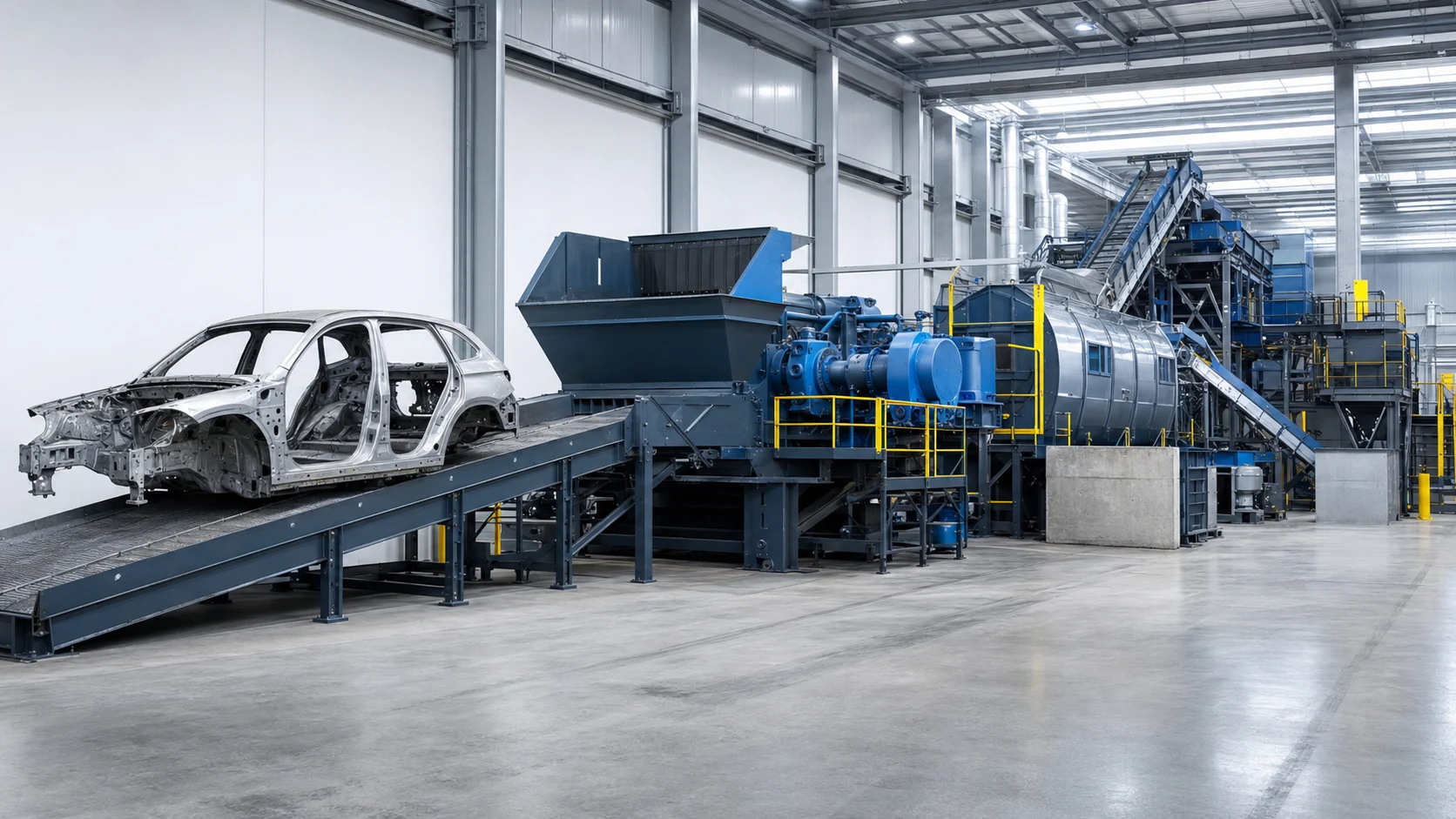
Vehicle recycling equipment usually includes decontamination tools,disassembly stations,material processing equipment,automobile balers or shredders,secondary crushers and metal separation systems.The correct configuration depends on whether the facility receivesz the complete parked vehicle or only the prepared car hull.Batteries,fuels,refrigerants,free liquids and other controlled components must be disposed of before crushing or chopping.For deeper metal recovery,the downstream line can combine primary paper shredding,hammer crushing,magnetic separation and vortex separation.
What Equipment Is Needed for Vehicle Recycling?
The answer changes with the change of business model. A list of equipment for disassemblers who get most of the profits from engines,transmissions,catalytic converters and reusable parts is different from a scrap processor that buys stripped bodies by tons.The third company may receive the compkete vehicle,recycle valuable parts,crush the remaining hull,and sel the separated black and pigmented debris.Calling all three facilities a “vehicle recycling plant” does not mean they should buy the same line.
Divide the operation into stages before choosing the main machine. Otherwise, a buyer may order a large shredder before deciding how vehicles will be made safe, what will be removed for resale and what product the downstream system must produce.
| Processing stage | Typical equipment | Main purpose |
|---|---|---|
| Receiving and inspection | Weighbridge, inspection bay, forklift or material handler | Register vehicles, check condition and isolate leaks or uncertain loads |
| Depollution | Drainage rack, pumps, drip pans, tanks and refrigerant recovery equipment | Remove fluids and controlled components before mechanical processing |
| Dismantling | Vehicle lift, dismantling stand, hand tools, grabs and hydraulic shears | Recover reusable parts and remove components that should not enter the shredder |
| Hulk preparation | Car baler, flattening press, shear, grabber and feed conveyor | Reduce volume or prepare bulky shells for the selected downstream route |
| Primary size reduction | Low-speed, high-torque double-shaft shredder | Tear irregular vehicle hulks into conveyable coarse fragments |
| Secondary reduction | Hammer mill metal crusher | Reduce size further and liberate metal from folded or attached material |
| Ferrous recovery | Overband, drum or pulley magnet | Recover iron and steel from the processed material stream |
| Non-ferrous recovery | Eddy-current separator and optional downstream sorting | Recover aluminum and other conductive non-ferrous metals |
| Light-fraction control | Screen, air classifier, gravity separator or sensor sorting | Remove or upgrade plastics, foam, rubber, fabric and mixed residue |
| Line operation | PLC, interlocks, sensors, variable-speed drives and emergency controls | Coordinate machines as one process instead of separate islands |
Field note: Not every yard needs every machine. A smaller dismantling operation may stop after depollution, parts recovery and hulk compaction. A processor paid for cleaner furnace-ready fractions needs more liberation and sorting. Buying beyond the required product specification can be just as expensive as buying too little equipment.
Understand the ELV Recycling Process Before Selecting Equipment
When the factory process is written in simple operating language,the equipment selection becomes easier:what arrives,what is removed,what is sold as parts,what becomes shredder feed,and what leaves the site as recycled materials.The U.S. EPA’s end-of-life vehicle guidance separates the work into vehicle acceptance and storage, hazardous-material removal, dismantling, hulk storage, management of removed fluids and materials, and final crushing or shredding. That sequence is a useful planning framework even though exact legal requirements vary by country and region.
Vehicle receiving and inspection
Receiving is not only a weighing function. Staff need to identify vehicle type, visible leakage, fire damage, unknown cargo and signs that a vehicle has already been partly dismantled. Hybrid and battery-electric vehicles must be recognized before they enter the normal yard flow. A plant that cannot identify what is arriving will eventually feed an unsuitable component into a crusher, shear or shredder.
Depollution
Depollution removes the risks that size-reduction equipment cannot safely solve. The work commonly covers the starter battery, fuel, lubricating oil, transmission fluid, coolant, brake fluid, power-steering fluid, refrigerant and other locally regulated components. Pressurized devices, pyrotechnic systems and unknown sealed containers also require a defined procedure.
A vehicle shredder is not a depollution machine. Auto-reverse and overload protection cannot make free fuel, refrigerant or an energized traction battery acceptable feed.
Dismantling and parts recovery
The value of reusable engines,transmissions,catalytic converters,wheels,electronic modules and body parts may be higher than their scrap value.Removing dense or non-matallic parts will also make the shell of the shredder more consistent;even if it retains more recyclable metals,leaving them will also increase the load and residue.
Hulk processing and material recovery
After preparation, the shell can be flattened for transport, cut, shredded into coarse fragments, or shredded and crushed for better liberation. Choose the route around transport cost, buyer specifications and the value of recovered non-ferrous metal.
Vehicle Depollution Equipment
Depollution equipment sits upstream from YUXI’s car-body shredding and separation section. It should therefore be specified as its own work area, with equipment chosen around the vehicles received and the rules that apply at the installation site.
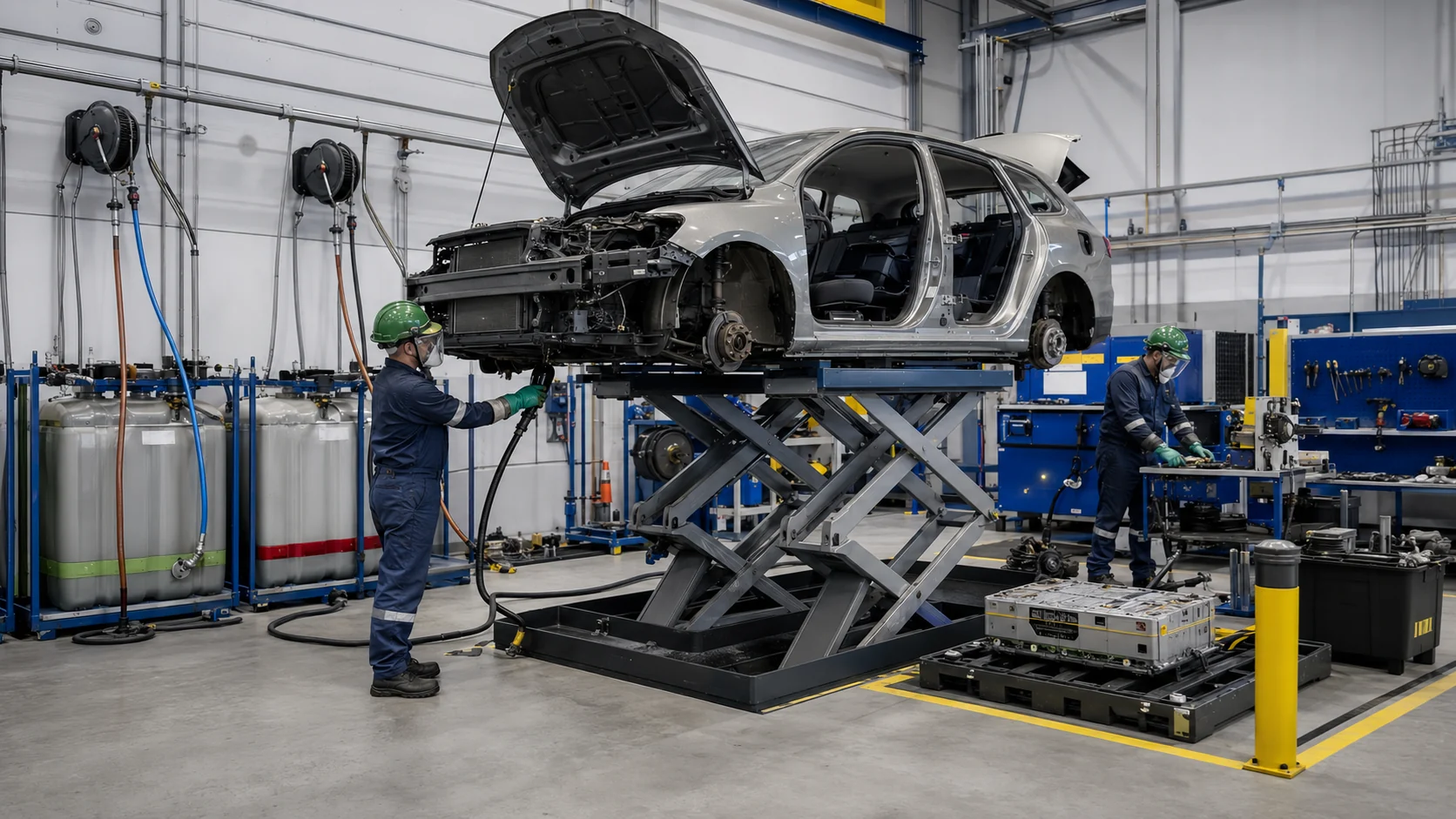
Vehicle drainage racks and lifts
A rack or lift must provide stable access to tanks, lines and underbody components. Check working height, vehicle restraint, drain access, operator clearance and spill containment—not lifting capacity alone.
Fluid extraction pumps and storage tanks
Pumps move fluids into identified containers. Size storage around daily vehicle volume and collection frequency, then provide labeling, secondary containment and a practical route for emptying full tanks.
Refrigerant recovery equipment
Air-conditioning refrigerant must be recovered with equipment intended for that purpose. It should not be released during dismantling or left for the shredder to discover. Facilities handling different refrigerants need compatible equipment and separate storage arrangements where required.
Battery and high-voltage component handling
A starter battery, a hybrid battery and an EV traction pack are different handling problems. EPA guidance notes that discarded lithium batteries may present ignitability and reactivity hazards. An energized or unidentified EV battery does not belong in a normal car-shell shredder feed specification.
EV identification, isolation, de-energization, removal, storage and transport should be handled by trained personnel under the applicable manufacturer instructions and local regulations. A shredder supplier can specify the downstream car-body line, but that does not replace specialist high-voltage procedures.
Vehicle Disassembly And Material Handling Equipment
Vehicle lifts and disassembly brackets
Lifts and stands should match the vehicle mix and provide tool clearance, safe access and a clear route for removed components. Fast dismantling equipment brings little benefit if parts accumulate around the station.
Hydraulic grabs and material handlers
The loader sets the pace of the yard. Check lifting capacity at the required radius and choose grab geometry that can control long, springy car bodies—not only loose scrap.
Engine, transmission and component removal
Supports, trolleys and lifting tools reduce manual handling. Select them according to whether components are removed for resale, rebuilding or simply to keep dense items out of the car-shell line.
Hydraulic shears
A shear cuts frames, axles and oversized sections before feeding. Treat it as a preparation tool, not an automatic substitute for a baler or continuous shredding line.
Conveyors, cranes and loading systems
Nameplate shredder capacity is meaningless without steady preparation and feeding. Loader delays, hopper bridging, undersized conveyors or downstream stops can reduce the whole plant far below the main machine’s rating.
Car Crusher, Baler, Shear or Shredder?
These machines are often compared as though they do the same job. They do not. A buyer should choose according to the product that must leave the site, rather than the size of the machine in a supplier’s video.
| Equipment | Best use | Typical result | Main limitation |
|---|---|---|---|
| Car crusher or flattening press | Reduce the storage and transport volume of prepared hulks | Flattened vehicle body | Little material liberation; downstream processor still handles separation |
| Hydraulic metal baler | Compact compatible scrap into dense transport or furnace packages | Compressed bale or log | Feed preparation and bale specification must match the press |
| Hydraulic shear | Cut frames, beams and oversized metal into manageable sections | Cut pieces | Intermittent cutting; does not create a continuously separated product |
| Double-shaft shredder | Primary reduction of bulky, irregular depolluted shells | Coarse, irregular fragments | May need secondary crushing for smaller size and better liberation |
| Hammer mill metal crusher | Secondary size reduction and liberation after controlled feeding | Smaller, denser metal-rich fraction | Requires prepared feed and protection from unbreakable objects |
If the business only needs to reduce transport volume, a crusher or metal baling machine may be enough. If the plant wants to sell coarse shredded material, a primary shredder can be the core machine. If the sales target is a cleaner ferrous fraction plus recovered non-ferrous material, the project moves from a single-machine purchase to an integrated shredding, crushing and sorting line.
Primary Vehicle Shredding Equipment
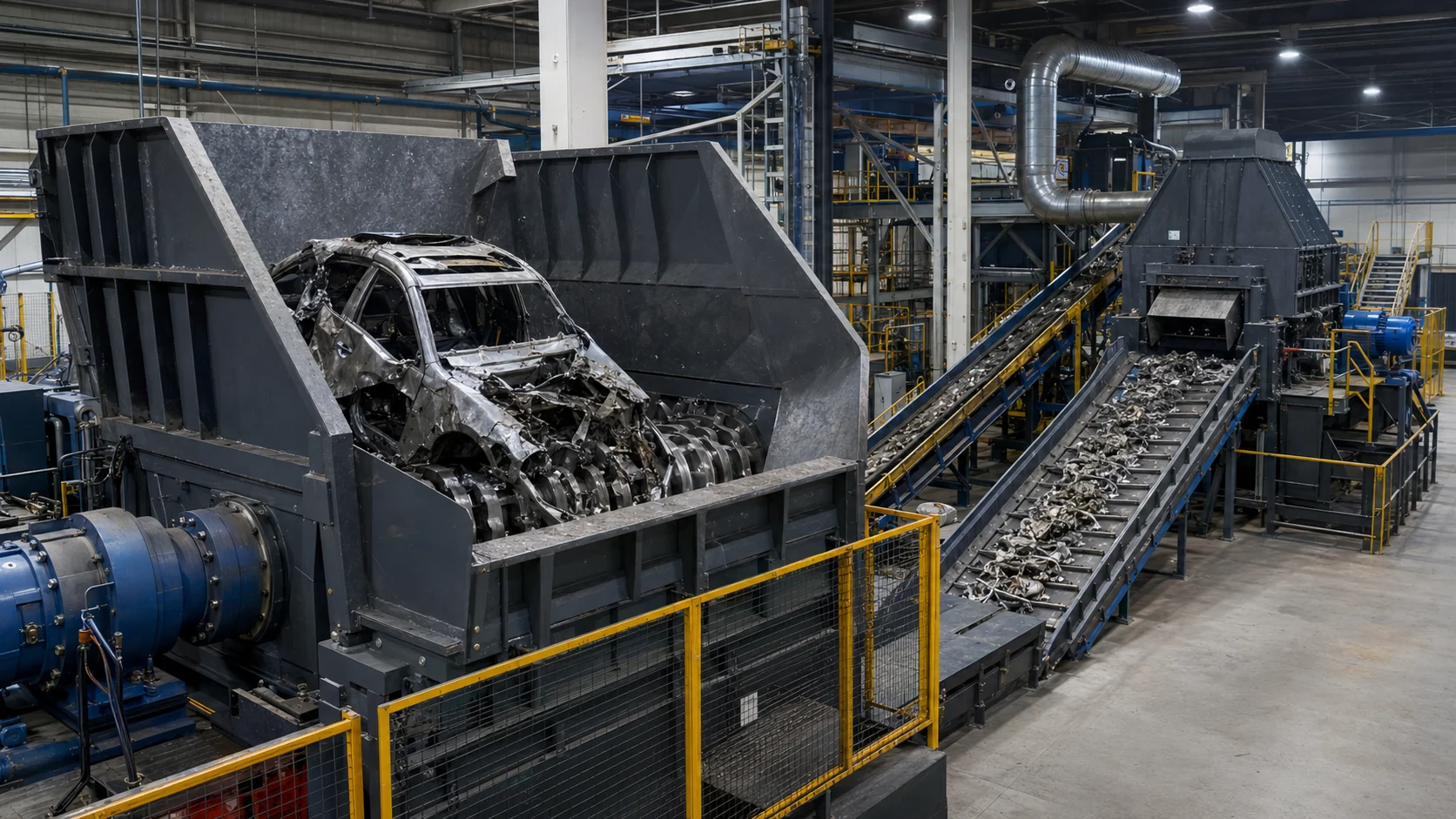
Primary shredding solves the shape problem. A car body is large, hollow, irregular and springy. Thin panels fold and bridge, while reinforced zones resist cutting. A low-speed, high-torque metal shredder uses opposing shafts and intermeshing cutters to pull the shell into the chamber and tear it into pieces that conveyors and downstream machines can manage.
Motor power alone is not a specification. Feed opening, chamber width, shaft torque, cutter profile, speed, drive arrangement and protection logic work together. Size the machine around the toughest recurring feed, not the easiest demonstration sample.
Feed opening and loading method
The hopper must accept the orientation operators can deliver. Discuss loader reach, grab control and whether hulks will be flattened; a wide opening can still feed poorly when material bridges across the chamber.
Torque, speed and drive choice
Hydraulic drive can offer flexible speed and torque control for variable heavy feed, while electric mechanical drive may suit more consistent material and different maintenance preferences. Require the supplier to explain why the proposed drive matches the duty cycle.
Cutter design and wear plan
Thin cutters can make narrower strips; thicker cutters provide more strength but coarser output. Compare material grade, heat treatment, rebuild options and replacement procedure as well as cutter dimensions.
Protection and maintenance access
Auto-reverse does not make unknown hard objects acceptable. Inspect how the machine clears jams, discharges unbreakables, isolates energy and provides lifting access. Difficult service access can erase the saving from a cheaper machine.
Field note: An unflattened shell, a compressed hulk, loose body panels and a mix containing engine casings or wheels impose different loads. Send the supplier a realistic material breakdown and videos of how the grab presents the feed. “Waste car” alone is not a usable engineering specification.
Secondary Crushing and Material Liberation
Primary shredding makes a hulk manageable but may leave folded sheet, wiring, plastics and non-ferrous pieces locked together. A hammer mill metal crusher can reduce the fragments further and improve liberation before sorting.
More crushing will not automatically get better. It consumes electricity, wears hammers and gaskets, makes fines and increase the demand for dust control.Stop under the particle conditions required by the separator and the product buyer.
Coarse shred sold to another processor may not need a hammer stage. Before adding one, test representative material and confirm that improved liberation covers its energy, wear, maintenance and residue cost.
Metal Separation Equipment
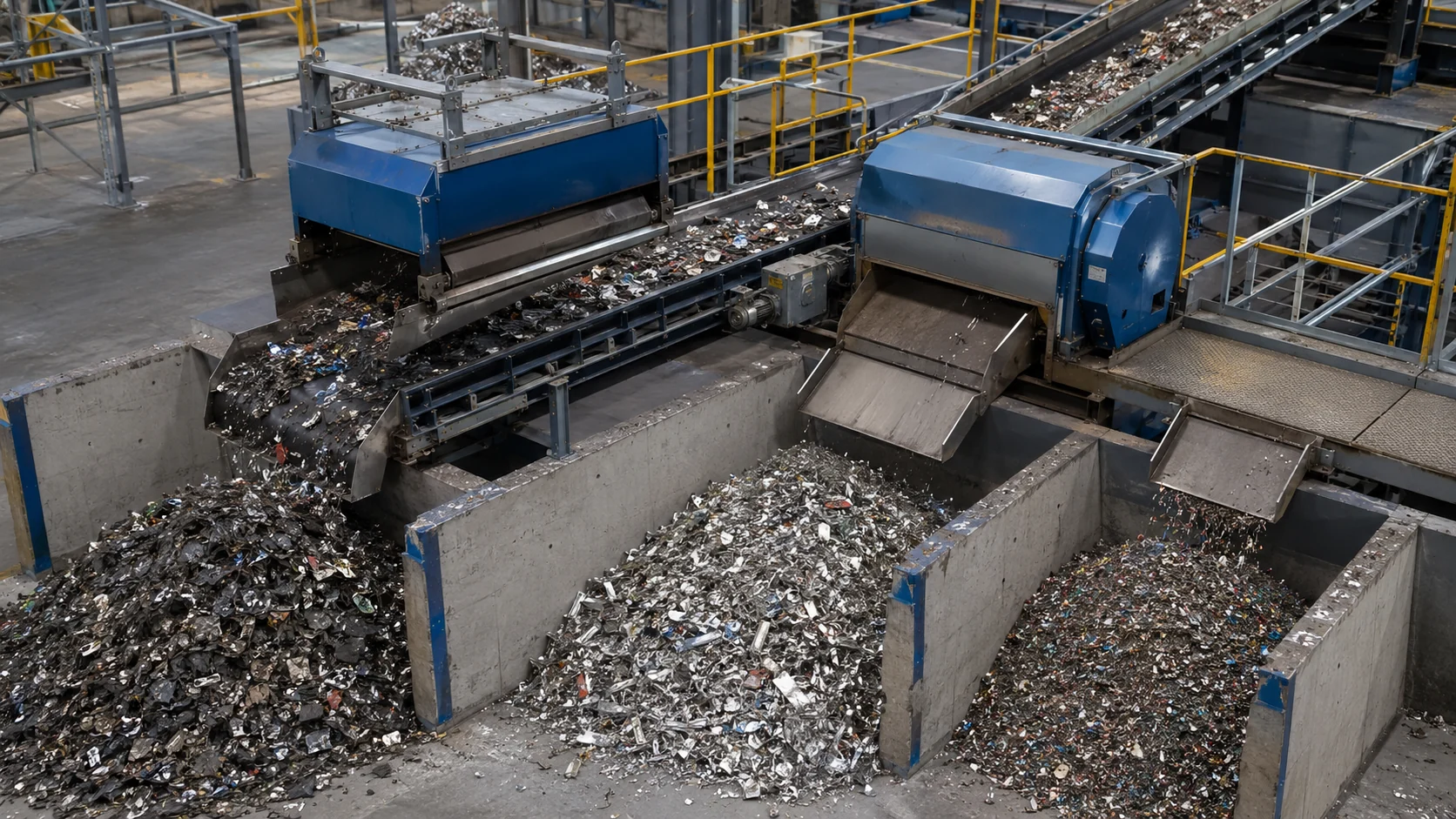
Magnetic separators
Magnetic separation normally removes the largest mass stream: iron and steel. Magnet type and strength matter, but so do burden depth, belt speed and liberation. A strong magnet cannot reliably pull every ferrous piece through an excessively deep mixed bed. Even feeding across the belt and controlling the layer thickness often improve recovery more than simply increasing magnetic intensity.
Eddy-current separators
After ferrous removal, an eddy current separator can eject conductive non-ferrous particles such as aluminum from a prepared stream. Results depend on particle size range, moisture, belt presentation, rotor speed, splitter setting and the degree to which metal has been released from non-metallic attachments. Mixed, wet or highly variable feed should be tested rather than judged only from a catalogue capacity.
Air, gravity and light-fraction separation
Foam, fabric, rubber, plastics and other light materials can overload a metal separator or reduce product quality. Screens and air classification may remove oversize, fines or light fractions before more precise sorting. For selected fine material streams, an air flow gravity separator can use differences in density and aerodynamic response, but it should be chosen for a defined particle range and material mixture—not added as a generic solution for every residue.
Sensor sorting and further upgrading
Where local metal values and product specifications justify it, sensor-based sorting can upgrade selected fractions after conventional separation. This is usually a later investment decision. The plant first needs stable feed preparation, controlled particle size and clean mechanical separation; advanced sensors cannot compensate for an inconsistent upstream process.
How the YUXI Waste Car Recycling Line Works
YUXI’s waste car recycling line is positioned as the downstream processing section for car shells and compatible automotive metal scrap. The published process combines a hydraulic-driven heavy double-shaft shredder, a hammer-type metal crusher, magnetic separation, vortex separation and Siemens PLC central control.
1. Double-shaft primary shredding
The first machine tears bulky shells into coarse fragments. YUXI describes the stage as low-speed, high-torque hydraulic shredding with automatic start, stop, reversal and overload response. The output can be sold as coarse material in some markets or passed forward for refinement.
2. Hammer-type secondary crushing
The hammer crusher reduces the primary fragments further and opens folded or attached structures. The target should be set by the downstream sorting requirement, not by pursuing the smallest possible particle.
3. Magnetic ferrous recovery
Magnetic rollers or an equivalent magnetic stage pull iron and steel from the moving stream. Consistent presentation and sufficient liberation are essential for a clean product.
4. Eddy-current non-ferrous recovery
The non-ferrous stage recovers conductive metals such as aluminum from the remaining prepared fraction. Additional screening or air separation may be required if the stream contains excessive light material or a particle-size range that is too broad.
5. Central line control
A PLC coordinates starts, stops, interlocks and fault response across conveyors and machines. This prevents each item of equipment from operating as an isolated unit. The control philosophy should include upstream and downstream stop logic, overload response, emergency zones and clear operator diagnostics.
This equipment scope should not be confused with a complete ELV depollution and dismantling facility. The vehicle must be prepared before it reaches the line. That distinction gives buyers a more accurate project budget and prevents safety work from being hidden inside the shredder specification.
How to Choose Vehicle Recycling Equipment
1. Define the incoming vehicle condition
Write down what the plant receives on a normal week, not only the ideal material.Distinguish between comploete vehicles,stripped hulls,flat shells,loose panels,motorcycles and hybrid vehicle scraps.Confirm whether the engine,transmission,wheels,tires,glass,seats,wires and large plastic parts are still there.Explain the maximum size,average weight,pollution,moisture and how the materials willbe loaded.
2. Define the target product
“Recycled metal” is too vague. Define whether the target is a flattened hulk, coarse shred, dense ferrous product, aluminum-rich fraction or feed for another upgrading system.
3. Set realistic capacity
State capacity as tonnes per operating hour and per shift with the expected vehicle mix. Ask whether the figure assumes continuous prepared feed and whether it refers to primary throughput or final sorted output.
4. Check utilities and site limits
Confirm the power supply, cooling, compressed air, dust removal, fire protection arrangement and drainage. Map truck movement, loader reach, crane access, residue storage and walkways; a line can fit on a drawing yet remain difficult to operate.
5. Evaluate maintenance conditions
Confirm who will change wear parts, what lifting equipment is available and how long spares take to arrive. Remote plants should favor maintainable designs and a realistic critical-spares package.
6. Test the actual material
Test a representative batch and record feed weight, operating time, output, recovery and residue condition. A trial without a material balance is a demonstration, not an engineering test.
Three Typical Vehicle Recycling Plant Configurations
Configuration 1: Parts-led dismantling yard
This arrangement suits a business earning most of its value from reusable components. The basic equipment is a controlled receiving area, depollution station, vehicle lift or stand, tools, component handling and a material handler. A car crusher or baler may be added to reduce the volume of hulks before they are sold to a regional shredder operator. Owning a full shredding line is difficult to justify when hulk volume is low or irregular.
Configuration 2: Prepared-hulk shredding plant
This plant buys or produces depolluted hulks and needs volume reduction plus basic ferrous recovery. A grabber, feed area, double-shaft shredder, discharge conveyor, magnet and line control form the core. The output remains relatively coarse, but the investment and operating complexity are lower than a complete liberation line. This configuration works when there is a reliable buyer for coarse shredded material.
Configuration 3: Integrated ELV metal recovery line
This line is intended for stable hulk supply and a market that rewards separated products. It combines primary shredding, secondary hammer crushing, magnetic separation, eddy-current separation and optional light-fraction control. Dust collection, fire protection, residue storage and central control become major project items. The line can recover more value, but only when feed preparation, maintenance capability and downstream sales are strong enough to support the extra stages.
Technical Specifications Buyers Should Compare
| Specification | Questions to ask |
|---|---|
| Feed opening | Can it accept the largest prepared hulk in the loading orientation used on site? |
| Drive system | Why is hydraulic or electric drive proposed for this feed and duty cycle? |
| Torque | Is the figure continuous, available operating torque or only a short peak value? |
| Cutter configuration | What are the thickness, hook profile, material, heat treatment and rebuild options? |
| Capacity | Under which feed condition, output size and operating assumptions was it measured? |
| Discharge size | Does it describe primary fragments or final product after secondary crushing and screening? |
| Hammer wear parts | What are the material, expected inspection interval and replacement method? |
| Magnetic separation | What burden depth, belt speed and feed-size range are assumed? |
| What particle size range,water level and feed demonstration are required for eddy current separation? | |
| What interlock,overload response,alarm,data point and remote support functions does the control system include? | |
| Maintenance access | How are jams, unbreakables, cutters, hammers, screens and bearings reached and lifted? |
| Dust, noise and fire controls | What is included in the supplier scope and what must be engineered locally? |
Common Vehicle Recycling Equipment Buying Mistakes
Buying the shredder before defining the process
The main machine is selected first, then the buyer tries to fit depollution, feeding and separation around it. This often creates bottlenecks or an output that local scrap buyers do not want.
Assuming untreated complete cars are normal feed
A supplier video may show a visually complete vehicle entering a machine, but it does not show its preparation history. The purchase contract should define removal of batteries, fluids, refrigerants, controlled devices and other excluded items.
Comparing only motor power
Power does not reveal torque at the shaft, cutter bite, feed opening, duty factor, control response or the capability of the downstream line. Compare the complete operating condition.
Treating rated throughput as guaranteed plant output
Real production includes loader cycles, mixed feed, inspection, reversals, magnet cleaning, wear-part checks and downstream stops. Require the assumptions behind every capacity figure.
Ignoring aluminum and mixed non-ferrous recovery
A line can produce a large quantity of ferrous material while losing value in the residue. Before buying more shredding power, calculate the likely value of better liberation and non-ferrous separation.
Failing to separate EV and hybrid battery handling
High-voltage vehicle preparation needs a dedicated procedure and trained staff. It should never be hidden inside a general statement that the line can “process all vehicles.”
Not planning for residue
Plastics, foam, glass, rubber, fabric, dirt and fines still leave the process. Confirm storage, testing, further recovery and disposal routes before the plant starts.
Forgetting maintenance space and lifting equipment
A compact layout looks attractive until a shaft, rotor or screen must be removed. Reserve crane access, maintenance platforms and component laydown space on the first drawing.
Buying every available separator without material testing
More machines do not guarantee cleaner products. Each separator needs a controlled feed range. Test the material, identify the valuable loss and then add the stage that solves that specific problem.
Vehicle Recycling Equipment Cost Factors
A useful budget cannot be built from tonnes per hour alone. Two projects with the same headline capacity may have very different costs when one only shreds prepared hulks and the other includes secondary crushing, non-ferrous recovery, dust collection, fire controls and automated conveying.
- Feed condition: unflattened shells, dense components and mixed scrap change the required shredder and preparation equipment.
- Required throughput: higher sustained output increases the size of loaders, conveyors, motors, separators and electrical infrastructure.
- Product specification: coarse scrap is less equipment-intensive than clean, separated metal fractions.
- Drive and control package: hydraulic system, variable speed drive, instrument and remote diagnosis will affect capital and service costs.
- Secondary crushing: the hammer crusher increases the requirements of energy demand,wear parts,foundation and dust control.
- Sorting depth: magnetic, eddy-current, air, gravity and sensor stages each need controlled feeding and additional conveyors.
- Environmental and safety systems: dust extraction, noise control, fire detection, suppression, drainage and residue management can be major project items.
- On-site work: foundation, structure, electrical room,passage, crane and installation labor vary from location to location.
- Spare parts and services: the cost of sufficient start-up inventory and operator training is usually lower than that of long-term closures in the future.
- Transportation and import scope: must include transportation size,containerization,tariff,local certification and inland delivery.
Evaluate cost per saleable tonne, not only machine price. A lower-cost line that loses aluminum in residue, stops frequently or requires excessive manual sorting can become the more expensive investment.
Information to Prepare Before Requesting a Quotation
A detailed inquiry lets the engineering team discuss a practical line instead of sending a generic model list. Copy the checklist below and attach current feed photos or videos.
- Vehicle and automotive scrap types:
- Are all vehicles fully depolluted before shredding?
- Are starter batteries, EV batteries, fuel, refrigerants, tires, engines and transmissions removed?
- Percentage of complete hulks, flattened shells, loose panels and mixed parts:
- Largest feed dimensions and estimated maximum piece weight:
- Required tonnes per operating hour and tonnes per day:
- Expected operating hours per shift and shifts per day:
- Required primary and final output size:
- Required products: ferrous, aluminum-rich, mixed non-ferrous or additional fractions:
- Local voltage, frequency and available transformer capacity:
- Available plant area, building height and loader access:
- Dust, noise, fire and environmental requirements:
- Available maintenance crane and local service capability:
- Destination country and delivery port:
Is a Complete Vehicle Recycling Line Right for Your Plant?
A complete line is easier to justify when the facility has a stable supply of prepared hulks, a reliable depollution process, defined buyers for recovered fractions, suitable power and site infrastructure, and a maintenance team capable of supporting several connected machines. It is especially relevant when the plant wants to retain the value of ferrous and non-ferrous recovery instead of selling compacted hulks to another processor.
It may not be the right first investment when monthly volume is low, parts dismantling generates most of the revenue, the site cannot manage vehicle depollution, or there is no outlet for shredder residue. In those cases, a focused dismantling operation with hulk compaction can be commercially stronger. The plant can reserve space for later shredding when feed supply and sales channels are proven.
Plan a Vehicle Recycling Line with YUXI
Send YUXI photos of the prepared car bodies, the expected hourly throughput, required output size, desired metal fractions and available plant space. The engineering discussion can then determine whether the project needs primary shredding only or a complete shredding, crushing and separation line.
FAQ About Vehicle Recycling Equipment
What equipment is required for vehicle recycling?
A complete facility may need receiving and inspection equipment, a depollution station, dismantling tools, vehicle handling, hulk compaction or shredding, secondary crushing and metal separation. The exact list depends on whether the plant receives complete vehicles or prepared hulks and on the product it intends to sell.
Can a vehicle shredder process a complete car?
Only after the vehicle has been prepared for the approved feed specification. Batteries, fuel, refrigerants, free liquids, controlled devices and unsuitable components must be removed or managed before crushing or shredding. “Depolluted hulk” is a safer and more accurate feed description than “untreated whole car.”
What is the difference between a car crusher and a car shredder?
A car crusher or flattening press mainly reduces the volume of a prepared hulk for storage and transport. The shredder tore the hulk into smaller pieces,which can be transported,further crushed and separated.
After the double-shaft shredder,do I need a hammer crusher?
Not always. Add a hammer mill when the required output is smaller or when better liberation is needed before magnetic and non-ferrous separation. Coarse shred sold to another processor may not need the second stage.
How are steel and aluminum separated after shredding?
A magnetic separator removes ferrous metal such as iron and steel. After suitable size control and liberation, an eddy-current separator can recover conductive non-ferrous metal such as aluminum.
Can the same line process electric vehicles?
The downstream metal equipment may process a prepared EV body after specialist high-voltage isolation, battery removal and other required safety work. An intact EV with its traction battery installed must not be treated as normal car-shell shredder feed.
How much does vehicle recycling equipment cost?
Cost depends on feed condition, throughput, output specification, the number of crushing and sorting stages, automation, environmental controls, site work, installation and spare parts. A quotation should be based on a defined process rather than capacity alone.
Technical References
The regulatory and handling requirements for a specific project must be confirmed locally. The following official resources support the general process and safety discussion in this guide: