




 Request Quote



How Does The Scrap Metal Baler Work?
The scrap metal baler looks very simple from the outside: open the chamber, load the metal, press the button,and take out the block. However,in daily recycling work, the result depends on the filling method of the chamber,how the hydraulic system generates force,the dischage method of the bundle,and how the operator controls the risk of stored energy.
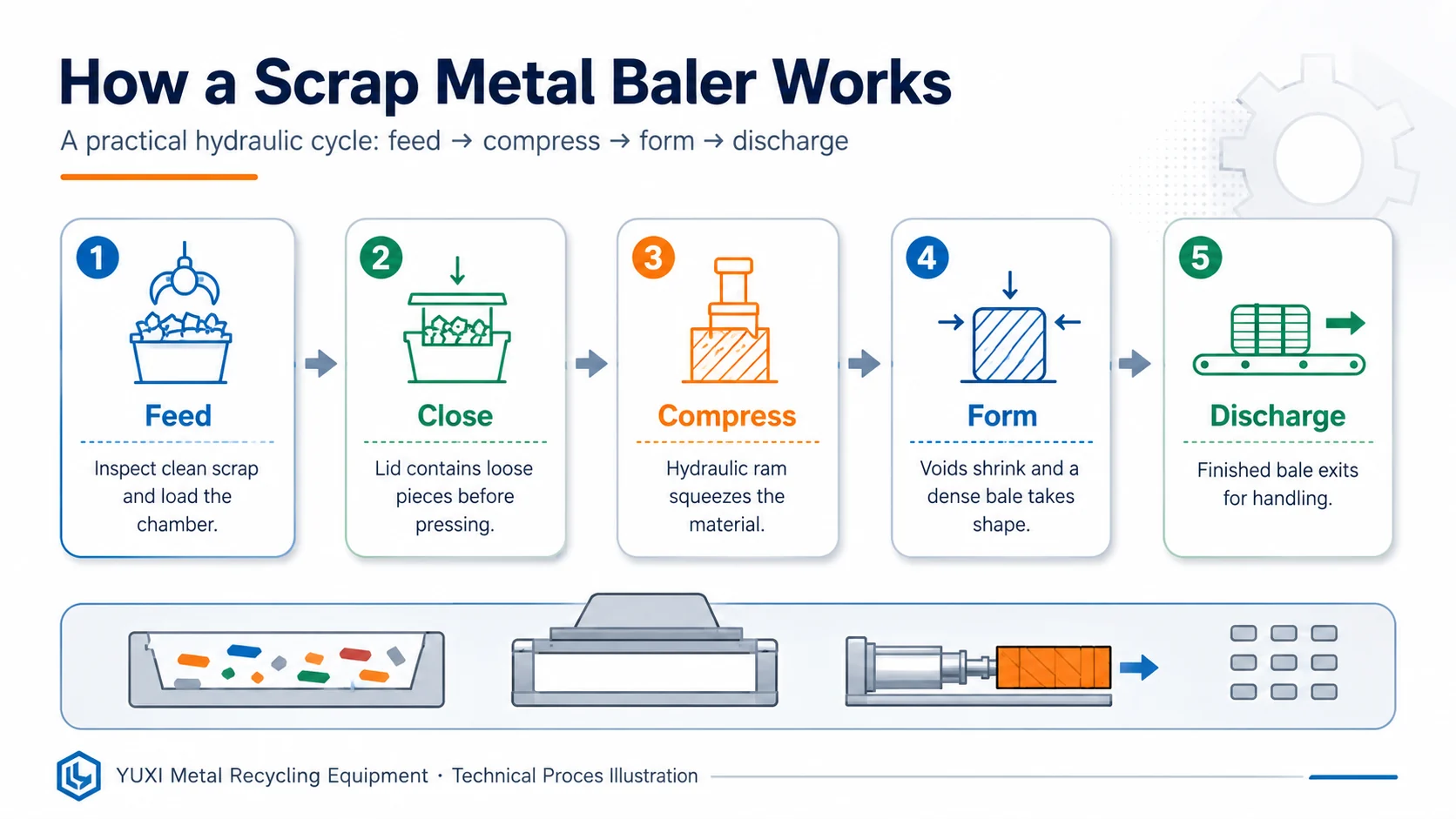
Quick answer: how does the scrap metal baler work?
The working principle of the scrap metal baler is to load the loose scrap into a reinforced compression chamber,close the chamber or cover,and use a hydraulic cylinder to push one or more rams into the material.The pressure from the hydraulic system forces the irregular metal sheets to form a dense,regular bundle.The finished product block is then discharged for storage,transportation or downstream melting.
YUXI describes its Metal Hydraulic Baling Machines as equipment that compresses scrap steel, aluminum and other metal waste into high-density blocks for steel mills, recycling and processing operations, and smelting plants. The official working principle is hydraulic: a pump supplies pressure, pushes the piston rod, and drives extrusion in the chamber.1
Why scrap yards use a baler before transport or smelting
Loose scrap is awkward. Sheet offcuts, light steel, aluminum profiles, cans, copper scraps and mixed production waste occupy a lot of space, catch on loaders, and create inconsistent truck loads. A baler does not chemically change the metal. It changes the shape and bulk density so the material becomes easier to stack, count, store and move.
This is why baling is usually treated as a logistics and pre-processing step, not just a “pressing” step. EPA describes recycling as collection and processing that turns materials into inputs for manufacturing, while worldsteel notes that steel scrap can be recycled repeatedly and remains valuable because of its recoverability and material properties.56 For a plant buying or selling scrap, a compact bale is often easier to price, ship and feed than a pile of loose irregular pieces.
In a YUXI-style metal recycling equipment workflow, a baler may work beside shredders, shears, crushers, separators and conveyors. For example, large items may need shearing or shredding first, while smaller clean scrap may be loaded directly into the baler. The broader YUXI metal recycling equipment category covers complementary machines used before and after size reduction or separation.
What parts make the baler work?
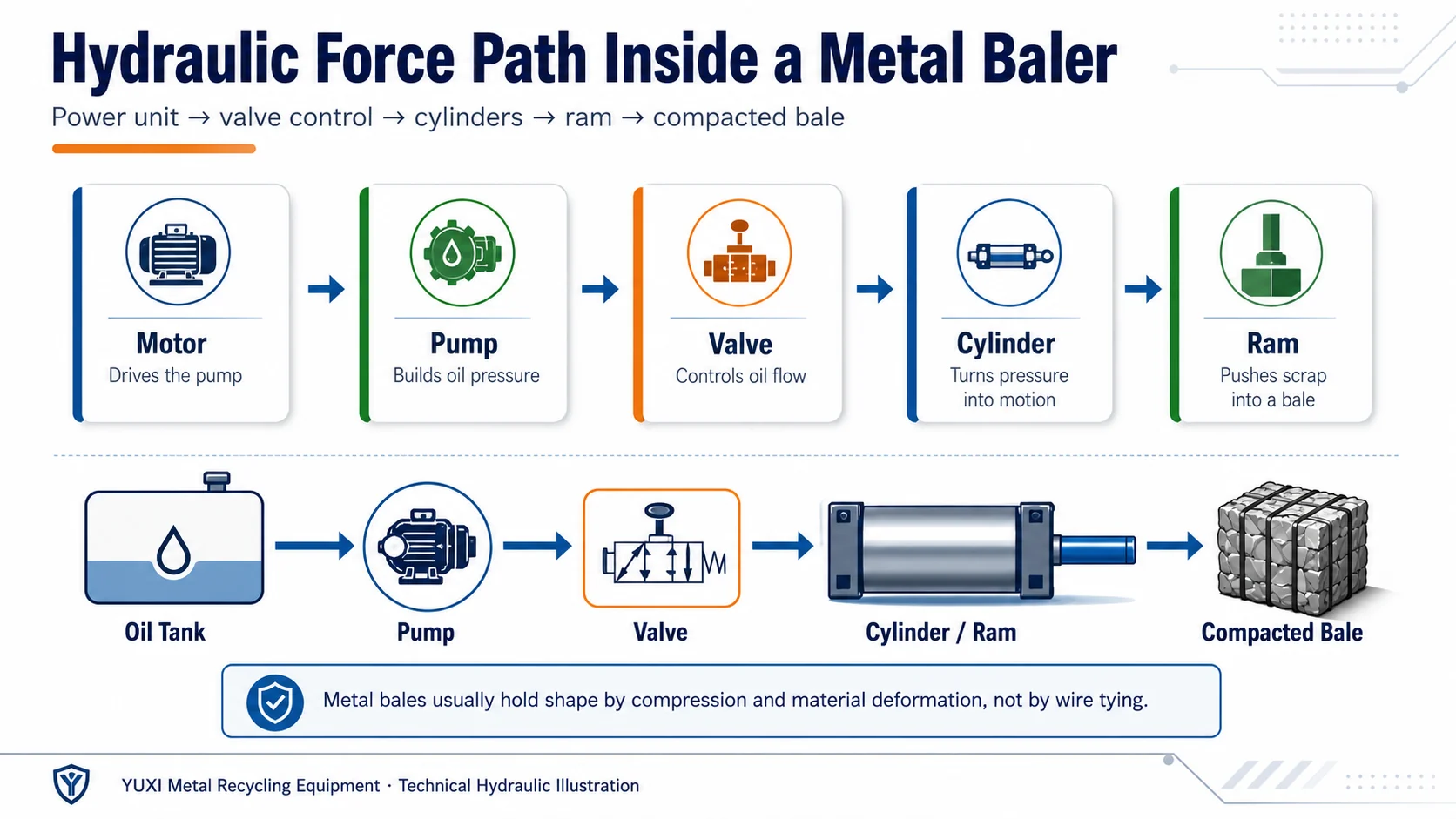
Most industrial scrap metal balers are built around six functional areas. The exact layout can vary, but the working logic is similar.
1. Feeding chamber
This is the heavy steel box that receives scrap. Chamber size controls what can be loaded without excessive pre-cutting. It also determines how the material settles before compression begins.
2. Lid or pre-compression cover
The lid contains springy material and may pre-press the charge. It also keeps scrap inside the compression zone instead of allowing long pieces to escape upward.
3. Hydraulic power unit
The motor, pump, reservoir, hoses and valves create controlled oil pressure. This is the core power source of a hydraulic metal baler.
4. Hydraulic cylinder and piston
The cylinder converts oil pressure into linear thrust. Ram face transfers this power to the scrap and squeeze it against the wall of the chamber.
5. Control system
Controls may be manual, semi-automatic or automatic. YUXI highlights hydraulic integrated control as one advantage of its metal baling machines.1
6. Bale discharge area
After compression, the bale exits by turning out, pushing out, side discharge or another configured method. The discharge plan must match the forklift, crane, pallet or downstream conveyor.
The scrap metal baler working cycle, step by step
Step 1: Inspect and prepare the feed
The operator first checks the material. Clean scrap steel and aluminum are typical feeding materials for YUXI metal balers, but dangerous goods should not be regarded as ordinary scraps. Sealed barrels, gas cylinders, batteries, pressurized containers, flammable residues and unknown liquids need to be handled separately. The baler is a kind of compressor; it is not a dangerous and accidental sorting station.
Step 2: Load the chamber evenly
Scrap is loaded by hand, forklift, grab, crane or conveyor depending on the line. Good loading matters because light sheet, cans, turnings, wire and extrusions do not behave the same way. If one side of the chamber is filled too much,the ram may be compressed unevenly,and the bundle may be twisted,bounced back or stuck during the discharge process.
Step 3: Close the lid or compression cover
The lid restrains loose material and begins to shape the charge. In some machines, this step also performs a first compression. The goal is to keep the scrap inside the chamber so the main ram can act against a controlled mass instead of chasing loose pieces.
Step 4: Main hydraulic compression
Once the chamber is closed, the hydraulic pump will provide pressurized oil to the cylinder. The cylinder extends, the ram moves forward, and the ram pushes the waste to the chamber wall or the previous compressed surface. The machine repeats or maintains the pressure until the bundle reaches the target shape. This is the core of the YUXI working principle: hydraulic pressure drives the piston rod to complete extrusion and compress scattered metal into blocks.1
Step 5: Multi-direction compression, when needed
Some metal balers compress from one direction; others use two or three compression directions. Multi-direction compression helps handle springy or irregular scrap because it reduces the chance that the material simply spreads sideways. The right structure depends on feed material, chamber dimensions, bale requirement and loading rhythm. For deeper model selection, the companion article How to Choose the Right Metal Baling Machine explains why capacity, feed size and bale handling should be checked together.
Step 6: Bale discharge
After compression, the machine releases pressure in a controlled sequence and opens the discharge path. According to the design of the packaging machine,the bundle can be pushed out,turned out or lifted.This step should not be handled casually:dense metal blocks may be heavy,the edges may be sharp,and the discharge area must be kept clear.
Why the bale stays compact
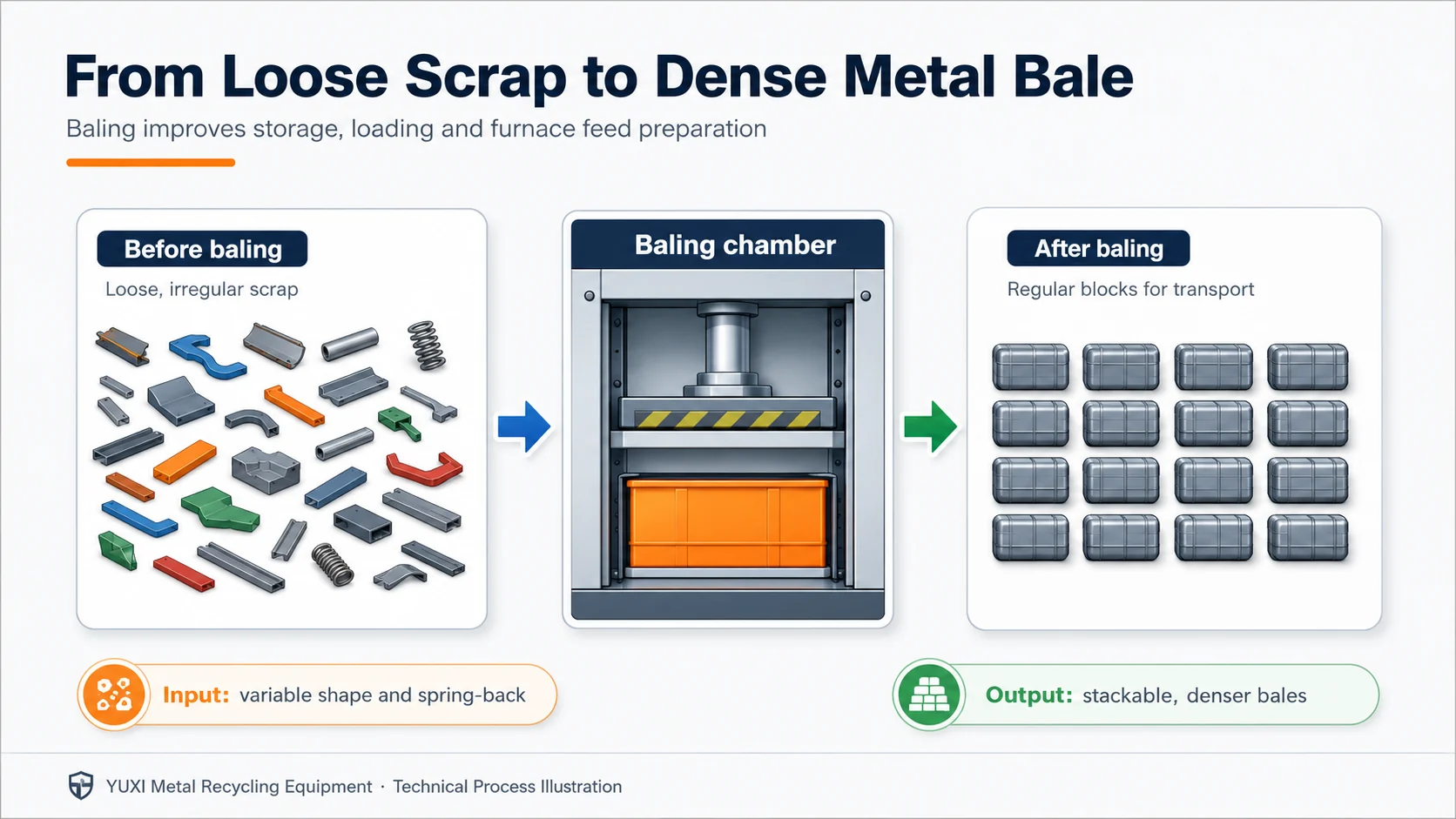
The bale holds together because compression reduces void space and plastically deforms many of the scrap pieces. Thin sheet folds, aluminum profiles flatten, light steel nests together, and irregular pieces interlock under pressure. In most scrap metal baling applications, the machine is not tying the bale like a paper or cardboard baler. The block remains stable because the metal has been forced into a dense geometry and because the material resists returning fully to its original shape.
This also explains why the same baler can behave differently with different feed. Thin aluminum may compress quickly but spring back; heavy steel offcuts may need more force and may load the chamber unevenly; wire-like material can tangle; turnings may compact but create handling and cleanliness issues. A real working trial is always more reliable than choosing a baler only by the word “steel” or “aluminum.”
Where hydraulic baling fits in the metal recycling chain
A scrap metal baler is most valuable when it solves a bottleneck. In a small yard, the bottleneck may be storage space. In a steel mill or smelting plant, it may be consistent furnace feed. In a trading operation, it may be transport cost and truck utilization. YUXI’s product page specifically positions metal baling machines for scrap steel recycling stations and smelting plants, with advantages including regular bale shape, easier storage, hydraulic integrated control and anti-rust body design for durability.1
The environmental case is also strong when scrap is recovered properly. IEA identifies resource efficiency, reuse and recycling as part of the pathway for a more sustainable iron and steel sector, and notes that iron and steel accounts for a significant share of global final energy demand and energy-sector CO₂ emissions.7 Aluminum recycling is similarly important: the Aluminum Association states that recycled aluminum takes around 5% of the energy required for new aluminum production, and that aluminum can be recycled repeatedly without theoretical limitation.8
Common problems when a baler “works,” but not well
| Problem seen on site | Likely cause | Practical check |
|---|---|---|
| Bale springs back or opens | Feed is too elastic, unevenly loaded, or compression is insufficient for the required bale | Run a trial with real material and inspect bale shape after discharge |
| Slow output | Loading method, chamber refill time, cycle time or bale removal is the bottleneck | Time a full cycle from loading to cleared discharge area |
| Hydraulic oil heating | Long duty cycle, poor cooling, leakage, wrong oil or excessive resistance | Check oil temperature, filters, seals and maintenance records |
| Chamber jams | Oversized pieces, mixed long scrap, poor feed preparation or wrong chamber size | Record maximum feed dimensions, not just average size |
| Unsafe operation | Weak guarding, poor training, bypassed interlocks or no lockout procedure | Review guarding and LOTO before any production trial |
Safety and operation notes before using a scrap metal baler
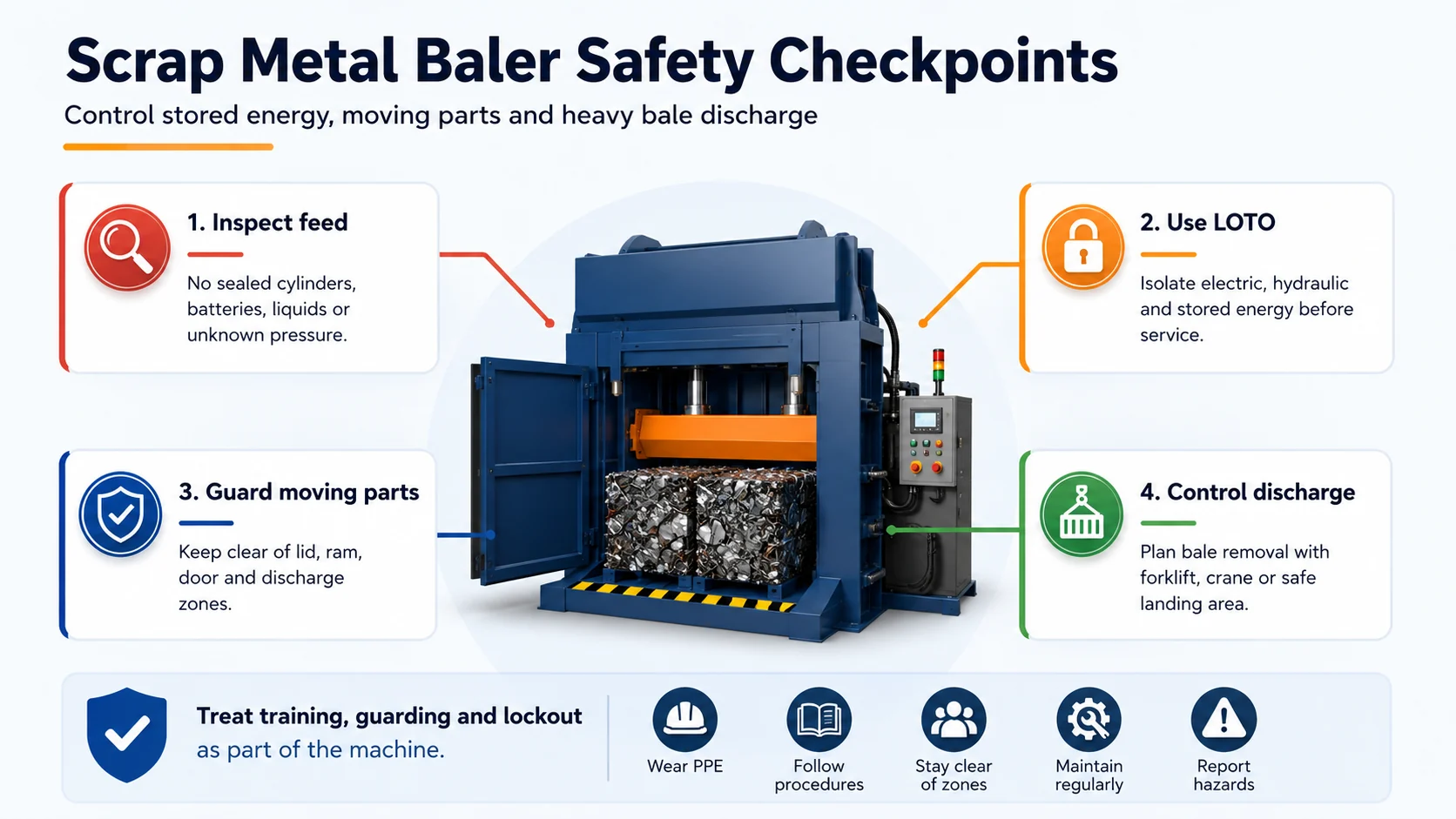
The working principle is straightforward, but the hazards are serious. OSHA lists the hazards of scrap metal recycling,such as machinery moving parts and accidental machine startup, and its recycling guidelines emphasize the machine protection and locking/marking of workers who repair equipment.23 OSHA also warns that accidental activation of the packing machine may have disastrous consequences in the packing operation,including crushing,moving parts and diacharging door locks.4
For metal balers,the actual safety control should include: keeping people away from the chamber and discharge areas; protecting the moving points of operation; turning off electricity and water energy before cleaning blockages or repairing; relieving the pressure of storage;verifying zero energhy;using appropriate bundle processing equipment;and training operators not to compress unsafe containers or unknown materials.
Maintenance points that affect how the baler works
A metal baler that has lost fluid, overheated or leaked oil may still move, but it will not produce a consistent bundle. Routine inspection should focus on hydraulic oil cleanliness, filter, hose condition, cylinder seal, piston alignment, chamber wear plate, cover pin, control valve, electrical interlock and discharge mechanism. The goal is not just the uptime. Good maintenance can protect the bundle density, cycle repeatability and operator safety.
When requesting a quotation or a trial, send the supplier real material photos, maximum piece size, daily tonnage, effective operating hours, loading method, target bale size, downstream handling method and site power conditions. This gives the manufacturer enough context to recommend a configuration instead of guessing from material name alone.
FAQ: how does the scrap metal baler work?
Does a scrap metal baler melt metal?
No. A scrap metal baler only compresses metal into dense blocks. Melting happens later in a smelting plant, foundry or steelmaking process.
Does the baler tie the metal bale with wire?
Usually no for metal scrap baling. The bale normally holds shape through hydraulic compression, deformation and interlocking of the scrap. This differs from many cardboard or paper balers that use straps or wire tying.
What metals can be baled?
Common materials include scrap steel, aluminum and other clean metal waste. The correct machine depends on thickness, piece size, shape, contamination and spring-back. YUXI’s page specifically mentions scrap steel and scrap aluminum applications.
Why use a hydraulic baler instead of just loading loose scrap?
Baling can reduce loose volume, make the output more regular, improve warehouse utilization and lower transport cost. It also gives downstream buyers or furnaces a more consistent form to handle.
What information should I provide before buying a metal baler?
Provide material type, maximum dimensions, thickness, contamination risks, daily volume, effective operating hours, loading method, desired bale size, discharge method, power supply and photos or videos of real scrap.
Need a metal baler for real scrap, not brochure scrap?
For YUXI metal baling machine selection, start with your actual feed material and bale-handling plan. The safest and most accurate way to confirm the working effect is to test representative scrap, check the bale after discharge, and match the hydraulic structure to your site routine.
References and source notes
- YUXI Metal Baling Machines product page
- OSHA: Scrap Metal Recycling hazards and precautions
- OSHA: Waste Management and Recycling, lockout/tagout and machine guarding
- OSHA: Cardboard Baling hazards, unexpected activation and crushing hazards
- US EPA: Recycling Basics and Benefits
- World Steel Association: Circular Economy and steel recycling
- IEA: Iron and Steel Technology Roadmap
- The Aluminum Association: Infinitely Recyclable