




 Request Quote



Car Recycling Business Guide
Car recycling business is not just a matter of buying scrapped vehicles and selling scrap steel.Profits usually come from decisions between these two points:the source of the vehicle,their pollution safety,which parts are removed before chopping,and the degree of cleanliness of the remaining shell crushing and separation.
Quick navigation
Business models
Process flow
Plant layout
Equipment
Revenue
Safety & compliance
Startup checklist
This Car Recycling Business Guide is written for investors, recycling yard owners, scrap metal processors and equipment buyers who want to build a practical end-of-life vehicle operation. It focuses on business planning and production logic rather than generic “green recycling” claims. Where equipment is discussed, the guide uses public information from YUXI’s waste car recycling line, which is designed to process scrapped vehicles and metal parts, crush and separate mixed materials such as scrap iron, aluminum and engine casings, and support resource recovery.
In the United States and Canada, the Automotive Recyclers Association says the professional automotive recycling industry recycles more than four million motor vehicles annually and supports more than 9,000 locations in the United States. In Europe, the European Commission notes that over six million vehicles reach end-of-life every year. Demand exists, but the winners are not simply the yards with the most cars. The stronger operators turn chaotic vehicle scrap into documented, safer, cleaner and more saleable material streams.
1. Choose the right car recycling business model
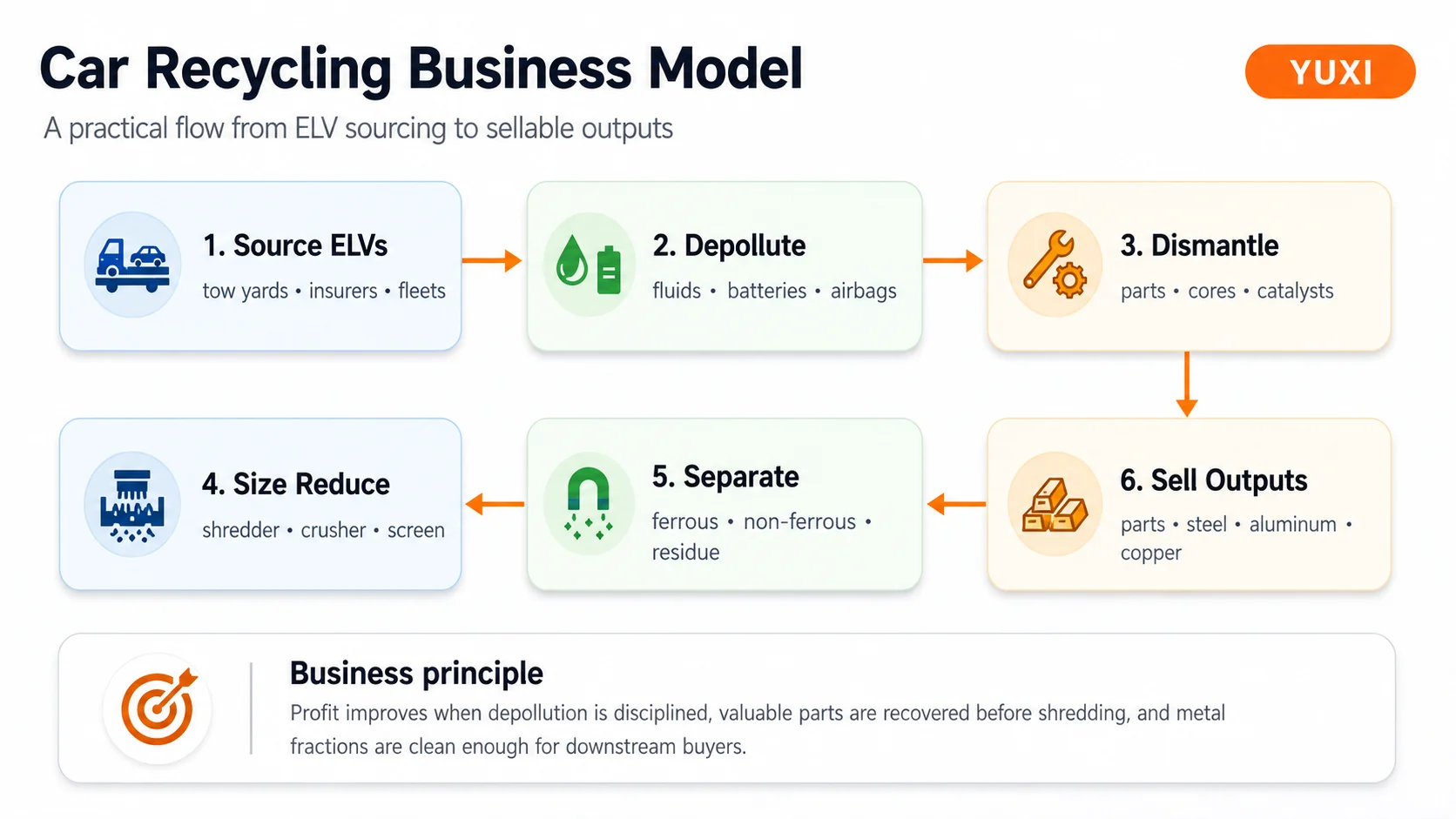
A car recycling business can operate at different depths of the value chain. Choosing the model first prevents the common mistake of buying a large shredder before the yard has stable feedstock, trained depollution staff, permits, buyers and safe traffic flow.
Dismantling-first yard
This model focuses on purchasing ELVs, depolluting them, removing reusable parts and selling prepared shells to a downstream shredder. It needs strong parts identification, warehousing and inventory systems.
Prepared shell supplier
This business depollutes vehicles, removes high-value components, flattens or cuts shells and sells cleaner feedstock to regional scrap processors. It is often a practical bridge before a full line investment.
Integrated recycling plant
This model adds shredding, crushing and separation equipment so the operator can sell ferrous and non-ferrous fractions directly. It requires more capital, layout planning and operator training, but can capture more processing value.
For new investors, the key question is not “How many cars can I buy?” And “What output can I continue to sell,with what quality,and with what compliance burden?”This business situation of a yard with buyers of second-hand engines,aluminum wheels,copper-rich motors and clean iron scrap is completely different from that of a yard that sells mixed and contaminated scrap at a discount .
2. Build the business around a disciplined ELV process flow
The basic flow of a car recycling business should be simple enough for workers to follow every day and strict enough to prevent valuable or hazardous items from entering the shredder. A practical sequence is intake, inspection, depollution, dismantling, shell preparation, size reduction, separation, storage and dispatch.
Vehicle intake and paperwork
Every ELV should be received with a record trail. Depending on the country or state, this may include ownership documents, certificate of destruction procedures, vehicle identification, supplier records and environmental documentation. Poor documentation creates legal risk and makes it harder to build stable contracts with insurers, municipalities, tow companies and fleet operators.
Depollution before any heavy processing
Depollution is where many low-margin yards lose money and expose themselves to risk. Batteries, fuel,engine oil, coolant, brake fluid, air-conditioning gas, wheels, tires, catalytic converters and explosive components such as airbags or seat-belt pretensers,must be handled according to local rules. The British Waste Farm Guide stipulates that ELV must be decontaminated,and the liquid should be stored according to the type in separate,clearly marked leak-proof container with spill containment. Even outside the UK, this is a useful operational standard for planning a serious facility.
Dismantling and pre-sorting
Before the shell enters the heavy line, remove reusable parts and high-value items that should not be destroyed. This can include engines, gearboxes, alternators, starters, wheels, electric motors, wiring harnesses, catalytic converters and selected body panels. The business case often depends on this step: parts and cores may provide cash flow while the metal market fluctuates.
Shell preparation and staged size reduction
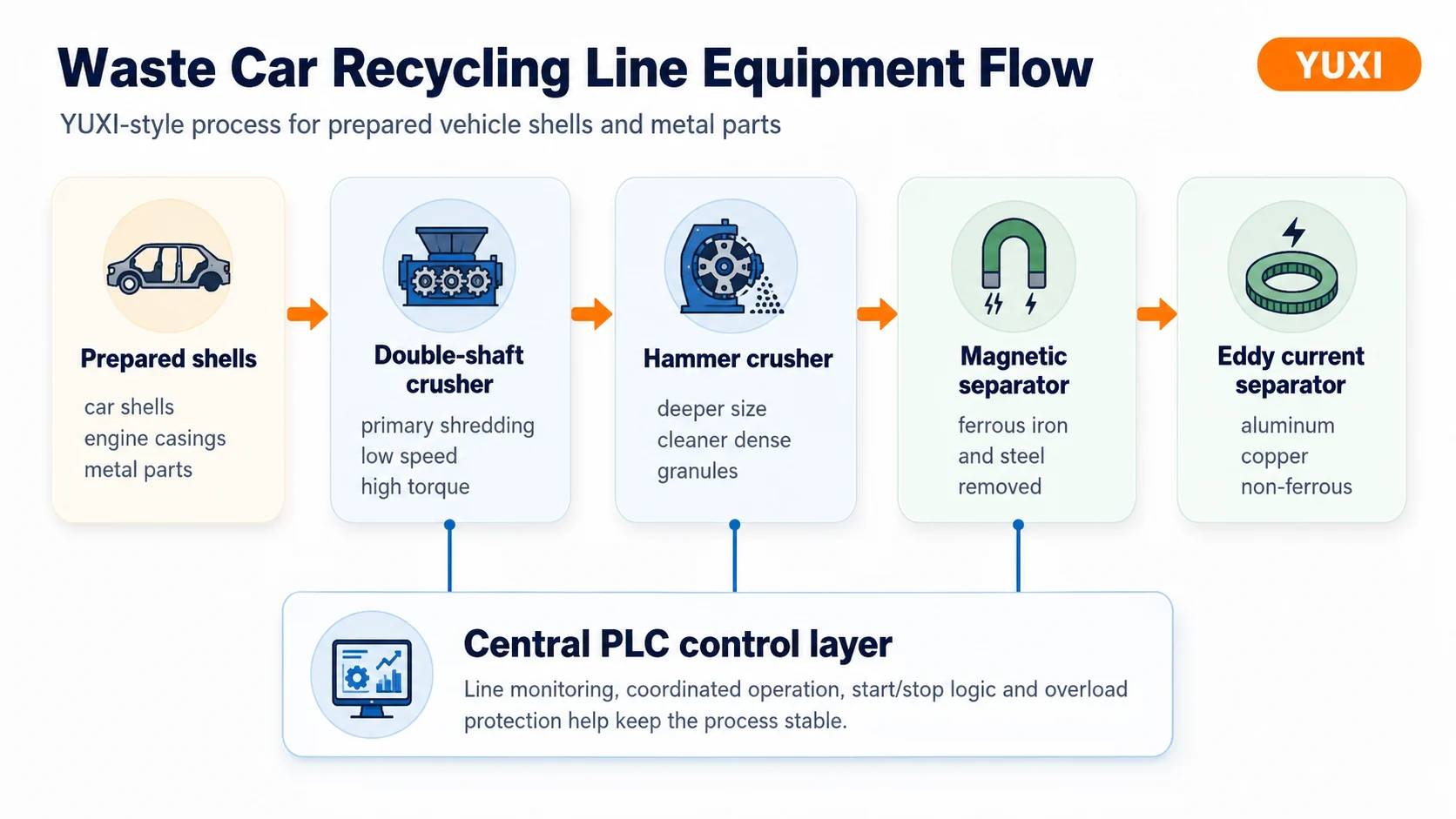
After depollution and parts removal, the remaining body shell and metal parts can enter the size-reduction stage. YUXI describes its process as beginning with a double-shaft crusher for primary shredding of waste car shells, followed by a hammer-type metal crusher for deeper shredding into granules that meet output size requirements. This staged approach matters because the first machine opens and reduces bulky shells, while the second improves liberation for downstream separation.
3. Plan the factory layout before buying equipment
A profitable car recycling business requires a layout that can protect people, prevent cross-contamination and keep material moving. Layout should never force loaders, forklifts, dismantling workers and trucks into the same narrow path. Separate receiving site, depollution bay, reusable-parts storage, hazardous materials area, prepared shell buffer, crushing line, separation area and outbound storage.
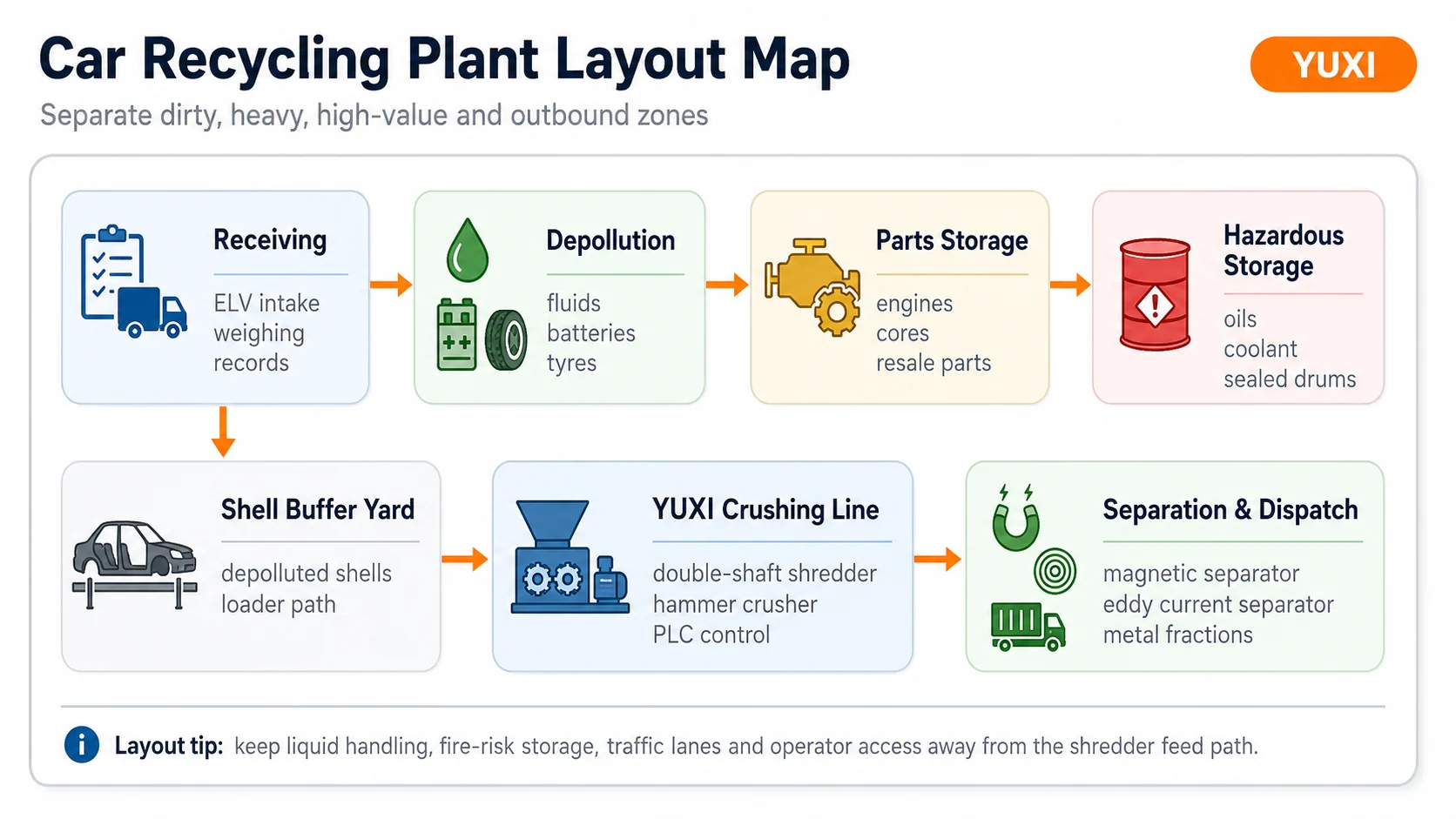
For a full plant, the receiving area should be close to the weighbridge and inspection point. The depollution zone should sit on an impermeable surface with drainage and spill containment. The parts warehouse should be accessible without sending customers or staff through heavy equipment zones. The shredder feed area should have enough turning radius for loaders and enough buffer stock to keep the line running without unsafe rushing.
Good layout also protects material value. Depolluted shells should not be mixed with unprocessed vehicles. Clean black waste should not be stored in a place where garbage,rubber,dirt or liquid can be picked up.Non-ferrous materials should be protected from re-contamination,because buyers usually pay according to purity,moisture and visible pollution.
4. Select equipment according to the business stage
Equipment should match your feedstock, labor model, buyer requirements and regulatory environment. A small dismantling yard may need lifting tools, depollution equipment, storage racks, fluid containers and a shear or baler before it needs a complete crushing line. A regional processor handling prepared shells may need a much more integrated system.
For the heavy processing stage, YUXI’s metal shredder product information describes shredding large light scrap materials such as car shells into smaller pieces by tearing, squeezing and shearing. For a car recycling business, this type of primary size reduction is useful when whole or prepared shells are too bulky for efficient transport, separation or furnace charging.
After primary shredding, a hammer mill metal crusher can provide deeper crushing. YUXI describes hammering, shearing and tearing actions for breaking scrap metals into smaller pieces or granules and improving metal/non-metal separation. In business terms, the purpose is not simply to make material smaller; it is to improve liberation so separation equipment can produce cleaner fractions.
For non-ferrous recovery, an eddy current separator helps recover aluminum and copper from shredder material. YUXI’s product page explains that non-ferrous metals such as aluminum are repelled by the magnetic field created as they pass over the high-speed rotor, allowing them to follow a different trajectory from non-metallic material. For a car recycling business, this is one of the key steps that turns mixed shredder output into saleable streams.
Questions to ask before specifying the line
- Will the feedstock be whole vehicles, depolluted shells, mixed car parts, engine casings or a combination?
- What output size do downstream buyers want for ferrous scrap and non-ferrous fractions?
- How much manual dismantling will happen before the line?
- What level of automation is needed for start/stop, reversal, overload protection and line monitoring?
- How will dust, noise, fire risk, unshreddables and maintenance access be controlled?
Practical advice: do not request a machine quote only by saying “car recycling line.” Send the supplier photos or videos of feedstock, the expected vehicle preparation level, desired output size, local power conditions, available layout area, labor plan and buyer specifications. This shortens the engineering discussion and reduces the chance of a wrong configuration.
5. Understand the revenue streams before calculating ROI
The car recycling business has several revenue streams. Some are generated before shredding, some after shredding, and some are actually cost centers unless handled well. A proper business plan should not rely only on the weight of steel in a vehicle.
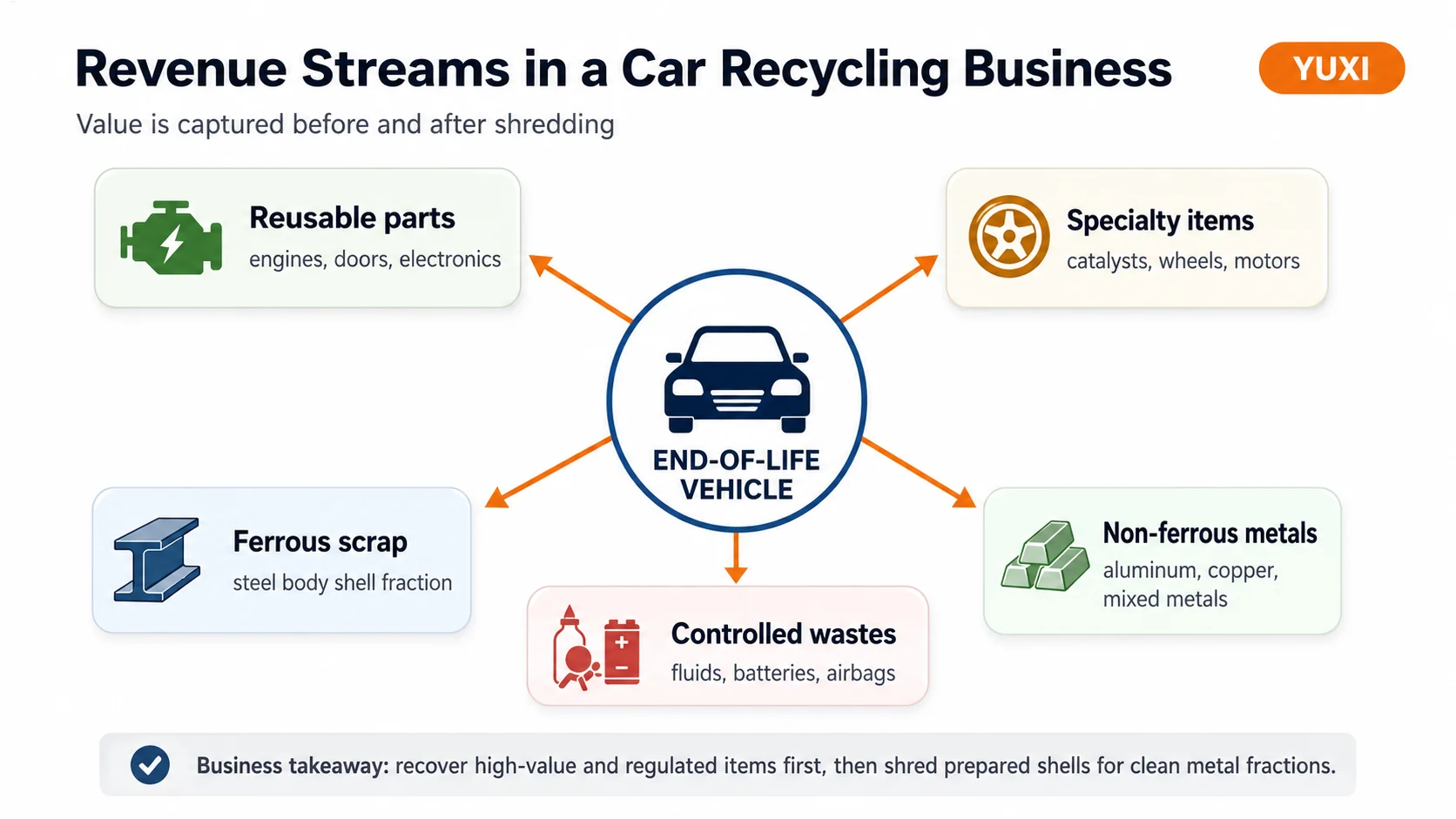
| Revenue or cost stream | How value is created | Business control point |
|---|---|---|
| Reusable auto parts | Engines, transmissions, panels, lamps and electronics may be sold as used parts where market demand exists. | Inspection, inventory, storage quality and sales channels. |
| Core materials | Alternators, starters, motors, wheels and selected assemblies may have stronger value than mixed scrap. | Remove before shredding and sort by buyer specification. |
| Ferrous scrap | Depolluted shells and steel components become a major weight-based output after shredding and magnetic separation. | Clean feedstock, stable size reduction and low contamination. |
| Non-ferrous metals | Aluminum and copper can be seperated and recycled from mixed debris material. | Liberation quality, eddy-current settings and downstream manual sorting if required. |
| Controlled waste | Oil, fuel, coolant, refrigerant, tires and batteries need to be handled in compliance and may involve costs or professional buyers. | Depollution discipline, labelled storage and licensed disposal or recycling partners. |
Because metal prices change, the most resilient car recycling businesses build flexibility into the operation. When steel prices are weak, parts and non-ferrous recovery may protect margin. When parts demand is weak, efficient line operation and clean ferrous output become more important. The best plan is not a single “profit per car” number but a sensitivity model based on vehicle cost, labor, parts yield, metal prices, disposal costs, electricity, maintenance and financing.
6. Treat security and compliance as operating costs rather than after the fact.
Scrap vehicles contain fuel, oil, coolant, refrigerants, batteries, airbags, mercury-containing parts in some vehicles, tires, glass and mixed metals. Crushing a poorly polluted vehicle may cause the risk of fire, explosion, pollution and injury to worker. A business plan that ignores these risks is not conservative; it is incomplete.
OSHA’s metal scrap recycling guidelines emphasize that metal scrap recycling operations involve hazards associated with material handling, metals, processed chemicals and equipment. OSHA also emphasizes locking/marking procedures to protect workers from hazardous energy during repair and maintenance. For automobile recycling plants, this means that the line design should include safe passages, guards, emergency stops, maintenance isolation procedures, loader traffic rules, operator training and record inspection.
7. Start-up checklist of car recycling business
Please use this list before promising to equipment or signing a long-term yard resettlement.
| Planning item | What to confirm |
|---|---|
| Feedstock supply | Monthly ELV volume, vehicle types, delivery distance, average purchase cost, seasonality and supplier reliability. |
| Output buyers | Used parts channels, ferrous scrap buyers, non-ferrous buyers, battery recyclers, tyre processors and waste disposal partners. |
| Site readiness | Land area, zoning, road access, floor load, drainage, power, fire control, noise limits and expansion space. |
| Process design | Depollution station, dismantling workstations, shell buffer, shredder feed path, separation equipment and outbound material bays. |
| Equipment scope | Whether the current stage needs dismantling tools, baling/shearing, a complete crushing line, magnetic separation or non-ferrous separation. |
| Operating team | Depollution staff, loader operators, line operators, mechanics, sorters, warehouse staff and sales support. |
| Risk control | Fire prevention, leakage response, locking/marking, security, traffic management, dust/noise control and recorded maintenance. |
Common mistakes that reduce profit
- Buying heavy equipment before securing consistent ELV supply and reliable output buyers.
- Sending valuable components into the shredder instead of recovering them first.
- Designing a yard without enough buffer space, causing loaders and workers to compete for the same area.
- Ignoring depollution costs, battery handling, tyres, fluids and disposal contracts in the ROI model.
- Focusing only on hourly capacity while neglecting output purity, maintenance access and downtime.
FAQ: Car recycling business planning
Is a car recycling business profitable?
It can be profitable when the operator controls feedstock cost, depollution discipline, parts recovery, metal separation quality and buyer relationships. Profitability should be modeled by output stream, not only by vehicle weight.
Do I need a full waste car recycling line at the beginning?
Not always. Many operators start with depollution, dismantling, parts sales and prepared-shell sales. A full line becomes more attractive when there is enough stable volume and buyers for ferrous and non-ferrous fractions.
Which devices are important for integrated ELV recycling?
Typical integrated flows may include double-shaft crushers for primary debris,hammer crushers for deeper size reduction,magnetic separation of black metals,vortex separation of non-ferrous metals,conveyors and central control systems.
What should be removed before crushing the vehicle?
Common decontaminating items include batteries, fuel, oil, coolants, refrigerants, wheels, tires, catalytic converters, airbags or other explosive parts and reusable/high-value parts.
Plan an ELV recycling line?
Share your raw material type, expected vehicle preparation level, target output size, available factory area and buyer requirements with YUXI.You should build a practical configuration around your material flow,not a non-size-fits-all machine list.
References and source notes
- Automotive Recyclers Association: automoboile recycling industry statistics, vehicle recycling volume, employment and sales data.
- European Commission:Europe’s end-of-life Vehicles overview, circular economy target and annual ELV volume.
- GOV.UK: End-of-life vehicles guidance for waste sites, depollution items, liquid storage and recycling/recovery target guidance.
- OSHA Metal Scrap Recycling Guidance and OSHA Lockout/Tagout: safety guidance for scrap recycling operations and machinery servicing.
Online Message