




 Request Quote


Product Center
-
- Biomass Shredding and Recycling Line
- OCC Paper Dry Pulping & Cardboard Recycling Line
- Scrap Aluminum Recycling Line
- Waste Car Recycling Line
- Waste Refrigerator Recycling Line
- Copper Aluminum Radiator Recycling Line
- Motor Rotor Recycling Line
- Copper Wire Recycling Line
- Waste Ink Cartridge Recycling Line
- Aluminum UBC Scrap Recycling Line
Get a Quote
Contact Us


An eddy current separator (ECS) recovers non-ferrous metals—primarily aluminum, copper, brass, and zinc—by repelling them out of a dry waste stream with electromagnetic induction. Unlike overband or drum magnets that pull iron upward, an ECS spins a high-frequency rare-earth NdFeB magnetic rotor at 1,500–4,000 RPM inside the conveyor head pulley, inducing opposing currents inside conductive particles and launching them forward over an adjustable splitter blade while plastics, rubber, foam, and glass drop straight down.
Key Takeaways for Plant Engineers
- Physics Governs Throw Distance: Separation trajectory scales with a metal’s conductivity-to-density ratio (σ/ρ)—aluminum (13.7) launches farthest, copper (6.7) trails behind, and austenitic stainless steel (<0.5) drops with plastics.
- Eccentric Rotors Protect Against Tramp Iron: In auto shredder Zorba and WEEE lines, an eccentric rotor prevents escaped steel fasteners from heating and puncturing the composite drum shell.
- Upstream Prep Decides Purity: Upstream ferrous removal, dry monolayer feeding, and narrow size screening (ideally ≤3:1 ratio) often swing non-ferrous recovery more than rotor pole count alone.
1. Step-by-Step Working Principle Inside a Recycling Line
In a commercial eddy current separator, mechanical feeding and electromagnetism must align across four sequential stages:
- Upstream Ferrous Protection: A heavy drum magnet or overband magnet strips free iron and steel first. Unremoved steel interferes with the ECS field and can overheat on the drum shell.
- Monolayer Vibrating Distribution: A vibrating feeder spreads pre-screened, dry scrap into a single-particle layer across the full conveyor width. Stacked material traps aluminum beneath plastic and cuts recovery.
- High-Frequency Alternating Magnetic Flux: Inside the non-metallic head shell, an independent rare-earth NdFeB magnetic rotor spins at 1,500–4,000 RPM—far faster than the conveyor belt—creating rapid polarity reversals.
- Lorentz Force Repulsion & Trajectory Split: Per Faraday’s Law and Lenz’s Law, alternating magnetic flux induces circulating eddy currents inside conductive non-ferrous fragments. The induced field opposes the rotor field, creating a repulsive Lorentz force that kicks aluminum and copper forward over an adjustable splitter divider while non-conductors follow a normal parabolic gravity drop.
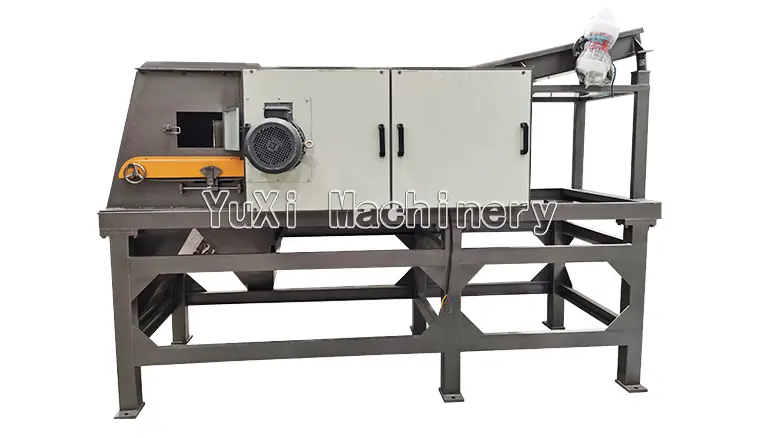
2. Why Aluminum Launches Farther Than Copper or Brass: The σ/ρ Ratio
Most equipment brochures simplify eddy current sorting to “metals fly forward, plastics fall down.” In real scrap yards processing mixed automotive Zorba or shredded appliances, throw distance depends on the balance between electrical conductivity (σ)—which drives induced current strength—and mass density (ρ)—which resists acceleration.
| Material | Conductivity σ (10⁶ S/m) | Density ρ (kg/m³) | σ / ρ Ratio (×10³) | ECS Sorting Behavior & Line Implication |
|---|---|---|---|---|
| Aluminum (Wrought & Cast) | ~37.0 | ~2,700 | 13.7 | Longest throw. Low mass and high conductivity let aluminum clear the splitter cleanly—ideal for UBC aluminum lines and Zorba recovery. |
| Copper | ~59.9 | ~8,960 | 6.7 | Strong reaction, shorter arc. Highest conductivity, but 3.3× heavier than aluminum; lands closer to the splitter than light aluminum fragments. |
| Zinc | ~16.9 | ~7,140 | 2.4 | Moderate throw. Recovers into mixed Zorba, requiring downstream dense-media or XRT sorting to meet low-zinc Twitch smelter caps. |
| Brass | ~15.2 | ~8,500 | 1.8 | Short throw. Sensitive to splitter angle and belt speed; chunky brass pieces often fall into the middlings cut if rotor RPM is set too low. |
| Austenitic Stainless Steel (304/316) | ~1.0 – 2.5 | ~7,500 – 8,000 | <0.5 | Negligible repulsion. Behaves like non-metallic waste on standard ECS belts; must be captured downstream by induction sensors to produce Zurik. |
| Plastics, Rubber, Glass, Foam | 0 | 900 – 2,500 | 0 | Zero deflection. Drops cleanly off the pulley edge into the reject chute unless physically entangled with metal hooks or wet fines. |
Under the ISRI / ReMA Nonferrous Scrap Specifications Circular, the mixed non-ferrous stream recovered by eddy current separation is traded as Zorba (predominantly aluminum alongside copper, brass, zinc, and trace heavy metals). Refining Zorba into high-value cast-aluminum Twitch—which caps free zinc, magnesium, and analytical iron at 1% each and total non-metallics at 2%—typically pairs upstream ECS sorting with downstream XRT or float-sink density separation inside a complete scrap aluminum recycling line.
3. Eccentric vs. Concentric Magnetic Rotors: Preventing Drum Burnout
Selecting the wrong rotor geometry is the single most expensive operational mistake on mixed-scrap lines. Both designs use rare-earth NdFeB magnets, yet their failure modes differ sharply:
| Design Parameter | Concentric Rotor | Eccentric Rotor |
|---|---|---|
| Rotor Axis Alignment | Centered inside the outer drum shell; uniform magnetic field around the full 360° circumference. | Offset forward inside the shell; magnetic field concentrates tightly at the 1–3 o’clock discharge zone. |
| Tramp Steel Risk | High burnout risk. Escaped steel bolts or nails pin to the shell underside, spin against the belt, and rapidly heat through the fiberglass/carbon drum. | Self-clearing protection. Weak magnetic flux on the return side lets tramp steel drop off safely before it can overheat or puncture the shell. |
| Pole & Adjustment Flexibility | Fixed magnetic center; fewer tuning options for variable scrap densities. | Eccentric angle adjusts easily to tune throw arcs for coarse vs. fine non-ferrous fractions. |
| Best Scrap Applications | Ultra-clean, pre-sorted non-ferrous feeds with virtually zero ferrous contamination (e.g., clean plastic regrind, dry UBC after double magnetic drums). | Auto shredder Zorba, WEEE e-waste, incinerator bottom ash (IBA), and mixed construction scrap where stray steel is unavoidable. |
4. When NOT to Rely on an Eddy Current Separator Alone
Engineering Guardrail: No matter how high the magnetic gauss rating, an ECS has hard physical limits. Plan complementary sorting stages whenever your feed hits these four boundaries:
- Fine Particles Below 2–3 mm: Induced eddy currents shrink dramatically with particle diameter while aerodynamic drag increases. For fine shredded copper cables or PCB powders (<2 mm), deploy an air-gravity table or high-voltage electrostatic separator instead.
- Austenitic Stainless Steel & Insulated Wire Harnesses: Thin insulated wires and 304/316 stainless lack sufficient σ/ρ repulsion. Recover them post-ECS with an induction sensor sorter (Zurik stage).
- Unscreened Wide-Ratio Feed (>3:1 Size Spread): Feeding 5 mm aluminum chips alongside 100 mm cast housings in one pass forces the splitter backward, dragging heavy plastics into the product bin. Always split material on a trommel or vibrating screen first (see our ECS particle-size separation guide).
- Wet, Oily, or Sticky Material: Moisture glues fine dust and plastic film onto aluminum surfaces, lowering effective throw and downgrading smelter acceptance.
5. Practical Tuning Checklist: Belt Speed, Rotor RPM & Splitter Setup
YUXI eddy current separators operate across a 3–150 mm particle window with adjustable 1,500–4,000 RPM rare-earth rotors and customizable eccentric or concentric pole layouts (achieving up to 98%+ dry non-ferrous recovery on properly screened feeds). During commissioning, lock in parameters in this order:
- Set Monolayer Feeder Amplitude First: Confirm zero particle overlap at peak tonnage before touching the splitter.
- Match Rotor RPM to Fraction Size: Coarse scrap (25–150 mm) separates cleanly at lower RPM (1,500–2,400 RPM) with lower bearing heat; fine fractions (3–25 mm) demand higher frequency (2,800–4,000 RPM) and tighter pole pitch.
- Balance Belt Speed Against Trajectory Spread: Higher belt speed widens the horizontal throw of both metals and plastics; slow the belt slightly if heavy plastics jump the divider.
- Audit Tailings Weekly: Hand-sort a 20 kg sample from the reject chute. If recoverable aluminum (>5 mm) exceeds 2%, check upstream drum-magnet carry-over, feeder clumping, or splitter height before increasing motor speed.
Need ECS Rotor & Belt-Width Sizing for Your Scrap Stream?
Share your target particle size distribution (mm), hourly throughput (t/h), and non-ferrous mix (UBC, Zorba, WEEE, or bottom ash) to get an eccentric/concentric pole recommendation and factory material test-run plan.
References
- Recycled Materials Association (ReMA) / ISRI, Nonferrous Scrap Specifications Circular (Zorba, Twitch & Zurik Definitions).
- Recycled Materials Association (ReMA), Industry Standards & Recycled Commodity Specifications Portal.
- U.S. Geological Survey (USGS), National Minerals Information Center: Aluminum Statistics and Scrap Recovery Information.
Frequently Asked Questions
Why can an eddy current separator sort aluminum and copper if they are non-magnetic?
An eddy current separator does not attract metals with a static magnet. Instead, its high-speed rotating rare-earth rotor creates a rapidly alternating magnetic field that induces circulating electrical currents (eddy currents) inside conductive metals. Those currents produce an opposing magnetic field that physically repels aluminum and copper forward over the splitter plate while plastics drop vertically by gravity.
Should a scrap metal yard choose an eccentric or concentric eddy current rotor?
For mixed shredder scrap, ELV Zorba, WEEE, or UBC bales where stray steel bolts or nails can slip past upstream magnets, an eccentric rotor is strongly preferred. Offsetting the magnetic rotor inside the shell keeps the active field focused at the discharge point so stray ferrous pieces fall away instead of pinning to the drum and burning through the composite shell.
Can an eddy current separator recover stainless steel or fine particles below 3 mm?
Standard eddy current separators cannot reliably eject austenitic stainless steel (304/316) because its electrical conductivity-to-density ratio is near zero. Likewise, very fine particles below 2–3 mm develop weak eddy loops and suffer from air drag; plants typically use induction/XRT sensor sorters for stainless (Zurik) and electrostatic or air-gravity separators for fine granules.
Why must shredded scrap be screened into narrow size fractions before eddy current separation?
Throw trajectory depends on both metal chemistry and particle geometry. Mixing 6 mm fines with 80 mm chunks on one belt forces a compromised splitter position—either kicking plastics into the metal bin or letting smaller aluminum pieces fall into tailings. Keeping each ECS feed within roughly a 3:1 top-to-bottom size ratio maximizes both recovery and purity.
Online Message