




 Request Quote

Product Center
-
- Biomass Shredding and Recycling Line
- OCC Paper Dry Pulping & Cardboard Recycling Line
- Scrap Aluminum Recycling Line
- Waste Car Recycling Line
- Waste Refrigerator Recycling Line
- Copper Aluminum Radiator Recycling Line
- Motor Rotor Recycling Line
- Copper Wire Recycling Line
- Waste Ink Cartridge Recycling Line
- Aluminum UBC Scrap Recycling Line
Get a Quote
Contact Us


Summary
A motor stator recycling machine can mean two quite different systems. A cutter and winding puller works on a stator that has been exposed and secured; it tries to remove the winding before the iron core is broken into small pieces. A crushing and sorting line takes approved, prepared motor parts, breaks the attachment between metals and then separates the resulting fractions. The first route depends on how well individual stators can be handled. The second depends on liberation, feed consistency and separation. Neither is automatically the better buy.
For customers considering YUXI equipment, start with the published motor rotor recycling line. It describes a crushing and separation route using a vertical crusher, magnetic separation, specific-gravity sorting and dust collection. It does not publish a stand-alone hydraulic stator cutter/puller specification. This guide explains how to decide when a dismantling work cell makes sense, when bulk processing deserves a trial, and what to send a supplier so the quotation covers the right task.
First identify the metal you are trying to recover
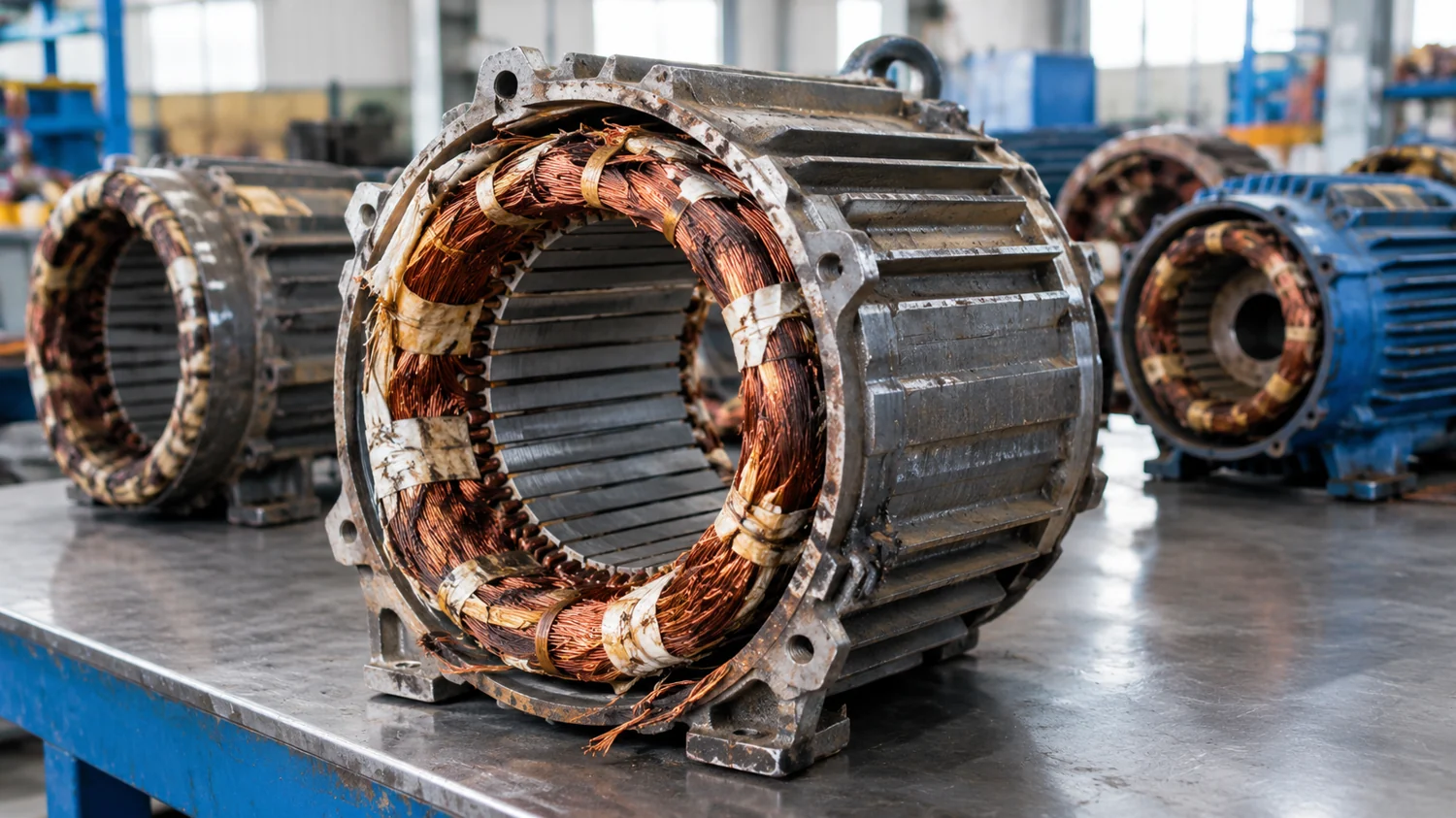
“Motor recycling” covers several feedstocks that should not go on the same purchase order without clarification. In a common induction motor, the stator is the stationary laminated core carrying the power windings. The rotor sits on the shaft. Its squirrel-cage bars are frequently aluminum, although copper designs exist. Wound-rotor and DC machines introduce further differences. A U.S. Department of Energy motor-repair glossary makes this distinction explicit, and a technical study of low-voltage induction motors describes the separate stator and rotor metal fractions.[1][2]
That matters to the buyer standing beside a container of scrap. A machine offered for “rotor copper recovery” may be excellent for a copper-wound armature but of little use for an ordinary aluminum-cage induction rotor if copper is the only sales target. Likewise, a clean-looking stator is not necessarily easy to pull. Resin, slot liners, winding geometry and damage from previous dismantling all affect the job.
Before asking for capacity, divide the lot into practical groups: complete motors; exposed stators with copper windings; exposed stators with aluminum windings; loose rotors and armatures; and mixed broken motor scrap. Keep unfamiliar EV traction motors and magnet-bearing assemblies in a separate, unapproved group. The motor nameplate, the outside diameter of the stator, its axial length, its mass and photographs of both winding ends are more useful than simply calling everything “scrap motors.”
If a seller cannot show where the copper is situated in the supplied material, pause the equipment comparison. Copper content, copper accessibility and copper saleability are different questions. A projected recovery percentage without a material definition is not an operating specification.
Two different machine routes, side by side
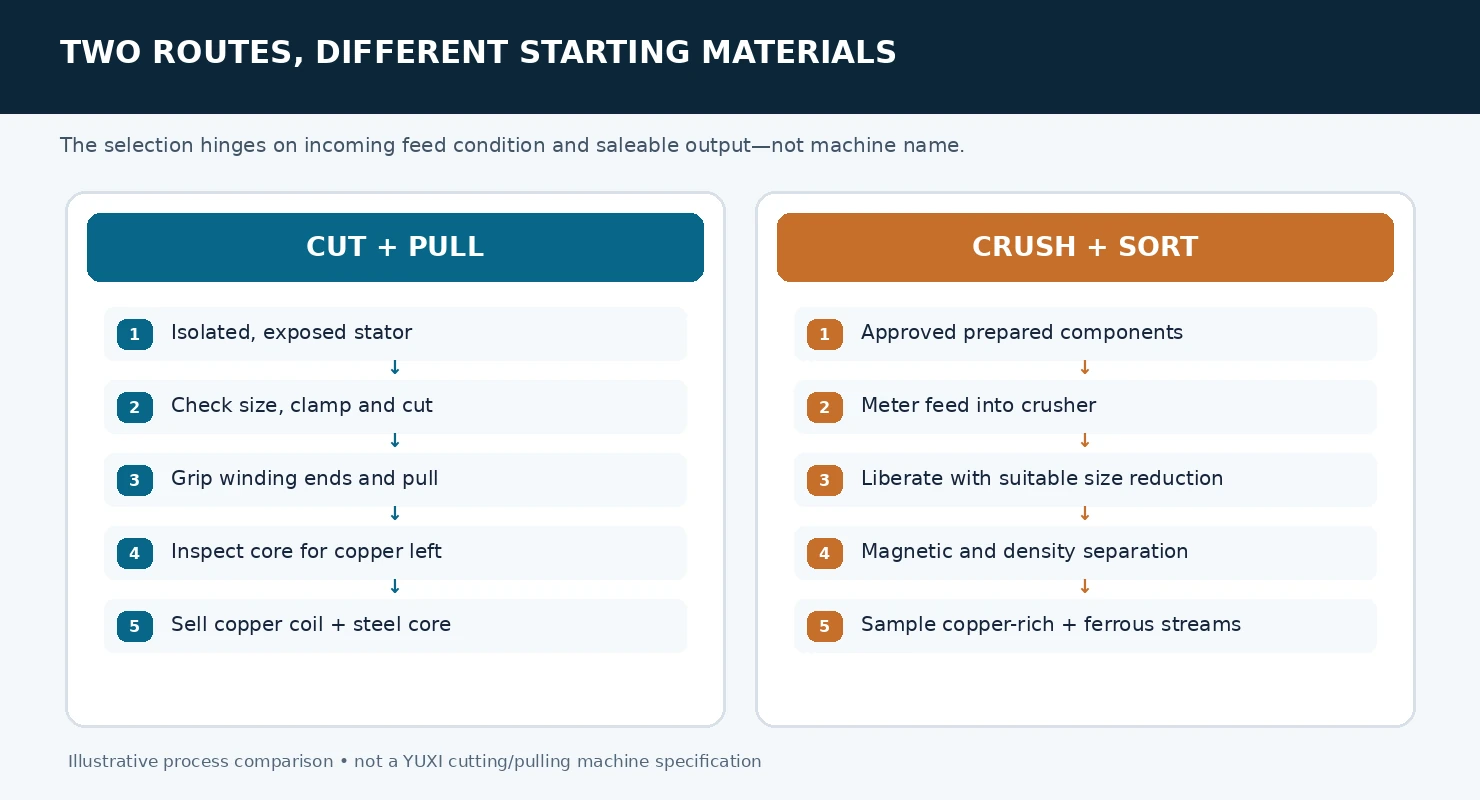
A cutter/puller and a crusher-based plant can both play a part in motor recycling, but they solve different mechanical problems. One tries to remove coherent windings. The other aims to free metals from each other after size reduction.
| Buying question | Cutting and pulling | Crushing and sorting |
|---|---|---|
| Best starting feed | Individual, accessible stators within the tool’s clamping range | Approved prepared or mixed motor components suited to controlled size reduction |
| Main operation | Secure the core, sever winding ends and draw coils from slots | Reduce size, liberate attachments, remove iron and sort remaining fractions |
| Work before the main machine | Housing removal, rotor removal, orientation and presentation | Inspection, prohibited-item removal, sometimes dismantling and size preparation |
| Output to verify | Extracted winding grade and copper left inside the stator | Contained copper and iron contamination across every output fraction |
| Likely throughput bottleneck | Handling, cutting, pulling and failed extractions | Feeding, liberation, recirculation or downstream separation |
| Often overlooked cost | Operator time and rework of stuck windings | Wear, energy, collection systems, fines and sorting rejects |
The table is a starting point, not a ranking. A recycler with 100 similar, accessible copper-wound stators per day may need an entirely different installation from a processor receiving several tonnes of mixed dismantled motors each shift. A cheap machine sized to the wrong incoming lot is expensive from the first week.
What a stator cutter and copper winding puller actually does
The sequence is more demanding than the sales phrase “cut and pull” suggests. First, the housing must be removed or opened without making the stator unsafe to clamp. A worker or handling device then positions the stator so the tooling can act on the winding ends. A cutting tool severs the coils on one end. On a suitable stator, a hydraulic gripper then draws the freed conductors from the opposite side. A historic motor-recycling patent documents this combination of holding, cutting and opposed pulling equipment.[3]
Some commercial machines cut the exposed winding ends. Others split the stator core as part of the process. Do not treat those as identical operations. Ask whether a quote includes housing removal, stator splitting, coil-end cutting and winding extraction, or only one or two of them. The answer changes your upstream labor and whether additional tools are needed.
Why the pull sometimes fails
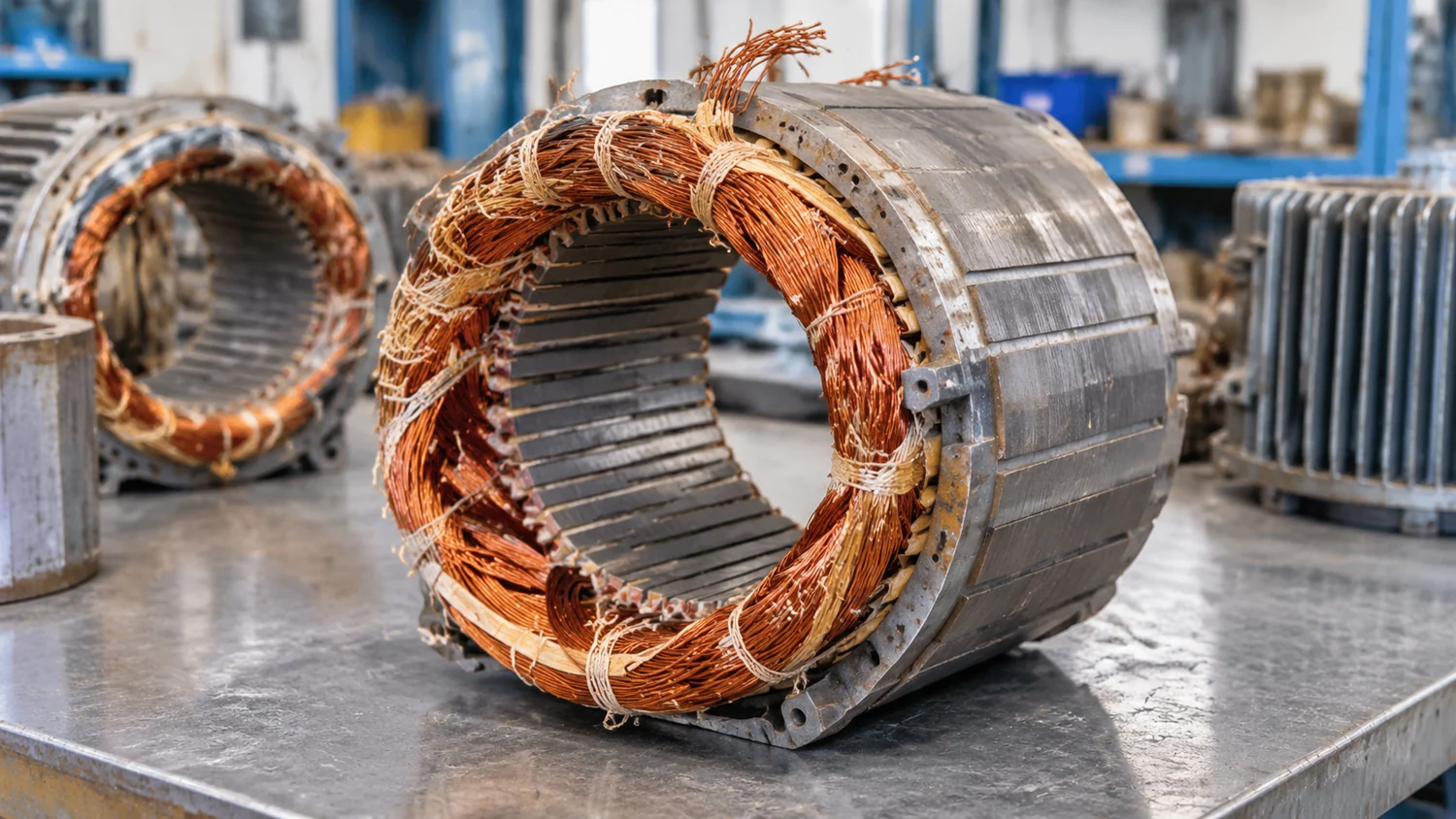
Look closely at a used stator. The wire is not loose copper sitting in a tube. It lies in laminated slots with insulation. Some cores have heavily impregnated windings; others have collapsed slots or damaged conductors from prior handling. A pulling jaw may grip only one part of a bundle. If the coil breaks or leaves copper trapped deeper inside the slot, a second stroke may not finish the job.
The important test is not how smoothly a machine extracts a clean demonstration coil. It is what happens with the worst recurring stator in your own supply. Does the operator have to rearrange the grip? Is the core too short to seat properly? Can the tooling reach both ends? How many units go to a rework bench? These questions usually tell you more than an advertised cycles-per-hour figure.
Diameter is only the first fit check
Most published stator cutter/puller brochures list a usable diameter range. It is useful, but incomplete. A narrow, long core and a wide, shallow one can have very different clamping and pulling behavior at the same outside diameter. Add the core’s axial length, overall weight, winding end-turn geometry, available clearance and lifting method to the acceptance sheet. A supplier should confirm each limiting dimension with an actual machine drawing or trial.
Also distinguish copper from copper-colored aluminum winding. Aluminum coils may require a different sales destination and should never be priced as recovered copper. A sorting rule is needed before either machine is purchased.
What changes when you crush the stator instead?
In a bulk route, the goal shifts from extracting a recognizable coil to liberating metal fractions. Prepared motor components pass through suitable crushing equipment. A magnetic step pulls out much of the ferrous fraction. Nonmagnetic material may need additional sizing and density-based separation, depending on what was fed and the quality the buyer expects. In YUXI’s published configuration, the main stages are vertical crushing, magnetic separation, specific-gravity separation and dust collection.
The vertical metal crusher is relevant because the breakup stage determines what the sorter receives. If a copper strand remains caught around an iron fragment, a magnetic separator may carry some of that copper away with the iron. The magnet is not defective; the upstream liberation was incomplete. Shredding finer is not always the answer either. Excessive fines can complicate dry sorting and increase dust-handling demands.
A hammer mill metal crusher can be considered where a supplier’s process design calls for further impact-based size reduction. That does not mean adding a hammer mill automatically improves copper recovery. The machine must be justified by feed trials showing the effect on liberation, wear and downstream sorting. For mixed motor scrap, the interaction between crusher discharge and the separators is usually more consequential than the crusher’s no-load rating.
One practical mistake is to ask for “99% purity” without naming the stream. Purity of the copper-rich fraction, recovery of total incoming copper, ferrous removal efficiency and total plant mass yield are four different measurements. They can improve or deteriorate independently.
The problem with long wires and tangled fragments
Scrap stators can yield wire loops and strips of steel that travel together. A longer copper winding may wrap around a rotating part or become entangled with ferrous scrap instead of forming easily separable particles. That is a reason to inspect discharge geometry and downstream screen performance, not a reason to claim crushing is unsuitable for all stators. An experienced equipment proposal should explain where entanglement is expected and what trial will reveal it.
If your waste stream also contains cable and loose insulated wire, do not assume the motor line will automatically perform the same job as a copper wire recycling line. Wire granulation and separation generally operate on a different material condition from an intact steel-laminated stator. Combining the feedstreams can obscure both capacity and output-grade measurements.
Feedstock matrix: which route deserves a trial?
Buyers often request a recommendation from one photograph. That is rarely enough. Use a feed matrix to decide which samples should be tested on which route. The categories below describe a trial priority, not blanket approval for processing.
| Incoming material | Cut/pull trial | Crush/sort trial | What to check before acceptance |
|---|---|---|---|
| Uniform copper-wound stators, housing removed | Strong candidate | Also possible | Slot design, end-turn access and residue after pull |
| Complete small induction motors | Only after opening/preparation | Only if approved with preparation rules | Time to remove housing, rotor and accessories |
| Mixed broken stator and rotor components | Weak fit for direct pulling | Stronger candidate | Oversize, shafts, attachments and copper versus aluminum |
| Hard-impregnated stators | Test failure and rework rates | Test liberation and contamination | Residual copper in core, fumes/dust controls |
| Aluminum-wound stators | Different value stream | Separate test and collection route | Confirm conductor metal before sales valuation |
| EV permanent-magnet traction motors | Specialist assessment required | Specialist assessment required | Magnet hazards, stored energy and material-specific plan |
Particularly avoid treating a sealed compressor, energized electrical assembly, fluid-containing device or unknown battery-containing unit as an ordinary motor stator. These must go through a separate identification and safe-preparation process. A general-purpose motor recycling quotation is not approval to feed hazardous or unprepared items.
How to compare throughput without getting fooled
One brochure may quote pieces per hour. Another may quote tonnes per hour. Neither figure is wrong by itself; they just describe different boundaries. A cutter/puller might be measured from a stator already resting in a fixture. A crusher line may be measured from the belt inlet with pre-dismantled components. What you need is the rate from your incoming accepted material to the collected product fractions under an agreed operating schedule.
For a cutter/puller trial, record five time blocks: unloading and identification, housing or rotor removal if required, cutting, pulling, and sorting or rework. Include tool adjustments and handling of the largest recurring piece. Record rejected units separately rather than erasing them from the denominator.
For a crushing line, record preparation, net feed time, clearing stops, separator adjustment, cleanout and any repeat pass. A running motor is not evidence that the full system is producing saleable copper. A full bin of copper-rich particles does not establish that the steel discharge is free of residual copper.
Worked example: same 1,080 kg batch, different scope
Imagine a representative, already-sorted batch of 180 accepted stators weighing 6 kg each. This is an illustration of the calculation method, not a result from a YUXI or competitor test.
- Cut/pull route: an average 85-second active cycle per stator gives 4.25 hours of active cycles. Add 1.2 hours of preparation and 0.8 hours of handling and rework. Total elapsed processing time is 6.25 hours, or about 173 kg of input per hour.
- Crush/sort route: suppose the same batch takes 0.6 hour to prepare, 2.1 hours to process and 0.8 hour for sorting adjustments and cleanout. Total elapsed time is 3.5 hours, or about 309 kg of input per hour.
That does not prove the crusher is nearly twice as productive in a real plant. It illustrates why a fair comparison uses the same input boundary, includes the work that gets left out of demonstration videos, and confirms identical output requirements. The two routes may also demand different labor crews and space.
Now add the copper grade instead of comparing bag weight
Assume separate feed sampling estimates that the batch contains 94 kg of recoverable copper. The cut/pull route collects 84 kg of winding material assaying 97% copper; this contains about 81.5 kg of copper. The crush/sort route collects 86 kg of copper-rich product assaying 92%; this contains about 79.1 kg of copper. The estimated copper recoveries are therefore about 86.7% and 84.2%, respectively.
Notice the trap. The second route produced the heavier copper-rich fraction but less contained copper. Both purity and contained-copper recovery matter. The assumed 94 kg in the feed must itself be established by a representative, documented material audit; without one, calling either recovery figure accurate would be misleading. For commercial acceptance, also agree whether customers will pay for the impurities or penalize them.
Once these numbers are known, calculate labor cost, measured electrical consumption, maintenance allowance and disposal cost per accepted input tonne. The correct commercial question is not “which machine is cheaper?” It is “which tested route produces a saleable result at a sustainable total processing cost for this specific incoming lot?”
The five results worth asking for in a supplier trial
Ask the supplier to process samples that reflect how the yard actually works. That means including badly varnished pieces, aluminum-wound surprises, large but common stators and anything the operator normally struggles to prepare. A perfectly clean batch of identical demonstration pieces is valuable for seeing the mechanism, but it is a poor substitute for an acceptance trial.
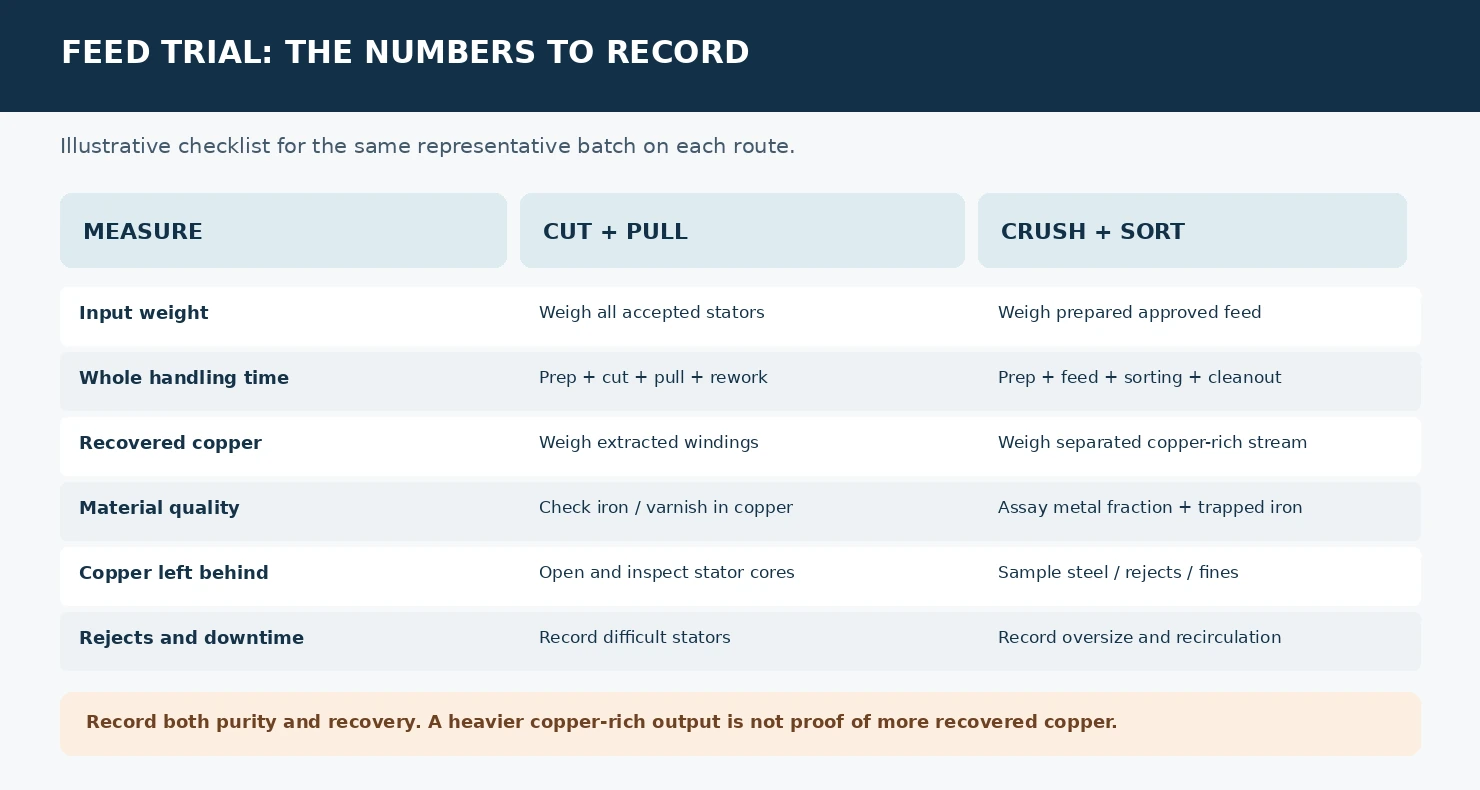
- Accepted input and rejects: weigh the initial lot, sort accepted and rejected items, and explain why each item was rejected. Only approved material belongs in the rate calculation.
- Elapsed labor and machine time: record operators, shifts, setup, stoppages, cutting/pulling repetitions and any re-feed. Show net running time and total elapsed time.
- All output weights: weigh copper-rich material, iron, aluminum, other nonmetallic fractions, retained oversize and collected dust where relevant. Reconcile the mass balance rather than showing one selected product tray.
- Quality and unrecovered copper: sample copper products for iron, aluminum, coatings and insulation. Then sample steel streams, rejects and fines for copper still present. Report the test method and sample size.
- Operating conditions: document electricity metering, wearing parts, tool changes, number of personnel, dust controls and the floor space used by material handling and maintenance access.
A useful inspection is to open a random selection of supposedly “finished” stator cores after pulling and check for trapped windings. For the crushing route, examine random ferrous product samples for attached copper. Both checks tell you something that a glossy photograph of recovered copper cannot.
One further distinction is essential: do not multiply a claimed “separation efficiency” by a copper content guess and call it a recovery guarantee. Efficiency may refer to a particular sorting machine or test material, not the whole line. Ask for the exact test definition.
Machine selection: which specification should drive the quote?
For a cutting and pulling work cell
Request the allowable stator outside diameter, core length, unit mass and winding-end geometry. Ask whether the machine clamps exposed cores or opens motor housings. Clarify whether it cuts a copper end turn, splits the laminated core, or both. Confirm the clamping method, pulling stroke, gripping-tool sizes, handling aids, oil requirements, power supply and operator guarding. If the supplier promises a rapid cycle, ask how much of it is actual productive extraction on the largest repeated feed size.
For a crushing and separation system
Request the exact maximum incoming part size, material exclusions, belt loading method, rotor/stator proportion and expected output size range. Ask what the crusher releases, what the magnet actually removes, and how the remaining metal mixture is further classified. Include separation settings and dust collection in the quotation. Do not accept the main crusher motor’s rated output as the guaranteed capacity of the entire installation.
If you are comparing equipment makers rather than process routes, the site’s existing electric motor recycling manufacturers comparison offers a broader supplier overview. The present article intentionally stays with the narrower decision: where copper removal belongs in your material path.
Hybrid routes are sometimes more sensible
A yard can remove accessible copper windings from a high-value stator group and send the awkward or mixed remaining components to a suitable liberation line. That sounds complicated, but it may be more practical than forcing every piece through one machine. The extra sorting and transfer work has to earn its place. A hybrid route is justified only if test results show that the recovered product value or reduced contamination outweighs the extra handling, floor space and capital cost.
Another workable approach is to keep two commercial streams: stators with known copper windings for a removal cell, and rotor-heavy or broken scrap for bulk treatment. That can simplify batch records and prevent aluminum-rich pieces from quietly lowering the value assigned to a copper-rich lot.
Safety and operating boundaries that belong in the purchase specification
Hydraulic equipment can create severe point-of-operation hazards where a stator is clamped, cut or pulled. Operators may be close to the cutting zone when feeding and removing parts. OSHA’s guidance on hydraulic presses highlights the need for machine guarding around moving dies and pinch points; its recycling guidance also addresses safeguarding and lockout/tagout during maintenance.[4][5] Requirements vary by jurisdiction, so local safety review is still necessary.
For a dismantling cell, verify safe loading, guarded cutting and gripping, suitable lifting devices, emergency stops and procedures for jammed windings. A foot pedal is a control, not by itself a substitute for effective safeguarding. Stored hydraulic pressure must be addressed in the energy-isolation procedure.
For crushing and sorting, discuss feed inspection, containment of flying fragments, access interlocks, dust capture, bearing or drive service, and the steps for removing wrapped wire safely. Do not clear a machine by hand while it can restart. Mixed scrap can include oils, capacitors, batteries or other hazardous attachments; the acceptance procedure must identify and remove prohibited items before processing.
Thermal stripping should not be treated as a routine substitute for difficult pulling. Heating coated windings can create emissions requiring specialist controls, permits and processes. This guide concerns mechanical route selection, not instructions for burning insulation.
Situations where the obvious machine is the wrong one
- A mostly rotor-only lot: a stator coil puller cannot recover copper windings from material that does not contain those windings. First identify whether the rotors are aluminum-cage, copper-cage or wound-armature types.
- Unopened complete motors: a cutter/puller quotation that assumes clean exposed cores may leave you with an unpriced housing-opening operation and unplanned labor.
- Varnished, deformed or heavily mixed stators: the pulling route may require repeated grips and manual work; the crusher route needs a contamination and liberation trial. Neither deserves a blanket promise.
- Low-volume, occasional scrap: selling properly sorted motor scrap to a specialist may be more sensible than buying either process. Account for fixed costs before assuming vertical integration will pay.
- EV drive units or magnet-bearing motors: these require material-specific engineering and safety checks, not automatic approval under a generic motor stator recycling specification.
For most buyers the wrong decision is made before the equipment arrives, when the receiving material is described too broadly. A purchase request that says only “2 tons per hour motor machine, copper 99%” leaves too much undefined for a meaningful supplier comparison.
A purchase-request template you can actually use
Send a short material brief with photographs of a typical lot and its difficult edge cases. Include weekly tonnes, expected operating hours, the percentage of complete motors versus bare stators and loose rotors, and whether copper and aluminum windings are already separated. List maximum outside diameter, stator length, individual mass and remaining housing or shaft attachments. State the required saleable outputs, likely local buyer specifications and any limits on labor or floor space.
Then ask the equipment supplier for two things: the specific duty their machine will perform from the stated feed condition, and the test evidence that confirms the output condition. It is reasonable to request an itemized quotation showing preparation stations, main equipment, sorting modules, handling, safety systems, utilities, installation support and exclusions. It is not reasonable to expect one headline tonnage figure to answer every one of these questions.
When discussing YUXI’s existing crushing and separation line, ask which of your stator and rotor categories may be processed under the proposed configuration and which must be dismantled or rejected beforehand. If you need a stand-alone stator coil puller, say so explicitly: that is a different equipment requirement from the currently published YUXI line.
Choosing a machine for your motor scrap?
Share the material photos, stator dimensions, approximate lot mix and output target. YUXI can review the suitability of its published motor-component crushing and separation route; dedicated winding cutting/pulling capability should be confirmed separately rather than assumed.
FAQ
What is the difference between a stator recycling machine and a rotor recycling line?
A stator cutting/pulling machine targets windings embedded in an exposed stator core. A rotor or mixed motor-component recycling line generally focuses on size reduction and downstream material separation. The names are used loosely in listings, so confirm the incoming material and process stages before purchasing.
Is cutting and pulling better than crushing for copper recovery?
It can be a strong option for accessible copper-wound stators of repeatable sizes. Crushing can be more appropriate for approved mixed or awkward components, provided metal liberation and downstream separation are tested. Compare contained copper, quality, labor and waste from the same batch.
Can every electric motor stator be processed with a hydraulic puller?
No. Geometry, available winding ends, core length, unit mass, resin impregnation and conductor material all affect compatibility. Test both the common sizes and the difficult pieces that regularly arrive at the yard.
Why does a crushing line need magnetic separation?
Motor scrap contains substantial laminated steel and other ferrous parts. Magnetic separation removes much of that material after suitable liberation. It cannot reliably free copper physically attached to iron, so crusher discharge condition still matters.
How should a buyer compare motor recycling capacity claims?
Define accepted input material, record all preparation and downtime, then weigh finished saleable fractions. For cutter/pullers report pieces and input mass per elapsed hour; for a line report prepared feed and finished fraction throughput, including separator limitations.
Does YUXI’s published motor rotor line include a stand-alone stator cutter and puller?
The currently published YUXI motor rotor line describes crushing, magnetic separation, gravity separation and dust collection. It does not specify a separate hydraulic stator cutting/pulling work cell. Confirm any additional equipment in a written technical proposal before assuming it is included.
References
- U.S. Department of Energy, Model Repair Specifications for Low Voltage Induction Motors, glossary of stator, rotor and squirrel-cage construction. DOE motor glossary.
- Advances in Environmental and Engineering Research, Recycling Potential in the EU of Low Voltage Three-Phase Induction Motors Up to 75 kW. Research article.
- German patent DE3911490C1, Apparatus for recovering copper during the scrapping of electric motors; mechanical holding, cutting and pulling arrangement. Patent record.
- U.S. Occupational Safety and Health Administration, machine guarding eTool, hydraulic presses. OSHA press guidance.
- U.S. Occupational Safety and Health Administration, recycling and waste management hazards. OSHA recycling guidance.
Online Message