




 Request Quote


The best electric motor recycling machine manufacturer is not simply the company with the largest machine or the longest product list. The right choice depends on whether the feed is sorted stators, complete motors, loose rotors, starter motors, compressors or a mixed stream—and whether the required output is intact copper windings or separated metal fractions.
This 2026 editorial shortlist compares ten suppliers whose published equipment is relevant to at least one of those duties. Stokkermill ranks first for its unusually direct combination of a dedicated motor wrecker and integrated shredding systems. YUXI ranks second because its current motor-rotor line covers continuous crushing, magnetic removal, gravity separation and centralized dust collection. Bronneberg takes third place for a focused hydraulic dismantling route. The order changes if your project only handles sorted stators or, at the other extreme, needs a broad mixed-scrap plant.
What This Ranking Covers—and What It Does Not
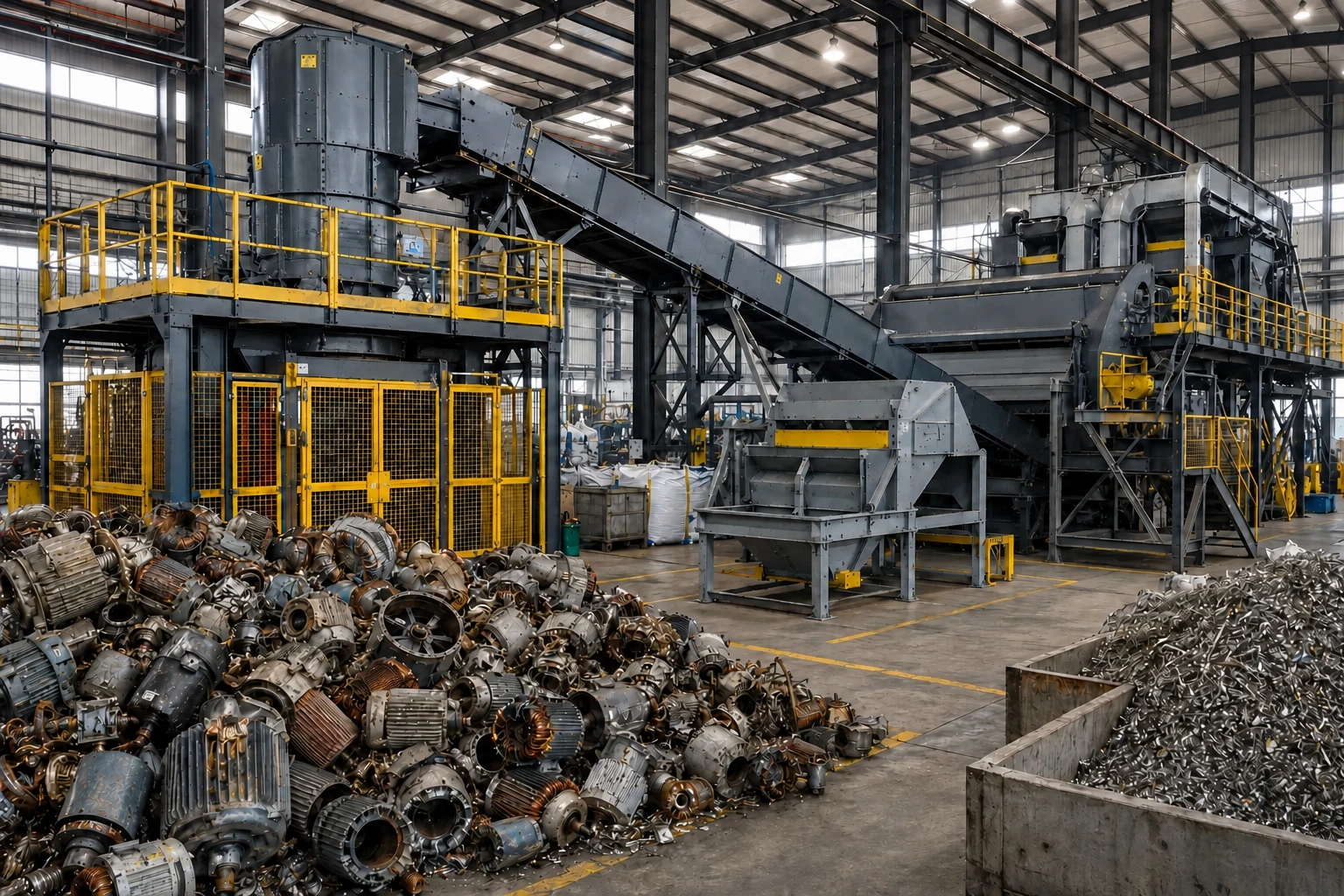
Search results often place three unlike products under the same name. A motor wrecker cracks a housing, splits a stator and pulls windings. A stator cutter and puller assumes the housing and rotor have already been removed. A liberation line reduces mixed motor components, removes ferrous metal and separates the remaining fractions. Comparing their stated “capacity” without defining the feed boundary is meaningless.
How We Ranked Electric Motor Recycling Machine Manufacturers
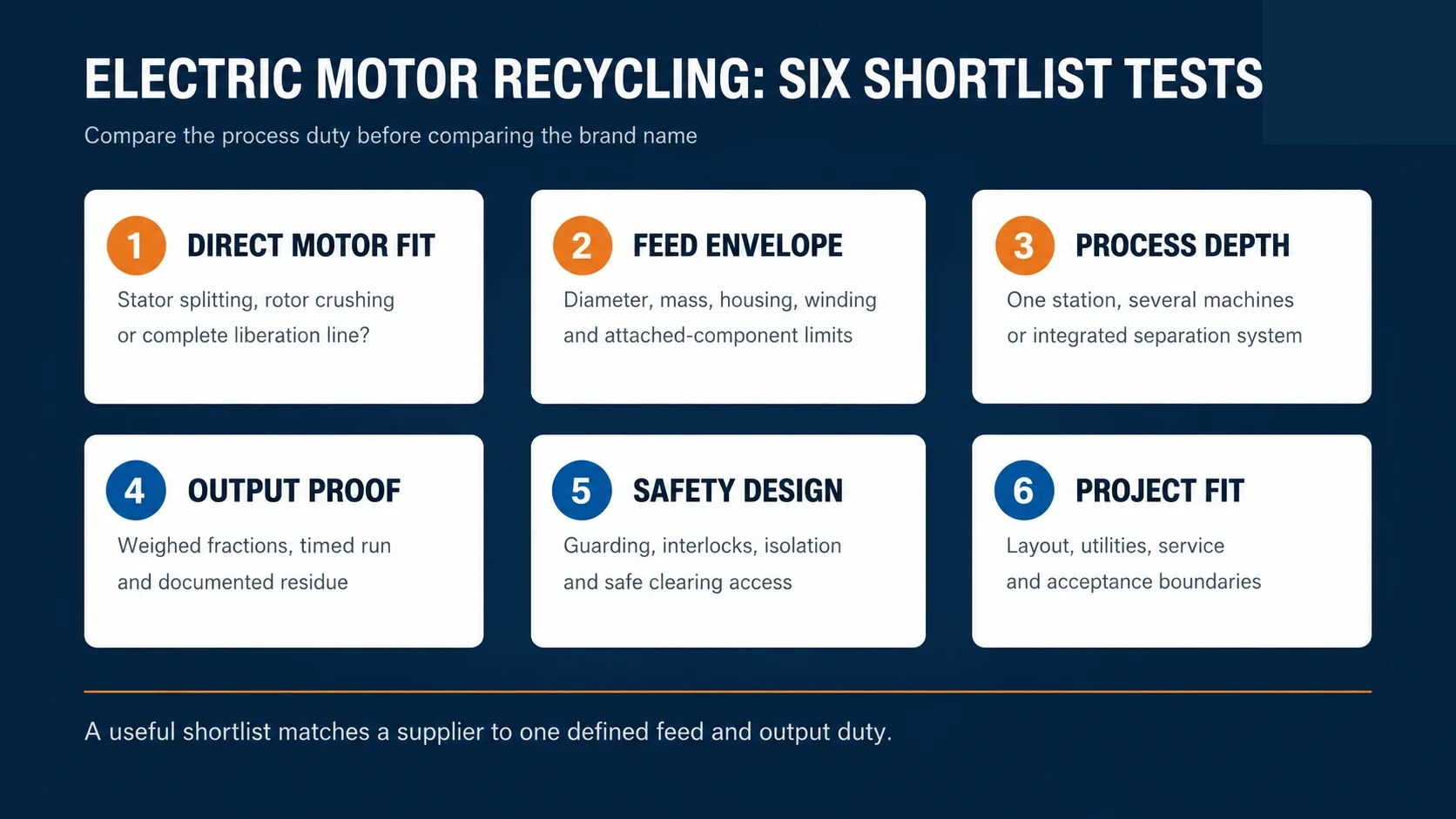
The ranking uses six criteria rather than treating company size as a proxy for project fit:
- Direct electric-motor relevance: dedicated stator, motor or rotor equipment carries more weight than a generic shredder that might accept motor scrap.
- Feed envelope: useful public information identifies diameter, mass, housing condition or the type of motor components accepted.
- Process completeness: the supplier can explain what happens before and after its main machine.
- Output evidence: the process can be tested through weighed streams rather than judged from one attractive copper sample.
- Safety and maintainability: guarding, interlocks, isolation, safe access and wear-part work are treated as design requirements.
- Project fit: utilities, layout, service and commissioning scope match the buyer’s actual plant.
Top 10 Electric Motor Recycling Machine Manufacturers
| Rank | Manufacturer | Country / base | Relevant equipment focus | Best project fit |
|---|---|---|---|---|
| 1 | Stokkermill Recycling Machinery | Italy | Dedicated E‑MotorChop plus hammer mills, refining and sorting systems | Buyers comparing both discrete dismantling and continuous liberation routes |
| 2 | YUXI Machinery | China | Motor-rotor crushing line with magnetic and gravity separation | Project-configured processing of rotors and mixed motor components |
| 3 | Bronneberg Recycling | Netherlands | Hydraulic electric motor wrecker | Organized dismantling of suitable complete motors and stators |
| 4 | O’Jung / Solid Equipment | South Korea / USA distribution | Multi-platform motor cracking, stator splitting and winding extraction | North American yards seeking a focused semi-automatic work cell |
| 5 | BSGH Granulator | China | Motor wreckers, stator cutters and copper pullers | Small-to-medium dismantling operations needing several station formats |
| 6 | 3T Machinery | China | Housing breaking, stator cutting and winding extraction equipment | Buyers needing configurable motor-dismantling machinery |
| 7 | SUNY Group | China | Stator/rotor dismantling machines and crushing-separation lines | Projects comparing manual-fed machines with broader e-waste systems |
| 8 | VANER Machinery | China | Motor stator recycling machines and copper extraction equipment | Compact stator-processing applications |
| 9 | Amisy / Whirlston | China | Stator cutting and copper winding pulling systems | Entry and intermediate-scale dismantling applications |
| 10 | Walldorn Machinery | China | Motor stator cutting and pulling equipment | Buyers evaluating a basic dedicated work cell |
Manufacturer Profiles
1. Stokkermill Recycling Machinery
Stokkermill stands out because it addresses both sides of the buying decision. Its dedicated E‑MotorChop targets copper recovery from stators, while its electric-motor shredding systems combine hammer milling, refining and sorting for motors, starters, alternators, compressor units and related feed. That breadth matters: a recycler can discuss whether a clean dismantling route or a bulk liberation route is justified instead of forcing every motor through the same machine.
Ask during evaluation: define the exact feed assigned to the wrecker and the material assigned to the hammer-mill route; request separate acceptance criteria for each.
2. YUXI Machinery
YUXI’s strongest fit is the integrated processing of waste motor rotors and related motor components. Its published line uses a vertical crusher to improve liberation, magnetic separation for ferrous material, specific-gravity separation for copper and aluminum, centralized dust collection and PLC control. This is a production-line proposition, not simply a hand-fed winding puller.
The advantage for a mixed-feed project is scope continuity. The same supplier portfolio includes upstream metal size reduction and downstream separation equipment, so the proposal can be developed around a material path rather than a single machine. Buyers should still send a representative feed inventory and agree a trial protocol. The vertical metal crusher is a relevant internal reference for the liberation stage, while the motor rotor recycling line defines the overall process route.
Ask during evaluation: which incoming motor parts require disassembly, what maximum recurring item governs the feed system, and how each output fraction will be sampled.
3. Bronneberg Recycling
Bronneberg is a strong specialist for discrete motor dismantling. Its electric motor wrecker is presented around a three-stage hydraulic sequence: opening the housing and removing the rotor, splitting the stator, then separating copper from the iron core. That makes the process boundary easy to understand for yards receiving motors within a controlled range.
Ask during evaluation: test the smallest, largest and most awkward recurring motor and record operator handling time separately from hydraulic cycle time.
4. O’Jung / Solid Equipment
O’Jung equipment, distributed in North America by Solid Equipment, uses two- or three-platform arrangements for housing cracking, stator splitting and winding extraction. Separate platforms can reduce waiting between operations, but the practical output still depends on motor preparation, material presentation and operator rhythm.
Ask during evaluation: clarify local parts support, voltage, guarding, accepted stator diameter and whether the quoted rate includes housing removal and material handling.
5. BSGH Granulator
BSGH offers a broad family of motor dismantling machines, including stator cutters, winding pullers and combined motor wreckers. It is relevant to buyers who want to size a work cell around a narrower motor range or compare staged and combined configurations.
Ask during evaluation: request a live trial using the buyer’s varnished, aluminum-wound and difficult-to-grip stators, not only clean copper-wound samples.
6. 3T Machinery
3T focuses directly on scrap electric motor processing and markets equipment for housing breaking, stator cutting and winding extraction. Its position in the middle of the list reflects direct application relevance, while project buyers should obtain clearer evidence for sustained production, service response and the limits of each configuration.
Ask during evaluation: obtain an itemized machine scope, tool-change method, cylinder cycle data under load and a guarded operating layout.
7. SUNY Group
SUNY combines motor stator/rotor equipment with a wider portfolio of cable, e-waste and metal-separation systems. That broader scope can help where the project also handles harnesses or mixed electronic scrap.
Ask during evaluation: separate the performance commitments for motor scrap from those for cables or general e-waste; they should not share one generic capacity claim.
8. VANER Machinery
VANER offers compact motor-stator recycling machines aimed at opening housings and extracting copper. The range is relevant for smaller yards, repair networks and aggregators that can pre-sort motors before processing.
Ask during evaluation: confirm the accepted stator range, aluminum-winding behavior, guarding and the number of manual lifts required per motor.
9. Amisy / Whirlston
Amisy markets stator cutting and copper pulling systems for recovering windings from prepared motor cores. Its equipment belongs in the shortlist when the buyer’s feed is already dismantled and the business case depends more on reducing hand work than on building a full separation plant.
Ask during evaluation: include resin-heavy, damaged and short-end windings in the trial and record incomplete pulls as rework.
10. Walldorn Machinery
Walldorn’s published motor stator machine uses a cutting stage followed by winding extraction. The simple duty can suit a dedicated work cell, but buyers need to do more verification around throughput, safety architecture, parts and after-sales support before placing it beside the higher-ranked integrated suppliers.
Ask during evaluation: request manuals, electrical drawings, guarding details, consumable tooling prices and a remote-support procedure before comparing purchase price.
Choose the Process Route Before the Manufacturer
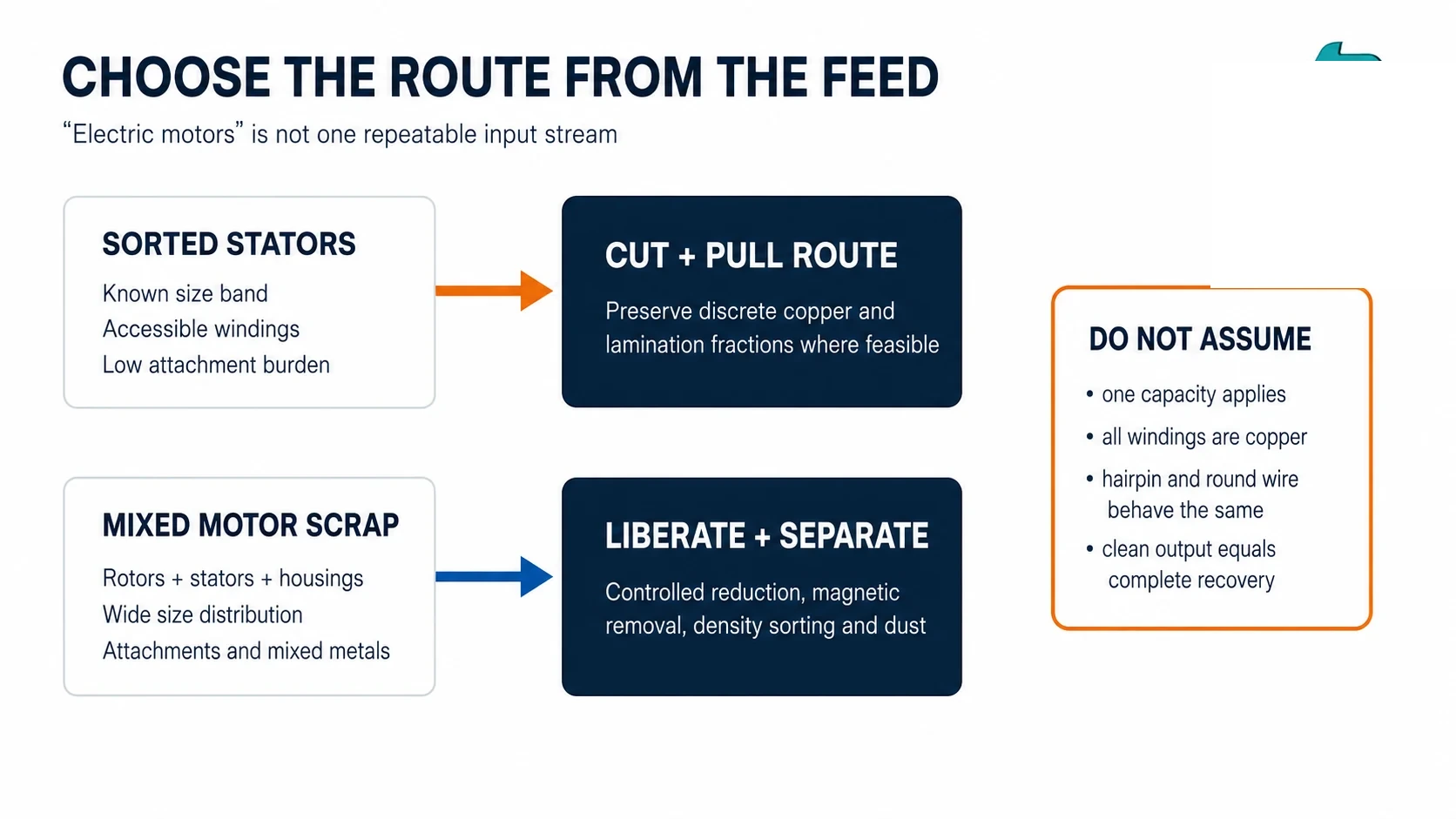
Route A: crack, split and pull
This route can preserve bulky copper windings and relatively clean steel laminations. It works best when motors are pre-sorted into a manageable size range, attachments have been removed and the windings can be gripped. The constraint is labor and feed variability. A large motor may require lifting assistance; resin-rich or aluminum windings may not pull like the demonstration sample.
Route B: liberate and separate
A continuous line is better suited to a larger or less uniform mix of rotors, stators and motor components. Size reduction exposes joined materials; magnetic separation removes ferrous metal; gravity or other separation stages concentrate the non-ferrous fraction. If the project includes liberated wire pieces or other copper-plastic material, the separate copper wire recycling line helps explain why granulation is a different downstream duty rather than an automatic part of every motor line.
The correct comparison is net value per accepted ton after labor, rework, residue, copper loss, energy, wear and downtime—not copper purity alone.
Build a Feed Envelope That a Supplier Can Test
A useful feed schedule divides at least one representative month of receipts by component type, size and condition. Record complete motors, stripped stators, rotors/armatures, starters, alternators and compressors separately. Then add:
- Diameter and length bands, plus the largest recurring item;
- Mass per piece and approximate pieces per hour;
- Housing material and whether housings remain attached;
- Copper-wound, aluminum-wound, hairpin or unknown winding construction;
- Shafts, gears, bearings, oil, plastics, fans and cable attachments;
- Burned, wet, dirty, varnish-heavy or damaged material;
- Prohibited items and the inspection method used to remove them.
The metal shredder versus hammer mill comparison explains why low-speed shearing and high-speed impact do different work. Motor composition and preparation decide which stage becomes the bottleneck.
Use a Mass-Balance FAT, Not a Showroom Sample
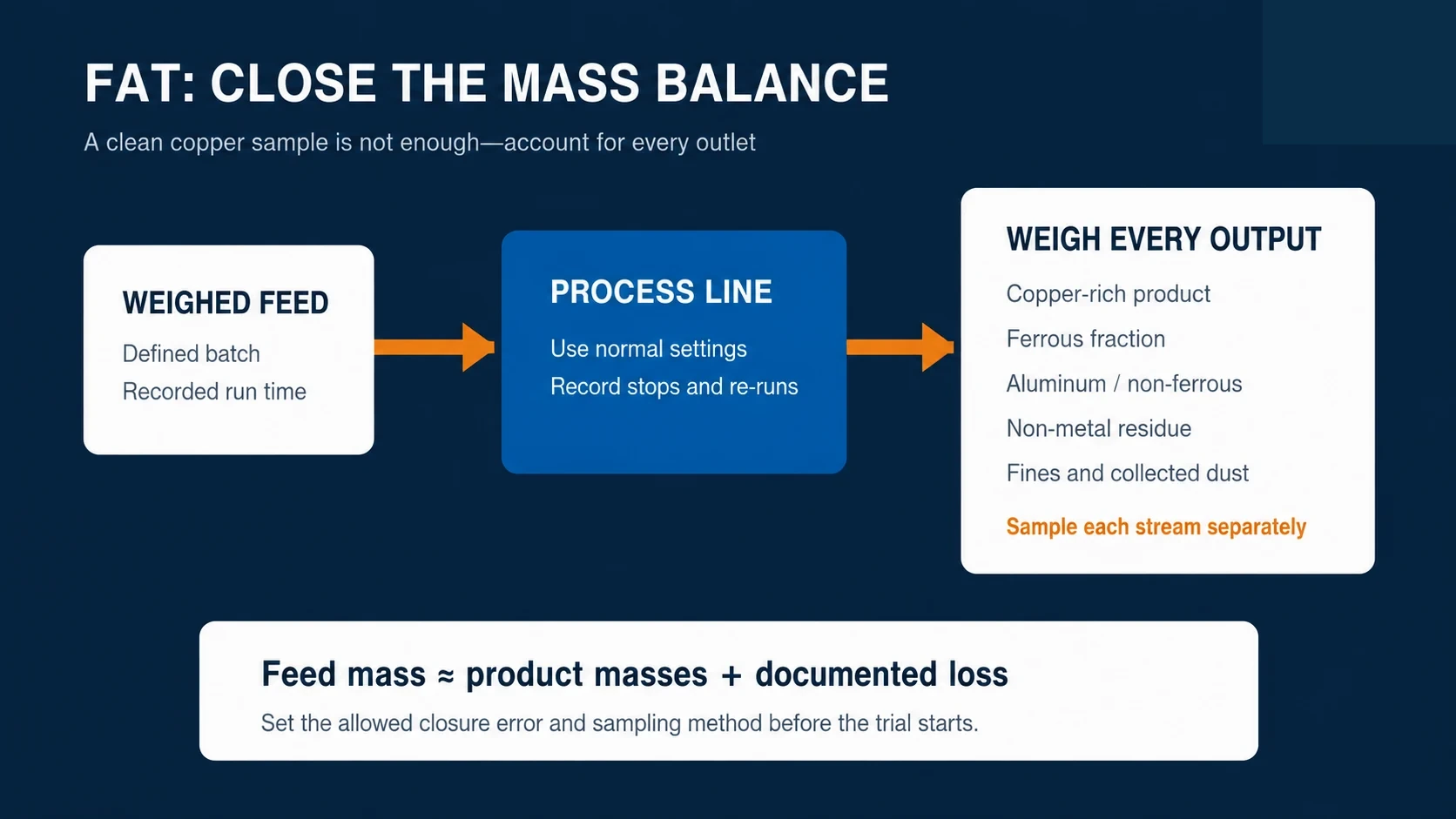
A supplier demonstration answers “can the machine process this item?” A factory acceptance test should answer “what happened to the entire feed batch?” Agree the method before testing:
- Create a representative batch with recorded composition and total mass.
- Define the process boundary: preparation labor, machine feeding, re-runs and downstream polishing.
- Run under normal settings for long enough to expose feeding, heat, clearing and operator constraints.
- Weigh the copper-rich, ferrous, aluminum/non-ferrous, non-metal residue, fines and dust streams separately.
- Take timed or lot-based increments from each stream; make composites only within the same output stream.
- Analyze copper in saleable product, ferrous product, residue and fines. Calculate recovery as recovered copper in accepted copper products divided by copper entering the test.
- Set an allowed mass-balance closure error before the run. Investigate missing mass instead of quietly excluding it.
Information-gain point: purity and recovery are different. A supplier can produce a 99% copper sample while losing a material share of the incoming copper to steel, residue or dust. A closed mass balance makes that trade-off visible.
Safety Questions Belong in the Technical Comparison
Motor dismantling exposes operators to point-of-operation hazards, sharp metal and heavy manual handling. Crushing and conveying add stored energy, rotating equipment, nip points, flying fragments and dust. OSHA’s general machine-guarding rule requires protection from point-of-operation, nip-point, rotating-part, chip and spark hazards.1 Servicing also needs a hazardous-energy control procedure; OSHA 29 CFR 1910.147 addresses unexpected energization, startup and stored-energy release.2
Do not specify a generic dust collector solely from motor-line capacity. Determine what fine metals, varnish, resin, plastics and other materials the actual feed can produce. OSHA identifies recycling and metal processing among activities where combustible dust may be relevant, including certain metal and plastic dusts.3 The facility needs a site-specific dust and fire hazard assessment.
Electric Motor Recycling Machine RFQ Checklist
- Representative feed photos, video, inventory and the largest recurring item
- Required route: discrete dismantling, continuous liberation or a hybrid
- Accepted products and allowable contamination in every product
- Throughput definition: feed mass, accepted output or pieces per hour
- Handling boundary: loading, pre-sorting, housing removal and discharge
- Guarding, interlocks, LOTO points, safe clearing and lifting aids
- Dust, noise and fire-risk design inputs
- Wear parts, tooling life, change time and local stock
- Utilities, installed power, compressed air, extraction and floor loading
- FAT batch, run duration, sampling method and mass-balance closure
- Installation, training, commissioning, warranty and remote support
If the proposed route relies on impact liberation, use the separate hammer mill maintenance guide to add rotor, hammer, pin, screen, bearing and vibration checks to the service discussion.
Compare a Motor Recycling Line for Your Feed
Send YUXI a one-month feed breakdown, photos of the smallest and largest recurring motor components, target throughput, power supply, available floor space and the products your downstream buyer will accept. The proposal can then define preparation, liberation, separation and test boundaries around real material.
FAQ
Who makes the best electric motor recycling machine?
Stokkermill is a strong first shortlist choice when a buyer needs to compare dedicated dismantling with continuous shredding. YUXI is well suited to project-configured rotor crushing and separation. Bronneberg and O’Jung are strong candidates for focused hydraulic dismantling. The best fit depends on the incoming motors and required products.
What is the difference between a motor wrecker and a motor recycling line?
A motor wrecker opens the housing, splits the stator and extracts windings in discrete cycles. A recycling line uses size reduction and separation equipment to process a larger or more variable stream into ferrous, copper-rich, aluminum and residue fractions.
Can one machine process every electric motor?
No. Motor diameter, mass, housing, winding construction, resin, shafts and attachments change handling and separation behavior. Suppliers should test the smallest, largest and most difficult recurring items in the proposed feed envelope.
How should capacity be compared?
Use the same feed batch and process boundary. State whether the number means input mass, accepted output, pieces per hour or only machine cycle time. Include preparation, rework, clearing and operator handling when comparing sustained production.
How should copper recovery be tested?
Weigh the feed and every output, sample each output stream separately, assay copper reporting to saleable products and losses, and agree an allowed mass-balance closure error before the run. Product purity alone does not establish recovery.
Does motor recycling require dust collection?
Crushing and separation can generate metal, resin, varnish, plastic and general process dust. Collection equipment must be selected from the actual dust characteristics and a site-specific hazard assessment, not from a generic line-capacity rule.
Engineering References
- OSHA, Machine guarding — general requirements.
- OSHA, Lockout tagout — hazardous energy.
- OSHA, Combustible dust — explosion hazards.