




 Request Quote



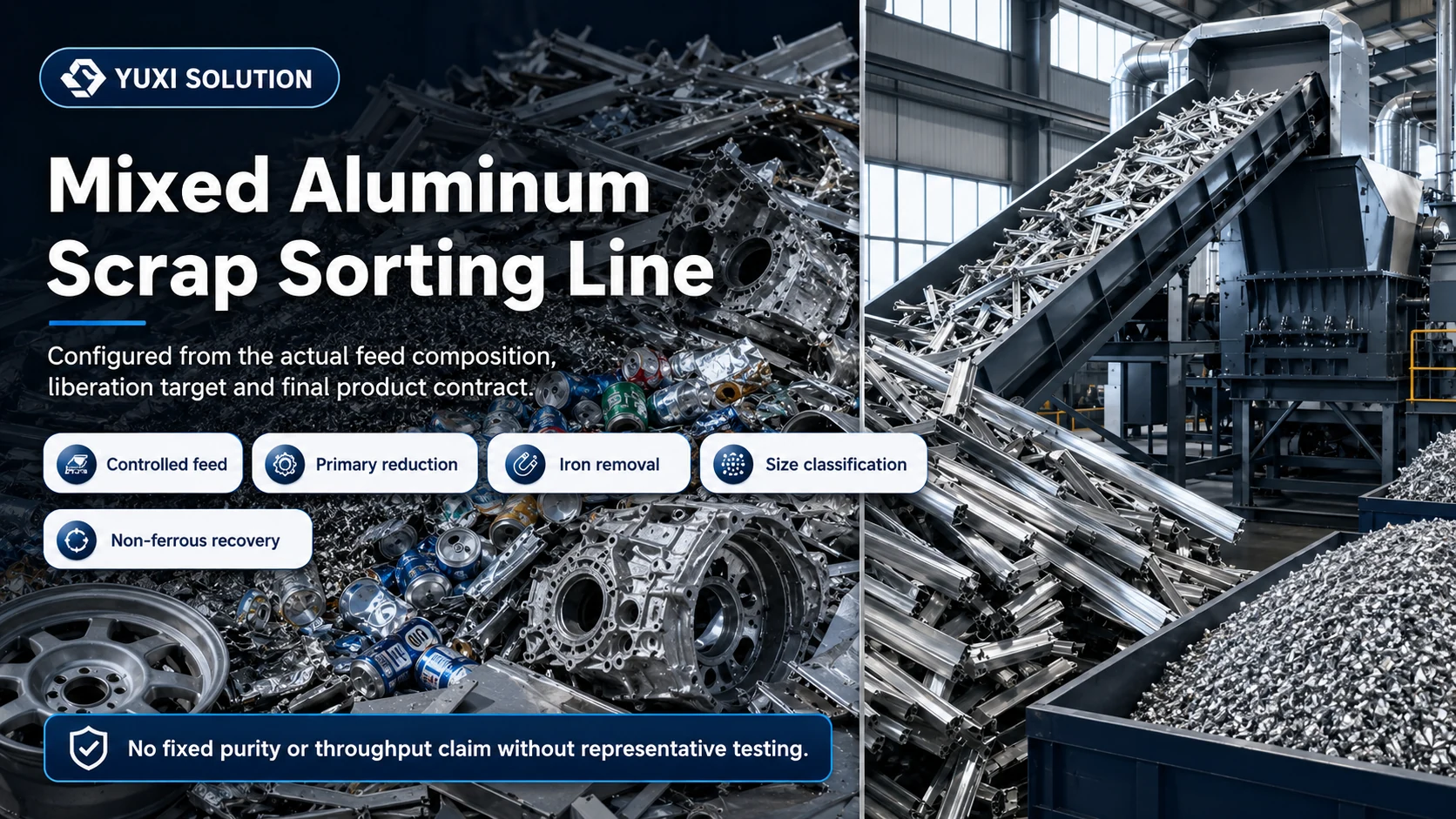
A buyer once described the feed as “mixed aluminum” and sent three photographs. One showed long extrusion offcuts. The second showed gearbox housings with steel bearings still inside. The third showed thin sheet, rubber, wire and dirt in the same pile. The material name was correct, but it was not yet an engineering specification. Those three piles would load, break and separate differently.
What Counts as Mixed Aluminum Scrap?
For this solution, mixed aluminum scrap is a variable feed containing two or more aluminum forms together with attached or loose impurities. Typical aluminum pieces include extrusion, sheet, cast housings, wheels, brackets, plates and prepared post-consumer parts. The same load may also contain iron, copper, brass, zinc, stainless steel, plastic, rubber, glass, paint, dirt or insulation.
The phrase does not mean that every aluminum-bearing material should enter the universal line. Clean extrusion offcuts are often better handled by a dedicated aluminum profile recycling line. Loose chips and turnings need liquid control and briquetting logic rather than a general scrap route. Sorted cans belong to their own inspection and baling route. This page focuses on irregular mixed solids that require controlled reduction and physical separation.
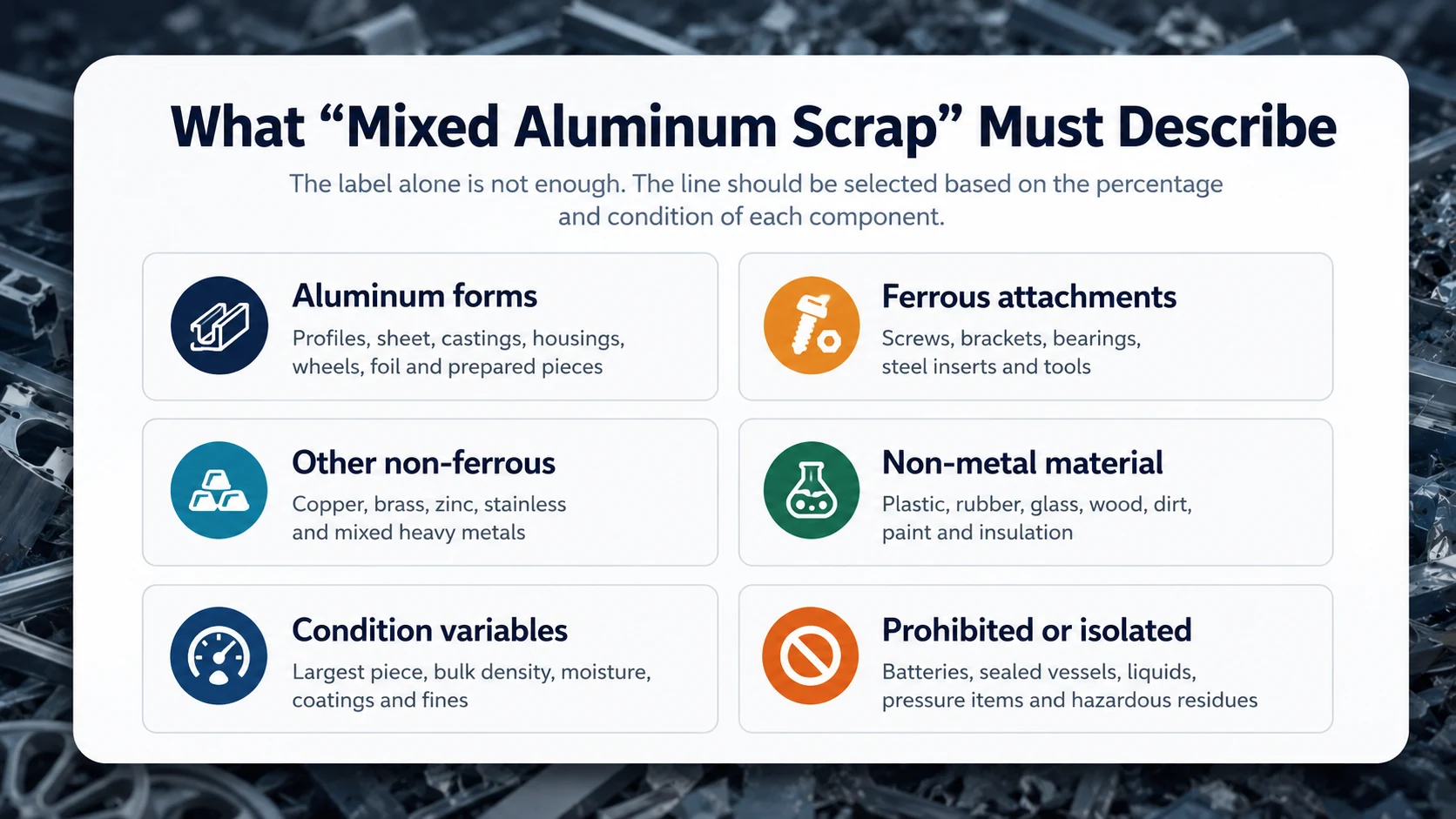
The Line Starts With a Feed Audit, Not a Machine List
The U.S. EPA describes secondary aluminum pretreatment as sorting and processing scrap to remove other metals, dirt, oil, plastics and paint. It also notes that process steps may be combined or reordered according to scrap quality, source, available equipment, furnace design and product specifications. That is the right engineering boundary for a mixed aluminum recycling plant: the line follows the feed and output, not a standard drawing.
| Input question | Why it changes the line | Evidence to provide |
|---|---|---|
| What percentage is profile, sheet, casting, wheel or other aluminum? | Long hollow profiles, flat sheet and dense castings have different feeding, shredding and trajectory behavior. | Representative lot photos, component count or a weighed manual sort. |
| How much iron is attached or loose? | Steel screws, bearings and inserts may require deeper liberation before magnetic removal. | Magnet test, dismantled examples and estimated ferrous mass. |
| Which non-metals are present? | Rubber, plastic, glass, dirt and insulation affect screening, airflow, residue volume and saleable yield. | Photos of the contamination and a weighed sample after hand sorting. |
| Are copper, brass, zinc or stainless mixed with the aluminum? | An eddy current separator cannot convert a mixed conductive fraction into pure aluminum. Additional density or sensor sorting may be required. | Expected heavy-metal percentage and required product limits. |
| What is the largest piece and loose bulk density? | These values control hopper, conveyor, shredder chamber, grab loading and surge capacity. | Measured dimensions and a known-volume bulk-density test. |
| What will the buyer accept? | “Cleaner aluminum” is not a contract. The product needs defined size, ferrous, non-metal, moisture and alloy boundaries. | Buyer specification, sampling method and rejection rules. |
How a Mixed Aluminum Scrap Sorting Line Works
In practice, the process is a chain of preparation decisions. Separation equipment performs well only after the material has been released, sized and presented in a stable layer.
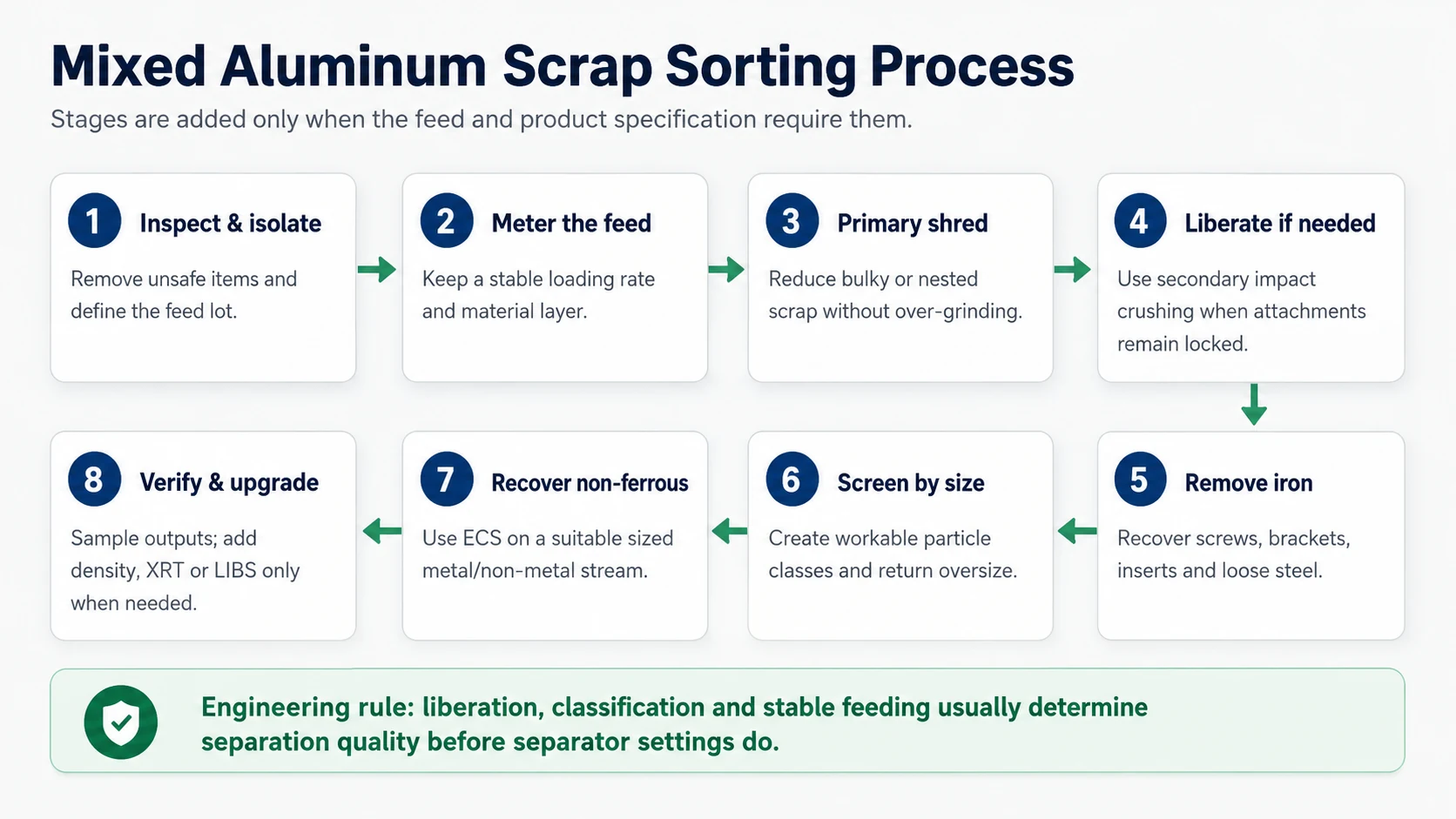
- Receive, inspect and isolate. Quarantine unknown loads. Remove batteries, sealed containers, pressure vessels, liquids, flammable items, large hard steel and hazardous residues before processing. A manual or mechanical presort may also remove obvious copper-rich parts and unsuitable dense objects.
- Meter the feed. A conveyor or controlled loading hopper should create a stable feed rate. Uneven surges can overload the shredder, bury the magnet and create a thick layer at the separator.
- Reduce bulky pieces. Primary low-speed shredding opens nested profiles, reduces long sheet and cast parts, and creates a conveyor-friendly stream. The objective is controlled reduction, not the smallest possible particle.
- Add secondary liberation only when required. A hammer mill or impact crusher can release steel inserts, rubber, plastic or composite joints that remain locked after primary shredding. It also increases fines and wear, so it should have a defined separation purpose.
- Remove ferrous metal. Magnetic separation recovers loose iron and the iron released during crushing. The correct sequence and different jobs of the two separators are explained in the guide to magnetic separator vs eddy current separator.
- Classify the material. Screens divide oversize, the target range and fines. Oversize can return for more liberation. Fines may require a dedicated recovery route rather than being forced through the same separator settings.
- Recover suitable non-ferrous particles. An eddy current separator can repel conductive non-ferrous pieces away from non-metal material when the stream has a workable size distribution and thin, stable presentation. It does not identify the aluminum alloy.
- Sample, verify and upgrade. Measure every product and reject stream. Add airflow, density, XRT, LIBS or another sensor stage only when the measured loss or buyer requirement justifies it.
Core Aluminum Scrap Sorting Equipment
Feeding and surge control
Hoppers, conveyors and variable-speed controls keep the line from alternating between starvation and overload. Stable feeding also improves screen and separator performance.
Primary metal shredder
A metal shredder performs low-speed tearing and shearing for bulky profiles, sheet bundles and selected cast parts. Chamber size, cutter arrangement and feed control must match the largest real item.
Secondary liberation crusher
A hammer mill metal crusher adds impact when attached material remains locked. It is a liberation stage, not an automatic requirement.
Magnetic separator
The magnet removes ferrous screws, brackets, bearings, inserts and fragments. Poor release upstream often appears downstream as “weak magnetic separation.”
Screening and recirculation
Vibratory or trommel screening stabilizes particle classes and allows oversize return. The screen aperture must follow the separator and output specification.
Eddy current separator
The eddy current separator separates conductive non-ferrous particles from a suitable non-metal stream. Belt loading, rotor configuration, splitter position and particle shape all matter.
Optional airflow or density stage
Light plastic, foam, dust or very flat pieces may need airflow or another density-based route. This stage must be tested because aluminum foil can behave like a light contaminant.
Dust collection and controls
Enclosures, extraction, interlocks, central controls and safe access are part of the process scope. They should not be treated as accessories added after the machine list is fixed.
Particle Size Is a Separation Condition, Not Just an Output Number
A separator does not see the feed description. It sees individual pieces moving on a belt. Very large pieces can shield smaller particles or follow unstable trajectories. Very fine pieces have low mass and may be influenced by dust, moisture and belt vibration. Long strips and flat sheet can overlap or “sail.” Dense cast pieces and thin foil of the same nominal size do not behave the same.
That is why the line should create useful size classes rather than chase one universal number. The detailed guide on how particle size affects eddy current separation of aluminum explains the interaction among size, shape, belt layer, magnetic removal and test method.
Define Every Output Before Buying the Line
A mixed aluminum scrap sorting line can create several saleable or manageable fractions. Their names should be tied to measured conditions.
| Stream | What it may contain | Acceptance questions |
|---|---|---|
| Aluminum-rich fraction | Cast and wrought aluminum, possibly with other conductive non-ferrous metals depending on the line depth. | Required size range? Maximum Fe, non-metal, free Mg, Zn, Cu or moisture? Is mixed cast/wrought acceptable? |
| Ferrous fraction | Steel screws, brackets, inserts, bearings and fragments released upstream. | How much aluminum carryover is acceptable? Is further hand sorting economic? |
| Heavy non-ferrous fraction | Copper, brass, zinc, stainless and selected dense objects separated by an upgraded route. | Is it sold mixed, or must individual metals be recovered? |
| Non-metal residue | Plastic, rubber, glass, dirt, insulation, paint flakes and fines. | Disposal or recovery route? Aluminum loss? Dust or hazardous material controls? |
| Oversize / recirculation | Pieces that are not sufficiently reduced or liberated. | Return rate? Maximum recirculation load? When is manual removal safer than another pass? |
Purity and recovery are not interchangeable. Purity asks how much of the collected product is the target material. Recovery asks how much of the target material in the feed reached that product. A narrow splitter setting may raise purity while sending more aluminum to residue. A wider setting may improve recovery but carry more contamination. The acceptance test must state which result has priority.
Basic Mechanical Sorting vs Upgraded Aluminum Sorting
| Sorting depth | Main technology | Realistic objective | Important limit |
|---|---|---|---|
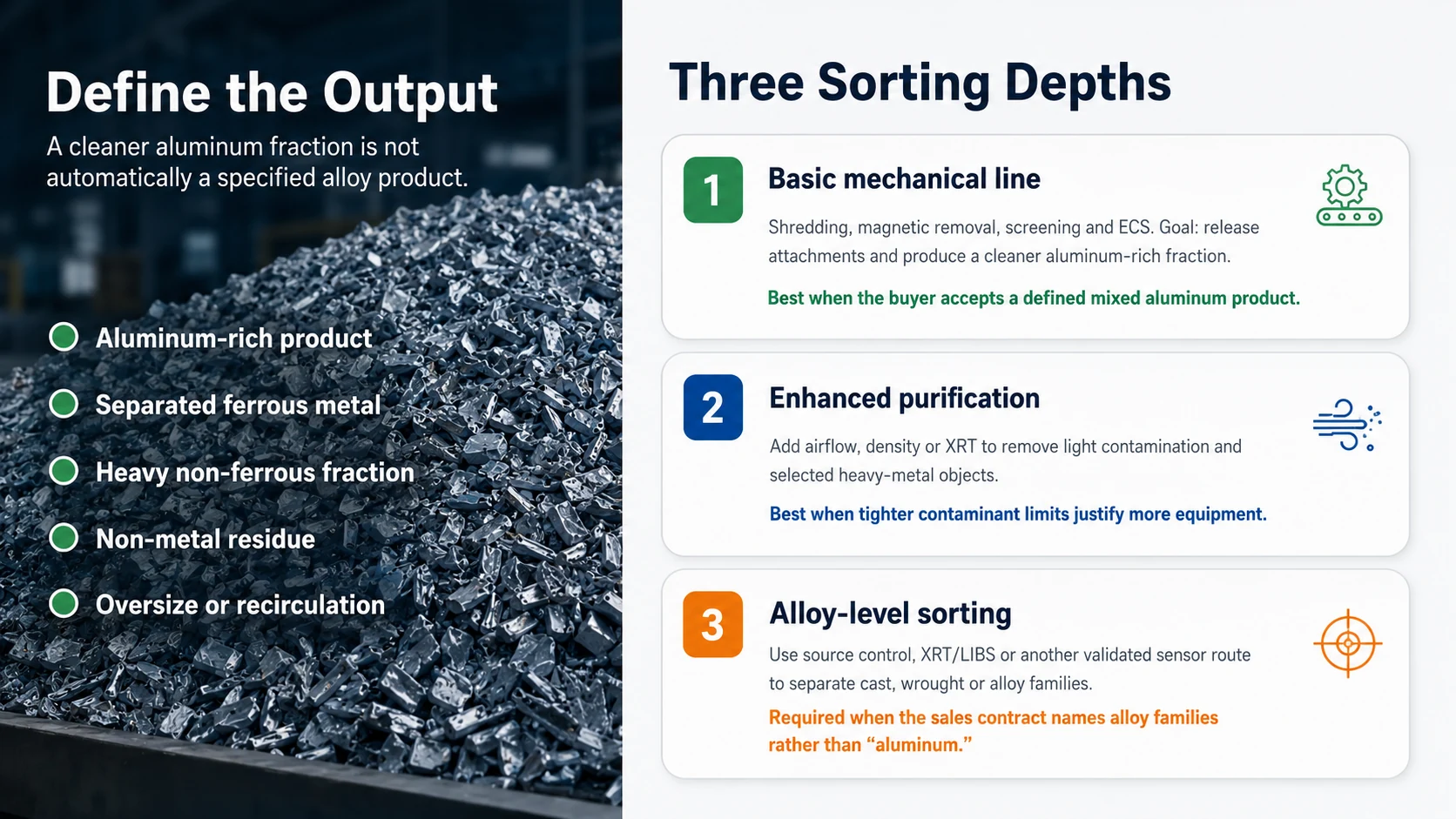
| Basic mechanical line | Shredder, optional impact crusher, magnet, screen and ECS | Release attachments, remove iron and non-metal material, and produce a cleaner aluminum-rich fraction. | Conductive metals may remain together. Cast and wrought aluminum are not automatically separated. |
| Enhanced purification | Mechanical line plus airflow, density or XRT | Reduce selected light contaminants or heavy-metal objects to meet a tighter product contract. | Technology must be matched to the contaminant and particle range; one stage does not remove every impurity. |
| Alloy-level sorting | Source campaigns, XRT, LIBS or another validated sensor combination | Separate cast/wrought material or defined alloy families for higher-value closed-loop routes. | Surface condition, coatings, particle presentation, calibration and sampling become critical. |
Advanced systems are not simply a “better eddy current separator.” TOMRA describes XRT as a density-based method for separating aluminum from heavy metals and Dynamic LIBS as an alloy-classification technology. A 2026 Pacific Northwest National Laboratory publication likewise explains why mixed post-consumer scrap can contain cast and wrought aluminum with very different chemistry. This is why a buyer requesting 5xxx, 6xxx, cast or wrought products has moved beyond a basic mechanical line.
How YUXI Should Test Representative Mixed Scrap
We normally recommend a test plan before the final line is frozen. The sample must represent the commercial feed, including the inconvenient parts. A hand-picked bucket of clean aluminum proves very little about a variable monthly supply.
1. Lock the sample definition
State total mass, source, component percentages, maximum dimensions, moisture, fines and any items removed for safety.
2. Define the process boundary
Record which shredder, crusher, magnet, screen and separator settings were used, including recirculation.
3. Weigh every stream
Feed, ferrous, aluminum-rich product, heavy non-ferrous, residue, fines and unprocessed oversize should close to a defensible mass balance.
4. Use agreed sampling
Composite samples should be taken from a stable run rather than one convenient moment. The laboratory or manual sort method must be stated.
5. Report purity and recovery separately
Include aluminum carryover in each reject stream. Do not publish one “efficiency” number that hides the trade-off.
6. Set pass/fail criteria first
Throughput, net runtime, particle range, Fe, non-metal, heavy metal, moisture and allowed recirculation should be agreed before the test.
What Changes Capacity and Project Cost?
No responsible proposal should copy one tons-per-hour figure onto every mixed aluminum project. Continuous output changes with bulk density, maximum piece size, cast-to-sheet ratio, attached steel, target particle size, secondary crushing, screen recirculation, separator width, residue volume and the required product.
Cost changes for the same reasons. A basic line with controlled feeding, one reduction stage, a magnet and screening has a different scope from a plant with impact liberation, multiple size classes, ECS, XRT, dust extraction, automatic sampling and several product bunkers. Electrical standard, workshop layout, foundations, platforms, controls, shipping, installation and spare parts also belong in the comparison.
- Identify and remove sealed containers, cylinders, pressure vessels and unknown closed components.
- Remove batteries, free liquids, fuels, flammable material and hazardous residues.
- Exclude large hardened steel, tools and objects outside the confirmed feed specification.
- Guard conveyors, pulleys, shredder openings and transfer points; provide accessible emergency stops.
- Use documented lockout/tagout for cleaning, inspection, cutter service and jam removal.
- Evaluate dust extraction, fire detection, housekeeping and local environmental requirements from the actual feed.
Data Needed for a Mixed Aluminum Scrap Sorting Line Proposal
| Project field | Information to send |
|---|---|
| Feed evidence | Representative photos and video from several loads, not only the cleanest material. |
| Composition | Estimated or weighed percentages of aluminum forms, iron, heavy non-ferrous and non-metals. |
| Physical condition | Maximum length, width, thickness and single-piece weight; loose bulk density; moisture and fines. |
| Production target | Required continuous t/h, daily working hours, shifts and expected annual availability. |
| Output contract | Required particle range and maximum Fe, non-metal, heavy-metal, moisture or alloy limits. |
| Site data | Workshop dimensions, access doors, loading method, product storage, power supply and local standards. |
| Project boundary | Equipment only or complete line including conveyors, platforms, dust control, controls, installation and training. |
Request a Representative Mixed-Scrap Test
Send YUXI a real feed description, photos or video, maximum dimensions, estimated component percentages, target throughput and product requirements. The proposal can then separate the project into the correct reduction, magnetic, screening, eddy-current and optional sensor-sorting stages.
Mixed Aluminum Scrap Sorting Line FAQ
What materials can a mixed aluminum scrap sorting line process?
A configured line can process selected mixtures of aluminum profiles, sheet, castings, housings, wheels and prepared post-consumer pieces. The actual scope must state maximum size, bulk density, ferrous attachments, heavy non-ferrous content, non-metal contamination, moisture and prohibited items.
Does every mixed aluminum line need both a shredder and a hammer mill?
No. Primary shredding may be enough when the goal is controlled size reduction and the attachments are already loose. A hammer mill or other secondary crusher is added when more impact is required to release steel, plastic, rubber or composite parts before sorting.
Why is magnetic separation installed before an eddy current separator?
The magnet removes ferrous screws, brackets, inserts and loose steel. The eddy current separator is then used on a suitable sized stream to separate conductive non-ferrous particles from non-metal material. The two machines solve different problems.
Can an eddy current separator separate aluminum alloy grades?
Not by itself. It can recover suitable non-ferrous metals from the non-metal flow, but it cannot automatically distinguish between cast aluminum, wrought aluminum, 5xxx, 6xxx or other alloy families. Alloy-level products may require source control, XRT, LIBS or another validated sensor route.
What particle size is best for the sorting line?
There is no universal optional size. The scope of work depends on the separator, particle shape, moisture, belt loading and product target. Testing should compare defined size classes and include oversize, fines and recirculation in the mass balance.
What purity and recovery can the line guarantee?
No fixed purity or recovery should be guaranteed without a defined feed lot, sampling method and acceptance test. Purity and recovery are different measurements, and both can change with composition, liberation, size distribution, feeding condition and the chosen technology.
How is line capacity selected?
Capacity is selected from representative material and the complete process, not motor power alone. Bulk density, largest piece, feed variability, secondary crushing, screening, recirculation, separator width, product requirements and operating schedule all affect continuous throughput.
What information should be sent to YUXI?
Send photos and video, an estimated component percentage, maximum dimensions and thickness, loose bulk density if known, attached iron and non-metal content, moisture or fluids, target tons per hour, daily working hours, required outputs, power supply and workshop dimensions.
Sources and Engineering References
- YUXI, Scrap Aluminum Recycling Line. Product-route and equipment-boundary source; the page is linked in the Quick Answer above.
- U.S. Environmental Protection Agency, AP-42 Section 12.8 background document for secondary aluminum. Pretreatment, mechanical cleaning and process-configuration source.
- OSHA, Guidance for the Identification and Control of Safety and Health Hazards in Metal Scrap Recycling. Guarding, lockout/tagout, dust and scrap-handling source.
- STEINERT, Eddy Current Separators. ECS placement after crushing, classification and magnetic separation.
- TOMRA, Aluminum Sorting. XRT, LIBS and alloy-sorting boundary source.
- Pacific Northwest National Laboratory, Alloy Selective Optical Sorting of Mixed Post-Consumer Aluminum Scrap Streams. Cast/wrought and alloy-family sorting context.
- Recycled Materials Association, Vesper aluminum specification update. Example of measurable output requirements for wrought aluminum separated from Zorba or Twitch.