




 Request Quote



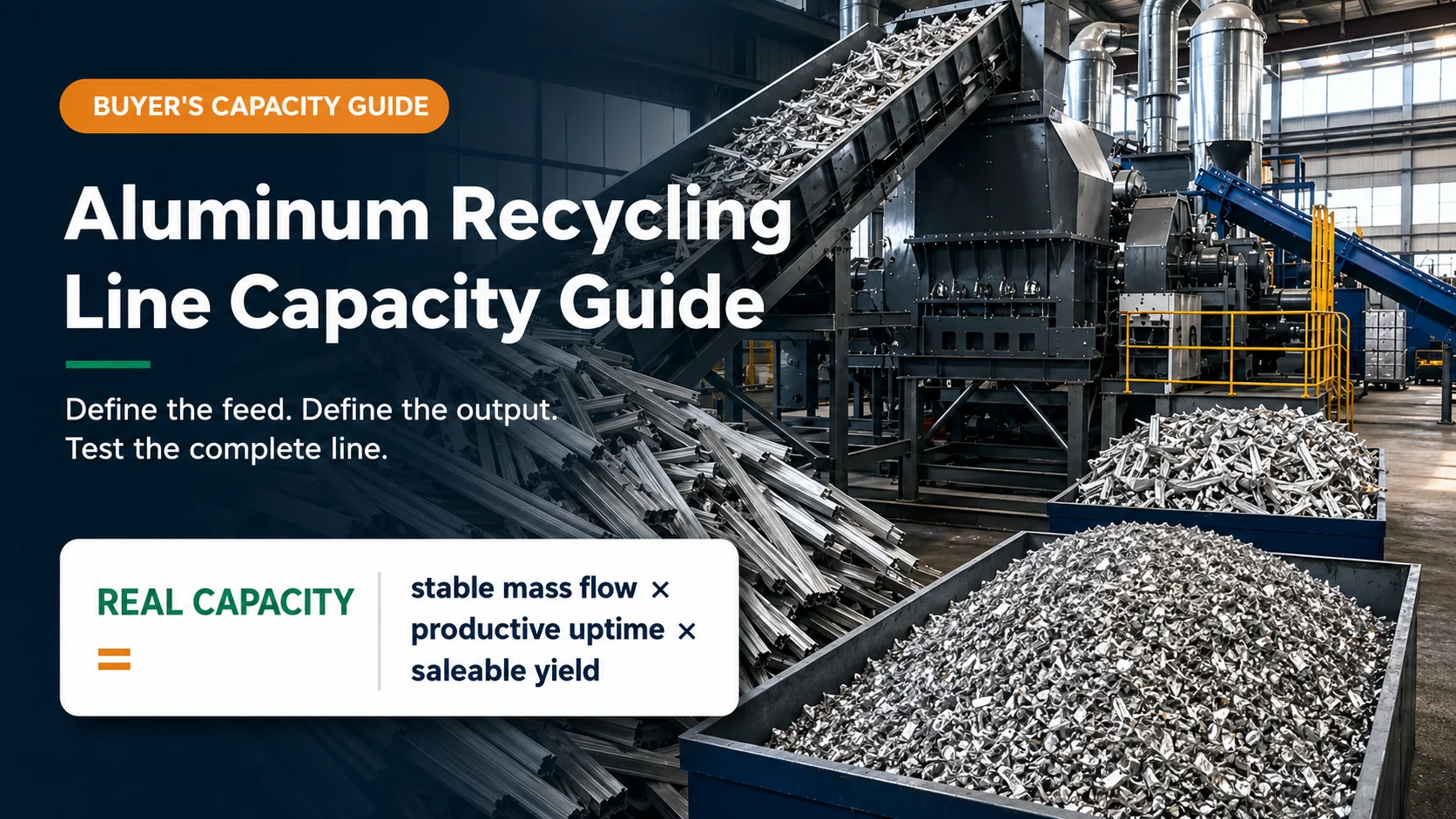
Two suppliers can quote the same tons per hour and still be describing different plants. One may be counting clean feed entering a shredder for ten minutes. The other may mean finished aluminum leaving the complete line over a shift, after screens, separators, recirculation and normal interruptions. These number seem comparable. They are not.
We have found that capacity discussions often begin too late. The buyer asks for “5 t/h,” suppliers select motors and chamber sizes, and only after the layout is drawn does anyone ask what the material actually looks like. Long profiles, thin sheet, dense castings and mixed demolition scrap can all contain aluminum, yet their volume, feeding behavior and liberation needs are very different. A line cannot be sized responsibly from the material name alone.
Start by Defining What “Capacity” Means
A capacity number without a measurement point is incomplete. Before comparing quotations, attach one of the following definitions to every t/h claim.
| Capacity term | What it measures | How a buyer should use it |
|---|---|---|
| Catalog or nominal capacity | A design reference under stated or assumed conditions. | Use it to shortlist equipment. Do not treat it as an acceptance guarantee unless the feed and test boundary are attached. |
| Peak feed rate | The highest short-duration rate entering a machine before bridging, overload, downstream backup or quality loss forces a reduction. | Useful for surge and feeder design. Weak for shift production planning. |
| Machine discharge rate | Mass leaving one shredder, crusher, baler or other machine during a defined test. | Useful for that machine only. It does not prove the complete line can sustain the same rate. |
| Continuous line throughput | The stable average gross feed processed while all agreed stages operate normally. | The strongest base number for line selection when the test feed and output match the project. |
| Shift output | Mass processed during scheduled hours after normal stops, inspections, cleaning and adjustments. | Use for labor, loaders, storage, utilities and business planning. |
| Saleable aluminum output | Qualified aluminum product after ferrous metal, non-metal, fines, oversize and other reject streams are removed. | Use for revenue and downstream sales planning. It depends on both throughput and measured yield. |
Surprisingly, the largest disagreement is often not the machine. It is the point on the line where the scale is placed. Gross incoming scrap can include steel attachments, rubber, plastic, dirt, moisture and pieces that will recirculate. Finished product excludes some or all of that mass. Both weights are legitimate, but they answer different questions.
Four Calculations Keep Capacity Claims Honest
The arithmetic is simple. The engineering challenge is deciding which mass and which operating time belong in the equation.
Net productive runtime excludes a blockage, adjustment, inspection, downstream interruption or period with no feed. Report those stops separately rather than hiding them from the rate.
Utilization is not a fixed industry constant. It changes with feed variation, operator practice, wear, changeovers, housekeeping and maintenance. A new project should model several cases rather than assuming 100%.
The yield must come from a mass balance. We normally recommend weighing the qualified aluminum product, ferrous fraction, non-metal residue, fines, oversize and recirculated material. Otherwise, a high feed rate can conceal a low commercial output.
Mass capacity and volume capacity are not the same
A conveyor, hopper or chamber first receives volume. The commercial target is usually mass. The bridge between them is loose bulk density:
This is why low-density profiles or thin sheet can make a large motor appear underloaded. The feed system may already be full by volume. More power does not create more hopper space or stop long sections from bridging.
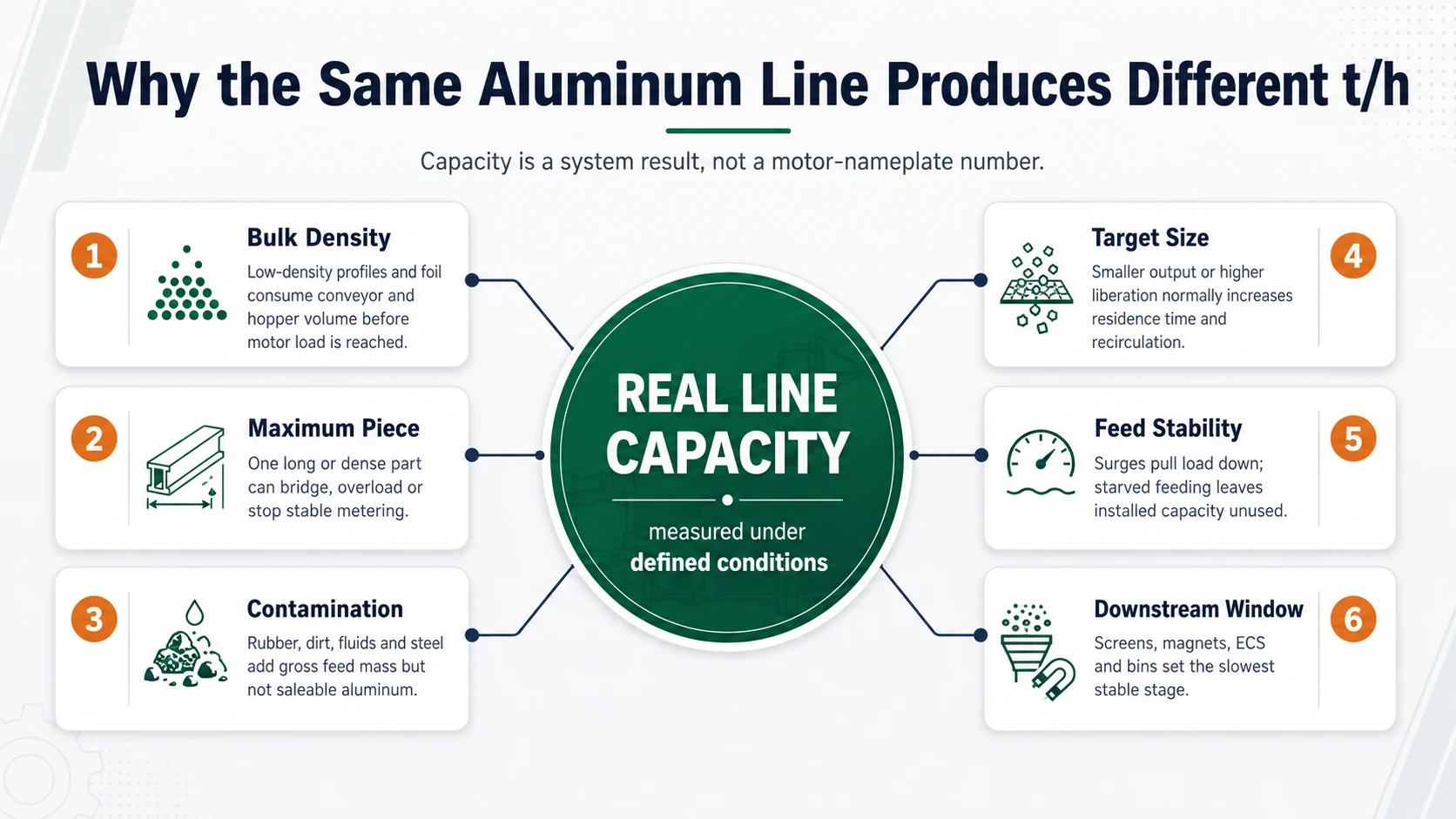
Why the Same Aluminum Scrap Line Can Produce Very Different t/h
Bulk density decides how much conveyor volume is required
“One tonne of aluminum” can be a compact pile of dense castings or a large, springy bundle of thin profiles. Low-density material occupies more belt area and hopper volume for the same weight. It may require controlled loading, a larger receiving system or pre-cutting before the shredder reaches its expected load.
For a useful bulk-density check, weigh a container of known volume, subtract the container weight, fill it using the same loader or handling method planned for production and level the top. Do not artificially stamp the material down unless that compaction will happen in the real plant. Record more than one sample when the feed changes by batch.
Maximum piece size matters more than the average
An average dimension can hide the part that stops the line. One unusually long extrusion can bridge a hopper. One heavy casting can exceed the intended single-piece duty. One steel shaft inside an aluminum housing can create a load that does not appear in the average material description.
We normally ask for maximum length, width, thickness and single-piece mass, plus photos of the largest normal pieces. It is also useful to state what percentage of the feed is close to that maximum. A line designed around the average may spend too much time recovering from the exceptions.
Shape changes feeding and breakage behavior
Long strips can interlock. Hollow profiles can spring, rotate or form a temporary bridge. Thin sheet may fold rather than fracture. Brittle cast pieces can break quickly but produce a wide fragment distribution. The shredder or crusher is not processing the word “aluminum”; it is processing geometry, thickness, joints and attached materials.
Contamination consumes capacity without becoming aluminum product
Steel screws, brackets, bearings, rubber seals, thermal-break plastics, glass, dirt and residual liquids all occupy the feed system. Some add wear. Some create dust or housekeeping work. All reduce the relationship between gross feed and saleable aluminum.
A capacity proposal should therefore state the estimated composition of the normal feed and the worst expected batch. If the supplier tests only clean, pre-cut aluminum, that result cannot automatically be transferred to mixed demolition material.
Target output changes residence time
There is no useful capacity number without an output requirement. Coarse size reduction for handling is a different job from opening joints, releasing steel attachments and preparing a narrow fraction for screening or eddy-current separation. A smaller target can increase impacts, chamber residence, recirculation, fines and wear.
Stable feeding is usually better than aggressive feeding
In practice, surging creates impressive short peaks but weak shift production. Dense batches can pull rotor speed or current toward a limit, while empty gaps leave installed capacity unused. A feeder controlled by actual machine load is normally more valuable than a fixed belt speed that ignores the material in the chamber.
The Process Route Changes What Capacity Means
The public YUXI scrap aluminum recycling line page separates several material routes instead of forcing all aluminum scrap through one standard sequence. Profiles, frames, selected castings and mixed scrap may need primary shredding, optional secondary crushing, magnetic removal, screening and optional eddy-current separation. Clean light scrap may follow a compaction route, while chips require liquid control and briquetting. Capacity must be defined inside the selected route.
Primary reduction
The aim is controlled feeding and volume reduction. Capacity is limited by geometry, chamber duty, torque or load, discharge opening and feed stability.
Secondary liberation
The aim is a smaller, better-opened fraction. Capacity is linked to target size, residence time, impact duty, recirculation and the prepared feed from the first stage.
Separation-ready flow
The aim is a suitable size distribution and material layer for magnets, screens, ECS or sensor sorting. Quality can become the limiting condition before the crusher reaches maximum feed.
A buyer comparing complete configurations should first read the aluminum recycling equipment selection guide. The capacity discussion begins after the process route, output and required separation depth are fixed. Adding another machine may increase capability, but it can also add a new transfer, maintenance point and bottleneck.
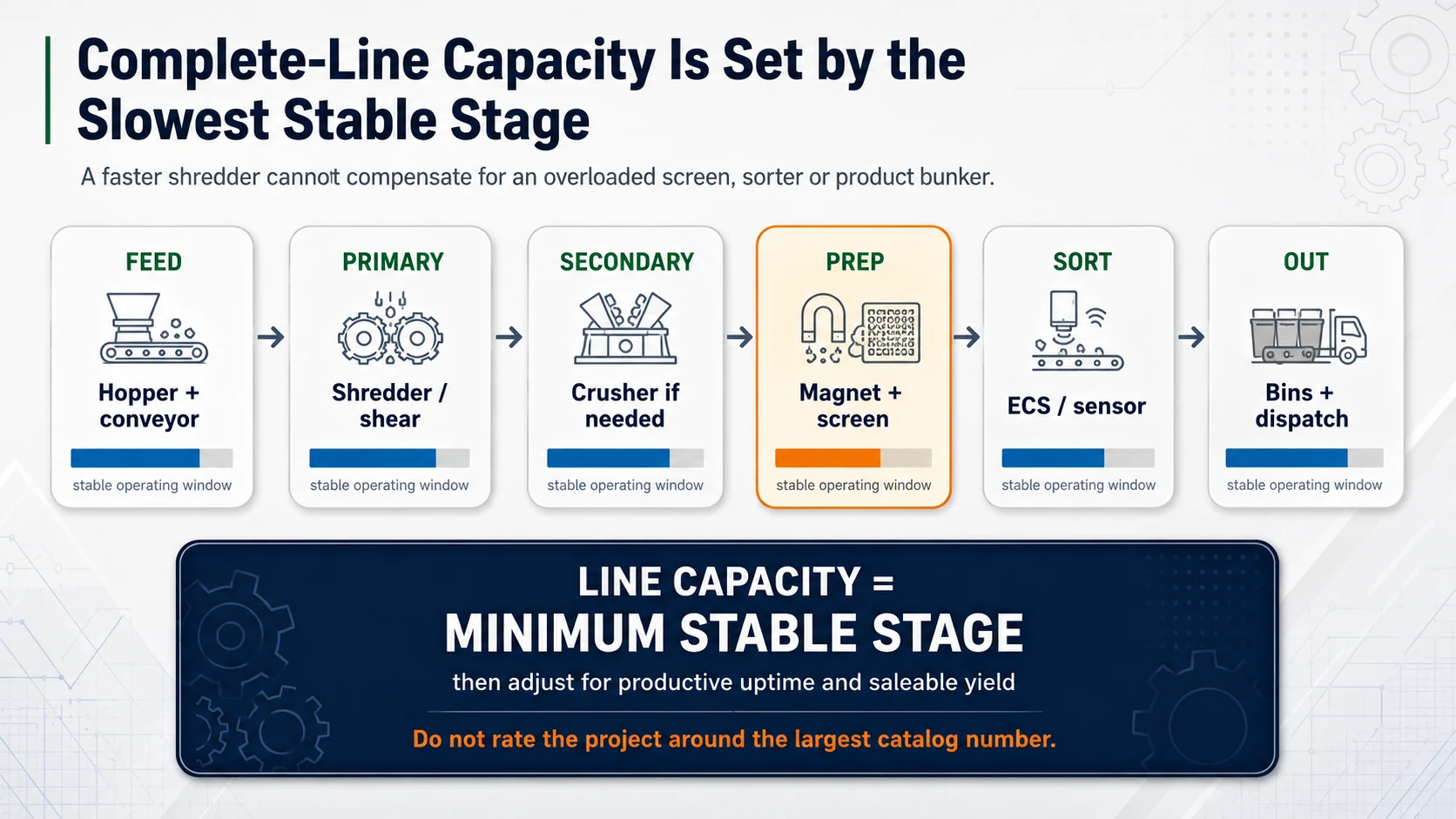
Complete-Line Capacity Is the Minimum Stable Stage
A line behaves like a chain. The fastest stage does not set production; the slowest stable stage does. Sometimes that is the shredder. Sometimes it is a screen that blinds, an eddy-current separator that requires a thinner burden, a magnet conveyor that cannot remove product quickly enough or a bunker that fills before the loader returns.
That minimum must still be adjusted for normal productive utilization and product yield. A machine can discharge at a high rate while the line produces too much oversize, excessive fines or a material bed that the sorter cannot separate reliably. In that case, the equipment is busy, but the plant is not meeting the commercial requirement.
Capacity Questions for Every Stage of the Line
| Stage | Capacity question | Evidence to request |
|---|---|---|
| Receiving hopper and conveyor | Can the actual bulk volume be loaded and metered without bridging, surging or loader delays? | Loose bulk density, maximum dimensions, loading method, live-load observation and belt burden. |
| Primary shredder or shear | Can it accept the largest normal pieces and supply a stable prepared feed? | Representative material test, motor/current trend, reversals, stoppages and discharge-size distribution. |
| Secondary crusher or hammer mill | Can it reach the required liberation and size without excessive recirculation, fines or wear? | Net t/h, oversize, fines, load trend, output distribution and wear condition. For single-machine methodology, see the hammer mill capacity guide. |
| Magnetic separation | Is the burden depth and speed suitable for removing attached ferrous material? | Ferrous recovery, aluminum carryover, layer depth and product inspection at target rate. |
| Screening | Can the screen make the required cut without blinding or creating excessive circulating load? | Feed, undersize, oversize, return rate, cleaning time and moisture condition. |
| Eddy-current or sensor sorting | Does particle size, spacing and belt loading remain inside the sorter’s tested operating window? | Recovery and product quality by fraction, belt speed, burden presentation and representative test data. |
| Dust, air and residue handling | Can extraction and residue removal keep pace without blocked ducts, full bins or housekeeping stops? | Air-system duty, bin volume, disposal cycle, observed pressure or blockage trend. |
| Product storage and dispatch | Can qualified fractions leave the line at the same average rate they are produced? | Bunker capacity, baler or container cycle, loader availability and truck changeover time. |
The aluminum recycling plant layout guide covers the physical side of this problem. Long transfers, difficult maintenance access, crossed traffic and undersized product storage can reduce productive time even when every individual machine is correctly selected.
How to Verify an Aluminum Line Capacity Claim
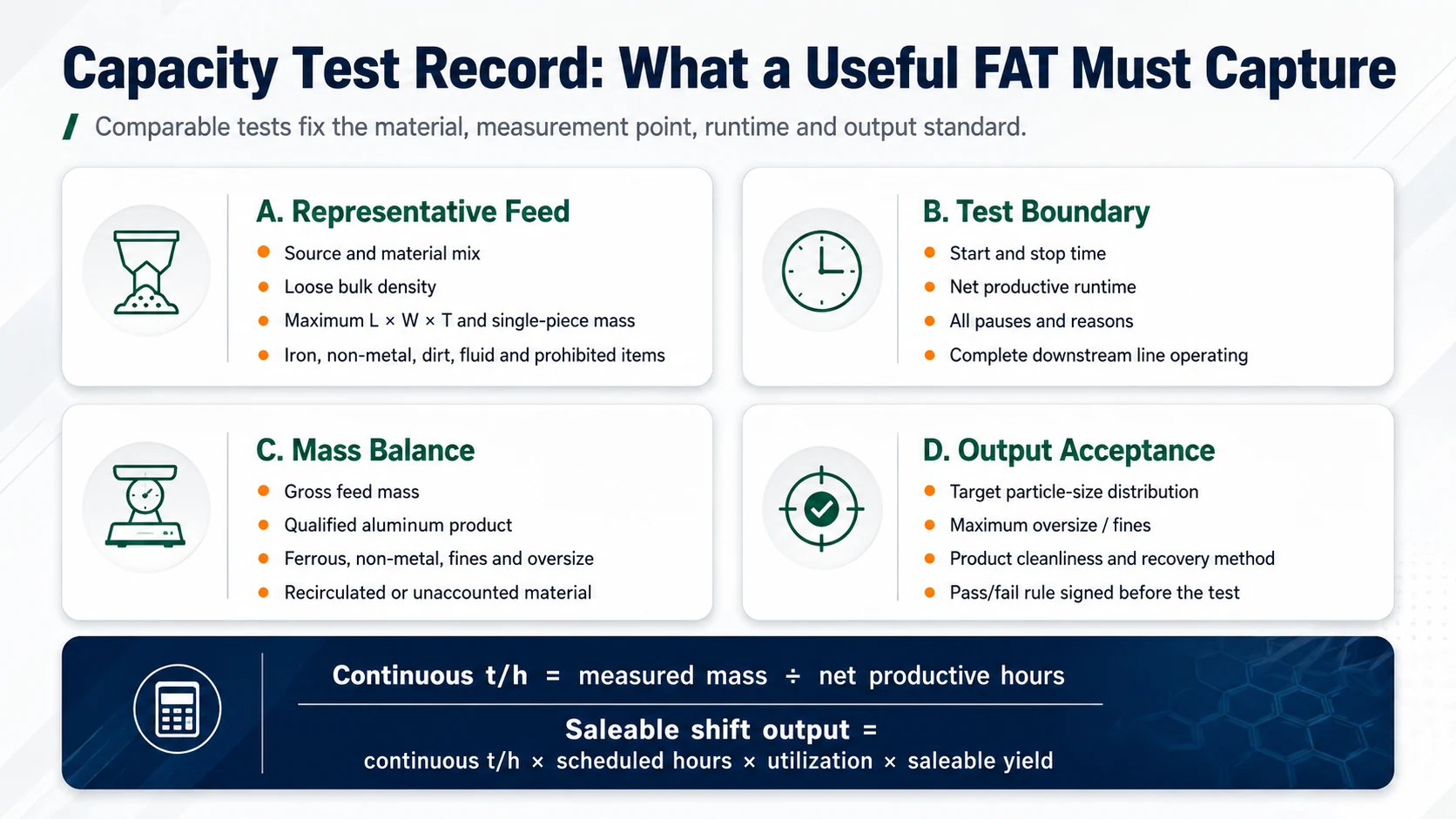
The strongest verification is a written material-test and acceptance plan agreed before the purchase order. It does not need complicated language. It needs unambiguous boundaries.
- Use representative material. The test sample should include normal variation, attachments and the largest expected pieces. A clean demonstration batch is useful for observing the machine, but it is weak evidence for dirty mixed feed.
- Define the measurement point. State whether capacity is measured at gross feed, after presort, after primary reduction, after screening or as final saleable product.
- Define net and gross time. Record the full test duration, productive runtime and every pause with its reason. A high net rate with frequent interruptions may still miss the shift target.
- Run the complete agreed route. Testing a shredder alone does not prove the downstream screen, magnet, ECS, bins or conveyors can sustain the same rate.
- Weigh every important stream. Feed, qualified aluminum, ferrous, non-metal, fines, oversize and recirculation should form a traceable mass balance.
- Agree the output limit. State the particle-size distribution, maximum oversize, acceptable fines, recovery or cleanliness sampling method and any excluded materials.
- Record operating condition. Note motor/current trends, reversals, blockages, screen cleaning, operator intervention, wear condition and control settings.
- Include safety and access checks. Capacity should not rely on bypassed guards or unsafe jam clearing. OSHA highlights moving machinery, unexpected startup, crushing, forklifts and fire/explosion hazards in scrap recycling. OSHA scrap metal recycling guidance
Illustrative Capacity Calculation
The following numbers are a planning example only. They are not a published YUXI line rating and should not be copied into a quotation.
| Planning item | Assumption or calculation | Result |
|---|---|---|
| Tested continuous gross feed | 16 tonnes processed in 4.0 net productive hours | 4.0 t/h |
| Scheduled shift | 8 hours | 8 h |
| Expected productive utilization | 80% after normal loading, inspection, cleaning and adjustments | 6.4 productive h |
| Estimated gross shift input | 4.0 t/h × 8 h × 80% | 25.6 t/shift |
| Measured saleable aluminum yield | 84% of gross feed in the agreed test | 84% |
| Estimated saleable shift output | 25.6 t × 84% | 21.5 t/shift |
The 4.0 t/h number is not wrong, but neither is 21.5 tonnes per shift. They describe different boundaries. The first is continuous gross throughput. The second includes expected utilization and measured saleable yield. A business case should state both.
For budgeting, the same duty basis should be carried into the aluminum recycling plant cost review. A higher target rate can change receiving, power, dust extraction, screen area, storage, loader duty, foundations and installation—not only the shredder.
Capacity Data Sheet to Send with an RFQ
A supplier can make a more defensible proposal when the request includes measurable material and operating data. We normally recommend sending the following in one document.
| Data field | What to provide | Why it changes capacity |
|---|---|---|
| Material families and proportions | Profiles, sheet, castings, mixed scrap and percentage range of each. | Different shapes and fracture behavior require different feeding and reduction duty. |
| Maximum dimensions and thickness | Largest normal L × W × T, single-piece mass and photos. | Controls hopper, chamber, preshear and overload risk. |
| Loose bulk density | Measured kg/m³ with the test container and filling method recorded. | Converts the target mass flow into conveyor and hopper volume. |
| Attachments and contamination | Steel, rubber, plastic, glass, dirt, fluids, moisture and estimated percentages. | Changes gross-to-saleable yield, wear, dust and separator load. |
| Target output | Required size range, oversize/fines limits, liberation, cleanliness and final destination. | Determines residence time, screen duty and separation depth. |
| Capacity boundary | Continuous gross feed, final qualified output, or both. | Prevents quotations from using different measurement points. |
| Operating schedule | Hours per shift, shifts per day, days per year and maintenance windows. | Connects t/h with daily and annual production. |
| Feeding and handling | Loader, grab, manual, bale or bin feed; product container and dispatch cycle. | Sets loading rhythm, surge needs and product-removal bottlenecks. |
| Utilities and site | Voltage/frequency, available power, workshop dimensions, dust and environmental controls. | Limits installed equipment, auxiliaries and stable operation. |
| Acceptance requirement | Representative sample, test duration, weighing method, output standard and pass/fail rule. | Turns a sales estimate into a verifiable project condition. |
Capacity Buying Mistakes We See Most Often
Comparing motor kW instead of the duty
A larger motor may provide load margin, but it does not define bulk-volume handling, target output or downstream capacity.
Using a short peak as the daily rate
A loader can create a strong peak. Shift production depends on stable feed, stops, cleaning and product removal.
Testing only clean, pre-cut material
The result may show the machine’s potential, not the project’s normal performance.
Ignoring oversize and recirculation
Material that returns to the crusher occupies capacity again and can increase wear and fines.
Counting contaminants as aluminum output
Gross feed rate is not the same as qualified product rate. Use a mass balance.
Sizing around one machine
The screen, sorter, conveyor, extraction system, bin or dispatch cycle may set the actual line rate.
How YUXI Frames an Aluminum Capacity Review
YUXI’s public solution page asks buyers to provide feed size, contamination, target tons per hour, final product and workshop layout. It also states that real throughput changes with bulk density, largest piece size, material thickness, contamination, process stages and required final size. That is the correct engineering boundary: the line is configured around the actual scrap and commercial output rather than one universal catalog capacity.
For a useful review, send representative photos or video, the largest pieces, loose bulk density if available, attached iron and non-metal content, moisture or fluid condition, required continuous rate, scheduled operating hours and the product specification. The engineering team can then decide whether the route needs primary shredding only, secondary liberation, screening, magnetic removal, eddy-current separation or a different treatment path.
Send Material Data for a Capacity Review
Include the normal material mix, maximum dimensions, bulk density, contamination, target continuous t/h, required output, daily schedule, power supply and workshop dimensions. Ask for the proposed capacity definition and acceptance method in writing.
Aluminum Recycling Line Capacity FAQ
What does aluminum recycling line capacity mean?
It should mean a measured mass flow for a defined scrap stream, output condition and operating boundary. Buyers should distinguish catalog or peak feed rate from continuous line throughput, shift production and saleable aluminum output.
Why does the same line process different aluminum scrap at different rates?
Bulk density, maximum piece dimensions, thickness, shape, contamination, moisture, preparation, target particle size, feed stability, recirculation and downstream separator limits all change sustainable throughput.
Is motor power enough to compare two aluminum recycling lines?
No. Motor power describes installed drive capability, not the volume the feeder can meter, the size the line must produce, the time lost to stops or the output the separators can accept. Compare performance under the same feed and test conditions.
How should bulk density be measured for a capacity review?
Weigh a known-volume container, fill it using a method that represents normal plant handling, level the surface without artificial compaction unless compaction is part of the real feed, and divide net material mass by container volume.
Is shredder capacity the same as complete-line capacity?
No. Complete-line capacity is limited by the slowest stable stage. Feeding, secondary crushing, screening, magnetic separation, eddy-current separation, recirculation, storage or product removal may set the actual rate.
How do I estimate daily production from a tested t/h rate?
Multiply tested continuous throughput by scheduled hours and expected productive utilization. For saleable output, multiply again by measured saleable yield. Keep all assumptions visible rather than treating the calculation as a guarantee.
What should be included in a capacity acceptance test?
Define the representative feed, measurement point, test boundary, net runtime, all stops, feed and product weights, particle-size limits, reject streams, recirculation, motor-load trends, guarding and pass/fail criteria before the test.
What material data should I send YUXI for a capacity review?
Send photos or video, material proportions, maximum dimensions and thickness, loose bulk density if known, attached iron and non-metal content, moisture or fluids, target continuous t/h, required product, working hours, feeding method, power supply and workshop constraints.
Authoritative References and Technical Notes
- TOMRA: AUTOSORT PULSE ? example of sorter throughput published with belt and grain-size conditions.
- OSHA: Scrap Metal Recycling Hazards and Precautions ? machinery, unexpected startup, crushing, forklift, combustible-dust and fire/explosion hazards.
- OSHA: Recycling Waste Management and Lockout/Tagout ? hazardous-energy control context for service and maintenance.
- U.S. EPA: Industrial Stormwater Fact Sheet Series ? sector guidance for scrap and waste recycling facilities.