




 Request Quote



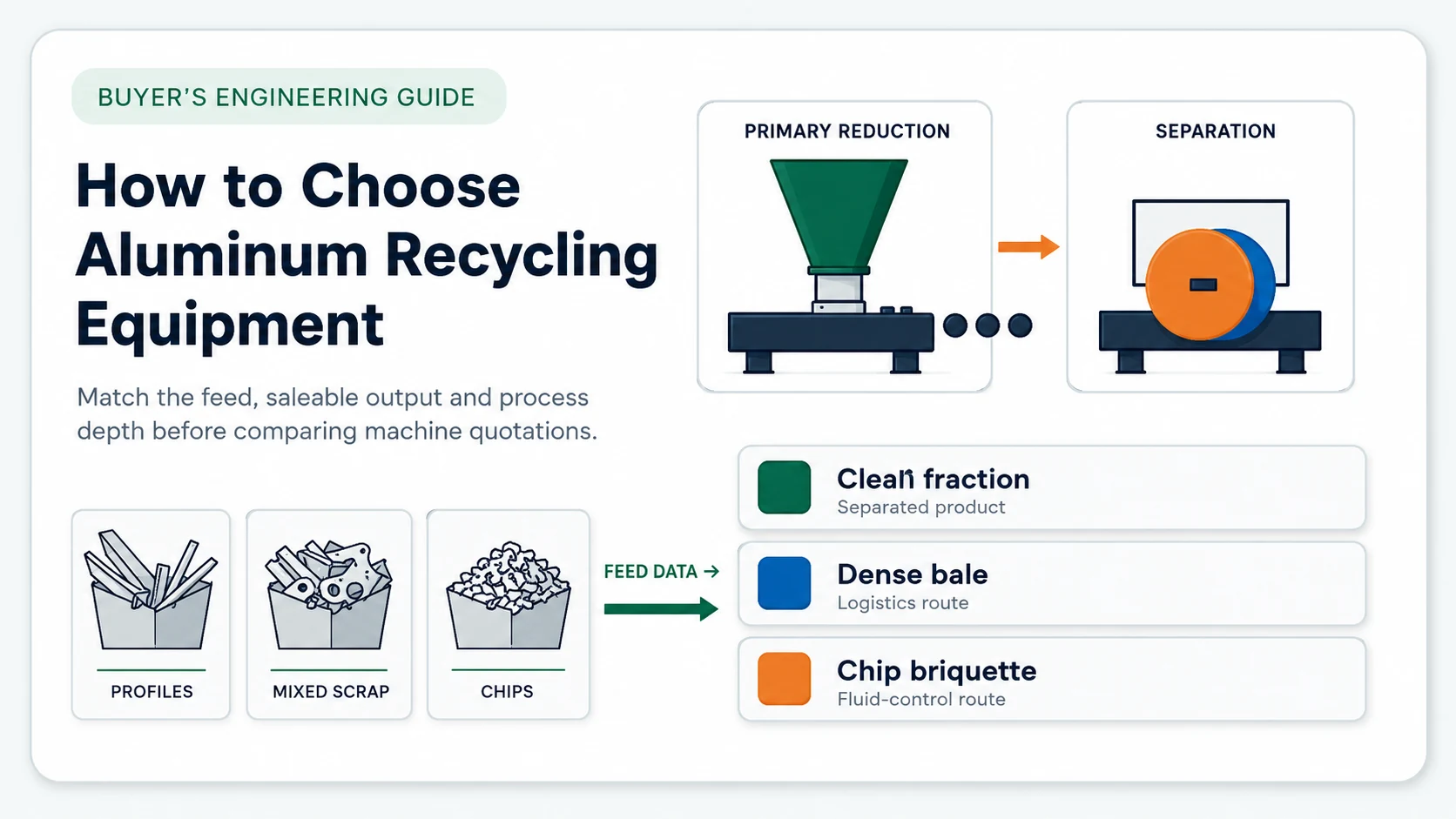
A quotation can look technically impressive and still be wrong for the material. We see this most often when a buyer sends one line of text—“need an aluminum recycling machine”—but the photos show three very different feeds: long window profiles, oily machining chips, and dense cast parts with steel attachments. Those materials should not be forced through one fixed route.
Sometimes the right answer is a shredder and separation line. Sometimes it is a baler. Sometimes the project needs liquid control and briquetting, while a general scrap shredder would only create more fines and maintenance. The selection work is not about finding the machine with the largest motor. It is about defining what problem each stage must solve.
Equipment Selection Begins Before the Equipment List
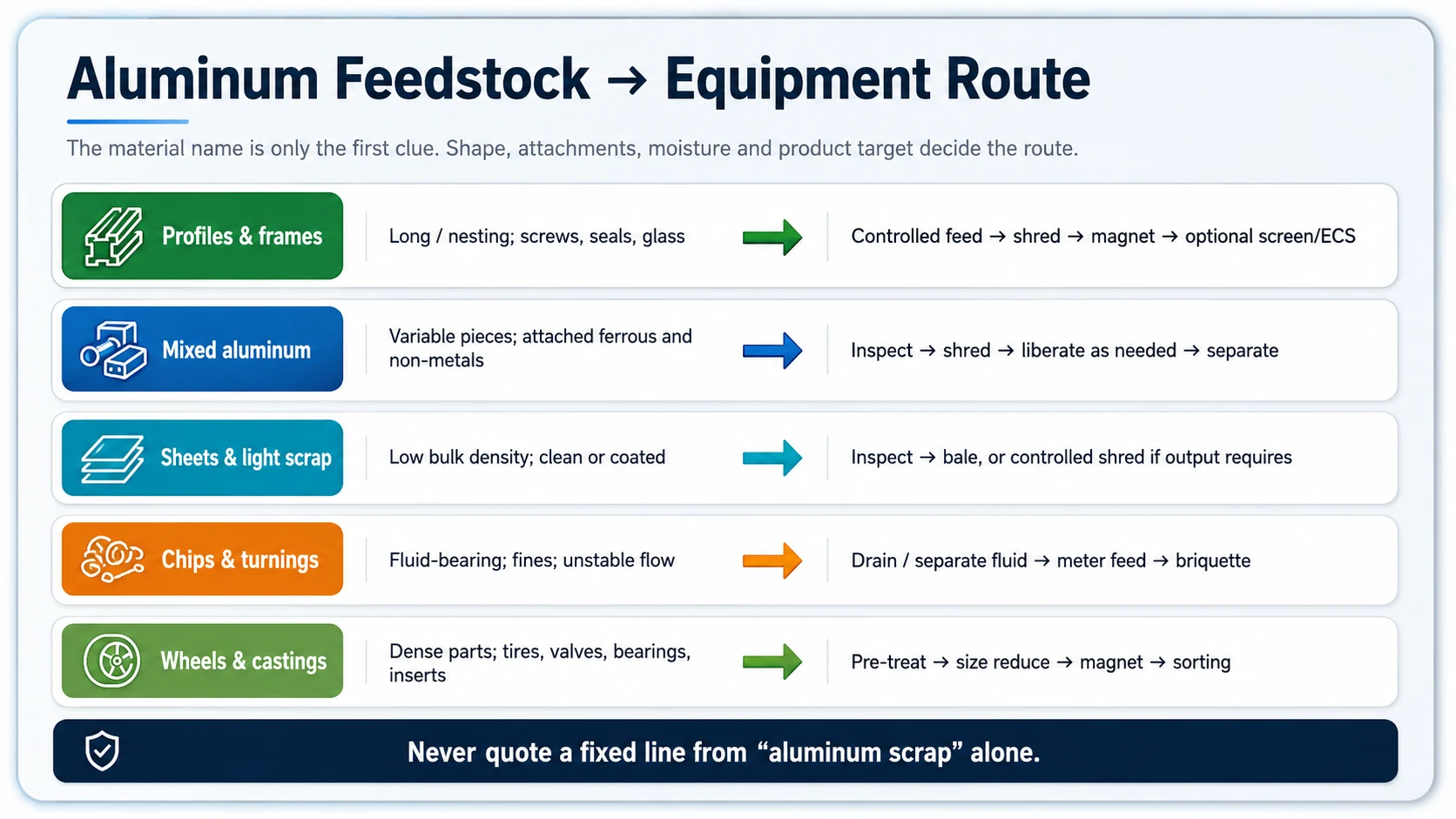
The public YUXI scrap aluminum recycling line page separates profiles and frames, mixed scrap, sheets and foil, chips and turnings, and wheels or automotive castings. It then routes projects toward shredding and physical separation, light-scrap baling, or chip collection with liquid control and briquetting. That is a more useful buying framework than asking for one universal “aluminum machine.”
The U.S. EPA’s secondary-aluminum process material also treats pretreatment as a set of possible operations rather than one mandatory sequence. Inspection and sorting may be followed by crushing, screening, baling, shredding, classifying or other preparation depending on the scrap stream and the next metallurgical step. EPA AP-42: Secondary Aluminum Operations
- Describe the incoming scrap. Record dimensions, bulk density, attachments, moisture, contamination and variability.
- Define the product that earns revenue. Decide whether the buyer needs reduced pieces, a cleaner aluminum fraction, bales, briquettes or alloy-separated products.
- Select only the stages needed to bridge that gap. Every machine must remove a known constraint.
- Test the proposed route with representative material. A catalogue cannot show how the scrap will bridge, wrap, carry moisture or split between product and residue.
1. Define the Feedstock in Engineering Terms
“Aluminum profiles” is not a complete feed specification. A bundle of clean extrusion offcuts is very different from demolition frames containing screws, thermal-break strips, rubber seals and glass fragments. The same applies to castings. A clean housing and a part containing a bearing, steel shaft and trapped fluid may share a material name, yet they create different loads and reject streams.
In our experience, six variables normally change the equipment recommendation more than a nominal tons-per-hour request.
Physical form
Longest piece, cross-section, thickness, bundle size, single-piece weight, loose or compacted condition, and whether the material nests or bridges.
Bulk behavior
Bulk density, feeding method, pile condition and how the material changes after cutting or unloading. Light foil and rigid castings can share the same chemistry but not the same conveyor behavior.
Attached materials
Steel screws, brackets, bearings, copper, plastic, rubber, wood, glass, paint, labels and dirt. Estimate percentages rather than writing “some contamination.”
Moisture and fluids
Rainwater, cutting fluid, oil and trapped liquid affect feeding, housekeeping, dust control and downstream separation. Chips deserve special attention.
Feed variability
Minimum, typical and worst-case loads. A line sized for the clean sample may struggle when demolition scrap or dense cast parts arrive.
Prohibited items
Identify sealed containers, pressure vessels, batteries, flammable material, hazardous residue and large hard steel pieces before they reach the process.
Photos help, but they rarely show the whole problem. A loading video reveals whether profiles tangle. A measured container volume and weight improve the bulk-density estimate. A hand-sorted sample exposes the real contamination mix. One export proposal can change substantially after those three checks.
2. Define the Saleable Output Before Choosing the Machines
Buyers sometimes describe the input precisely and leave the output as “clean aluminum.” That phrase is too vague for a contract. It does not say whether the product will be sold as a reduced mixed fraction, a furnace-preparation grade, a dense logistics bale, a chip briquette or an alloy-specific product.
Write the output in measurable terms: product form, target particle range where relevant, limits for attached ferrous and non-metal material, moisture expectation, packaging, sampling method and downstream buyer. This prevents a familiar dispute—the supplier shows a visually attractive handful, but the recycler’s customer grades the full lot by a different rule.
| Required output | Likely equipment logic | Questions to settle first |
|---|---|---|
| Reduced aluminum pieces | Controlled feeding and primary size reduction; secondary crushing only when a smaller, more liberated product is required | Maximum size, fines limit, attached hardware and downstream buyer requirement |
| Cleaner mixed aluminum fraction | Size reduction, ferrous removal, sizing and optional non-ferrous recovery from a suitable non-metal stream | Contaminant types, sampling method, acceptable aluminum loss in rejects and whether alloy sorting is required |
| Dense bales | Inspection, preparation and hydraulic compaction | Material cleanliness, bundle condition, bale dimensions, transport and buyer acceptance |
| Chip briquettes | Collection, drainage or liquid separation, controlled feeding and briquetting | Cutting-fluid content, fines, foreign metal, briquette handling and downstream use |
| Alloy-separated products | Mechanical preparation plus suitable sensor-based sorting and quality control | Which alloy families, particle presentation, detection limits, ejection accuracy and verification method |
A magnet removes ferrous material. An eddy current separator recovers conductive non-ferrous pieces from a prepared non-metal stream. Neither machine identifies aluminum alloy grades. Research on automatic scrap sorting has combined electromagnetic and dual-energy X-ray sensing for metal identification, and newer aluminum-scrap facilities use singulation, sensor scanning and controlled ejection. Mesina, de Jong and Dalmijn (2007); Wu, Oudshoorn and Rem (2024).
3. Choose the Least Complex Route That Meets the Output
More machines do not automatically create a better line. They create more transfer points, wear parts, controls and places where aluminum can report to a reject stream. Complexity is justified only when the feed or product specification requires it.
Route A: Volume reduction and logistics
Clean sheets, light scrap or sorted offcuts may only need inspection, preparation and densification. A metal baling machine can be the correct core equipment when the problem is storage, transport or furnace charging—not liberation. Adding a shredder without a downstream need can create fines, noise and maintenance without improving the saleable product.
Route B: Bulky scrap reduction and ferrous removal
Long profiles, frames, selected wheels, cast parts and mixed scrap often need controlled feeding, primary shredding and magnetic removal of screws, brackets or inserts. The YUXI metal shredder is used as a primary reduction stage for bulky light scrap. The buyer still needs to confirm hopper behavior, chamber access, blade arrangement, overload response, output control and transfer to the next machine.
Route C: Liberation, sizing and deeper physical separation
When attachments remain locked after primary reduction, a secondary stage may be justified. A hammer mill metal crusher can provide further size reduction and liberation before magnetic removal, screening and optional downstream separation. That stage should not be selected merely because finer output sounds better. Excessive reduction can raise wear, dust and small-metal losses.
Route D: Chips and turnings
Loose machining chips are a different handling problem. They may carry cutting fluid, moisture, fines and foreign metal. The practical route is collection, liquid control, metered feeding and briquetting. Treating them as rigid mixed scrap often causes unstable feeding and unnecessary fines.
Route E: Alloy-level sorting
When the commercial goal is to separate cast from wrought material or create alloy-family products, the project moves beyond broad mechanical recovery. Particle singulation, sensor choice, detection limits, ejection timing, data interpretation and reject strategy all become part of equipment selection.
4. Match Each Machine to a Specific Job
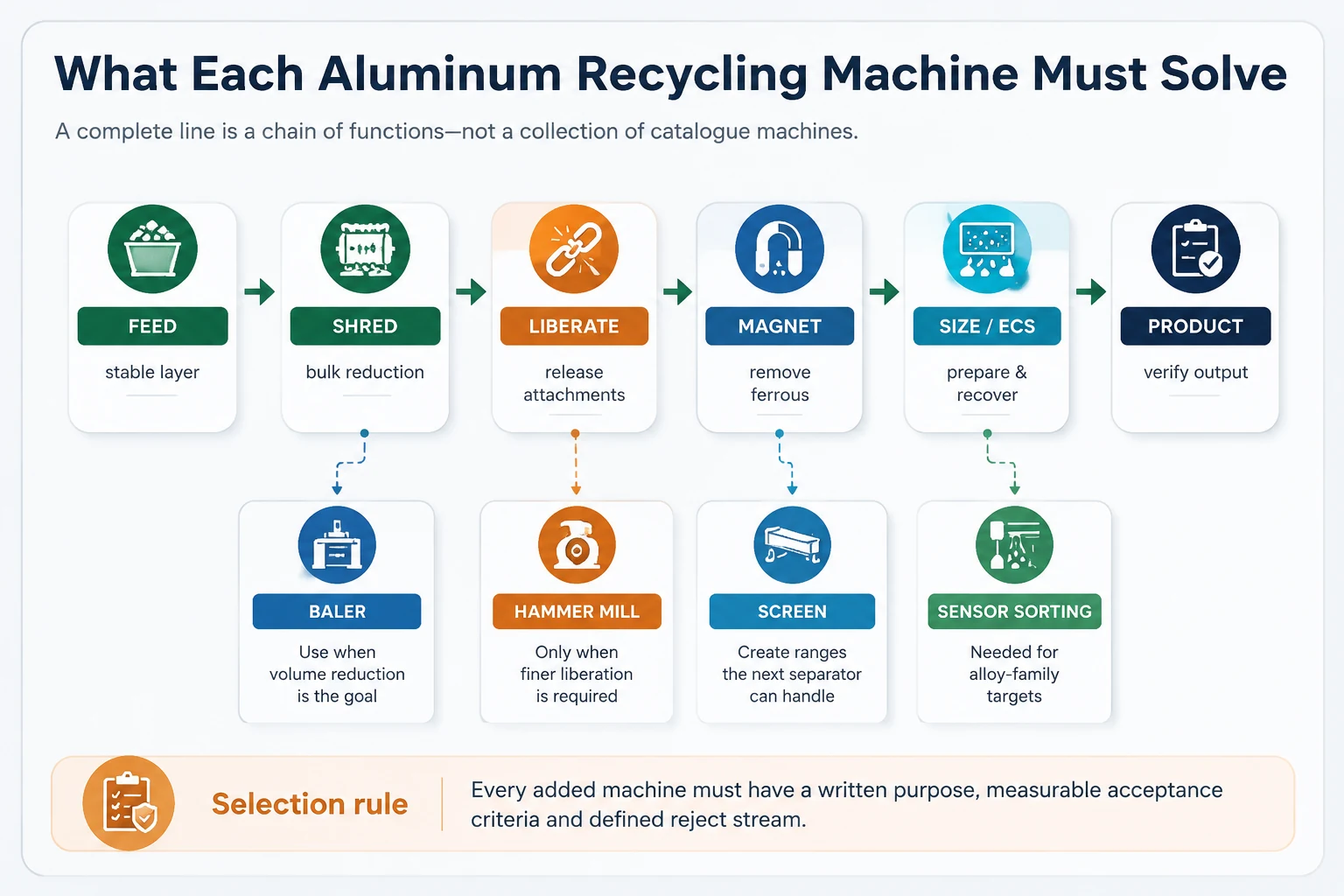
A useful equipment list explains cause and effect. “Add a screen” is incomplete. The proposal should state which size fraction the screen creates, why that fraction helps the next separator and where aluminum losses will be checked.
| Equipment | What it should do | What it does not prove |
|---|---|---|
| Feeding conveyor | Connect loader, grab or manual feeding to the process and create a stable material layer | It cannot correct a hopper that bridges or a feed mix that changes wildly |
| Primary shredder | Reduce bulky profiles, frames and mixed light scrap into conveyable, separable pieces | It does not guarantee liberation, final purity or stable capacity for every scrap form |
| Hammer mill / secondary crusher | Release attached material and create a smaller, more controlled range when downstream separation needs it | Finer output is not automatically better; wear, dust and fines must be reviewed |
| Magnetic separator | Remove iron and steel screws, brackets, wire and inserts from a suitable material layer | It does not recover aluminum from plastic, rubber or other non-metal material |
| Screen | Split the stream into ranges that behave more consistently in downstream separation | One aperture does not suit every shape, thickness, moisture level or target product |
| Eddy current separator | Eject conductive non-ferrous material from a prepared non-metal stream | It does not replace ferrous removal or perform alloy-grade identification |
| Baler | Compress suitable clean scrap for storage, transport or downstream handling | Compaction does not remove hidden contamination |
| Briquetting system | Densify prepared chips after appropriate liquid and fines control | It cannot make wet or mixed chips suitable without upstream preparation |
The strongest proposals show every reject stream. Where does ferrous material discharge? Where do fines go? Can the operator sample the non-metal residue? How is oversize recirculated? A flowsheet showing only the saleable product hides half of the process.
5. Size the Complete Line, Not the Largest Motor
Real throughput is a system property. A primary shredder may process a dense, easy feed faster than the screen or separator can accept it. A light, springy profile bundle may limit the hopper and conveyor before the cutting system reaches its nominal load. Wet chips may bridge. Thin foil may carry in an air stream. None of those effects can be resolved by comparing motor kilowatts alone.
Feed basis
Material name, representative photos, largest piece, thickness, single-piece weight, bulk density, contamination and moisture. State whether the sample is typical or unusually clean.
Output basis
Required product size, separation depth, recirculation, allowable residue, bale or briquette form, and whether manual quality control is included.
Operating basis
Net running time, planned stops, cleaning, blade checks, screen changes, bin changes and normal operator intervention.
Test basis
Batch weight, duration, feed method, load trends, jams, oversize, product weights and reject weights.
When two suppliers quote the same “capacity,” ask whether they mean instantaneous feed into one machine, average complete-line feed, or final product per net operating hour. Those are not interchangeable. The YUXI solution page also warns that bulk density, piece size, thickness, contamination, process stages and target size affect real capacity.
6. Check the Limits of Magnetic and Eddy Current Separation
Separation equipment works best after the feed has been prepared for it. A magnet needs accessible ferrous pieces and a material layer that allows capture. An eddy current separator needs a suitable particle range, stable presentation and enough spacing for conductive pieces to follow a different trajectory from the non-metal stream.
In practice, the following questions matter more than a generic efficiency claim:
- Has ferrous material been removed before the ECS?
- What particle-size and shape range was used in the test?
- How deep and even was the material layer?
- Were wet, flat, wire-like or very fine pieces present?
- How much aluminum reported to the reject stream?
- Does the buyer need broad non-ferrous recovery or actual alloy identification?
The YUXI eddy current separator belongs after suitable preparation, not as a cure for poor liberation, excessive burden depth or unremoved steel.
7. Review Layout, Utilities, Dust and Safe Access Before Ordering
A line can fit on a supplier’s flow drawing and still be difficult to operate in the workshop. Buyers should check the loader access,dumpling height,aisle width,forklift and pedestrain routes,platform access,bin removal,overhead or mobile crane requirements,wear parts replacement space,and future expansion routes.
Dust control should be regarded as part of the process, not as a decorative add-on. EPA points out that crushing, shredding and screening produce metallic and non-metallic particulates. OSHA’s metal-scrap guidance discusses guarding, hazardous-energy control, dust, flying material and operator training around baling and shredding equipment. OSHA 3348: Metal Scrap Recycling
At quotation stage, ask for the electrical standard, connected and expected operating load, control voltage, cable boundary, hydraulic cooling requirement, compressed air, dust-extraction volume, foundation loads and environmental limits. Safety requirements must be reviewed for the installation country and site; a machine quotation is not a compliance certificate.
8. Normalize Supplier Quotations Before Comparing Price
Two quotations can carry the same headline capacity and still describe different projects. One may include only core machines. Another may include conveyors, platforms, dust collection, controls, spare parts, supervision and commissioning. The lower price is not necessarily lower cost; it may simply be a shorter scope.
Ask every supplier to return the proposal in the same structure:
- Confirmed feed specification and excluded materials.
- Process flow with every machine, conveyor, transfer and reject discharge.
- Function of each stage and the problem it solves.
- Capacity definition: feed rate, product rate, test basis and operating assumptions.
- Output definition and sampling method.
- Wear parts, access points, recommended inspection and routine maintenance.
- Electrical, dust-control, civil, utility, installation and commissioning boundaries.
- Factory and site acceptance responsibilities.
- Documents, training, spare parts and after-sales communication included.
We also recommend asking what the line should not process. A supplier who can define the feed boundary is more useful than one who claims the same machine can handle every metal without qualification. Budget questions that belong to scope and installation should be cross-checked against the separate aluminum recycling plant cost guide rather than repeated here.
9. Use a Representative Factory Acceptance Test
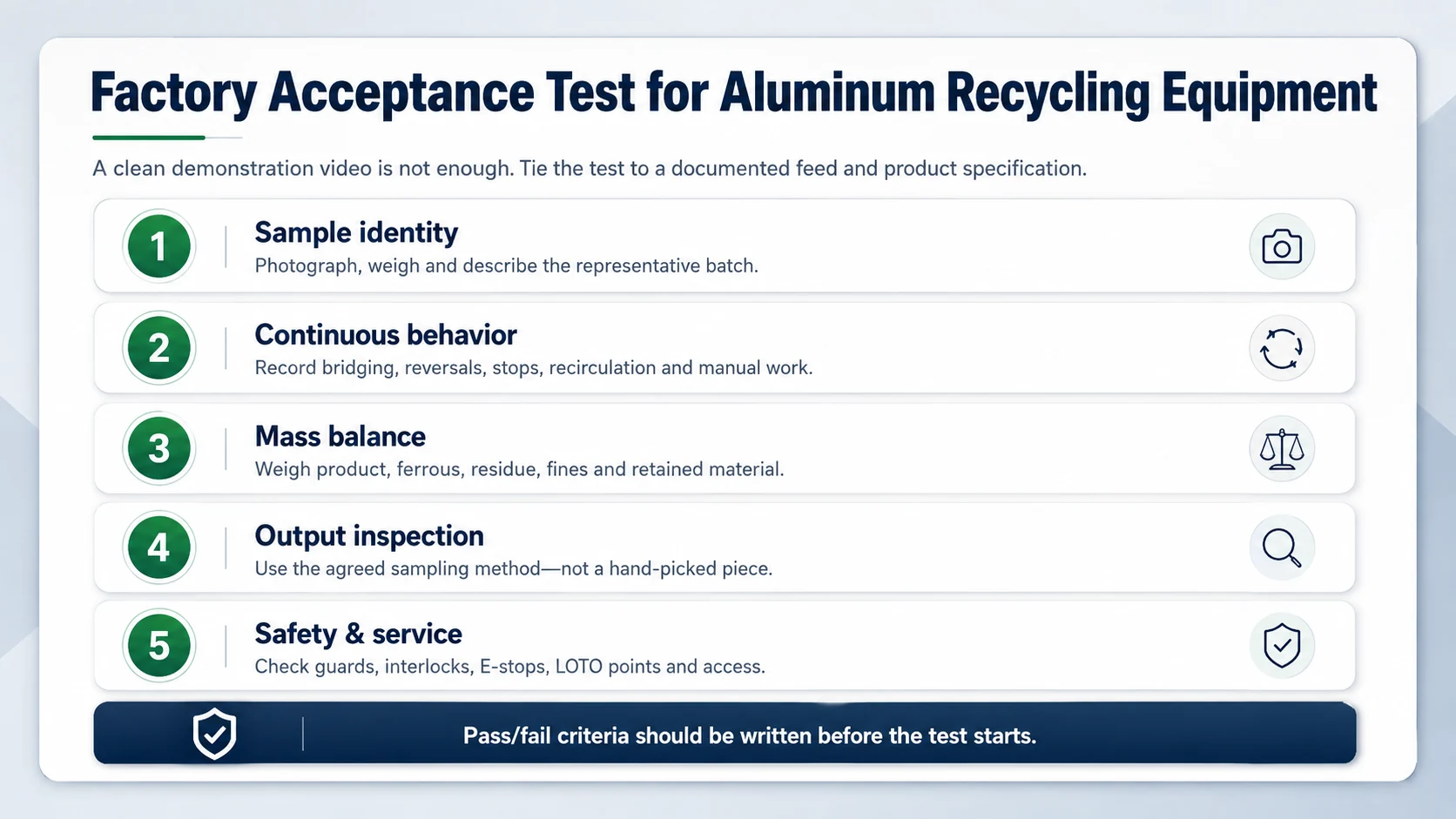
A video of clean material passing through a machine is not a complete acceptance test. The test should use a documented sample that represents the quoted feed, run the agreed complete route, record all important discharges and compare the output with the written specification.
- Sample identity. Photograph and weigh the batch. Record dimensions, moisture, attachments and contamination. Confirm that it is comparable to the design feed.
- Continuous process behavior. Record feed interruptions, bridging, overload reversals, manual picking, recirculation and cleaning. Hidden labor matters.
- Mass balance. Weigh the aluminum product, ferrous fraction, residue, fines and retained material. This shows where metal is lost.
- Output inspection. Use the agreed sampling method. Measure product form, size and contamination; do not rely on one hand-picked photo.
- Safety and service review. Demonstrate interlocks, emergency stops, guarding logic, lockout points, access for wear parts and supplied documentation.
For a variable project, the site acceptance test should repeat the method under normal utilities, feeding and operator conditions. Feed changes must be logged so that a later performance issue can be traced to material, operation or equipment.
10. Common Aluminum Equipment Buying Mistakes
Buying by material name alone
“Aluminum” does not describe shape, density, attachments or moisture. A machine may be able to cut the metal and still fail as a system because the scrap bridges, wraps, contains hard inserts or arrives as a fluid-bearing chip mass.
Comparing only motor power and chamber width
Those figures matter, but they do not show feeding stability, liberation, screen load, reject handling, service access or final product rate. Compare the full route and test basis.
Assuming finer output always improves value
Finer reduction can help liberation. It can also create more wear, dust and small metal losses. The target size should be connected to downstream separation or buyer specification.
Adding an ECS before preparing the feed
An eddy current machine cannot compensate for poor liberation, excessive burden depth, ferrous contamination or a particle range outside the intended operating window.
Ignoring reject streams
A line can look successful while losing aluminum to the magnetic discharge, light residue or fines. A product photo without a mass balance is incomplete evidence.
Accepting a universal purity statement
Purity and recovery depend on the feed, process configuration, sampling method and product definition. Ask for the exact test basis and inspect every output stream.
11. RFQ Data That Produces a Useful Recommendation
A strong RFQ does not need to be long. It needs to be measurable. Send the following information before asking for a final equipment list:
| RFQ field | What to provide | Why it matters |
|---|---|---|
| Feed photos and video | Typical and worst-case loads, loading method and mixed components | Reveals nesting, bridging and hidden attachments |
| Dimensions and density | Maximum piece, thickness, weight, bundle size and measured bulk density | Sets hopper, conveyor and reduction boundaries |
| Contamination | Estimated ferrous, copper, plastic, rubber, glass, dirt, fluid and fines | Determines liberation, separation and reject handling |
| Target product | Form, size, contamination limits, moisture, packaging and buyer | Defines the process depth and acceptance test |
| Throughput basis | Required product rate, hours per shift, shifts, duty cycle and seasonal variation | Prevents confusion between feed rate and saleable output |
| Site data | Power supply, workshop dimensions, headroom, loading equipment and environmental limits | Connects machine selection to a buildable project |
Get a Feed-Based Equipment Recommendation
Send representative material data, required product, throughput basis, power supply and workshop dimensions. YUXI can divide the project into the appropriate shredding, sorting, baling or briquetting route instead of forcing the scrap into one fixed line.
FAQ
What is the first step in choosing aluminum recycling equipment?
Define the incoming scrap and the required saleable output. Record dimensions, bulk density, attachments, contamination, moisture, variability and prohibited items. Then select the least complex route that can transform that feed into the agreed product.
Does every aluminum recycling line need a shredder?
No. Clean sheets or light scrap may be better suited to inspection and baling. Chips normally need liquid control and briquetting. A shredder is justified when bulky or mixed scrap needs size reduction, handling improvement or liberation before separation.
When is a hammer mill needed after primary shredding?
When the primary output is still too large, the attachments remain locked, or the downstream screen and separator need a smaller and more controllable range, consider a secondary hammer mill or crusher. Do not add it just to make the process look complete.
Can an eddy current separator sort aluminum alloys?
A standard eddy current separator recovers conductive non-ferrous material from a suitable non-metal stream. It does not identify aluminum alloy grades. Cast/wrought or alloy-family sorting may require sensor-based technologies and a separate validation method.
How should equipment capacity be compared?
Use the same representative feed, output definition and operating assumptions. Distinguish between the primary-machine feed rate and the final saleable product rate, and record downtime, recirculation, manual intervention and all reject streams.
What should be included in a factory acceptance test?
Document the sample, run the complete agreed route, record feeding and stops, weigh product and rejects, inspect output using the agreed sampling method, and verify guarding, interlocks, emergency stops, lockout points, maintenance access and supplied documents.
Can a supplier guarantee fixed purity?
A fixed purity statement is not meaningful without a defined feed, process configuration and sampling method. Ask for the material basis, test conditions, product definition and aluminum loss in each reject stream.
What information does YUXI need for a line proposal?
Provide representative photos or video, maximum feed size, bulk density, attached iron and non-metal content, moisture or fluid condition, target throughput, final product, working hours, power supply, feeding method and workshop dimensions.
Source Notes
- U.S. EPA AP-42, Chapter 12.8: Secondary Aluminum Operations ? used to separate mechanical pretreatment from downstream smelting/refining and to support particulate-control context.
- OSHA 3348: Guidance for the Identification and Control of Safety and Health Hazards in Metal Scrap Recycling ? used for machine guarding, lockout/tagout, dust, flying-material and training boundaries.
- The Aluminum Association: Aluminum Recycling ? used for aluminum recycling and circular-economy context.
- International Aluminium Institute: Recycling ? used for global aluminum recycling context.