




 Request Quote



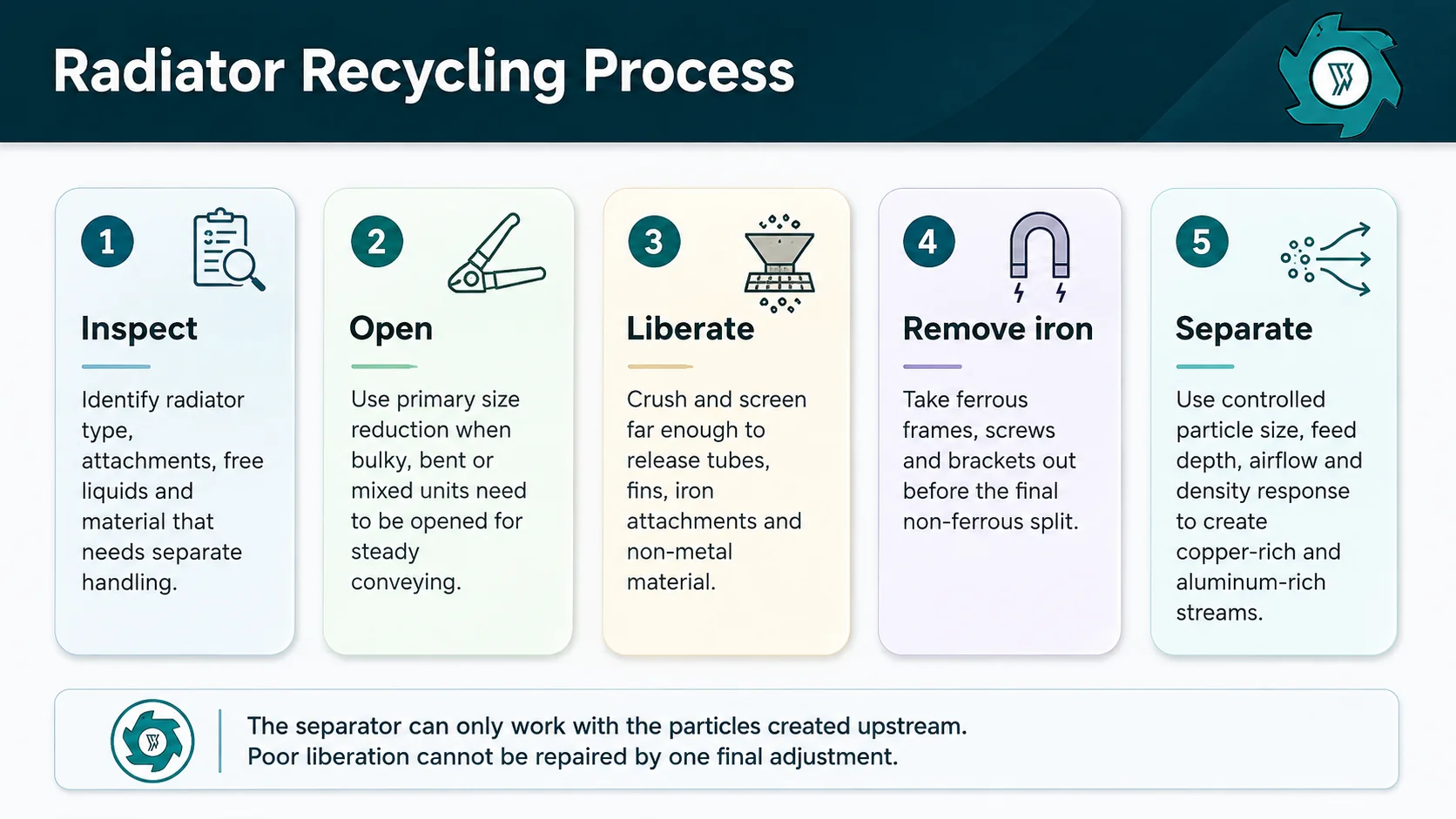
A scrap radiator is awkward material because several thin materials are built into one compact unit. Copper tubes may be bonded to aluminum fins; steel brackets and screws sit around the edges; plastic tanks, hoses, soldered joints, dirt and residual liquids can arrive with the same load. Recycling it well is therefore less about “breaking the radiator” than about opening those connections until each material behaves like a sortable particle.
1. Define and Prepare the Feed Before It Reaches the Shredder
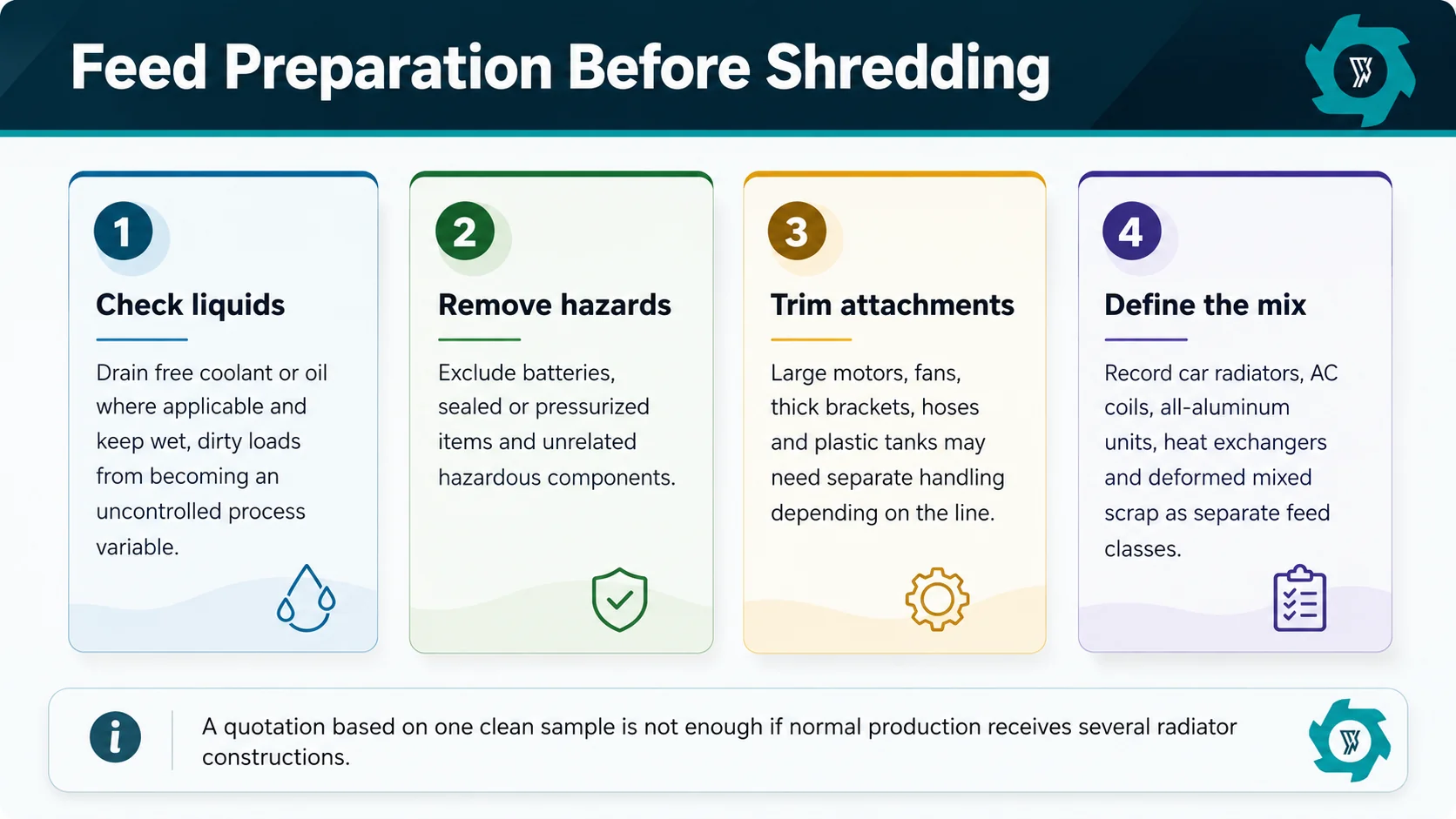
Receiving is where a stable recycling process is either protected or lost. A load described as “radiators” can contain car cooling modules, air-conditioner coils, copper-aluminum cores, all-aluminum heat exchangers, industrial coils and badly deformed mixed scrap. They do not carry the same metal ratio, frame weight, plastic content or geometry.
Before the equipment is sized, separate those feed classes and record how much of each is expected. Also record the worst pieces, not only the average ones. An occasional fan motor, thick bracket or nested bundle can set the real opening requirement even if most pieces are light.
Free liquids and attached components
Radiators removed from vehicles or cooling systems can arrive with coolant, oil, hoses, tanks or other attachments. Free liquid should be dealt with before shredding under the site’s environmental and operating procedures. Refrigeration and air-conditioning equipment brings an additional boundary: in the United States, EPA Section 608 safe-disposal rules require refrigerant recovery from applicable stationary refrigeration and AC equipment before disposal. The coil may be suitable scrap only after that upstream refrigerant-handling obligation has been completed.[1]
Do not assume every attachment should simply go through the line. Large motors, heavy steel assemblies, sealed items and unrelated components can change load, wear and safety conditions. The accepted feed list should be written down so operators and the supplier are working to the same material definition.
2. Meter Material Into the Line Instead of Dumping It in Batches
Radiators are light for their volume and can interlock. That makes “tons per hour” a poor description of the feeding problem by itself. One bucket can be loosely stacked; the next can be compressed or full of steel attachments. If both arrive as sudden slugs, the first shredder may recover, but the surge keeps traveling toward the crusher and separators.
Even feeding is therefore part of the separation system. The feeder and conveyor should deliver a controlled stream that the next machine can accept without repeated overload and recovery cycles. When feed rate changes, the entire line should respond in a coordinated way rather than allowing a fast upstream machine to bury a slower downstream stage.
This is also why a nominal machine capacity cannot be treated as complete-line capacity. For a broader explanation of the difference between catalog throughput and material-dependent throughput, the metal shredder capacity guide is a useful companion. In radiator recycling, the limiting point may be the secondary crusher, screen or separator rather than the primary shredder.
3. Primary Shredding Opens Bulky and Irregular Radiators
Primary shredding has a simple job: make bulky composite units easier to convey and easier to process in the next stage. It does not need to finish the copper-aluminum separation. Trying to force a low-speed primary shredder to produce the final particle condition can add wear without solving the real liberation problem.
A double-shaft shredder is useful when the feed includes bent coils, larger frames or mixed radiator forms that do not enter a finer crusher consistently. Counter-rotating cutters pull, tear and shear the material into smaller pieces. The output is more manageable, but copper tubes can still carry aluminum fin and steel attachments can still be present.
For readers comparing different size-reduction concepts, types of metal shredders explains why a low-speed twin-shaft machine and a high-speed or vertical crusher should not be judged as interchangeable equipment. They create different material behavior and occupy different positions in a process.
4. Crushing and Screening Create the Liberation the Separator Needs
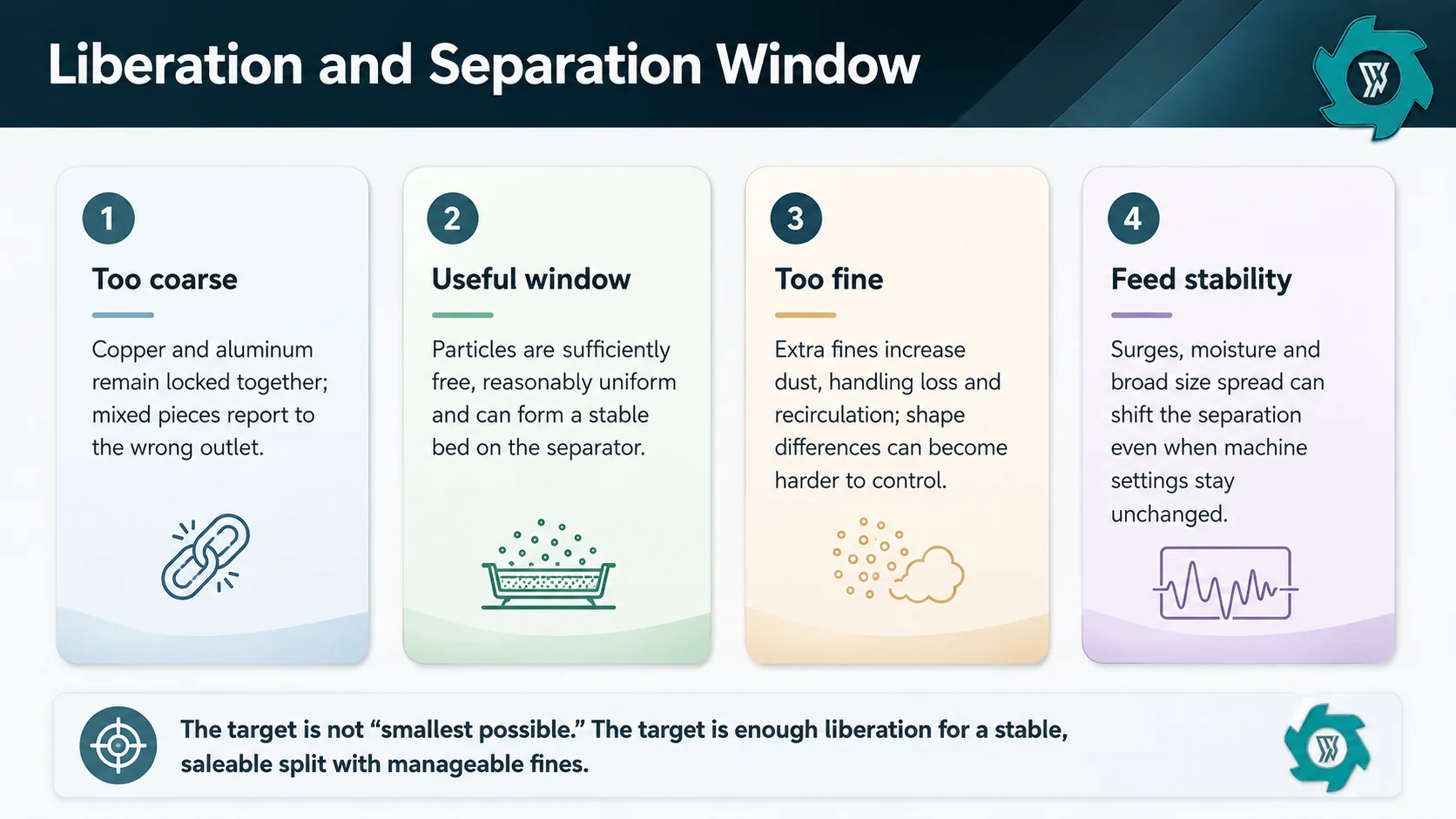
This is the stage that decides whether the downstream separation has a fair chance. Copper and aluminum do not separate just because both metals are present. They separate when enough of their physical connection has been broken and the resulting particles fall inside a usable size and shape range.
The secondary crusher works on the pre-opened radiator pieces, breaking tubes, fins and joints further. Screening then controls the stream. Oversize material may need another pass; undersize and fines need to be understood rather than simply celebrated as “more crushing.” The best setting is not the smallest possible particle. It is the size at which the target metals are sufficiently liberated without creating unnecessary dust, loss or an unstable separator feed.
What incomplete liberation looks like
Mixed copper-aluminum pieces remain in one outlet or bounce between fractions. Operators often respond by changing airflow or deck settings. Sometimes that helps. Often it does not, because the separator is being asked to split a particle that is physically still both materials.
What over-crushing looks like
Too much secondary size reduction can create excess fines, increase dust loading and move valuable metal into hard-to-handle small fractions. Very fine, thin pieces also behave differently in air from more compact granules. The process should therefore be tuned around a separation window, not a slogan about “finer output.”
5. Magnetic Separation Removes the Easy Ferrous Fraction First
Once the material has been opened and crushed, iron and steel should be removed before the more sensitive non-ferrous separation stage. Brackets, frames, screws and other ferrous parts can otherwise contaminate product streams and disturb the loading of the final separator.
The magnet is straightforward in principle, but its performance still depends on presentation. A deep, surging bed can hide iron beneath non-ferrous material. A thinner, more even stream gives the magnetic field a better chance to act on individual pieces. This is another reason feed control cannot be treated as a separate conveyor problem.
Check the ferrous outlet as well as the cleaned non-ferrous stream. If copper-bearing composite pieces are being pulled out with steel attachments, the plant may be losing value before the gravity separator ever sees the material.
6. Gravity and Airflow Separation Split the Remaining Non-Ferrous Stream
After iron removal, the remaining material is still not “copper on one side, aluminum on the other” automatically. A gravity or airflow separator exploits differences in how particles respond to vibration, air, density, size and shape. That means two pieces of the same metal can travel differently if one is flat and light while the other is compact and heavy.
Three conditions matter most in daily operation: particle preparation, feed depth and air balance. If the screen sends a very broad size distribution, the separator has to deal with several aerodynamic behaviors at once. If the feeder buries the deck under a thick layer, particles cannot stratify cleanly. If airflow is adjusted to rescue one difficult fraction, it can push another out of specification.
A stable setting is therefore a result of stable upstream conditions. Operators should record what feed was running when a setting worked. Otherwise, a parameter copied from yesterday may be blamed when today’s radiator mix is the real difference.
7. Treat “Clean Metal Fractions” as a Measured Output, Not a Visual Claim
The practical products from a mechanical radiator line are usually described as copper-rich, aluminum-rich, ferrous and light non-metal fractions. The word rich matters. A mechanical line prepares saleable or further-refinable material; it does not magically create chemically pure metal.
Before commissioning, agree on how each fraction will be sampled. A handful taken from the top of a bin is easy but weak evidence. A better method defines sample location, timing, sample mass, how mixed pieces are classified and what happens to oversize or recirculated material. If the buyer wants a purity or recovery guarantee, those terms need a written test method behind them.
Use a simple mass balance
We prefer to record the incoming test mass and every final outlet: copper-rich, aluminum-rich, ferrous, light residue, dust/fines and reject material. Recirculated material should be tracked separately as an internal process flow rather than counted again as a final output. The numbers do not need to be complicated. Their value is that they force the team to account for material that would otherwise disappear into a mixed bin or housekeeping pile.
What Changes Radiator Recycling Performance From One Batch to the Next?
The process rarely drifts for only one reason. Several small changes can arrive together. A wetter batch increases sticking. A higher share of all-aluminum radiators changes density balance. More steel attachments load the magnetic stage. Tightly nested material affects feeding. Worn crushing parts change the particle-size distribution. The final separator is often where the problem becomes visible, but it may not be where the problem began.
Feed mix
Car radiators, AC coils, all-aluminum units and industrial heat exchangers do not behave identically. Record the percentage mix during tests.
Geometry
Flat, loose material feeds differently from compacted, bent or nested scrap. Maximum piece size alone does not describe this.
Moisture and contamination
Liquid, oil, dirt and non-metal attachments affect conveying, dust, screening and separation response.
Particle-size distribution
Averages hide tails. Oversize locked pieces and excessive fines can both lower saleable output.
Feed-bed depth
Surges can overwhelm magnets and gravity separators even when average hourly throughput looks acceptable.
Wear condition
Cutters, hammers, screens, bearings and transfer points change over time; output quality should be checked after maintenance changes.
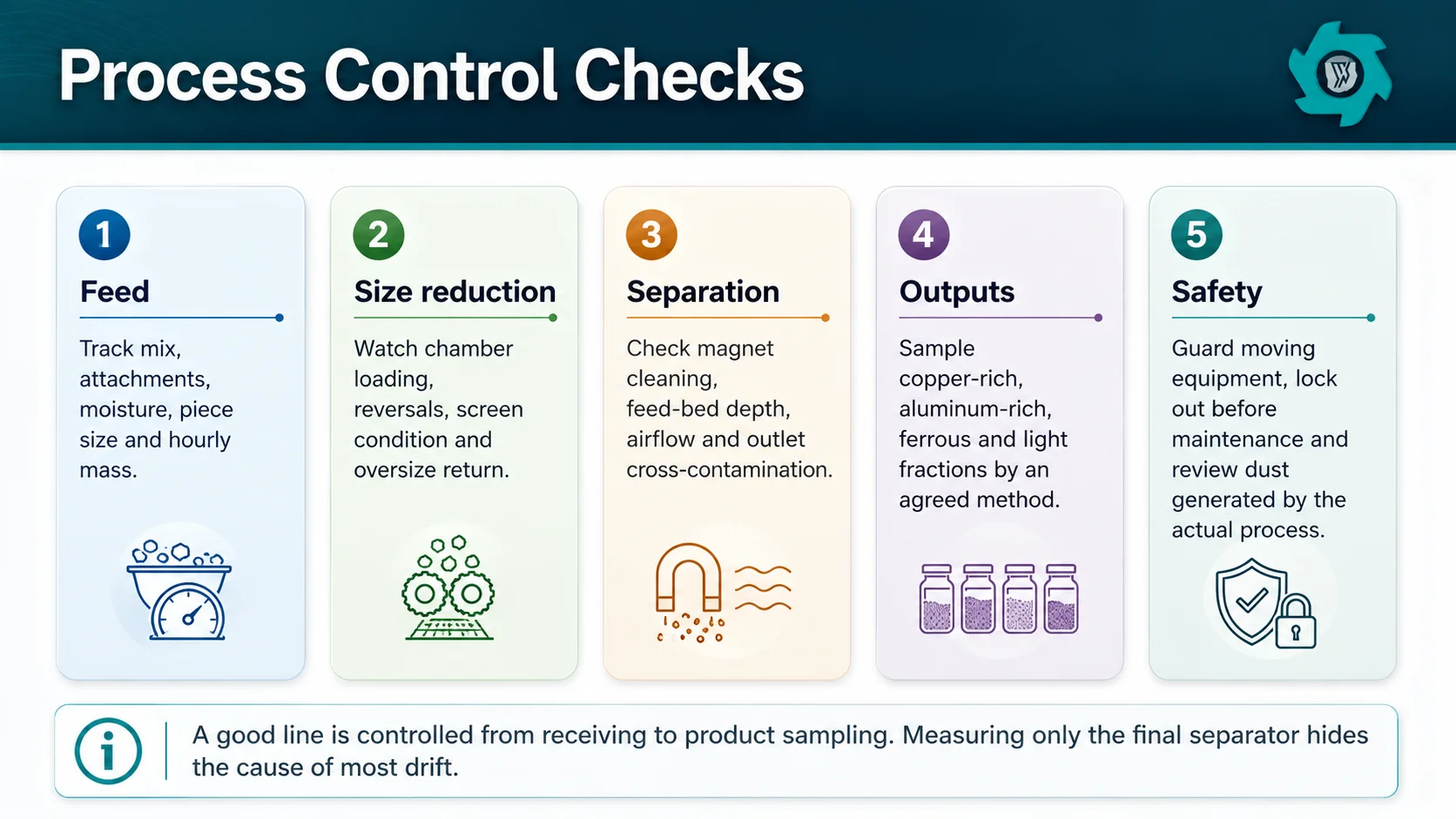
Safety and Dust Controls Belong Inside the Process Design
Shredders, crushers, screens, conveyors and separators create multiple access points where operators may be tempted to clear a jam or inspect moving material. OSHA’s recycling guidance highlights hazards from moving machinery, unexpected startup and crushing, and requires lockout/tagout procedures for servicing where hazardous energy is involved.[2] Guards and interlocks should be planned with maintenance access, not added after the line has been squeezed into the building.
Dust needs its own review. Crushing and screening aluminum-bearing scrap can create fine particles, and OSHA notes that even metals that do not burn readily in larger pieces can become explosible when finely divided and suspended under the right conditions.[3] The important question is what dust this radiator process actually produces. Collector design, grounding, isolation, housekeeping and fire protection should be based on the real material and local requirements rather than on a generic “metal dust” assumption.
If this becomes a major design issue for the project, the site’s dust control and fire risk planning guide goes deeper into feed exclusion, dust characterization, collector location and layered protection. The radiator line should also be laid out so maintenance crews can reach screens, magnets, crusher wear parts, ducts and transfer points safely; the metal shredder installation guide covers that wider access and site-interface logic.
Five Process Mistakes That Usually Show Up as “Separator Problems”
- Feeding a changing radiator mix without recording it. Operators then chase settings while the material itself keeps changing.
- Expecting primary shredding to finish liberation. Coarse size reduction opens the feed; it does not guarantee that copper and aluminum are physically free.
- Over-crushing to make the material look uniform. The result can be extra fines, dust and metal loss rather than cleaner products.
- Running the final separator under a deep or pulsing bed. A good separator still needs an even feed layer.
- Calling an outlet “high purity” without a sampling method. Visual inspection can miss mixed pieces, fines and cross-contamination.
RFQ Data for a Radiator Recycling Process
A supplier can only design the process around the information it receives. Sending “we have 2 tons per hour of radiators” leaves nearly every important variable open. For a first technical review, provide:
- Representative photos and short videos of normal and worst-case feed
- Percentage split between car radiators, AC coils, all-aluminum units and other heat exchangers
- Average and maximum dimensions; note compacted, nested or badly deformed material
- Attached steel, plastic, rubber, motors, fans and other components
- Observed free coolant, oil, water or other contamination
- Required sustained complete-line throughput and operating hours
- Desired copper-rich, aluminum-rich, ferrous and residue outlets
- Any contamination limits or downstream buyer specification
- Available floor area, loading method, power standard and dust-control constraints
- How the factory acceptance test will measure mass balance and output quality
That information allows the process discussion to start with the material instead of a machine model. It also makes quotations easier to compare because each supplier is solving the same problem.
Planning a Radiator Recycling Process?
Send YUXI representative radiator photos, the expected feed mix, target sustained throughput and the metal fractions you want to produce. The line can then be reviewed around the actual material rather than a generic radiator sample.
FAQ About the Radiator Recycling Process
What is the main purpose of shredding a radiator before separation?
Primary shredding opens bulky or irregular radiators and creates pieces that can be conveyed into a finer liberation stage. It is preparation for separation, not the final copper-aluminum split.
Can whole radiators go directly into a recycling line?
Only when they fall inside the approved feed specification. Free liquids, sealed or hazardous items, large motors, heavy brackets and unsuitable attachments may require upstream removal or separate handling.
Is a radiator separator machine the same as a complete recycling line?
No. A small stripping machine is generally aimed at clean, flat and dimensionally consistent coils. A complete line is designed to open, crush and separate a broader mixed feed.
Why does particle size matter for copper-aluminum separation?
Particles must be liberated enough to behave as individual materials, but excessive fines can increase dust and handling loss. The useful size range depends on the feed and separator configuration.
What should be measured during a radiator recycling line test?
Record the feed mass and composition, sustained throughput, downtime, recirculation and the mass and contamination of each main output fraction. Use an agreed sampling method rather than visual inspection alone.
Short Summary
A radiator recycling process succeeds when the material is prepared for separation, not merely reduced in size. Define the feed, meter it steadily, open bulky units, create enough liberation, remove iron early and keep the final separator within a stable particle and feed-depth window. Then verify the result with samples and a mass balance. Those steps turn a pile of mixed heat exchangers into copper-rich, aluminum-rich, ferrous and light fractions that can be evaluated and sold on a clearer basis.
External References
- U.S. Environmental Protection Agency. Stationary Refrigeration Safe Disposal Requirements.
- Occupational Safety and Health Administration. Recycling: Waste Management and Recycling — Lockout/Tagout.
- Occupational Safety and Health Administration. Combustible Dust: An Explosion Hazard.