




 Request Quote



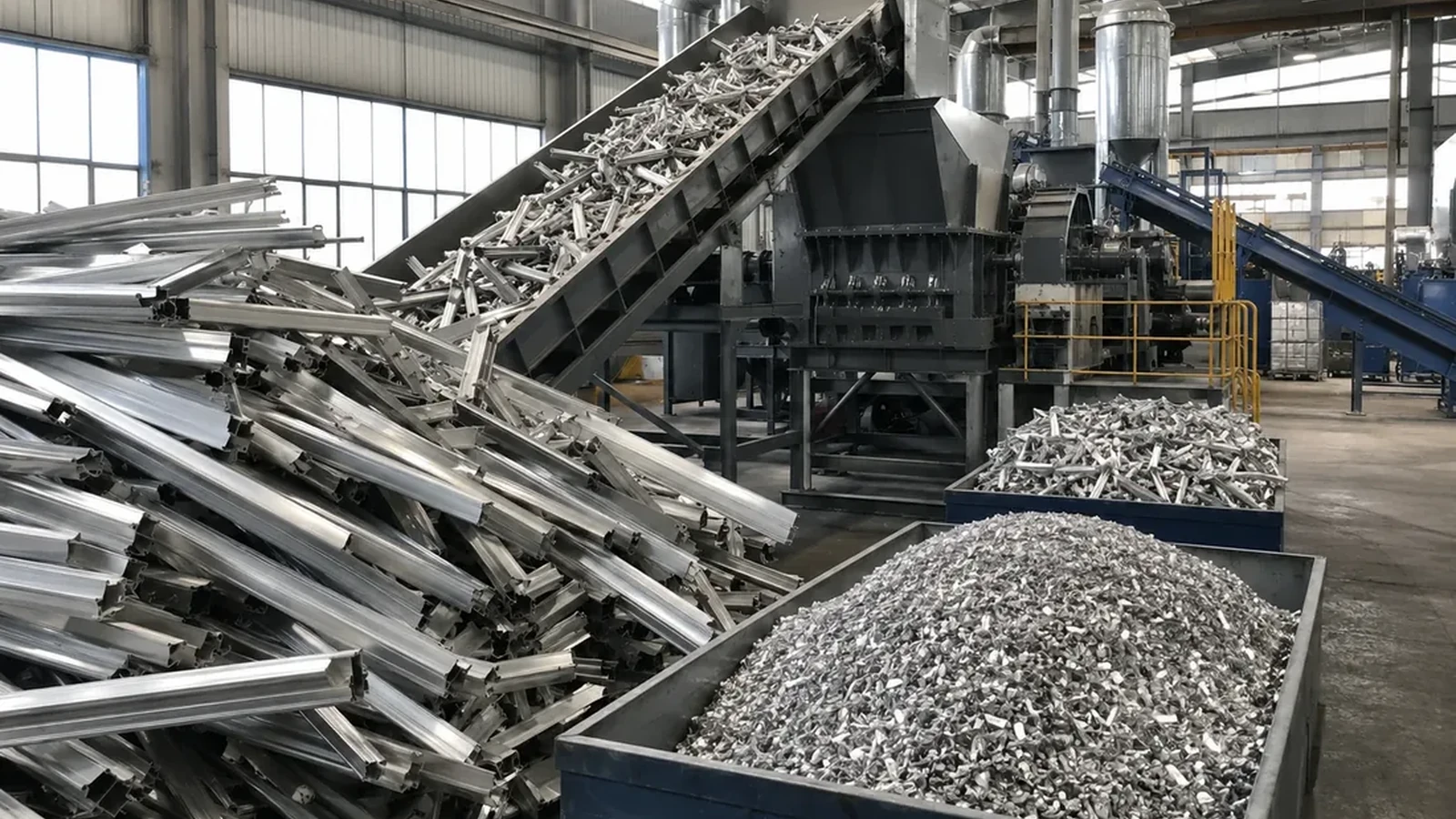
Two quotations can describe an “aluminum recycling plant” and still cover very different projects. One may be a shredder with a discharge conveyor. Another may include controlled feeding, two-stage size reduction, magnetic separation, screening, eddy current separation, dust collection, platforms, controls, commissioning and an acceptance test. Comparing the totals without normalizing that boundary is rarely useful.
Why Aluminum Recycling Plant Quotations Differ So Much
Most price confusion begins with an undefined noun: plant. A supplier may use it for one machine, a connected processing line, an installed line, or a complete site with buildings and downstream metallurgy. Those are not comparable scopes.
Feedstock descriptions are often just as vague. “Aluminum scrap” may mean long window profiles, thin sheet bundles, cast housings, wheels after tire removal, machining turnings, or a mixed pile containing steel fasteners, rubber, plastics and dirt. Each material behaves differently in a feeder, shredder, crusher and separator. Bulk density alone can change the size of conveyors and hoppers even when the hourly mass target remains the same.
Then comes the output. Some buyers only need volume reduction. Others need a controlled particle range and a separate ferrous fraction. A tighter contract may require non-ferrous recovery from a non-metal stream, low residual contamination, a specific bulk density, or sample-based acceptance by a downstream buyer. Every extra requirement creates equipment, control and verification work.
A useful quotation does not start with “How cheap can the line be?” It starts with “What must the line consistently produce from this feed?”
First Define What the Plant Includes
This article covers the physical preparation of waste aluminum: receiving, controlled feeding, cutting or shredding, optional secondary size reduction, magnetic removal, screening, optional eddy-current or air separation, quality control, baling or briquetting, and the systems required to connect these steps.
It does not assume that a quotation includes decoating, washing, drying, melting furnaces, flux treatment, alloy adjustment, casting, rolling or the emissions systems associated with thermal processing. These downstream operations can dominate the capital and permitting discussion, so they must be stated separately.
The distinction matters because recycled aluminum is often discussed as one industry. The Aluminum Association’s secondary production overview describes recycling as the conversion of scrap into aluminum that can be used again and notes the large energy advantage over primary production. That broad benefit does not mean every collection yard, physical sorting line and remelt facility needs the same equipment.
The Installed Budget Has Several Cost Modules
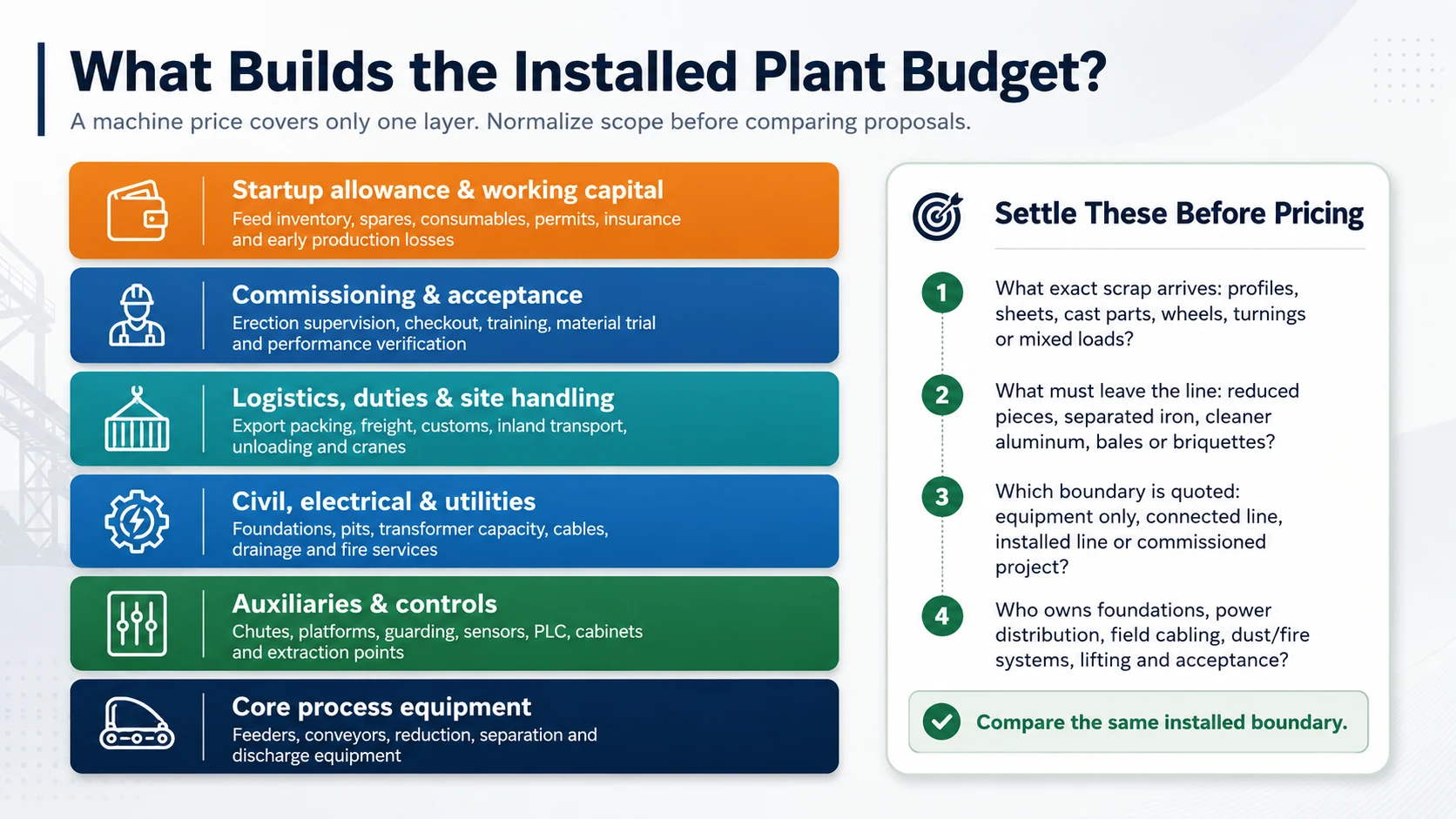
| Budget module | What it may include | Why buyers miss it | What to request |
|---|---|---|---|
| Core process equipment | Feeder, conveyor, shredder, crusher or hammer mill, magnet, screen, eddy-current separator, baler or briquet machine. | The machine list is easy to see, so it is often mistaken for a complete project. | Model,responsibilities, feed assumptions, drive specifications, wear parts and defined output. |
| Auxiliaries and controls | Dust extraction points, ducting, platforms, guarding, interlocks, sensors, PLC, cabinets and cable interfaces. | They may be shown in a layout but omitted from the commercial total. | A tagged equipment list and electrical responsibility matrix. |
| Civil and utilities | Foundations, pits, slab loading, drainage, building clearance, incoming power, transformer, compressed air and fire services. | These are usually local costs rather than factory-supplied items. | Foundation loads, power list, utility list and minimum clearances. |
| Logistics and site handling | Export packing, inland transport, ocean or land freight, duties, port charges, unloading, cranes and internal movement. | Incoterms do not describe every destination-side charge. | Package dimensions, weights, shipping basis and unloading plan. |
| Installation and acceptance | Mechanical erection, electrical connection, cold tests, material trials, training, commissioning and performance acceptance. | “Installation support” can mean remote advice, supervision, or a full crew. | Days, personnel, travel assumptions, buyer labor, test feed and acceptance method. |
| Startup and working capital | Initial feed inventory, consumables, spare parts, operator recruitment, insurance, permits and early production losses. | It sits outside the machinery contract but is needed before stable production. | A separate owner’s budget and startup risk allowance. |
Three Common Project Scopes
We normally group early budgets by process depth, not by an arbitrary “small, medium or large” label. The three scopes below can all process aluminum, but they solve different material problems.
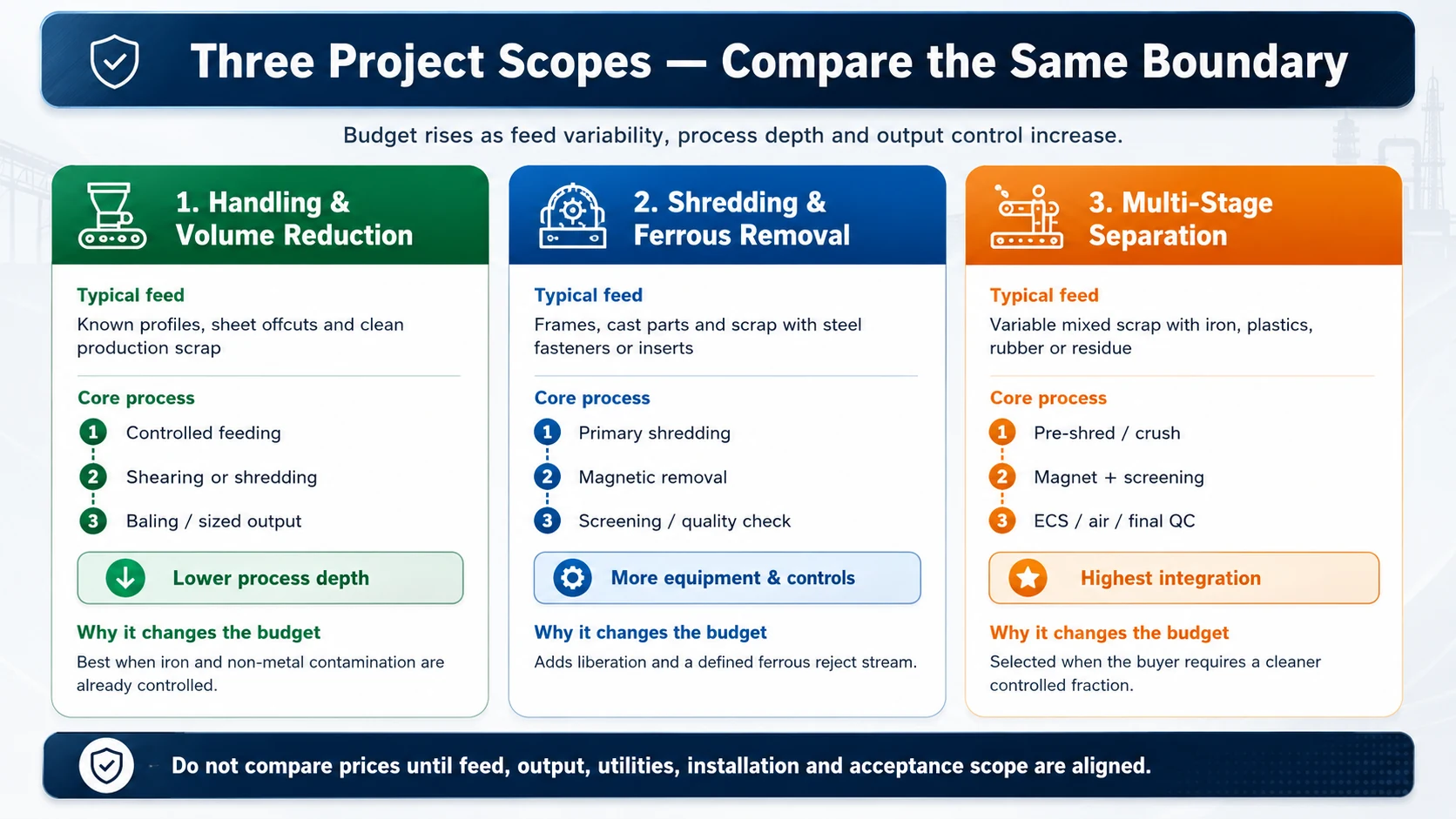
Handling and Volume Reduction
Suitable for known production scrap such as relatively clean profiles, sheet offcuts or controlled bundles. The main job is to create a manageable form for transport, storage or downstream processing.
Typical items include a receiving area, controlled feeder, shear, shredder or baler, discharge conveyor and basic controls. It is usually the least complex route, but it still needs a verified maximum piece size and a clear exclusion list.
Shredding and Ferrous Removal
Used when frames, castings or mixed pieces contain screws, brackets, bearings or steel inserts that must be released and removed. Primary reduction is followed by a magnet and often a screen or inspection point.
The cost rises because the line must create liberation, stabilize the material layer and manage a separate reject stream. Wear protection and access for cleaning become more important.
Multi-Stage Separation
Selected for variable mixed scrap where aluminum is combined with iron, plastics, rubber, glass or other residue. A pre-shredder, secondary crusher or hammer mill, magnet, screen, optional eddy current separator, air management and final quality control may be required.
This scope has more transfer points, interlocks and acceptance variables. It also needs a more disciplined sample test because a machine cannot compensate for an undefined feed.
Alloy-level sorting is a separate decision. A magnet removes ferrous material. An eddy current separator can recover suitable conductive non-ferrous particles from a non-metal stream. Neither automatically separates one aluminum alloy family from another. If the sales contract depends on alloy chemistry, sensor sorting or laboratory control may need to be added and verified as its own project scope.
Equipment Variables That Move the Budget
Feed geometry and bulk density
Long profiles bridge differently from compact castings. Thin sheet can spring, fold and wrap. Turnings may carry liquid and fines. A low-density feed may require a larger hopper and wider conveyor than a denser feed at the same mass flow. This is why a photo alone is not enough; dimensions, weights and bulk density should be measured.
Throughput and duty cycle
Nominal tons per hour is only useful when the test feed, operating time and output definition are stated. A line expected to run one shift with planned cleaning is not the same as a line expected to run around the clock. The connected equipment must also be balanced. A large shredder does not create a high-capacity plant when the screen, magnet, separator or discharge system becomes the bottleneck.
For this reason, we recommend settling the assumptions in an aluminum recycling line capacity guide before negotiating price.
One-stage reduction or two-stage liberation
A primary shredder reduces bulky scrap and makes feeding more predictable. A secondary crusher or hammer mill may be added when attachments must be liberated, a smaller particle range is needed, or downstream separation works better with controlled sizing. The second stage adds motor power, wear parts, dust points, conveyors and controls. It should solve a defined separation problem, not be added because another supplier’s flow sheet shows it.
Separator technology
Magnetic separation is generally considered when free iron or attached steel can be released. Screening controls size and removes fines. Eddy current separation may be considered after stable sizing and feeding when non-ferrous particles must be recovered from a non-metal stream. Air separation or sensor sorting can add another layer, but only when the target contaminants and acceptance standard justify it.
Wear protection and maintenance access
Scrap with steel inserts, sand, hard cast parts or unexpected foreign objects changes wear risk. Liners, replaceable wear plates, rotor access, lifting provisions and safe maintenance clearances affect initial cost but also determine how long a shutdown lasts. In practice, the cheapest maintenance access is the access designed before fabrication.
Automation and data
Basic controls may start and stop machines in sequence. A more integrated system can add load monitoring, level sensors, variable-speed conveyors, alarms, remote diagnostics and production records. Automation is valuable when it prevents overfeeding and stabilizes separation; it is less valuable when the feed and acceptance criteria remain undefined.
Site, Electrical and Utility Costs
Many project budgets look reasonable until the machine drawings reach the local electrical contractor. Voltage and frequency are only the beginning. Buyers should confirm the available transformer capacity, starting method, cable distance, earthing, cabinet standard, local component requirements and whether the supplier includes field cabling.
Civil work also depends on the selected line. A conveyor may need a pit. A heavy shredder may require foundation details and dynamic load review. Platforms need access stairs, handrails and maintenance openings. The building must provide enough height for ducts, cyclones, cranes and material discharge. Forklift and loader routes should not cross operator access without a deliberate traffic plan.
Outdoor storage and processing areas bring environmental controls into the budget. The U.S. EPA’s Sector N guidance for scrap recycling facilities highlights how storage, loading, processing, leaks, surfaces and precipitation influence stormwater risk and recommends site-specific control measures. Local requirements vary, but drainage and housekeeping should be treated as design inputs rather than afterthoughts.
Dust, Fire and Safety Systems Are Part of the Project
Coarse metal pieces do not behave like fine aluminum dust. However, shredding, screening and transfer points can create fines from coatings, plastics, rubber, dirt and metal abrasion. Dust characterization, collection design, housekeeping and ignition control therefore need professional review for the actual material.
OSHA notes that even materials that do not burn in larger pieces can become explosible in finely divided form, including aluminum. Its combustible dust guidance is a useful reminder that a generic dust collector is not a complete hazard assessment. The required system depends on the dust, enclosure, ignition sources, ventilation and local code.
Machine guarding, interlocked access, emergency stops and energy isolation also affect the commercial boundary. OSHA’s metal scrap recycling guide emphasizes guarding moving parts and following lockout/tagout procedures before cleaning or maintenance. These are operational requirements, but the equipment and layout must make safe procedures practical.
Freight, Installation, Commissioning and Acceptance
Export packing and freight should be based on actual package dimensions and weights. A line with the same factory price can have a different landed cost depending on containerization, oversize pieces, inland transport, port handling, duties and the distance from the destination port to the plant.
Installation language must be specific. “Guidance” may mean drawings and online support. “Supervision” may mean one engineer while the buyer supplies mechanics, electricians, lifting equipment, accommodation and local transport. A full installation crew is a different commercial scope. The quotation should state who provides cranes, welding consumables, cable, trays, fasteners, oil, test instruments and operator labor.
Commissioning should end with an agreed acceptance method. The feed sample, test duration, stable operating period, measured throughput, product sampling and allowed exclusions should be written before the factory test or site test. Otherwise, the buyer and supplier may use different definitions of “capacity” and “qualified output.”
Operating Cost Belongs in the Budget Discussion
CAPEX attracts attention because it is visible before the order. OPEX determines whether the plant remains competitive after startup. Useful operating cost categories include electricity, labor, wear parts, planned maintenance, unplanned downtime, lubrication, dust-filter service, residue handling, internal material movement and quality control.
| Operating variable | What drives it | What to compare |
|---|---|---|
| Power | Number of reduction stages, motor loading, idling, conveyors, extraction and compressed air. | Complete connected load and expected load profile on the stated feed. |
| Labor | Manual presort, loader and forklift work, quality checks, cleaning, bag or bale handling and maintenance. | People per shift and the tasks each person performs. |
| Wear parts | Steel contamination, abrasive dirt, hard inserts, rotor speed, target size and operating hours. | Part list, expected inspection interval, change method and stock recommendation. |
| Downtime | Blockages, unplanned foreign objects, access time, spare availability and troubleshooting support. | Maintenance access, critical spares and recovery procedure. |
| Residue | Incoming contamination and the number of separated fractions. | Mass balance, handling method and local disposal or sales route. |
| Product value | Size, cleanliness, chemistry, moisture, density and buyer acceptance rules. | Local buyer specification rather than a generic “high purity” claim. |
How to Compare Two Quotations Fairly
- Use the same feed description. Attach the same photos, video, measurements, contamination estimate and representative sample results.
- Use the same production duty. State required net tons per hour, shift pattern, planned cleaning and expected feed changes.
- Use the same output contract. Define particle range, allowed contamination, separate fractions, moisture or density requirements and sampling method.
- Normalize the equipment list. Compare conveyors, transfer chutes, magnets, screens, dust points, platforms, controls and discharge systems—not just the main machine.
- Separate included and excluded work. Civil work, electrical installation, freight, duties, erection, commissioning and training should each have an owner.
- Compare acceptance terms. A performance promise without a feed and sampling boundary is not measurable.
- Review lifetime service. Confirm drawings, manuals, spare parts, remote support, field support and response responsibility.
A structured aluminum recycling line quotation comparison prevents commercial omissions from being mistaken for engineering savings.
The same discipline applies to project delivery. A modular vs turnkey aluminum recycling line decision should identify interface responsibility and expansion plans. “Turnkey” should not be assumed to include a smelting plant unless that thermal scope is explicitly contracted.
RFQ Data That Produces a Useful Budget
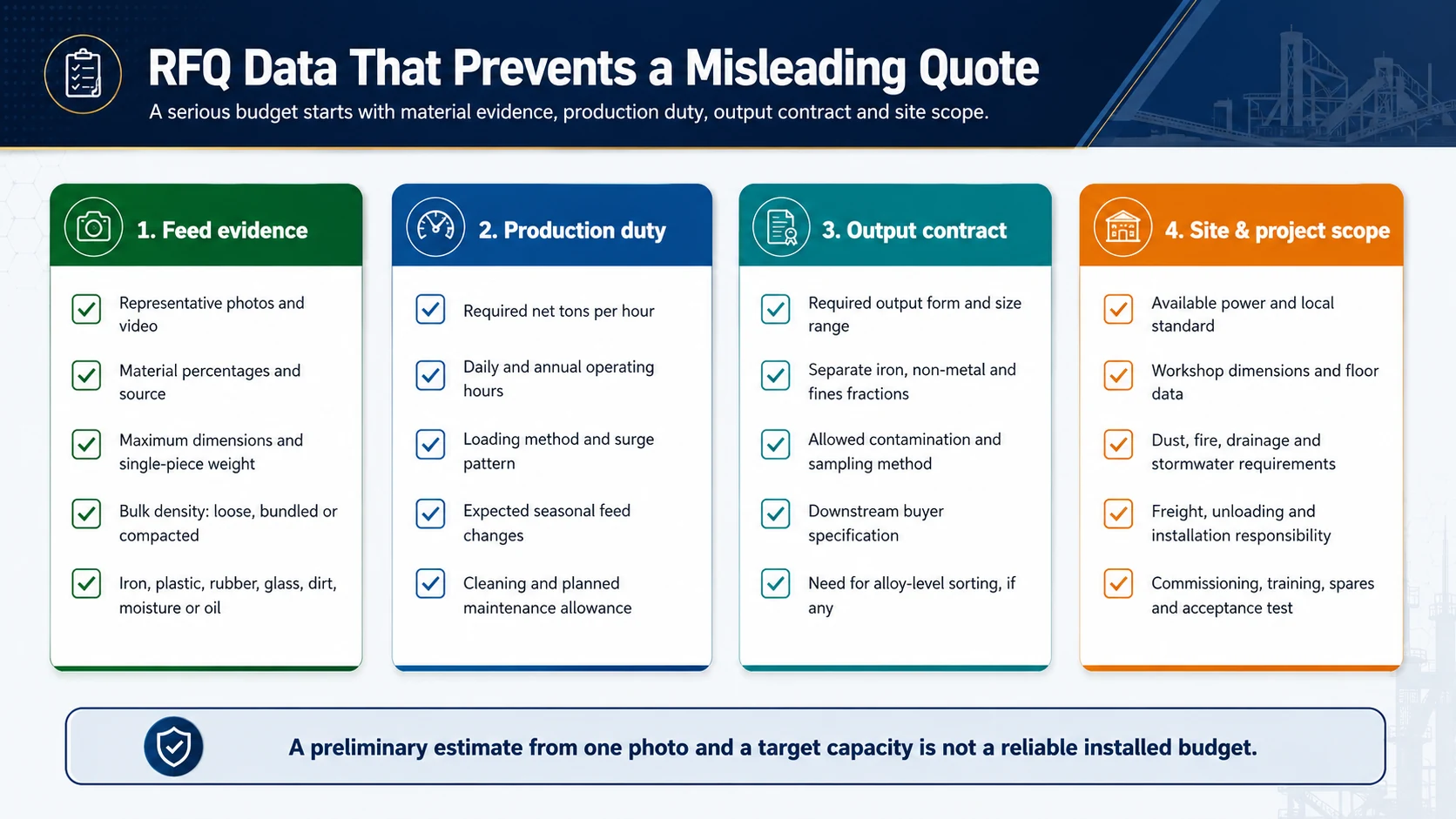
Material evidence
- Representative photos and video
- Material names and approximate percentages
- Maximum length, width, thickness and single-piece weight
- Loose or bundled bulk density
- Attached iron, rubber, plastic, glass, dirt, moisture or oil
- Prohibited and unexpected items found in current loads
Production and output
- Required net throughput on the described feed
- Daily and annual operating hours
- Expected feed changes during the year
- Required output form and particle range
- Separate ferrous, non-metal and fines fractions
- Buyer acceptance specification and sampling method
Site and utilities
- Power supply, transformer capacity and local electrical standard
- Workshop length, width, height and column spacing
- Foundation and floor information
- Loader, forklift, crane and truck routes
- Dust, fire, drainage and environmental requirements
- Available compressed air and other utilities
Commercial boundary
- Required Incoterm and delivery destination
- Installation labor and lifting responsibility
- Commissioning, training and acceptance test
- Spare parts and consumables for startup
- Documentation language and component preferences
- Future expansion or shared equipment plans
How YUXI Builds the Project Boundary
YUXI’s public aluminum recycling line page does not present one fixed machine arrangement. It separates routes for profiles and frames, mixed aluminum scrap, sheets and foil, machining chips, wheels and selected automotive castings. The line may combine feeding, low-speed primary shredding, optional secondary crushing, magnetic removal, screening, eddy current separation, baling or briquetting according to the feed and final product.
For bulky profiles and mixed light scrap, a metal shredder may provide primary reduction. A hammer mill metal crusher may be considered when secondary liberation and controlled sizing are required. An eddy current separator is relevant only after the feed has a suitable particle range and stable material layer and when non-ferrous recovery from a non-metal stream is part of the output target.
That modular approach is useful for budgeting because the project can be divided into necessary, optional and future stages. It also prevents an expensive mistake we see often: purchasing a deep separation line when a controlled reduction route would meet the buyer’s contract—or purchasing a simple shredder when the product value depends on impurity release and separation.
Request a Process-Based Project Budget
Send representative material photos or video, dimensions, contamination, target throughput, required output, power supply and workshop layout. The proposal should separate core equipment, options, local work, delivery, installation and acceptance so the budget can be evaluated on one clear boundary.
FAQ
How much does an aluminum recycling plant cost?
There is no reliable universal figure. The budget depends on feedstock, throughput, process depth, output specification, equipment boundary, electrical standard, civil work, dust and safety systems, freight, installation and commissioning. A supplier should price a defined project scope rather than a generic plant name.
What does the equipment quotation usually include?
The quotation may only include core machines, and may also add conveyors, separators, dust collections, controls, platforms, spare parts, supervision and commissioning. Before comparing the total number,the buyer should request a written inclusion and exclusion schedule.
Does a physical recycling line include melting and casting?
Not by default. Shredding, screening, magnetic separation, eddy current separation, baling and briquetting are physical preparation steps. Furnaces, decoating, alloy adjustment, casting, emissions control and related utilities are separate systems unless the contract explicitly includes them.
Why can two lines with the same rated capacity have different prices?
The rated tons per hour may be based on different feed density, largest piece size, contamination, target particle size, duty cycle and output definition. One line may also include more conveyors, separation stages, wear protection, controls and site services.
Which information is needed for a useful project budget?
Provide representative photos and video, dimensions and bulk density, attached iron and non-metal content, required tons per hour, operating hours, target output, power supply, workshop dimensions, local standards, installation responsibility and the proposed acceptance test.
Is the lowest equipment price usually the lowest project cost?
Not necessarily. Missing conveyors, electrical panels, platforms, dust control, freight, foundations, installation labor, spare parts or acceptance testing can move cost downstream. Compare the complete installed boundary and the operating assumptions, not only the headline equipment total.
Should alloy sorting be included in the first quotation?
Only when the product specification requires it. Magnetic separation removes ferrous attachments, while eddy current separation recovers suitable non-ferrous particles from non-metal streams. Alloy-level sorting may require additional sensor technology and should be quoted as a separate, verified scope.
How should buyers compare operating costs?
Use the same feed and duty assumptions for power, labor, wear parts, planned maintenance, residue disposal, downtime and product yield. A low motor rating on one machine does not describe the energy or labor of the complete process line.
Authority Sources and Scope Notes
- The Aluminum Association: Secondary Production 101 — industry context for secondary aluminum and the energy advantage of recycled production.
- OSHA: Guidance for the Identification and Control of Safety and Health Hazards in Metal Scrap Recycling.
- OSHA: Combustible Dust — An Explosion Hazard.
- U.S. EPA: Industrial Stormwater Fact Sheet Series, Sector N: Scrap Recycling and Waste Recycling Facilities.