




 Request Quote



A practical planning guide for aluminum scrap plants that need to control airborne fines without turning ducts, collectors, transfer points or storage areas into a larger fire and explosion problem.
A buyer once asked us for “the dust collector size” before the scrap mix, crusher route or building layout had been confirmed. The question sounded straightforward. It was not. A collector can reduce visible dust and worker exposure, yet it can also become the most concentrated dust enclosure in the line. Without feed data, representative testing and a coordinated fire-risk review, choosing a fan and filter first is backwards.
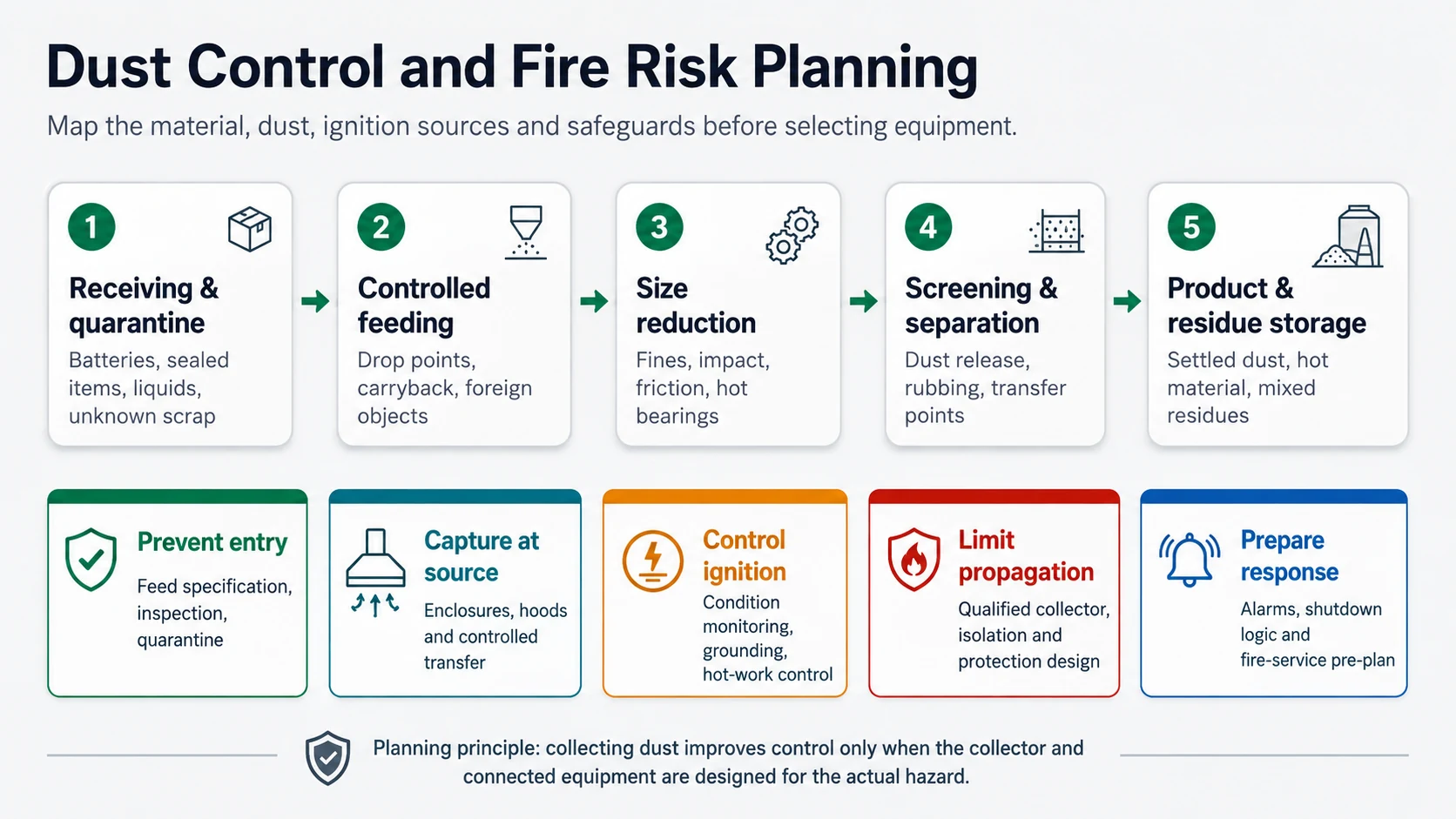
A Dust Collector Is Not the Whole Fire-Risk Plan
Dust control and fire protection are connected, but they are not identical. A hood may capture airborne material effectively while the downstream collector still lacks the safeguards required for that dust. A clean workshop floor may hide deposits inside ducts. A spark detector may respond to hot particles but do nothing about a smoldering battery that entered with the feed. This is why a line cannot be judged by the presence of one collector, one extinguisher or one thermal camera.
OSHA notes that even materials such as aluminum, which do not normally burn as bulk pieces, can become explosible when finely divided and suspended in air. The familiar dust-explosion pentagon adds dispersion and confinement to the three fire elements of fuel, ignition and oxygen.[1] In a recycling plant, confinement may exist inside a shredder enclosure, duct, cyclone, filter, bin, conveyor housing or room.
The practical surprise is that collection concentrates what was previously dispersed. That is useful for exposure control and cleanliness. It also means the collector, duct network and discharge arrangement must be treated as process equipment, not as a housekeeping accessory.
Start With the Aluminum Process Route
The YUXI scrap aluminum recycling line is configured around the material and required product. Profiles and mixed scrap may need shredding, optional secondary crushing, magnetic removal, screening and an eddy current separator. Clean cans or light sheet may be inspected and baled. Machining chips usually need liquid control and briquetting. Fire-risk planning should preserve those distinctions rather than attaching the same dust package to every proposal.
| Route | Likely dust / fire questions | What should not be assumed |
|---|---|---|
| Sorted light scrap or sheet baling | Dirt, coating fragments, residual liquids, tramp batteries, hydraulic leaks and storage fire load | That “no crusher” means no fire planning is needed |
| Profile or mixed-scrap shredding | Fines at cutters and transfers, impact sparks, hot bearings, attached steel, plastics, rubber and dust collection | That all visible dust is aluminum or that one magnet removes every ignition source |
| Secondary crushing or hammer milling | Higher-energy impact, more liberation, a larger fine fraction, temperature rise and concentrated dust load | That a collector selected for primary shredding remains suitable after process changes |
| Screening and physical separation | Vibration, drop points, belt rubbing, carryback, dust release and residue accumulation | That the separator is the only important machine once size reduction is complete |
| Chip drainage and briquetting | Cutting fluid, moisture, fine chips, long turnings, mixed metals and storage of wet or oily residues | That a general mixed-scrap dust system is suitable for machining fines |
The feed specification matters as much as the machine list. Aluminum castings with bearings and oils, thermal-break profiles with polymer, painted sheet, clean extrusion offcuts and mixed automotive scrap can create very different dusts and fuel mixtures. The existing aluminum scrap contamination removal guide explains why attached metals, organics, fluids and wrong alloys require different controls. For fire planning, those contaminants also change ignition potential, smoke, residue behavior and the appropriate emergency response.
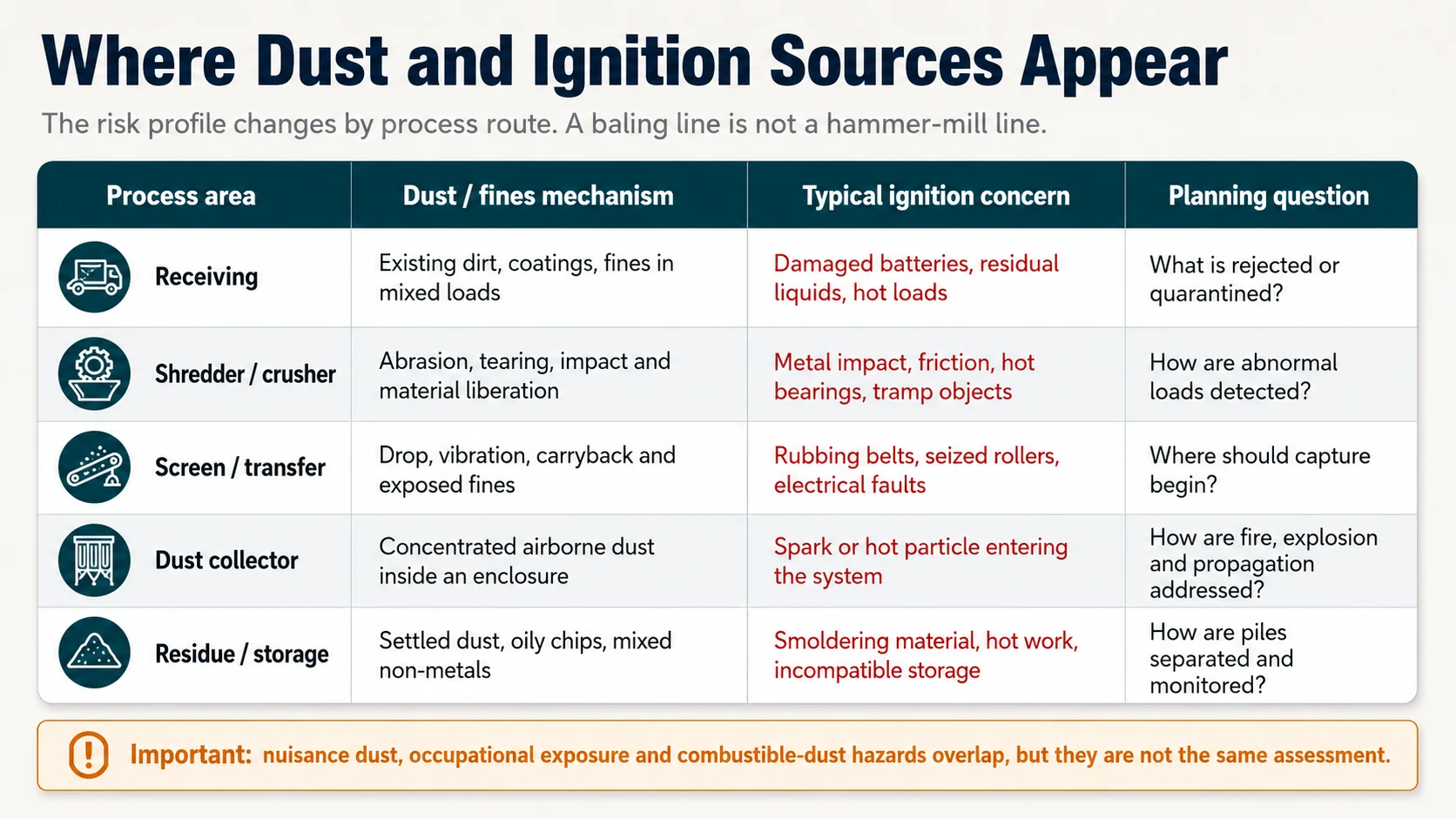
Map Dust and Ignition Sources Along the Material Path
A useful survey follows the material from the truck to the final bin. We normally mark four things at every stage: what can become airborne, what can ignite it, where it can accumulate and what connects that location to the next one. The last point is easy to miss. Ducts, enclosed conveyors and transfer chutes can carry flame or pressure as well as material.
Receiving and quarantine
Fire prevention begins before the feeder. Incoming loads may contain damaged lithium-ion batteries, sealed containers, aerosol cans, residual fuel, oil-soaked parts, hot material or unidentified packages. EPA’s review of the U.S. waste-management system found more than 240 lithium-ion-battery fires at 64 facilities between 2013 and 2020, including scrap yards and similar facilities.[7] The number is not an aluminum-line design value. It is a reminder that feed inspection and separate battery management are basic fire controls.
Feeding, shredding and crushing
At the machine, long profiles can whip or bridge, dense objects can strike cutters, and steel attachments can create friction or impact. A high-energy secondary crusher normally generates a different fine fraction from a low-speed primary shredder. Wear, cutter clearance, bearing condition, overload events and feed surges all change the heat and dust pattern. The aluminum scrap shredder selection guide should therefore be read together with the fire-risk plan: machine choice changes both liberation and the hazard envelope.
Transfers, screens and separators
Material becomes airborne at drops, vibrating screens, belt discharge points and residue transfers. A belt that tracks poorly may rub. A seized roller can heat. Fine metal can enter an electrical enclosure that was not selected for the location. These are not dramatic design errors, yet they are common ignition pathways because they develop slowly and become normalised by operators.
Collectors, bins and residue storage
OSHA’s technical guidance distinguishes fire, flash-fire/deflagration and explosion hazards. Confinement is what turns a dispersed dust deflagration into an explosion hazard, and pressure or flame can move into connected equipment.[3] The CSB investigation of the 2003 Hayes Lemmerz incident found that explosive aluminum dust generated during scrap-chip handling was pulled into a dust collector; the event likely originated in a collector that was not adequately vented or cleaned, and the explosion propagated through ducting.[5] The lesson is not “never use a collector.” It is that collection, location, protection, isolation, cleaning and management of change must be designed together.
Determine Whether the Dust Is Combustible—Do Not Guess From the Scrap Name
Visible gray dust is not a laboratory result. It may contain aluminum fines, iron oxide, soil, paint, polymer, paper, rubber, abrasive, oil or a mixture. Particle size, shape and moisture influence ignitability and explosion severity. OSHA warns that published values are useful only as an initial reference because dust from the actual facility should be sampled and tested when engineering controls depend on its characteristics.[2]
For U.S. projects, the 2025 edition of NFPA 660 is the current consolidated standard for combustible dusts and particulate solids. It brings the previous combustible-dust standards, including the former combustible-metals standard, into one framework.[6] The project team should confirm which edition has been adopted or required by the authority having jurisdiction, insurer and contract.
Information a qualified assessment may need
- Representative dust samples from the actual or comparable process—not only bulk scrap chips.
- Particle-size distribution and the conditions that may create a finer fraction over time.
- Combustibility and explosibility test data appropriate to the design question.
- The minimum ignition energy, minimum explosible concentration, deflagration index and maximum pressure where applicable.
- Whether the dust can form a hybrid mixture with vapors from oil, solvent, fuel or process residues.
- Where dust is suspended in normal operation and where it can accumulate during abnormal operation.
The Aluminum Association’s aluminum-fines guidance also emphasizes that changes in alloy, speed, lubricant or abrasive can alter the particle characteristics, which is a strong reason to repeat the review after a material or process change.[4] We would not copy its older dimensional or airflow recommendations directly into a new project specification; current design should follow the adopted standard and qualified engineering. The broader lesson remains valid: test the dust you actually make.
Build Dust Control From the Source Outward
General building ventilation may improve comfort, but it is rarely a substitute for capturing dust where it is released. Good source control starts with the process geometry: enclose the release point where practical, keep the capture distance short, avoid cross-drafts, and prevent the enclosure from interfering with feed inspection or maintenance access.
1. Reduce unnecessary dust generation
Stable feeding, correct machine settings, sharp or serviceable wear parts, controlled drop heights and clear discharge paths can reduce fines and spills before air volume is added. Surprisingly, many “dust collector problems” begin as feed surges, worn liners, blocked screens or uncontrolled carryback.
2. Capture at each release point
Shredder discharge, crusher outlet, screen, transfer and residue drop may need separate capture logic. One large hood at the ceiling is late. By then the material has crossed the breathing zone and settled on structures. The hood should work with the direction of material travel and must not create a new path for lightweight aluminum to be lost as product.
3. Design ducting as process equipment
Duct diameter, velocity, branches, elbows, abrasion, grounding, access and cleanout points belong in the design basis. Dead legs and hidden pockets create deposits. Excessive suction can pull saleable aluminum into the system. Too little transport can leave a combustible layer inside. A field-installed branch added later may unbalance every other pickup point.
4. Select wet or dry collection only after the hazard review
There is no universally safer collector type. A dry collector may require explosion prevention or protection, safe venting direction, isolation and suitable discharge arrangements. A wet collector changes the problem rather than removing it: slurry handling, hydrogen generation potential, ventilation, corrosion, wastewater, sludge storage and incompatible-material control become part of the system. The Aluminum Association notes that both wet and dry systems can be used for aluminum fines, but its guidance also shows why each requires specific construction, grounding, ventilation, cleaning and disposal provisions.[4]
5. Plan discharge and disposal
Collected dust still exists after it leaves the air stream. Define how it is discharged, contained, inspected, cooled if necessary, moved and sent to an approved destination. A collector that works well but empties into an open bin beneath a hot-work area has only moved the risk.
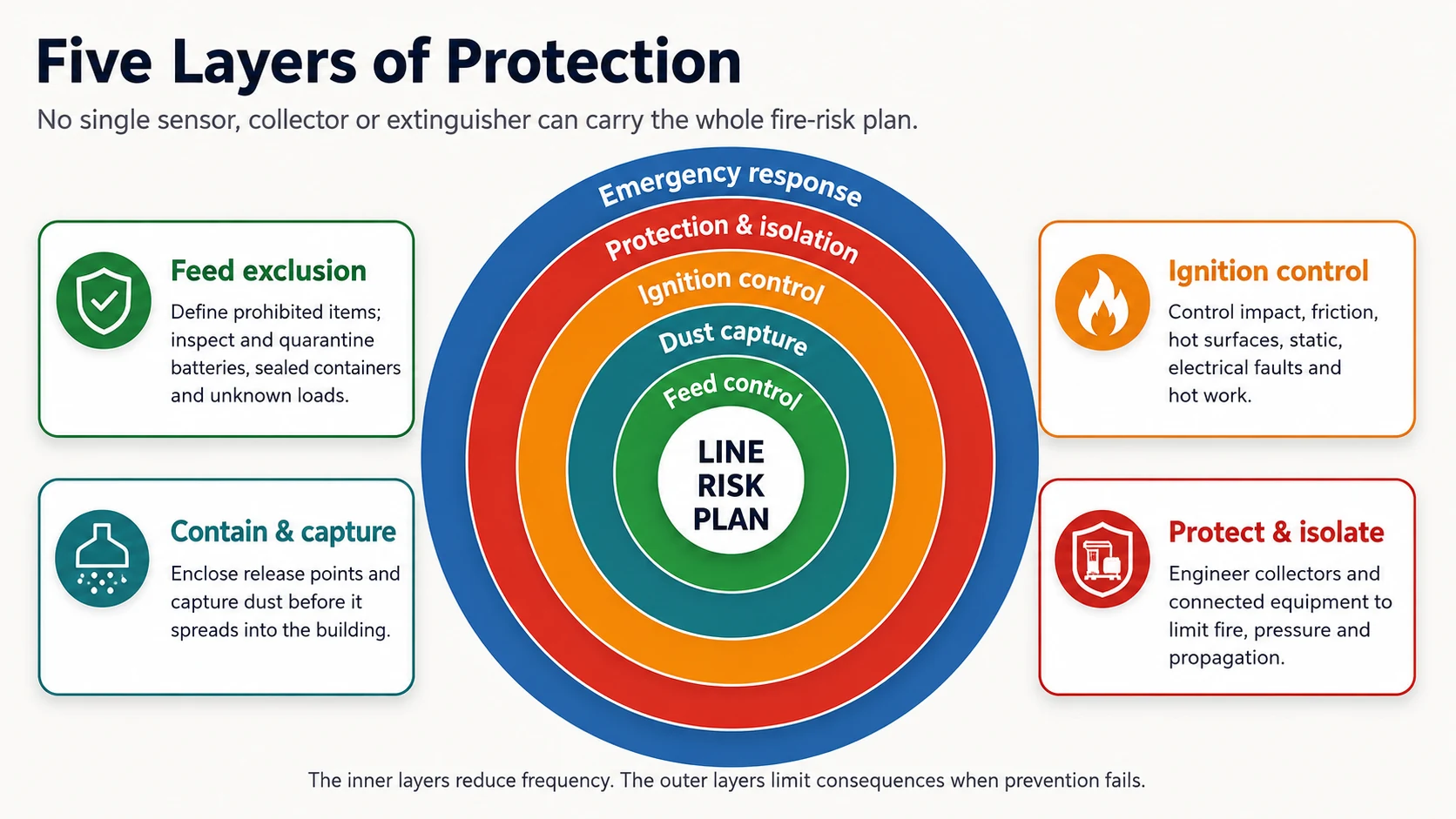
Plan Fire Prevention as Several Independent Layers
We have seen proposals that rely on one device: a spark detector, temperature sensor, water spray or extinguisher. A credible plan assumes one layer may fail or arrive too late.
Feed exclusion and quarantine
Define prohibited items in the purchase and operating specifications. Train receiving staff to identify batteries, sealed vessels, pressurized items, fuels, reactive metals, hot loads and unknown packages. Give them a real quarantine area and authority to stop a load. A rule without physical space becomes a pile beside the feeder.
Ignition-source control
Review mechanical impact, friction, belt slip, bearing temperature, hydraulic leaks, static, unsuitable electrical equipment, smoking and hot work. The correct controls depend on the process, but condition monitoring should lead to action. A temperature alarm that does not stop feed or call an operator is merely a display.
Detection, interlocks and controlled shutdown
Define what the system should do when it detects a hot particle, abnormal temperature, airflow loss, filter problem, belt slip, jam or fire signal. The sequence may need to stop upstream feed, preserve a safe extraction state, isolate equipment or activate engineered protection. It should also prevent an automatic restart before inspection and authorization.
Protection and propagation control
OSHA identifies pressure relief, suppression, prevention and isolation as possible approaches for equipment that contains combustible dust, depending on the hazard.[2] The selected method must be engineered for the dust, equipment strength, location and connected system. A vent that releases toward a walkway or neighboring structure is not safe simply because it is a vent.
Material-specific emergency response
Do not write “use water” or “use a Class D extinguisher” as a universal line instruction. An aluminum recycling facility may contain bulk scrap, combustible metal fines, plastics, oil, batteries and electrical equipment at the same time. OSHA documented a fatal firefighter incident after water and foam were applied to a fire involving aluminum shavings and hot slag.[8] The emergency plan should therefore identify credible scenarios, approved agents, isolation points, safe stand-off positions and who has authority to act. Coordinate the pre-incident survey with the local fire service.
Use Layout to Limit Propagation, Exposure and Delay
The location of equipment changes the consequences of an incident. A collector beside an occupied control room, a residue bin under a conveyor, or a quarantine area blocking fire access can defeat an otherwise reasonable machine package.
The aluminum recycling plant layout guide covers one-direction material flow, traffic routes and maintenance clearance. For dust and fire planning, add the following questions:
- Where can pressure, flame, smoke or burning material be safely directed?
- Which ducts, conveyors or chutes could transmit an event to another zone?
- Can operators reach shutdown controls without moving toward the incident?
- Are emergency exits, hydrants, fire-department connections and access lanes kept clear?
- Are incoming scrap, quarantine, combustible residue and finished aluminum stored in defined, separated areas?
- Can maintenance staff open, remove and clean components without creating temporary dust piles or blocking egress?
Distance alone is not a complete safeguard, but cramped layouts make every other control harder. They also encourage shortcuts: bins in aisles, hoses across escape routes, collector discharge next to hot work and impossible cleaning access above equipment.
Housekeeping, Maintenance and Change Control Keep the Design Valid
A system can be well designed on day one and unsafe six months later. Filters blind, ducts leak, pickup points are moved, bearings run hotter, product changes, and operators learn unofficial workarounds.
Housekeeping should remove dust without dispersing it
OSHA stresses routine removal of settled dust and warns that a primary event can loft accumulated material into a more destructive secondary explosion.[2] The cleaning method must be approved for the dust and location. Dry sweeping, compressed-air blowdown and ordinary shop vacuums can create a cloud or ignition source. Include beams, cable trays, duct exteriors, ledges and inaccessible overhead surfaces in the inspection map—not only the floor.
Maintenance should track the conditions that create ignition
Trend bearing and motor temperatures, vibration, belt tracking, roller condition, filter differential pressure, airflow, leakage, fan condition, grounding continuity where required, sensor faults and unexplained shutdowns. The aluminum recycling line maintenance checklist provides the line-wide mechanical framework. The dust/fire plan should add hazard-specific acceptance limits and escalation steps from the final engineering documents.
Treat near misses as design information
A duct flash, hot bearing, smoldering bin, unexpected spark, battery found after shredding or repeated dust alarm is not “normal for recycling.” CSB recommendations specifically call for management review of incidents and near misses, including duct fires and dust flashes, and for corrective actions to be tracked.[9] Record the feed, operating state, alarm history and physical evidence before cleanup erases the cause.
Use management of change
Repeat the review before processing a new scrap stream, increasing speed, replacing a screen, changing crusher settings, adding a branch duct, moving the collector, recirculating air, changing lubricant, or modifying shutdown logic. The Hayes Lemmerz investigation identified inadequate management of change when scrap and collector systems were added.[5] Small production improvements can change dust generation, particle size and propagation paths.
Commission the Complete System, Not Just the Fan
Before production release, the owner should have a documented acceptance plan. A fan rotation check and visible suction at one hood are not enough.
| Acceptance area | Evidence to collect |
|---|---|
| Feed control | Approved feed specification, prohibited-item list, quarantine method and receiving training |
| Capture | Measured or verified performance at each operating pickup point, including simultaneous operation |
| Containment | Leak inspection, duct access, cleanout provisions and confirmation that dust is not accumulating in dead zones |
| Protection | Design documentation for collector location, fire/explosion protection, isolation and discharge |
| Controls | Cause-and-effect test for alarms, interlocks, emergency stops, airflow loss and controlled restart |
| Operations | Cleaning method, inspection frequency, waste handling, hot-work controls and maintenance responsibilities |
| Emergency response | Scenario plan, equipment labels, facility maps, contacts, drills and fire-service pre-incident review |
| Documentation | Drawings, manuals, test data, training records, spare parts and management-of-change procedure |
We also recommend a controlled run with representative material, not only clean demonstration scrap. Observe the fine fraction, carryback, hot spots, alarm behavior, residue and how operators actually clean the line. Production reality is the final test of the design assumptions.
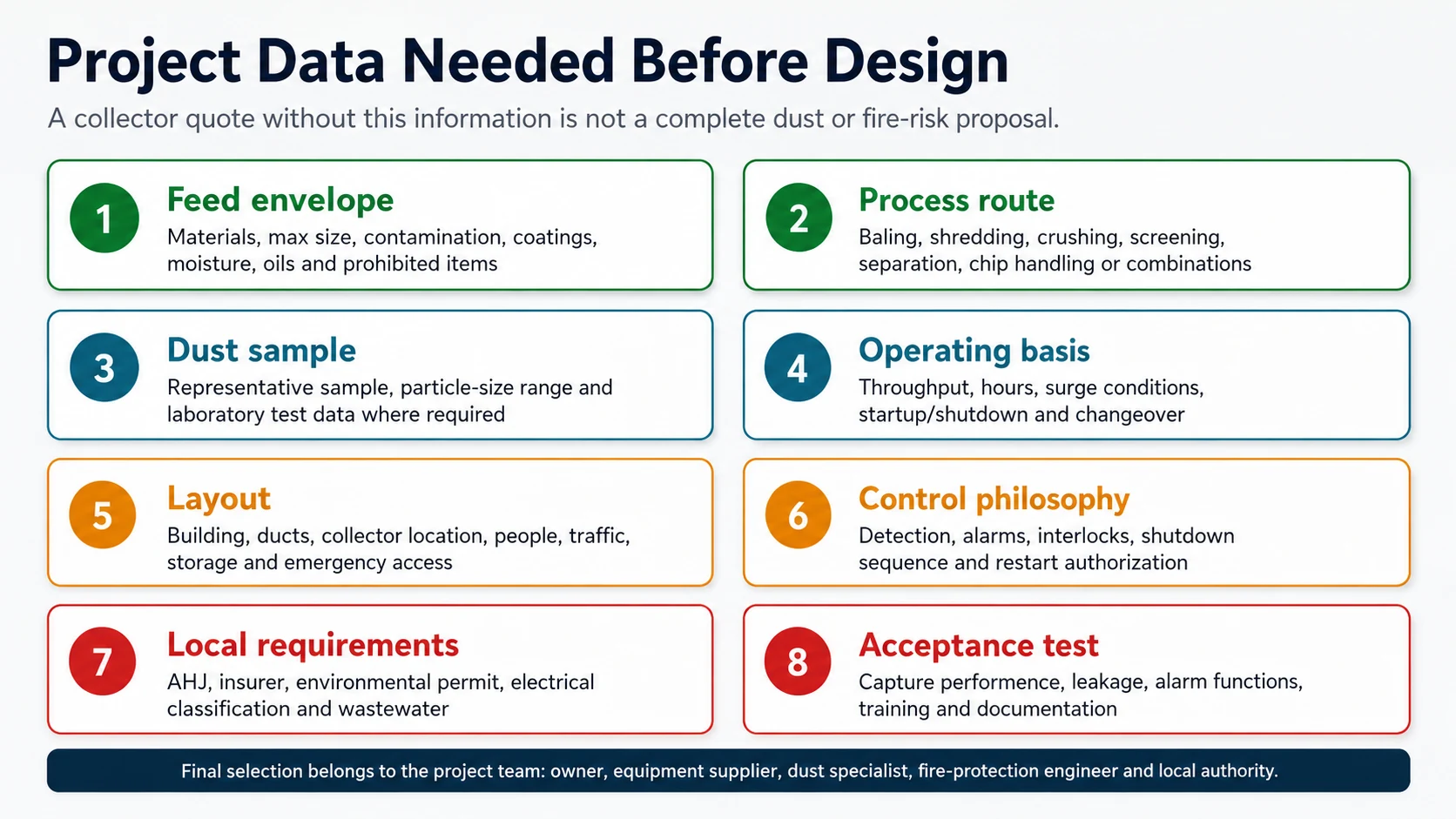
Information Needed for a Dust and Fire-Risk Proposal
YUXI can define the mechanical process route and identify likely dust-generation points, but the final dust and fire-protection design should be coordinated with qualified specialists and local authorities. Send the following information early:
- Photos, video and representative samples of each scrap stream.
- Maximum piece size, bulk density, coatings, moisture, oils and contamination.
- Known batteries, sealed parts, pressure vessels or hazardous residues in the supply chain.
- Required throughput, operating hours, surge feed and future expansion.
- Selected route: baling, primary shredding, secondary crushing, screening, separation or briquetting.
- Existing dust test reports, SDS information and incident history.
- Building drawing, occupied areas, neighboring property, storage zones and emergency access.
- Local electrical standard, environmental limits, wastewater constraints, insurer requirements and authority having jurisdiction.
- Preferred division of responsibility among YUXI, local duct/collector supplier, fire-protection engineer and installer.
Plan the Aluminum Line Before Selecting the Collector
Send the feed details, process target and workshop drawing. YUXI will define the material route and mark the dust, transfer and fire-risk interfaces that need specialist design.
Common Planning Mistakes
Buying by airflow alone
CFM does not prove capture at every point, safe transport in every branch or protection of the collector.
Calling all dust “aluminum dust”
Mixed scrap dust may contain several metals, coatings, soil, oil and polymers. Test the real material.
Using one collector for incompatible streams
Combining unknown dusts can change fire, reaction and disposal behavior.
Ignoring the collector location
A protected collector can still expose people or buildings if pressure and flame are directed toward them.
Adding extraction after layout approval
Duct routes, access, structure, electrical classification and safe discharge space should be reserved early.
Assuming housekeeping means blowing down
Cleaning that disperses settled dust can increase the immediate hazard.
Using a generic fire response
Bulk scrap, metal fines, oil, plastics and batteries may require different tactics and agents.
Failing to review process changes
A new screen, higher speed or new scrap grade can change the fine fraction and invalidate the original design basis.
FAQ
Is aluminum scrap itself explosive?
Bulk aluminum scrap is not the same hazard as a suspended cloud of fine aluminum particles. The risk depends on particle size, concentration, ignition, confinement and the actual mixture. Evaluate the dust generated by the process rather than applying a label to every piece of scrap.
Does every aluminum recycling line need a combustible-dust system?
Not every route has the same hazard. A clean baling operation differs from secondary crushing or aluminum-fines handling. Each project still needs a documented review of its feed, dust generation, contamination, collection and local requirements.
Is a wet dust collector always safer for aluminum?
No. Wet collection can reduce some airborne-dust concerns, but it introduces liquid, sludge, ventilation, hydrogen, corrosion, wastewater and maintenance questions. Dry and wet systems both require process-specific engineering.
Can the machine supplier size the complete fire-protection system?
The machine supplier can provide process data, dust-generation points, equipment geometry and control interfaces. Final collector and fire-protection design usually requires a coordinated team that includes qualified dust and fire-protection specialists, the owner, insurer and local authority.
What is the first fire control for mixed aluminum scrap?
Prevent hazardous items from entering. Define the feed specification, inspect loads and provide quarantine for batteries, sealed containers, liquids, hot material and unknown items. Downstream detection does not replace receiving control.
Can ordinary shop vacuums clean aluminum dust?
Do not assume they can. Cleaning equipment must be approved for the dust and location under the applicable design. Ordinary vacuums may introduce ignition or discharge hazards.
When should the risk assessment be updated?
Review it after new scrap grades, machine-speed changes, screen or cutter changes, duct modifications, collector relocation, control-logic changes, incidents, near misses or any other change that can alter dust generation or propagation.
Sources
- OSHA — Combustible Dust: An Explosion Hazard.
- OSHA — Hazard Communication Guidance for Combustible Dusts.
- OSHA Technical Manual, Section IV, Chapter 6 — Combustible Dusts.
- The Aluminum Association — Guidelines for Handling Aluminum Fines Generated During Various Aluminum Fabricating Operations.
- U.S. Chemical Safety Board — Combustible Dust Hazard Study, including the Hayes Lemmerz aluminum dust incident.
- NFPA 660 (2025) — Standard for Combustible Dusts and Particulate Solids.
- U.S. EPA — Lithium-ion battery fires in the waste-management system.
- OSHA — Firefighting Precautions at Facilities with Combustible Dust.
- U.S. Chemical Safety Board — Combustible Dust Recommendations.