




 Request Quote



Aluminum scrap grades for recycling plants are not simply names for “clean,” “mixed” or “high-value” aluminum. A usable grade tells the receiving team what the material is, how it is presented, which foreign materials are permitted, what must be checked, where the lot may be stored and which processing route can release it to the next buyer.
That sounds obvious. In practice, the word grade is used for three different things: a commercial trade specification, an alloy number, and an internal yard class. The confusion usually appears at the gate. A driver says “6063,” the paperwork says “extrusion,” and the load contains painted window frames with screws and thermal-break polymer. All three statements may contain some truth, but none is a complete receiving specification.
What Does “Aluminum Scrap Grade” Mean?
Commercial scrap specifications give buyers and sellers a common language. ReMA’s aluminum list contains separate descriptions for sheet, UBC, extrusions, castings, turnings, foil, wire, shredded nonferrous concentrates and other products.1 The code is useful because it points to a written definition. It is not useful when the code is remembered from an old load ticket while the current material condition is different.
Inside a recycling plant, we normally separate the word into three layers.
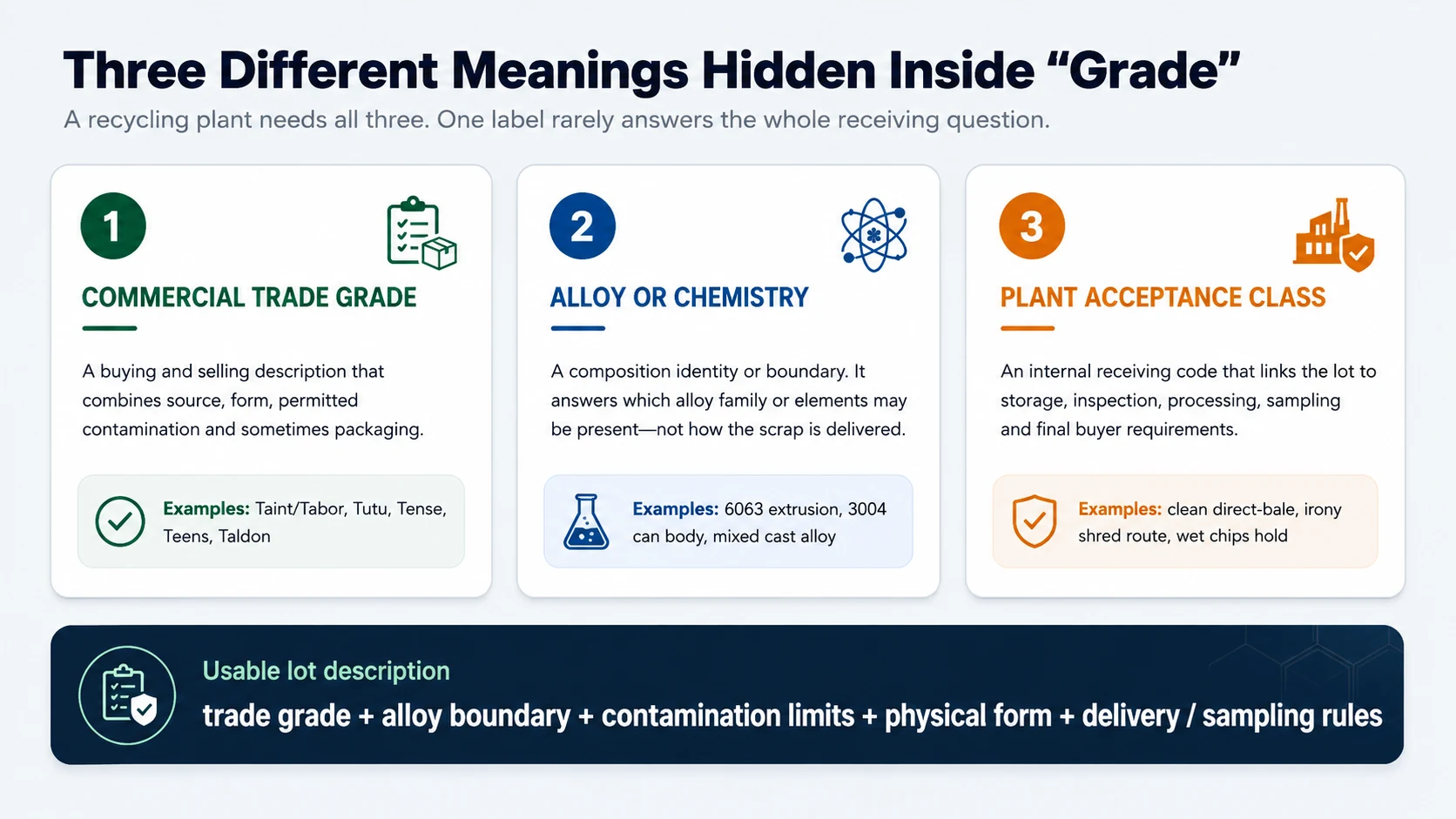
1. Commercial trade grade
This layer describes the commodity being bought or sold. It may define whether the material is new or old, sheet or extrusion, loose or baled, one alloy or several alloys, and which contaminants are excluded. Taint/Tabor, for example, is a clean mixed old-alloy sheet grade with named exclusions and an oil-and-grease limit.2
2. Alloy or chemistry identity
An alloy designation describes composition, not delivery condition. The Aluminum Association groups wrought alloys into series according to their main alloying system; 6xxx alloys use magnesium and silicon, while 7xxx alloys are primarily zinc-based.9 This matters because two pieces that look similar can create different melt chemistry. It also explains why “one-alloy extrusion” is a stronger claim than “aluminum profile.”
3. Internal plant acceptance class
The plant still needs its own code. It can be as simple as accepted for direct baling, shred-and-sort route, wet chips hold or chemistry verification required. The internal class connects the purchased grade to a bay, bin, inspection plan, machine route and disposition rule. Without it, a correct purchase description can still be lost through poor handling.
Why Scrap Grades Change Plant Decisions
The U.S. EPA notes that secondary-aluminum pretreatment can be combined or reordered according to scrap quality, source, available equipment, furnace design and product specification.10 That is the operating reason grades matter. A name at the scale house becomes a series of physical decisions farther into the plant.
Receiving and pricing basis
The grade establishes what was ordered, what variation is permitted and what evidence supports an acceptance, downgrade or rejection. A vague “mixed aluminum” ticket gives both sides little protection.
Storage and traceability
Segregated extrusion, castings, turnings and UBC should not share a bay simply because they are all aluminum. One bucket transfer can erase alloy or source traceability built over several production shifts.
Equipment route
Clean production offcuts may only need size control or compaction. Irony demolition scrap may need shredding, liberation and magnetic removal. Wet turnings require liquid management. The route follows the material behavior, not the color of the metal.
Output verification
The finished fraction must be checked against the output grade, not merely compared with the feed. A cleaner-looking shred may still contain the wrong nonferrous alloy mix.
Surprisingly, the most expensive grading mistake is not always accepting visible contamination. It can be blending two individually saleable grades into a mixed lot that no longer meets either buyer’s chemistry or form requirement. The machines may still process it. The commercial value and destination can change anyway.
Major Aluminum Scrap Grade Families a Plant Encounters
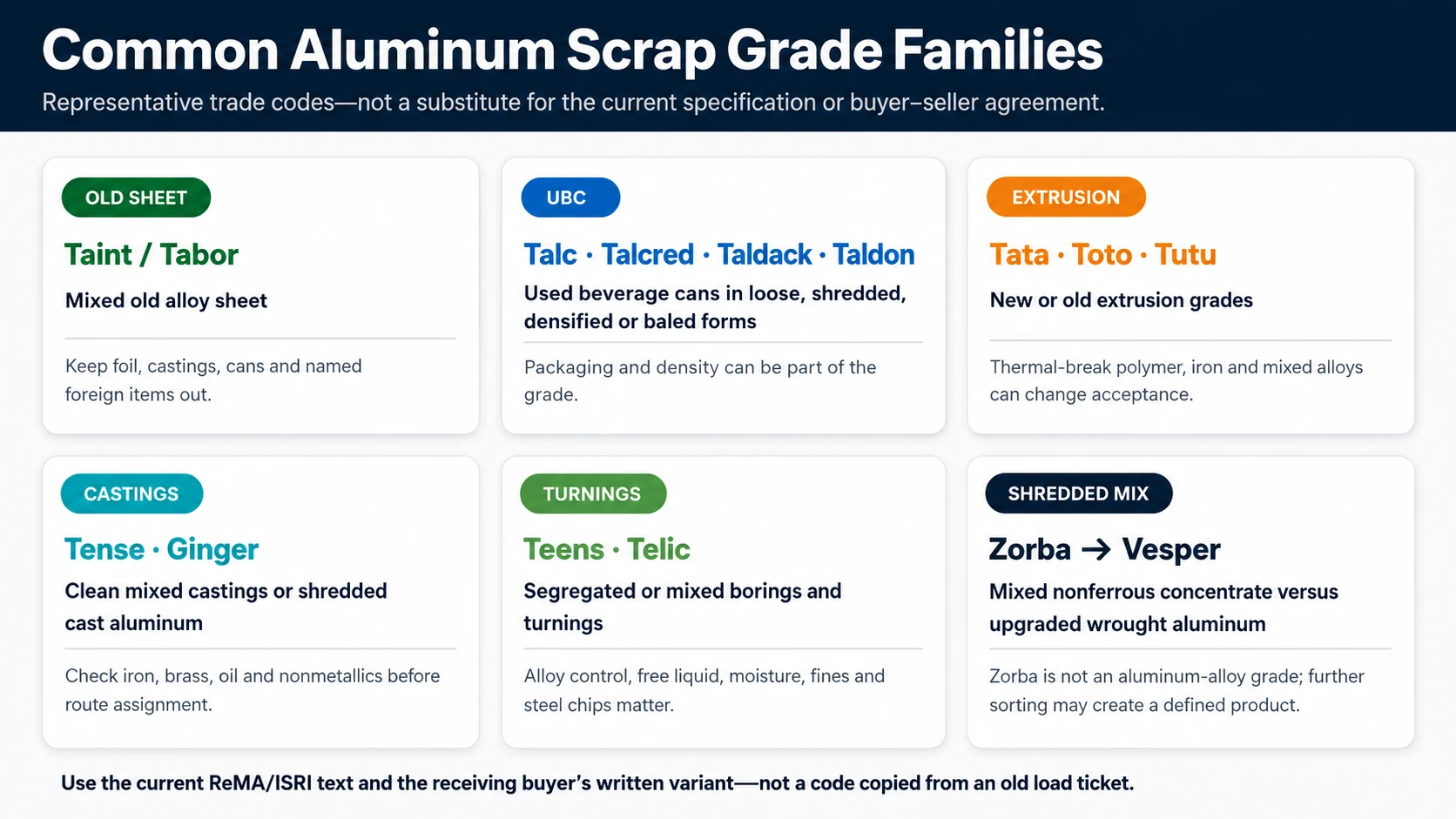
| Grade family | Representative examples | What the plant must confirm | Typical routing consequence |
|---|---|---|---|
| Old alloy sheet | Taint/Tabor | Sheet identity, excluded forms, nonmetallics, oil/grease and attached metals. | Segregate from castings, foil, cans and wire; bale or prepare for size reduction according to buyer and condition. |
| Used beverage cans | Talc, Talcred, Taldack, Taldon | UBC-only content, magnetic separation, dirt and plastics, moisture, density, bale dimensions or other delivery form. | Inspection and sorting remain essential; compaction form should match the receiving specification. |
| Extrusions | Tata, Toto, Tutu | New versus old, one alloy versus mixed, paint allowance, iron, thermal-break material, zinc corners and saw chips. | Clean segregated offcuts may bypass intensive sorting; post-consumer frames often need dismantling, shredding and separation. |
| Cast aluminum | Tense, Ginger | Cast identity, iron and brass attachments, oil/grease, nonmetallics, sealed parts and whether the material is whole or shredded. | Prepared castings may be sold as a controlled lot; irony or composite parts need attachment removal and verification. |
| Borings and turnings | Teens, Telic | One alloy or mixed alloys, steel chips, free liquid, moisture, oxidation, fines and foreign nonmetallics. | Source segregation, drainage or centrifuging, magnetic checking and controlled briquetting are usually more important than a general mixed-scrap line. |
| Shredded nonferrous concentrate | Zorba | Estimated nonferrous content, size range, prior magnetic separation and the proportions of aluminum, copper, zinc, magnesium, stainless and other metals. | Do not treat the percentage after “Zorba” as aluminum purity. Additional sensor or density sorting may be needed. |
| Upgraded wrought aluminum | Vesper | Wrought sheet/extrusion/plate identity, dryness, free Mg and Zn, analytical Fe, nonmetallics and sealed-item exclusions. | Requires a much more controlled separation and verification basis than a general mixed nonferrous concentrate. |
Sheet: one shape, several commercial possibilities
Taint/Tabor excludes a long list of other aluminum forms because “flat aluminum” is not a sufficient commercial boundary.2 A plant receiving demolition sheet should therefore inspect edges, attached insulation, fasteners, coatings and hidden laminated material before it assigns the load to the sheet bay.
UBC: packaging can be part of the grade
Taldon does not stop at “used cans.” It defines density ranges, bale dimensions, tying methods and contamination exclusions.3 This is an important lesson: compacting a commodity can create a different delivery grade, but a denser bale is not automatically a better bale. It may be off-spec or difficult to inspect.
Extrusions: alloy and attachments both matter
Tutu is old extrusion of one alloy—typically 6063, 6061 or 7075—and excludes iron, thermal-break material, saw chips, zinc corners and several nonmetallic contaminants; paint and other-alloy allowances are agreed by buyer and seller.4 That is why the aluminum profile recycling line is a feed-specific topic rather than a synonym for every extrusion load.
Castings: “automotive aluminum” is not a grade by itself
Tense permits clean mixed aluminum castings, including automotive and aircraft castings, but excludes ingots, iron, brass, dirt and nonmetallic items and sets an oil/grease limit.5 A transmission housing with steel inserts and residual oil may be an acceptable feed for a preparation route, yet it is not automatically an accepted Tense lot.
Turnings: source control comes before densification
Teens is a one-alloy borings and turnings grade with limits on foreign metals, oil, flammable liquids, moisture and fines.6 This is why the aluminum chips recycling process begins at the machine tool and collection bin. Briquetting a mixed or wet chip stream improves handling; it does not restore lost alloy identity.
Zorba and Vesper: concentrate versus controlled wrought product
Zorba contains a combination of nonferrous metals, and the number after the name estimates total nonferrous content—not aluminum content.7 A “Zorba 90” load can therefore be commercially valid while still containing copper, zinc, magnesium, stainless steel and other metals. The mixed aluminum scrap sorting line article covers the deeper separation problem.
Vesper, effective in 2025, describes wrought aluminum sheet, extrusion or plate segregated from Zorba or Twitch and includes limits for free magnesium, free zinc, analytical iron and nonmetallics.8 The contrast is useful: a new grade can represent a new marketable product only when the separation route and evidence support it.
The Grade Can Change When the Physical Form Changes
A recycling line does more than make pieces smaller. It can convert a loose commodity into a shredded, screened, densified or baled product, and many trade grades explicitly recognize those forms. The important word is can. A form change does not guarantee a quality upgrade.
| Operation | What may improve | What it does not prove |
|---|---|---|
| Shredding | Feedability, piece size, exposure of attachments and downstream presentation. | Alloy identity, removal of every attachment or compliance with a buyer’s finished grade. |
| Magnetic separation | Removal of suitably exposed ferrous material. | Separation of aluminum from copper, zinc, brass, magnesium or stainless steel. |
| Eddy-current separation | Recovery of conductive nonferrous pieces from a suitable nonmetal stream. | Aluminum-alloy sorting or automatic conversion of Zorba into a specified aluminum product. |
| Baling | Bulk density, storage and transport handling. | Cleanliness inside the bale, dryness, alloy control or correct bale density and dimensions. |
| Briquetting | Chip density and handling; it may help express free liquid when the system is designed for it. | One-alloy status, zero moisture, absence of steel chips or furnace acceptance. |
The practical rule is simple: name the feed grade, the transformation and the output grade separately. “Tutu extrusion → shredded and magnetically cleaned extrusion fraction” is clearer than “clean aluminum.” It leaves room to specify the actual particle size, residual iron, polymer, other-alloy allowance and sampling method.
How a Recycling Plant Should Identify an Incoming Grade
We have seen receiving teams spend more time untangling a mixed bay than they would have spent inspecting the original load. A controlled workflow is not bureaucratic overhead. It protects the highest-value information the plant has: where the material came from and what has happened to it.
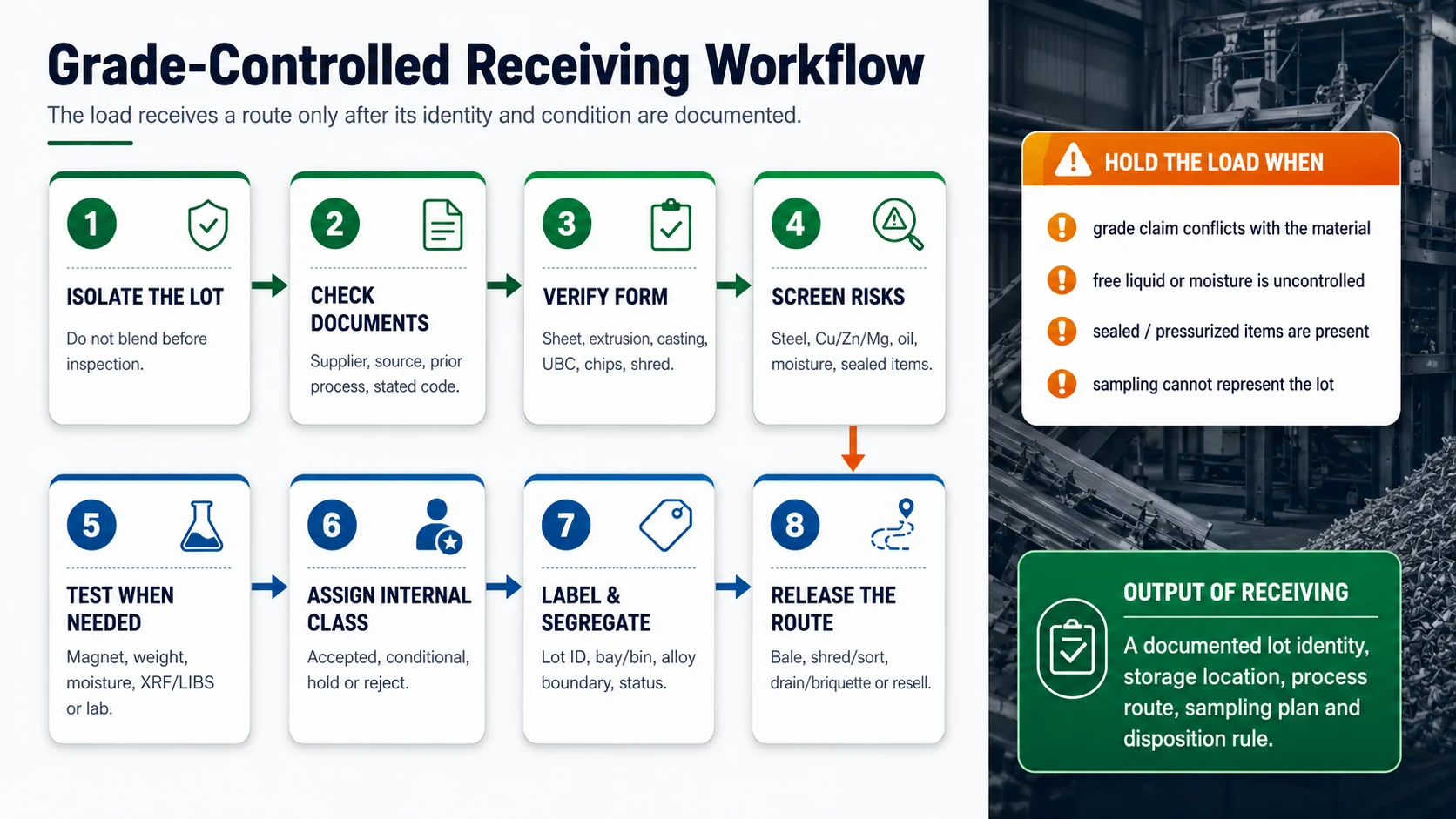
- Isolate the lot. Keep it separate from accepted inventory while paperwork and material condition are checked.
- Read the description literally. Record supplier, source, trade code, alloy claim, prior processing and delivery form. “Extrusion” and “one-alloy extrusion” are different claims.
- Inspect the whole load pattern. Look across the top, sides and accessible internal areas. One clean sample on the scale deck cannot represent hidden layers in a container or bale.
- Check the risks that change routing. These include attached steel, copper or zinc components, thermal-break polymer, oil, free liquid, moisture, fines, sealed items, batteries and unknown composites. The aluminum scrap contamination removal guide explains why each contaminant needs a different method.
- Use the appropriate test. A magnet checks exposed ferrous material; it does not identify aluminum alloys. Portable XRF or LIBS can support alloy sorting when the method and sampling plan are suitable. Laboratory analysis may be required for contractual chemistry.
- Assign receiving status. Accepted, conditionally accepted, held for test, downgraded or rejected should be visible on the lot label and in the inventory system.
- Release the defined route. The routing instruction should name the permitted bay or bin, preparation steps, target output and verification point.
Match the Grade to the Processing Route
The YUXI scrap aluminum recycling line is organized around feed behavior: shredding and physical separation for suitable bulky or mixed scrap, baling for appropriate light material, and liquid control plus briquetting for chips. That structure is deliberately broader than one trade code. The machine list comes after the plant defines the incoming grade mix and the required outgoing products.
| Incoming condition | Likely first decision | Possible route | Output evidence |
|---|---|---|---|
| Clean, segregated production offcuts | Preserve source and alloy identity. | Direct sale, controlled size reduction or baling. | Source records, alloy declaration, contamination and package check. |
| Old extrusions with fasteners or thermal breaks | Determine whether attachments must be dismantled or liberated. | Manual preparation, primary shredding, optional secondary liberation, magnetic removal, screening and suitable physical separation. | Particle-size distribution, ferrous and nonmetal limits, alloy/other-metal rule. |
| Mixed sheet, castings and components | Decide whether the goal is a mixed aluminum-rich fraction or alloy-specific products. | Feed segregation plus mechanical preparation; optional sensor sorting when chemistry matters. | Mass balance, composition or chemistry by product, residue disposition. |
| UBC and light packaging | Confirm can-only content, moisture and delivery form. | Inspection, sorting and baling or another buyer-approved route. | Density, bale dimensions, contamination and moisture checks. |
| Wet or oily chips and turnings | Protect alloy traceability and control free liquid. | Source segregation, drainage/centrifuging, magnetic check, metering and briquetting. | Alloy/source record, free-liquid or moisture result, density and foreign-metal check. |
| Zorba or another mixed nonferrous shred | Define whether the plant is trading the concentrate or upgrading it. | Screening, density/sensor sorting and product-specific quality control. | Nonferrous content, size, metal composition and named buyer limits. |
One export project can contain several of these routes under one roof. That does not mean every load should see every machine. Bypassing unnecessary size reduction is often the better engineering decision when the grade is already clean, controlled and accepted in its existing form.
Write an Acceptance Specification the Plant Can Use
| Field | What to write | Why it matters |
|---|---|---|
| Grade and revision | Trade code or buyer grade, current source and agreed variation. | Prevents two parties from using different versions of the same name. |
| Source and material family | Production offcuts, post-consumer frames, cast automotive parts, UBC, machine-shop turnings, post-shred concentrate. | Source predicts attachments, coatings, alloy variability and sampling risk. |
| Alloy boundary | One named alloy, one alloy family, mixed wrought, mixed cast or declared mixed nonferrous. | Controls blending and downstream melt chemistry. |
| Permitted and prohibited material | Ferrous attachments, Cu/Brass/Zn/Mg, polymer, rubber, glass, dirt, coatings, sealed items and batteries. | Connects the commercial grade to safety and process equipment. |
| Moisture, oil and free liquid | Test method, limit and action for wet loads. | Changes storage, handling, briquetting and furnace acceptance. |
| Physical form | Maximum dimensions, particle-size range, fines, bulk density, bale or briquette dimensions and tying. | Determines feedability, storage, inspection and transport. |
| Sampling and inspection | Lot definition, sample locations, frequency, analytical method, scale basis and inspection point. | Turns a quality claim into a repeatable decision. |
| Off-spec action | Hold, re-sort, downgrade, reject, return or settle by agreed adjustment. | Avoids improvisation after the truck has tipped. |
The outgoing specification deserves the same attention. The furnace-ready aluminum scrap guide explains the receiver-specific acceptance question in more detail. Here, the key point is that the output grade should be written before the equipment is finalized, because “aluminum-rich” and “one-alloy furnace charge” require different separation and verification strategies.
Common Aluminum Scrap Grading Mistakes
Using an alloy number as the full grade
“6063” does not state whether the material is new or old, painted or bare, loose or baled, clean or attached to steel and polymer. Add the source, form and contamination limits.
Calling Zorba “90% aluminum”
The ReMA description uses the number to estimate total nonferrous metal content. It does not convert the mixed concentrate into a 90% aluminum-alloy product.7
Assuming a machine creates a grade
An eddy-current separator can recover suitable nonferrous pieces from nonmetal material; it cannot identify 5xxx versus 6xxx extrusion. A magnet removes suitably exposed ferrous material; it cannot remove copper or zinc. The output grade belongs to the complete route and test basis.
Blending before the receiving decision
Once a questioned load enters a common pile, the plant may lose the ability to reject only the off-spec material. Traceability should survive until acceptance and lot release are complete.
Ignoring delivery form
Loose, shredded, densified and baled UBC can be separate commercial products. The same is true for whole versus shredded castings. Form affects handling and can be part of the contract.
Sampling only the easiest material
A handful from the top of a truck or one exposed bale face is convenient, not necessarily representative. Sampling effort should increase with lot heterogeneity and the cost of a wrong decision.
Grade Data YUXI Needs Before Configuring a Line
For an equipment proposal, a list of trade codes is helpful but not enough. Send representative photos and video for each grade, approximate percentages in the feed mix, source and alloy information, maximum dimensions, bulk density, attached steel and nonmetal content, moisture or oil condition, prohibited items, target throughput and the exact output the buyer will accept.
We normally recommend separating the RFQ into a feed table and an output table. The feed table describes what arrives. The output table describes what will be sold, remelted or sent to another sorting stage. Between them sits the equipment route and the mass balance. No fixed purity, recovery or accepted-output capacity should be promised until those three parts are tested on representative material.
Small Test Today, Confident Scale Tomorrow
Send us your feedstock details and output requirement. We’ll configure a line around your real material.
Aluminum Scrap Grades FAQ
What is an aluminum scrap grade?
An aluminum scrap grade is a commercial description of a lot. Depending on the specification, it may define source, alloy or alloy mix, physical form, permitted contamination, moisture or oil, size, density, packaging and prohibited items. A plant should also assign its own receiving class so the lot has a documented storage, processing and sampling route.
Is a 6063 alloy number the same as a scrap grade?
No. 6063 identifies an alloy composition, while a scrap grade also describes the material condition and delivery. Old 6063 extrusion with thermal-break polymer, iron screws and dirt is not commercially equivalent to clean segregated 6063 production offcuts.
Are ReMA or ISRI codes mandatory?
They are widely used trading guidelines, not a substitute for a contract. The current specification text and any buyer–seller variation should be agreed before shipment. A receiving plant may use its own internal codes alongside the trade description.
Is Zorba an aluminum scrap grade?
Zorba is a shredded nonferrous concentrate that is predominantly aluminum but can contain several other nonferrous metals. Its number describes estimated nonferrous metal content, not aluminum-alloy purity. Further sorting may be needed before a buyer accepts the material as an aluminum-rich or alloy-controlled product.
Can one truck contain several aluminum scrap grades?
Yes, but only when the grades are physically segregated, individually identified and accepted by the buyer. Mixing them in one loose pile can destroy traceability and may force the plant to downgrade the whole load.
Does shredding improve the aluminum scrap grade?
Shredding can improve handling and expose attachments, but it does not prove alloy chemistry or automatically remove copper, zinc, magnesium and other nonferrous metals. Grade improvement depends on the complete preparation, separation and verification route.
How should a recycling plant verify an incoming grade?
Use supplier and source records, visual inspection, weight and dimensional checks, magnetic checks, moisture or free-liquid checks, representative sampling and—when the contract requires chemistry—appropriate analytical testing such as XRF, LIBS or laboratory analysis. The method should match the lot and the buyer’s acceptance rule.
What should be sent to YUXI before a line proposal?
Send representative photos and video, proposed scrap grades and percentages, source and alloy information, maximum piece size, bulk density, attached steel and nonmetal content, moisture or oil condition, target throughput, required output grade, buyer specification, available space and utilities.
References
- Recycled Materials Association — Aluminum Specifications — Current index of commercial aluminum scrap grades and item codes.
- ReMA — Taint/Tabor: Clean Mixed Old Alloy Sheet Aluminum — Example of a trade grade defined by material family, exclusions and an oil/grease limit.
- ReMA — Taldon: Baled Aluminum UBC Scrap — Shows how density, bale dimensions, tying and contamination rules can form part of a grade.
- ReMA — Tutu: Aluminum Extrusions Dealer Grade — One-alloy old extrusion grade with named contamination exclusions and buyer–seller variations.
- ReMA — Tense: Mixed Aluminum Castings — Clean mixed casting definition with exclusions and oil/grease control.
- ReMA — Teens: Segregated Aluminum Borings and Turnings — One-alloy turnings grade with moisture, liquid, foreign-metal and fines requirements.
- ReMA — Zorba: Shredded Nonferrous Scrap — Mixed nonferrous concentrate in which the following number estimates nonferrous metal content.
- ReMA — Vesper — A 2025 wrought-aluminum grade segregated from Zorba or Twitch with specified limits.
- The Aluminum Association — Standards and Alloy Series — Explains how wrought aluminum alloy series are organized by principal alloying elements.
- U.S. EPA — AP-42 Chapter 12.8, Secondary Aluminum Operations — Describes how scrap source, quality, equipment, furnace design and product specifications change pretreatment and plant configuration.