




 Request Quote



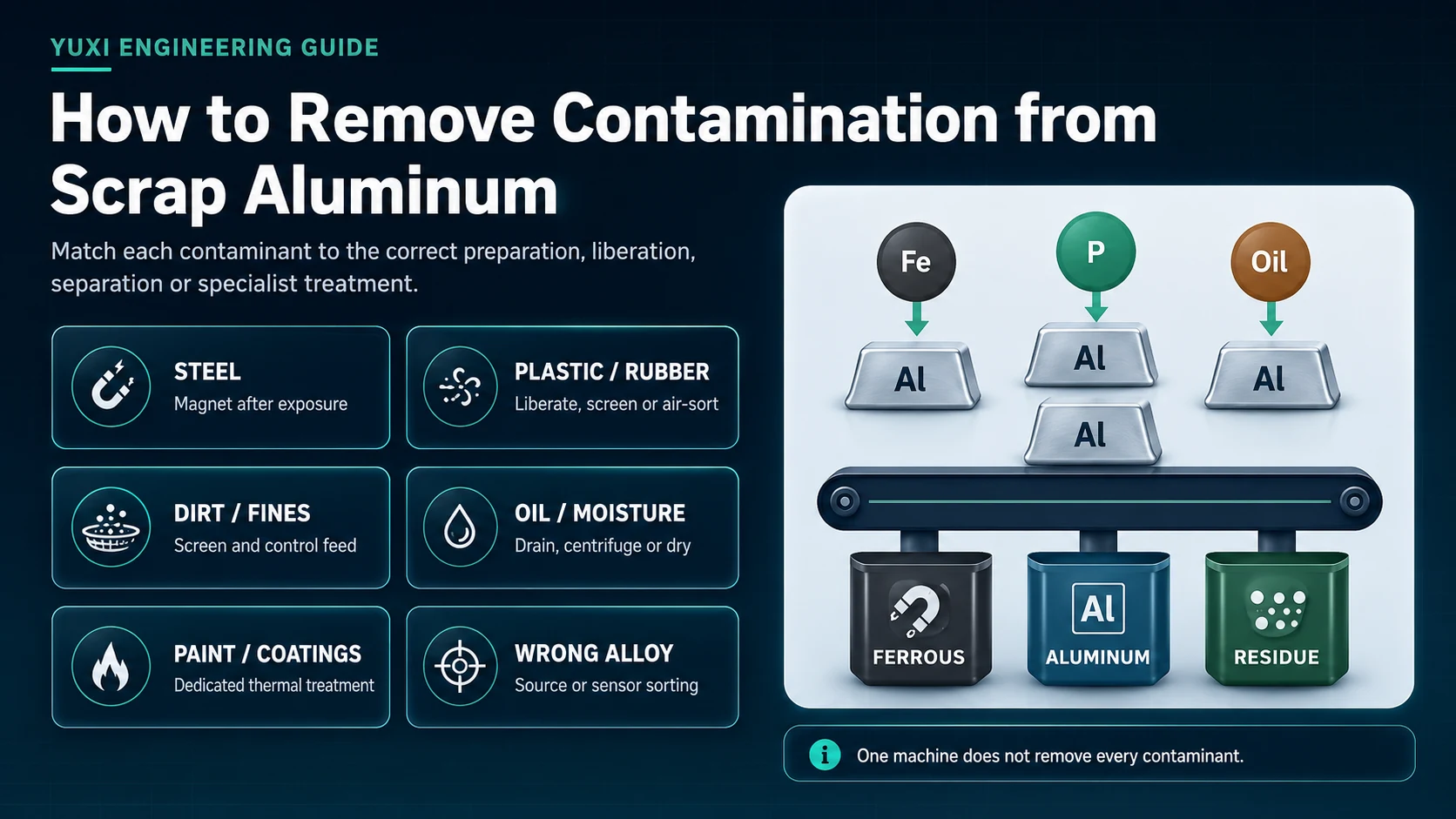
Put two aluminum samples beside each other. The first is an extrusion with screws, rubber seals and a thermal-break strip. The second is a clean-looking mixture of cast and wrought parts. The first sample has a physical separation problem. The second may have an alloy problem even though no dirt is visible. Calling both of them “dirty aluminum” hides the decision that matters.
For an industrial project, aluminum scrap contamination removal starts by naming the failure: unsafe material, an attached component, loose residue, liquid, coating, foreign metal or incompatible alloy. Equipment comes after that diagnosis. The YUXI scrap aluminum recycling line is configured around the feed for the same reason. Profiles, mixed scrap, sheet, chips, wheels and castings do not enter an identical flowsheet.
Start with the Buyer’s Definition of Clean Aluminum
The U.S. EPA describes secondary-aluminum pretreatment as the sorting and processing used to remove other metals, dirt, oil, plastics and paint before smelting.[1] That is a sound starting point, but a purchase specification normally goes further. It may set limits for free iron, non-metal content, moisture, attached rubber, coatings, particle size or alloy family.
This changes the meaning of “clean.” Painted extrusion may be acceptable under one scrap grade. The same material may need decoating before a particular furnace route. A batch of cast aluminum can be free of plastic and steel yet still be unsuitable for a wrought-alloy loop. The receiver’s test method therefore belongs in the process discussion from the beginning.
| What is in the feed? | Typical examples | What usually has to happen |
|---|---|---|
| Ferrous attachments | Screws, shafts, brackets, bearings and inserts | Expose the steel by dismantling or controlled liberation, then remove it magnetically |
| Other metals | Copper, brass, zinc, magnesium, lead and non-magnetic stainless | Use source control, manual removal, density separation or sensor sorting according to the target product |
| Non-metal solids | Plastic, rubber, glass, wood, foam, fabric and sealant | Remove accessible parts first; liberate and classify the remainder before air or density separation |
| Dirt and fines | Soil, sand, dust, glass fines and fragmented coating | Screen at the point where the chosen size cut improves the downstream burden |
| Liquids | Water, oil, coolant and cutting fluid | Drain, centrifuge, collect and dry through a controlled route |
| Bonded organics | Paint, lacquer, adhesive and polymer coating | Use a dedicated decoating or other approved specialist process when the outlet requires it |
| Wrong alloy | Mixed cast and wrought grades or incompatible alloy families | Preserve identity at source or add suitable alloy-sorting technology |
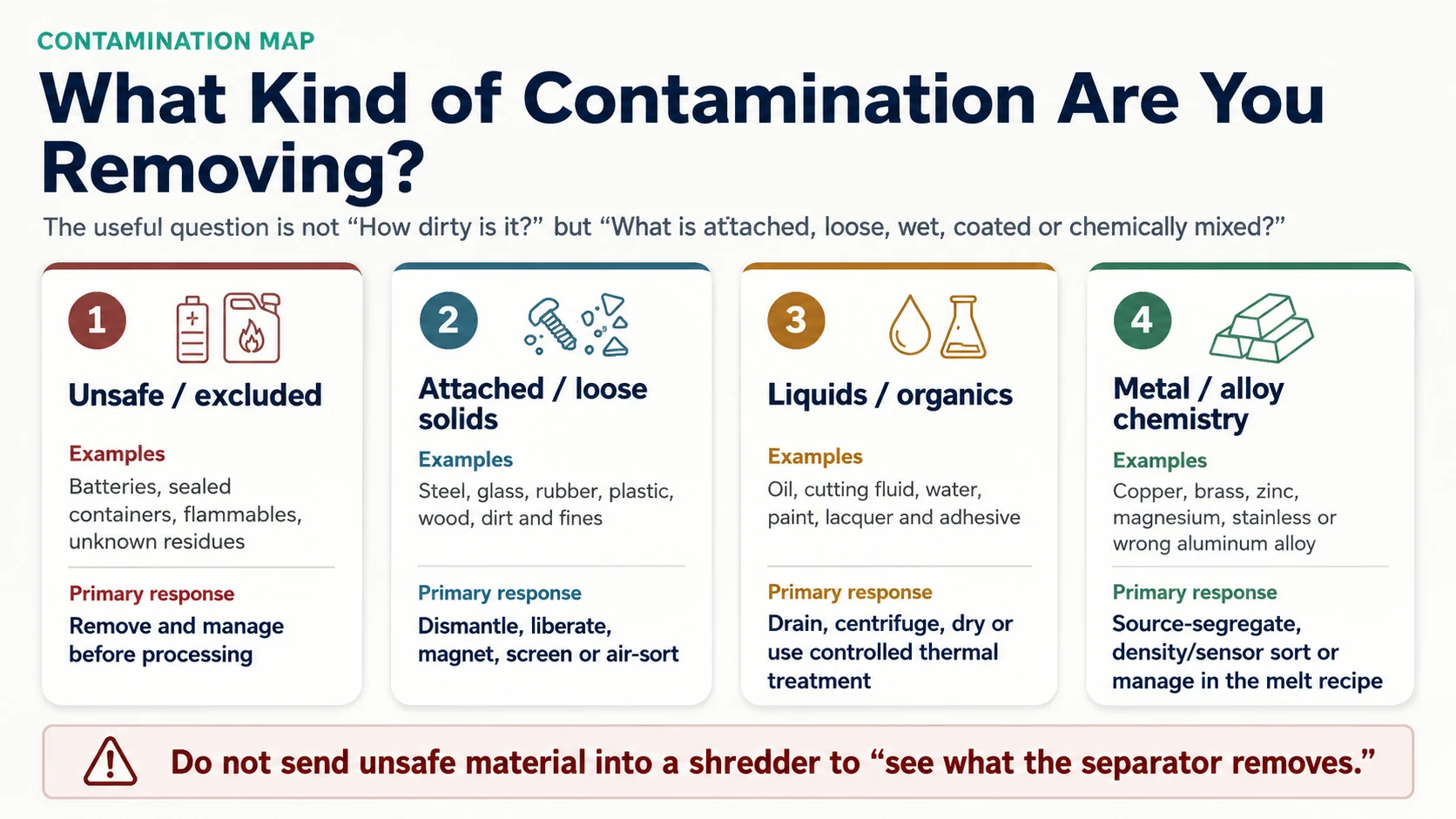
Diagnose the Feed Before Choosing the Line
Remove hazards before they become a separation problem
Sealed containers, pressure vessels, batteries, gas cylinders, flammable liquids, unknown residues and large hard steel pieces should be identified before the feed reaches a shredder. OSHA’s scrap-recycling guidance warns that fuels and other hazardous materials need to be removed before scrap enters processing machinery.[5] Once removed, those materials need their own documented storage and disposal route; they do not become ordinary plant residue simply because they came from a scrap load.[6]
Ask whether the contaminant is loose or still locked to the aluminum
A loose bolt, a strip of rubber and a steel insert inside a casting are three different jobs. The loose item can be picked. The attached component may be dismantled. The insert may need the aluminum to be opened before a magnet can reach it. EPA process guidance describes crushing, shredding, magnetic removal, screening, eddy current separation and pneumatic classification as complementary preparation methods rather than a single cleaning step.[2]
The degree of size reduction should be tied to the next separator. If a low-speed shredder already opens the profile and releases the hardware, extra impact adds wear and fines without improving the split. When small fasteners or polymer strips remain locked, a second liberation stage may be justified. The target is release, not the smallest possible particle.
Keep surface condition and alloy chemistry out of the mechanical-sorting bucket
Cutting fluid and moisture need drainage, centrifuging or drying. Paint and lacquer remain bonded to the surface after ordinary magnetic and size separation. The Aluminum Association describes used aluminum containers being opened, shredded and passed through a controlled high-temperature stage to remove paints, lacquers and coatings before melting.[4]
Alloy mix is different again. Automotive scrap, for example, may be sorted using properties such as size, weight, magnetic response, electrical conductivity, density and chemical composition.[3] Where alloy retention carries value, a dedicated collection bin often does more useful work than an additional separator at the end of the line.
A Seven-Stage Aluminum Scrap Contamination Removal Route
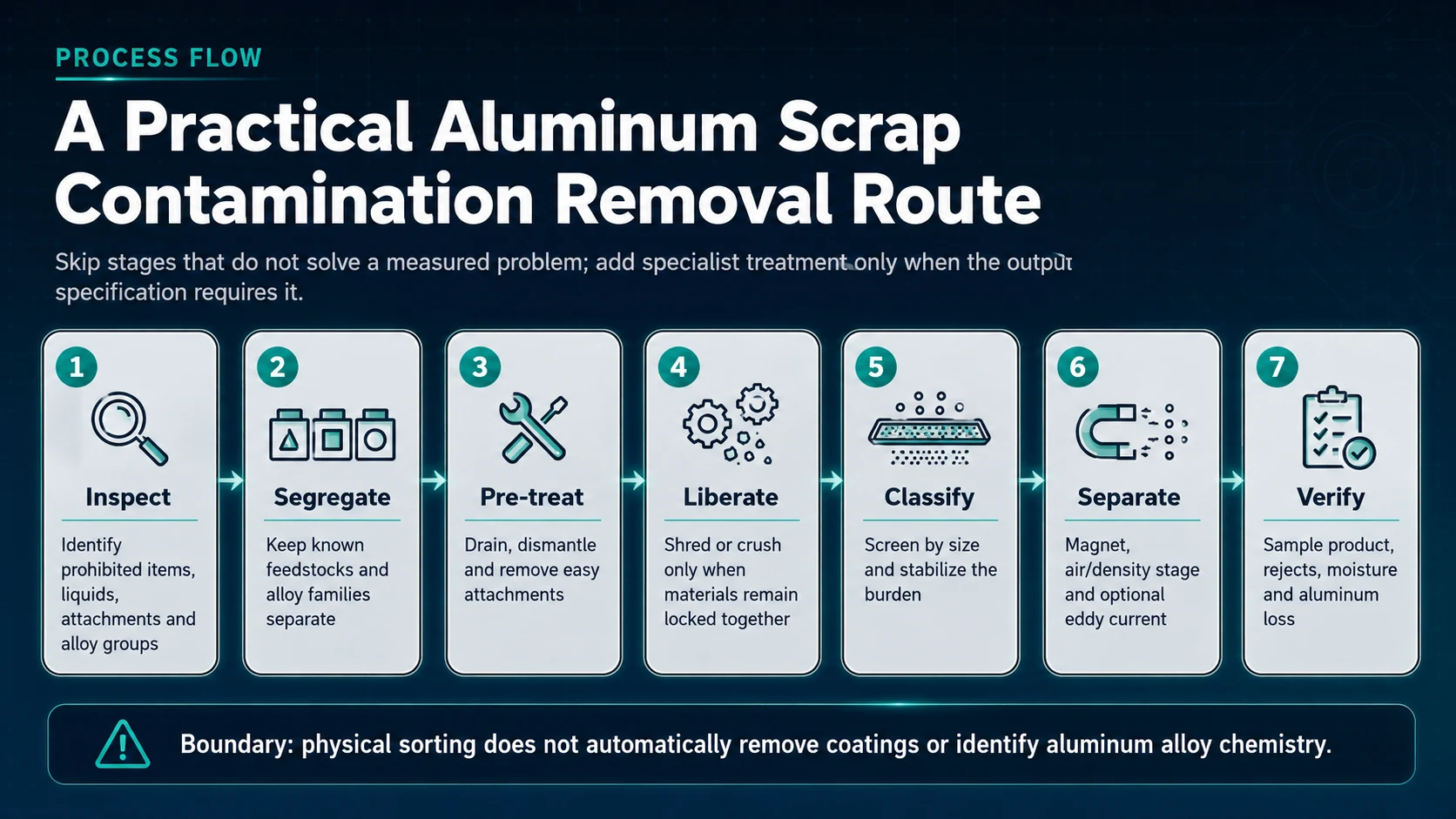
- Define the feed and the accepted product together. Record sources, component mix, maximum size, bulk density, moisture, fluids and known alloy groups. Beside that description, place the buyer’s limits and sampling method.
- Exclude hazards and deal with free liquid. Remove batteries, sealed items, pressure vessels and unknown residues. Drain wet components and machining scrap before they contaminate storage, conveyors or dry separators.
- Segregate and dismantle while the pieces are still recognizable. Keep profiles, sheet, wheels, castings and chips apart where their outlet differs. Take off tires, bearings, glass, large brackets and accessible copper before those items are broken into smaller pieces.
- Liberate only what remains attached. A low-speed shredder can shorten bulky material and open assemblies. Stronger impact or secondary crushing belongs only where the first stage leaves steel or non-metal locked to the aluminum. The aluminum shredder vs hammer mill guide explains the difference between primary reduction and secondary liberation.
- Classify the burden. Remove a chosen fine or oversize fraction and stabilize the particle range. Screens improve presentation; they do not identify the material passing through them.
- Separate in the order the feed requires. Remove exposed ferrous material before the downstream non-ferrous split. Air or density stages can target selected light fractions. An eddy current separator then works best on a controlled stream in which conductive non-ferrous pieces are presented against non-metal material. The magnetic versus eddy current separator comparison covers the sequence in more detail.
- Verify the complete mass balance. Weigh the aluminum product, ferrous reject, non-metal reject, fines and recirculation. Inspect each reject for lost aluminum. A visually cleaner discharge can still be a poor commercial result when too much metal leaves in the residue.
Where Each Machine Fits
Machine names are less useful than feed conditions. The table below uses the point at which each stage earns its place in the process.
| Stage | Use it when | Watch during testing |
|---|---|---|
| Manual inspection and dismantling | Hazardous items or large valuable attachments remain recognizable | Labor requirement, access to hidden parts and the amount of material that still needs liberation |
| Drainage or centrifuging | Chips or components carry free oil, coolant or water | Liquid collection, residual moisture and stable feeding after treatment |
| Low-speed shredder | Profiles, frames or mixed bulky pieces must be shortened and opened | Whether the assembly is actually released, along with bridging, blade loading and strip-like output |
| Hammer mill or secondary crusher | Smaller fasteners or composite interfaces remain locked after primary reduction | Fines generation, aluminum flattening, wear and the particle range required downstream |
| Magnetic separator | Ferrous material has been exposed | Burden depth, steel still trapped inside aluminum and aluminum carried with the magnetic reject |
| Screen and air or density stage | The stream needs a tighter size range or a selected light/heavy split | Moisture, shape effects, density overlap and metal loss in the removed fraction |
| Eddy current separator | Conductive non-ferrous pieces must be recovered from a prepared non-metal stream | Particle-size range, feed layer, belt stability and the mixture of metals in the ejected product |
| Thermal or sensor treatment | The saleable grade depends on removing bonded organics or identifying metal/alloy chemistry | Emission control, calibration, product sampling and the actual value gained from the extra stage |
How the Route Changes with the Feedstock
Profiles, frames and composite extrusion
Take out glass, handles, hinges and accessible steel before shredding. Long extrusion often needs primary reduction mainly for feeding and opening. Thermal-break polymer or hidden hardware may then determine whether secondary liberation is needed. The aluminum profile recycling line guide covers profile-specific feeding and composite separation.
Mixed scrap, wheels and castings
This group can contain iron, copper, brass, zinc, rubber, glass, dirt and several aluminum forms in the same load. Wheels and automotive castings also bring tires, valves, balance weights, bearings and trapped fluids. Remove those items while the component can still be recognized. After that, use the minimum liberation needed to expose inserts and prepare the requested product. The detailed mixed-feed flowsheet belongs in the mixed aluminum scrap sorting line.
Chips and turnings
Machining scrap is usually governed by cutting fluid, fines, steel chips, tangling and alloy identity. A dedicated route built around segregation, drainage or centrifuging, controlled feeding and optional briquetting is normally more stable than sending wet chips through a general line. The aluminum chips recycling process explains the liquid-control and briquette checks.
Sheet, foil and prepared non-ferrous residue
Clean sheet offcuts may require little more than inspection and baling. Painted sheet and foil laminates bring coatings and low bulk density into the decision. A prepared residue after ferrous removal is different: it may contain aluminum, copper, brass, zinc, magnesium, stainless, plastic, rubber and glass. Eddy current separation can recover a conductive fraction from suitable non-metal material, while further metal or alloy upgrading may call for density or sensor stages. Particle presentation is covered in the eddy current particle-size guide.
When Washing Scrap Aluminum Is Justified
Washing makes sense when the unwanted material is water-removable, the cleaned surface has commercial value, and the plant has a route for wastewater and drying. Loose salts, selected dirt or a known process residue may fit that case. A screw inside an extrusion, a bearing in a casting, a bonded lacquer and an alloy mix do not.
The drying stage is part of the decision, not an afterthought. Water left in nested, compacted or porous scrap changes screening and air separation and may create downstream furnace risk. Before adding a washer, answer three questions:
| Question | Why it changes the process |
|---|---|
| What residue is water expected to remove? | The answer determines whether washing is technically relevant or simply moves the problem elsewhere. |
| How will water and captured solids be managed? | Collection, filtration, treatment and disposal or reuse become part of the plant. |
| How will dryness be measured? | The downstream separator or receiver needs a defined moisture condition rather than a visual judgement. |
Verify the Cleaned Product, Not Just the Machine Discharge
The strongest test is deliberately ordinary: use a representative feed sample, run the agreed route, weigh every output and inspect the rejects. A short peak at the first machine says little about the saleable output rate.
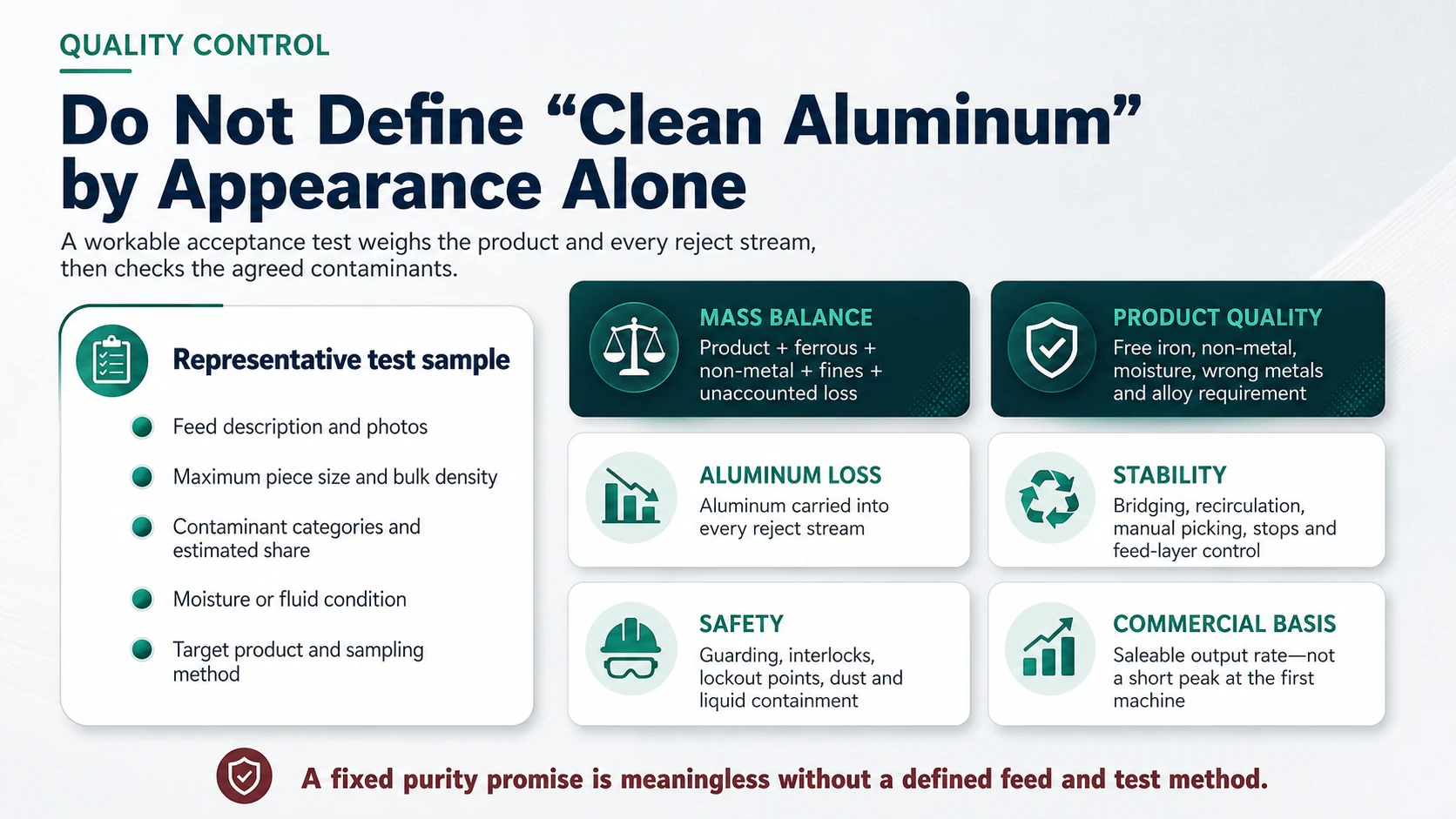
- Feed basis: source mix, dimensions, bulk density, moisture, liquid and estimated contaminants.
- Capacity basis: incoming mass, dry metal, intermediate fraction or final saleable product.
- Product check: free iron, non-metal, other metals, moisture, coating condition and alloy requirement.
- Reject check: aluminum found in ferrous, non-metal, fine and recirculating streams.
- Operating notes: bridging, surges, manual picking, recirculation, stops and feed-layer stability.
- Safety controls: guarding, interlocks, lockout points, dust control and liquid containment.
Purity, recovery and throughput depend on the feed composition, size distribution, moisture and sampling method. Those conditions should appear beside the test result. Without them, a percentage is difficult to compare and easy to misunderstand.
Three Places Contamination-Removal Projects Go Wrong
The line starts too late
A tire, bearing, large bracket or pool of free liquid is easier to handle before shredding. When obvious attachments enter the machine, they become smaller pieces, increase wear and spread into more product streams. Upstream preparation is often the cheapest separation stage in the plant.
More size reduction is treated as more cleaning
Impact helps only when it releases something that the next separator can remove. Past that point, the line may create extra fines, flatten aluminum or carry good metal into the residue. During a trial, compare liberation after each stage rather than judging the process only by the final particle size.
Metal separation is confused with alloy separation
A magnet targets ferrous material. Eddy current equipment responds to conductive non-ferrous pieces in a prepared stream. Neither result automatically gives an alloy-pure aluminum product. Where chemistry matters, preserve source identity or specify a suitable sensor-sorting and sampling method.
Information to Send for a Contamination-Removal Proposal
The most useful enquiry describes the worst normal feed as well as the best pieces. Include:
- Material names, sources and estimated share of each feedstock
- Representative photos and video before manual cleaning
- Maximum dimensions, wall thickness, unit weight and loose bulk density
- Attached steel, copper, brass, zinc, rubber, plastic, wood and glass
- Dirt, fines, oil, cutting fluid, moisture and trapped-liquid condition
- Paint, lacquer, adhesive, thermal-break polymer or laminate structure
- Known aluminum alloy families and whether identity must be retained
- Required saleable output rate and the basis used to measure it
- Buyer specification, particle range, sampling method and allowed rejects
- Power supply, operating hours, loading method, workshop limits and local environmental requirements
Aluminum Scrap Contamination Removal FAQ
What is the pollution in waste aluminum?
Pollution includes anything that prevents the scrap from reaching the agreed level:attached steel or other metals,plastics and rubbers,dirt and fine powder,oil or water,adhesive coatings,anf aluminum from the wrong alloy family.
Can the eddy current separator clean aluminum scrap?
It can recover conductive non-ferrous pieces from a properly sized non-metal stream. It is useful after ferrous removal and feed control, but it is not an alloy analyzer and will not turn mixed aluminum, copper and brass into separate products by itself.
Should scrap aluminum be cleaned before recycling?
Washing is justified when the target residue is water-removable and the plant has wastewater treatment and a verified drying stage. Steel attachments, bonded coatings and mixed alloys call for other methods.
How are oil and cutting fluid removed from aluminum chips?
Keep chip streams separate, allow free liquid to drain, and use centrifuging or another approved liquid-separation step where required. Briquetting may express additional free liquid and improve handling, but the acceptable residual-fluid level still has to be agreed with the receiver.
Can a magnetic separator remove every steel part?
A magnet works on ferrous material that has been exposed and presented to the field. Bearings, screws or inserts still locked inside a casting may need dismantling or controlled size reduction first.
Authoritative References
- U.S. Environmental Protection Agency – AP-42 Section 12.8: Secondary Aluminum Operations. Scrap pretreatment, mechanical cleaning and contaminant categories.
- U.S. Environmental Protection Agency – Preferred and Alternative Methods for Estimating Air Emissions from Secondary Metal Processing. Mechanical separation, shredding, magnetic removal, eddy current separation, screening and pneumatic classification.
- The Aluminum Association – Automotive Aluminum Recycling at End of Life. Downstream separation and the composition of mixed non-ferrous residue.
- The Aluminum Association – Four Keys to Circular Recycling: An Aluminum Container Design Guide. MRF sorting and controlled removal of paints, lacquers and coatings.
- OSHA – Guidance for the Identification and Control of Safety and Health Hazards in Metal Scrap Recycling. Feed exclusions, machine hazards and dust controls.
- California Department of Toxic Substances Control – Hazardous Waste Management for Scrap Metal Recyclers. Removed hazardous materials and generator responsibilities.
Send YUXI a Representative Scrap Sample
Include feed photos or video, dimensions, contamination categories, liquid condition, required saleable output and the buyer’s acceptance method. YUXI can then separate the project into the appropriate preparation, shredding, sorting, baling or briquetting route.