




 Request Quote



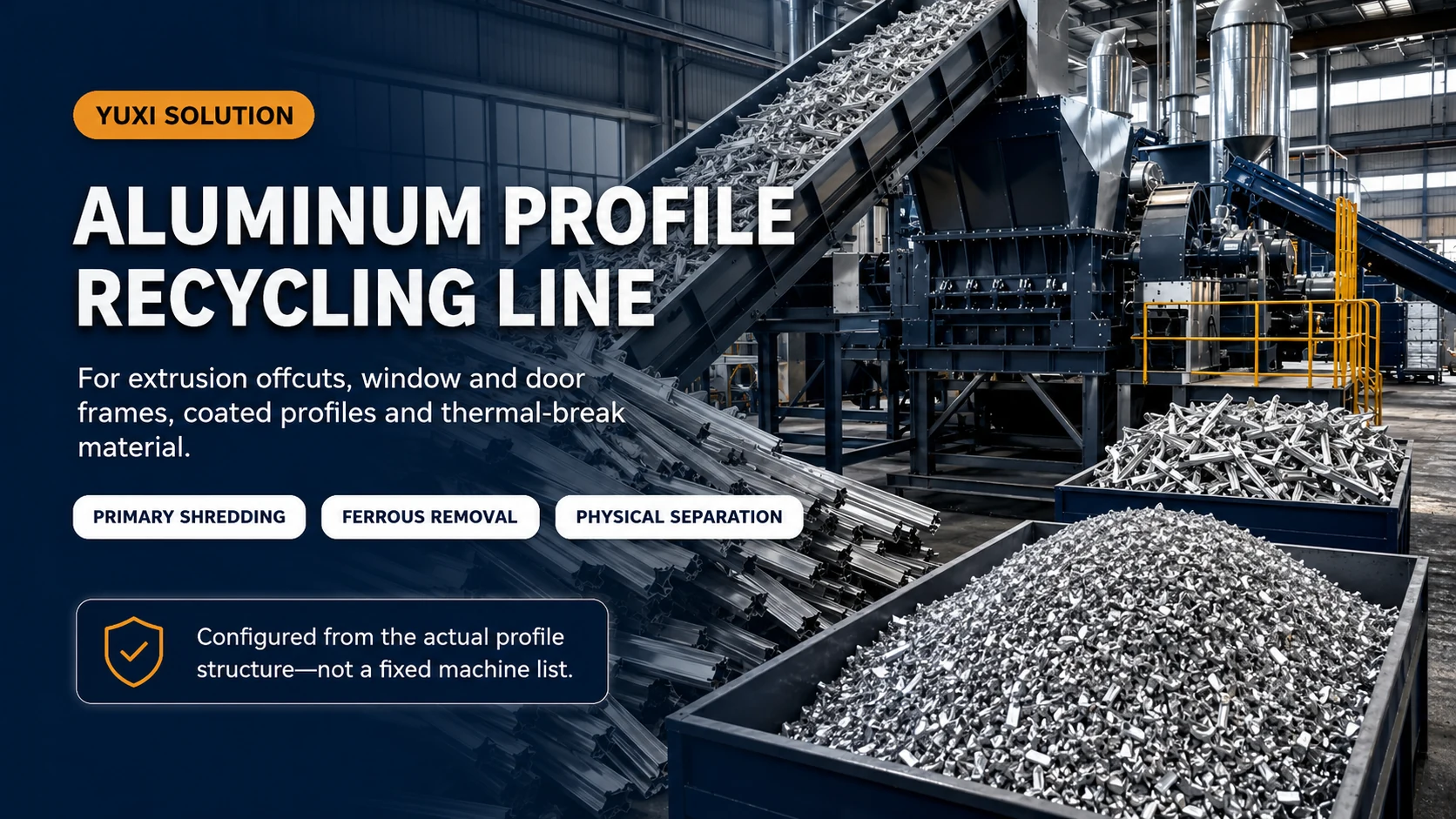
A pile of clean extrusion cutoffs and a pile of demolished thermal-break window frames can both be sold as “aluminum profiles.” They are not the same feed. One is mostly a handling and size-reduction problem. The other can contain steel screws, hinges, rubber seals, coatings, glass fragments and a polymer strip locked inside the extrusion. In practice, this difference determines whether the project needs one reduction stage or two, magnetic separation, screening, eddy-current separation, or only disciplined quality control.
What Profile Scrap Is This Line Designed For?
The phrase aluminum profile describes a shape, not a complete recycling specification. Extruded aluminum appears in building systems, industrial frames, solar structures, transportation components, furniture and many production offcuts. The line must be selected from the condition in which those profiles arrive.
| Feed category | Typical condition | Main processing objective | Likely equipment depth |
|---|---|---|---|
| Clean extrusion offcuts | Known plant source, limited attachments, repeatable alloy family, loose or bundled lengths | Reduce volume, improve handling and prepare an agreed furnace size | Controlled conveyor feeding and primary shredding; optional screening or baling according to the buyer |
| Rejected or obsolete profiles | Painted, anodized or powder-coated material; occasional fasteners or packaging contamination | Open bundles, reduce size and remove attached ferrous parts | Primary shredding, magnet and quality control; secondary crushing only when liberation is insufficient |
| Window and door frames | Post-consumer hardware, gaskets, brushes, sealants and possible glass contamination | Release aluminum from hardware and non-metal components | Preparation, shredding, magnetic removal, screening and a verified physical-separation stage |
| Thermal-break profiles | Two aluminum sections mechanically joined by an insulating polymer strip | Break the composite structure and separate aluminum from polymer and hardware | Primary reduction plus stronger liberation, classification, ferrous removal and non-ferrous/non-metal separation |
| Mixed architectural profile scrap | Variable percentage of clean extrusion, frames, cast hardware, rubber and plastic | Stabilize the feed and prevent one contamination type from setting the whole line | Presort or source control, modular reduction, magnet, screen and adjustable downstream separation |
We normally ask for photographs from several loads rather than one attractive sample. A clean top layer can hide short steel sections, nested frames or a much higher percentage of thermal-break material underneath. The most useful evidence is a simple composition estimate by mass, supported by video of unloading and manual inspection.
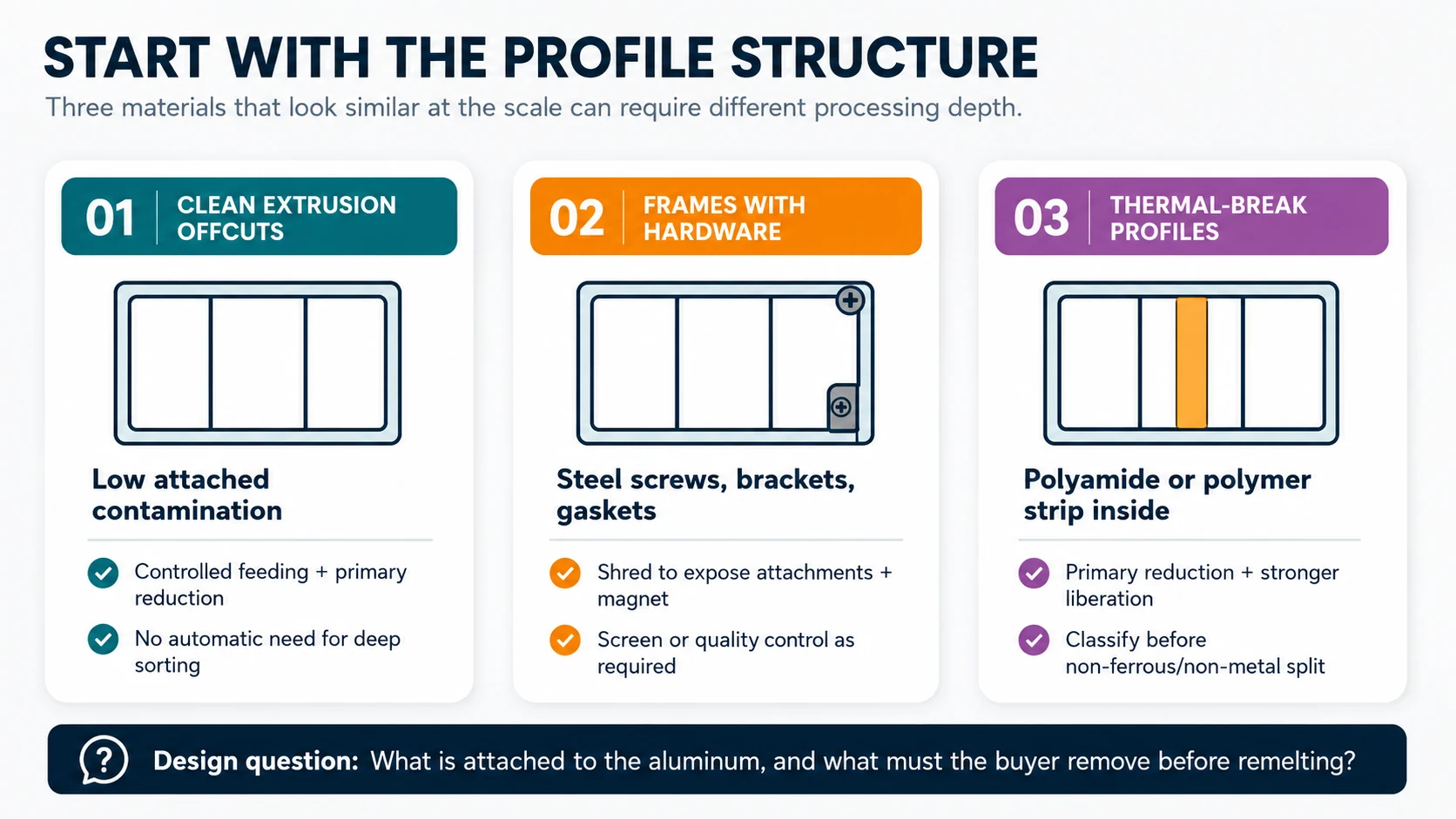
Ordinary Profiles and Thermal-Break Profiles Are Not the Same Job
A thermal-break extrusion is a composite structure in which two aluminum sections are mechanically connected by low-conductivity insulating strips, often made from polyamide. European Aluminium illustrates end-of-life thermal-break window profiles moving through shredding, eddy-current and density-based separation before the aluminum and polyamide fractions continue to their own outlets.
Surprisingly, “more crushing” is not automatically the answer. Excessive size reduction can make light gaskets and polymer harder to control, increase dust and widen the particle-size distribution. The engineering target is enough liberation for the selected separator—not the smallest particle a machine can produce.
How an Aluminum Profile Recycling Line Works
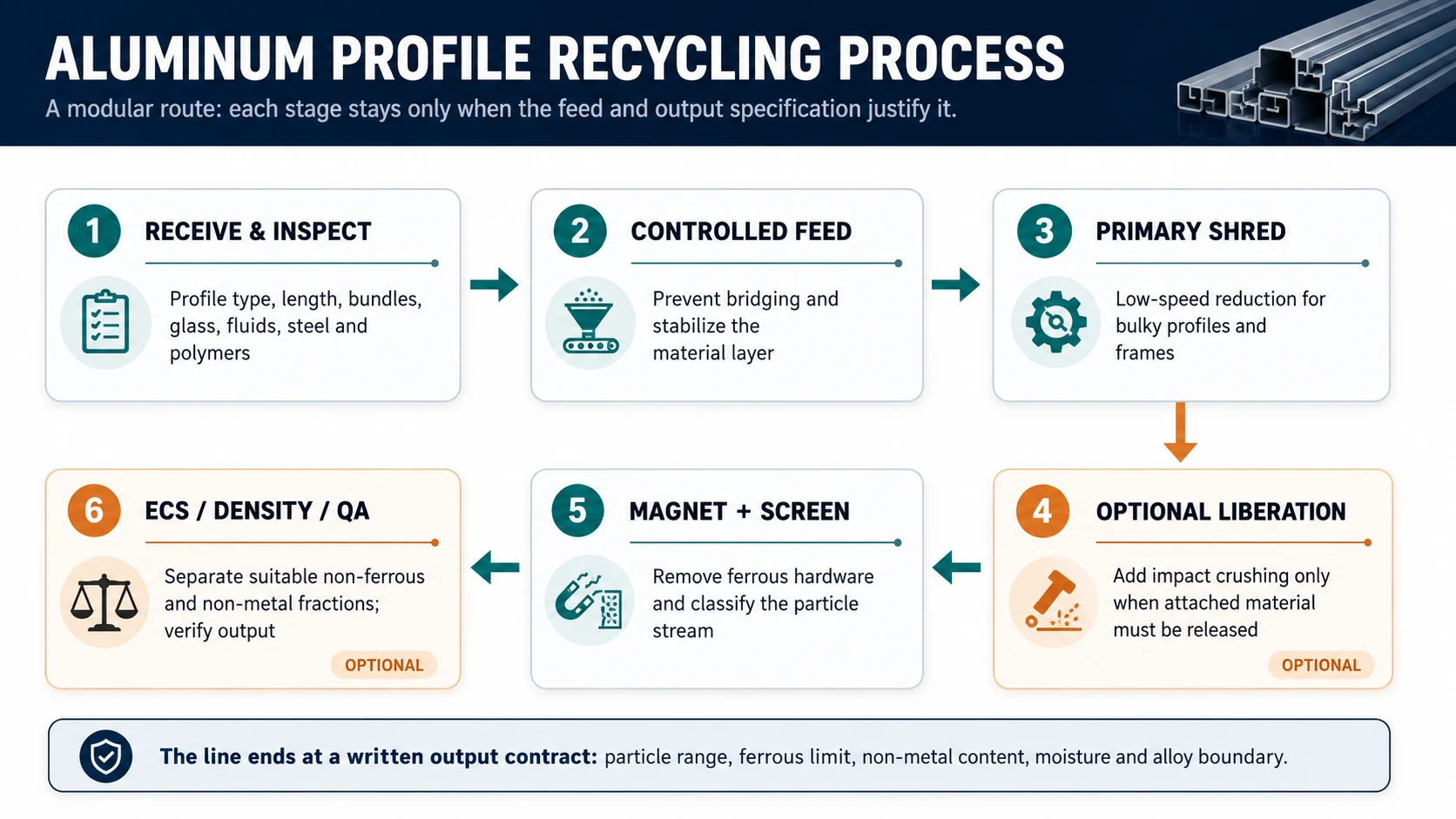
The U.S. EPA describes secondary aluminum pretreatment as sorting, processing and cleaning scrap before smelting. It notes that mechanical cleaning can break aluminum-bearing scrap into smaller pieces to improve downstream removal of iron, while the exact arrangement changes with scrap source, quality, available equipment and product specification. That is a good design rule for profile projects: the process is modular, and every stage needs a reason.
Receive, identify and inspect the profile scrap
Separate clean production scrap from post-consumer frames where practical. Confirm maximum length, wall thickness, bundled or nested condition, ordinary-versus-thermal-break percentage, attached steel, glass, rubber, sealant, dirt and moisture. Sealed items, pressure-containing parts, batteries, liquids and unidentified hazardous residues remain outside the confirmed feed specification.
Prepare the material and define the loading method
Whole glazed windows should not be treated as ordinary profiles. Upstream dismantling and glass management must follow the site’s procedures and local rules. Long flexible extrusions can bridge in a hopper or spring across a conveyor, so loading by grab, loader or conveyor has to be matched to the chamber opening and a controlled feed rate.
Use primary shredding to open and reduce bulky profiles
A low-speed, high-torque twin-shaft shredder grips and shears long hollow sections. Its duty is stable primary reduction: shortening the material, opening nests and producing a stream that conveyors and downstream machines can handle. YUXI’s metal shredder is selected from feed dimensions, thickness, bulk density, required throughput and the following process rather than from the metal name alone.
Add secondary liberation only when the output requires it
Post-consumer and thermal-break profiles may still hold polymer, rubber or fittings after coarse shredding. A hammer mill metal crusher or another secondary crusher can create more impact and deformation, releasing attached components. Clean extrusion offcuts do not automatically need this stage.
Remove ferrous hardware before non-ferrous sorting
Screws, brackets, lock parts and steel reinforcement belong in a ferrous fraction. A magnetic separator addresses that problem. It does not recover aluminum from plastic, and an eddy current separator should not be specified as a substitute for iron removal. The correct order is explained in YUXI’s magnetic versus eddy current separator guide.
Screen or classify the stream before final separation
Separators work on particles, not on the original description of the scrap. A screen can divide oversize, a working size fraction and fines so each stream receives appropriate treatment. It can also expose incomplete liberation: if aluminum-polymer composites remain concentrated in one fraction, the line may need a controlled return path rather than repeated crushing of the entire product.
Separate aluminum from suitable non-metal material and verify the result
YUXI’s eddy current separator repels conductive non-ferrous particles so their trajectory differs from non-metal material. Stable particle size, an even material layer and prior ferrous removal are important. Density separation or manual quality control may be added according to the residue and output contract. Alloy-level separation is a separate requirement.
Three Practical Line Configurations
Buyers often ask for a “complete” line before defining what complete means. For profiles, three scopes cover most early discussions.
Clean Extrusion Downsizing
Best fit: factory offcuts, rejected lengths and source-separated profiles with little attached material.
Typical modules: loading or conveyor feed, primary shredder, discharge conveyor and optional size check or compaction.
Reason: the buyer needs shorter, denser, easier-to-handle scrap rather than intensive separation.
Frames with Hardware
Best fit: window and door frames containing screws, brackets, gaskets and moderate non-metal contamination.
Typical modules: presort, primary shredder, optional secondary liberation, magnet, screen and quality control.
Reason: attached hardware must be exposed and removed before the aluminum fraction is sold or remelted.
Thermal-Break Separation
Best fit: profiles with continuous polymer insulation strips and variable post-consumer attachments.
Typical modules: controlled feed, primary reduction, stronger liberation, magnet, classification, ECS or density-based separation and recirculation.
Reason: a composite profile needs a measurable aluminum-polymer release target, not only volume reduction.
One export enquiry we would challenge immediately is a request for the deepest configuration based only on a photograph of clean offcuts. Another is a request for Configuration A when the material is mostly dismantled thermal-break windows. In both cases, the machine list is being chosen before the problem is defined.
What Each Machine Contributes
| Equipment | Duty in a profile line | Selection questions | Common misunderstanding |
|---|---|---|---|
| Receiving and feeding system | Controls long-profile loading and stabilizes mass flow | Longest piece, bundle size, loader or grab, hopper geometry, bridging risk | A wider conveyor alone does not guarantee steady feeding |
| Twin-shaft shredder | Primary cutting, opening and volume reduction | Profile wall thickness, nested condition, contaminants, chamber, cutter geometry, downstream target | It does not automatically make a uniform fine particle or clean product |
| Secondary crusher or hammer mill | Additional size reduction and liberation of attached material | Required release, acceptable fines, wear duty, screen or recirculation strategy | More impact is not always needed for clean extrusion scrap |
| Magnetic separator | Removes steel screws, brackets, inserts and reinforcement | Magnet type, burden depth, particle size, location and discharge route | It cannot separate aluminum from plastic |
| Screen or classifier | Controls particle-size distribution and creates stable separator feeds | Cut points, fines handling, oversize return, screen loading and maintenance access | A screen does not solve incomplete liberation by itself |
| Eddy current separator | Separates conductive non-ferrous particles from a suitable non-metal stream | Size range, shape, moisture, feed layer, belt speed and splitter position | It does not remove ferrous hardware or separate aluminum alloys automatically |
| Dust and residue handling | Collects generated fines and transfers non-metal fractions safely | Dust characterization, local rules, collection points, containerization and cleaning plan | Dust control is not an accessory to be added after the layout is finished |
For a project-level comparison of equipment combinations, see how to choose aluminum recycling equipment. For the primary reduction stage specifically, the aluminum scrap shredder selection guide explains why cutter and chamber decisions depend on feed shape and downstream duty.
What Changes Aluminum Profile Recycling Line Capacity?
Profile scrap can be deceptively light by volume. A loader may fill the receiving area quickly while the actual mass rate remains low. The opposite can happen when profiles are tightly nested, bundled or mixed with dense steel hardware. A useful capacity statement therefore needs a defined feed and measurement point.
Feed variables
- Longest profile and maximum wall thickness
- Loose, nested or compacted bundle condition
- Bulk density at the actual loading method
- Ordinary versus thermal-break percentage
- Steel, rubber, plastic, glass, dirt and moisture
- Variation between suppliers and seasons
Process variables
- Primary reduction size and number of cutting passes
- Whether secondary liberation is required
- Screen cut points and recirculation load
- Magnet, ECS and quality-control burden depth
- Dust handling and residue-container change time
- Net productive time rather than scheduled hours alone
YUXI does not need a buyer to guess a catalog number first. Send the feed evidence, and the chamber, drive, conveyors and downstream stages can be reviewed against a continuous line target. The methodology is detailed in the aluminum recycling line capacity guide.
What Outputs Can the Line Produce?
The commercial product is not simply “recycled aluminum.” It is a defined fraction sold under a buyer’s specification. Depending on the process, the line may produce:
- Reduced profile pieces: shortened extrusion scrap prepared for transport, furnace charging or a downstream plant.
- A cleaner aluminum fraction: aluminum particles after attached ferrous and selected non-metal components have been removed.
- A ferrous fraction: screws, brackets, inserts and other magnetically recovered hardware.
- A polymer-rich or non-metal fraction: thermal-break strips, gaskets, rubber, dust and other residue, subject to the actual feed and separation route.
- Oversize or composite return: incompletely liberated pieces routed for controlled reprocessing rather than hidden inside the finished product.
“Furnace-ready” should never be treated as a universal grade. The receiving smelter can control the maximum part size, iron, non-metal contamination, moisture, coatings, fines and alloy family. An eddy current separator can separate suitable non-ferrous metal from non-metal material, but it cannot turn mixed aluminum alloys into a single extrusion-grade alloy.
Layout, Maintenance and Safety Boundaries
Long-profile handling changes the layout before any motor is selected. The receiving zone needs room for unloading, inspection and source separation. The feed path should avoid crossing forklift and product routes. Around the shredder and separators, leave access for cutter inspection, screen changes, belt tracking, magnet cleaning, splitter adjustment and residue-container removal. The aluminum recycling plant layout guide explains how to connect material flow with maintenance and future expansion.
Machine guarding, emergency stops, interlocks and hazardous-energy controls must be designed for the installed jurisdiction. For U.S. facilities, OSHA 29 CFR 1910.212 addresses hazards including points of operation, ingoing nip points, rotating parts, flying chips and sparks. OSHA 29 CFR 1910.147 applies to servicing and maintenance where unexpected energization, startup or the release of stored energy could injure employees. Site-specific risk assessment, electrical design, fire and dust review, operator training, permitting and regulatory compliance remain the owner’s responsibility, supported by qualified professionals.
- Define prohibited items and receiving inspection responsibility.
- Control access around the hopper, cutters, conveyors and discharge points.
- Provide safe jam-clearing and maintenance procedures with energy isolation.
- Review dust generation, spark sources, fines collection and housekeeping.
- Keep emergency access, maintenance lifting and residue removal clear.
- Document the accepted feed specification and stop the line for off-spec loads.
What YUXI Needs to Configure the Line
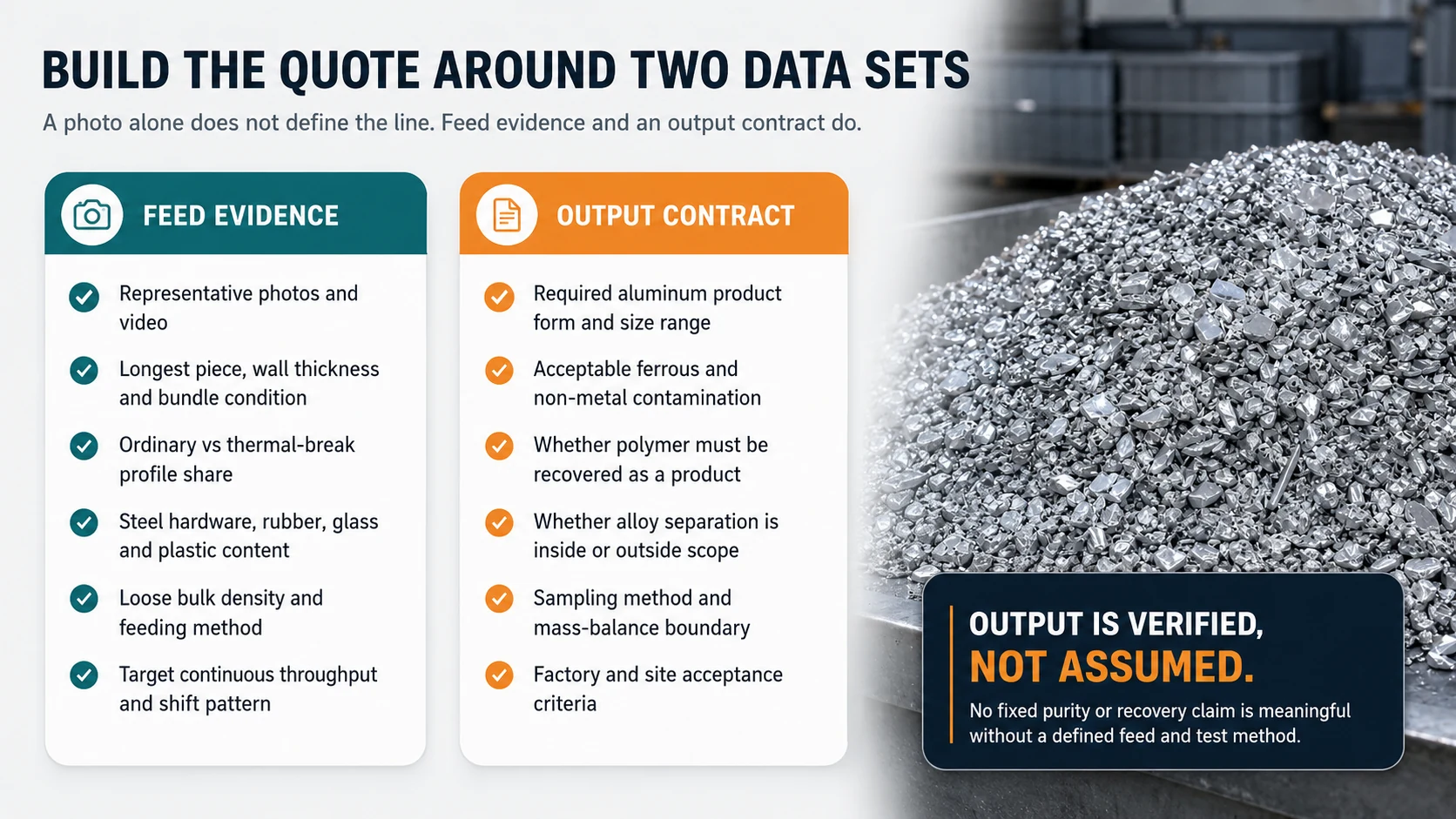
A proposal becomes much more useful when the first message contains engineering data instead of only “How much is the machine?” Send the following:
| Data group | Information to provide | Why it changes the design |
|---|---|---|
| Material evidence | Photos and video from several loads; clean offcuts, frames or thermal-break percentage | Defines the process route and whether the sample is representative |
| Geometry | Longest piece, maximum wall thickness, cross-section examples, loose or bundled condition | Sets hopper, chamber, cutter and feeding requirements |
| Contamination | Steel hardware, rubber, plastic, glass, sealant, dirt, fluids and unknown materials | Defines preparation, liberation, magnetic removal and residue handling |
| Production target | Continuous t/h, shift hours, planned utilization and loading method | Sizes the complete line and identifies the likely bottleneck |
| Output contract | Product form, size range, ferrous and non-metal limits, alloy boundary, sampling method | Determines whether primary reduction is enough or deeper sorting is needed |
| Site conditions | Power supply, workshop dimensions, door height, floor and foundation data, local standards | Controls layout, electrical scope, access and installation boundary |
| Project scope | Machine-only, modular line, controls, dust system, platforms, installation, commissioning and training | Makes supplier quotations comparable |
Get a Profile Recycling Line Proposal
Send representative material photos or video, maximum profile dimensions, ordinary and thermal-break percentages, attached steel and non-metal content, target continuous throughput, required output, power supply and workshop dimensions. YUXI can then separate the project into required modules, optional upgrades and items that should remain outside the equipment scope.
Send Project Details to YUXIAluminum Profile Recycling Line FAQ
What materials can an aluminum profile recycling line process?
A configured line can process clean extrusion offcuts, rejected profiles, window and door frames, painted or anodized profiles, and selected thermal-break profiles. The equipment scope changes with profile length, wall thickness, bundle condition, steel hardware, rubber, glass and polymer content.
Is a thermal-break aluminum recycling line different from a clean extrusion scrap line?
Yes. Clean production offcuts may only need controlled feeding and size reduction. Thermal-break profiles contain an insulating polymer strip and often post-consumer hardware, so they usually require stronger liberation, magnetic removal, classification and a verified metal/non-metal separation stage.
Does every profile project need a hammer mill?
No. A twin-shaft shredder may be sufficient when the goal is volume reduction or when attached contamination is limited. Secondary impact crushing is added when the output specification requires more complete release of plastic strips, gaskets or other attachments.
Why is a magnetic separator installed before an eddy current separator?
The magnet removes ferrous screws, brackets and inserts. An eddy current separator is intended to repel conductive non-ferrous particles from a suitable non-metal stream. Leaving iron in the feed creates a different separation problem and can reduce downstream stability.
Can an eddy current separator separate aluminum alloy grades?
Not by itself. It separates suitable non-ferrous particles from non-metal material; it does not automatically distinguish 6063 extrusion from every other aluminum alloy. Alloy-level sorting may require controlled source separation or additional sensor technology.
What capacity can the line reach?
Capacity must be confirmed from representative material. Long hollow profiles, tightly nested bundles, thermal-break content, target particle size, secondary crushing, recirculation, feeding method and downstream sorting can all change the continuous line rate.
What output should be specified before ordering?
Define the required product form and size range, acceptable ferrous and non-metal content, moisture condition, whether the polymer fraction must be recovered, the alloy boundary, and the sampling and acceptance method.
What data should be sent to YUXI for a proposal?
Send representative photos and video, the longest profile and wall thickness, bundle condition, estimated ordinary and thermal-break percentages, attached steel and non-metal content, bulk density if known, target throughput, working hours, required output, power supply and workshop dimensions.
Engineering References
- U.S. EPA — AP-42 Section 12.8 background document: secondary aluminum pretreatment, sorting, mechanical cleaning and process variation by scrap and product.
- European Aluminium — Sustainability of Aluminium in Buildings: recycling route for coated and thermally broken window profiles.
- European Aluminium — Circularity in modern facades: mechanical separation of plastics and thermal breaks from facade aluminum.
- The Aluminum Association — Extruded Aluminum EPD: treatment and recycling context for extrusion scrap.
- OSHA 29 CFR 1910.212 and OSHA 29 CFR 1910.147: general machine guarding and hazardous-energy control for U.S. facilities.