




 Request Quote



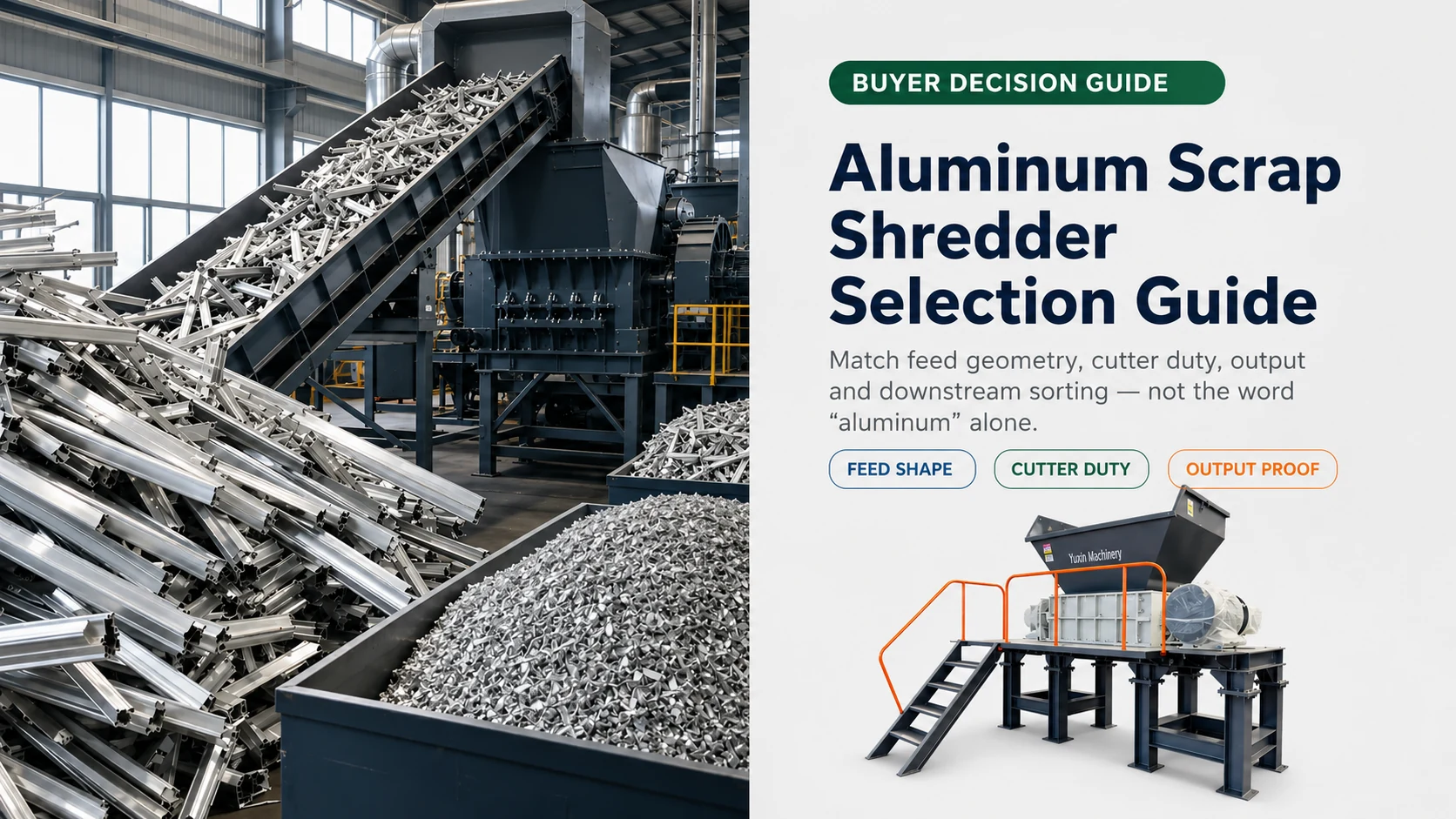
A buyer sends three photographs and writes, “We process aluminum scrap.” That sounds specific. In practice, it is not enough to choose a shredder.
Long window profiles can bridge above a cutting chamber. Thin sheet can fold, spring back or wrap. A compact casting may fit through the same opening yet create a much harder local load. Mixed demolition aluminum adds screws, rubber, plastic, dirt and the occasional object that should never reach the cutters. We have seen otherwise sensible machine comparisons fail because these materials were treated as one duty.
Therefore,before commercialization,the choice problem is mechanical:what is the most difficult duplicate item,how must the machine catch it,what should leave the chamber,and how must the next process handle the output?
First Decide Whether the Aluminum Actually Needs Shredding
Shredding is a means, not the final objective. It should solve a defined handling or separation problem. The published YUXI scrap aluminum recycling line is built around this principle: profiles, mixed scrap, sheet, chips and cast parts do not automatically follow one fixed route.
Start with the saleable product and work backward. A primary shredder makes sense when the plant needs to open nested or bundled material, reduce awkward volume, expose attached steel, stabilize feeding to a second stage or prepare a manageable fraction for screening and sorting. It may be unnecessary when clean material only needs compaction, or insufficient when the downstream process requires fine, controlled liberation.
| Project objective | Likely first decision | Why |
|---|---|---|
| Reduce long or bulky profiles for handling | Primary twin-shaft shredder or shear | The choice depends on whether the goal is irregular opening or controlled cuts. |
| Densify clean sheet for transport or furnace charging | Baler, sometimes shear | There may be no value in creating loose shredded pieces. |
| Release screws, brackets or steel inserts | Primary shredding followed by magnetic separation | Reduction must create enough exposure for the magnet to work. |
| Create a smaller fraction for advanced sorting | Primary shredder plus verified secondary stage | A twin-shaft machine alone normally does not guarantee a narrow final size. |
| Process wet chips or turnings | Drainage, fines control and briquetting review | Loose turnings behave differently from profiles and mixed pieces. |
A useful comparison of complete routes belongs in the separate guide to choosing aluminum recycling equipment. Here, the route is assumed; the question is whether the primary shredder can perform its assigned duty reliably.
Describe the Feed as a Mechanical Load, Not a Scrap Name
In our experience, the most useful RFQ document is rarely a long specification sheet. It is a representative feed record. The record should show what the shafts will actually meet—especially the item that appears regularly and is hardest to grip or cut.
Geometry and presentation
State maximum length, width and height, but also describe section shape. A hollow extrusion, flat panel, coiled strip and ribbed casting can share the same maximum dimension while entering the chamber very differently. Note whether pieces are loose, nested, bundled, flattened, compressed or tangled.
Thickness, unit weight and the hardest recurring item
Average wall thickness can hide the part that controls the selection. A mostly light profile stream may contain heavy corner blocks, steel-reinforced sections or dense cast components. List the maximum recurring wall or section thickness, maximum unit weight and any solid pieces. Do not use a rare accident as the design basis; put it on the prohibited-feed list instead.
Bulk density and feeding behavior
Low-density scrap can fill a hopper and conveyor before it reaches the required mass rate. Long profiles can bridge. Thin sheet can form a roof over the chamber. The feed system, hopper angle, loading method and operator rhythm are therefore part of shredder performance, not separate details.
Attachments and contamination
Record steel fasteners, bearings, thermal-break strips, rubber, glass, dirt, liquids and other non-aluminum content. An attached screw is a liberation problem; an unknown sealed cylinder is a safety exclusion. Those should never be treated as the same category.
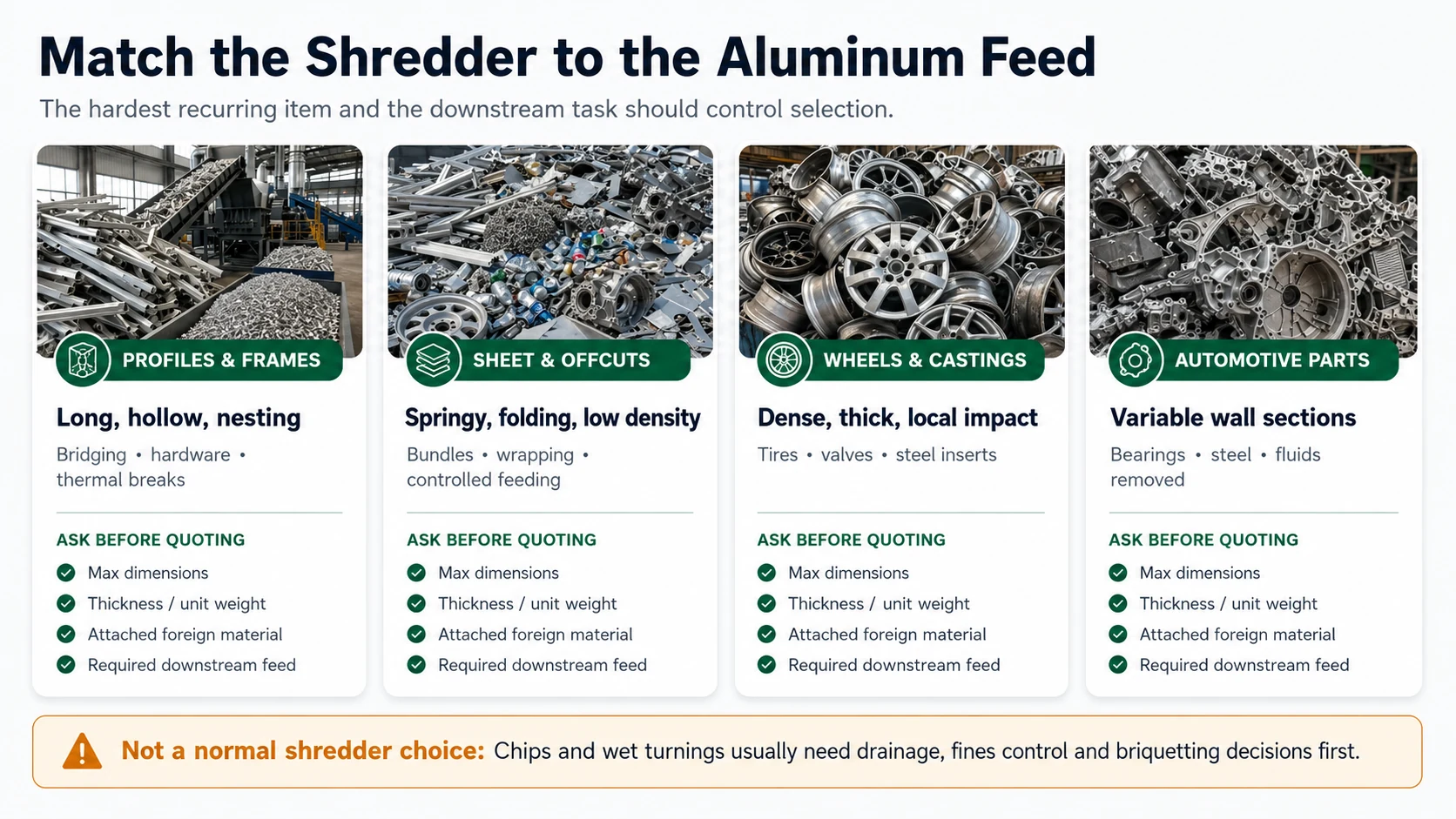
How Common Aluminum Scrap Forms Change the Selection
Profiles, window frames and long extrusions
Profiles are often light by mass but awkward by volume. Long pieces can bridge in a short hopper, while nested frames may enter as a springy bundle. Thermal-break profiles can add plastic strips, screws and brackets that need to be exposed before separation. The selection should focus on chamber length, hopper presentation, hook engagement and whether pre-cutting is required—not simply on total motor power.
One practical test is to load the longest and most hollow recurring bundle in the same orientation the operator will use on site. A test made only with short loose offcuts proves very little about real profile feeding.
Thin sheet, siding and factory offcuts
Thin aluminum looks easy because it is not thick. Surprisingly, it can still be troublesome. Wide sheets fold over the cutters, spring upward or wrap when presented inconsistently. If the objective is only densification, a baler may be simpler. Where shredding is needed to open bundles or prepare sorting, controlled feeding and anti-bridging behavior deserve as much attention as cutter strength.
Wheels and dense castings
Cast parts concentrate load in a small contact area. Wheels can also carry tires, valve assemblies, balancing weights or steel inserts. Pre-treatment rules must be explicit. A chamber large enough to accept a wheel does not prove that the chosen cutter package should process every wheel condition. We normally recommend separating “prepared wheels or castings” from “unknown mixed assemblies” in both the quotation and FAT.
Prepared automotive aluminum parts
Housings, selected body panels and dismantled aluminum assemblies vary widely. Bearings, shafts, steel sleeves and trapped fluids can change both mechanical and safety risk. The feed should be prepared and classified before it is used to specify a downstream aluminum shredder. This is not a complete end-of-life vehicle feeding application.
Mixed aluminum scrap
Mixed scrap creates two design problems: the feed changes over time, and the hardest recurring item may represent only a small percentage. Write the expected composition as a range and define what happens when the mix moves outside it. The acceptance test should include the agreed proportions, not a hand-picked easy batch.
Chips and turnings
Loose turnings can bridge, carry cutting fluid and generate fines. They are not a normal substitute feed for a profile or mixed-scrap rotary shear. Drainage, storage, fire and dust controls, briquetting and the buyer’s final specification should be reviewed before placing a conventional shredder in the route.
Twin-Shaft, Screened Multi-Shaft or Hydraulic: Choose by Duty
The machine label is only a starting point. Different suppliers use “shredder,” “rotary shear” and “crusher” differently, so compare the actual cutting mechanism, speed range, drive response, output control and test evidence.
| Architecture | Typical reason to consider it | Selection caution |
|---|---|---|
| Low-speed twin-shaft rotary shear | Coarse primary reduction of bulky, irregular profiles, offcuts and selected mixed pieces; opening material before magnetic or secondary processing. | Output is irregular. Cutter spacing does not guarantee one final size, and difficult feed still requires a representative test. |
| Screened four-shaft or single-shaft system | Tighter size control on a suitably prepared, consistent feed where recirculation through a screen is acceptable. | A screen can increase residence time, fines, heat and wear. Do not assume it is the best first machine for long, dense or highly contaminated scrap. |
| Hydraulic rotary shear | Specialist heavy or shock-loaded duties where controlled torque response and drive protection justify the architecture. | “Hydraulic” is not a performance guarantee. Require the operating curve, cooling scope, energy boundary and proof on the actual feed. |
| Hammer mill or secondary crusher | Further size reduction and liberation after controlled primary preparation. | It is not interchangeable with a low-speed primary shredder. Dust, wear, feed size and downstream separation must be engineered as a system. |
YUXI publicly presents its metal shredder as a double-shaft, low-speed, high-torque primary machine. For finer liberation, the published equipment family also includes a separate hammer mill metal crusher. That separation of duties is important: asking the primary shredder to produce a fine, uniform fraction can lead to an oversized or poorly matched machine.
Choose the Cutter Package Around First Bite and Repeated Load
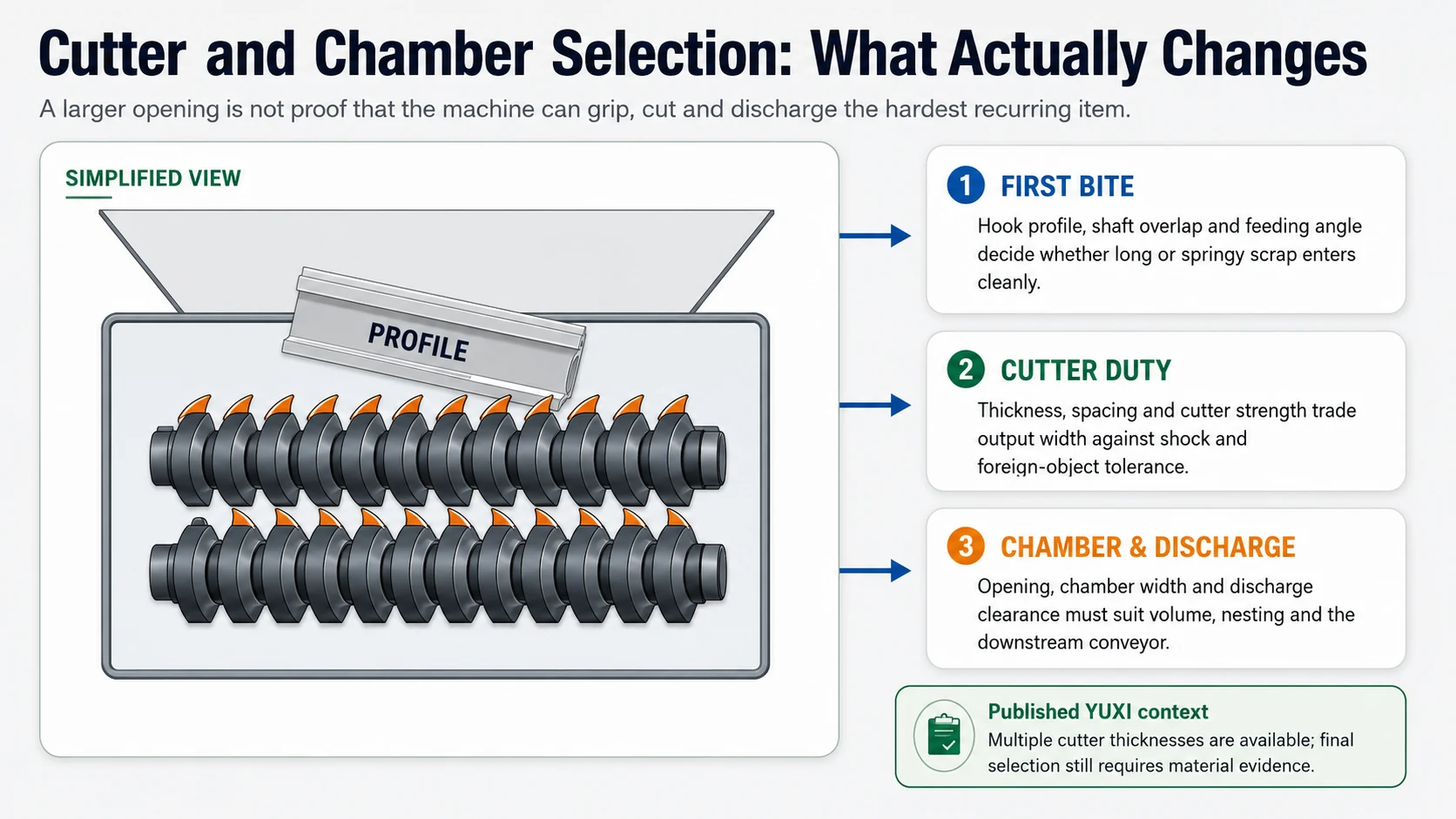
Cutter selection is where a generic buying checklist becomes an engineering decision. The shafts must engage the feed, pull it into the cutting zone, survive recurring local load and discharge an output the next machine can accept.
Cutter thickness is a tradeoff, not a quality score
YUXI’s public product page lists multiple cutter-thickness options from 15 to 100 mm. Thinner cutters can create narrower strips on suitable light scrap; thicker cutters provide a more robust cutting section but generally produce a coarser result. Neither direction is universally better. The choice must be checked against section thickness, hard inclusions, hook profile, spacer arrangement, shaft design and downstream duty.
Hook count and profile control grip
A cutter can be strong and still fail to take the first bite cleanly. Hook geometry and shaft overlap influence whether smooth sheet slips, hollow profiles flatten, or springy bundles are pulled into the chamber. Frequent reversing in a test may be a control feature doing its job—or evidence of overfeeding, poor engagement or a duty mismatch. The event log matters.
Chamber opening describes fit, not capability
Buyers often shortlist machines by hopper and chamber dimensions. Those numbers matter, but they answer only “Can the item enter?” They do not answer “Can the cutter package process it continuously?” A thick casting and a hollow frame may fit through the same opening while imposing very different load.
Material, heat treatment and wear design need separate evidence
Blade steel should be considered with hardness, toughness, heat treatment, repair policy and the expected contaminants. The separate metal shredder blade materials guide covers that subject in more depth. For this selection, ask for documented cutter material, process, wear-part drawing, allowable regrinding and replacement procedure rather than relying on a single alloy name.
Write an Output Duty the Supplier Can Actually Test
“We need 50 mm output” sounds clear, but it may not be a valid promise for a primary twin-shaft shredder without a screen. Tearing creates an irregular distribution. Cutter spacing influences one dimension, while feed shape, fracture path, repeated passes and long strips influence the others.
Instead of writing one nominal size, define:
- the next machine or process receiving the output;
- maximum acceptable oversize and long pieces;
- whether liberated steel must be exposed for a magnet;
- whether a secondary crusher or screen is included;
- the allowable fines fraction and any value loss it creates;
- how the output sample will be measured during the FAT.
Sometimes the right answer is a coarser primary output. It reduces unnecessary recirculation and lets a purpose-built second stage do the liberation work. More size reduction in the first machine is not automatically more efficient.
Make the Shredder Feed the Separation System, Not Fight It
The value of shredding is often measured downstream. If steel screws remain trapped in folded profiles, a magnet cannot recover them reliably. If the output layer is too irregular for stable screening or eddy-current presentation, a large shredder has not solved the complete process problem.
For profiles and mixed pieces, the usual logic is controlled primary opening, magnetic removal after enough liberation, size control where needed and optional non-ferrous sorting according to the product target. An eddy-current separator can recover suitable conductive non-ferrous particles from a non-metal stream; it does not automatically separate one aluminum alloy family from another.
Ask the supplier to show the complete handoff: discharge conveyor width and speed, maximum lump dimensions, transfer height, magnet location, screen opening and any secondary-machine feed limit. These interfaces often reveal more than the shredder’s nameplate.
Do Not Let a Catalog t/h Number Choose the Machine
Throughput changes with bulk density, piece geometry, thickness, feed stability, contamination, output duty, reversals and the slowest downstream stage. A short peak test on easy scrap is not the same as continuous production on the agreed mix. Keep the detailed definitions, bottleneck method and acceptance calculations in the Aluminum Recycling Line Capacity Guide; in this selection, require the shredder claim to state the feed basis, net runtime, output boundary and all interventions.
Review the Machine Through the Maintenance Door
Shredder selection is incomplete until the buyer understands how cutters, spacers, seals and bearings will be inspected and changed. A machine that performs well in a short demonstration can still be expensive to own when access is poor or wear parts are not documented.
YUXI’s published configuration highlights sealed bearing arrangements, overload reversal and a split chamber intended to support service access. During supplier review, turn those features into evidence:
- show the isolation and chamber-opening procedure;
- identify lifting points and the heaviest routine service component;
- provide cutter, spacer and seal drawings with part numbers;
- state the inspection criteria for wear, cracking and shaft movement;
- explain whether cutters can be rotated, rebuilt or reground and under what limits;
- demonstrate how wrapped sheet, trapped wire or unshreddables are removed safely;
- record bearing temperature and reversal events during the material test.
The site also needs room to perform this work. Machine access, lifting routes, maintenance clearances and safe traffic belong in the separate Aluminum Recycling Plant Layout Guide, but they should be checked before the purchase order is finalized.
Use a Representative Factory Acceptance Test
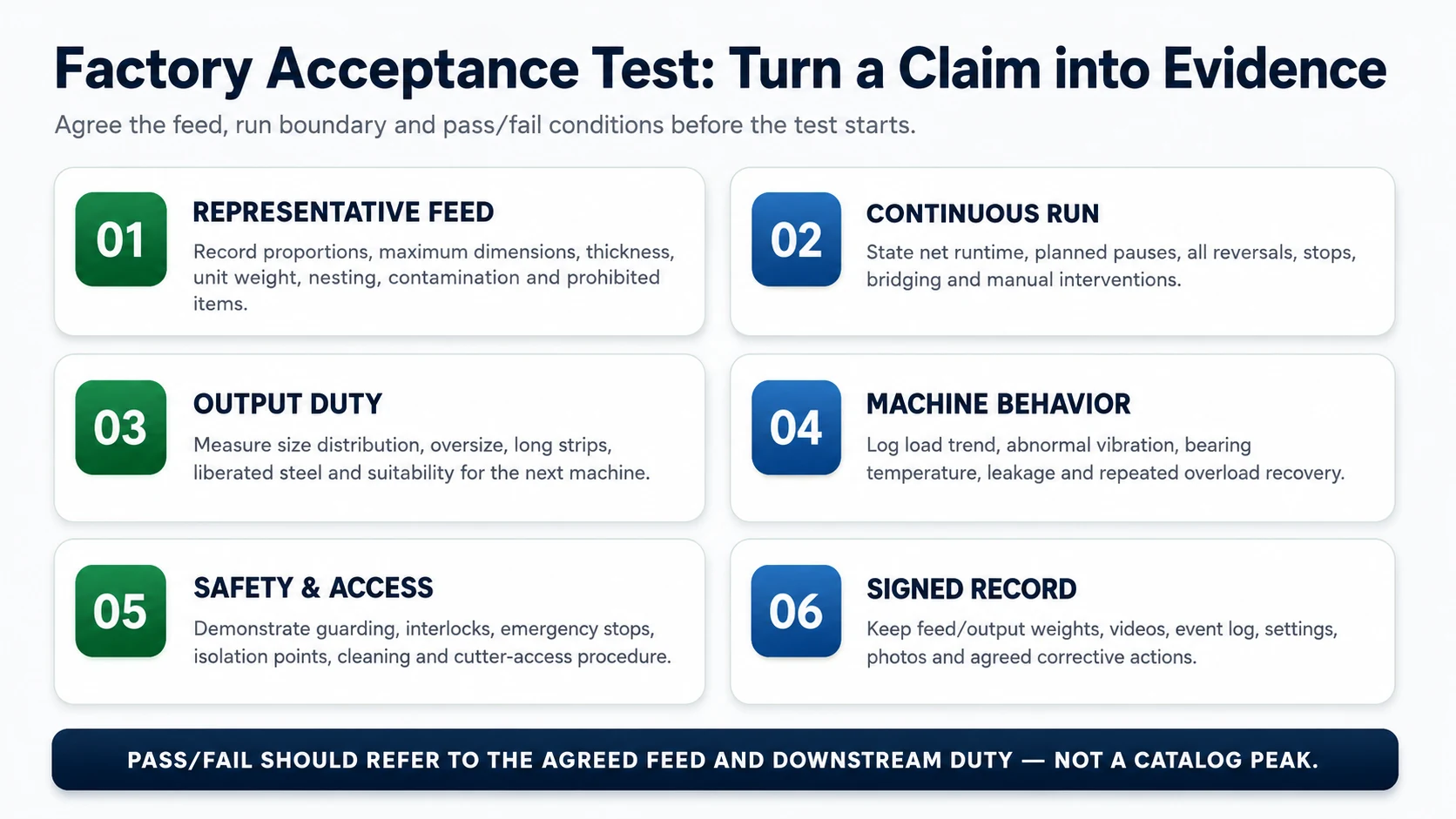
We have found that a good FAT begins before anyone starts the machine. The buyer and supplier agree the feed batch, measurement method, operating boundary and pass/fail criteria in writing. Otherwise, a visually impressive demonstration can answer the wrong question.
| FAT item | Record during the test | Why it matters |
|---|---|---|
| Feed definition | Material percentages, dimensions, thickness, unit weight, bundle condition, attached foreign material and total mass. | Prevents an easy sample from replacing the agreed production mix. |
| Run boundary | Net runtime, feed interruptions, bridging, reversals, stops, manual intervention and restart time. | Separates stable duty from a short peak rate. |
| Machine behavior | Load trend, repeated overloads, vibration, leakage, bearing temperature and unusual noise. | Shows whether the cutter and drive package are comfortable with the duty. |
| Output sample | Size distribution, oversize, long strips, fines, liberated steel and suitability for the next machine. | Connects shredder performance to the actual process objective. |
| Safety functions | Guards, interlocks, emergency stops, isolation points, warning labels and safe clearing procedure. | Confirms that normal and abnormal work can be controlled. |
| Service review | Access, tools, lifting, cutter-change sequence, spare parts and maintenance documents. | Exposes ownership issues that a production run alone will not show. |
One export project can fail at the acceptance stage simply because “output size” means different things to the two parties. Avoid that by keeping labeled feed and output samples, photographs with scale, test video, event logs, settings and a signed action list.
Common Aluminum Shredder Buying Mistakes
Choosing by motor power
Installed power does not describe grip, cutter geometry, reducer duty, chamber fit, feed stability or output. Two machines with similar power can behave very differently on a long hollow profile or a dense casting.
Testing only clean, short offcuts
The machine may look smooth because the difficult geometry and foreign material were removed from the test. Use the hardest recurring feed within the agreed scope.
Assuming every item that fits is acceptable
Hopper dimensions are not a cutting guarantee. Maximum thickness, unit weight, material condition and attachments still need to be defined.
Demanding a fine, exact output from the primary shredder
This often causes unnecessary recirculation or pushes the wrong machine architecture into the project. Define what the next stage actually needs.
Leaving contaminants to the operator
“The operator will remove dangerous items” is not a feed-control system. Inspection, segregation, training, detection and an exclusion procedure must be designed.
Comparing quotations with different boundaries
One quotation may include feeding, discharge, magnet, controls, platforms and dust interfaces; another may include only the shredder body. Normalize installed scope, acceptance evidence and spare-parts policy before comparing price.
Where the YUXI Aluminum Scrap Shredder Fits
Based on YUXI’s public pages, the double-shaft metal shredder is positioned as a low-speed primary machine for bulky light- and medium-duty metal scrap, including aluminum profiles and factory offcuts. Its job is coarse opening and size reduction before optional secondary crushing, magnetic separation, screening or other sorting selected around the feed and final product.
That makes it a logical candidate when the project needs to reduce long or nested profiles, open selected mixed aluminum pieces or prepare a steadier downstream feed. It should not be selected from a universal aluminum tonnage or a single photograph. YUXI’s own project workflow asks for feed dimensions, thickness, density, contamination, target throughput, final product and workshop conditions before configuration.
Prepare a Useful Shredder Selection Request
Send representative photos and video, material percentages, maximum dimensions and thickness, maximum unit weight, bundle or nesting condition, loose bulk density if known, attached steel and non-metal content, prohibited items, target continuous throughput, acceptable output, downstream equipment, working hours, power supply and site limits.
Ask the engineering team to return a proposed feed boundary, cutter and chamber basis, test plan, line interface, safety exclusions, maintenance scope and list of assumptions. That is more useful than a model number without context.
Frequently Asked Questions
What type of shredder is normally used for aluminum profiles and frames?
A low-speed twin-shaft rotary shear is often considered for coarse primary reduction because it can grip and open long, hollow or nested pieces. The final cutter and chamber configuration must be tested against profile length, wall thickness, attached hardware, bundle condition and the required downstream feed.
Can one aluminum shredder process profiles, sheet and castings equally well?
Not at the same settings or performance boundary. Profiles can bridge, sheet can fold and wrap, and castings create concentrated load. A mixed project should be selected around the hardest recurring item and should define how the feed mix may change during the acceptance test.
Does a wider shredder chamber mean it can process thicker aluminum?
No. Chamber opening describes fit and volume, not cutting duty. Thickness, section shape, alloy condition, unit weight, cutter geometry, reducer torque, shaft design and foreign material all influence whether an item can be processed safely.
How small will a twin-shaft aluminum shredder make the material?
A primary twin-shaft shredder usually generates irregular coarse pieces instead of one exact screened size. Cutter spacing influences strip width, but feed shape, tearing path and repeat passes also affect length. A screen or secondary crusher may be required when the next process needs a controlled size range.
Should clean aluminum sheet be shredded or baled?
That depends on the sales and process objective. Clean sheet that only needs densification may be better suited to baling or shearing. Shredding becomes useful when opening bundles, reducing awkward volume, releasing attachments or preparing a more stable feed for separation.
Can an aluminum shredder separate steel from aluminum?
The shredder can expose or liberate attached steel, but it does not perform the final separation by itself. A downstream magnet is normally used for liberated ferrous material, with screening or other separation selected around the required product.
What should be included in an aluminum shredder FAT?
Use a representative feed mix and record its dimensions, thickness, unit weight and contamination. Agree net runtime, reversals, stops, manual interventions, output distribution, liberated foreign material, machine load behavior, safety checks and pass/fail criteria before the test.
What information should I send YUXI before asking for a shredder recommendation?
Send clear photos and video, material percentages, maximum dimensions and thickness, unit weight, loose bulk density if known, bundle or nesting condition, attached steel and non-metal content, prohibited items, target continuous throughput, required output, downstream equipment, working hours, power supply and site constraints.
Authority and Product Sources
- U.S. Occupational Safety and Health Administration, Guidance for the Identification and Control of Safety and Health Hazards in Metal Scrap Recycling.
- U.S. Occupational Safety and Health Administration, Combustible Dust.
- National Fire Protection Association, NFPA 660: Standard for Combustible Dusts and Particulate Solids.