




 Request Quote



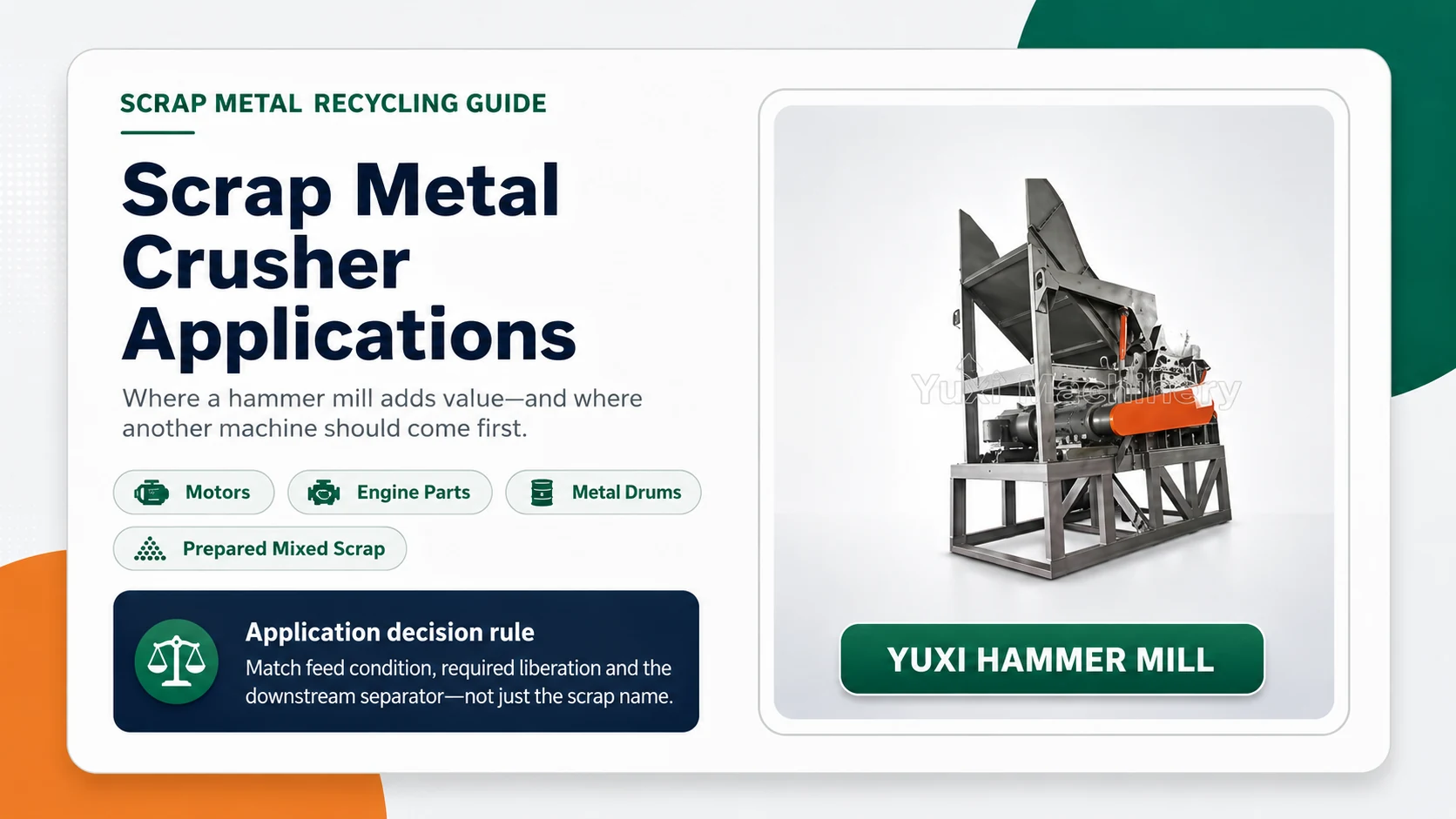
Quick Answer: What Are Scrap Metal Crusher Applications?
Scrap metal crusher applications are recycling jobs in which prepared metal or metal-bearing assemblies need impact-based size reduction, stronger material liberation or higher bulk density before sorting, handling or remelting preparation.
Typical feed categories include prepared electric motors, engine components, cleaned metal drums, selected aluminum scrap, dismantled appliance fractions and pre-shredded mixed metal. A hammer mill is most useful when the material has already been made safe and reasonably predictable, but the downstream process still needs smaller, more open and more uniform fragments.
A Crusher Application Is Defined by the Job, Not Just the Scrap Name
“Motor,” “drum” or “aluminum scrap” is not enough information to select a machine. Two loads with the same name can behave very differently. A small dismantled motor and a large motor with a long shaft create different impact loads. An empty, opened steel drum is not the same feed as a sealed drum with unknown residue. Loose aluminum profiles behave differently from dense castings.
A practical application therefore has four parts:
1. Feed condition
Maximum dimensions, thickness, hardness, geometry, moisture, contamination and the presence of shafts, bearings, cables or dense inclusions.
2. Upstream preparation
Inspection, depollution, draining, dismantling, cutting, shearing or primary shredding needed before the material reaches the hammer mill.
3. Output objective
Smaller size, higher bulk density, exposed copper or aluminum, a narrower particle range, easier conveying or better preparation for furnace charging.
4. Downstream process
Magnetic separation, eddy current separation, screening, air classification, manual quality control, storage, baling or remelting preparation.
The detailed rotor, hammer and discharge cycle belongs in YUXI’s Hammer Mill Working Principle guide. For application selection, the more important point is that repeated impact must produce an output that the next machine can use.
Core Scrap Metal Crusher Applications
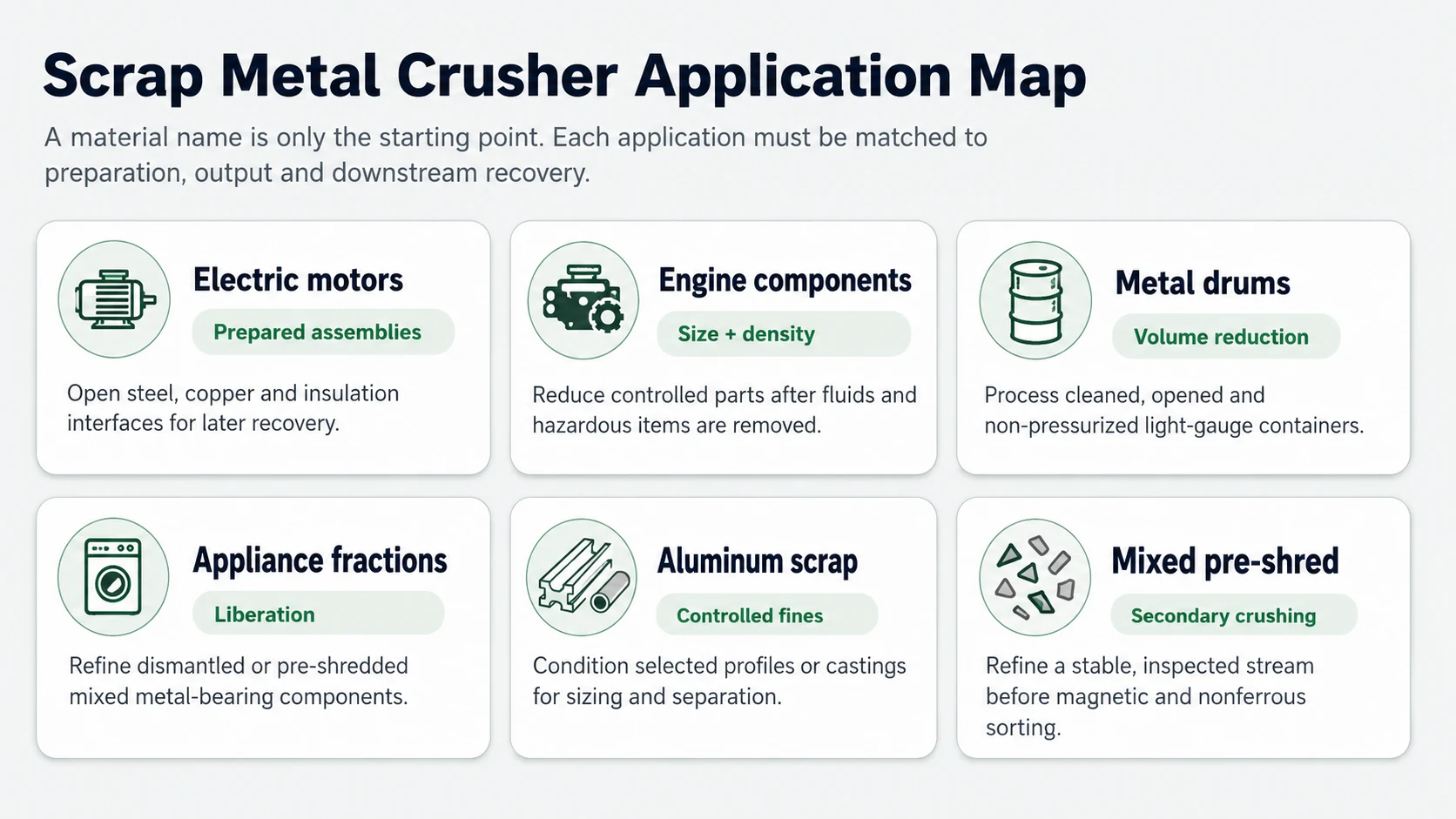
1. Electric motors, stators and rotor-bearing assemblies
Electric motors combine ferrous housings, copper windings, aluminum, insulation, bearings and shafts. The application is not simply to “make the motor smaller.” The more useful objective is to open the assembly so that connected materials can be recovered in later stages.
Suitability depends on motor size, casing material, shaft geometry and the level of dismantling already completed. Large shafts or unusually dense parts may need separate handling. Smaller and more consistent assemblies can be better candidates for controlled impact crushing, followed by magnetic and nonferrous recovery. For a complete process context, see YUXI’s Motor Rotor Recycling Line.
Application goal: liberation of copper-bearing and ferrous fractions, not a guaranteed final copper purity from the crusher alone.
2. Prepared engine and gearbox components
Engine and gearbox scrap may contain cast iron, steel, aluminum, shafts, bearings, residual oil and attached non-metal parts. Impact crushing can be useful after the components have been inspected, drained and reduced to a feed condition the chamber can accept.
This application normally prioritizes size reduction and exposure of mixed metals. It should not be treated as direct processing of an untreated vehicle. Whole end-of-life vehicles follow a broader sequence that includes depollution, dismantling and primary reduction; YUXI’s Waste Car Recycling Line provides that wider process context.
Application goal: create smaller, denser and more separable fragments from already prepared automotive components.
3. Metal drums, pails and light-gauge containers
Drums and pails are bulky relative to their metal weight. Once they have been correctly identified, emptied, cleaned, opened and confirmed non-pressurized, crushing can reduce empty volume and prepare the steel for magnetic recovery or further handling.
The previous contents matter more than the drum’s appearance. Containers related to fuel, solvents, chemicals or unknown residues require acceptance and decontamination procedures. The crusher cannot replace the control of hazardous materials.
Application goal: reduce the volume and create manageable light-ferrous parts without introducing pressure or residue hazards.
4. Dismantled appliance and white-goods fractions
Refrigerators, washing machines and other appliances combine steel shells with motors, wiring, plastics, foam and other materials. The hammer mill application begins after required depollution and dismantling—not when a complete appliance with hazardous components is pushed into a crusher.
Prepared appliance fractions may be impact-crushed to expose connections and reduce fragment size before magnets, nonferrous sorting or screens. The value lies in improving the physical condition of the mixed stream, while actual material separation remains a downstream task.
Application goal: improve liberation and sorting readiness of prepared mixed appliance material.
5. Selected aluminum profiles, sheet and cast components
Aluminum applications need careful output control. Excessive fines can make handling and separation more difficult, while insufficient breakage can leave iron attachments and mixed-material connections intact. The best setup therefore works backward from the required aluminum fraction and the downstream separator.
Profiles, thin sheet and cast pieces can have very different impact behavior. Alloy segregation, attached steel, coatings, moisture and the desired particle range should be confirmed through sample testing rather than assumed from the word “aluminum.”
Application goal: condition selected aluminum scrap for sizing, iron removal and further nonferrous recovery.
6. Pre-shredded mixed ferrous and nonferrous scrap
This is one of the clearest hammer mill applications. A low-speed shredder or shear first turns bulky and irregular scrap into a controlled stream. The hammer mill then performs deeper size reduction and liberation before magnets, screens and nonferrous recovery equipment.
The arrangement is especially useful when primary shredding has solved the feeding problem but has not created enough material exposure for the sorting target. A downstream Eddy Current Separator may then recover conductive nonferrous metals from a suitable, correctly prepared fraction.
Application goal: secondary refinement between rough size reduction and precision separation.
Application Matrix: Feed, Preparation and Output
| Application | Typical upstream preparation | Why use the crusher | Likely downstream stage | Critical exclusion or question |
|---|---|---|---|---|
| Electric motors | Inspection, optional dismantling, shaft and size control | Open assemblies and expose copper-bearing interfaces | Magnet, screen, nonferrous sorting, manual QC | Large shafts, dense castings, batteries or attached hazardous parts |
| Engine parts | Drain fluids, remove prohibited components, control dimensions | Reduce size and expose mixed metal connections | Magnetic separation, screening, alloy or nonferrous sorting | Residual oil, filters, pressurized items and oversized dense pieces |
| Metal drums | Identify contents, empty, clean, open and confirm non-pressurized | Reduce empty volume and condition light steel | Magnet, storage, baling or furnace preparation | Unknown residues, sealed drums or flammable contamination |
| Appliance fractions | Depollution, dismantling and primary reduction where needed | Improve liberation and create a sortable mixed stream | Magnet, eddy current, screen, air or manual sorting | Refrigerants, compressors, batteries and untreated complete units |
| Aluminum scrap | Remove obvious iron, sort feed categories, control size | Create a usable particle range and expose attachments | Magnetic removal, eddy current, screening or alloy sorting | Fines limit, alloy mixing, dense castings and long profiles |
| Pre-shredded mixed scrap | Primary shredding, inspection and removal of unbreakables | Secondary reduction and stronger material exposure | Magnet, nonferrous sorting, screens and final QC | Feed variability, tramp metal, moisture and unstable fragment size |
Where the Hammer Mill Fits in a Metal Recycling Line
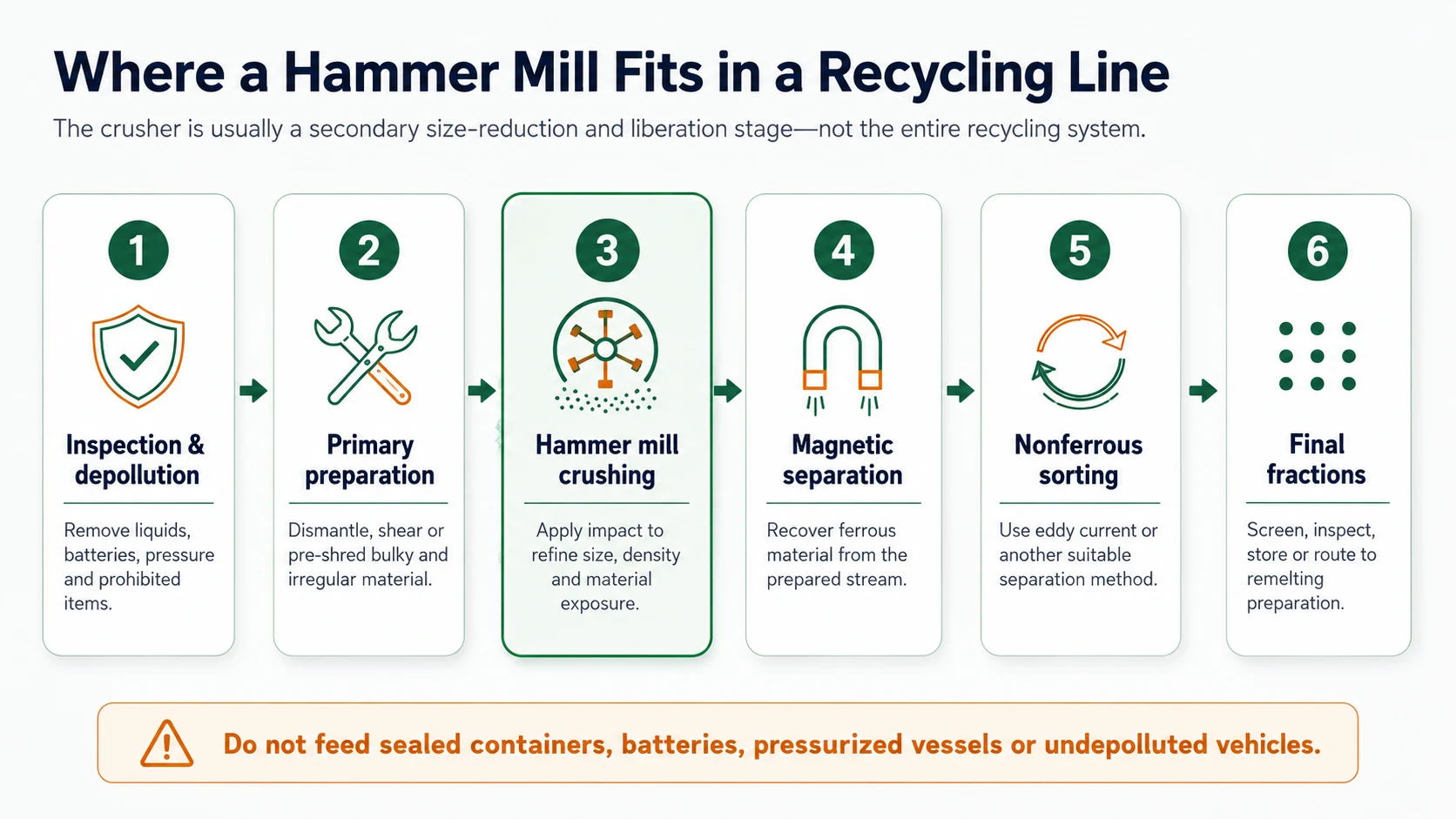
A stand-alone crusher can be useful for a narrow and well-controlled feed, but many industrial applications need a complete line. The upstream section protects the crusher from unsuitable material and creates a predictable feed. The downstream section converts crushed material into saleable fractions.
Upstream responsibilities
- Inspect incoming loads and reject prohibited or unknown items.
- Remove liquids, batteries, pressure, explosive risk and hazardous components.
- Dismantle or shear dense assemblies that exceed the intended duty.
- Use primary shredding when bulky, hollow or tangled scrap cannot be fed consistently.
- Meter material so the crusher receives a stable load rather than sudden surges.
Downstream responsibilities
- Recover ferrous material with a correctly selected magnetic system.
- Classify particle size before precision sorting where necessary.
- Recover nonferrous metals with technology matched to size and composition.
- Remove light fractions, dust or contamination through appropriate systems.
- Inspect product quality before storage, sale or remelting preparation.
Crusher, Shredder, Shear or Baler: Which Application Matches?
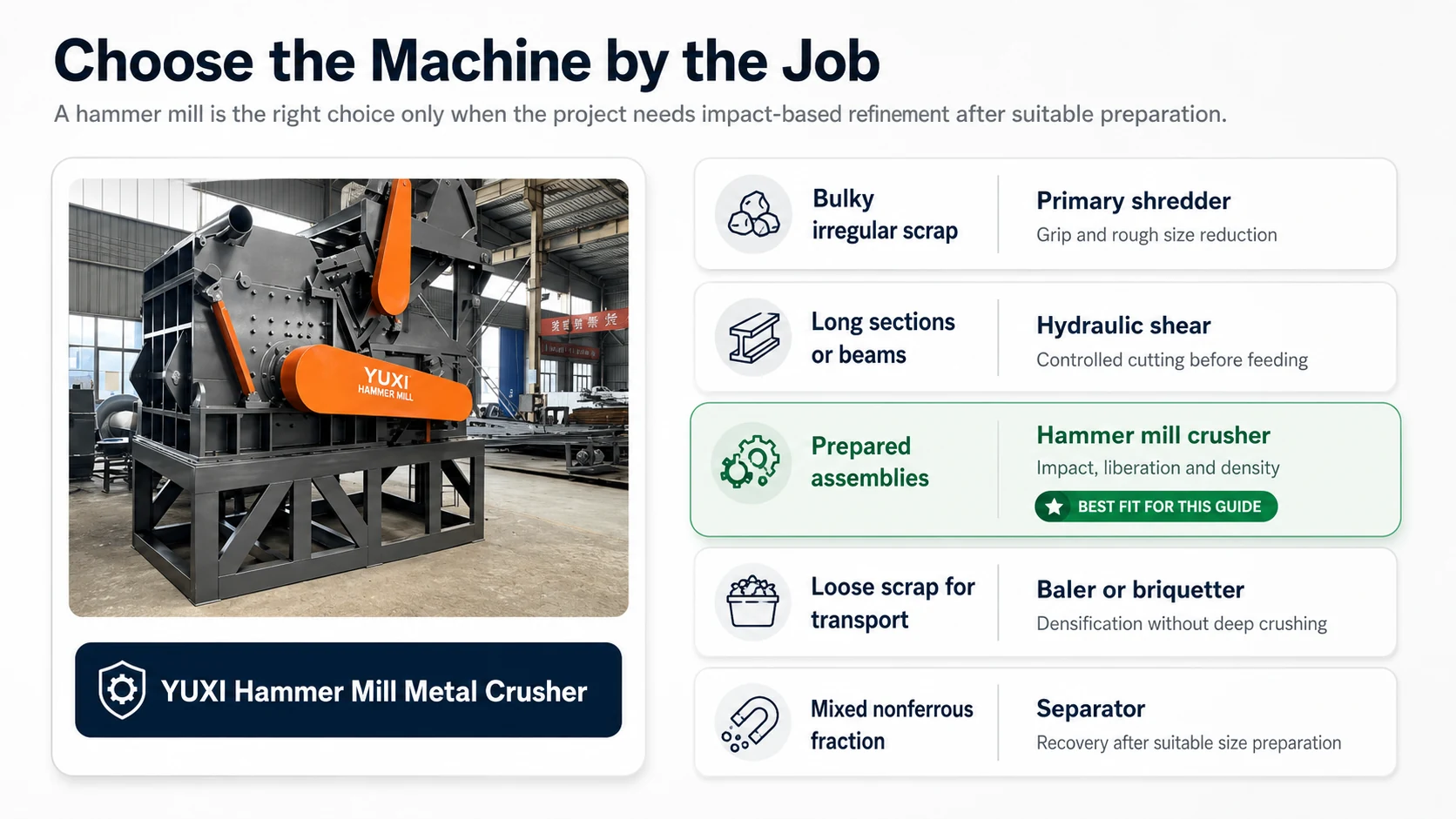
| Processing problem | Most likely first choice | Reason |
|---|---|---|
| Bulky, hollow or irregular scrap will not feed consistently | Primary metal shredder | Low-speed gripping and shearing create a more controllable stream. |
| Long beams, pipes or oversized sections need controlled reduction | Hydraulic shear | Cutting can create a defined feed length without unnecessary impact crushing. |
| Prepared scrap needs smaller size and stronger liberation | Hammer mill metal crusher | Repeated impact opens assemblies and refines fragments for later recovery. |
| Loose scrap only needs transport or furnace-charge density | Metal baler or briquetter | Compression may solve the logistics problem without deep size reduction. |
| Material is already sized but metals remain mixed | Separation equipment | The bottleneck may be identification and sorting rather than crushing. |
For a deeper comparison of the first two size-reduction stages, use YUXI’s Metal Shredder vs Hammer Mill Crusher guide.
Applications That Need Another Route First
A broad application list can create the dangerous impression that every metal object is acceptable feed. The following categories require rejection, separate treatment or engineering review before any hammer mill recommendation:
Undepolluted vehicles
Before crushing or shredding, remove fuel, oils, batteries, airbags, refrigerants and other hazardous components in accordance with applicable requirements.
Sealed or pressurized containers
Gas cylinders, containers, sealed drums and pressure vessels may cause explosion, fire and projectile hazards.
Unknown mixed loads
Unverified scrap can contain hard tramp pieces, batteries, chemicals, radioactive sources or items outside the machine duty.
Very heavy structural scrap
Thick plate, large castings and long structural sections may need shearing, torch cutting or a different primary process.
Long entangling materials
Wire rope, long cable, chains and thin strips can wrap or feed unpredictably unless prepared for the specific design.
Fine metal chips with special hazards
Dust, oil and reactive metal risks may require dedicated briquetting, filtration, dust collection or explosion-protection engineering rather than a general scrap crusher.
How the YUXI Hammer Mill Metal Crusher Fits These Applications
YUXI’s official Hammer Mill Metal Crusher page positions the machine for scrap-metal processing through hammering, tearing and shearing actions. The published examples show car engines, electric motors and metallic drums, while the listed user groups include steel plants, smelters, foundries, scrap recycling stations, metal-processing plants and automobile manufacturers.
The page also describes a selectable screen or mesh arrangement for output control, a safety-door concept for removing unbreakable objects and PLC with hydraulic control. These features support application engineering, but they do not remove the need to verify feed limits, installed configuration, capacity and output through an official quotation and material test.
Safety and Environmental Checkpoints
Scrap processing combines moving machinery, sharp material, flying fragments, stored energy, noise, dust and unknown contamination. Application selection must therefore include operating controls—not just production goals.
- Machine guarding: OSHA’s 29 CFR 1910.212 requires guarding methods to protect workers from operating point hazards, rotating parts, entering bite points, cracks and sparks.
- Hazardous energy: cleaning, jam removal and maintenance require an energy-control procedure consistent with OSHA’s lockout/tagout guidance.
- Scrap-yard hazards: OSHA’s metal scrap recycling guidance addresses machinery, hazardous materials, lifting, cutting and other risks across scrap operations.
- Vehicle depollution: UK Environment Agency guidance states that end-of-life vehicles must be fully depolluted before crushing, baling or shredding; the same principle should be built into any ELV application review.
- Noise control: NIOSH’s recycling-worker hearing-loss guidance highlights hazardous noise in e-waste, scrap and other recycling activities and prioritizes engineering and administrative controls.
- Environmental handling: oil, residues, dust and stormwater exposure should be managed under the site’s permits and local waste rules. EPA’s scrap recycling stormwater fact sheet identifies common pollutant sources and control considerations.
Application-Driven RFQ Checklist
A useful quotation starts with the material and the required process result. Send the following information before asking for a model:
| Information to provide | Why it changes the recommendation |
|---|---|
| Material photos, video and composition | Shows geometry, mixed materials, attachment points and obvious contamination. |
| Largest dimensions and estimated thickness | Determines whether cutting, dismantling or primary shredding is required. |
| Previous contents and hazardous components | Defines depollution, cleaning, rejection and safety procedures. |
| Hourly throughput target and operating hours | Supports line balancing rather than selecting the crusher in isolation. |
| Required output and acceptable fines | Influences chamber, hammer, screen and downstream classification choices. |
| Upstream and downstream equipment | Confirms whether the crusher is the first stage, second stage or unnecessary. |
| Power, workshop, foundation and dust-control conditions | Defines the installed project scope beyond the machine body. |
| Representative sample availability | Allows testing of feed behavior, output condition and separation response. |
Define the Application Before Selecting the Crusher
Send YUXI the material, maximum dimensions, preparation method, capacity target, desired output and downstream recovery plan. Then the engineering team can determine whether the project needs a hammer mill crusher, primary shredder, hydraulic shear, baler, separator or a combined recycling line.
FAQ: Scrap Metal Crusher Applications
What are the main scrap metal crusher applications?
Typical applications include prepared electric motors, engine components, cleaned metal drums, selected aluminum scrap, dismantled appliance fractions and pre-shredded mixed metal. Final suitability depends on dimensions, thickness, contamination, required output and downstream separation.
Is a hammer mill suitable for whole car bodies?
A whole end-of-life vehicle should not be treated as a general direct-feed item. Vehicles must be contaminated and dismantled as required, and bulky shells usually need to be preliminarily prepared before secondary impact crushing.
Can the scrap metal crusher separate copper from steel by itself?
The crusher mainly reduces size and helps expose connected materials. Actual recovery normally requires downstream equipment such as magnets, eddy current separators, screens, air systems or other sorting technologies.
When should a shredder be used before a hammer mill?
A primary shredder is commonly used when the feed is bulky, hollow, tangled or too irregular for controlled impact crushing. The shredder creates a more predictable stream for the hammer mill.
Can sealed drums be fed into a metal crusher?
No sealed, pressurized or residue-containing container should be treated as ordinary feed. It must be identified, emptied, cleaned, opened and approved under the site’s safety and environmental procedures before processing.
What information is needed for YUXI application selection?
Provide material photos or video, composition, maximum dimensions and thickness, previous contents or contamination, hourly target, required output, upstream preparation, downstream equipment, power supply and workshop constraints.
Authoritative References
- OSHA: Guidance for the Identification and Control of Safety and Health Hazards in Metal Scrap Recycling.
- OSHA 29 CFR 1910.212: General Requirements for All Machines.
- OSHA: Control of Hazardous Energy / Lockout-Tagout.
- NIOSH: Reducing Hearing Loss in Recycling Workers.
- UK Environment Agency: End-of-life vehicles appropriate measures for permitted facilities.
- U.S. EPA: Industrial Stormwater Fact Sheet Series, Sector N Scrap Recycling and Waste Recycling Facilities.