




 Request Quote



What “Top Hammer Mill Manufacturers” Means in This Guide
The term “hammer mill” covers animal feed,biomass,minerals,food,chemicals and recycling equipment.This guide narrows down the topic to industrial machines that use repeated high-speed shocks to process ferrous and non-ferrous scrap.
This distinction is important because mills designed to grind grains cannot be compared with scrap metal hammer crushers built around heavy rotors,swing hammers,wear-resistant liners,discharge grates or screens and systems that handle vibrations,dust,noise and uncrushable objects.Buyers who search for top hammer mill manufacturers usually need more than a list of brand names.They need to know which suppliers serve small refining applications,which suppliers manufacture automotive shredders,which suppliers integrate sorting lines,and which suppliers can support international installation.
The metal recycling hammer mill is usually placed after the controlled feeding,and for large materials,it is placed behind the main shredder. It uses repeated impact to reduce and densify prepared scrap, expose joined materials and create a more sortable fraction. For a detailed explanation of the machine itself, see YUXI’s guide to what a hammer mill metal crusher is. The operating sequence is covered separately in the hammer mill working principle guide.
The value of the machine is therefore tied to the saleable output, not only the hourly feed rate.The Bureau of International Recycling has noted the resource conservation related to the recycling of steel,and its non-ferrous metal guide records the energy advantages of recycling aluminum.The World Steel Association describes steel as a highly recyclable material.These circular economy benefits depend on whether processors can recycle materials with useful quality and consistency,not just break them down into smaller pieces.
How We Selected These Hammer Mill Manufacturers
The shortlist was built from public manufacturer pages available in July 2026. Inclusion required a visible connection to metal recycling and enough published information to identify the supplier’s likely market position. We did not score private sales, installed base, revenue or global market share because comparable verified data are not publicly available across all ten companies.
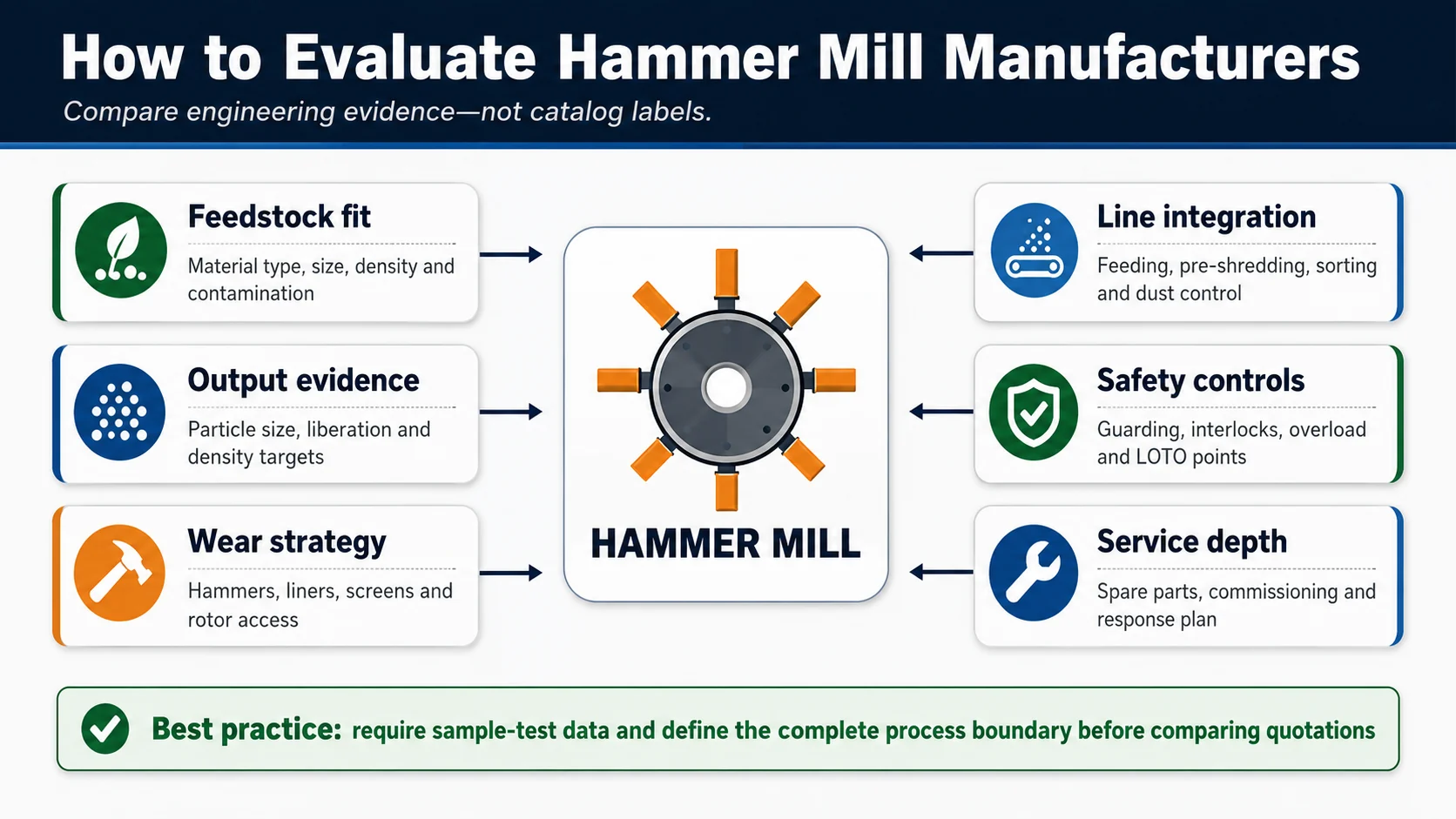
Metal-recycling focus
The supplier publicly presents hammer mills, hammermill shredders or impact mills for ferrous, non-ferrous, vehicle, appliance, motor, WEEE or mixed-metal applications.
Engineering scope
The public range shows whether the company sells a compact standalone mill, a heavy shredder plant, a refining system or a complete line with separation.
Buyer-verifiable evidence
Useful supplier pages describe components, access, materials, output goals, process integration or service rather than relying only on generic claims.
The resulting list is intentionally diverse. It includes established heavy-shredder specialists, European modular-recycling suppliers and internationally marketed Chinese equipment providers. That diversity is useful because “best” changes with plant scale, feedstock, local service expectations and budget.
Top Hammer Mill Manufacturers: Quick Comparison
| Manufacturer | Publicly Emphasized Position | Likely Best Fit | Important Buyer Check |
|---|---|---|---|
| YUXI Machinery | Hammer mill metal crusher plus shredding and separation equipment | Buyers seeking a configurable machine or complete metal-recycling line | Test the actual scrap and confirm every included upstream/downstream module |
| WENDT Corporation | Heavy hammermill shredders for clean, high-density scrap | North American automotive and high-volume scrap processors | Installed power, emission controls, foundations and long-term operating cost |
| LINDEMANN | Large metal shredders, crushers, shears and processing systems | Heavy-duty, large-scale and automotive shredding projects | Local project support, complete scope and lifecycle service |
| Zato | Blue Shark hammer mills integrated with pre-shredding and sorting | Processors wanting modular Italian systems and compact options | Match the selected mill to feed preparation and sorter configuration |
| Panizzolo Recycling Systems | Mobile, stationary, industry and refining hammer-mill families | Plants valuing modularity, refining and flexible expansion | Clarify the exact series, End-of-Waste target and required pre-treatment |
| FOR REC | Z-series mills with hydraulic access and customizable hammers | Metal, motors, aluminum, WEEE and mixed recycling applications | Confirm wear-part configuration, vibration control and service access |
| Stokkermill | HM refining and shredding mills across compact and industrial duties | Small-to-medium refinement through heavier continuous lines | Separate nominal motor range from guaranteed throughput on your material |
| ENERPAT | Internationally marketed scrap-metal mills for motors, appliances and autos | Buyers comparing packaged solutions with published capacity ranges | Verify model-specific references, certification scope and local support |
| GME Recycling | MAX 1700 heavy-duty mill for aluminum and metal scrap | Defined heavy aluminum, casting, rim and engine-block applications | Check feed envelope, wear rate, foundation loads and downstream separation |
| Sure Origin | Custom scrap-metal hammer mills and broader recycling-line equipment | Cost-conscious buyers seeking configurable Chinese equipment | Contractualize test method, component brands, documentation and spare parts |
10 Hammer Mill Manufacturers Worth Comparing
1. YUXI Machinery — Configurable Metal-Recycling Systems
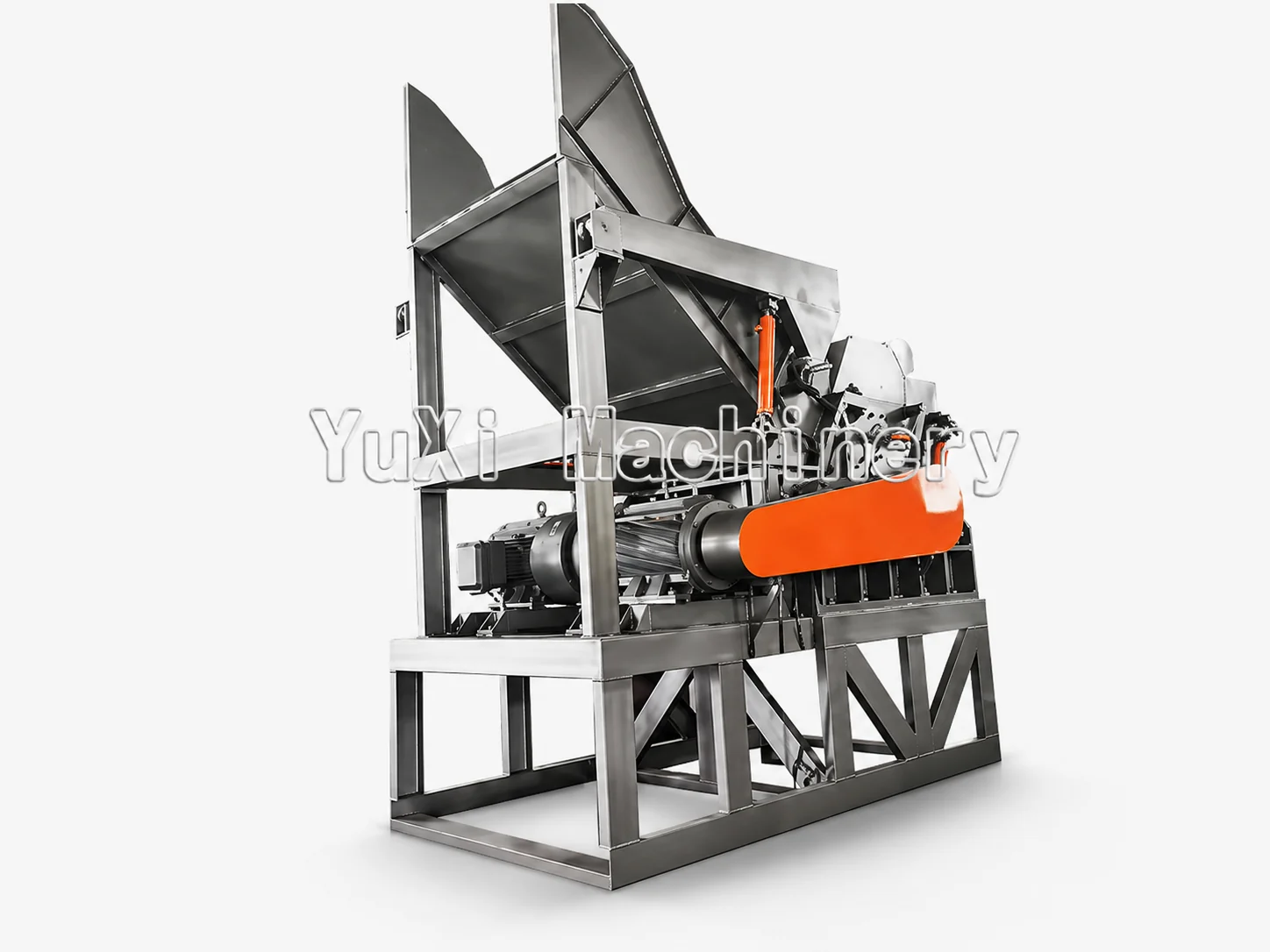
YUXI’s public hammer mill metal crusher page positions the machine for scrap-metal processing through hammering, tearing and shearing. It lists applications that include steel plants, foundries, scrap-recycling stations, metal processors, aluminum-product factories and automobile manufacturers. The page also describes selectable discharge-screen sizing, PLC and hydraulic control, and a safety door for removing unbreakable objects.
YUXI is particularly relevant when the buyer needs more than the mill body. The same website presents double-shaft metal shredders, conveyors, magnetic and eddy-current separation equipment, and complete vehicle, appliance and aluminum recycling solutions. This makes YUXI a practical candidate for projects where the primary shredder, secondary hammer crushing and downstream recovery must be configured as one process.
Best suited to: Global buyers seek tailor-made independent crushers or complete production lines,especially large chunks of scrap that must be pre-chopped before high-speed impact crushing.
Pre-order verification: Representative material test results, actual continuous throughput, output-size distribution, wear-part life assumption, dust removal range, electrical standards, installation responsibilities and an exact list of included separation equipment.
2. WENDT Corporation — Heavy Hammermill Shredder Plants
WENDT’s official hammermill page focuses on HEAVY shredders designed to produce clean, high-density scrap while controlling energy use and cost per ton. The company markets a range aimed at demanding North American scrap and automotive processing operations, where the hammermill is the central machine in a large shredder plant rather than a small secondary crusher.
WENDT should be considered when project scale, emissions control, downstream recovery and plant-wide operating economics matter more than purchasing a compact standalone mill. Its public positioning emphasizes durability, serviceability and engineered plant performance.
Best suited to: Medium-to-large scrap processors, automotive shredder operators and buyers requiring a North American plant integrator.
Verify before ordering: Feed preparation, installed horsepower, foundation and utility loads, air-cleaning scope, non-ferrous recovery targets, operating staffing and the availability of regional service personnel.
3. LINDEMANN — Large-Scale Metal Shredding Heritage
LINDEMANN publicly offers metal shredders, crushers, shears, balers and briquetters and traces its early scrap-crushing development to hammer-mill and automotive-shredder work. Today its market position is strongest in large industrial metal-processing systems rather than low-cost compact mills.
The company belongs on a serious shortlist for high-capacity vehicle or mixed-ferrous plants where the machine, downstream separation, wear parts and lifecycle support must be evaluated together. The brand’s long metal recycling history is relevant, but buyers still need project-specific guarantees,because even verified platforms will perform differently with changes in feed density,pollution and preparation.
Best suited to: Large scrap yards, automobile shredding plants and operators that give priority to the support of established heavy-equipment.
Pre-order vertification: What kind of LINDEMANN shredder or crusher architecture,performance conditions,local service coverage,spare parts delivery time,and interface with the separation and residue treatment system.
4. Zato — Blue Shark Mills with Pre-Shredding and Sorting
Zato’s official pages present Blue Shark hammer mills for ferrous and non-ferrous scrap and emphasize integration with Blue Devil pre-shredders and Blue Sorter downstream systems. The company offers several mill sizes, including compact configurations, which gives buyers more flexibility than a single-model supplier.
Zato is attractive where the processor wants a coordinated Italian system and expects to expand from size reduction into cleaner sorted fractions. The public product pages emphasize access, compactness, plant integration and operating efficiency.
Best suited to: Scrap processors that need a modular shredder–hammer mill–sorting route and value compact or relocatable configurations.
Verify before ordering: Whether the selected mill requires a Zato pre-shredder, what feed envelope is guaranteed, which sorter modules are needed, and how the supplier measures product yield and quality.
5. Panizzolo Recycling Systems — Broad Hammer-Mill Families
Panizzolo’s official website presents one of the broadest visible metal-recycling hammer-mill portfolios in this group: Mega stationary mills, Flex stationary mills, mobile mills, Industry mills, Compakt mills and pre-refining mills. Its positioning centers on modular plants, metal-scrap grinding, refining and flexible expansion.
This breadth helps buyers choose between a mobile unit, a fixed production system and a deeper refining route. It also creates a responsibility to define the project precisely: an initial size-reduction mill and a refining mill are not purchased for the same feed or output objective.
Best suited to: European and international recyclers seeking modular systems, mobile processing or staged refining of mixed metal scrap.
Verify before ordering: The exact series and process duty, required pre-shredding, guaranteed output specification, automation package, energy conditions and the buyer’s local End-of-Waste or product-quality requirement.
6. FOR REC — Accessible, Customizable Z-Series Hammer Mills
FOR REC presents Z14, Z15 and Z16 hammer mills for aluminum, iron, motors, WEEE, electronic waste and other heterogeneous materials. The manufacturer’s public page highlights hydraulic top opening for rapid access to wear components, customizable hammer type, thickness and number, and vibration dampers on the support structure.
These details are useful because maintenance access and vibration control have a greater impact on long-term uptime than the headline motor rating.FOR REC also provides shredders,granulators,conveyors and complete recycling plants,so it can be evaluated as a system supplier.
Best suited to: Give priority to buyers who maintain accessibility and need to integrate the hammer crusher into a wider recycling line.
Verify before ordering: Hammer metallurgy, liner and screen life, hydraulic-access safety, foundation design, test results for the actual feed and regional spare-parts support.
7. Stokkermill — HM Series from Refining to Heavy Shredding
Stokkermill’s HM series publicly separates refining hammer mills from heavier shredding mills. The company describes refining units in a lower power range and larger primary-processing units with heavier hammers, serving aluminum, copper, motors, aggregates of scrap and mixed metallic fractions.
The clear distinction between refining and shredding duties makes Stokkermill useful for small and medium recyclers that may otherwise overbuy a heavy machine or under-specify a refining unit. Its wider catalog also includes cable, motor, WEEE and metal-refining plants.
Best suited to: Compact recycling plants, motor and cable processors, and industrial operators that need a defined refinement stage.
Verify before ordering: Whether the proposed model is a refining or primary mill, the actual screen and hammer setup, continuous duty cycle, aspiration requirements and the guaranteed production on the buyer’s material.
8. ENERPAT — Packaged Scrap-Metal Hammer Mill Options
ENERPAT’s official site markets hammer mills for electric motors, appliance scrap, automotive material, steel and aluminum. The site publishes capacity ranges for several applications and emphasizes hydraulic opening and rotor-access features.
ENERPAT may appear attractive to buyers who want a packaged machine with a clearly marketed application. However, capacity numbers shown across product pages must be treated as starting points, not guarantees. A motor-rich feed, appliance shells and pre-shredded aluminum can have very different bulk density, contamination and impact behavior.
Best suited to: International buyers comparing application-specific packaged systems for motors, appliances and mixed metal.
Verify before ordering: Model-specific test data, company and manufacturing entity, applicable certification documents, local electrical compliance, commissioning plan, warranty procedure and support in the destination country.
9. GME Recycling — MAX 1700 for Aluminum and Heavy Metal Scrap
GME’s MAX 1700 page describes a 500 kW hammer mill for aluminum and metal scrap with a cast-iron rotor, swinging hammers, hardened internal armor, hydraulic inspection access, elastic supports and configurable discharge grids. The public specification gives buyers a concrete architecture to evaluate rather than only a generic “hammer crusher” label.
GME is a focused option for processors dealing with heavier aluminum and metal fractions such as castings, rims and engine-related scrap. Because the product range is more concentrated than some multi-family suppliers, the key question is whether the MAX 1700 feed envelope and output match the project.
Best suited to: Aluminum and heavy-metal recyclers with a stable, defined feedstock and sufficient supporting infrastructure.
Verify before ordering: Maximum acceptable dimensions and density, uncrushable-object protocol, hammer consumption, rotor-balancing method, foundation loads, dust extraction and downstream ferrous/non-ferrous separation.
10. Sure Origin — Customizable Chinese Scrap-Mill Systems
Sure Origin’s public page describes scrap-metal hammer mills used as primary or secondary machines to reduce, densify and liberate ferrous and non-ferrous fractions. The wider website also shows conveyors, dust collectors, magnetic separators, eddy-current separators and other recycling equipment, plus material testing and installation services.
The company can be relevant for buyers comparing Chinese line suppliers and looking for customization. As with any custom-equipment purchase, the contract must transform a wide range of marketing statements into a bill of materials,test agreements,drawings,acceptance standards and service obligations.
Best suited to: Budget-sensitive international buyers who can manage detailed technical procurement and acceptance processes.
Verify before ordering: Exact component brands, steel and wear-part specifications, control logic, fabrication inspection, pre-shipment test, English documentation, spares package and local installation responsibility.
Standalone Hammer Mill or Complete Metal Recycling Line?
The manufacturer shortlist changes when the buyer changes the project boundary. A prepared, consistent motor fraction may only need a hammer mill, screen, magnetic separator and dust collector. A yard receiving drums, appliance shells or car-body panels usually needs controlled feeding and primary shredding before the hammer mill. A processor seeking saleable non-ferrous fractions may also need magnetic separation, eddy-current separation, density or sensor sorting, conveyors and residue handling.
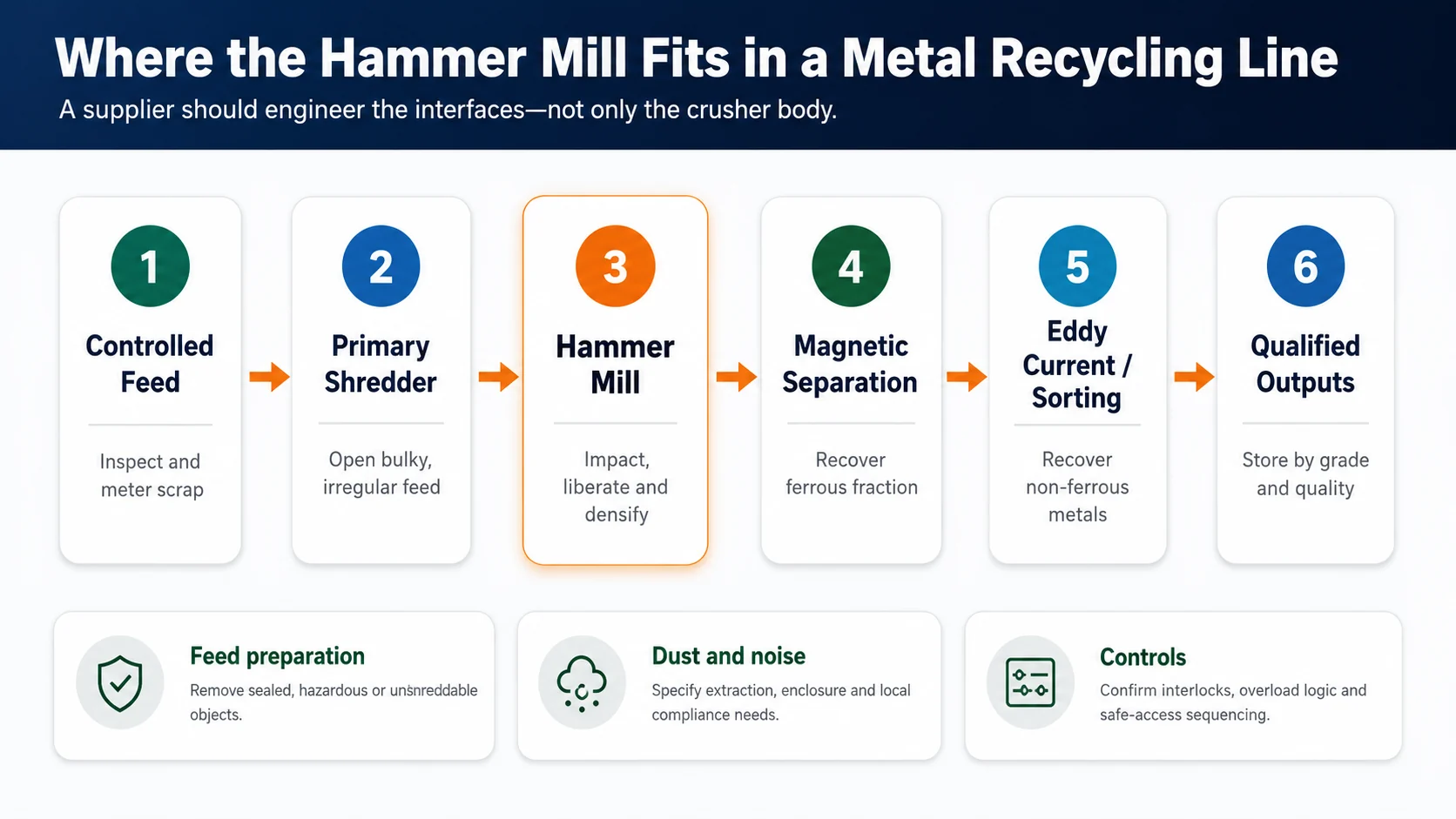
This is why a low machine price can become an expensive project. If the mill rejects oversized feed, overloads the dust system, produces too many fines or cannot be accessed safely for hammer changes, the buyer pays through downtime and rework. The comparison between a primary shredder and a hammer mill is explained in YUXI’s metal shredder vs hammer mill crusher guide.
How to Evaluate Hammer Mill Manufacturers
1. Start with the raw materials, not the model name
Send representative photos, videos and samples. Explain the source of the material,size,bulk density,moisture,pollution,ferrous and non-ferrous metal content,the presence of rubber or plastic,and whether the waste has been chopped or sheared.“Mixed metal” is not an engineering specification.
2. Define the required product
Describe what the downstream buyer or process accepts: maximum size, screen fraction, bulk density, liberation, paint or attachment removal, ferrous purity, non-ferrous recovery and allowable fines. A manufacturer cannot select the correct rotor, hammer, grate and separation arrangement without knowing what counts as qualified output.
3. Separate catalog capacity from guaranteed capacity
Catalog throughput is normally a broad reference. Guaranteed throughput should identify the tested feed, average feed size, bulk density, preparation method, screen opening, moisture, installed motor condition, operating hours and accepted output. Ask whether the number is instantaneous, average, continuous or peak.
4. Examine maintenance access and wear economics
The hammer crusher is a machine with high impact force.Compare how the shell is opened,how the hammer and pin are lifted,how the screen and lininhg are replaced,how to check the rotor balance,and whether the supplier has key parts in stock.Request a list of consumables including materials,unit weight,quantity,expected inspection interval and replacement procedure.
5. Review dust, noise, vibration and fire controls
The correct controls depend on the feed and local rules. High-speed crushing will produce dust, noise, vibration, hot particles and ignition risks. OSHA’s metal-scrap recycling guidelines emphasize the protection of machines and lockout/tagout before cleaning or maintenance. Buyers should require guarded drives, controlled access, emergency stops, safe jam-clearing procedures and a dust/fire concept appropriate to the material.
6. Evaluate the whole service chain
Confirm who designed the foundation,provide electrical drawings,supervise installation,commission and troubleshoot the equipment,train operators,perform remote diagnosis and respond to warranty problems.For imported equipment,please determine which parts are locally available and which parts must be shipped from the factory.
7. Ask for references that resemble your project
A reference processing light appliance sheet is not evidence for engine blocks or prepared vehicle hulks. Ask for installations with similar feedstock, throughput, climate, electrical standard and output objective. Where confidentiality prevents a direct visit, request anonymized operating data, test videos and a live factory demonstration.
8. Compare total installed cost
Total installed cost includes freight, customs, unloading, foundation, power distribution, controls, guarding, dust extraction, noise treatment, fire protection, conveyors, separation equipment, commissioning, training and startup spares. Operating cost should include electricity, labor, wear parts, planned maintenance, residue disposal and lost production during service.
Factory Test and Contract Checklist
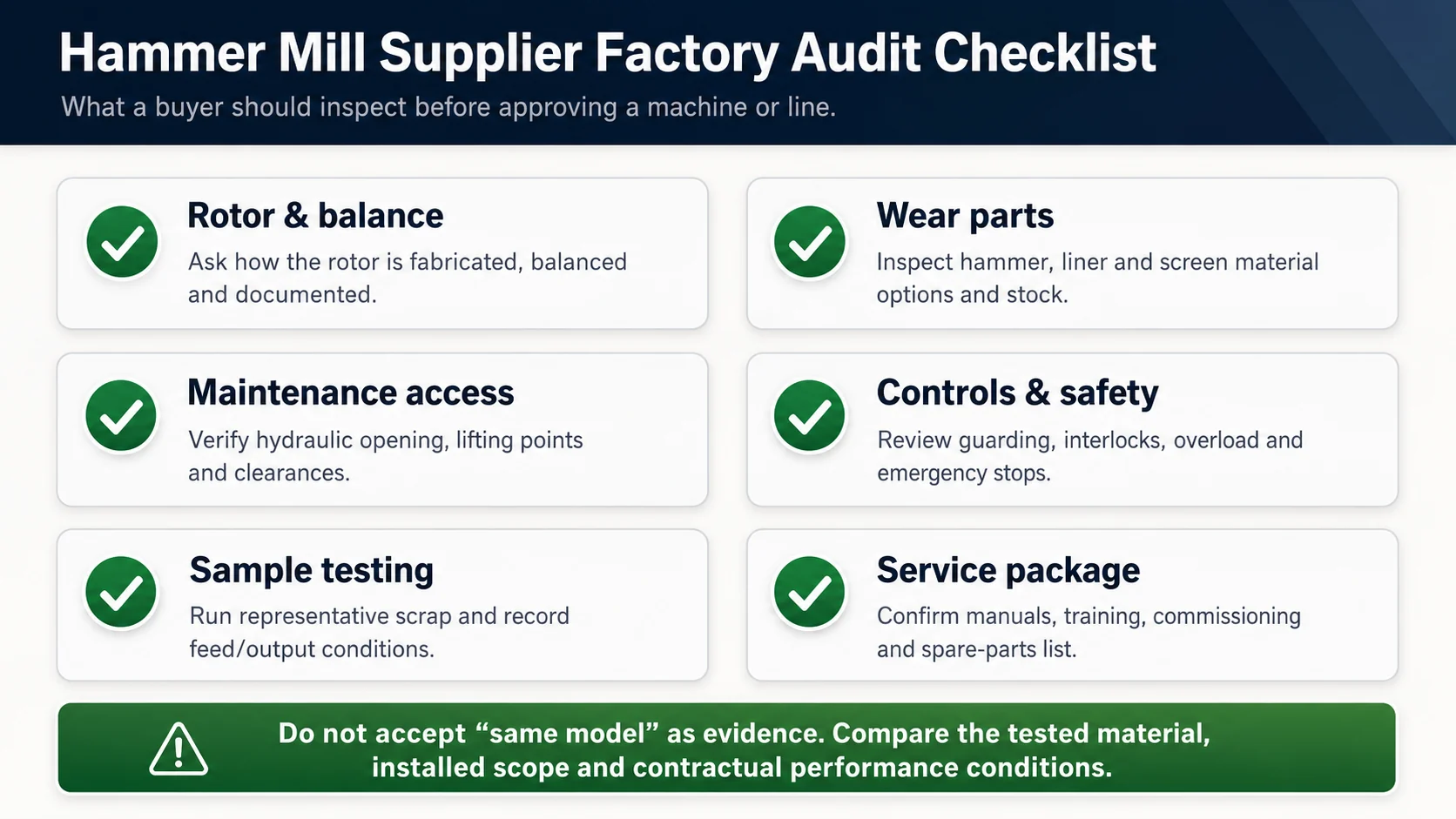
Before the test
- Agree the material source, sample weight and preparation method.
- Record moisture, bulk density and oversize objects.
- Define screen opening, operating time and output sampling method.
- State which machine and auxiliary equipment will be used.
During the test
- Measure steady-state throughput rather than feeder peak.
- Record current, vibration, temperature, noise and visible dust.
- Observe feeding stability, rejection and uncrushable handling.
- Collect representative output from the full test period.
After the test
- Analyze size distribution and saleable metal fractions.
- Inspect hammers, liners, screens, bearings and rotor chamber.
- List all deviations between test machine and quoted machine.
- Attach test data to the technical agreement.
In the contract
- Include drawings, utilities, exclusions and interface responsibilities.
- Define acceptance conditions and remedies for non-performance.
- Specify documentation language and electrical standards.
- List commissioning, training, warranty and spare-parts scope.
Where YUXI Fits Among Top Hammer Mill Manufacturers
YUXI is not positioned as the only suitable supplier for every hammer-mill project. Large automotive shredding plants may prefer a heavy-shredder specialist with a long regional installed base. A European recycler may prioritize local service and a mobile refining mill. YUXI’s strongest fit is a buyer who wants the hammer mill evaluated together with upstream shredding and downstream sorting, and who is prepared to provide detailed project data for a configured proposal.
The YUXI product page describes the crusher’s use of hammering, tearing and shearing, selectable screen sizing, PLC and hydraulic control, and a safety door for unbreakable objects. The broader product catalog allows the project to combine conveyors, metal shredders, magnetic recovery, eddy-current separation and other modules rather than forcing the buyer to coordinate unrelated suppliers.
Need a Comparable Hammer Mill Proposal?
Send YUXI your material photos and video, maximum feed dimensions, bulk density, target tonnes per hour, required output size, available power, site layout and downstream separation goal. Ask for a process diagram, equipment list, test plan, installed-utility schedule and spare-parts recommendation—not only a machine price.
Final Recommendation
A credible list of top hammer mill manufacturers should help buyers narrow down, rather than replace technical due diligence. Begin by separating compact refining mills from large automotive shredders. Then compare suppliers on representative test data, feed tolerance, qualified output, wear access, dust and safety controls, line integration, local service and total installed cost.
The safest purchase decision is rarely the supplier with the largest catalog number or the lowest initial price. The supplier clearly defines the process boundaries,proves the performance of the relevant materials,and assumes measurable responsibilities in the technical agreement.
FAQ
Who is the top hammer mill manufacturer for metal recycling?
Manufacturers worth comparing include YUXI, WENDT, LINDEMANN, Zato, Panizzolo, FOR REC, Stokkermill, ENERPAT, GME Recycling and Sure Origin. The best supplier depends on whether the project needs a compact refiner, a heavy-duty car shredder,or a complete production line with pre-shredding and metal separation.
Are hammer mills the same as metal shredders?
Not usually. A low-speed, high-torque metal shredder tears bulky scrap for primary size reduction. A hammer mill uses high-speed repeated impact for finer crushing, liberation and densification. Many complete lines use both machines in sequence.
What information should I send a manufacturer for a quotation?
Send material photos and video, feed dimensions, bulk density, contamination, daily volume, target hourly throughput, desired output size, downstream separation objective, site layout, power conditions, local electrical standard and required service scope.
How can I verify a manufacturer’s capacity claim?
Run a representative sample test and define the test conditions in writing. Record feed preparation, screen size, steady-state throughput, energy load, output size distribution and saleable fractions. Attach the agreed results and acceptance conditions to the contract.
Which wear parts should be included in the comparison?
Compare hammers, pins, liners, grates or screens, rotor protection, bearings and seals. Ask for material specifications, quantities, weights, replacement access, inspection intervals, local stock and delivered price.
Should I buy a standalone hammer mill or a complete line?
A standalone mill can work for consistent, pre-sized feed with a simple output goal. Bulky or mixed scrap usually requires controlled feeding and primary shredding, while higher recovery targets may require magnetic, eddy-current or density separation and dust handling.
What safety functions should a metal hammer mill have?
The final design should include protected mobile components,controlled access and guarded feed openings,emergency stops,overload protection,safety isolation and locking/markling points,recorded clearance procedures,and dust,noise,vibration and fire control suitable for materials and local regulations.