




 Request Quote



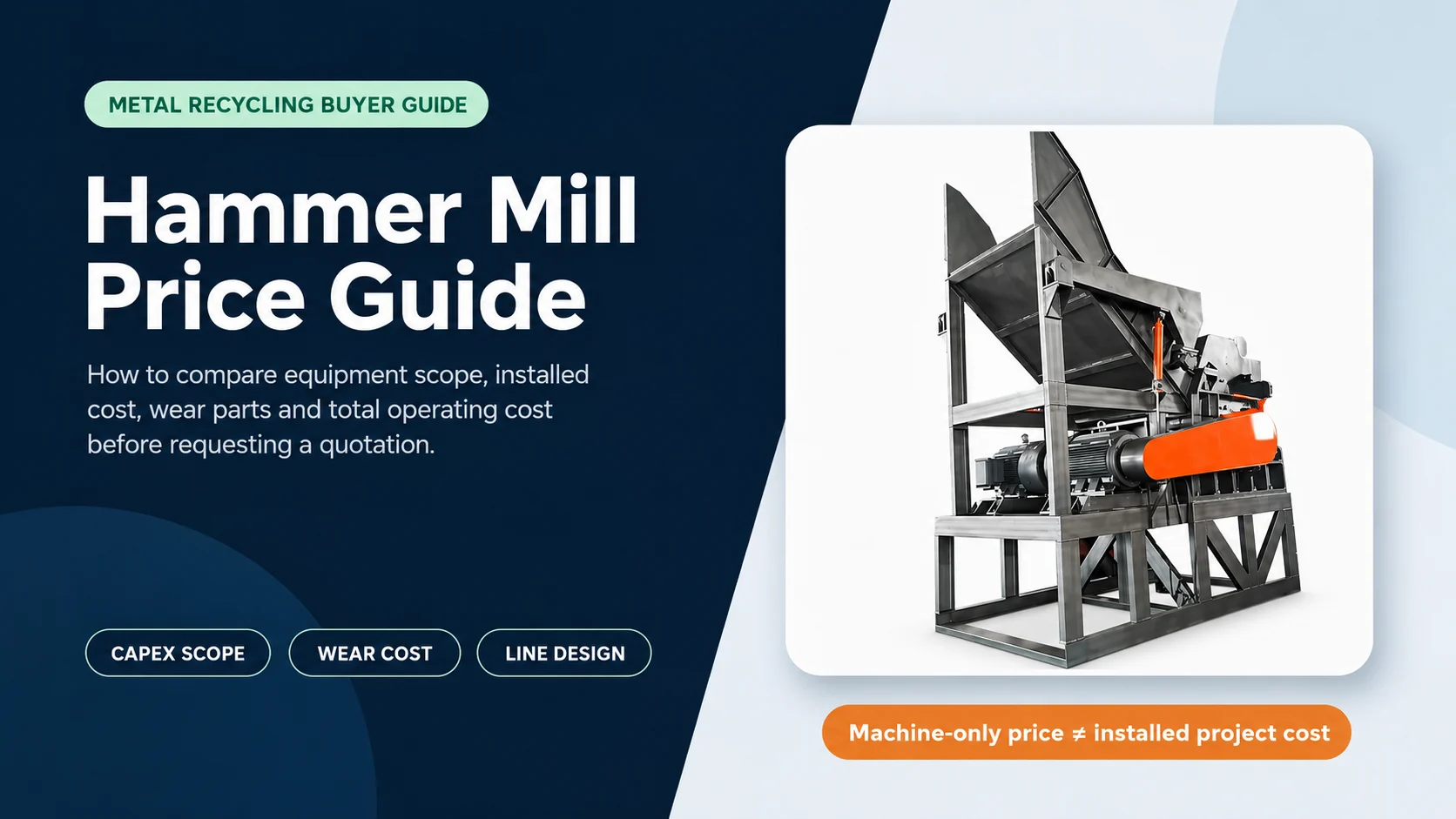
Quick Answer: How Much Does a Hammer Mill Cost?
A metal recycling hammer mill does not have one dependable list price. The final quotation depends on the material, maximum feed condition, realistic throughput, required fragment quality, rotor and wear-part duty, drive system, feeding and discharge equipment, dust and noise controls, downstream separation, shipping and the work required to commission the system.
The first number a buyer sees may describe only the crusher body. Another supplier may include the motor, control cabinet, feed conveyor, discharge conveyor, magnet, access platform, guards and startup spares. A third quotation may cover the complete installed line. Comparing those three totals without normalizing scope produces a false “cheap versus expensive” conclusion.
This guide is specifically about industrial hammer mills for scrap metal recycling. It is not a price guide for grain, feed, biomass, laboratory or stone hammer mills. Generic search results mix those categories, even though their rotors, wear duty, power demand and safety requirements are not comparable.
First Define Which Hammer Mill You Are Pricing
“Hammer mill” describes an operating principle more than one standardized product. In metal recycling, high-speed hammers repeatedly strike prepared scrap, redirect fragments through the chamber and help expose joined materials. YUXI’s published Hammer Mill Metal Crusher page describes hammering, tearing and shearing actions used to reduce scrap and improve metal/non-metal separation preparation.
Before discussing price, establish four boundaries.
Horizontal or vertical duty
Different chamber layouts, rotor systems and feed behaviors can all be marketed as hammer mills or metal crushers. Do not transfer the price or specification of one layout to another.
Primary or secondary role
Some systems accept prepared scrap directly. Many recycling lines use a low-speed shredder first, then use the hammer mill for refinement and liberation. The upstream requirement changes the project cost.
Machine or complete process
A core crusher is not the same product as a packaged station or a crushing-and-separation line. Feed, discharge, magnets, screens, dust extraction and platforms may be separate items.
Output target
“Smaller pieces” is not enough. Define acceptable oversize, fines, bulk density, exposed metal and the condition required by the downstream sorter or buyer.
Main Factors That Affect Hammer Mill Price
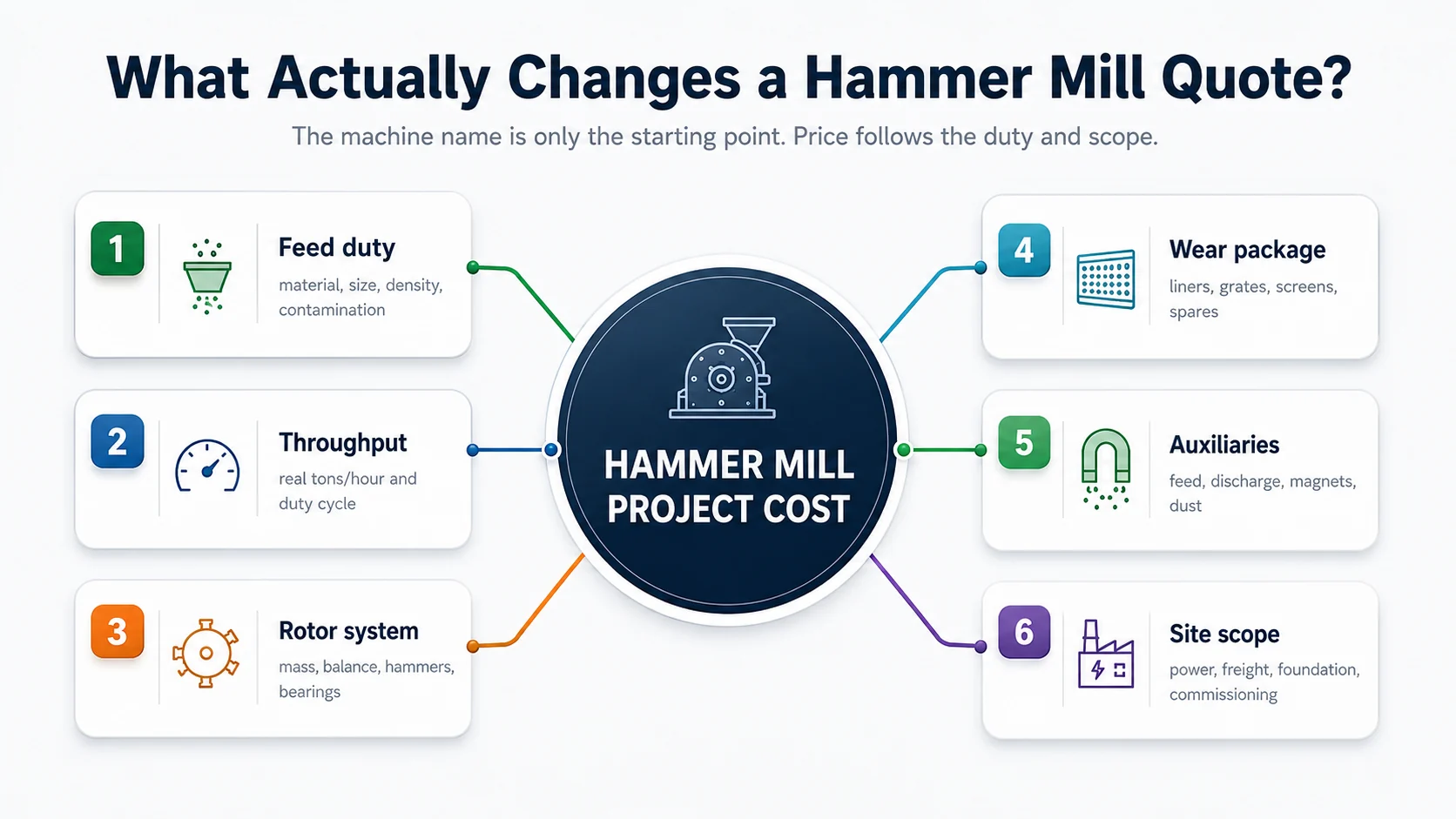
1. Raw material and feed condition
A quotation starts with what actually enters the chamber. Clean pre-sized sheet scrap is different from mixed appliance fragments, electric motors, cast components, cans with contamination or compacted material. Material hardness is only one variable. Shape, ductility, bulk density, packing, moisture, non-metal attachments and unexpected hard objects influence loading and wear.
The maximum piece must fit the inlet and behave predictably under impact. Long pieces can bridge. Hollow pieces can bounce. Dense parts can create large impact events. Mixed feed can cause changing motor load from minute to minute. A supplier who asks only for “steel” or “aluminum” does not have enough information for a serious price.
2. Required throughput under a defined duty
Capacity drives rotor width, drive power, chamber size, feeding equipment and structural duty, but a tons-per-hour figure is meaningless without a feed description. Five tons per hour of low-density cans does not create the same loading as five tons per hour of motors or dense pre-shredded steel.
Ask whether throughput is a nominal maximum, an expected continuous rate or a result from a representative material test. Also state planned operating hours, shift pattern and utilization. Equipment designed for occasional batches is priced differently from a machine expected to run continuously across two shifts.
3. Rotor, hammer and bearing system
The rotor is the high-speed core of the machine. Its mass, working width, diameter, shaft design, hammer arrangement, bearings, transmission and balance affect both price and operating stability. Larger is not automatically better. The system must store enough energy for the duty while recovering speed after impact and avoiding excessive vibration.
Hammer quantity, geometry, mounting and replacement access also matter. A design that costs more initially may reduce service time if wear parts can be changed without dismantling unrelated equipment. Conversely, an elaborate system is wasted cost when a simpler duty is all the project needs.
4. Liners, grates, screens and wear package
Metal impact crushing transfers cost into wear parts. Hammers receive direct blows. Liners protect the housing and redirect fragments. Grates or screens control residence time and discharge where the design uses them. These parts should not be treated as small accessories: their material, thickness, mounting and replacement method influence the machine price and the annual maintenance budget.
A tighter discharge condition may require longer residence time, more impacts and more wear. It can also reduce throughput or create extra fines. The correct target is the coarsest output that still allows the downstream recovery process to perform its job.
5. Motor, drive and electrical controls
High-speed impact equipment can create a demanding motor-starting and load profile. The price can change with installed power, motor efficiency class, starting method, variable-frequency control where technically appropriate, coupling or belt arrangement, switchgear, PLC functions, sensors and local electrical standards.
Do not compare motor nameplate power alone. A useful review asks how the feeder responds to motor load, how overload is detected, what interlocks exist, how emergency stops are arranged and what electrical equipment remains outside the supplier’s scope.
6. Feeding and discharge equipment
Stable feeding is not optional process decoration. A surge of dense material can pull down rotor speed and produce an overloaded chamber; starved feeding wastes capacity. The correct conveyor, metering method, hopper, anti-bridging arrangement and discharge system are part of the production solution.
Discharge height and flow determine whether material can reach a magnet, screen, air separator, eddy current separator, bunker or baler. Retrofitting incompatible heights and conveyor widths after delivery can cost more than designing the interface during quotation.
7. Dust, noise, guarding and access
Impact crushing can create airborne fines, flying fragments and high noise. Enclosures, extraction points, ducting, collection equipment, sound control, guards, platforms and safe maintenance access add real cost. Excluding them may lower the factory price but does not remove the need at the site.
8. Separation and complete-line equipment
The hammer mill creates a more processable stream; it does not automatically sell the recovered fractions. Magnets, screens, air classification, eddy current separation, manual quality control and residue handling can be required after crushing. The correct scope depends on whether the plant wants coarse ferrous scrap, separated non-ferrous metals, a cleaner furnace feed or another commercial product.
9. Shipping, foundation and commissioning
A factory price excludes many costs that appear before production: packing, inland transport, sea freight, insurance, duties, unloading, cranes, foundation, structural steel, cabling, transformer or switchgear work, dust ducting, commissioning, travel and operator training. Ask for the project responsibility matrix in writing.
Machine Price, Packaged Price and Installed Project Cost
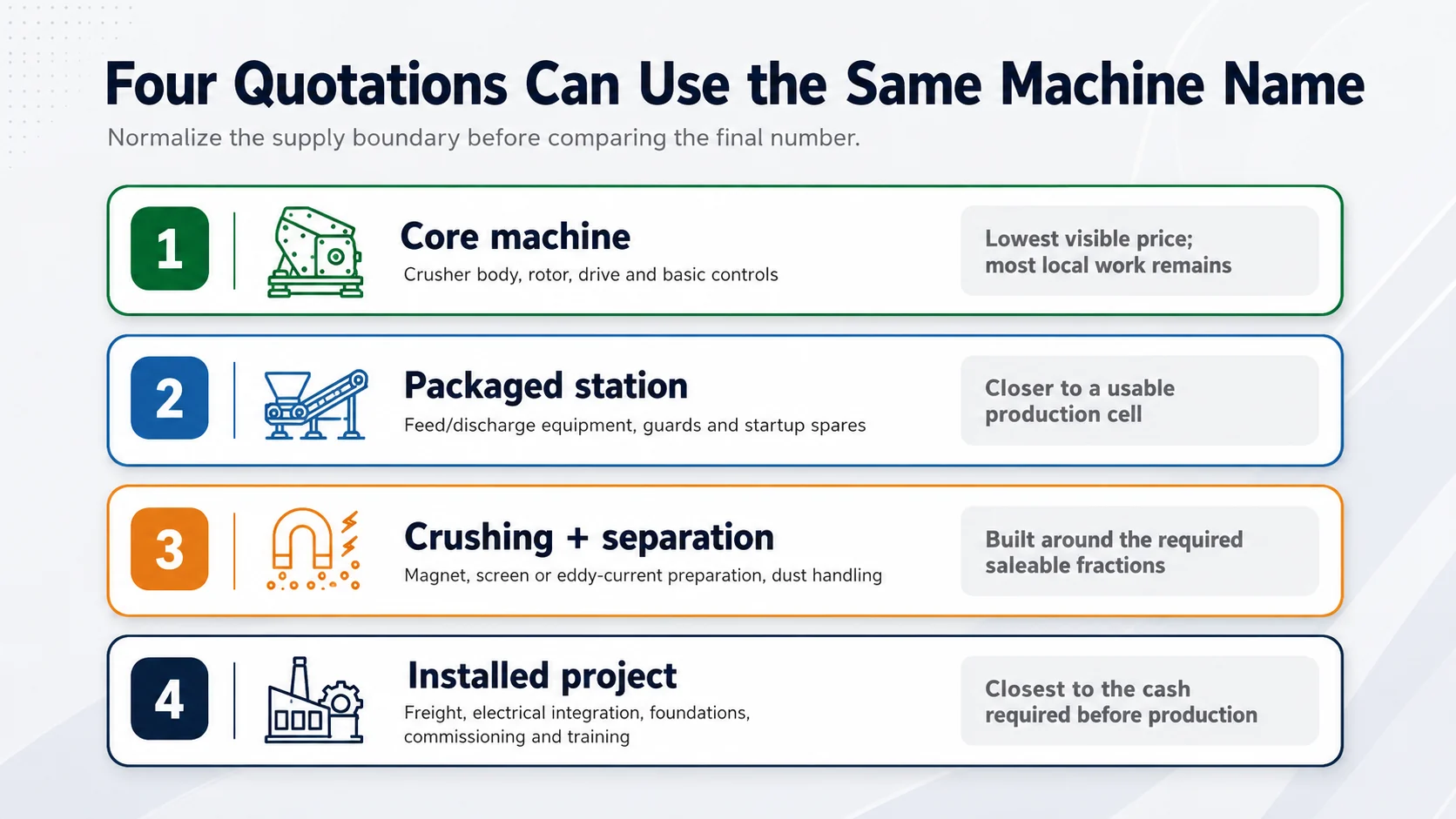
| Quotation level | Commonly included | What buyers should verify |
|---|---|---|
| Core machine | Crusher housing, rotor, hammers, drive and basic controls. | Motor and control cabinet inclusion, guards, base frame, access equipment, installed wear set and interface dimensions. |
| Packaged crushing station | Core machine plus feed/discharge conveyors, platforms, guards, control integration and startup spares. | Feed regulation, discharge height, structural support, emergency stops and local electrical work. |
| Crushing and separation system | Hammer mill, conveyors, magnets, screens or other sorting preparation, dust handling and central controls. | Which final fractions are expected, test basis, residue outlets, purity assumptions and equipment excluded. |
| Installed project | Equipment package plus some combination of freight, site integration, foundations, installation, commissioning and training. | Incoterms, taxes and duties, local labor, cranes, utilities, civil work, acceptance criteria and who owns each risk. |
An apples-to-apples comparison requires a one-page supply boundary. Mark every line item as included, optional, buyer-supplied or excluded. This is more useful than negotiating the total before understanding what the total represents.
When the Price Also Needs a Double Shaft Pre-Shredder
A hammer mill uses high-speed impact. A double-shaft shredder uses low-speed, high-torque cutting to grab, tear and open bulky material. They are not interchangeable versions of the same machine. They solve different feed problems.
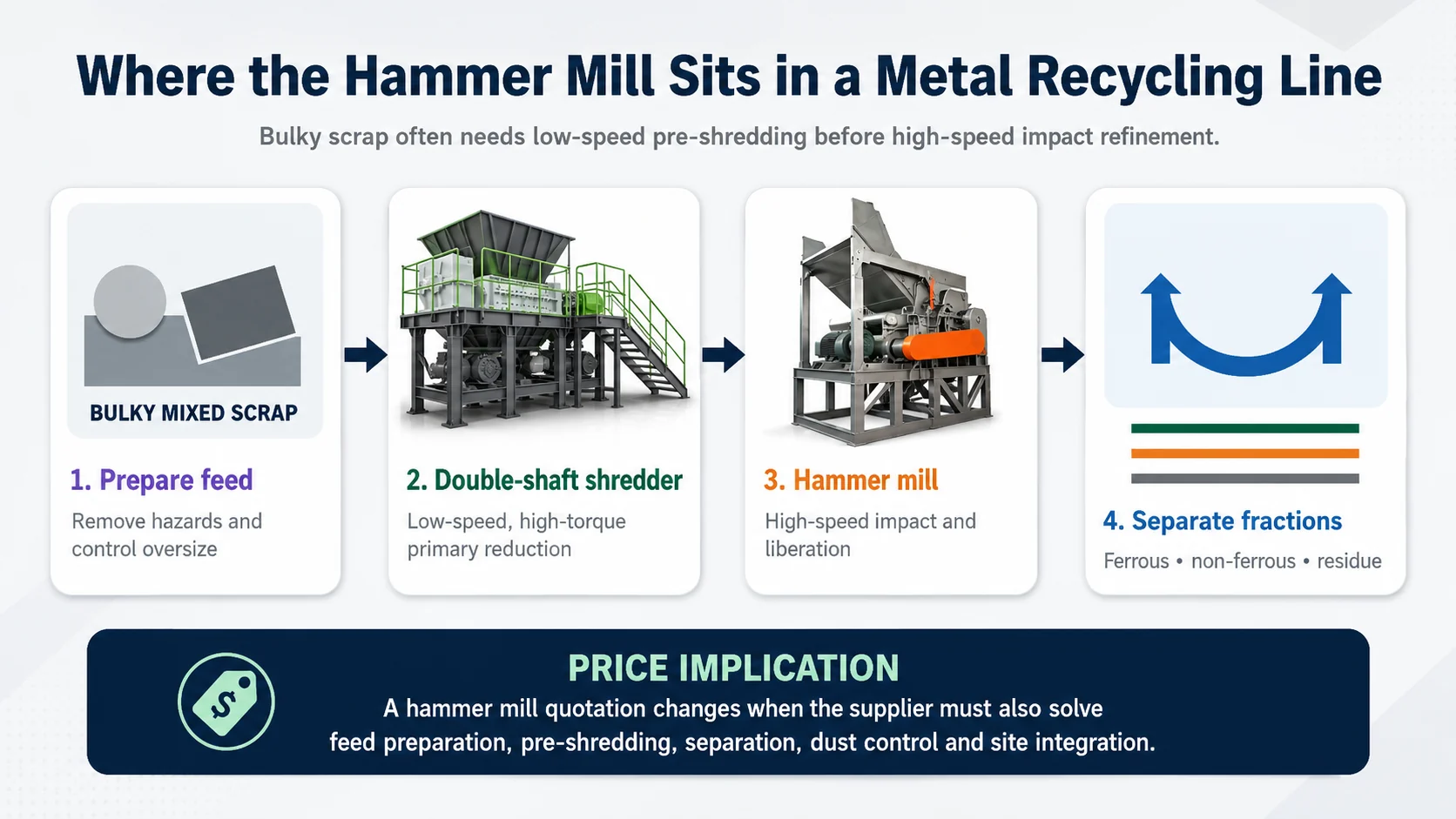
For large, hollow, irregular or mixed feed, a double shaft shredder machine can prepare a more predictable stream before impact crushing. YUXI’s published page describes this machine as a primary stage using two counter-rotating shafts, low-speed torque and automatic overload reversal for bulky waste and mixed materials.
The price implication is important. A buyer may ask for a hammer mill and later discover that the feed cannot enter it steadily. The project then needs a shredder, extra conveyor, magnet, buffer and additional controls. Planning the sequence at the start is less expensive than forcing the wrong machine to perform the first reduction step.
The waste metal shredding and recycling system published by YUXI shows this staged logic: primary shredding, hammer crushing, magnetic separation, eddy current separation and dust collection. The exact line for a new project must still be based on representative material and the required finished fractions.
Buyers already budgeting the primary stage can use the separate double shaft shredder price guide. Keeping the two budgets separate prevents the hammer mill article from becoming another general shredder cost page.
Calculate Total Cost of Ownership, Not Only Purchase Price
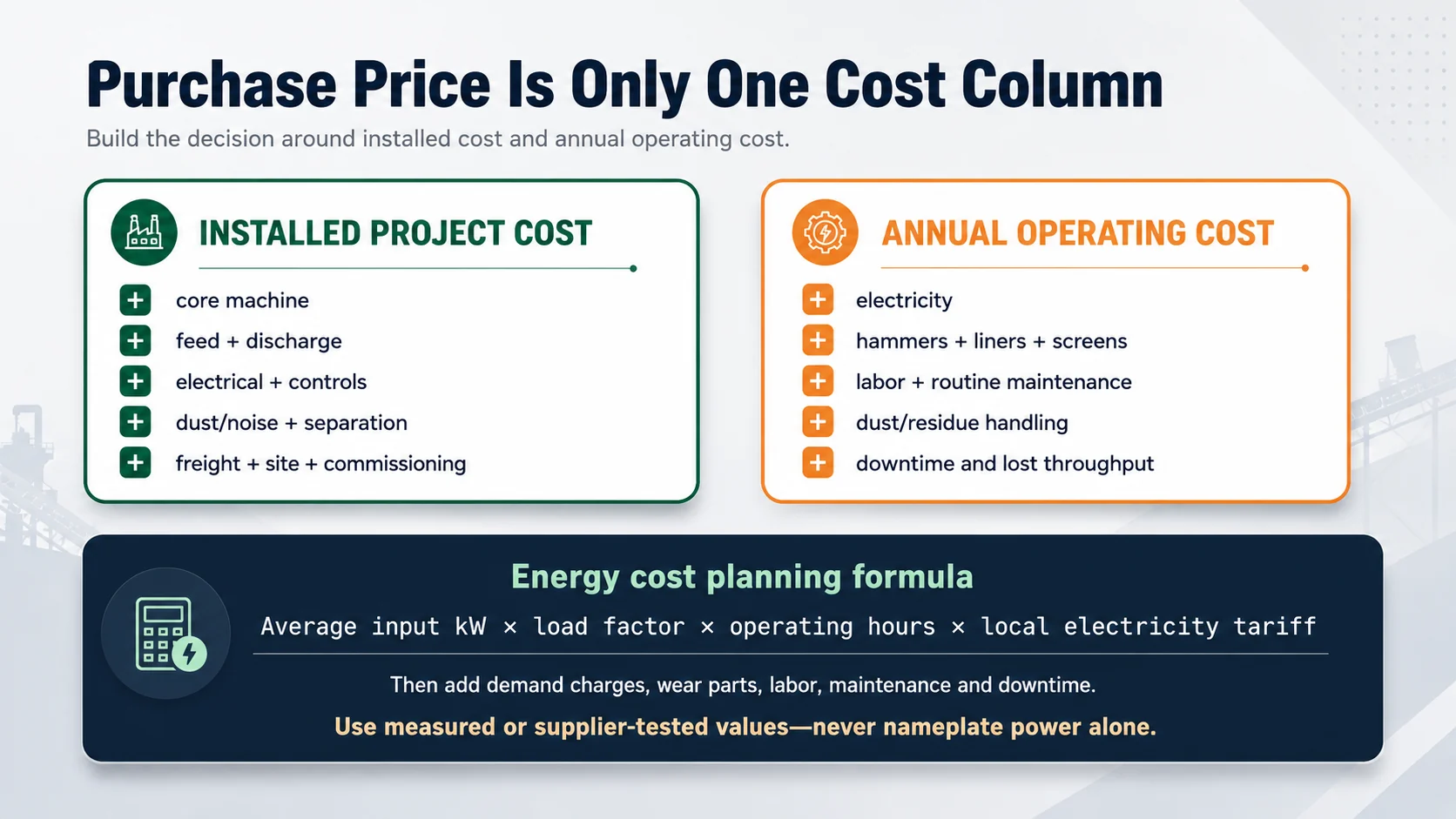
Electricity cost
A practical planning formula is:
Use measured or test-based average input, not only motor nameplate power. Industrial bills may also include demand costs, power-factor penalties and usage time components. The U.S. Department of Energy pointed out that motor-system efficiency and energy management can create meaningful cost savings, and the U.S. Energy Information Administration reported that the average industrial electricity revenue in April 2026 was 8.66 cents/kWh.This national figure is a reference value, not a quotation for a specific location, and actual industrial tariffs can vary substantially by state, utility and rate structure. DOE motor systems guidance and EIA electricity data provide useful starting points.
Wear-part cost per processed ton
Track hammer, liner, grate or screen consumption against actual tons processed. Calendar replacement intervals are weak because wear changes with contamination, feed density, maintenance and the requested discharge condition. The useful measure is:
Ask the supplier to identify the installed wear set, expected inspection points, safe replacement method and a startup spare package. Do not demand a universal service life when no representative material test exists.
Downtime and throughput loss
A less expensive machine can become the high-cost option if it is difficult to clear, slow to service or unstable under feed variation. Record planned service hours, unplanned stops, lost production and downstream starvation. The most valuable design feature may be access that removes several hours from a recurring maintenance job.
Labor and housekeeping
Labor includes more than one operator at the control panel. It may include loader or grab operation, quality inspection, clearing bridged feed, housekeeping, dust collection service, wear inspection and maintenance support. Automation reduces some tasks but does not remove the need for safe observation and planned maintenance.
Recovery value and product quality
Finer crushing is not automatically more profitable. It can expose joined metals and improve downstream presentation, but it can also make more fines, increase dust handling and consume more wear parts. The economic target is the lowest crushing intensity that delivers the required saleable fractions and acceptable residue.
How to Compare Two Hammer Mill Quotations
Put both offers into the same table. Leave any unconfirmed field blank rather than assuming the suppliers mean the same thing.
| Comparison item | Questions to ask | Why it matters |
|---|---|---|
| Duty basis | What exact feed, size, density, contamination and moisture is the offer based on? | It defines whether the machine is being priced for your real material. |
| Throughput basis | Is the rate continuous, peak, calculated or material-tested? | Two identical tons-per-hour claims may use different assumptions. |
| Rotor and hammers | What arrangement is proposed, and which details are confirmed in the technical offer? | High-speed core components determine duty, wear and maintenance. |
| Discharge control | What grate, screen or opening is supplied, and how is output verified? | Nominal opening is not the same as a guaranteed size distribution. |
| Drive and controls | Motor, starting method, feeder interlock, sensors, PLC and overload response? | Electrical scope and load control affect both price and operation. |
| Included equipment | Feed conveyor, discharge conveyor, magnet, screen, dust system, platform and guards? | Prevents a bare machine from being compared with a production cell. |
| Wear and spares | Installed set, startup spares, recommended stock and replacement procedure? | Shows the first-year maintenance commitment. |
| Site interface | Foundation loads, layout, discharge elevation, cable limits and extraction connections? | Exposes local work before the purchase order. |
| Testing and acceptance | Which material will be tested, what outputs recorded and what acceptance criteria apply? | Turns vague performance language into measurable conditions. |
| Commercial scope | Incoterms, packing, freight, duties, commissioning, training and written warranty terms? | Converts factory price into a landed and usable project budget. |
New vs Used Hammer Mill: What the Lower Price Can Hide
Used equipment can be appropriate when the buyer has strong in-house engineering support, the duty is understood and the machine has traceable documentation. It is risky when the sale is based only on a running video or external appearance.
- Rotor condition and balance: look for repair history, cracks, uneven buildup, missing components and evidence of vibration.
- Bearings and shaft: check temperature history, lubrication records, clearances and replacement availability.
- Wear surfaces: confirm remaining hammer, liner, grate and screen life rather than valuing the machine shell alone.
- Drive system: check the motor, coupling, belt, pulley, guard, starter and control obsolescence.
- Foundation and relocation: include demolition, loading, freight, crane work, new foundation, electrical conversion and recommissioning.
- Safety upgrade: outdated access doors, guards, emergency-stop devices and safety interlocks may need to be redesigned before use.
A used machine is not inexpensive if the first production month becomes a rebuild project. Price the condition survey and recommissioning plan before assigning value to the asset.
Common Mistakes When Buying on Hammer Mill Price
- Using a generic hammer mill search result. Feed, wood, mineral and scrap-metal machines can share the same name but have completely different duty and cost.
- Quoting without representative feed. A material name is not enough. Send photos, dimensions, packing condition and contamination details.
- Choosing the smallest possible output. Extra reduction can add power, wear, dust and fines without adding saleable value.
- Ignoring the pre-shredder. Bulky, hollow or irregular scrap may require low-speed primary reduction before it can be metered into a hammer mill.
- Comparing a machine to a line. One quote may exclude conveyors, magnets, dust collection and site integration.
- Not pricing maintenance access. A recurring six-hour service task can matter more than a small purchase discount.
- Accepting unqualified capacity. Require the feed condition and test basis behind every throughput statement.
- Leaving local compliance until installation. Guarding, hazardous-energy control, noise, dust and electrical requirements can change layout and budget.
Information YUXI Needs for a Useful Hammer Mill Quotation
A detailed RFQ reduces guessing and makes competing quotations easier to compare.
Material information
- Material names and estimated mix
- Clear photos and a short feed video
- Maximum length, width, thickness and single-piece weight
- Loose, baled, flattened or pre-shredded condition
- Moisture, oil, dirt and non-metal attachments
- Objects that must never enter the machine
Production target
- Required average and peak tons per hour
- Hours per shift and shifts per day
- Target fragment condition and oversize tolerance
- Allowed fines and dust level
- Required bulk density or liberation goal
- Downstream separator, furnace or buyer specification
Plant and utility data
- Country, voltage and frequency
- Available electrical capacity and starting limits
- Workshop dimensions and clear height
- Feeding equipment and discharge elevation
- Dust extraction and noise constraints
- Maintenance access and lifting equipment
Commercial scope
- Core machine, packaged station or complete line
- Required conveyors and separation equipment
- Startup spare-parts expectation
- Destination port or site
- Installation and commissioning responsibility
- Target schedule and acceptance-test plan
When the feed is difficult or mixed, a representative material test is more valuable than a long list of adjectives. Record feed condition, motor load, throughput, fragment distribution, fines, metal exposure and any stoppages during the test.
YUXI Product Context and Article Boundary
YUXI publicly positions its metal hammer mill as scrap-processing equipment that uses hammering, tearing and shearing to reduce material and prepare metals for downstream recovery. The product page also describes PLC and hydraulic control features and a safety-access concept for removing unbreakable objects. Final rotor, hammer, screen, power, capacity and feed limits must come from the confirmed technical proposal; they are not inferred in this article.
On scrapshredder.com, the commercial anchor remains the primary shredder. YUXI’s double shaft shredder working guide explains the low-speed cutting stage in more depth. This price guide owns a different intent: the cost of high-speed hammer-mill refinement, its wear package and its position in the installed metal recycling project.
Safety and Compliance Items That Affect the Budget
Safety requirements are not generic accessories added after procurement. They influence guards, platforms, access doors, interlocks, isolators, extraction systems, layout and maintenance procedures.
For U.S. facilities, OSHA’s general machine-guarding standard requires protection from hazards such as points of operation, ingoing nip points, rotating parts, flying chips and sparks. OSHA’s hazardous-energy standard covers servicing and maintenance where unexpected startup or stored energy can injure workers. Review 29 CFR 1910.212 and 29 CFR 1910.147 with the facility’s qualified safety team.
Noise should also be assessed for the installed system, not assumed from a catalog. NIOSH recommends limiting occupational noise exposure to 85 dBA in an eight-hour shift. That recommendation supports early planning for enclosure, distance, sound control, monitoring and hearing-loss prevention. See the NIOSH noise exposure guidance.
Local fire, dust, environmental, electrical and structural rules vary. The article is a procurement guide, not a compliance determination. The plant owner, equipment supplier and qualified local professionals should document responsibilities before installation.
Hammer Mill Price FAQ
How much does a metal recycling hammer mill cost?
There is no reliable universal price. The quotation changes with feed material, required throughput, rotor and wear-part duty, discharge control, auxiliaries, electrical scope, shipping and whether the offer covers a core machine or an installed recycling system.
Why do many suppliers not publish a fixed hammer mill price?
Industrial hammer mills are normally selected around a specific waste stream and process position. A machine for clean pre-sized scrap is not the same project as a system that must accept mixed feed, control dust and connect to separation equipment.
Is a hammer mill more expensive than a double shaft shredder?
Not automatically. They perform different duties. The double-shaft shredder is usually used for low-speed primary size reduction, while the hammer mill is used for high-speed impact refining. The required size, power, wear package and line scope determine which quotation is higher.
Can I buy only the hammer mill without conveyors or separators?
Yes, when the plant already has compatible feeding, discharge and downstream equipment. The supplier should still confirm interface heights, feed control, motor starting requirements, guarding and the discharge condition.
Which wear parts should be included in the quotation?
Ask for the installed hammer set, recommended startup spares, liners, grates or screens where applicable, fasteners and the parts required for the first planned service interval. Quantities and materials must match the confirmed machine proposal.
Does a smaller discharge size always increase the price?
It often increases duty because material stays in the chamber longer and may require a different grate, screen, rotor setup or downstream classification. It can also raise power use, fines generation and wear. A tested output distribution is more useful than one nominal size.
Is a used hammer mill a better deal?
It can be, but only after checking rotor condition, dynamic balance, bearings, wear surfaces, drive system, controls, maintenance records and spare-parts availability. Moving and recommissioning used high-speed machines can eliminate obvious purchase price savings.
What information is needed for an accurate quotation?
Provide material photos or video, maximum feed size, bulk density or packing condition, contaminants, required throughput, working hours, target output, downstream separation goal, site voltage, plant layout, feeding method and required delivery or commissioning scope.
Request a Price Based on Your Actual Material
Prepare the feed photos, maximum size, target throughput, output requirement and desired equipment scope. YUXI can then confirm whether the project needs a hammer mill alone, a double shaft pre-shredder, or a connected metal recycling line.
Authority Sources and Fact Notes
- Machine guarding reference: OSHA 29 CFR 1910.212.
- Hazardous-energy control reference: OSHA 29 CFR 1910.147.
- Occupational noise reference: OSHA 29 CFR 1910.95 Occupational Noise Exposure.
- Energy reference: U.S. EIA Electric Power Monthly, Table 5.6.A, used only as national industrial electricity price context. Site tariffs must be checked locally.
- Recycling context: U.S. EPA Recycling Basics and Benefits.