




 Request Quote



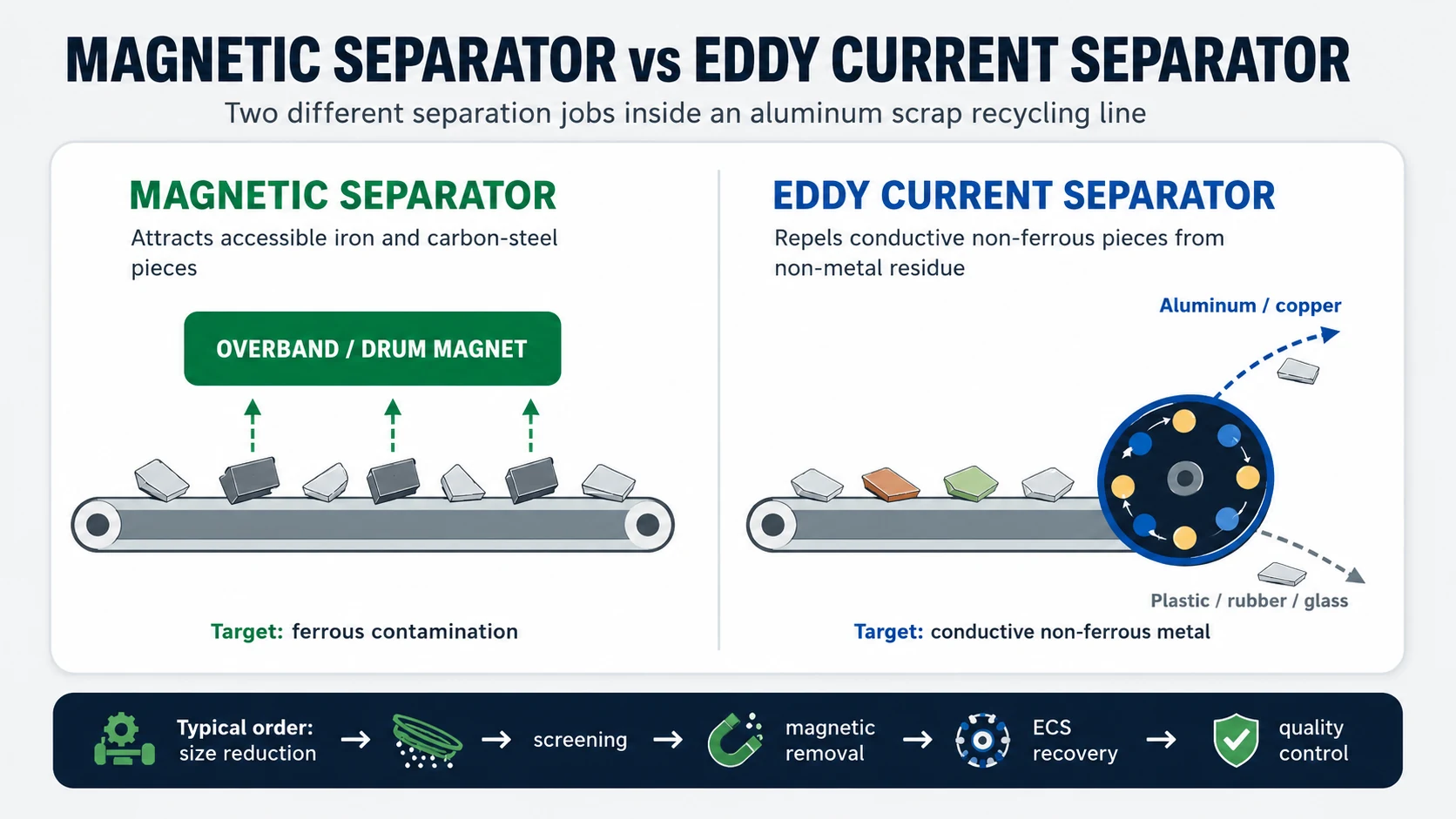
During a separator trial, the dramatic moment is easy to spot: aluminum pieces jump farther from the end of the belt. The harder question comes afterwards. Was that actually the fraction the plant was losing? If the original problem was steel screws in clean extrusion scrap, the impressive ECS trajectory does not solve it. A magnet probably does.
That distinction sounds obvious on paper. It is still missed in equipment inquiries. Buyers ask for “a metal separator,” suppliers show whichever machine they manufacture, and the discussion moves to belt width and motor power before anyone has defined the unwanted fraction. We prefer to reverse the order. Start with the feed, open it up, look at where the aluminum is going, and only then choose the separator.
Before Comparing Machines, Find the Wrong Fraction
YUXI’s public scrap aluminum recycling line page gives the two stages separate jobs. Ferrous screws, brackets and steel inserts go to magnetic removal. The ECS comes later, after sizing and controlled feeding, when conductive non-ferrous pieces have to be taken out of a non-metal stream.
We would not turn that description into a fixed recipe. Sometimes the material has already been sorted so well that the ECS has almost nothing useful to do. Sometimes the magnet looks successful, yet steel remains locked inside castings because the shredder has not opened the parts far enough. The separator can only act on what reaches it in a workable form.
The U.S. EPA’s secondary aluminum guidance makes the same broader point from a process perspective. Scrap preparation can include size reduction, magnetic removal, screening and air classification, but the route changes with the source and condition of the scrap. In other words, “aluminum scrap” is not one feedstock.
A useful line-design discussion can start with three piles on the floor. One pile is the product. One is the reject. The third is whatever keeps circulating because the plant has not decided what to do with it. Now ask: where is the aluminum that should have been sold? Where is the steel that should have been removed? That conversation usually tells us more than the first equipment list.
If steel is showing up in the aluminum product, improve liberation and magnetic removal. If aluminum is leaving with plastic, rubber or glass, an ECS may be justified. If aluminum and copper are already together in the recovered non-ferrous fraction, the problem has changed again. Neither a conventional magnet nor a standard ECS reads alloy chemistry.
What Actually Happens Inside Each Machine
The magnet: simple principle, not always a simple application
Scrap magnets will produce a field to attract ferromagnetic materials.In practice,this may mean conveyors,drums,hanging magnets or over-band magnets above the magnetic head pulley.The layout has changed,but the work is familiar:capture iron or carbon steel,keep it long enough,and then discharge it from the aluminum flow.
The word we pay attention to is accessible. Put a loose steel washer on top of an aluminum fragment and the magnet has a fair chance. Leave the same washer trapped under a thick burden, or lock a steel bolt inside a casting, and the result becomes less certain. Long wire can wrap. Flat pieces can hide. Small fasteners can travel under larger light scrap. A stronger field may help, although it cannot replace liberation and sensible feeding.
The ECS: the particle has to fly differently
An eddy current separator is not pulling aluminum toward a magnet. The high-speed rotor inside the discharge pulley creates a rapidly changing magnetic field. A conductive non-ferrous piece passing through that zone develops induced electrical currents. The interaction produces a force that changes the way the piece leaves the belt. Plastic, rubber and glass do not receive the same electromagnetic push, so they follow a shorter path. A splitter is then positioned between the two trajectories.
YUXI’s eddy current separator page shows this belt-and-rotor arrangement for prepared material containing aluminum, copper and other non-ferrous metals. The underlying mechanism is also set out in an analytical study of eddy-current separation. The paper is useful for the physics. It is not a shortcut to a plant guarantee, because the real feed never behaves like one ideal particle.
The Comparison Buyers Actually Need
| Question from the plant | Magnetic separator | Eddy current separator |
|---|---|---|
| What are we trying to remove? | Accessible iron, carbon steel and other strongly ferromagnetic pieces | Conductive non-ferrous pieces that are mixed with a suitable non-metal fraction |
| What does the machine do to the particle? | Attracts and retains it | Changes its discharge trajectory through an induced electromagnetic force |
| Where does it normally sit? | After enough liberation has taken place and before sensitive downstream sorting | After ferrous removal, screening and steady feed presentation |
| When is the case convincing? | Steel is contaminating the aluminum product | Recoverable aluminum is leaving with plastic, rubber, glass or another non-metal stream |
| What tends to spoil the result? | Hidden steel, deep burden, poor discharge, tangled wire and incomplete liberation | Residual ferrous, wet or sticky feed, mixed size ranges, overlapping particles and unsuitable settings |
| What should the buyer not expect? | Recovery of aluminum from non-metal material | Reliable alloy identification or an automatic aluminum/copper grade split |
| What needs to be checked? | Steel left in product and aluminum carried into the ferrous reject | Metal left in residue, non-metal in product and repeatability at the intended feed rate |
Why the Magnet Usually Goes First
There are exceptions in recycling plants, but this is one sequence we rarely argue with: remove accessible ferrous material before the prepared feed reaches the ECS. STEINERT describes ECS recovery after stages such as crushing, classification and magnetic separation. Bunting presents the same general arrangement with upstream ferrous separation.
The quality reason is straightforward. Steel does not belong in the recovered non-ferrous product. The mechanical reason is less visible in a brochure. Loose ferrous pieces carried toward the high-speed rotor can collect in an awkward place, disturb the material flight and increase the chance of belt or shell damage. Even when nothing breaks, the operator is left cleaning a machine that should have received a much cleaner feed.
There is also a tuning advantage. Once the bulk of the ferrous material is gone, the operator can work with the fractions that matter to the ECS: conductive non-ferrous pieces and non-conductive residue. Belt speed and splitter position become easier to judge because the feed is less chaotic.
Do not read “magnet first” as “ferrous-free after one pass.” Fine wire, partially exposed inserts, stainless grades and material hidden under a deep burden can still move forward. On difficult feed, a second magnetic check or a different magnet position may be justified. The test should tell you, not the drawing.
The Feed Decides Whether You Need One Machine, Both, or Neither
Clean profiles and fabrication offcuts
Suppose the feed is mostly clean extrusion offcuts. A few screws, brackets or steel straps are present, but there is little plastic or rubber. The obvious first step is magnetic control. Once the steel is out, there may be no meaningful non-metal stream for an ECS to separate. In that case, adding the ECS gives the line another belt, another wear item and another place to lose small aluminum pieces—without creating a better product.
Window and door profiles
These are less tidy. Screws, reinforcement, seals and thermal-break material can remain attached after rough shredding. A magnet removes the steel that has actually been released. If the next size fraction contains liberated aluminum mixed with rubber or plastic, the ECS starts to make sense. The important word, again, is liberated. A profile section still carrying its plastic bridge may fly as one composite object.
Mixed aluminum scrap
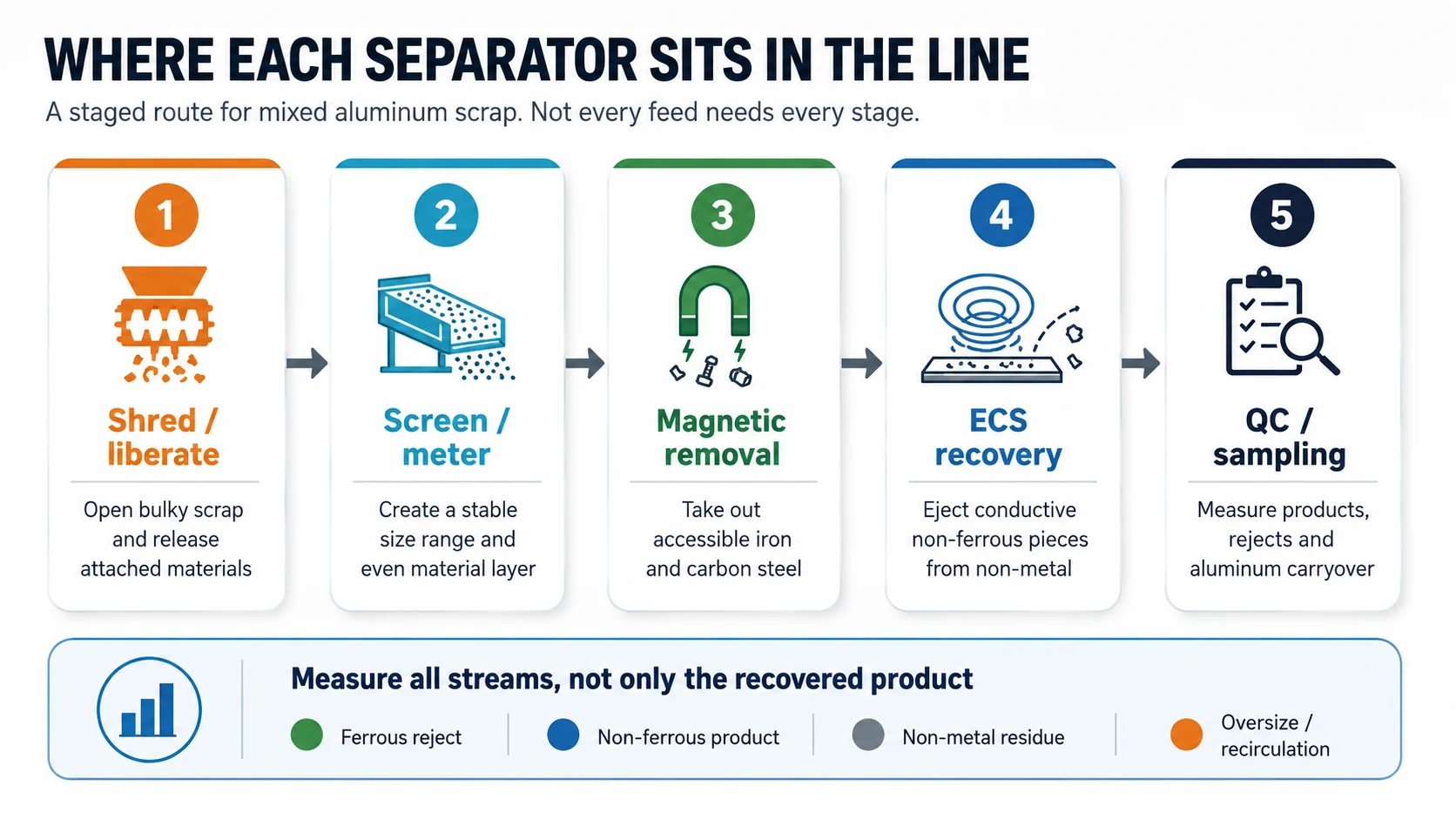
This is where both machines usually earn their place. The feed may contain aluminum sheet, small cast pieces, steel attachments and non-metal residue. Primary shredding opens the bulky items. Secondary reduction is used only if more liberation is needed. Screening narrows the size range. The magnet takes the accessible ferrous fraction, and the ECS then recovers conductive non-ferrous pieces from what is left.
Even after a good run, the ECS product may still be a mixed non-ferrous product. Copper and brass can respond too. That may be acceptable if the next buyer purchases a mixed fraction. It is not the same as producing a defined aluminum alloy grade.
Wheels and automotive castings
A wheel is not just aluminum when it enters the yard. Tires, valves, balancing weights, bearings, shafts and fluids change the preparation route. Remove or release those components first. A magnet can deal with exposed steel. An ECS is only relevant if smaller aluminum pieces later appear in a non-metal stream. It will not turn a mixture of cast and wrought scrap into separate chemistry-controlled products.
UBC cans and light packaging
Clean cans accepted for direct baling do not automatically need a long separation line. Inspection and optional ferrous removal may be enough. The ECS becomes useful when the cans are mixed with paper, plastic or other dry residue and the aluminum is being lost. More processing is not always better. Thin aluminum can turn into fines, and fines are hard to sell if the original product could have been baled intact.
Chips and turnings
Wet or oily chips are a different project. They can clump, bridge and stick to the belt, while long turnings wrap around rotating equipment. Liquid control, controlled feeding and briquetting may matter more than a standard dry ECS layout. Foreign steel still needs attention, but copying a profile-scrap line usually creates new problems instead of solving the old ones.
| What the feed looks like | Likely route | Reasoning |
|---|---|---|
| Clean aluminum with occasional loose steel | Magnet; ECS often unnecessary | The loss problem is ferrous contamination, not aluminum mixed with non-metal residue |
| Dry mixture of iron, aluminum and plastic | Magnet followed by ECS | Two unwanted fractions require two different mechanisms |
| Aluminum and copper already recovered together | Further sorting after ECS | The ECS may recover both from residue but does not reliably identify them as separate grades |
| Clean cans going directly to a baler | Inspection and optional ferrous control | A simpler route may preserve yield and reduce wear |
| Wet fine chips or tangled turnings | Dedicated chip preparation route | Moisture, fines and material handling dominate the design |
A Good Separator Cannot Rescue a Bad Feed Presentation
Catalogue comparisons focus on magnet strength, rotor speed, belt width and motor power. Those details matter. They are just not the first things we would look at when a plant is losing aluminum. A separator acts on individual pieces. If those pieces are still attached, buried in a thick bed or stuck together with oil and fines, the machine is being asked to solve the wrong problem.
Size range
Large cast pieces and small foil do not leave the belt in the same way. Put both under one splitter setting and the operator is forced into a compromise. Screening often improves the decision, provided the process does not create unnecessary fines.
Shape
Flat sheet, compact cast metal, wire and jagged fragments have different drag and contact behavior. A thin piece may flutter. A dense piece may carry forward. Long material can bridge or rotate before it reaches the separation zone.
Liberation
An aluminum-plastic composite is one object until the two materials are opened apart. The same applies to a steel insert locked inside a casting. Separators sort released pieces, not the buyer’s intention.
Burden depth
A thin, even layer gives each piece room to respond. A deep bed lets particles hide and collide. In factory trials, hand-spread material can look excellent; continuous feeding is the more revealing test.
Moisture and dirt
Water, cutting fluid, sticky dust and soil alter friction and adhesion. They also make belts harder to clean and results harder to repeat. Drying may be necessary, but that depends on the feed and local process economics.
Settings
Belt speed, rotor configuration, magnet position and splitter setting need to match the actual fraction. A single “efficiency” percentage without those conditions is not a useful comparison.
We normally look for the coarsest size that gives enough liberation and a stable separation. Crushing finer than necessary may make the demonstration look busy, but it also creates dust, oxidized fines and additional wear. Sometimes the best improvement is a screen or feeder adjustment, not a larger separator.
The same principle applies to the upstream machine choice. The YUXI guide on how to choose aluminum recycling equipment covers shredders, hammer mills, balers and chip-processing equipment in the wider line. The separator should be chosen after the material flow is understood, not bolted onto an equipment list at the end.
Where Both Machines Reach Their Limit
Alloy identification
A magnet reacts to magnetic behavior. An ECS reacts to conductive-particle behavior in a changing field. Neither machine reads chemical composition. If the buyer needs cast and wrought separation, or defined 5xxx and 6xxx products, the conversation has moved into sensor sorting and material verification.
Material that is still attached
A separator cannot pull a bolt through a solid casting. Nor can it recover the aluminum layer from a bonded panel while the panel is still one piece. Upstream size reduction must expose the boundary between materials. The challenge is to do that without grinding valuable aluminum into fines.
Guaranteed purity from an undefined feed
Purity and recovery are results of the complete test, not fixed properties of the machine. Incoming composition, size distribution, settings, feed rate and sampling method all affect the number. YUXI’s solution page does not promise one universal purity figure, and that is the responsible position. A percentage without the feed definition and reject analysis cannot be audited.
Stainless steel
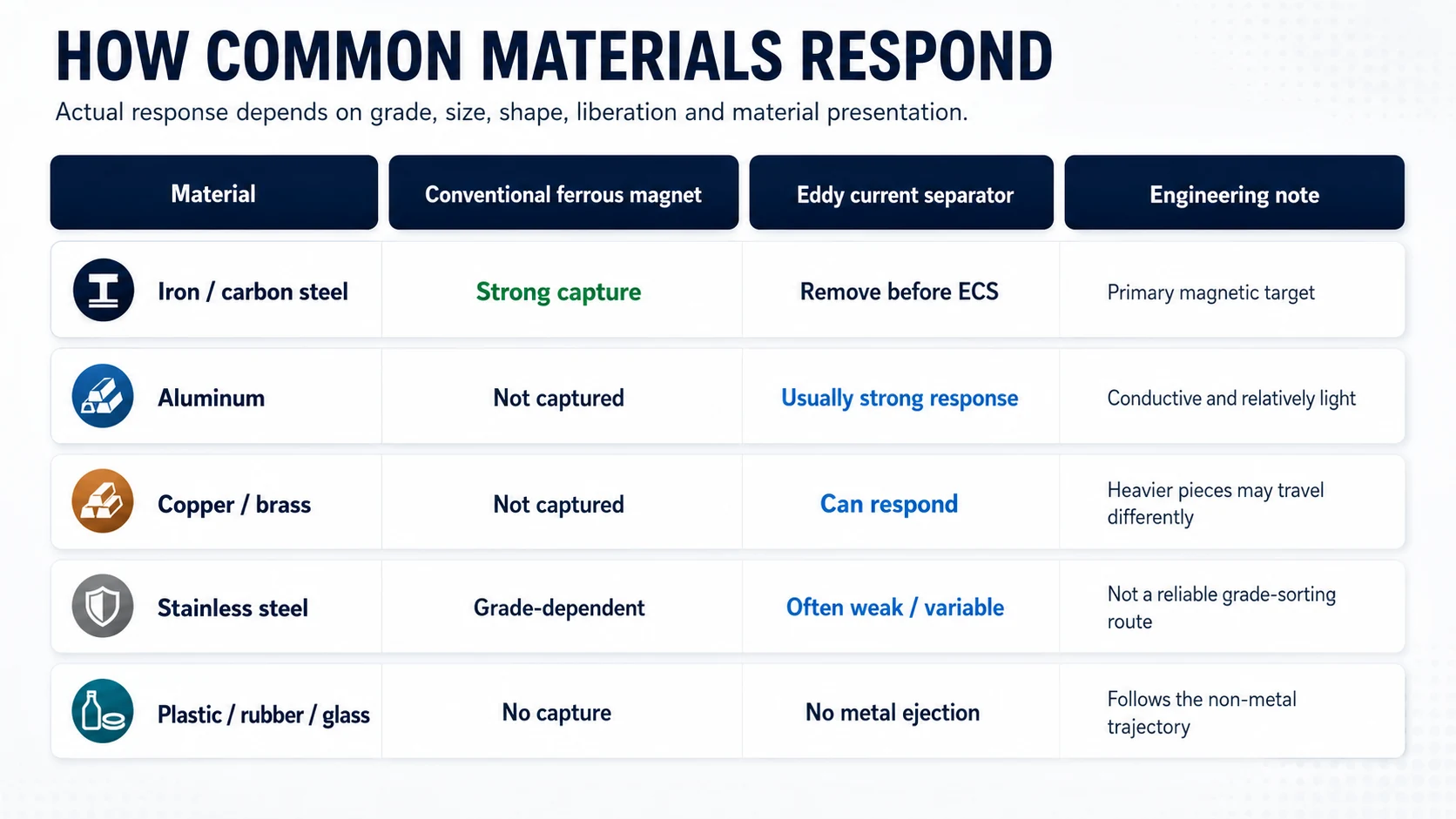
Stainless is where simple “ferrous versus non-ferrous” charts become misleading. Some grades or work-hardened pieces show magnetic attraction; others do not. Their ECS response can also be weak or inconsistent. If stainless matters commercially, put the actual grades into the sample and judge the result by mass balance—not by category name.
Wet, sticky or tangled material
Water, oil, fine dirt and long wire can spoil the feed before either separator has a fair chance. Drainage, drying, de-oiling, screening or wire control may be the real engineering work. A different separator cannot compensate for every handling problem.
How the Two Stages Fit a YUXI Aluminum Recycling Line
YUXI’s public solution does not force every aluminum material through one layout. Profiles, frames, selected castings and mixed scrap may use primary shredding, optional secondary crushing, magnetic removal, screening and an optional ECS. Clean light scrap may go through inspection and baling. Chips and turnings follow a liquid-control and briquetting route.
That “optional” wording should survive the quotation stage. A separator deserves a place only when it removes a known contaminant, recovers a saleable fraction or reduces a measured loss. Otherwise, it is another conveyor transfer, another cleaning task and another spare-parts line.
Start the inquiry with material evidence
Send representative photos or video, maximum piece size, approximate bulk density, visible steel and non-metal content, moisture or fluid condition, target throughput, expected product and available workshop space. For a separator test, agree in advance which output and reject streams will be weighed and sampled.
A Factory Test Should Show Where the Aluminum Went
Product videos nearly always follow the attractive stream. The useful camera angle is often on the reject side. A clean handful of recovered aluminum proves very little if valuable pieces are still leaving with the plastic or buried in the ferrous discharge.
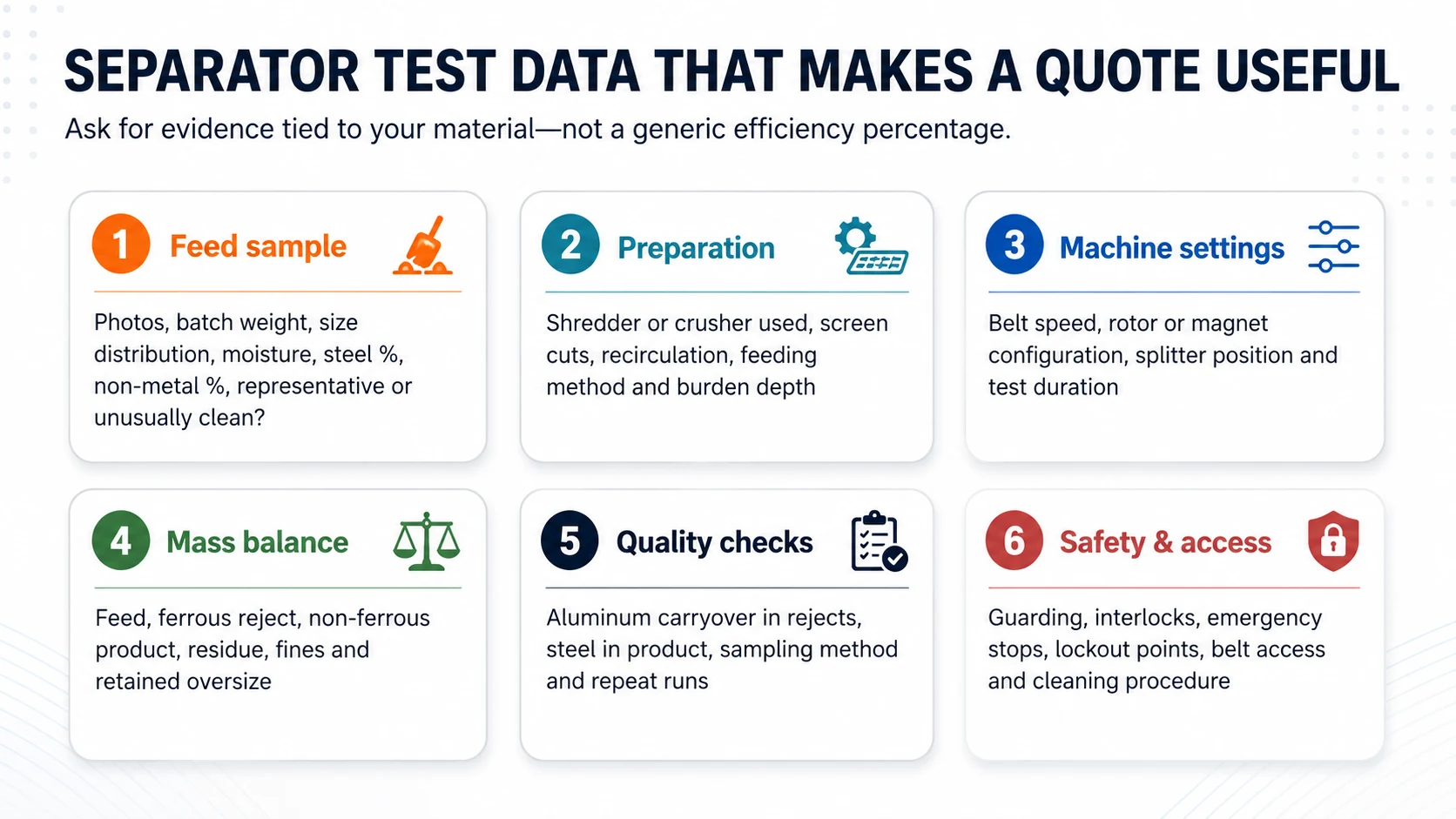
Begin with a representative sample—not a hand-picked batch of large, clean aluminum pieces. Record its weight, source, size distribution, moisture and visible composition. Then document what happened before the separator: shredding, screening, recirculation, manual picking and any air separation.
During the run, note the feeder, average feed rate, burden depth, belt speed, magnet position, rotor setting and splitter position. When a setting changes, write it down. Otherwise, a better second run may be credited to the wrong part of the machine.
At the end, weigh every stream. Feed should reconcile with ferrous reject, recovered non-ferrous product, non-metal residue, fines, oversize, recirculation and material left inside the line. Then sample the places where the business loses money: aluminum in reject streams, steel in the product and non-metal contamination in the recovered fraction.
One short run is rarely enough. Carefully hand-fed material may give a cleaner result than continuous production. Repeat the test at a realistic rate, and pay attention to the ordinary run—not only the best five minutes.
Do Not Leave Maintenance Access Until the Layout Is Finished
Separator lines bring together conveyors, rotating drums, high-speed rotors, drives, nip points and sharp scrap. OSHA 29 CFR 1910.212 addresses guarding around rotating parts, ingoing nip points and material hazards. OSHA 29 CFR 1910.147 covers control of hazardous energy during servicing and maintenance.
The practical review is broader than checking whether a guard exists in a product photo. Can the belt be inspected without climbing over a bin? Can the magnet discharge area be cleaned safely? Is there room to remove the rotor or bearings? Where are the isolation points when the feeder, magnet belt and ECS are interlocked? A compact layout can save floor space and still make every maintenance job harder.
- Provide guarded access to nip points, rotating parts and the material discharge area.
- Define isolation points for the feeder, conveyors, magnet discharge and ECS rotor.
- Allow enough space for belt replacement, splitter adjustment and routine cleaning.
- Address sharp scrap, flying fragments, unstable bins and dust according to the actual feed.
- Confirm local electrical, fire, machinery and occupational-safety requirements before commissioning.
Frequently Asked Questions
Can a magnetic separator remove aluminum?
Not with the conventional ferrous magnets normally used on scrap lines. Those machines are there for accessible iron and carbon steel. Aluminum usually stays on the belt. When aluminum has to be recovered from plastic, rubber or glass, that is the eddy-current stage—not the magnet’s job.
Why put the magnet before the eddy current separator?
Because steel is the wrong material to carry into the ECS. Removing it first gives the rotor a cleaner, more stable feed and helps keep ferrous contamination out of the non-ferrous product. It also reduces the chance of loose steel collecting around the rotor area or damaging the belt and shell.
Can an eddy current separator split aluminum from copper?
A standard ECS can eject both metals from a suitable non-metal stream, but that does not mean it will make a clean aluminum product and a clean copper product. Their trajectories can differ, yet the result is still strongly affected by size, shape and density. Alloy- or metal-specific separation normally needs another validated sorting stage.
Does every aluminum recycling line need both machines?
No. Clean profile scrap with a few steel screws may need only magnetic removal. A mixed dry stream containing aluminum and non-metal residue is a more convincing case for a magnet followed by an ECS. Clean cans going straight to baling may need little more than inspection and optional ferrous control.
What changes the result of an ECS test?
More than most quotations show. Particle size, shape, liberation, moisture, burden depth, belt speed, rotor configuration and splitter position all influence the flight path. The practical answer is to test the real material and record the settings, rather than borrow a recovery figure from another feed.
Can an ECS sort stainless steel?
Do not assume so. Stainless grades behave differently, and work hardening, size and shape can change the response again. Some pieces show weak magnetic attraction; many do not produce a useful ECS trajectory. If stainless matters to the product specification, include representative pieces in the test.
What should be recorded during a separator test?
Record the feed batch, size range, moisture, burden depth, machine settings, running time and every product or reject weight. Then check the places where value can disappear: aluminum in the ferrous reject, aluminum in the non-metal residue, steel in the product and unaccounted material left in the machine.
Sources and Technical Notes
- U.S. Environmental Protection Agency, AP-42 Chapter 12.8, Secondary Aluminum Operations.
- James R. Nagel, “An Analytic Model for Eddy Current Separation,” Minerals Engineering, 2018.
- S. Capuzzi and G. Timelli, “Preparation and Melting of Scrap in Aluminum Recycling,” Metals, 2018.
- OSHA 29 CFR 1910.212 and OSHA 29 CFR 1910.147, covering machine guarding and hazardous-energy control.