




 Request Quote



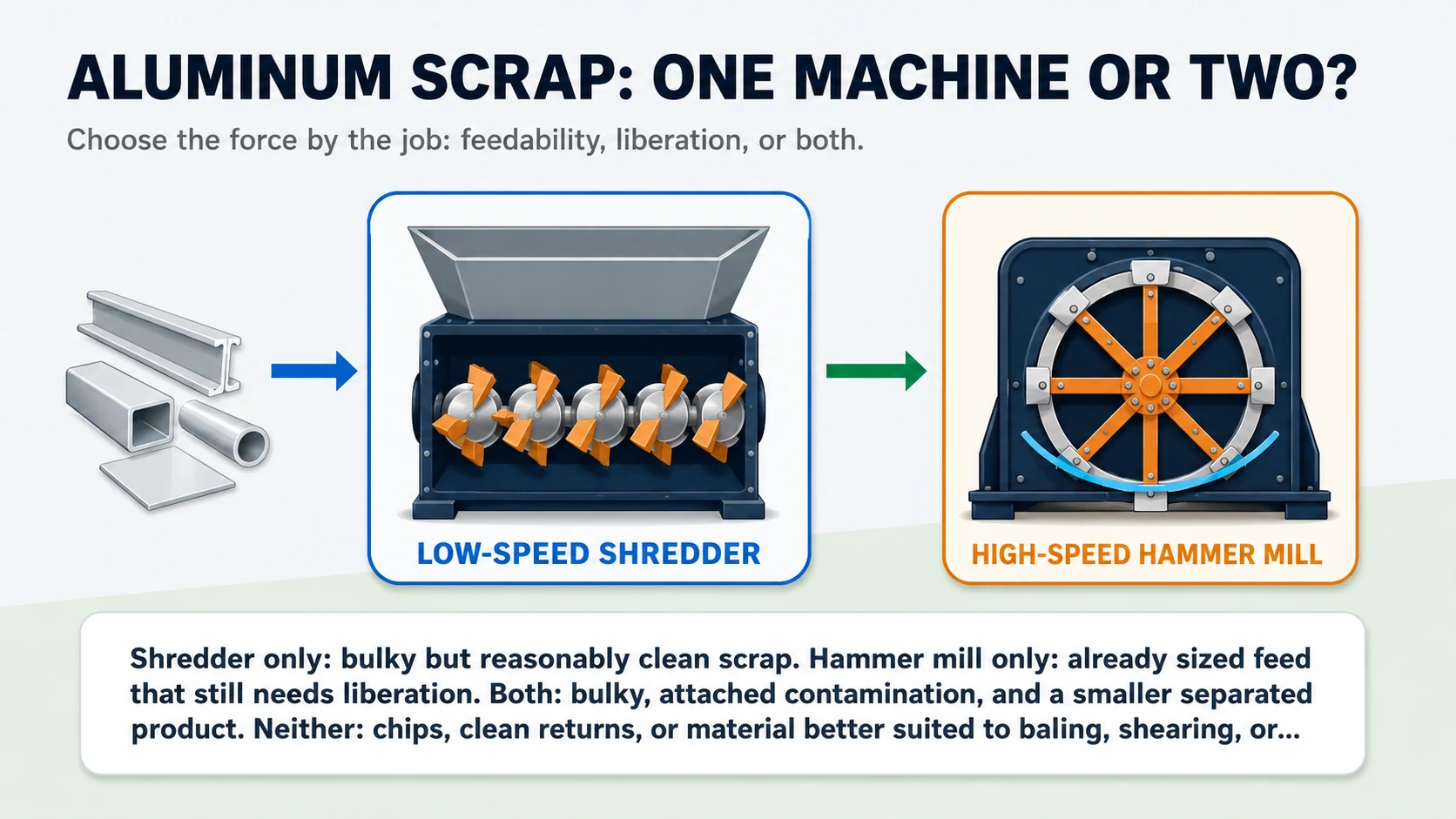
A buyer sends photos of long aluminum profiles, several cast housings, and a pile of mixed offcuts. The first quotation contains a double-shaft shredder. The second contains a hammer mill. The third includes both. All three suppliers may sound confident, yet only one route may make sense for the actual product the plant needs to sell.
This happens because “aluminum scrap” is too broad to select a machine. Long profiles behave differently from dense cast returns. A frame with steel screws and a plastic thermal break is not the same feed as clean production offcuts. Oily chips should not be treated like bulky post-consumer scrap.
In This Guide
- Why this is an aluminum-specific decision
- The three jobs size reduction can solve
- When a shredder alone is enough
- When a hammer mill alone can work
- When both stages are justified
- When neither machine is the right answer
- Feedstock-by-feedstock selection
- Fines, dust, wear, and aluminum loss
- How to verify the route
- RFQ checklist and FAQ
Why This Article Is Not a Generic Machine Comparison
YUXI already publishes a broad comparison of low-speed metal shredders and high-speed hammer mill crushers. This cluster article has a narrower job. It asks how aluminum form, attached contamination, separator requirements, and melt preparation change the decision.
That narrower scope matters. Aluminum is light, ductile, and available in very different forms. It can fold, spring back, nest, smear, or become fine material depending on the feed and force. A hammer mill may create valuable liberation in one stream and unnecessary fines in another. A primary shredder may solve feeding and volume without producing the particle range needed by a separator. Sometimes the right answer is a different route altogether.
The public YUXI scrap aluminum recycling line page follows this same feed-based logic. It separates profiles and frames, mixed aluminum, sheets and foil, chips and turnings, wheels, and automotive parts instead of forcing every material through one fixed line. That is the engineering boundary used here.
The Three Jobs Size Reduction Can Solve
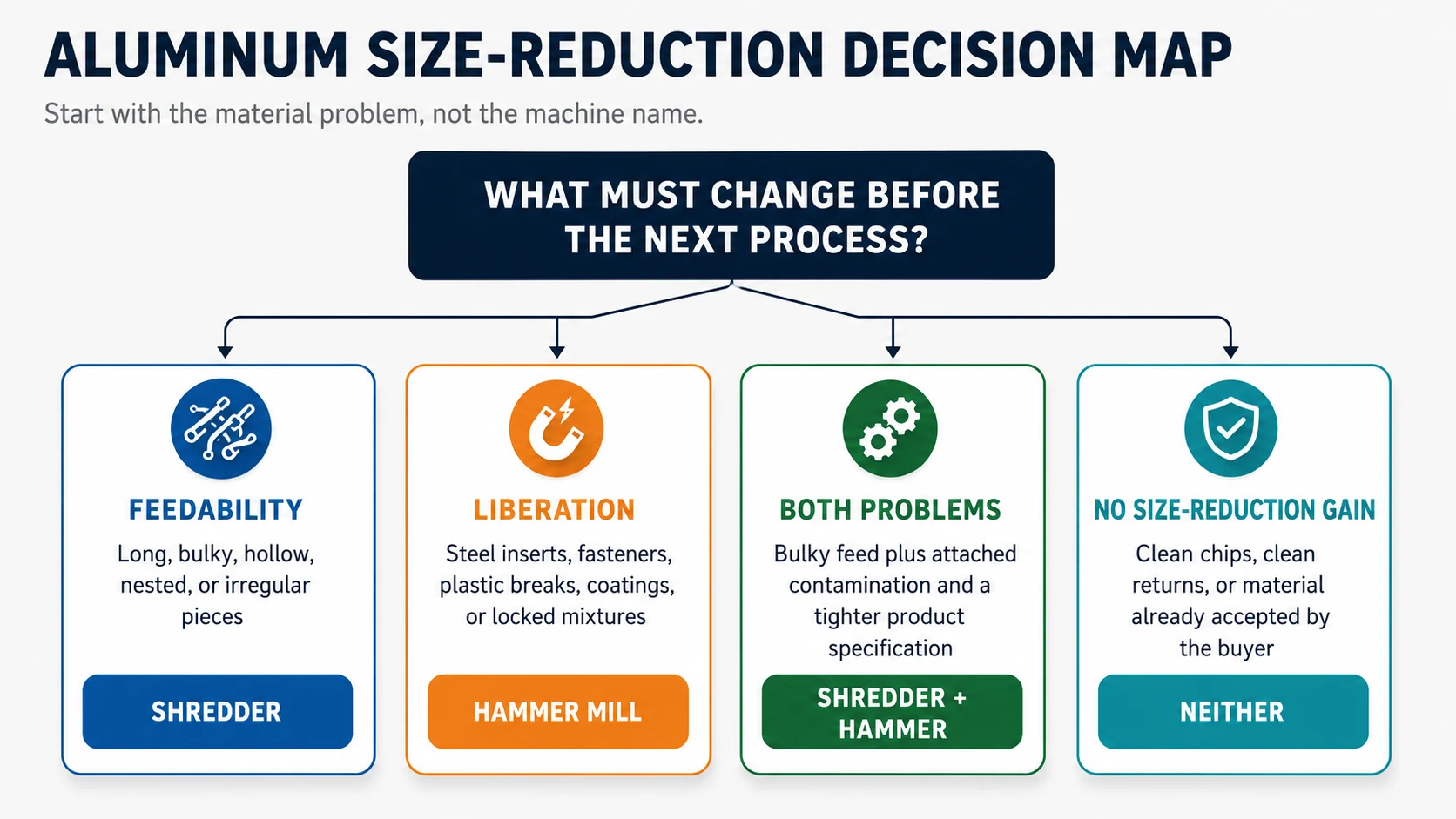
Before selecting equipment, write one sentence that describes the material problem. Most valid answers fall into three categories.
1. Make the scrap feedable
Long, hollow, bulky, nested, or irregular pieces need a machine that can grab and control them. This is primarily a low-speed shredding problem.
2. Liberate attached materials
Steel inserts, screws, bearings, plastic breaks, rubber, coatings, and mixed components may remain locked after coarse reduction. Repeated impact may be justified.
3. Create a usable particle range
Screens, magnets, air systems, sensor sorters, and furnaces perform best within defined feed conditions. The size-reduction stage must prepare that condition without destroying value.
When an Aluminum Shredder Alone Is Enough
A low-speed shredder is usually the first candidate when the incoming scrap will not feed steadily into faster equipment. The machine uses high torque and controlled grabbing rather than repeated high-speed impact. In aluminum projects, that often means long profiles, frames, hollow sections, light sheet structures, selected cast returns, and bulky mixed pieces.
The YUXI metal shredder is positioned as primary size-reduction equipment for light scrap including aluminum. For this article, the important product fact is the role: reduce difficult feed into conveyable pieces so inspection, magnetic removal, screening, or another downstream step can work more consistently.
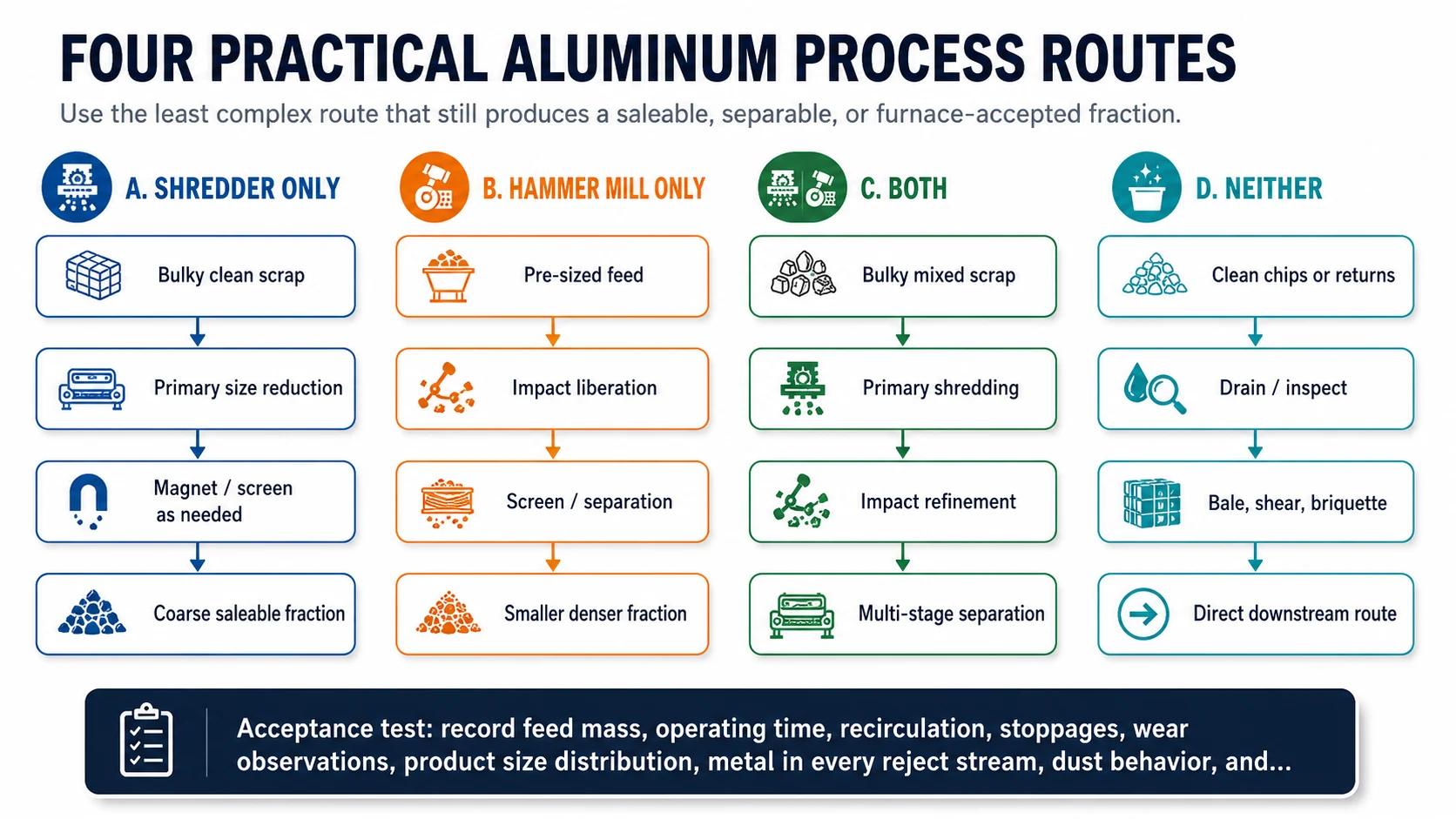
Shredder-only is a strong route when:
- The main objective is volume reduction, controlled feeding, transport, or furnace charging.
- The scrap is reasonably homogeneous and attached steel can be removed after coarse opening.
- The downstream buyer accepts a coarse, irregular fraction.
- The line does not need deep separation of tightly bonded materials.
- A finer product would add dust and wear without increasing the sale price or metal yield.
Clean extrusion returns are a good example. If the material is long and awkward but chemically controlled, a shredder may solve the handling problem without the expense and wear of a hammer mill. The same can be true for selected cast returns that only need a smaller charge size.
However, “shredder only” should not be interpreted as “shredder and nothing else.” A magnet, screen, manual quality check, or discharge handling system may still be required. The point is that secondary impact crushing is not automatically justified.
When a Hammer Mill Alone Can Work
A hammer mill becomes relevant when the feed is already sized, stable, and safe to enter a high-speed impact chamber, but the material is not sufficiently liberated or dense for the next process. The YUXI hammer mill metal crusher page describes hammering, tearing, and shearing actions used to create smaller pieces and improve separation of metal and non-metal components.
The phrase “already sized” is critical. A hammer mill is not a cure for uncontrolled feeding. Long springy profiles, large hollow structures, and nested sheet bundles can bridge, bounce, or enter inconsistently. Pre-cutting, primary shredding, or a controlled feeder may be required before impact processing.
Hammer-mill-only can be considered when:
- The plant buys pre-shredded or pre-cut aluminum with a controlled maximum size.
- Steel fasteners, plastic, rubber, coatings, or compact mixed components still need liberation.
- The product must reach a smaller and denser range for screening or separation.
- The feed composition is stable enough to design wear, dust, and recirculation controls.
- A representative test shows that the extra stage increases recovered saleable aluminum.
That last point is often missed. A hammer mill can make material look more processed without making it more valuable. The test must follow aluminum through every fraction, including dust, screen undersize, light reject, and recirculation. A clean-looking main product is not proof of total recovery.
When Aluminum Scrap Needs Both Machines
Both stages are justified when the plant has two separate problems: the feed is too bulky or irregular for stable impact processing, and coarse shredding alone does not expose the materials that must be separated.
Mixed automotive aluminum housings illustrate the logic. A housing may carry bearings, shafts, bolts, seals, oil residue, and attached steel. The primary shredder opens the structure and reduces the maximum piece size. Accessible iron can then be removed or controlled. The hammer mill refines the remaining prepared fraction so magnets, screens, air systems, or other sorters see a more liberated feed.
Thermal-break aluminum profiles can create a similar case. Primary shredding makes long frames conveyable. Yet plastic strips and fasteners may remain trapped inside folded aluminum. A second impact stage may be useful—but only if it actually releases those materials and the resulting fines remain acceptable.
| Stage | Problem solved | Evidence to request |
|---|---|---|
| Controlled feeding | Creates a stable feed layer and protects the first machine from surges. | Maximum piece dimensions, bulk density, loader method, and feed-rate control. |
| Primary shredding | Opens bulky scrap and reduces it to a conveyable size. | Discharge size distribution, oversize rate, wrapping or bridging observations. |
| Intermediate removal | Removes exposed ferrous items or uncrushable contaminants before refinement. | Magnet pull-out results and rejected-item record. |
| Hammer milling | Improves liberation, density, and particle-range control. | Power draw, recirculation, wear observation, fines percentage, and output distribution. |
| Final separation | Converts liberated particles into saleable aluminum and reject fractions. | Mass balance and metal content in every output stream. |
There is no universal placement for every separator. Some lines remove exposed ferrous material after primary shredding to protect the hammer mill. Others need a second magnetic check after impact refinement. An eddy current separator is relevant when aluminum must be recovered from a suitable mixed stream, but its performance also depends on particle size, shape, feed presentation, and the difference between the aluminum trajectory and the background material.
When Neither Machine Is the Right Answer
Sometimes the best aluminum shredder vs hammer mill decision is to reject both options. This is not a compromise. It is often the more disciplined engineering choice.
Machining chips and turnings
Chips are already small. The real problems are cutting fluid, moisture, low bulk density, oxidation exposure, and safe handling. Drainage, liquid control, chip conditioning, and briquetting usually deserve attention before any additional crushing.
Clean sheet, foil, and production offcuts
If the material is clean and the commercial goal is transport or furnace charging, baling or shearing may be more direct. Impact milling can create light fines that are harder to capture and may not improve the buyer’s acceptance.
Clean cast or extrusion returns
A furnace may accept clean returns after inspection and controlled sizing. If no attached material must be liberated, a hammer mill may only add wear and surface area. Confirm the charge specification before reducing the scrap further.
Feedstock-by-Feedstock Selection
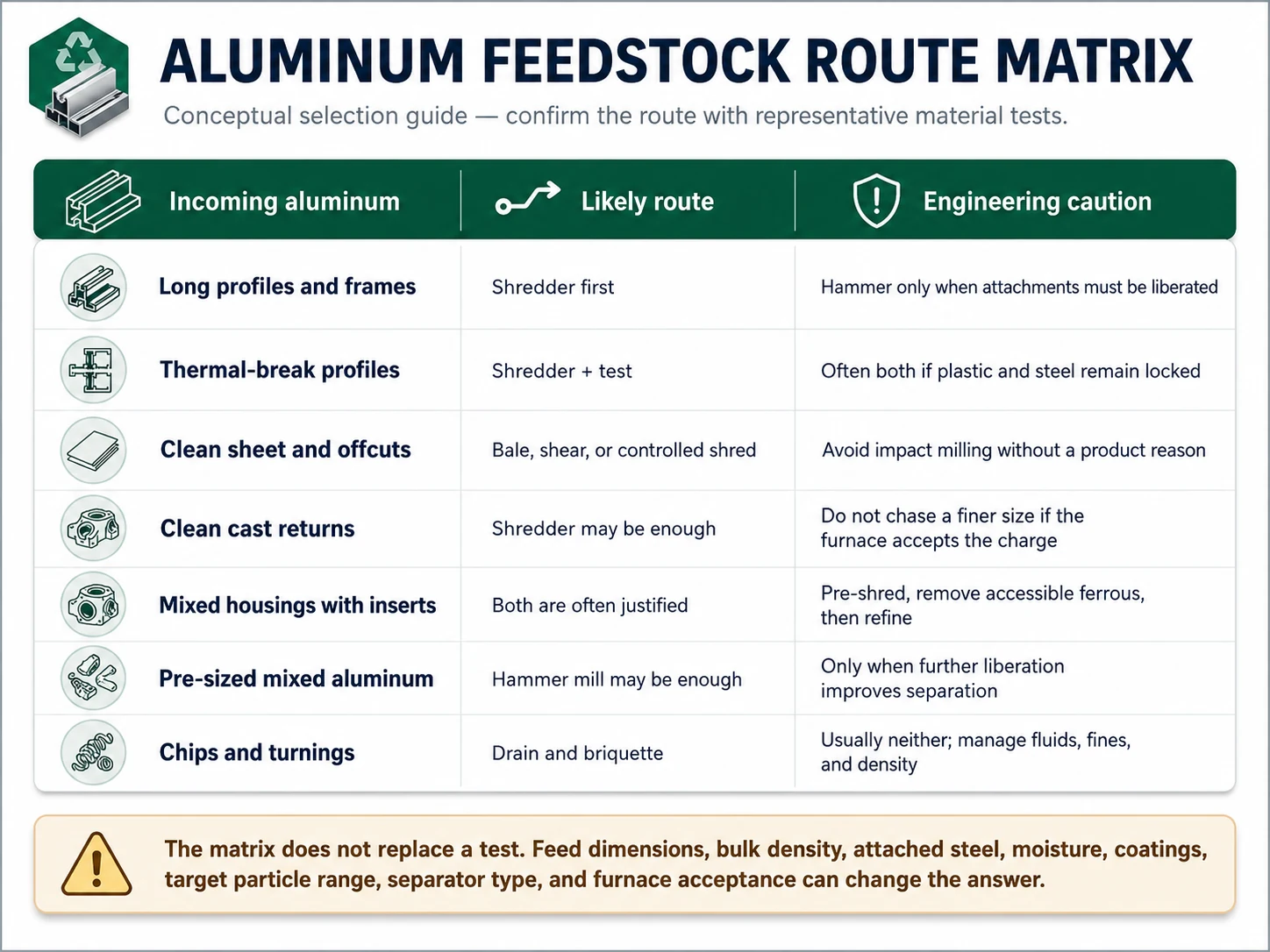
| Aluminum feed | Start with | Add a hammer mill when | Main reason not to over-process |
|---|---|---|---|
| Long profiles and frames | Primary shredder or pre-cutting | Fasteners, thermal breaks, or mixed attachments remain locked | Clean extrusion value may not improve with finer impact crushing |
| Thermal-break profiles | Shredder plus a liberation test | Plastic strips and steel remain attached after coarse reduction | Excessive fines can report to light reject or dust collection |
| Clean sheet and offcuts | Baler, shear, or controlled shredder | Only when a downstream process requires a smaller liberated fraction | The material may already meet transport or furnace requirements |
| Clean cast returns or wheels | Inspection and controlled size reduction | Steel inserts or mixed components cannot be removed economically otherwise | Homogeneous metal may be accepted without impact refinement |
| Mixed housings and automotive aluminum | Primary shredder and staged removal | Bearings, shafts, seals, plastic, and steel stay locked | A fixed two-stage route may be unnecessary if dismantling removes the attachments first |
| Pre-sized mixed aluminum | Hammer mill test | The test proves better liberation and saleable recovery | Appearance of the main product can hide aluminum losses in fines and reject |
| Chips and turnings | Drainage and briquetting | Rarely; only for a defined conditioning purpose | They are already fine and may contain oil or moisture |
Fines, Dust, Wear, and Aluminum Loss
This is where aluminum-specific judgment becomes important. High-speed impact can improve liberation, but it also creates more surface area, light particles, dust, and wear. The correct balance is project-specific.
Capuzzi and Timelli’s review of aluminum scrap preparation describes shredding, screening, magnetic separation, eddy-current separation, density techniques, and other upgrading steps as parts of a broader preparation system. The practical implication is that size reduction must be designed together with the separation method and the melting route—not treated as an isolated machine choice.
The U.S. EPA also warns that violent grinding and shredding will produce heat and particulate emissions, especially when the incoming scrap contains paints, plastics, sealants, rubber, fluids, or other non-metallic materials. Therefore, decontamination, contaminant removal, equipment enclosure, emission capture, and air-control measures should be addressed early in project planning rather than added after the line has been installed.
For aluminum, fines are not automatically wasted, but they are a separate material-management problem. Ask where the undersize is, whether it can be sold or re-melted,and whether the remelting operartion can recover it economically. Also ask how the line prevents valuable aluminum from leaving with light fraction, dust, or screen reject.
Signs the hammer mill adds value
- More exposed ferrous material is removed.
- Non-metal attachments are released.
- The separator receives a stable size range.
- Saleable aluminum mass increases after all losses are counted.
Signs the line is over-processing
- Fines and dust rise without a product-value gain.
- Recirculation becomes a permanent operating condition.
- Wear and downtime increase faster than recovered value.
- The furnace or buyer would accept a coarser product.
How to Verify the Route Before Purchase
A representative material test is more useful than a catalogue comparison. The test batch should include the difficult pieces, not only the easiest clean scrap. Include the longest profile, thickest casting, heaviest attachment, typical dirt, and normal variation.
Record a complete mass balance
- Weigh the incoming material and document the composition.
- Record actual operating time, idle time, jams, reversals, and recirculation.
- Sieve or classify the product into meaningful size fractions.
- Measure ferrous, aluminum, and non-metal content in every product and reject stream.
- Collect fines and dust so the aluminum loss is visible.
- Ask the downstream buyer or furnace operator to evaluate the product.
The Aluminum Association’s automotive recycling study shows why this wider view matters: shredded non-ferrous streams are upgraded using combinations of size, magnetic response, conductivity, density, and other separation properties. It also notes that some downstream separation businesses process pre-shredded feed without operating a hammer mill themselves. In other words, the commercially correct boundary may sit between companies, not inside one plant.
Balance the entire line, not only the first machine
A primary shredder can produce more material than the hammer mill or separator can accept. Conversely, an oversized hammer mill may sit idle because irregular feed reaches it in surges. The proposal should state the continuous basis for each stage, expected recirculation, planned buffer capacity, cleaning time, wear access, and the conditions used for the throughput claim.
RFQ Checklist: Data YUXI Needs to Configure the Route
A useful quotation begins with material evidence. Send enough information for the supplier to decide whether the project needs primary shredding, impact refinement, separation, densification, or a simpler alternative.
| RFQ item | What to provide | Why it changes the configuration |
|---|---|---|
| Material identity | Photos, video, alloy groups if known, and monthly mix variation | Separates homogeneous production returns from mixed post-consumer scrap |
| Physical form | Maximum length, width, thickness, wall section, bundle conditions, and volume density | Determine the feeding, chamber size, pre-cutting, and primary reduction |
| Accessories | Steel screws, bearings, plastic, rubber, glass, dirt, coatings, and prohibited items | Determines the release depth, sorting stages, wear, and safety controls |
| Moisture and fluids | Oil, coolant, water, trapped liquid, and drainage conditions | Changes pretreatment, fire control, dust behavior, and whether the chip should be briquetted |
| Required product | Size range, fines limit, bulk density, metal purity, and buyer/furnace acceptance | Determines whether a hammer mill or secondary stage adds value |
| Throughput basis | Required net acceptable output, operating hours, shift pattern, and peak feed | Prevents a nominal machine rating from being mistaken for line output |
| Site conditions | Power, workshop dimensions, loading method, dust limits, maintenance access, and expansion plan | Changes motor/control configuration, conveyors, enclosure, and layout |
Get a Feed-Based Aluminum Line Review
Send representative feed photos or video, maximum dimensions, bulk density, attached contaminants, target throughput, required output, downstream separation or furnace specification, power supply, and workshop limits. YUXI can then divide the project into the least complex practical route rather than forcing every aluminum stream through one fixed machine sequence.
FAQ
What is the main difference between an aluminum shredder and a hammer mill?
A low-speed shredder mainly solves feedability and primary size reduction by grabbing, tearing, and shearing bulky scrap. A hammer mill applies repeated high-speed impact to pre-sized material when the project needs more liberation, density, or a smaller particle range.
Does every aluminum recycling line need a hammer mill?
No. Clean profiles, sheets, offcuts, cast returns, or other reasonably homogeneous scrap may only need controlled shredding, shearing, baling, or no additional size reduction. A hammer mill is justified only when its added liberation or particle control improves the next separation or melting step.
When is a hammer mill needed after primary shredding?
It is considered when steel inserts, fasteners, plastic thermal breaks, coatings, or mixed components remain locked after primary shredding and the downstream separator needs a smaller, more liberated feed. Representative tests should confirm that the additional stage improves saleable recovery rather than only creating more fines.
Can a hammer mill process long aluminum profiles directly?
Direct feeding is usually a poor starting assumption. Long, springy, nested, or irregular profiles can bridge or enter inconsistently. Primary shredding, cutting, or controlled feeding is normally evaluated first.
Is smaller aluminum scrap always better for melting?
No. The furnace operator may value density and consistent charging, but excessive size reduction increases surface area, dust, and fine generation. The correct product size is the range accepted by the downstream separator or furnace—not the smallest size a machine can produce.
What aluminum scrap usually needs neither machine?
Machining chips and turnings usually need fluid control and briquetting rather than impact crushing. Clean production returns may be accepted after inspection, shearing, baling, or direct furnace preparation. The right route depends on the buyer’s acceptance specification.
Where should magnetic separation be placed in a two-stage line?
The exact position depends on how accessible the ferrous attachments become after each reduction stage. Some projects remove exposed iron after primary shredding to protect downstream equipment, then use another magnetic check after refinement. The sequence should be confirmed during process design.
What data should be sent for an aluminum shredder vs hammer mill quotation?
Send representative photos and video, maximum dimensions, wall thickness, bulk density, attached steel or plastic, moisture or oil, prohibited items, required throughput basis, target product size, downstream separator or furnace requirements, power supply, and workshop limits.
Authoritative Sources and Technical Notes
- Capuzzi & Timelli ? Preparation and Melting of Scrap in Aluminum Recycling: review of scrap upgrading, shredding, screening, magnetic, eddy-current, density, and melting preparation methods.
- The Aluminum Association ? Automotive Aluminum Recycling at End of Life: shredding and downstream separation, including size, conductivity, density, and pre-shredded feed.
- U.S. EPA ? Metal Shredder Enforcement Alert: emissions, contaminant removal, enclosures, capture, particulate, and VOC controls.
- U.S. EPA AP-42, Secondary Aluminum Operations: pretreatment, heavy-media separation, and secondary aluminum smelting context.