




 Request Quote



Quick Answer: What Determines Hammer Mill Capacity?
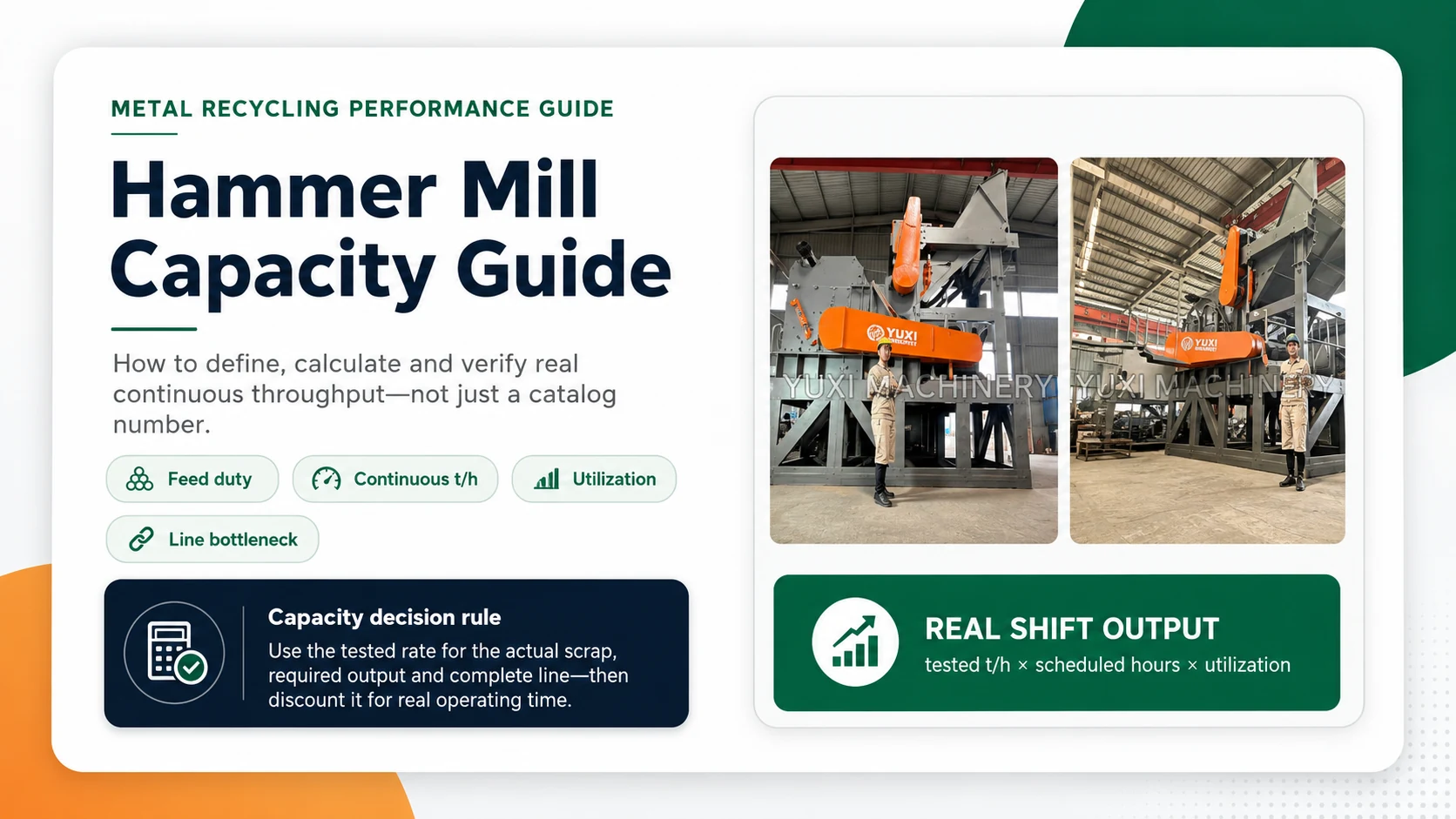
Hammer mill capacity is the mass of a defined material that the machine can process per unit of time while producing the required output and operating within acceptable load, wear and safety conditions.
For scrap metal, that number changes with material density, maximum piece size, thickness, shape, contamination, preparation, feed stability, screen or grate restriction, hammer condition and the capacity of the equipment before and after the mill. A short peak rate is not the same as a continuous rate, and neither is automatically the same as saleable finished output.
What Does Hammer Mill Capacity Really Mean?
A buyer may receive several numbers for the same machine. All of them can be mathematically correct while describing different operating realities. The first step is therefore to attach a definition to every tons-per-hour claim.
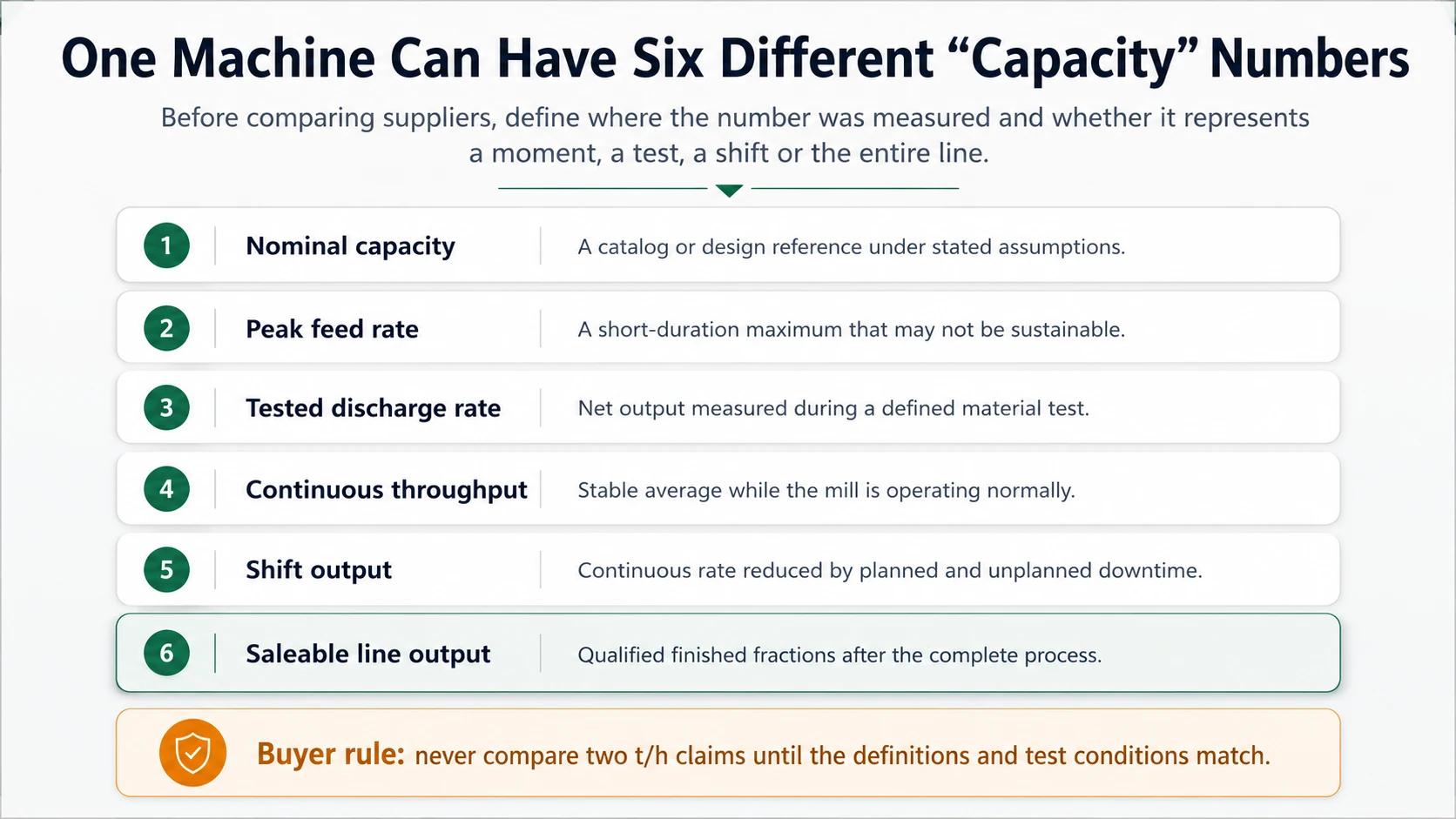
| Capacity term | What it describes | How buyers should use it |
|---|---|---|
| Nominal capacity | A design or catalog reference under stated or assumed conditions. | Use only as an initial range. It is not an acceptance guarantee without a duty basis. |
| Peak feed rate | The highest short-duration rate entering the machine before load, chamber level or another constraint forces a reduction. | Useful for feeder and surge design, but weak for daily production planning. |
| Tested discharge rate | Net material leaving the hammer mill during a defined test. | Check the feed material, net runtime, weighing method, output target and stoppages. |
| Continuous throughput | The stable average rate while the mill runs normally over a meaningful period. | This is the strongest single number for machine selection when the test conditions match the project. |
| Shift output | The tonnes produced during a scheduled shift after downtime, cleaning, inspection and adjustments. | Use for labor, inventory, loader, storage and revenue planning. |
| Saleable line output | The mass of qualified ferrous, nonferrous or other commercial fractions after the complete process. | Use for business planning. It depends on recovery yield as well as crusher throughput. |
The distinction is especially important because a hammer mill can be running at a high feed rate while producing too much oversize, too many fines or an output that overwhelms the next separator. In that case, the machine may be busy without the line meeting its commercial objective.
The basic machine definition is covered separately in What Is a Hammer Mill Metal Crusher?. This guide owns a narrower intent: how capacity should be defined, estimated, tested and accepted.
Why the Same Hammer Mill Processes Different Scrap at Different Rates
A hammer mill does not process a material name; it processes individual pieces with a particular mass, geometry and resistance to deformation. “Five tonnes of scrap steel” can describe thin open sheet, nested stampings, drums, pre-shredded fragments, motors, cast parts or a mixture of all of them. Those feeds do not enter, accelerate, break or discharge in the same way.
Bulk density changes the volume entering per tonne
Low-density material occupies more conveyor and chamber volume for the same mass. A feed system may become volume-limited before the motor reaches its expected load. Dense assemblies create fewer pieces per tonne but larger impact events. Capacity therefore needs both a mass target and a description of how the material packs.
Maximum dimensions control feeding reliability
Average size is not enough. One long section can bridge a hopper, one oversized assembly can interrupt metering, and one dense shaft can create an impact beyond the intended duty. Record maximum length, width, thickness and single-piece mass, together with the percentage of material near that maximum.
Shape and ductility change breakage behavior
Brittle cast parts may fracture quickly but produce a different fragment distribution from ductile sheet or aluminum profiles. Hollow material can rebound and circulate. Long strip can entangle. Assemblies with bearings, shafts, copper windings, plastic and rubber require impact energy not only for size reduction but also for opening material interfaces.
Preparation determines whether impact crushing is the first or second job
Bulky, tangled or irregular scrap may need dismantling, shearing or low-speed primary shredding before the hammer mill. YUXI’s Metal Shredder vs Hammer Mill Crusher comparison explains why primary shearing and secondary impact refinement are different process stages.
Contamination consumes capacity without creating saleable metal
Dirt, rubber, plastic, residual liquids and other non-metal material still occupy the feed system and crushing chamber. They can also increase dust, reduce the saleable fraction and change wear. Capacity testing should report feed composition and downstream yield rather than treating gross incoming mass as recovered metal.
Main Factors That Control Sustainable Hammer Mill Capacity
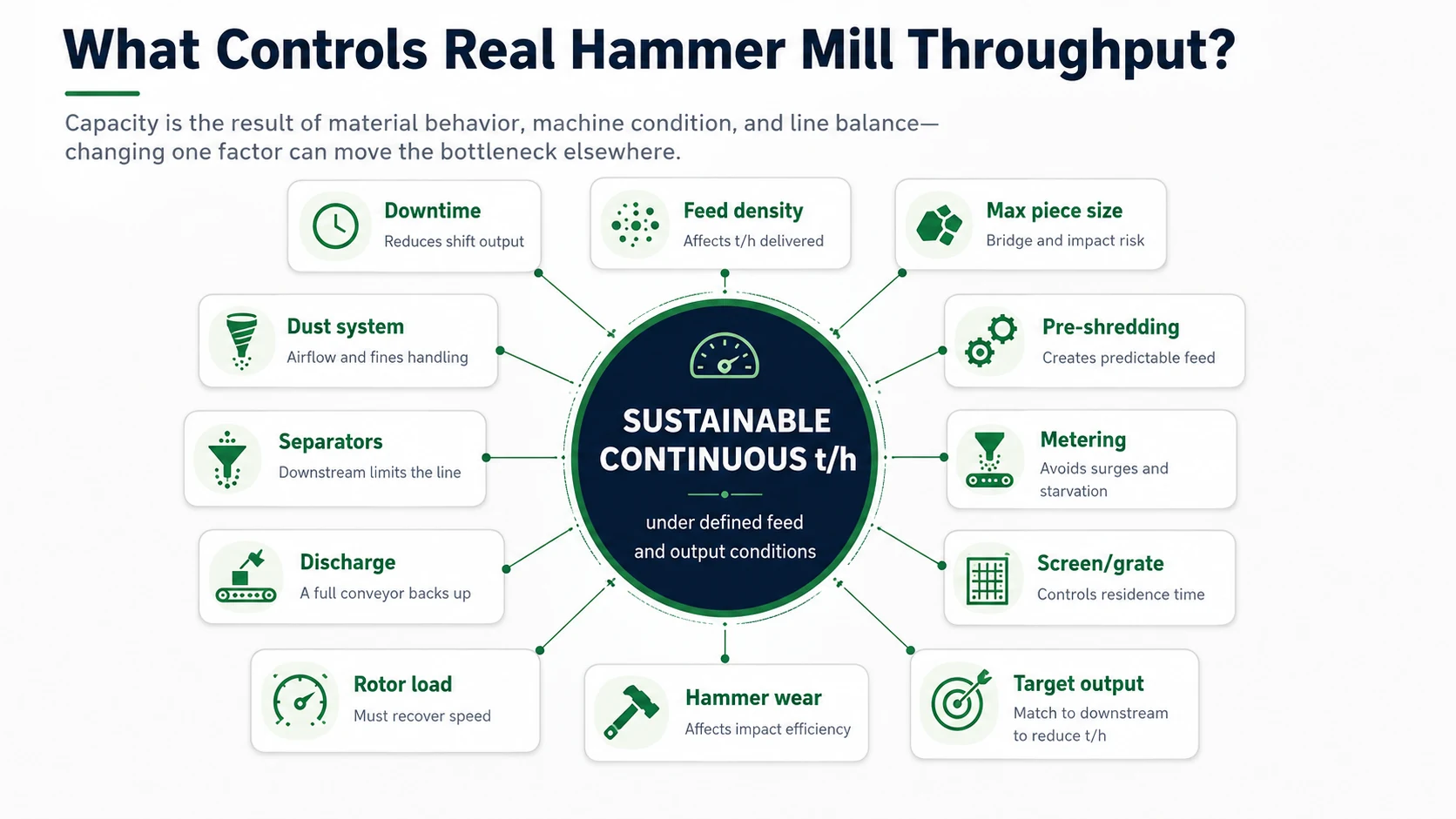
1. Feed metering and load stability
A stable feeder keeps the rotor working without repeated surges and empty periods. Dense surges can pull down rotor speed, raise current and increase recirculation. Starved feeding leaves installed capacity unused. A useful control strategy responds to measured machine load rather than a fixed conveyor speed alone.
2. Upstream reduction
Primary shredding or shearing can remove the feeding constraint and create a narrower feed envelope. It may also remove unbreakable items before they reach high-speed equipment. The extra machine adds cost, but it can improve sustainable line capacity when the original feed is bulky or inconsistent.
3. Rotor energy and recovery after impact
Rotor mass, speed, working width, hammer arrangement and drive design influence how the machine responds to each impact. Capacity is not determined by motor nameplate power alone. The rotor must recover speed, the feeder must react to load, and the mechanical system must remain within vibration and temperature limits.
4. Hammer and liner condition
Wear changes impact geometry, clearances and energy transfer. Production can decline gradually, making the loss easy to miss. Track throughput, average load and output distribution against tonnes processed so that maintenance decisions are based on performance rather than the calendar alone.
5. Chamber recirculation
Fragments that cannot leave remain active and receive additional impacts. Some recirculation is necessary for output control, but excessive residence time reduces fresh-feed capacity and can increase fines, heat and wear. The full internal cycle is explained in the Hammer Mill Working Principle guide.
6. Discharge and conveyor capacity
A hammer mill cannot maintain output if the discharge conveyor, magnet, screen or bunker backs up. Verify conveyor width, speed, transfer height, bulk volume and surge capacity using the actual fragment condition—not only the incoming feed tonnage.
7. Downstream separator operating window
Magnets, screens, air systems and eddy current separators often work best within a defined particle-size and loading range. Increasing hammer-mill feed beyond that range may reduce recovery quality even if the crusher itself continues to run.
8. Planned operating hours and downtime
Daily output is reduced by inspections, screen cleaning, hammer service, jam clearing, loader delays, material changes and downstream interruptions. Separate scheduled hours, operating hours and productive hours in every production report.
Screen or Grate Opening: Why Finer Output Can Reduce Throughput
YUXI’s public product page states that the discharge mesh can be selected according to the user’s metal-particle requirement. That is an important process variable, but a smaller opening should not be selected in isolation.
When the discharge condition becomes tighter, fragments may remain in the chamber longer and receive more impacts. Depending on the material and machine, this can reduce the throughput, increase the specific energy, accelerate the wear of the hammer and lining, and produce more fines. The correct target is usually the coarsest output, which still allows the downstream process to achieve the required recovery or product specifications.
| Output decision | Possible effect on throughput | What to verify |
|---|---|---|
| Larger opening or less restrictive discharge | Potentially faster discharge and higher rate, but wider fragments or more oversize may remain. | Whether magnets, screens, sorters or the buyer can accept the coarser stream. |
| Smaller opening or tighter grate | Potentially longer residence time, more impacts and lower rate. | Fines percentage, power trend, wear, temperature and whether recovery value actually improves. |
| Mixed openings or staged screening | Can help manage size classification outside the mill rather than forcing all reduction inside it. | Circulating load, oversize return, screen capacity and extra conveying. |
| No meaningful output specification | Capacity claims become easy to inflate because almost any discharged fragment can be counted. | Target range, oversize limit, fines limit, bulk density and liberation requirement. |
How to Calculate Hammer Mill Throughput and Shift Output
The formulas are simple. The quality of the result depends on measuring the correct mass and time.
Continuous throughput
Continuous throughput (t/h) = net measured mass ÷ net operating time
Net operating time excludes periods when feed is stopped for a blockage, adjustment, inspection or downstream interruption. Report those interruptions separately rather than hiding them from the rate.
Utilization
Utilization (%) = productive operating time ÷ scheduled time × 100
Use a realistic value based on similar equipment or recorded plant history. A new project should model more than one utilization case rather than treating 100% as normal.
Estimated shift output
Shift output = tested continuous t/h × scheduled hours × utilization
Example: 5.0 t/h × 8 h × 85% = 34 tonnes per shift.
Saleable metal output
Saleable output = line feed × measured saleable-fraction yield
Do not assume the yield. Measure ferrous, nonferrous, fines, oversize, non-metal residue and process loss under the agreed test method.
Example: Why a 6 t/h claim may produce less than 40 tonnes per shift
| Planning step | Calculation | Result |
|---|---|---|
| Short test result | 12 tonnes discharged in 2 hours of net operating time | 6.0 t/h tested rate |
| Expected shift utilization | 8 scheduled hours × 80% | 6.4 productive hours |
| Gross shift discharge | 6.0 t/h × 6.4 hours | 38.4 tonnes |
| Saleable fraction yield | 38.4 tonnes × 88% measured yield | 33.8 tonnes saleable output |
Hammer Mill Capacity vs Complete Recycling Line Capacity
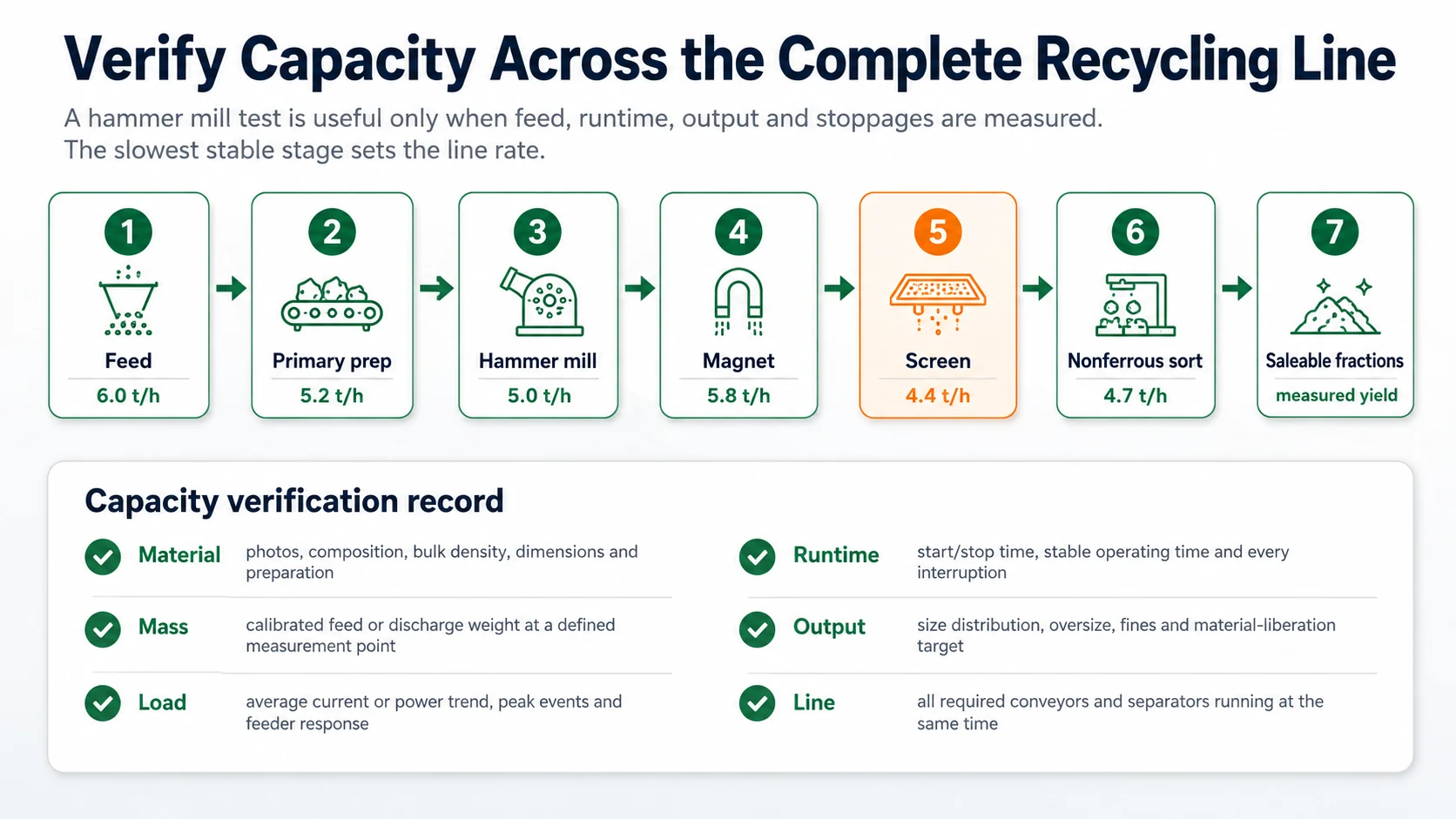
A line rated around one machine can still miss its target if another stage has lower capacity or greater variability. The most common bottlenecks are not always dramatic. A screen that blinds, a magnet conveyor with limited bed depth, a loader that cannot maintain feed, or an undersized bunker can reduce the average rate more than the hammer mill itself.
| Line stage | Capacity question | Typical evidence |
|---|---|---|
| Feed hopper and conveyor | Can it meter the actual bulk volume without bridging or surging? | Live-load test, belt loading, current trend and hopper observation. |
| Primary shredder or shear | Can it prepare material at or above the hammer mill’s stable demand? | Prepared-size distribution and sustained discharge rate. |
| Hammer mill | Can it maintain the required output condition within load and vibration limits? | Net t/h, motor trend, rotor recovery, oversize and fines. |
| Magnetic separation | Is the bed depth and belt speed compatible with the crushed stream? | Ferrous recovery, carryover, burden depth and product cleanliness. |
| Screening | Can the screen pass the required fraction without blinding or excessive recirculation? | Screen feed, undersize, oversize, circulating load and cleaning time. |
| Nonferrous sorting | Does loading and size distribution remain inside the sorter’s operating window? | Recovery and purity by fraction at the target line rate. |
| Storage and handling | Can bins, balers, trucks or furnace-feed systems remove product fast enough? | Surge volume, changeover time and dispatch cycle. |
How to Verify a Supplier’s Hammer Mill Capacity Claim
The best verification is a written test plan agreed before the purchase order. It should define what will be fed, what will be measured, how long the stable period lasts, what output is acceptable and how interruptions are recorded.
1. Use representative material
A clean, uniform demonstration sample cannot prove capacity on dirty, mixed or oversized production feed. Provide a representative range, including normal variation and the expected maximum pieces. Remove prohibited hazardous items before testing.
2. Define the measurement point
Specify whether mass is measured at the feed conveyor, hammer-mill discharge, after screening or after final separation. The result changes as oversize, fines and non-metal fractions are removed.
3. Separate gross duration from net runtime
Record start time, stop time and every pause. Report both the net operating rate and the gross test-period rate. A machine that achieves a high net rate but requires frequent interruptions may not deliver the required shift output.
4. Record output quality at the same time
A capacity test without an output test is incomplete. Measure the agreed size distribution, oversize, fines and—where relevant—bulk density, exposed material interfaces and downstream recovery.
5. Capture load and stability data
Record average current or power where available, peak events, feeder response, vibration observations, bearing temperatures and alarms. The objective is stable production, not one aggressive run that leaves no operating margin.
6. Operate the required line modules
When the contract covers a complete line, the acceptance test should include the conveyors, magnets, screens, air systems and nonferrous separators needed for the specified product. Testing the mill into an empty pile does not prove integrated line capacity.
| Acceptance item | Write into the test plan |
|---|---|
| Feed duty | Material names, composition range, preparation, bulk density if known, maximum dimensions, contamination and sample mass. |
| Test duration | Warm-up method, stable measurement period, permitted adjustments and how pauses are classified. |
| Mass measurement | Scale location, calibration status, batch weighing or belt-scale method, and moisture or residue treatment if relevant. |
| Throughput acceptance | Minimum continuous rate and whether it applies to mill discharge or complete line output. |
| Output acceptance | Target size range, maximum oversize, maximum fines, bulk density or downstream recovery requirement. |
| Operating limits | Permitted current, vibration, temperature, alarm and shutdown conditions. |
| Downtime | How blockages, screen cleaning, adjustments, downstream stops and operator delays affect the result. |
| Evidence package | Photos, video, weight records, operating log, sample results and signed acceptance report. |
How the YUXI Hammer Mill Product Relates to Capacity Planning
YUXI’s official Hammer Mill Metal Crusher page describes scrap-metal processing through hammering, tearing and shearing, selectable discharge mesh, a safety-door concept for unbreakable objects, PLC control and hydraulic power. The published examples include car engines, electric motors and metallic drums, and the intended users include steel plants, smelters, foundries, scrap recyclers, metal processors and automobile manufacturers.
Higher required production usually changes rotor duty, wear package, drive, feeding, discharge, dust control and complete-line scope. Those cost effects belong in the separate Hammer Mill Price Guide, while this article remains focused on technical throughput definition and verification.
Safety and Operating Controls Affect Available Capacity
Production planning must include the time required to operate and maintain the machine safely. Guards, interlocks, energy isolation, inspections and dust or noise controls are not avoidable “losses”; they are part of the operating method.
- Machine guarding: OSHA’s 29 CFR 1910.212 requires guarding against point-of-operation hazards, rotating parts, ingoing nip points and flying material.
- Hazardous energy: jam clearing, inspection and maintenance require a site procedure consistent with OSHA’s control of hazardous energy guidance.
- Scrap-specific hazards: OSHA’s metal scrap recycling guide addresses machinery, material handling, cutting, hazardous substances and other risks in scrap operations.
- Noise: NIOSH identifies 85 dBA averaged over an eight-hour workday as its recommended exposure limit and has published guidance for recycling workers. Noise measurement and controls should be included in the installed project.
A production plan that assumes no inspection, no wear service, no housekeeping and no safe isolation may look attractive in a spreadsheet but will not describe sustainable plant output.
Capacity RFQ Checklist for a YUXI Project Review
| Information to send | Why it matters |
|---|---|
| Material photos, video and composition range | Shows geometry, mixed materials, contamination and feed variability. |
| Loose bulk density, if available | Helps size hoppers, conveyors and volumetric loading. |
| Maximum length, width, thickness and single-piece mass | Defines whether dismantling, shearing or primary shredding is required. |
| Feed preparation condition | Separates direct feed, cut feed and pre-shredded duty. |
| Required average and peak t/h | Supports feeder, rotor, drive and surge design. |
| Hours per shift, shifts per day and target operating days | Defines duty cycle and annual wear or maintenance planning. |
| Target output range, oversize and fines limits | Prevents capacity from being evaluated without product quality. |
| Downstream process and required recovery | Establishes the real line bottleneck and saleable output objective. |
| Power supply, workshop and foundation conditions | Defines installation and electrical constraints. |
| Acceptance-test expectation | Aligns material, measurement point, runtime and pass/fail criteria before quotation. |
Request Capacity Based on Your Actual Scrap
Send YUXI representative material evidence, the required continuous rate, operating schedule, output specification and downstream line plan. The engineering review can then determine whether a standalone hammer mill, upstream shredder or complete crushing-and-separation line is required.
FAQ: Hammer Mill Capacity Guide
What does hammer mill capacity mean?
Hammer mill capacity should describe a measured mass flow under stated feed and output conditions. Buyers should distinguish nominal capacity, short-term peak rate, tested discharge rate, continuous throughput, shift output and saleable line output.
Why can the same hammer mill have different tons-per-hour rates?
Scrap density, maximum size, thickness, preparation, pollution, screen or grate restriction, target output, hammer condition, feeding stability and downstream bottlenecks all change the sustainable throughput.
Does a smaller screen opening reduce hammer mill capacity?
It often can because material may remain in the chamber longer and receive more impacts before discharge. The result depends on the machine and material, so the required output should be confirmed through testing rather than assumed.
How do I calculate shift output from tons per hour?
A practical estimate is tested continuous throughput multiplied by scheduled operating hours and expected utilization. For example, 5 t/h × 8 hours × 85% utilization equals 34 tonnes for the shift. This is a planning estimate, not a guarantee.
Is hammer mill capacity the same as complete line capacity?
No. Complete line capacity is limited by the slowest stable stage, which may be feeding, primary shredding, discharge conveying, screening, magnetic separation, nonferrous sorting or residue handling.
What should be included in a capacity acceptance test?
Record representative feed, dimensions and preparation, test runtime, net operating time, calibrated mass, output size distribution, oversize and fines, motor or current trends, stoppages and whether the complete downstream line was operating.
What capacity information should I send YUXI?
Send material photos and video, composition, bulk density if known, maximum dimensions and thickness, hourly and daily targets, required output condition, upstream preparation, downstream equipment, operating schedule, utilities and site layout.
Authoritative References and Technical Notes
- OSHA: Guidance for the Identification and Control of Safety and Health Hazards in Metal Scrap Recycling.
- OSHA 29 CFR 1910.212: General Requirements for All Machines.
- OSHA: Control of Hazardous Energy / Lockout-Tagout.
- NIOSH: Criteria for a Recommended Standard, Occupational Noise Exposure.
- U.S. EPA: Industrial Stormwater Fact Sheet Series, Sector N Scrap Recycling and Waste Recycling Facilities.