




 Request Quote



Aluminum Sheet and Foil Scrap Recycling Guide
A feed-first guide to preserving clean sheet grades, controlling loose foil, releasing contamination only when necessary, and choosing between shearing, shredding, separation and baling.
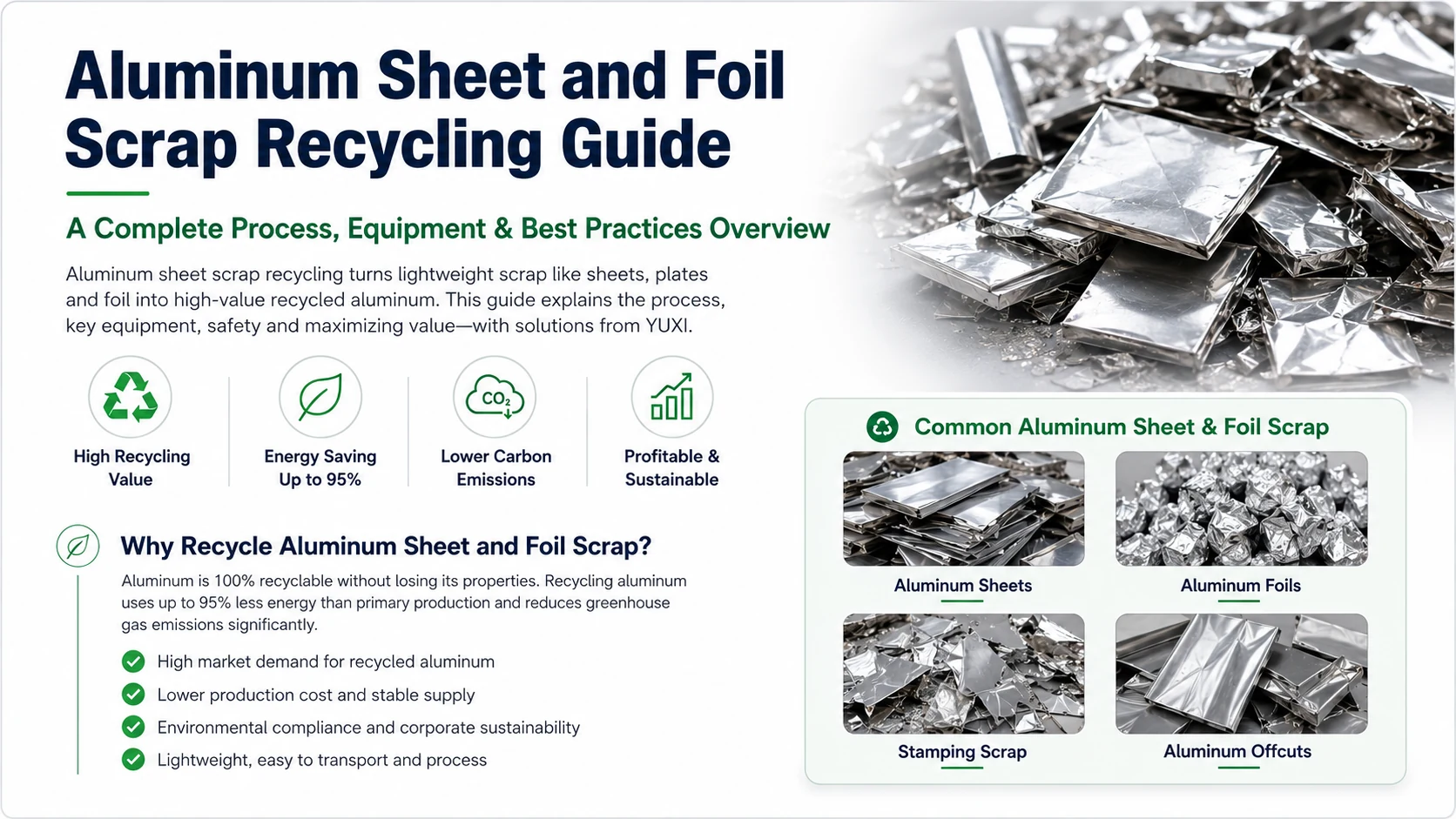
What This Aluminum Sheet Scrap Recycling Guide Covers
The phrase aluminum sheet scrap recycling can describe anything from clean stamping skeletons at a factory to old painted siding, formed food containers or flexible foil laminated to plastic. Those materials should not be forced through one standard flowsheet.
The U.S. Environmental Protection Agency pretreatment as sorting,processing and cleaning of waste before smelting.Its process description includes the removal of other metals,dirt,oils,plastics and paints,and points out that mechanical preparations can be made with size reduction,magnetic removal,screening and air classification. It also makes an important engineering point: the sequence changes with scrap quality, scrap source, available equipment, furnace design and product specification.1
Sheet and Foil Scrap Are Not One Feedstock
European Aluminium’s circularity work distinguishes rolled products from extruded and cast products and argues that better separation is needed if recovered aluminum is to return to higher-value closed loops rather than being mixed into a broad “cast sink.”2 For a sheet or foil project, that means preserving known alloy and product streams has value before any machine starts.
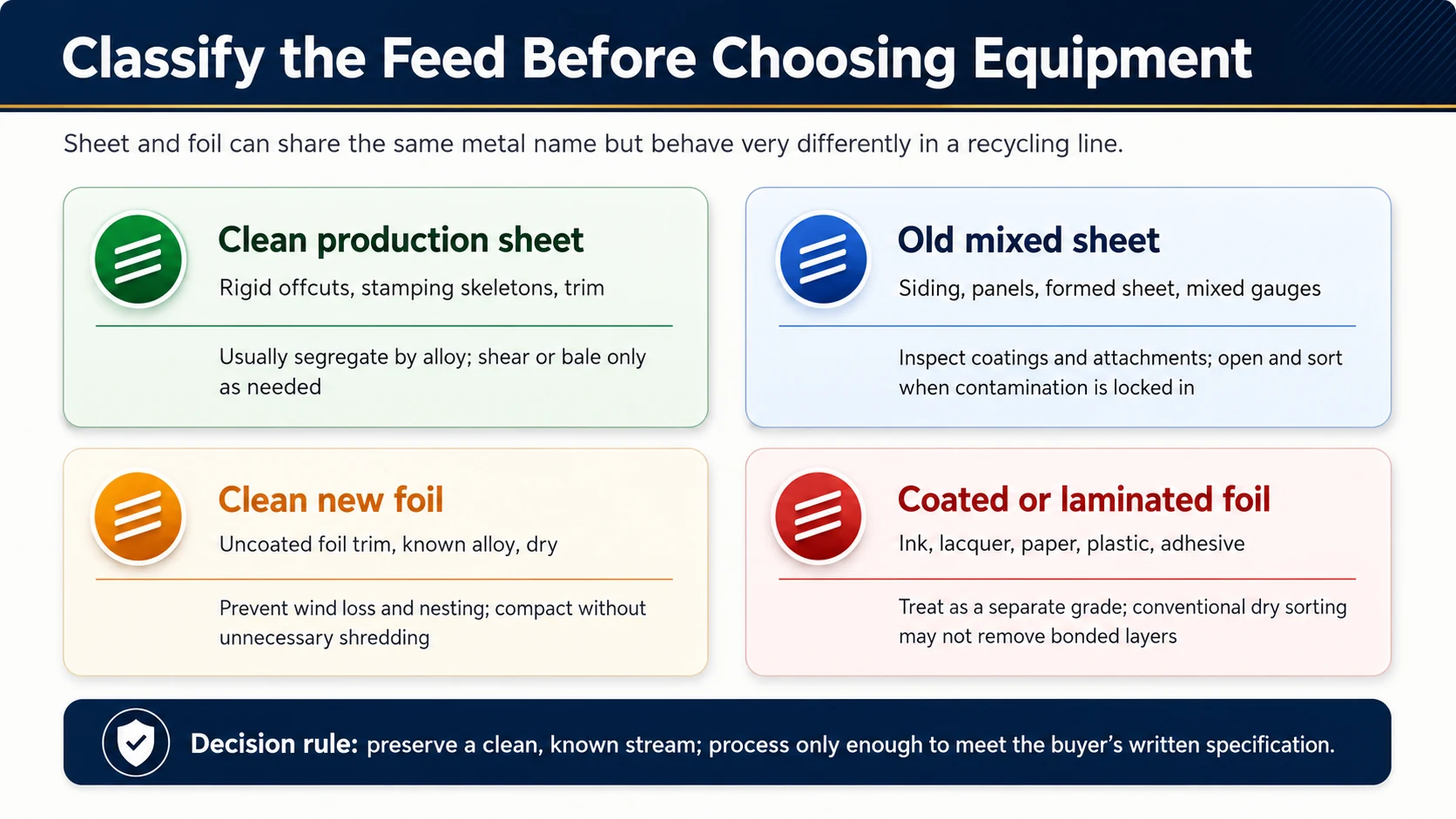
| Feed class | Typical examples | Main risks | Likely preparation direction |
|---|---|---|---|
| Clean production sheet | Stamping skeletons, blanking scrap, trim, edge offcuts, clean sheet bundles | Alloy mixing, oil, sharp edges, awkward dimensions | Segregate, shear only for handling, then bale or sell loose to buyer specification |
| Old mixed sheet | Siding, panels, cookware, signs, building sheet, formed parts | Paint, screws, steel clips, plastic film, dirt, mixed alloys | Inspect, remove attachments, open or shred only when contamination is locked in, then separate and densify |
| Clean new foil | Rolling and slitting trim, uncoated foil production scrap | Very low bulk density, wind loss, wrapping, nesting | Keep dry and alloy-controlled; use enclosed conveying and controlled compaction |
| Post-consumer foil | Household foil, formed foil containers, lids and trays | Food and organic residue, mixed small pieces, collection variability | Accept only to a written grade; clean, inspect, consolidate and limit non-metal carryover |
| Coated or laminated foil | Printed foil, lacquered foil, foil bonded to paper or plastic | Bonded non-metal layers, adhesives, PVC risk, uncertain metal content | Store separately and use a specialty recovery or metal-content contract; do not assume a conventional dry line will delaminate it |
Why low bulk density changes the real line capacity
Rigid sheet tends to lie, bridge or spring according to its shape. Loose foil can flutter, wrap around moving parts, disappear into dust or light-fraction systems, and occupy a large volume for very little weight. YUXI’s public scrap aluminum recycling line page therefore treats sheets and foil as a route that may use baling or shredding according to condition, and specifically notes that low bulk density affects feeding, wind separation and real capacity.
Start with the Sale Specification, Not the Shredder
ReMA’s ISRI Specifications provide a common commercial language for recycled commodities and list separate aluminum categories for clean mixed old alloy sheet, new foil, post-consumer foil and new coated foil. The current index identifies Taint/Tabor for clean mixed old alloy sheet aluminum, Terse for new aluminum foil, Tesla for post-consumer aluminum foil and Tetra for new coated aluminum foil.3
Those names are useful starting points, not a substitute for a purchase agreement. ReMA states that parties may agree to variations and that any deviation should be written into the transaction.4 Before choosing equipment, confirm:
- Accepted alloy or alloy family
- Whether painted, anodized or coated material is allowed
- Maximum ferrous, plastic, paper, dirt and organic residue
- Allowed foil, fines and undersize content
- Moisture, oil and grease limits
- Required package: loose, bundle, bale or briquette
- Bale dimensions, density and wire requirements
- Sampling, downgrade and rejection method
One of the most expensive mistakes is producing a visually clean pile that does not match the buyer’s actual grade. A process line should be designed backward from the accepted output, not forward from a preferred machine model.
Four Practical Sheet and Foil Recycling Routes
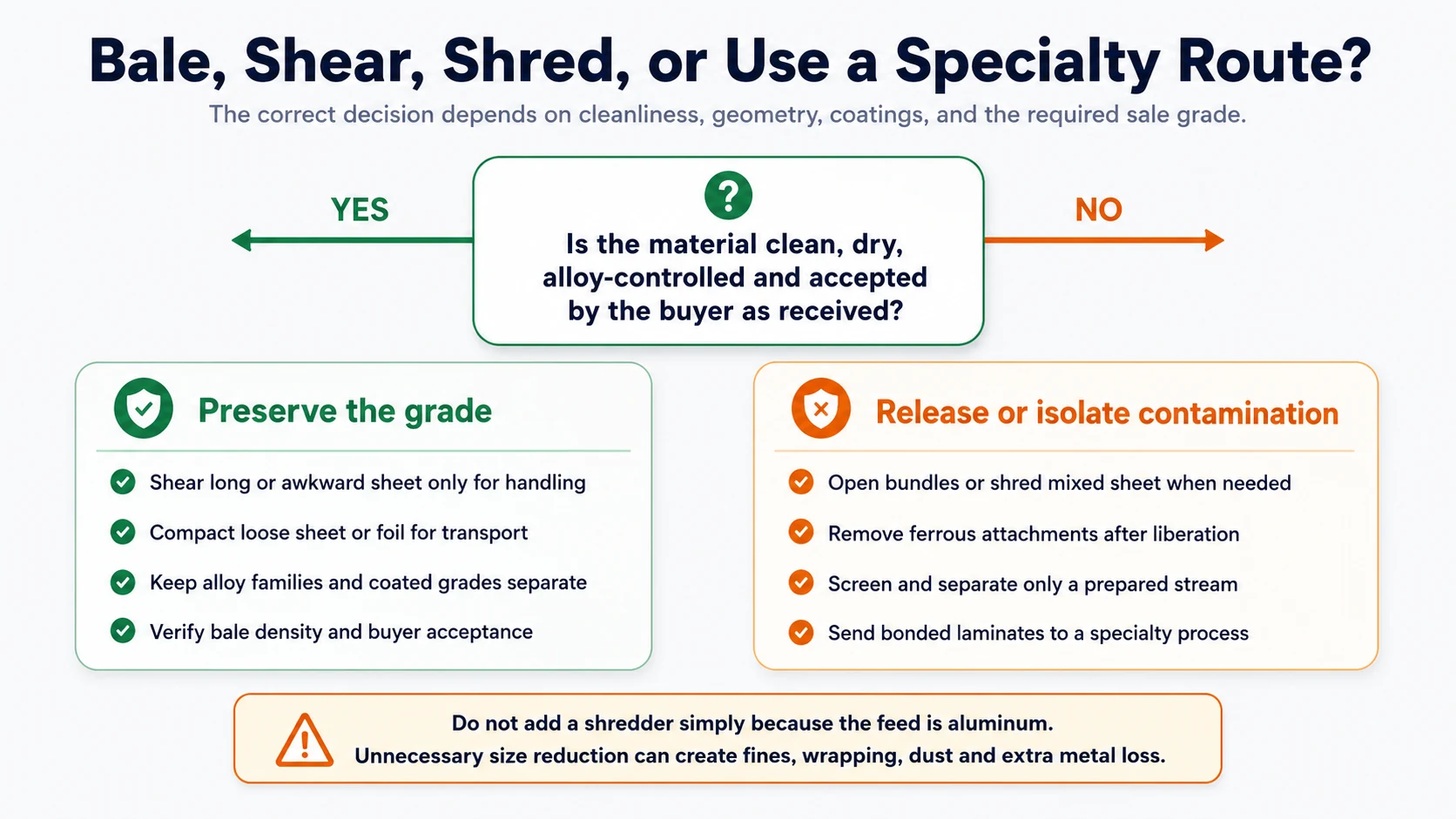
Route A: Clean production sheet—segregate, shear and bale
Clean stamping scrap, trim and known-alloy sheet normally have the highest value when their identity is preserved. The main jobs are safe handling, size control and densification. Long or springy pieces may be cut with a shear so they fit a container or baler. If the material already meets the buyer’s cleanliness and alloy requirements, a shredder adds wear and fines without creating a better grade.
Route B: Old mixed sheet—open, remove attachments and sort
Old sheet often arrives with paint, screws, brackets, seals, labels or plastic film. Manual removal is efficient when contamination is visible and accessible. A low-speed metal shredder becomes useful when folded panels, nested material or attached components need to be opened for downstream recovery. It is a primary reduction stage; it does not guarantee a uniform particle or a clean aluminum product by itself.
Route C: Clean foil—control the material and compact it
Clean new foil is often a handling problem before it is a separation problem. The project may need enclosed storage, metered feeding and a suitable hydraulic compaction system. A metal baling machine can reduce transport volume, but the feed chamber, ram arrangement and bale specification must match the light material. A general statement such as “high-density bale” is not enough; the buyer should define acceptable bale integrity and contamination.
Route D: Coated or laminated foil—separate the grade and define a specialty route
Coated or laminated foil contains aluminum bonded to ink, lacquer, paper, plastic or adhesive. ReMA treats coated foil as its own commercial category, and foil-industry sources note that thin and laminated foil behaves differently in collection and recovery systems.5 A standard dry shredder–magnet–eddy-current line may reduce loose components, but it does not automatically remove a bonded polymer layer from the foil surface. This feed should be tested with the intended specialty process and sold on an agreed metal-content or recovered-product basis.
Aluminum Sheet Scrap Recycling Process: Step by Step
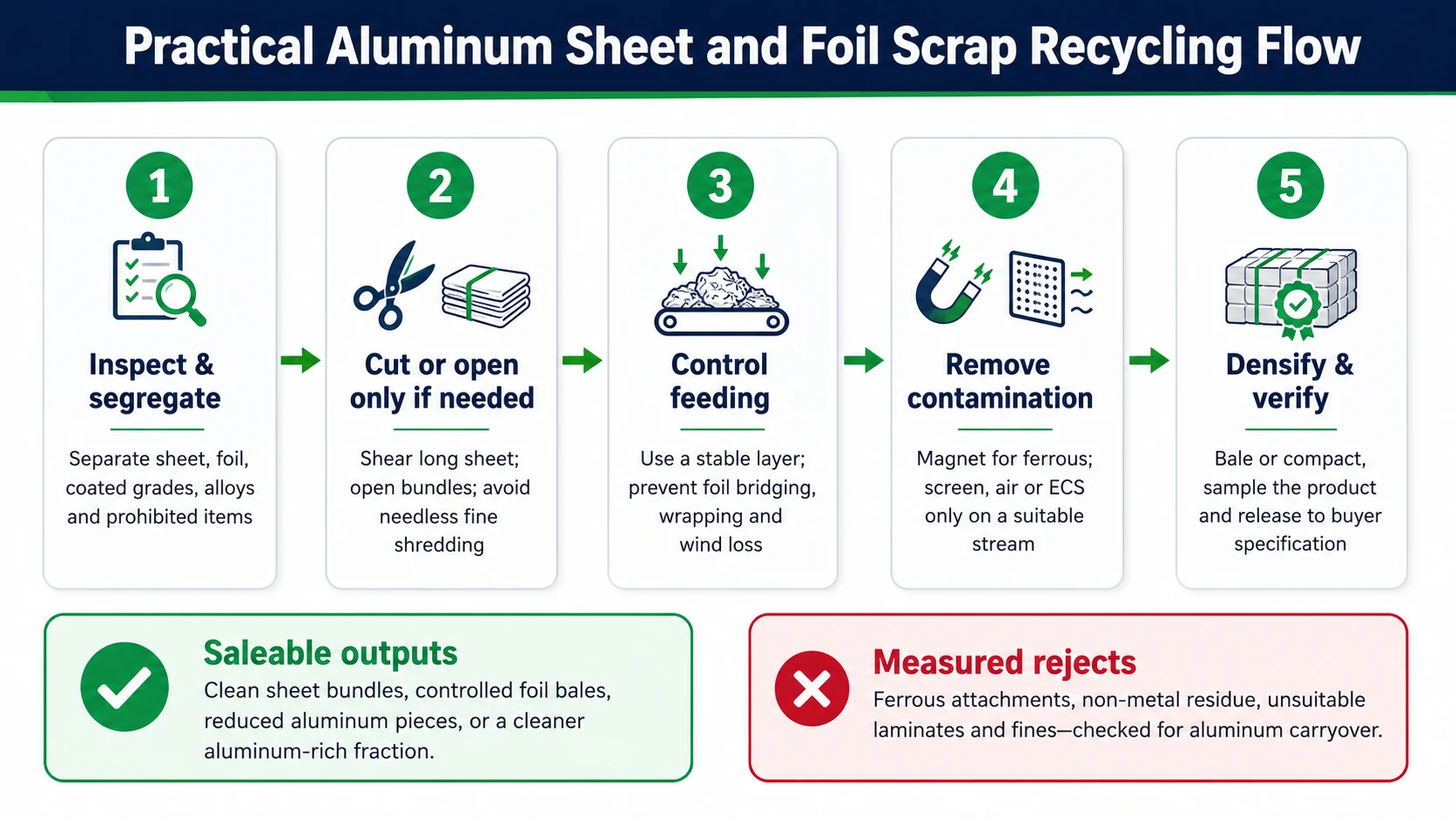
Define the incoming feed and the revenue product
Record sheet thickness, longest dimension, bundle size, bulk density, coatings, alloy knowledge, regular attachments and the percentage of foil. Photograph different layers of the pile, not only the clean top surface. Then define what the buyer will pay for: clean sheet, reduced pieces, a foil bale, an aluminum-rich fraction or an alloy-controlled product.
Receive, quarantine and store separately
Keep clean production scrap apart from old mixed sheet, painted material and laminated foil. Use covered storage when moisture or wind can change the load. Quarantine unknown material until it is inspected. Mixing a small quantity of low-grade foil or steel-attached sheet into a clean alloy stream can reduce the value of the entire shipment.
Remove prohibited and unsafe items
Exclude sealed containers, pressure vessels, lithium batteries, flammable liquids, explosive items, radioactive scrap and unidentified hazardous residue. Remove large hard steel components that are outside the approved feed. The line’s reversing logic is equipment protection; it is not permission to feed unsafe material.
Cut, shear or open only when the next stage needs it
Use shearing for long sheet, large bundles or pieces that will not feed safely. Use low-speed shredding when the material must be opened to expose attachments or create a stable conveyor stream. Avoid fine reduction when it does not improve the sale grade. Excess processing can create fines, increase dust and make thin foil harder to retain.
Create a stable, controlled feed layer
A conveyor is not just transport. It meters the load into the cutter, magnet, screen or separator. Loose foil may require enclosed transfer points, anti-wrapping details and careful air management. Deep piles can hide small steel parts or carry non-metal contamination through a separator.
Remove exposed ferrous contamination
Place magnetic removal after the material has been opened enough to expose screws, clips, brackets and steel fragments. Inspect the ferrous discharge for aluminum carryover. A strong magnet cannot remove steel that remains physically locked inside a folded assembly.
Add screening, air control or eddy-current recovery only when justified
Screens can remove fines or stabilize particle ranges. Air systems can separate selected light fractions, but light aluminum foil may report with the residue if the settings are not tested. An eddy current separator is useful when sized non-ferrous pieces must be recovered from a suitable non-metal stream. It does not remove iron and it does not sort aluminum alloys from one another.
Compact the accepted fraction
Baling reduces storage and transport volume and can make light sheet or foil easier to handle. Confirm chamber dimensions, feeding method, bale size, density, tying method and whether the downstream buyer accepts mixed sheet and foil in the same bale. A compact bale is not automatically a clean bale.
Sample both product and rejects
Check the aluminum product for steel, plastic, paper, moisture and coating load. Also inspect the ferrous, light and fines fractions for lost aluminum. A line that makes a clean-looking product but throws valuable foil into the reject stream is not performing well. Use representative samples over time rather than one hand-picked sample.
What Each Machine Does—and Does Not Do
| Equipment | Main duty | Good fit for sheet or foil | Important limitation |
|---|---|---|---|
| Inspection conveyor | Meter material and provide a sorting zone | All routes | Cannot compensate for poor upstream storage or an uncontrolled loader batch |
| Crocodile or hydraulic shear | Cut long sheet, plate edges or bundles | Clean or mixed rigid sheet | Batch cutting does not liberate every attached material |
| Double-shaft shredder | Low-speed tearing, shearing and opening | Bulky, folded or mixed sheet that needs liberation | Does not normally produce a fine, tightly uniform product by itself |
| Hammer mill or secondary crusher | Further reduction and stronger liberation | Only when the product or separator requires smaller pieces | Higher impact, wear, noise, dust and fines; not the default route for clean foil |
| Magnetic separator | Remove iron and steel | Mixed sheet after attachments are exposed | Does not recover aluminum from plastic or paper |
| Screen | Control size and remove fines | Prepared shredded streams | May send fine foil to reject; requires recovery checks |
| Air classifier | Separate by aerodynamic behavior | Selected dry, controlled particle streams | Foil itself is light; settings must be proven with representative material |
| Eddy current separator | Recover conductive non-ferrous pieces from non-metal | Mixed, sized material after ferrous removal | Does not sort aluminum alloy chemistry or remove bonded laminates |
| Hydraulic baler | Compress material for storage, transport or furnace handling | Clean sheet, light sheet and suitable foil | Densification does not improve alloy purity or remove contamination |
How YUXI Equipment Fits the Sheet and Foil Route
YUXI’s public product information does not present one universal aluminum machine. It separates projects by feed material and lists “aluminum sheets and foil” as a route using baling or shredding according to condition, with a baler, shear or shredder and controlled feeding. The stated project questions are sheet thickness, bundle size, cleanliness and buyer specification.
That is the correct design logic. A project may use:
- Receiving and controlled feeding for stable inspection and flow.
- Shearing for long or awkward rigid sheet.
- Low-speed primary shredding for bulky mixed sheet that needs opening.
- Magnetic removal for exposed steel attachments.
- Screening and optional eddy-current recovery for a suitable mixed stream.
- Hydraulic baling when the main goal is transportable, buyer-accepted density.
Model selection should follow the method described in YUXI’s guide to choosing aluminum recycling equipment: define the feed in measurable terms, define the output contract, select the least complex route that bridges the gap, and verify the proposal with representative material. No fixed capacity, purity or recovery rate should be published without a comparable test and a defined sampling method.
Send the Actual Sheet and Foil Feed, Not Only a Material Name
Provide photos or video, thickness, bundle condition, coatings, estimated contamination, bulk density, target tons per hour, required product, power supply and workshop dimensions. YUXI can then review whether the project needs shearing, shredding, separation, baling or a specialty route.
What Changes Real Capacity and Product Quality
Rated motor power does not tell a buyer how many tons of sheet or foil the complete line will process. Loose foil may occupy the hopper while contributing little mass. Folded sheet may bridge. Dense bundles may feed smoothly but hide contamination. A realistic capacity estimate needs the actual material and the full sequence.
| Variable | Why it matters | What to document |
|---|---|---|
| Bulk density | Sets volumetric loading on conveyors, hoppers and balers | Loose, bundled and compacted density |
| Maximum size and thickness | Changes bite, shear force, bridging and reverse frequency | Longest piece, maximum gauge and largest regular bundle |
| Foil percentage | Affects airflow, wrapping, fines and loss to light residue | Approximate mass and volume percentage |
| Coatings and laminates | Change sale grade, residue load and downstream process | Paint, lacquer, plastic, paper, adhesive and PVC risk |
| Contamination variability | Changes sorter workload and separator balance | Average and worst regular batch, not only a clean sample |
| Target output | More separation depth can reduce throughput and increase cost | Bale, reduced pieces, purity limits and sampling method |
| Feeding stability | Intermittent loader batches create overloads and poor separator presentation | Loader cycle, conveyor capacity and operator method |
Use a mass balance during testing: incoming material equals accepted aluminum product plus ferrous reject, non-metal reject, fines, moisture change and unaccounted loss. Track both product cleanliness and aluminum recovery. For broader sizing logic, the aluminum recycling line capacity guide explains why bulk density, single-piece size, target particle size and sorting depth must be shown beside any tons-per-hour figure.
Common Aluminum Sheet and Foil Process Mistakes
1. Shredding every clean sheet stream
Clean, known production scrap may already be mill-ready after safe cutting and baling. Adding unnecessary reduction creates wear, fines and extra handling.
2. Treating loose foil as small sheet
Foil is not only thinner; it has different aerodynamic and wrapping behavior. Conveyor covers, feed control and loss checks can matter more than installed motor power.
3. Mixing laminated foil with clean metal
Bonded plastic or paper does not disappear because the material passes through a shredder. Keep the grade separate and test a dedicated recovery process.
4. Installing an eddy current separator without a prepared stream
An ECS needs appropriate size distribution, stable feeding and a defined non-metal fraction. It cannot repair poor magnetic removal or distinguish one aluminum alloy from another.
5. Measuring only the aluminum product
Inspect rejects for lost sheet and foil. A visually clean product can hide poor recovery when small aluminum pieces leave with steel, plastic, paper or fines.
6. Quoting one fixed capacity for sheet and foil
The same machine can process very different tons per hour on rigid bundles and loose foil. A credible quotation states the reference feed, feed method, target output and acceptance conditions.
RFQ Checklist for an Aluminum Sheet or Foil Line
- Material origin: factory scrap, demolition, packaging, MRF or mixed dealer scrap
- Sheet and foil percentages by weight and by volume
- Known alloy, alloy family or mixed-alloy condition
- Maximum thickness, longest size and bundle dimensions
- Paint, lacquer, paper, plastic, adhesive and organic residue
- Ferrous attachments and hardest regular inclusion
- Loose, nested, bundled, baled or compacted condition
- Bulk density and normal loader or conveyor feeding method
- Target tons per hour and operating hours per shift
- Required output form and written buyer specification
- Sampling, recovery and acceptance test method
- Power supply, workshop dimensions, dust control and local safety requirements
Frequently Asked Questions
Should aluminum sheet scrap be shredded before baling
Not automatically. Clean, segregated sheet may only need shearing for safe handling and hydraulic baling. Shredding is justified when it opens mixed bundles, releases contamination or creates a required size for the next stage.
Can aluminum foil scrap use the same line as rigid sheet scrap
Some projects can share receiving or baling equipment, but foil should be evaluated separately because low bulk density, wind loss, wrapping, coatings and food residue change the process. A line that handles rigid sheet well may lose or jam on loose foil.
Does an eddy current separator sort aluminum alloys
No. A conventional ECS separates conductive non-ferrous pieces from a suitable non-metal stream. Alloy-level sorting requires different sensor technology, a controlled particle presentation and a defined commercial objective.
Can laminated aluminum foil be processed by a standard dry recycling line
A standard dry line may reduce and separate loose components, but it does not automatically remove plastic, paper, lacquer or adhesive bonded to the foil. Laminated foil usually needs a dedicated recovery route or a buyer agreement based on metal content.
What final products can the line produce
Depending on the feed and route, outputs may include clean sheet bundles, sheared pieces, shredded aluminum, a cleaner aluminum-rich fraction, foil bales, ferrous reject and separated non-metal residue. The product must be defined by the buyer’s written specification.
What should be sent to YUXI for a proposal
Send representative photos or video, thickness, dimensions, bundle condition, coatings, contamination, bulk density, target throughput, final product, power supply and workshop dimensions. Include the buyer specification when available.
References and Source Notes
- U.S. EPA, AP-42 Background Document for Secondary Aluminum Operations — pretreatment, sorting, cleaning, mechanical size reduction, magnetic removal, screening and process variability.
- European Aluminium, Circular Aluminium Action Plan — separation of rolled, extruded and cast product loops and the value of higher-quality sorting.
- ReMA’s ISRI Specifications: Aluminum — current index of sheet and foil scrap grade names.
- ReMA’s ISRI Specifications overview — purpose, commercial use and written variations between buyer and seller.
- European Aluminium Foil Association, Recycling & Recovery — collection and recovery context for thin and laminated foil packaging.
- The Aluminum Association, Recycling — recyclability and energy benefits of recycled aluminum.
- European Aluminium, Strategy for the Availability and Quality of Aluminium Scrap in Europe (2025) — quality, strategic value and energy implications of scrap recycling.