




 Request Quote



Thermal Break Aluminum Recycling: Removing Plastic Strips and Steel
Thermally broken window and door profiles look like ordinary aluminum scrap from a distance. Inside, however, two aluminum sections can be mechanically locked to a polymer strip, while screws, brackets, hinges and reinforcement add a separate ferrous problem. From a process point of view, the order matters more than the number of machines. If the profile has not opened, the separators are only sorting partly joined pieces.
Quick answer: We normally start with the feed, not the machine list. Check how the profile is built and what steel hardware is still attached, then use primary shredding to shorten and open it. If sample testing shows that the polymer is still locked into the aluminum, a second liberation stage may be justified. Once the steel is exposed, magnetic separation comes next; screening then gives the downstream separator a more stable size range. Eddy-current or density-based separation is used only where the particle shape, size and material mix suit it. The final arrangement still depends on the thermal-break system, attached hardware, required output and downstream buyer specification.
Why This Scrap Behaves Differently from Ordinary Profiles
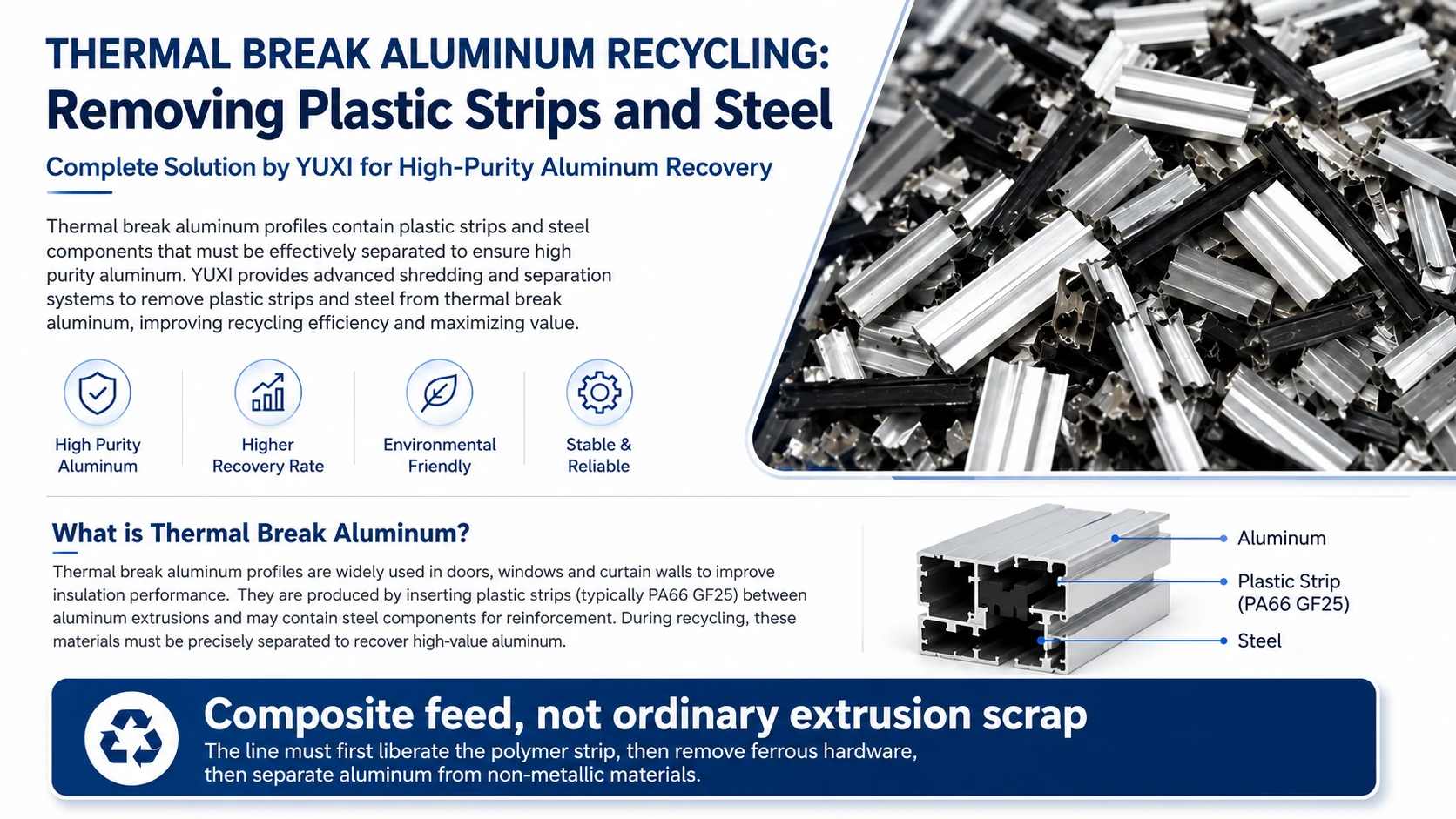
From a buyer’s point of view, thermal-break material can look like ordinary extrusion scrap. It is not. The aluminum sections are interrupted by a low-conductivity barrier, and that barrier is part of the construction rather than loose contamination. The Aluminum Extruders Council describes two common designs: a rigid polyamide strip mechanically crimped between two extrusions, and a pour-and-debridge system in which polymer is poured into an extrusion pocket before the remaining aluminum bridge is removed.1
This article focuses mainly on the mechanically joined strip system because it creates a clear liberation duty. The strip is not loose packaging that can be blown away before processing. It is held inside knurled grooves and crimped into a load-bearing composite. A first cut may shorten the window profile but still leave aluminum and polymer joined.
Post-consumer frames add another layer. Steel screws, corner brackets, hinges, locks and reinforcement pieces may be hidden inside hollow sections. Rubber gaskets, brush seals, cured sealant, coatings, dirt and glass can be present as well. That is why the broader aluminum profile recycling line guide treats thermal-break profiles as the deepest of the normal profile-processing configurations.
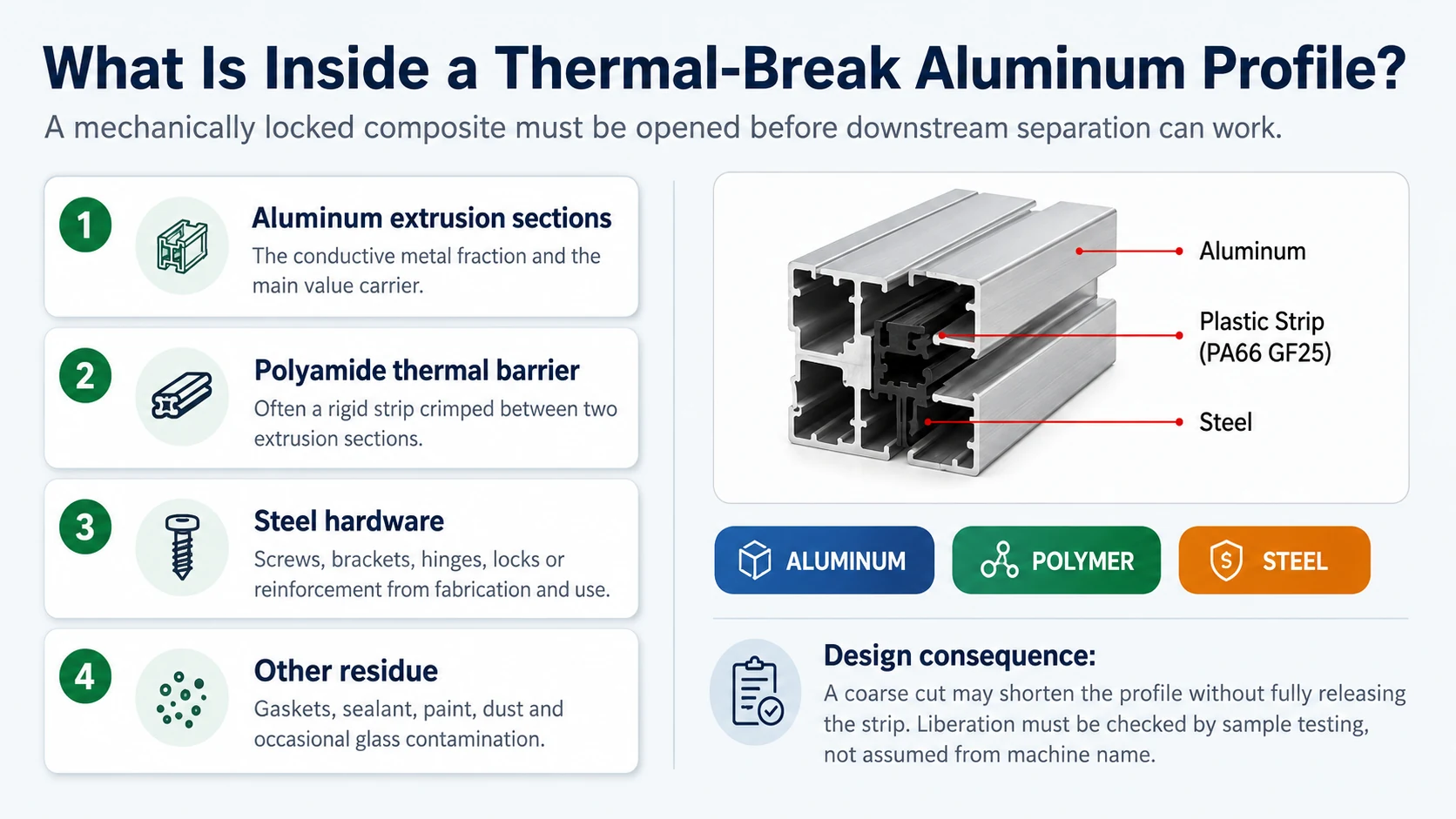
Engineering point: the target is not the smallest possible particle. It is sufficient liberation for the selected separator, with an acceptable amount of fines, wear and aluminum loss.
Identify the Feed Before Choosing the Machines
We would not design this project from the phrase “old aluminum windows” alone. The first useful sample review separates at least four questions: how the thermal barrier is made, how much steel is attached, how variable the incoming loads are, and what the final aluminum buyer will accept.
| Feed question | Why it matters | What to document |
|---|---|---|
| Strip system or poured polymer? | The two constructions do not necessarily release in the same way. | Cut cross-sections, photos and sample profiles from several suppliers. |
| Clean fabrication scrap or dismantled frames? | Factory offcuts may have controlled alloys and little hardware; demolition scrap is usually more variable. | Source, ordinary-versus-thermal-break percentage and estimated composition by mass. |
| What steel is present? | Small screws are different from thick reinforcement or large lock bodies. | Largest ferrous piece, approximate percentage and whether it is internal or external. |
| What else is attached? | Glass, rubber, sealant, timber and dirt affect safety, wear, screening and residue disposal. | Several-load inspection, not only a clean sample from the top of one pile. |
| What is the output contract? | The required aluminum size, iron limit, non-metal content and alloy boundary determine process depth. | Written acceptance method and sampling plan from the buyer or furnace. |
The U.S. EPA’s description of secondary aluminum pretreatment remains a sound starting principle: sorting and processing are used to remove other metals, dirt, oil, plastics and paint before smelting, and the exact mechanical-cleaning arrangement varies with scrap quality, source, available equipment and product specification.2
How the Process Usually Comes Together
European Aluminium shows coated and thermally broken window profiles moving through shredding, eddy-current and sink-float separation before aluminum and polyamide fractions are sent onward for remelting or refining.3 We treat that diagram as a process principle, not a machine shopping list. In practice, the first trial often shows where the real bottleneck sits: sometimes the polymer releases after primary shredding; sometimes joined pieces remain and a second liberation step earns its place. Either way, the line still has four jobs to do in sequence—open the composite, take out the wrong metals, steady the particle stream and check what each product actually contains.
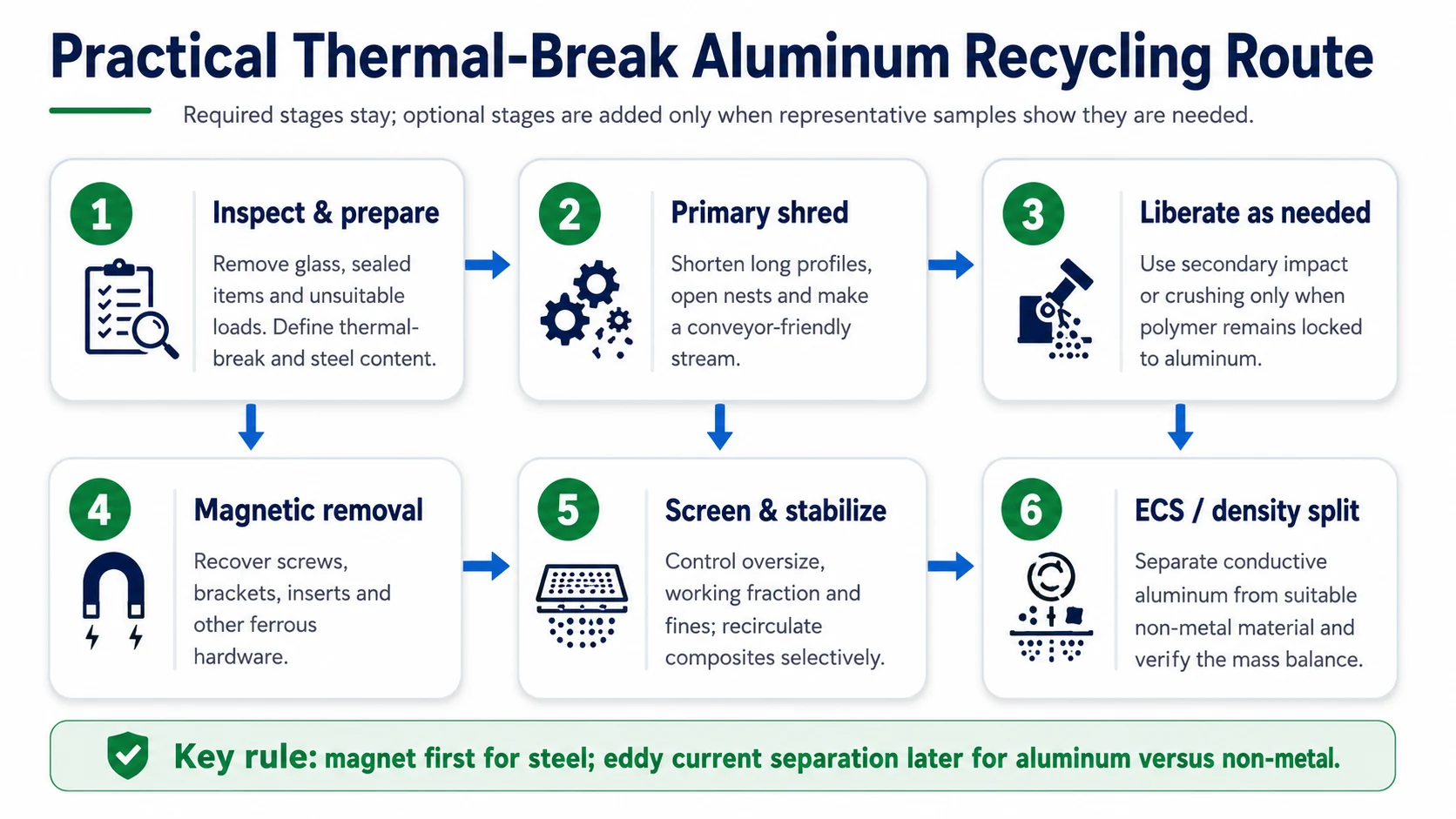
1Receive, inspect and prepare the frames
Whole glazed units should not be treated as ordinary aluminum profiles. Glass management, dismantling and removal of unsuitable items belong upstream. Sealed containers, batteries, liquids, flammable materials and unidentified hazardous residues stay outside the approved feed specification.
Preparation also protects the line from avoidable wear. Large steel sections or unusually hard components should be identified before they reach the shredder. Long flexible frames can bridge across a hopper, so loader, grab and conveyor feeding must match the receiving geometry rather than relying on a catalog belt width.
2Use primary shredding to open and shorten the profile
A low-speed, high-torque shredder performs the first controlled reduction. It grips long hollow sections, opens nested frames and creates pieces that downstream conveyors can carry. YUXI describes the primary metal shredder’s duty in a profile line as low-speed reduction for bulky profiles, frames and mixed light scrap. The machine is selected from maximum dimensions, wall thickness, bulk density, contaminants and downstream target—not from the word “aluminum” alone.
Primary shredding may be sufficient for clean extrusion offcuts when the commercial goal is transport size or furnace charging. For thermal-break scrap, it is usually the beginning of liberation rather than the end.
3Add secondary liberation only when the sample requires it
After the first stage, examine the output. Are long polymer strips still locked inside aluminum channels? Do steel inserts remain shielded? Is the piece size too wide for stable screening or separator feeding? A hammer mill or another secondary crusher can add impact and deformation to release these attachments.
However, deeper crushing has costs. It can raise wear, dust and fines, and it can widen the particle-size distribution. We normally recommend a staged test: measure composite pieces after the first pass, add secondary liberation, and compare aluminum recovery, non-metal removal and fines generation. The aluminum shredder versus hammer mill guide explains why the two machines solve different parts of the problem.
4Remove steel after it has been exposed
A magnetic separator removes ferrous screws, brackets, hinges, inserts and reinforcement. It does not remove the polyamide strip, and it does not separate aluminum from rubber or sealant. The magnet works best after size reduction has exposed the steel and reduced the burden depth to a controllable layer.
Common specification error: an eddy current separator is not a substitute for magnetic removal. The magnet addresses ferrous metal. The ECS addresses conductive non-ferrous metal in a suitable non-metal stream. Their working principles and normal sequence are compared in YUXI’s magnetic vs eddy current separator guide.
5Screen and stabilize the liberated stream
Separation equipment sees individual particles, not the original feed description. Screening can divide oversize composites, a working fraction and fines. This matters because a wide size distribution can make splitter adjustment unstable and can hide incomplete liberation.
A controlled oversize return is usually better than repeatedly crushing the entire stream. Fines may need a separate route because very small aluminum pieces can behave differently from larger profile fragments and may be carried into residue. The influence of size and feed presentation is discussed in How Particle Size Affects Aluminum Eddy Current Separation.
6Separate aluminum from the non-metal fraction and verify it
An eddy current separator repels suitable conductive non-ferrous particles, changing their discharge trajectory relative to non-metal material. The feed should already have most ferrous material removed, and it should be sized and spread into a stable layer. Density-based separation or manual quality control may be added where the residue composition justifies it.
The ECS does not identify aluminum alloy grades. A mixture of 6063 architectural extrusion, cast handles and other non-ferrous pieces can still report to the same metal fraction. Closed-loop profile recycling therefore depends on source control or additional sensor sorting, not on ECS alone. The Aluminum Association notes that contamination and commingling of aluminum alloys can cause high-quality wrought material to be downcycled into more impurity-tolerant cast applications.4
What Each Machine Actually Does
| Equipment | Duty in the line | Selection questions | What it cannot guarantee |
|---|---|---|---|
| Receiving and feed conveyor | Controls long-profile loading and stabilizes mass flow. | Longest frame, bundle condition, loader type, bridging risk and inspection access. | Constant tons per hour when the bulk density changes. |
| Twin-shaft shredder | Primary cutting, opening and volume reduction. | Wall thickness, nesting, steel contamination, chamber size, cutter geometry and target piece size. | Full polymer liberation or a uniform fine product. |
| Hammer mill / secondary crusher | Additional impact and deformation for liberation. | Remaining composite rate, acceptable fines, wear duty, screen and recirculation strategy. | Better economics when the feed is already clean and liberated. |
| Magnetic separator | Removes exposed steel hardware and inserts. | Magnet type, burden depth, particle size, installation position and discharge route. | Aluminum-plastic separation. |
| Screen / classifier | Creates controlled fractions and exposes incomplete liberation. | Cut points, oversize return, fines route, loading and maintenance access. | Liberation by itself. |
| Eddy current separator | Recovers suitable conductive non-ferrous pieces from a prepared non-metal stream. | In practice, performance moves with particle size and shape, moisture, belt speed, feed depth and splitter position. | It does not remove ferrous metal or sort one aluminum alloy from another. |
| Air or density separation | Polishes selected residue streams where density and aerodynamic differences are useful. | Polymer type, particle shape, moisture, fines, dust and product acceptance. | A universal solution for every mixed particle. |
| Dust and residue handling | Collects generated fines and transfers the polymer-rich fraction. | Dust characterization, local requirements, container changes, housekeeping and fire review. | Safe operation without a site-specific assessment. |
Define “Clean Aluminum” Before the Test
We are cautious when a supplier quotes a single purity figure without explaining how it was measured. One buyer may set a maximum iron level; another may be more concerned about plastic, fines, moisture, coatings or alloy mixing. Surprisingly, a broad remelt fraction can sometimes be acceptable while a small amount of residual polymer is not, because the furnace operator is watching emissions and dross. In our experience, the useful discussion starts with the sampling method and the rejection limits, not with a percentage printed on a proposal.
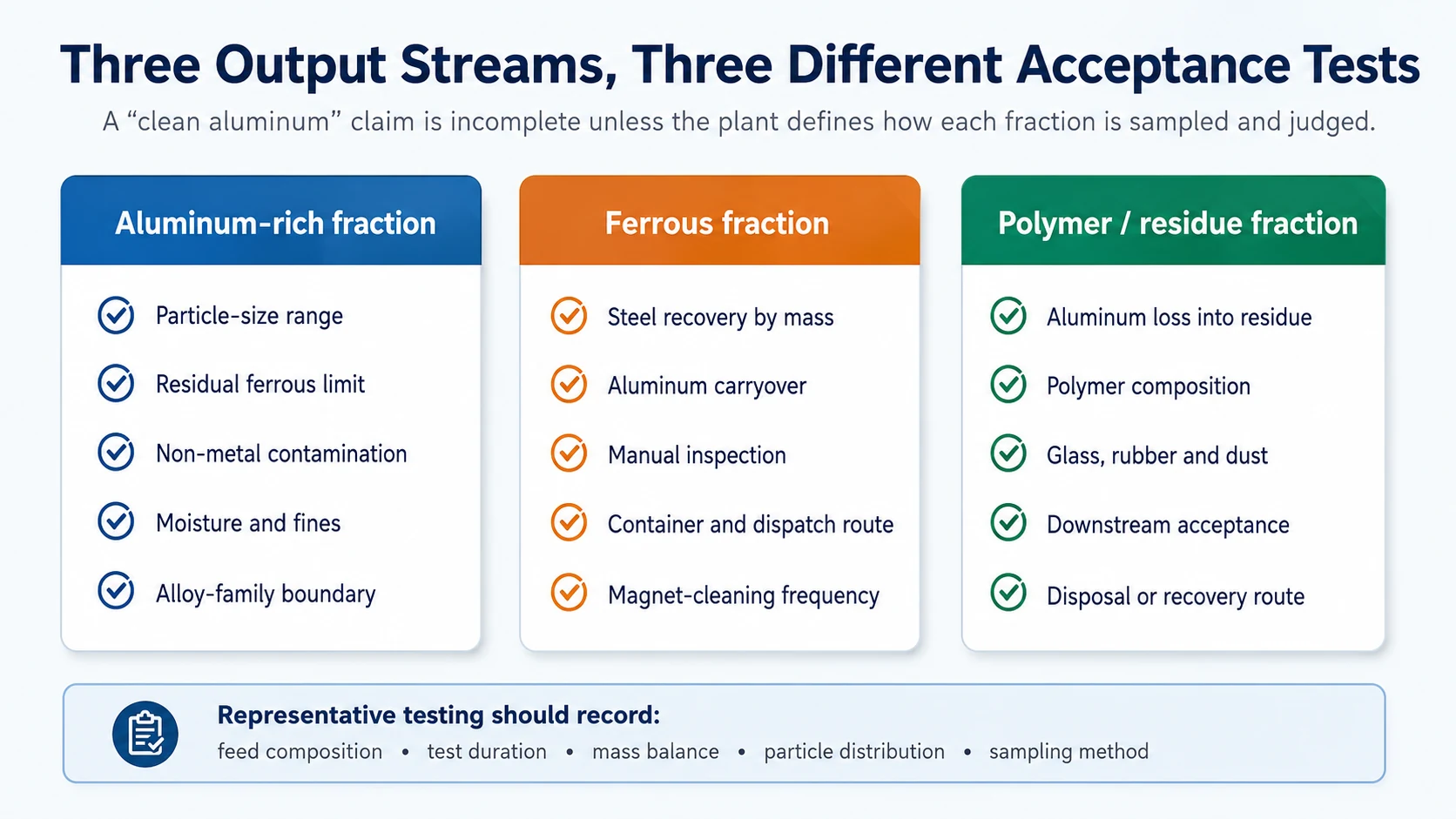
A representative line test should record the incoming composition, test duration, feed rate, mass of every output, particle-size distribution and the sampling procedure. It should also count incompletely liberated pieces. Hiding those pieces inside the aluminum product may make a short demonstration look better, but it does not create a stable commercial specification.
The polymer fraction deserves the same caution. PA66-based insulating strips can be recyclable, but post-consumer reuse is sensitive to origin, contamination and quality documentation. Technoform’s information on recycled insulating profiles notes that post-consumer material needs controlled conformity and that unspecified recycled polyamide can carry contamination risks.5 Therefore, do not promise a high-value PA66 outlet before a downstream buyer accepts the actual recovered material.
What Changes Real Capacity, Wear and Recovery?
Long hollow profiles can occupy a large receiving volume while carrying little mass. Tightly nested frames can create the opposite problem: the shredder sees a dense, spring-loaded bundle that is difficult to feed evenly. The complete-line rate can also be set by the screen, magnet, ECS or residue handling rather than by the primary shredder motor.
Feed geometry
Longest member, wall thickness, cross-section, nesting and bundle size change hopper and cutter duty.
Composite percentage
A 10% thermal-break feed and an 80% thermal-break feed do not create the same liberation or residue load.
Steel burden
Small screws affect product quality; heavy inserts also affect wear, shock load and magnet sizing.
Particle target
Smaller output can improve release but may increase fines, dust, recirculation and aluminum loss.
Feed stability
ECS and screening performance depend on an even layer and a controlled size range.
Net operating time
Inspection, jam clearing, cutter service, screen cleaning and container changes reduce scheduled hours.
For that reason, YUXI’s main scrap aluminum recycling line page does not publish one universal thermal-break capacity or purity. It asks for maximum feed size, contamination, required tons per hour, output target, power supply and workshop dimensions before selecting the line.
How YUXI Would Configure a Thermal-Break Aluminum Line
YUXI’s public solution framework places profiles and frames on a shredding-and-physical-separation route. The core equipment can include a conveyor, low-speed shredder, secondary crusher when required, magnetic separator, screen and optional eddy current separator. That framework fits thermal-break material because every stage can be justified by the attached components and final product.
We would separate the proposal into three groups:
| Required modules | Conditional modules | Project-specific scope |
|---|---|---|
| Receiving inspection, controlled feeding, primary reduction, ferrous removal and product collection. | Secondary liberation, screening, ECS, air or density separation, recirculation and manual polishing. | Dust system, platforms, controls, electrical standard, foundations, installation, commissioning and local safety integration. |
The buyer should send photographs and video from several loads, cross-section samples, maximum profile length and wall thickness, ordinary-versus-thermal-break percentage, steel and non-metal estimate, target continuous throughput, output contract, power supply and workshop dimensions. A representative sample test can then determine whether one reduction stage is enough and which separator sequence produces the best mass balance.
Do not select equipment by deepest possible process. A line with every separator can be more expensive and harder to operate without producing a better sellable fraction. The correct scope is the minimum stable process that meets the written output specification.
Safety and Environmental Boundaries
Shredders, conveyors, screens and separators create moving-part, stored-energy, pinch-point and ejected-material hazards. OSHA’s scrap-metal recycling guidance says employees must follow lockout/tagout procedures before cleaning or maintenance and that machinery must be guarded to prevent contact with moving parts.6 The installed system also needs jurisdiction-specific electrical, fire, dust, noise and access reviews.
Plastic-containing scrap should not be casually burned or heated outside an engineered and permitted process. OSHA notes that heating certain plastics can release hazardous substances, while the EPA identifies mechanical, pyrometallurgical and hydrometallurgical pretreatment as distinct controlled approaches. For a physical thermal-break line, dust capture, housekeeping, spark-source review and residue characterization should be included in the layout from the beginning.
Thermal Break Aluminum Recycling FAQ
What is thermal break aluminum recycling?
It is the controlled reduction, liberation and physical separation of thermally broken profiles into aluminum-rich, ferrous and non-metal fractions. The process is deeper than simple downsizing because the insulating polymer is mechanically joined to the aluminum.
Can the plastic strip be pulled out manually before shredding?
It may be possible for clean production pieces or small volumes, but post-consumer frames are variable and the strip is mechanically locked into the profile. Industrial projects normally compare manual preparation cost with mechanical liberation and downstream separation.
Why is the magnetic separator installed before the eddy current separator?
The magnet removes steel hardware. The ECS is intended to repel conductive non-ferrous metal from suitable non-metal material. Leaving steel in the ECS feed creates a different problem and reduces process stability.
Does every thermal-break line need a hammer mill?
No. Secondary impact crushing is added when representative testing shows that the primary shred leaves too many aluminum-polymer composites or cannot prepare a stable separator feed.
Can the recovered plastic strip be sold as clean PA66?
Not automatically. The stream may contain glass fiber, coatings, rubber, sealant, dust and other polymers. A downstream buyer should test and accept the recovered fraction before the project assumes a value.
Can an eddy current separator separate 6063 aluminum from cast aluminum?
Not by itself. It separates suitable conductive non-ferrous particles from non-metal material. Alloy-level separation requires source control or additional sensor technology.
What data is needed for a YUXI proposal?
Send material photos and video from several loads, profile cross-sections, maximum dimensions, wall thickness, bundle condition, thermal-break percentage, steel and non-metal content, target throughput, output specification, power supply and workshop dimensions.
Engineering References
- Aluminum Extruders Council — Thermal Barrier. Describes pour-and-debridge and mechanically crimped polyamide-strip systems.
- U.S. EPA — AP-42 Section 12.8, Secondary Aluminum Operations. Covers scrap pretreatment, contaminant removal, mechanical cleaning, magnetic removal, screening and air classification.
- European Aluminium Association — Sustainability of Aluminium in Buildings. Includes a recycling route for coated and thermally broken aluminum window profiles.
- The Aluminum Association — Semi-Fabricated Aluminum Products LCA Executive Summary. Discusses contamination, alloy commingling and downcycling.
- Technoform — Recycling of PA66 GF Insulating Profiles. Notes quality and conformity considerations for recycled polyamide insulating profiles.
- OSHA — Guidance for the Identification and Control of Safety and Health Hazards in Metal Scrap Recycling. Covers guarding, lockout/tagout and hazards around scrap processing machinery.
Send a Representative Thermal-Break Sample
Provide several-load photos or video, profile cross-sections, maximum dimensions, thermal-break percentage, attached steel and non-metal content, target throughput and the required aluminum output. YUXI can then separate required equipment from optional polishing stages.