




 Request Quote



Aluminum Chips Recycling Process and Briquetting
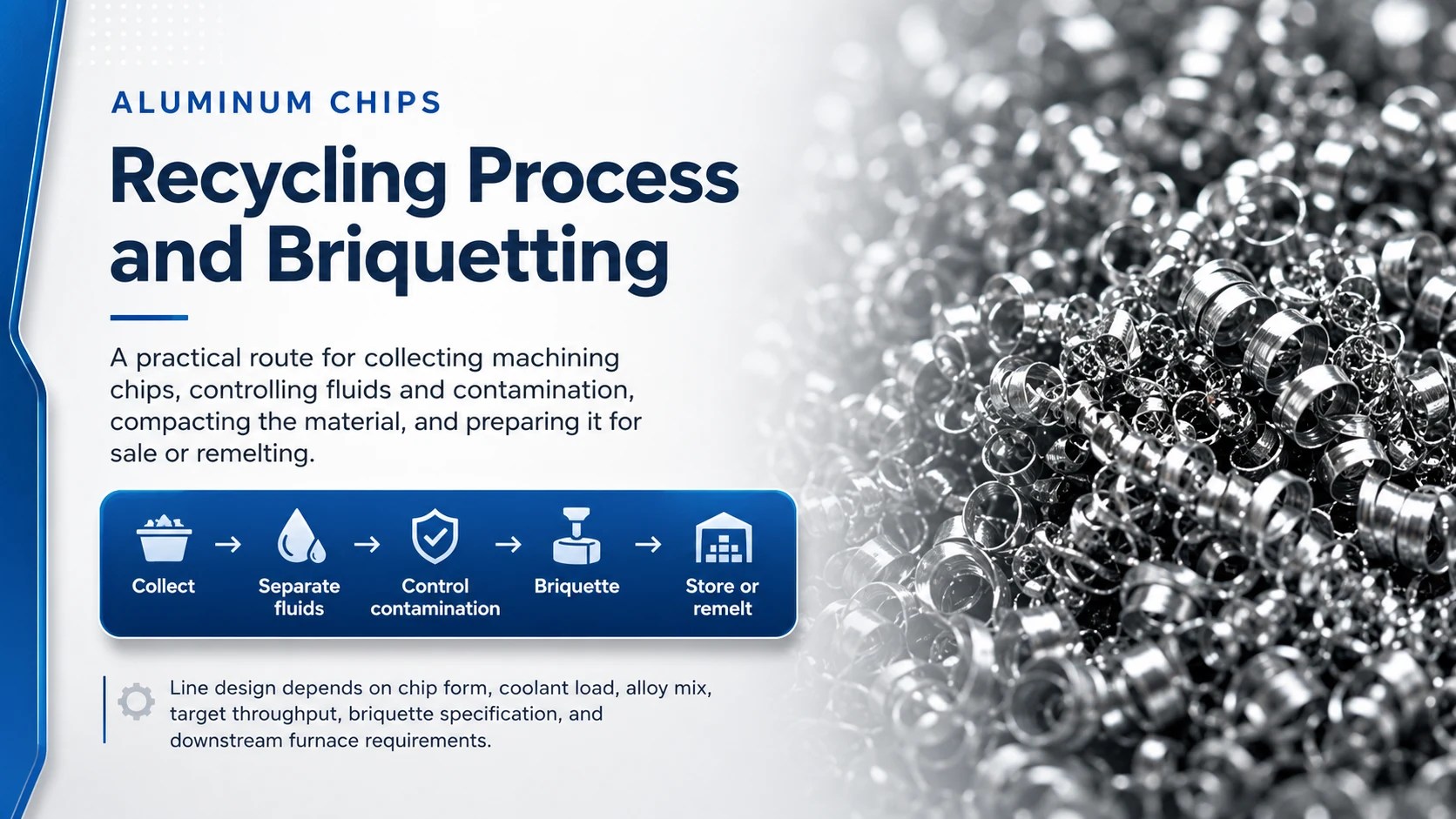
Loose machining chips look simple until they fill a hopper, carry cutting fluid across the floor, bridge a conveyor, or arrive at the furnace with the wrong alloy mixed in. The right aluminum chips recycling process starts with feed control—not with the press.
What Counts as Aluminum Chips, Turnings, or Swarf?
On a shop floor, “chips,” “turnings,” and “swarf” are catch-all names for what the cutting operation leaves behind. A milling machine may produce short flakes, while a lathe can fill a bin with long spring-like nests; sawing and grinding add still finer material. The same bin may also contain straight oil, water-based coolant, tramp oil, fines, or an occasional piece of steel from a tool or fixture.
The U.S. EPA classifies drilling and machining residue as “new” aluminum scrap. Its secondary-aluminum process description separates scrap pretreatment from smelting and notes that pretreatment is used to remove other metals, dirt, oil, plastics, and paint before the material enters the melting route.[1] That distinction matters. Chip recycling is not simply “press the swarf.” It is a controlled preparation job.
In practice, the name on the bin tells us very little. We need to know the alloy family, chip shape, bulk density, fluid type, moisture, fines content, foreign-metal content, hourly generation pattern, and what the receiver expects. Two bins marked “aluminum chips” can require different conveyors, different pretreatment, and a different briquette test.
Why Loose Aluminum Chips Are Difficult to Recycle
Low bulk density creates a handling problem first
Loose chips occupy a large volume for relatively little metal mass. Long turnings interlock. Fine chips can spread during transfer. A shop may reach its storage or conveyor-volume limit long before it reaches the desired tonnes per hour. This is why the receiving hopper and feeder often determine whether the line feels stable.
High surface area raises oxidation and melt-loss risk
Every small chip carries a surface oxide. The higher the exposed surface area relative to metal mass, the harder it is to charge loose chips without oxidation, dross formation, or burn-off. Research on aluminum swarf repeatedly identifies conditioning, moisture control, compaction, melting method, atmosphere, and melt treatment as important to recovery—not briquetting pressure alone.[5]
Metalworking fluid is both a value stream and a control issue
Metalworking fluids cool, lubricate, and remove chips from machining operations. NIOSH notes that exposure can occur through inhalation, skin contact, contaminated surfaces, and splashing, with reported skin and respiratory effects.[2] A chip system therefore needs enclosed transfer where appropriate, leak control, housekeeping, and a defined route for recovered liquid.
Contamination can destroy alloy value before the press starts
Steel chips, fasteners, grinding dust, mixed aluminum alloys, plastics, and absorbent material may all enter the same container unless segregation is designed at the machine-tool level. A briquetting press compacts what it receives. It does not separate alloys or make foreign metal disappear.
Aluminum Chips Recycling Process: Step by Step
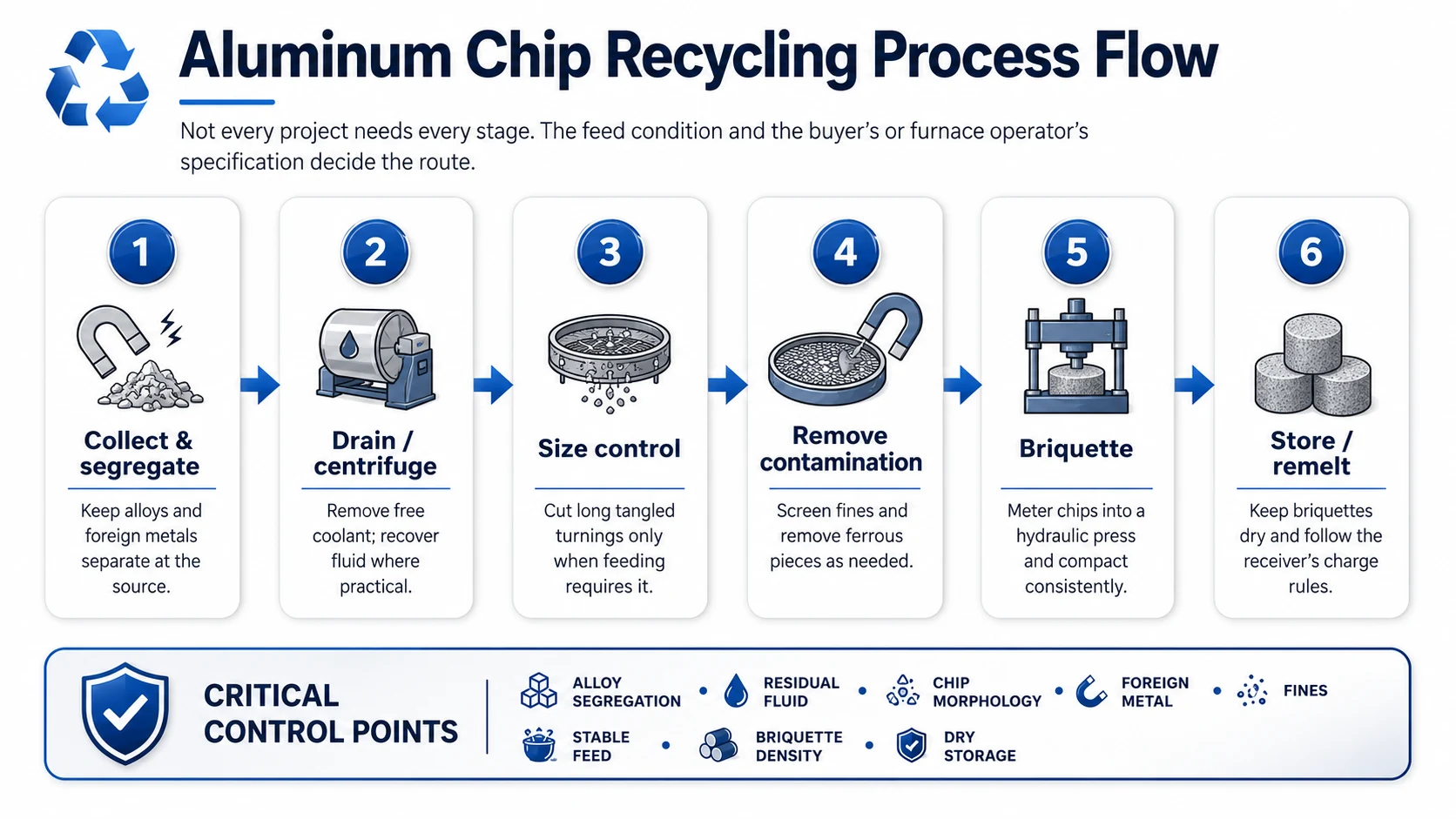
1. Keep each alloy in its own collection route
Mixing usually happens before the recycler ever sees the load. A labeled bin beside each machining cell—or a dedicated conveyor on a larger line—does more for metal value than trying to sort chips after they have been combined. Steel offcuts, copper, plastics, and grinding debris should stay out of the aluminum stream from the outset.
2. Collect chips without creating a second contamination problem
Collection can be local at a machine, by mobile bins, central conveyor, pneumatic system, or batch tipping station. The method should match generation rate and chip form. Long turnings can wrap around exposed shafts or bridge chutes; fine wet chips can settle in corners; intermittent batches can surge a press that was sized only by average mass flow.
3. Characterize the incoming feed
Take representative samples, not a single clean handful. Record chip morphology, alloy, loose bulk density, fluid percentage, moisture, fines, ferrous contamination, largest tangled bundle, and temperature. Decide whether quoted capacity will be based on wet incoming material, dry metal content, or finished briquette output.
4. Drain, centrifuge, or otherwise separate free liquid
Some chips arrive with only a surface film. Others carry enough emulsion or oil to drain continuously. Free liquid should be separated and collected before it spreads through storage or overloads the briquetting stage. Depending on the application, gravity drainage, a wringer or centrifuge, a screw-type dewatering arrangement, or another approved system may be used.
Do not assume that pressing is a universal substitute for upstream liquid control. The correct sequence depends on fluid type, loading, desired residual level, and the receiver’s requirements.
5. Reduce long turnings only when feeding requires it
Short chips often need no shredding. Long, nest-like or springy swarf may need a chip crusher or cutter so the material can enter a hopper, pass a metering device, and fill the press chamber consistently. The goal is feedability—not producing the smallest possible particle.
6. Remove foreign material where justified
A magnetic stage can remove ferrous pieces after the chip shape and burden allow effective exposure. Screening can remove selected fines, broken tools, or oversize tangles. Neither step should be added as decoration. The equipment must answer a measured contamination problem and be tested with the real chip stream.
7. Meter chips into the briquetting press
Stable feeding is more important than short peaks. A buffer hopper, level sensing, controlled screw or conveyor, and press-load feedback can prevent an empty/full cycle that reduces practical output. If the upstream system creates surges, the press may appear undersized even when its hydraulic cycle is adequate.
8. Briquette, discharge, cool, and collect liquid
The hydraulic press compacts the chip mass in a die or chamber and ejects a repeatable briquette. Free liquid expressed during compression should enter a contained collection route. Finished briquettes may need controlled discharge, cooling time, dry storage, and a container that prevents recontamination.
9. Agree on the delivery or furnace specification
Before a briquette leaves the plant, the buyer or melt shop needs to say what it will accept: alloy grouping, foreign metal, remaining liquid or moisture, briquette size and density, packaging, and the way the charge will enter the furnace. EPA notes that pretreatment sequence depends on scrap condition, available equipment, furnace design, and the required product.[1] In other words, the line should be designed backward from the next user’s requirements, not from the press alone.
How Aluminum Chip Briquetting Works
A metal-chip briquetting press uses hydraulic force to compress loose material into a dense, consistent unit. The basic sequence is filling, pre-compression or chamber closing, main compression, liquid discharge, pressure release, briquette ejection, and chamber refill.
The finished result depends on more than nominal hydraulic pressure. Chip length, spring-back, alloy, temperature, fines, oil or emulsion content, die geometry, fill consistency, dwell time, and wear condition all influence briquette integrity. This is why a representative material test is more useful than a catalog photograph.
Published research supports the broader principle that conditioning and compaction can improve remelting behavior, but results vary by alloy and process. One study on AA6060 machining chips found that extrusion produced better melting recovery than loose or simply compacted chips.[6] That result should not be turned into a universal briquetting guarantee; it shows why charge form and process conditions matter.
Does the Line Need a Chip Crusher Before Briquetting?
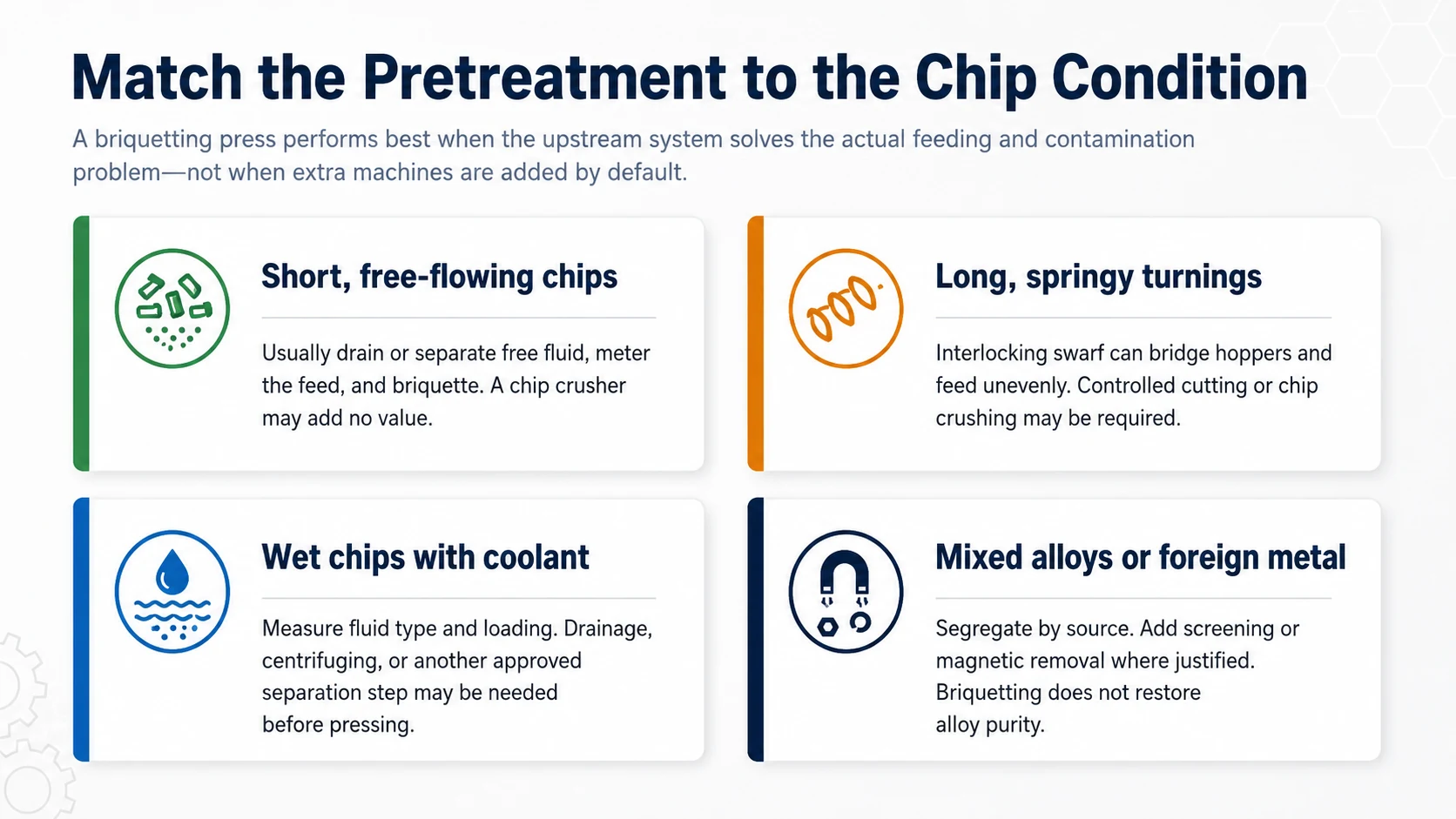
| Feed condition | Typical issue | Likely response |
|---|---|---|
| Short, free-flowing milling chips | Fluid and fines may be the main variables | Drain or separate free fluid, meter, test direct briquetting |
| Long turning nests | Bridging, wrapping, inconsistent chamber fill | Use controlled cutting or a chip crusher before metering |
| Mixed short and long chips | Unstable feed and variable briquette density | Buffer, condition the oversize fraction, stabilize the blend |
| Very fine aluminum particles | Dust, carryover, fluid retention, fire/explosion risk | Conduct a dust-hazard review and design enclosed handling; do not treat fines like ordinary swarf |
A general scrap-metal shredder is usually not the first choice for machining chips. The public YUXI scrap aluminum recycling line page treats chips and turnings as a separate route: chip collection, liquid control, controlled feeding, briquetting, and collection. Profiles and mixed bulky scrap follow different shredding and sorting routes. Keeping those routes separate prevents unnecessary size reduction and cross-contamination.
Wet Chips Versus Dry Chips
Wet chips require a measured fluid balance
Ask four questions: What is the fluid? How much arrives with the chips? How much is free-draining? What residual level will the receiver accept? A press may express free liquid, but the final result changes with chip morphology and incoming loading. Report residual fluid by an agreed sampling method rather than using a supplier-wide percentage.
Dry-looking chips are not automatically furnace-ready
Surface appearance is not a moisture test. Briquettes can also pick up water during outdoor storage or transport. The Aluminum Association’s molten-metal incident reporting identifies wet or contaminated scrap as a leading cause of melting explosions.[4] Storage, inspection, preheating, and charging rules must come from the receiving furnace operation.
Recovered liquid needs its own destination
Collected coolant may be filtered and returned, treated, or disposed of according to the fluid condition and local requirements. The chip line should include a closed collection point, level control, accessible cleaning, and a plan for tramp oil and solids. Liquid recovery is not complete until the recovered stream has a usable or compliant outlet.
Alloy Segregation and Foreign-Metal Control
For a machining plant, the highest-value improvement may happen before the recycling equipment: dedicated bins, machine identification, production scheduling, and operator discipline. Clean single-alloy chips can be more useful to a remelter than a dense but chemically mixed briquette.
Ferrous contamination can come from broken tools, fasteners, machine cleanout, steel bins, or mixed production. A magnet may help, but small steel embedded in a wet tangled mass may not present well. Representative testing should measure both ferrous removal and aluminum carryover.
Different aluminum alloys should not be blended simply because they share the same base metal. The buyer or internal foundry should set allowable chemistry and traceability. When alloy-level separation is impossible after mixing, compaction only makes the mistake denser.
What Briquetting Improves—and What It Does Not
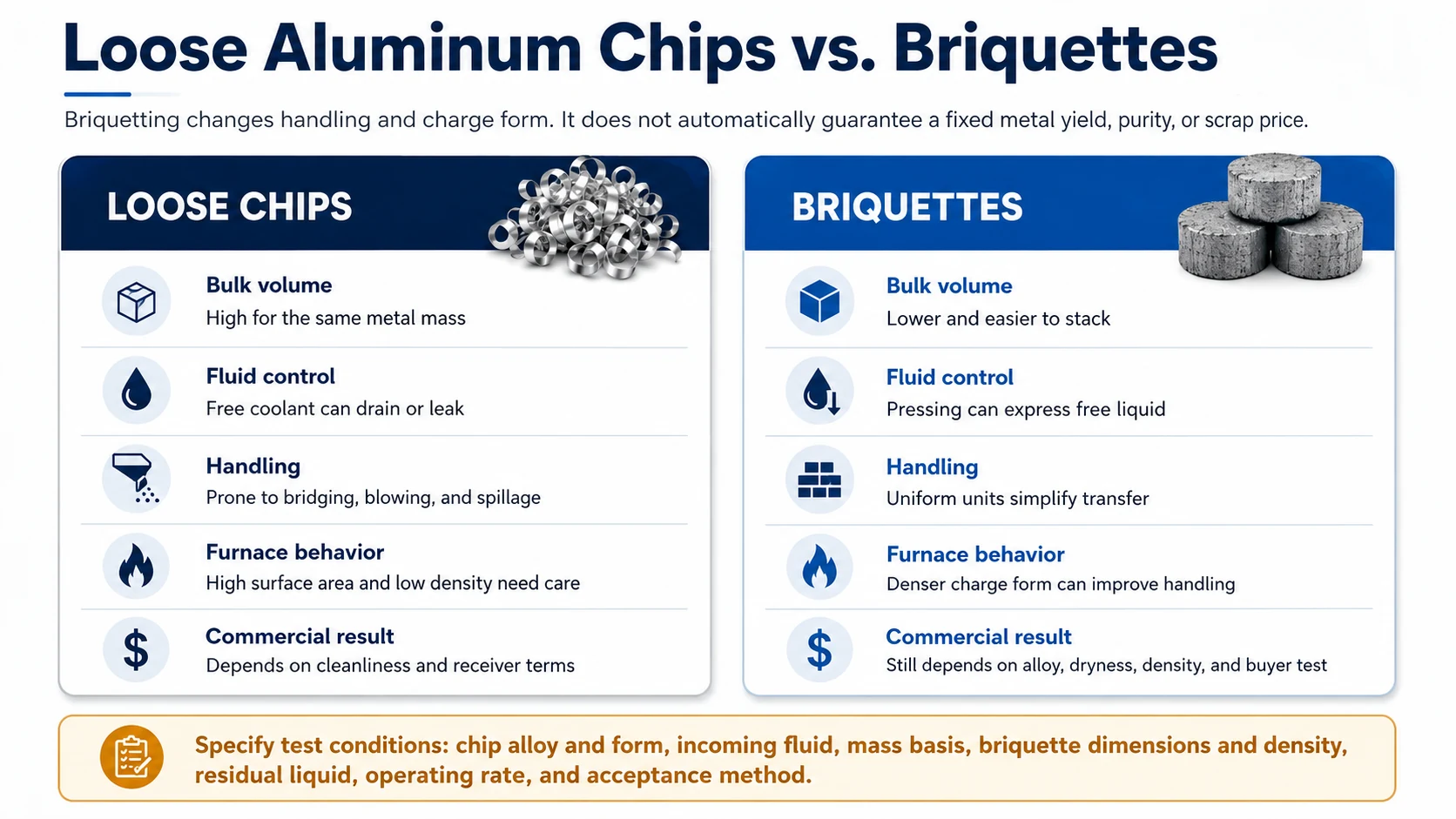
| Area | Potential improvement | What must still be verified |
|---|---|---|
| Storage and transport | Lower bulk volume, better stacking, fewer loose-chip spills | Actual bulk-density change, container payload, briquette breakage |
| Fluid management | Free liquid can be expressed and collected | Residual fluid, fluid quality, collection and reuse route |
| Handling automation | More consistent product units for conveying or charging | Briquette dimensions, cooling, discharge rhythm, receiver equipment |
| Melting preparation | Denser charge form and lower exposed area than loose chips | Dryness, alloy, density, furnace type, charging procedure, measured yield |
| Scrap value | Some receivers may pay more for clean, dry, dense, traceable material | Local buyer specification and price formula; never assume a universal premium |
Research on induction melting of aluminum swarf found that moisture reduction, protective atmosphere, compaction, and melt treatment were important to recovery, with reported results tied to the study’s alloy and operating conditions.[5] The lesson for equipment selection is not “promise 90%.” It is “define the feed and test the complete route.”
How YUXI Configures an Aluminum Chip Recycling Line
YUXI’s current aluminum solution page explicitly separates chip briquetting from the shredding-and-sorting route used for profiles and mixed scrap. For chips and turnings, the published project questions are moisture, cutting fluid, fines, foreign metal, and the required briquette target. The listed route is chip collection, drainage or fluid separation, controlled feeding, briquetting, and collection.
A practical configuration may include:
- Local bins, a tipping station, or a central chip conveyor
- Buffer hopper and level-controlled metering
- Drainage, centrifuging, or another liquid-separation stage selected for the fluid load
- Optional chip crusher for long tangled turnings
- Optional screen or magnetic removal for a measured contamination problem
- Hydraulic briquetting press with contained liquid collection
- Briquette discharge, cooling or accumulation, and dry storage
- PLC controls, interlocks, guarding, maintenance access, and housekeeping points
The line should be selected after the feed route is fixed. The broader aluminum recycling equipment selection guide is useful for comparing shredding, sorting, baling, and briquetting duties without treating them as interchangeable.
For an engineering proposal, send chip photos and video, alloy information, wet and dry sample weights if available, fluid type, bulk density, longest turning nest, foreign-metal content, generation rate by shift, target output, power supply, and workshop dimensions. The aluminum recycling plant layout guide covers access, traffic, product storage, and maintenance space that can reduce real uptime even when the press is correctly sized.
Capacity, Briquette Quality, and Acceptance Testing
“500 kg/h” can describe wet chips entering the hopper, dry metal after fluid removal, or finished briquettes leaving the press. Those are different numbers. Before comparing quotations, define the mass basis and the continuous operating boundary.
| Acceptance item | What to record | Why it matters |
|---|---|---|
| Representative feed | Alloy, chip form, fluid, fines, contamination, bulk density | Prevents a clean demonstration sample from replacing the real duty |
| Capacity basis | Wet input, dry metal, or briquette output; net and gross runtime | Makes supplier rates comparable |
| Briquette specification | Shape, dimensions, average density, integrity after handling | Connects the press result to storage and receiver requirements |
| Residual liquid | Sampling method, test temperature, fluid type, result | Supports storage, transport, value, and furnace decisions |
| Recovered liquid | Collected mass or volume and contamination condition | Shows whether fluid recovery has a practical outlet |
| Operating stability | Bridging, overloads, manual intervention, temperature, cycle variation | Separates a short peak from sustainable production |
| Foreign material | Ferrous and non-aluminum content before and after treatment | Protects alloy value and downstream quality |
The same logic applies to complete-line capacity: the slowest stable stage sets the real rate. The aluminum recycling line capacity guide explains how to define continuous throughput, productive time, and saleable output without confusing a peak machine cycle with shift production.
Safety Points That Belong in the Process Design
Combustible aluminum dust and fines
OSHA identifies aluminum among metal dusts that can create combustible-dust hazards. Its technical guidance specifically calls for chip-handling and processing methods that minimize dust-explosion risk.[3] A project with fine dry particles needs a dust-hazard analysis, suitable collection and housekeeping, ignition-source control, bonding and grounding where required, and equipment selected for the applicable hazard—not an ordinary open conveyor copied from coarse swarf.
Managing coolant around the line
Coolant control is largely a matter of containment and maintenance. Splash points may need covers or local enclosure, while floors, drains, and sumps should make leaks easy to find and clean instead of carrying them through the workshop. NIOSH reports that metalworking-fluid exposure can affect the skin, eyes, nose, throat, and respiratory system.[2]
Working safely around presses and conveyors
The highest-risk tasks are often jam clearing, inspection, and maintenance rather than normal production. Crushers, screws, conveyors, compactors, and hydraulic presses therefore require guarding, interlocks, emergency stops, safe access, and hazardous-energy isolation before anyone enters a danger zone. An acceptance trial should not pass if operators must reach into a hopper or bypass a guard to keep material moving.
How to Estimate Whether Briquetting Is Worth It
A useful business case separates metal value, fluid value, logistics, furnace benefit, and operating cost. Do not use a generic “payback in one year” claim without local data.
Annual project benefit can be modeled as:
recovered-fluid value + storage and transport savings + labor and housekeeping savings + verified scrap-price improvement + verified furnace-value improvement − electricity − wear parts − maintenance − labor − financing − disposal or treatment costs.
Measure the current baseline first. We normally recommend recording loose-chip mass, fluid content, container changes, truck payload, housekeeping time, current scrap terms, and any internal melting losses for several representative production periods. Then repeat the same measurements during the equipment test.
Plant cost changes with the upstream and downstream scope—not just the press. Long turnings may add size reduction; heavy fluid loading may add centrifuging; fines may add dust controls; alloy segregation may require multiple collection routes. The aluminum recycling plant cost guide provides a broader framework for budgeting conveyors, controls, environmental systems, installation, and commissioning.
Information to Send with an RFQ
- Chip-producing process: turning, milling, drilling, sawing, grinding, or mixed
- Aluminum alloy or alloy families and segregation requirement
- Photos, video, longest tangled bundle, and typical chip-size distribution
- Loose bulk density measured with the normal handling method
- Fluid type, incoming percentage, free-draining behavior, and target residual level
- Fines, steel, copper, plastic, absorbent, and other contamination
- Average and peak generation by hour and shift
- Required capacity basis: wet input, dry metal, or briquette output
- Briquette dimensions, density, integrity, packaging, and receiver specification
- Power supply, workshop dimensions, floor loading, access, and storage conditions
- Required automation, operator involvement, safety standard, and acceptance test
Aluminum Chips Recycling Process FAQ
What is the aluminum chips recycling process?
A typical route is source segregation, collection, fluid control, optional size reduction, contaminant removal, controlled feeding, briquetting, dry storage, and sale or remelting. The route changes with chip form, fluid, alloy, contamination, and receiver requirements.
Do aluminum chips need to be shredded before briquetting?
No. Short free-flowing chips may feed directly after liquid control. Long tangled turnings may need a chip crusher or cutter to prevent bridging and unstable chamber filling.
Does briquetting remove all cutting fluid?
No. Pressing can express free liquid, but residual fluid depends on the chip, fluid type, incoming loading, pressure, die, and upstream drainage or centrifuging. Measure it with a representative test.
Can mixed aluminum alloys be briquetted together?
They can be physically compacted, but the mixture may lose value or fail the specification of a particular remelting route. Decide alloy segregation before collection.
What determines aluminum chip briquetting capacity?
Loose bulk density, chip morphology, incoming fluid, feed consistency, required briquette dimensions and density, press cycle, pretreatment, and discharge handling all matter. Every quotation should state the mass basis and test feed.
Are aluminum briquettes safe to charge into a furnace?
Only after the receiver confirms the dryness, storage condition, inspection, and charging procedure. Wet or contaminated scrap is a recognized molten-metal explosion hazard.
Authoritative References and Technical Notes
- EPA U.S. Environmental Protection Agency, AP-42 Section 12.8: Secondary Aluminum Operations. Process descriptions are historical but remain useful for the distinction between scrap pretreatment and smelting/refining.
- NIOSH National Institute for Occupational Safety and Health, Preventing Health Hazards from Metal Working Fluids.
- OSHA Occupational Safety and Health Administration, OSHA Technical Manual, Section IV, Chapter 6: Combustible Dusts.
- Aluminum Association Molten Metal Incident Annual Summary Report, reporting wet or contaminated scrap among recurring melting-explosion factors.
- Research Puga, H.; Barbosa, J.; Ribeiro, C.S., Factors Affecting the Metal Recovery Yield during Induction Melting of Aluminium Swarf, Materials Science Forum 730–732, 781–786.
- Research Cooper, D.R.; Song, J.; Gerard, R., Metal Recovery during Melting of Extruded Machining Chips, Journal of Cleaner Production 200, 282–292.
- Review Chen, X. et al., Recent Advances in the Remelting Process for Recycling Aluminium Alloy Chips: A Critical Review, International Journal of Material Forming.
Send YUXI a Representative Chip Sample
Include chip photos or video, alloy, fluid type and loading, bulk density, longest turning nest, contamination, hourly generation, required briquette specification, workshop dimensions, and power supply. Ask for a process route and acceptance test based on that feed—not a universal catalog line.